FIA Approves Formula E Championship Calendar

Formula E Holdings, promoters of the new FIA Formula E Championship, today confirmed its 2014/2015 calendar featuring 10 city-centre events spanning four continents.

The calendar was submitted to the FIA during its World Motor Sport Council in Paris, France, and will run from September 2014 to June 2015. Beijing will remain as the host venue for the world's first ever fully-electric race commencing on 13th September 2014 – one week earlier than previously planned.

After the opening round in Beijing, the 10 teams and 20 drivers will remain in Asia for Round 2 with Putrajaya, the federal administrative centre of Malaysia on 18th October 2014. Round 3 will now see the championship head to Rio de Janeiro, the capital city of the State of Rio de Janeiro and the second largest city of Brazil. Rio replaces Hong Kong which will instead be considered as a candidate city for the following Formula E seasons.

From here, the series continues in South America with Round 4 in Punta del Este, Uruguay, on 13th December 2014 before starting the New Year in Buenos Aires, Argentina, for Round 5 on 10th January. The championship then heads to North America for Rounds 6 and 7 with Los Angeles on 14th February 2015 and Miami now brought forward to 14th March 2015.

The season then moves to Europe for the final three rounds beginning with Monte Carlo, Monaco, on 9th May 2015 followed by the German capital of Berlin on 30th May 2015 where the former airport of Tempelhof has already been revealed as the circuit location. The inaugural season then reaches its climax in London, United Kingdom, on 27th June 2015.

Alejandro Agag, CEO of Formula E Holdings, said: "It's a great feeling to be able to confirm our calendar for the inaugural Formula E season and we're very thankful to all the cities, and candidate cities, for showing their commitment to sustainable mobility. The level of interest we have received from cities all over the globe has been overwhelming and choosing the final 10 has been a challenging and meticulous process. We're confident our final 10 cities will provide an array of fantastic backdrops to showcase electric cars in their favoured urban environments, as well as allow us to put on a great spectacle for the fans."

All Formula E events will feature a free practice session, qualifying session, one-hour race and live music concert taking place in a single day (Saturday) in order to minimise disruption to the city and its surrounding areas. Precise circuit layouts for each venue will be revealed at a later stage but all will use city-centre locations. Tickets for the first rounds will go on sale in 2014.

Formula E is a new FIA championship featuring Formula cars powered exclusively by electric energy –representing a vision for the future and serving as a framework for research and development around the electric vehicle. For the first season only, all 10 teams - each with two drivers - will compete using the new Spark-Renault SRT_01E car which completed its successful test debut last month.

2014/2015 FIA Formula E Championship – Calendar

Round 1 Beijing, China 13th September 2014
Round 2 Putrajaya, Malaysia 18th October 2014
Round 3 Rio de Janeiro, Brazil 15th November 2014
Round 4 Punta del Este, Uruguay 13th December 2014
Round 5 Buenos Aires, Argentina 10th January 2015
Round 6 Los Angeles, USA 14th February 2015
Round 7 Miami, USA 14th March 2015
Round 8 Monte Carlo, Monaco 9th May 2015
Round 9 Berlin, Germany 30th May 2015
Round 10 London, UK 27th June 2015

Virgin to enter team in Formula E

Virgin is to enter a team for the first FIA Formula E Championship, which gets out of the grids next year.

The all-new championship will take place on purpose-built street circuits in ten city centres around the world. The Virgin Racing Formula E Team, is headed by Team Principal Alex Tai and has the backing of Virgin founder Sir Richard Branson. Both have been involved in a number of pioneering technology projects in aviation, space and more recently racing.

The Formula E Championship is intending to showcase electric car technology and speed up development and innovation amongst manufacturers. Against this backdrop, Virgin will bring fun, energy and excitement to create a concept that is compelling for both fans and commercial partners, and will create a winning team.

Richard Branson said: “The launch of the Formula E Championship is exciting news for racing fans but also for those that believe in developing the great electric cars of the future. The need to create fast, dependable and durable race cars will help to accelerate the sector and showcase electric cars to a large global audience. With races around many famous city centres, I am expecting a lot of spectators, plenty of fun and some sparks flying as the competition hots up.”

Alex Tai – Team Principal of Virgin Racing Formula E Team, said: “I’m absolutely sold on the concept of Formula E and believe that it is a great fit for the Virgin brand. The accessible nature of the series with its races being right in the heart of our great cities, should create a wonderful atmosphere. The drive to develop new technology appeals to Virgin, which has always been a pioneering organisation. I’ve been fortunate to have been involved in a number of such activities over years, from the Virgin Atlantic GlobalFlyer to Virgin Galactic activities that push technological and human boundaries and capture people’s imagination.

Alejandro Agag – CEO Formula E Holdings, said: “It gives me great pleasure to welcome Richard Branson and the Virgin Team to Formula E and for them to have chosen the FIA’s new zero emission series to make their return to top-flight motor sport. Having a global brand like Virgin, renowned for their technological innovation and sporting passion, as one of our ten teams is a fantastic addition to the championship and shows their commitment to sustainable mobility. Today’s announcement now means we just have one team left to announce before the grid for the inaugural 2014/2015 Formula E season is complete.”

FORMULA E ENTRANTS SO FAR

  • Drayson Racing
  • China Racing
  • Andretti Autosport
  • Dragon Racing
  • e.dams
  • Super Aguri
  • Audi Sport Abt
  • Mahindra Racing
  • Virgin Racing
  • Mahindra Racing will join the inaugural FIA Formula E Championship

    Mahindra Racing will join the inaugural FIA Formula E Championship beginning in September 2014. The motor sports division of the Mumbai-based USD 16.2 billion multinational Mahindra Group has signed an agreement with series promoters Formula E Holdings to become the eighth and only Indian team to join the new zero emission series.

    The innovative all-electric global race series will include 10 races in its first season in city-centre locations around the world, including London, Beijing and Los Angeles, designed to raise awareness about electric vehicles as well as help advance EV technology.

    The series has generated significant interest globally, and professional services firm EY recently released a report forecasting that Formula E will help contribute to the additional sale of 77 million electric vehicles worldwide over the next 25 years.

    Already a major global force in the development and production of electric vehicles through Mahindra Reva it was a natural step forward for the Mahindra Group to join the Formula E Championship.

    “We strongly believe that Formula E can provide an excellent global showcase for our electric vehicle technology,” said Mr Anand Mahindra, Chairman and Managing Director of Mahindra Group. “With advanced operations and expertise in electronics, IT, automotive technologies and manufacturing, we are already seeing the fusion of this technology into our electric vehicle operations. Racing will further accelerate that trend while Formula E is set to raise awareness globally about the benefits of electric vehicles.”

    With Mahindra’s participation confirmed, Formula E is guaranteed to start with at least eight teams coming from seven different nations. GP2 team DAMS has confirmed its entry (the delightfully-named e.dams) as well as ex-Formula One team Super Aguri.

    The driver line-ups are yet to be confirmed, but former F1 drivers Lucas di Grassi and Karun Chandhok are widely expected to secure a seat. Also, IndyCar’s Takuma Sato is also thought to be set to join Super Aguri, but he will be hoping that this partnership is far more fruitful than their time together in F1.

    Formula E electric single seater racing car – Track Debut [VIDEO]

    The fully-electric Spark Renault SRT_01E made its successful track debut at a circuit near La Ferté Gaucher, 80km east of Paris, France.

    In the hands of Lucas di Grassi, it completed 40 laps during the two-day run, the objective of which was to perform an overall systems check. For the purpose of this initial test, the Spark-Renault was equipped with smaller battery, limiting the maximum power to 50 kW instead of the 200kW (270hp) peak power the car will produce in its final trim.

    “It is a great feeling to be driving the Formula E car for the first time,” said Di Grassi. “I can assure all the drivers they will have a lot of fun with this car – even with just a quarter of the power, it has quite a lot of grip and the electric motor produces huge torque."

    Audi Sport join Formula E Championship

    ABT Sportsline, led by Team Principal Hans-Jürgen Abt, has today (15 November) reached an agreement that will see it become the seventh team and the only German outfit to enter the new FIA Formula E Championship – competing under the banner ‘Audi Sport ABT Formula E Team’.

    “We’re proud to have the opportunity to take part in the debut of this new racing series. Participating in the new FIA Formula E Championship marks a completely new chapter in our more than 60-year motorsport history,” said Hans-Jürgen Abt. “As a company that has been active in the field of regenerative powertrains and electric mobility we’re convinced of the series’ concept. It’s innovative, delivers motorsport at the highest level and a great show for fans around the world – all of which are a perfect fit for ABT Sportsline.”

    The outfit, from Germany’s Allgäu region, will race under the name of Audi Sport ABT Formula E Team, based on the name used in its successful commitment as an Audi factory team in the popular international touring car series DTM.

    Head of Audi Motorsport Dr Wolfgang Ullrich commented: “We’ve been watching this new project of the FIA with great interest and are delighted that ABT Sportsline as one of our close and long-standing partners will be involved right from the beginning. We’re keeping our fingers crossed for the squad on tackling this new challenge and are planning to support its commitment with drivers from our factory line-up if required.”

    The agreement was signed by Hans-Jürgen Abt and Alejandro Agag, CEO of Formula E Holdings, in Kempten, Germany. Audi Sport ABT Formula E Team will now be put forward to the FIA for final approval as the seventh outfit to enter the new global electric race series. They join IndyCar outfits Andretti Autosport and Dragon Racing, Asia’s China Racing and Super Aguri and fellow European squads Drayson Racing and e.dams.

    With five titles to its credit in the DTM alone ABT Sportsline is one of the most successful German teams, which has achieved victories and titles in GT and endurance racing as well. The commitment in Formula racing now also marks a return to the outfit’s early days. At the beginning of the 1990s, ABT scored its initial successes in Formel ADAC and Formula Three. One of the drivers back then was the subsequent Formula One and DTM star Ralf Schumacher. “We’ve been keen to embrace new challenges on many occasions in the past. Formula E is no doubt one of the most intensive ones, which makes our excitement about it even greater,” added Hans-Jürgen Abt.

    Alejandro Agag said: “We’re delighted to welcome the Audi Sport ABT Formula E Team into the championship, our seventh of 10 teams and the third European outfit. Formula E is very much an open championship and a platform for teams to showcase their own fully-electric cars, so to have one of the most successful German motorsport teams with the support of a big manufacturer on board is a fantastic addition to the series. I’m sure German racing fans will also be particularly pleased as they now have a home team to support during the Berlin Formula E race.”

    Alain Prost teams up with Dams for Formula E entry

    Four-times Formula One world champion Alain Prost will be involved with a team competing in the new electric Formula E series due to start next year, organisers announced on Thursday.

    They said in a statement that the Frenchman, who made a failed attempt to run his own team in Formula One from 1997 to 2001, had linked up with compatriot Jean-Paul Driot to enter a new e.Dams team.

    Five teams have now been signed up from a planned field of 10 to race in city centres around the world starting in Beijing in September.

    "Being able to actively participate in the development of this new technology, which is 100 percent electric, is extremely motivating," said Prost.

    "As we've seen in other championships, 2014 will see a move towards more sustainable racing, proving more than ever that motorsport is the benchmark for the future."

    Driot's Le Mans-based DAMS teams have won petrol-engined championships in various junior series, including GP2, A1 GP, Formula Renault 3.5 and International Formula 3000.

    Audi are World Endurance Champions in Japan

    Audi has defended its titles early in the FIA World Endurance Championship (WEC) in Japan. The success with the R18 e-tron quattro was achieved by Audi Sport Team Joest in odd circumstances: Heavy rain at Fuji meant that not a single lap could be completed under the Green Flag. In the end, the leaders of the standings, Loïc Duval/Tom Kristensen/Allan McNish (F/DK/GB), as the best Audi team took second place overall in the race, their team-mates Marcel Fässler/André Lotterer/Benoît Tréluyer (CH/D/F) were classified in fourth place in the LMP1 category. Consequently, the drivers’ classification will be decided between the two Audi squads at the remaining rounds.

    At the sixth of eight WEC rounds, difficult weather conditions prevailed. Steady rain had prompted race control to start the endurance race behind the safety car. But the 4.563-kilometer track at the foot of Mount Fuji was too wet for the race to be released in these conditions, so the stewards of the meeting interrupted the race after eight laps. A resumption behind the safety car after two and a half hours ended in another interruption 22 minutes later. Another two hours later, the participants again started behind the safety car before the race was finally stopped after just one lap. The stewards decided that force majeure had prevented a regular course of the race. As a result, the drivers, due to the shorter race distance, were awarded half the points equating to their positions – even if they had not been in the cockpit at all. With two remaining rounds, Audi is out of reach in the manufacturers’ World Championship with a 66.5-point advantage.

    As the best Audi squad in the race, the leaders of the standings, Loïc Duval/Tom Kristensen/Allan McNish, who had started from position four, achieved second place. They extended their lead in the Championship to 40.75 points. Among other things, the Audi designated as car number ‘2’ benefited from the fact that the number ‘8’ Toyota, which had qualified in position two, could not assume its place on the grid. As a result, the car had to start from the pit lane and was unable to overtake under safety car conditions.

    The number ‘1’ Audi suffered misfortune. André Lotterer/Marcel Fässler/Benoît Tréluyer initially led the race from position one on the grid. When debris impaired the intake duct of the engine Audi Sport Team Joest decided to perform a repair for safety reasons. The team used a second caution period to do so when there were prospects for a weather improvement and thus a resumption of the race. However, since this did not occur and the rain became heavier again, last year’s World Champions had to settle for fourth place in their class and 26th place overall. For the first time in almost exactly one year, the Audi LMP sports cars thus had to formally admit defeat. At Shanghai, the next WEC round will be on the agenda in three weeks from now. There, Audi could have another reason to celebrate, as an early title decision in the drivers’ classification is probable in China.

    New 1/4 Mile EV Record at 9.12 Seconds @ 145 mph [VIDEO]

    NEDRA President John Metric took his Miata, Assault and Battery to an all-time 1/4 mile record for an Electric door slammer at Royal Purple Raceway with a best time of 9.12 at 145 mph!

    The EV record has been held by Black Current III since 2010 with a 9.51 sec @135 mph pass of Santa Pod.

    The tube frame and tubbed 2002 Mazda Miata runs a 340 volt LiPo pack with 2x 2000 amp Zilla 2K-EHV controllers feeding dual brushed DC NetGain 9-inch motors, a Lenco 2 speed and double GV overdrive. For the record run the controllers were set to 170 volt & 1100 amps per motor.

  • 60ft 1.312
  • 330' 3.729
  • 660' 5.793 118.29mph
  • 1320' 9.161 144.23mph
  • Nissan ZEOD RC makes its first public run at Fuji Speedway [VIDEO]

    Japanese fans will have the first opportunity to see the revolutionary Nissan ZEOD RC in action when the car makes its public on-track debut at this year's Fuji Speedway round of the FIA World Endurance Championship.

    Running in pure electric mode, the Nissan ZEOD RC will undertake demonstration runs on October 18, 19 and 20 – all three days of the Japanese round of the WEC. The Fuji demonstration was announced today at the Nissan 360 global media event in California.

    The ZEOD RC (Zero Emission On Demand Racing Car) will make its race debut at next year's Le Mans 24 Hour. The global leader in electric vehicles for the road, Nissan will trial variants of new electric drive train technologies as part of its intended future return to LM P1 competition to challenge for overall victory at the world's most prestigious endurance race.

    The Nissan ZEOD RC will kick off its testing and development program soon in the UK with inaugural Nissan PlayStation GT Academy winner Lucas Ordóñez behind the wheel.

    Ordóñez and Krumm were teammates at Le Mans this year where they scored third place in the LM P2 class with 2011 GT Academy winner, Jann Mardenborough.

    Nissan is also enjoying a highly successful season in the FIA World Endurance Championship in the LM P2 class with pole position and victory at the first four rounds of the season at Silverstone, Spa-Francorchamps and Le Mans and Interlagos.

    "One of our goals with the Nissan ZEOD RC is to draw back the curtain for fans so they can see what goes on behind the scenes in the development of such a unique race car," said Nissan's Global Motorsport Director, Darren Cox.

    "As part of that philosophy, we thought it would be quite fitting that rather than just test behind closed doors, we give the fans the chance to see the car in action.

    "To be able to do that at such a great venue like Fuji Speedway only 90 minutes away from the home of Nismo in Yokohama was too good to pass up.

    "We'll be on track with many of the cars from the WEC at Le Mans next year so our demonstration runs will also give us some initial comparison data as well."

    After the Fuji events, the Nissan ZEOD RC will continue its development program in Europe with Lucas Ordóñez returning to the driver seat. The car is scheduled to make its race debut at next year's Le Mans 24 Hour where it will occupy Garage 56 – an additional entry reserved by the Automobile Club de l'Ouest for cars using new and innovative technology not previously seen in the French endurance classic.

    "Nissan has become a global leader in the development of zero emission automotive technology and the Nissan ZEOD RC will allow us to further develop those capabilities using the toughest endurance race in the world as a mobile test bed to test the potential of our planned LM P1 power train," said Andy Palmer, Executive Vice President and Executive Committee member at Nissan Motor Company Limited.

    "The ZEOD RC program is designed to develop multiple technologies to evaluate how they could be used for a future LM P1 class return of Nissan at the Le Mans 24 Hour."

    Nissan is already a global leader in the development of electric vehicles for the road. Launched in 2010, the Nissan LEAF has become the world's best-selling all-electric car. The LEAF won the 2010 Green Car Vision Award, the 2011 European Car of the Year, the 2011 World Car of the Year, and the 2011–2012 Car of the Year Japan.

    Nissan launched the Nissan LEAF RC in 2011 – a race car prototype powered by the same 107-hp electric motor that is used in the road car.

    The Nissan ZEOD RC is the next step in the electrification of motorsport. The new car will turn speeds faster than GTE class cars running purely on electric power with zero emissions.

    Pikes Peak EV Record Holder Demos 900 HP AWD [VIDEO]

    The recent Electric Vehicle Racing in Motor Sports Japan Festival saw some interesting EV race car demonstrations, some of which have made their way onto Youtube.

    While the environmental benefits of converting tire rubber into smoke are debatable, what is of particular interest is the demonstration of the horsepower available in Monster Tajima's EV class winning Pikes Peak Special.

    GKN EVO axial flux motors power all the leading Japanese Pikes Peak EV entries and we believe Tajima's Monster Sport E-RUNNER runs 2x AFM-240 Axial Flux motors, each capable of 335 kw (455 hp) and 1200 Nm Peak.

    While we don't know what differential gearing the car runs front and back so are unable to calculate torque at the wheels, anyway you look at it, that's just over 900 horsepower shredding tires in this car park demo, which equals the 900 hp 900 kg Peugeot 208 T16 Pikes Peak Special used by nine time World Rally Champion Sébastien Loeb to win overall.

    When asked about beating the new gasoline record, the 63 year old Tajima responded: “We are able to do that very soon, it depends on the battery. With a high quality and high density battery, I can beat that record for sure.”

    Nissan Race 48 kWh LEAF at ECOseries motorsport event

    Nissan employees working at the company's Barcelona Technical Centre are proving there's more to motorsport than striving for the fastest lap times by taking part in a new concept in motorsport: ECOseries, which rewards efficiency and fuel economy rather than outright speed.

    The employees - who are all taking part in the series in their spare time - are using three Nissan Leaf in the zero-emission category.

    ECOseries, which is based in Spain and combines track and road-rally events over the season, attracts entries from a wide variety of road cars. Aside from the Nissan team, there are cars from rival manufacturers including Peugeot, Toyota, Volkswagen, Porsche and Mercedes-Benz.

    In the EV category, the Nissan LEAFs and a Mercedes A-Class E-Cell have been fighting for outright honours. Although two of the team's three LEAFs are essentially standard, a third was introduced as a mobile test lab, running in the series' EV prototype category. For the final race, its battery pack was doubled in size to take battery performance to 48 kWh and allowing it to perform on more equal terms with the 36 kWh Mercedes.

    In the end, although the LEAF was quicker than the A-Class and ran at the same pace as the Nissan Juke with no potential range issues to affect the car's progress, the Mercedes took outright honours by lapping closer to its regularity target.

    A 48 kWh Leaf could have up to 250 miles (400 km) estimated range, although the extra weigh would reduce that slightly.

    Underdog Team Scores World Solar Challenge Pole Position

    Qualifying day for the Bridgestone World Solar Challenge at Hidden Valley Raceway didn't follow any script with an underdog team setting the fastest overall time, a Michelin Cruiser Class car coming in second fastest and many of the favorites struggling to set a competitive time at all.

    Pole position goes to Australian TeamArrow, a Queensland based team associated with the Queensland University of Technology who set a lap time 5 seconds clear of the entire field. Second in the Schneider Electric Challenger Class is Japanese team Kogakuin University Solar Vehicle Project with a close third place going to the Stanford team with Luminos.

    Of the favorite teams, University of Michigan are fifth in the starting order with Nuna7 starting lucky 13th having set a time 33 seconds off the pace while Tokai Challenger starts 20th after spinning twice at the final corner leading onto the main straight. The 'official' reason given is sand on the track although only one other car spun at that corner, the Hochschule Bochum SolarCar Team who still qualified third in the Michelin Cruiser Class.

    Of all the asymmetric cars (with the driver positioned on one side of the car) in the 2013 Bridgestone World Solar Challenge, Tokai Challenger is the only car with rear wheel steering which may have contributed to the car spinning each time it negotiated the final turn at Hidden Valley. We don't expect there are many hairpin corners along the 3,000 km route from Darwin to Adelaide so this may not be a good indicationn of likely race performance.

    On pole for the Michelin Cruiser class, and second fastest time overall is Solar Team Eindhoven with their 4 seater Stella. University of Minnesota starts second with final turn spinners Hochschule Bochum SolarCar Team starting third.

    UNSW Solar Racing Team with their Sunswift eVe two seater start forth with a qualifying time 26 seconds off the pace following some drama on their first attempt at a flying lap. Sunswift's eVe literally limped around the Hidden Valley track on it's first warm up lap and came straight back into the pits barely moving under it's own power. The problem turned out to be a seized front brake caliper that was only diagnosed after the team were forced to set a time before eVe could be repaired.

    Pole position for the GoPro Adventure class, which includes quite a few older generation three wheeled solar cars that no longer qualify for the outright class, was set by SIKAT Solar Philippines with SIKAT II followed by Aurora Evolution and Team Solaris from the Dokuz Eylül University in Turkey.

    This year’s Bridgestone World Solar Challenge is held from 6th – 13th October. If you can’t make it to Darwin or Adelaide, you can follow the race on Twitter via @tsport100 or @WorldSolarChlg.

    Disclosure: This post is sponsored by Bridgestone World Solar Challenge. Words and thoughts are entirely my own.

    Full results: Bridestone World Solar Challenge

    World’s Most Efficient EVs Travel 3,000 km without Plugging-In

    This time next week the world's most energy efficient electric cars will be hitting speeds of up to 130 km/h (81 mph) as they race 3,000 km (1,865 Miles) coast to coast across the Australian Outback contesting the Bridgestone World Solar Challenge.

    The outright contenders for line honours will come from the big budget single seater aerodynamic vehicles of the Schneider Electric Challenger Class. The only external energy source allowed during the race is solar irradiation received by a maximum of either 3 square meters of high-efficiency (22.5%+), triple-junction gallium arsenide (GaAs) solar cells or 6 square meters of silicon based solar cells with less than 22.5% efficiency. The solar array is paired with a maximum on-board energy storage capacity of 5 kw/h to assist with energy use strategy, hills, clouds or extra acceleration for overtaking.

    To have a good chance to win each car has to 1) Collect as much solar energy as possible and 2) Use as little energy as possible. This means special attention needs to be applied to the efficiency of transferring electrical energy to the wheels and minimising friction from aerodynamic drag and rolling resistance which is affected by vehicle weight amongst other things.

    To achieve the electrical efficiency goal, every Bridgestone World Solar Challenge winner since at least 1999 has used a direct drive in-wheel motor to propel the vehicle. Direct drive eliminates mechanical transmission losses that can be as much as 20%.

    Solar cars use very low rolling resistance tires that are specially designed for this race with a rolling resistance ten times less than an average road car. With the rolling resistance of a cars tyres accounting for roughly 20% of all energy used, tyres can account for up to one in every five tanks of fuel in a regular road car. Vehicle weight is also kept extremely low with extensive use of carbon fiber, again to minimise rolling resistance.

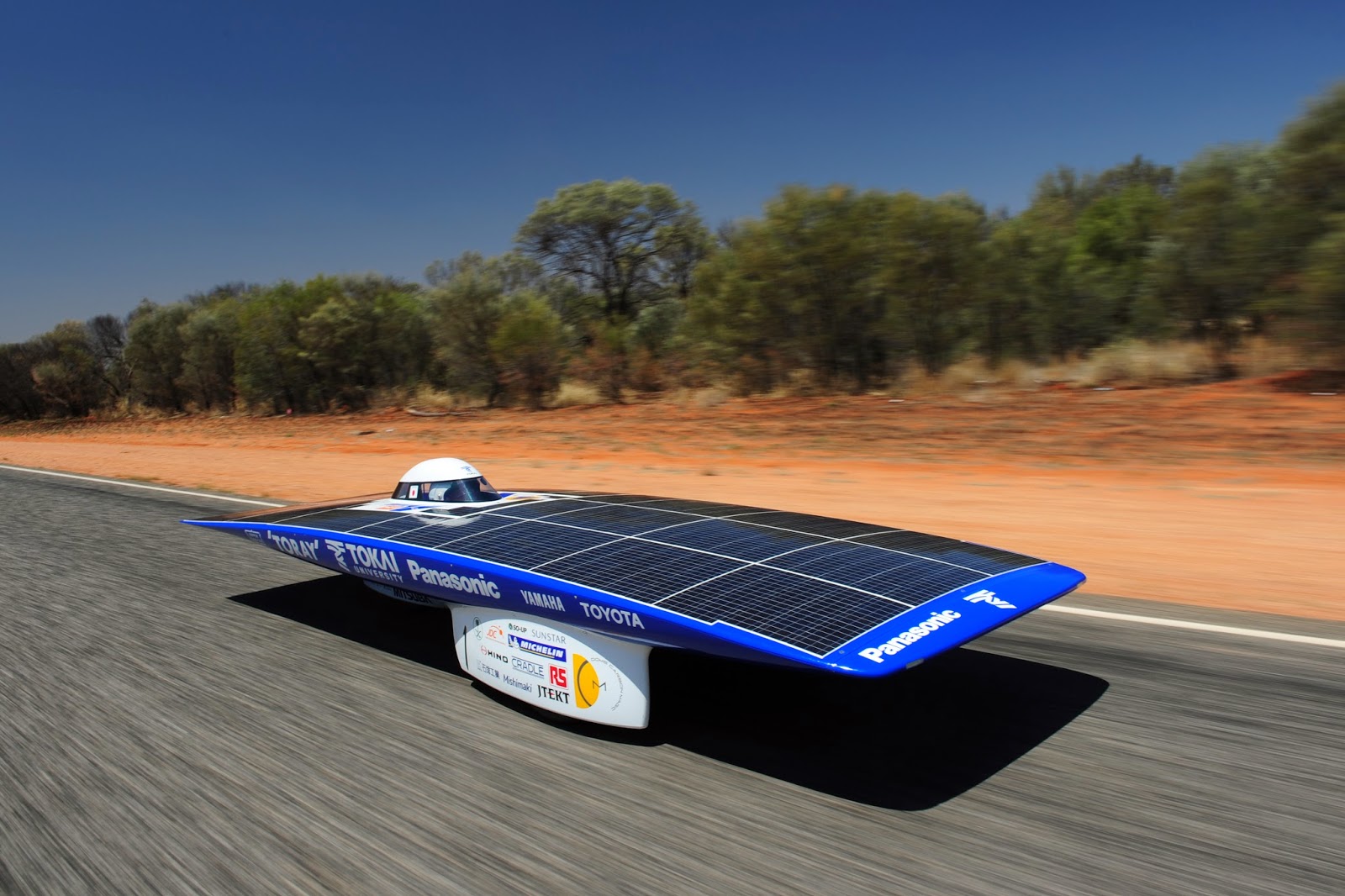
    Tokai Challenger in 2011 won with an average speed of 91.54 km/h (56 mph). With such high average speeds combined with the physics of air resistance being proportional to the square of speed, aerodynamic drag is the main source of losses on a solar race car. Much design effort is invested in CFD computer simulation, scale and full size wind tunnel testing. The best solar race cars achieve a drag coefficient as low as 0.07 (Nuna 3 – which holds the record for highest average winning speed @ 102.8 km/h) where a road car ranges from 0.24 (Tesla Model S) to 0.35 (Toyota Land Cruiser).

    It is the chase of maximum aerodynamic efficiency that has lead to the race winning dominance of “coffee table” type vehicle designs which brings up the question of how practical can a solar-powered vehicles be? The 2013 Bridgestone World Solar Challenge sees the introduction of the Michelin Cruiser Class which is not focused on speed but practicality, with the ultimate goal of entrants being able to meet the requirements for road registration. Cruiser Class cars must seat a minimum of two people and will be allowed over-night battery charging at select locations.

    While the Michelin cruiser class aligns solar race car design more closely with road car requirements, if the limitations of having the solar panels on the vehicle itself are removed, powering a regular road going EV with solar power is an affordable reality today!

    Tesla Motors recently launched a network of solar powered superchargers capable of charging their Model S to 320 km of range in 30 minutes. Even a modest 1.5 kw residential roof-top PV solar system generates enough energy to power a commuter EV like a Nissan Leaf for more than average annual mileage. In fact, displacing the cost of petrol instead of grid power will reduce the break even time on a roof-top PV installation to just a few months.

    This year’s Bridgestone World Solar Challenge is held from 6th – 13th October. If you can’t make it to Darwin or Adelaide, you can follow the race on Twitter via @tsport100 or @WorldSolarChlg.

    Disclosure: This post is sponsored by Bridgestone World Solar Challenge. Words and thoughts are entirely my own.

    Mitsubishi Outlander PHEV competes in cross country rally

    Mitsubishi Motors Corporation remains convinced of the virtues of motor sports to improve the breed and whilst the glorious days of the Dakar Rally and the World Rally Championship are long gone for Mitsubishi, the achievements of the innovative i-MiEV Evo electric monoposto racer at Pikes Peak still prove the point – especially for pioneering technologies.

    In the case of the bigger SUV/crossover Outlander, cross country was deemed better suited – more so as it would be an unusual showcase for Outlander PHEV and its unique Plug-in Hybrid Electric drivetrain.

    A pre-production Outlander PHEV was entered in the 2013 Asia Cross Country Rally (or “AXCR”) which took place August 10th – 16th between Thailand and Laos, post-event celebrations starting today in Japan.

    An officially FIA sanctioned race, the AXCR is an Asian take at a Dakar-type of extreme cross country rallying, which started this year from Pattaya and finished in Pakse, in the southern part of Laos.

    Over 6 days, competitors drove over 2,000km on various road surfaces and conditions including mountain roads, muddy jungle, river crossing, etc,…, making it a true challenge in terms of driving performance and endurance.

    A reliable choice

    Out of a total of 20 entries in the four-wheeled category (of which 19 finished), the Outlander PHEV attracted quite some attention as it was the only plug-in hybrid vehicle to participate, most competitors behind heavy-duty Diesel-powered pickup trucks.

    Entered by a private team (“Two and Four Motor Sports”), backed by Mitsubishi Motors, the sole Outlander PHEV finished 17th overall with no failure: quite a success for what was essentially a standard car – including the Twin Motor 4WD plug-in hybrid electric drivetrain, as well as the Super All Wheel Control (S-AWC) system – the only modifications being the regular cross-country racing routine of upgraded shock absorbers and springs, roll cage, underfloor protection, exhaust and snorkel duct, etc,…

    World markets

    Completing such a tough rally with no problem whatesoever confirmed the durability as well as the dynamic performance of Outlander PHEV just a few months before it starts its commercial career in world markets.

    Mitsubishi will launch Outlander PHEV sequentially, starting with selected PHEV markets (The Netherlands, Nordic countries, etc,…) from October 2013 onwards.

    The other European markets will gradually follow from November 2013 to Q1 2014.

    Highlights from WEC Six Hours of Circuit of the Americas [VIDEO]

    TOYOTA Racing fought a race-long battle for victory in the Six Hours of the Circuit of the Americas before taking second place in the fifth round of the FIA World Endurance Championship.

    After six hours of intense racing in hot temperatures, the #8 crossed the finishing line just 23.617 seconds behind the race winner.

    The TS030 HYBRID was able to get strong performance from the same set of tyres over two stints. This, combined with quick pit stops, reduced the amount of time the #8 needed to spend in the pits.

    The next round is TOYOTA Racing's home race, the Six Hours of Fuji on 20 October where the team will have two cars competing as the #7 of Alex Wurz, Nicolas Lapierre and Kazuki Nakajima returns to action.

    Dutch Students Break EV Acceleration Record 0-100 km/h in 2.13 sec [VIDEO]

    Dutch students today reset the Guiness world record for acceleration 0-100 km/h, in the category for electric cars. The Delft University of Technology Racing Team used their 2012 All-Wheel-Drive 148 kg Formula Student DUT12 to accelerate from zero to 100 km/h in just 2.13 seconds at Valkenburg Airport.

    The Formula SAE car has a four wheel drive powertrain with a 26 kw / 27 Nm motor driving each wheel giving a total peak power output of 104 kw. The front motors are out-board and drive through a 1:7 Planetary gear system. The rear motors are in-board and drive the wheels via a 1:13 two-stage spur gear system with carbon fiber half-shafts.

    The Delft Team first prepared the ground by pouring a solution of sugar in water over the track, and heating it with a gas-burner. All rubble was removed and a plastic sheet was put over the track to keep it dry. Additionally, tire warmers were used on the car, the driver was the team's lightest member, Marly Kuijpers, and the the run was repeated ten times with traction control and tire slippage tweaked within the four motor controllers via the CAN bus ECU for each run.

    The team says that rule changes make 2013 and 2014 Formula Student cars less likely contenders for future acceleration records. For one thing they will have high downforce wings, which add drag, and larger batteries, adding weight. The heavier machines are unlikely to reach a new record, so Delft may well hang on to the top spot longer than another student team, which held its record just over a year.

    Buckeye Bullet 3 Delayed in Bid to become first 400 MPH EV [VIDEO]

    The Buckeye Bullet is a collaboration between Ohio State University and Venturi, and although due to the flooding of Bonneville salt flats (Utah, USA), the FIA and the organizers of the world speed records program decided to cancel the competition for this year, the team were targeting a 400 MPH (640 km/h) world land speed record for electric cars.

    The car, called VBB-3, is actually the third “Buckeye Bullet” land speed record car. Driver Roger Schroer took the VBB-2.5 to 307.58 mph in 2010, giving him the current FIA world record.

    VBB-3 is powered by four electric motors, which generate 400 horsepower each (750 hp Peak) with energy storage provided by 2,000x prismatic A123 batteries that weigh 1600 kg. The 3.2 ton Carbon fiber skinned vehicle can output a total of more than 2 Megawatts (3,000 hp) which, when combined with a drag co-efficient of only 0.13, the team hope is sufficient to re-write the EV Land Speed Record.

    To break the record, the electric car must travel at least one mile and average two runs within an hour. The student team hopes that the new car will break 400 mph, something no electric car has achieved, but this will now have to wait till 2014.

    Panasonic Ene-1 GP Suzuka KV-40 Challenge [VIDEO]

    The "2013 Ene-1 GP SUZUKA" next-generation electric energy car event was held last month at Suzuka Circuit.

    It was sponsored by Land Mobility Inc, owner of Suzuka Circuit, and Panasonic was an official partner of the event.

    Panasonic promoted its "KV-40 Challenge" where cars were powered on 40x AA rechargeable nickel-metal hydride (NiMH) batteries. In this challenge, teams were invited to independently produce single-seater electric vehicles, powered by EVOLTA batteries, and complete 3 laps around the 5.8 km Suzuka circuit which features a maximum elevation change of 50 meters.

    75 teams from all over Japan participated, ranging from junior high school teams to serious hobbyists, with average speeds on the track reaching up to 60 km/h and it was noted that driving skill definitely played a large part in participant success.

    The winner of the time trial was "Ahiru-Ecopa Racing Togo" team.