 Can batteries spark a clean-energy revolution? A new book says, maybe.
 Can ‘Battery Geniuses’ Transform Cars and the Grid?
Can batteries spark a clean-energy revolution? A new book says, maybe. 
Charged with Electric Vehicle News and Views
Can batteries spark a clean-energy revolution? A new book says, maybe. 
There are more electric-car charging points in Japan than there are petrol stations.
That surprising discovery comes from Nissan Motor Co., which reported that the number of power points in Japan, including fast-chargers and those in homes, has surged to 40,000, surpassing the nation’s 34,000 gas stations.
The figure shows that in the relatively brief time since electric vehicles were introduced, the infrastructure to support them has become bigger than what the oil industry built over decades in the world’s third-biggest economy -- at least by this one measure.
Why that matters is obvious. Nissan’s battery-powered Leaf can travel 84 miles (135 kilometers) on a charge, and the anxiety of being stuck away from home without power has restrained consumer demand. As the charging network expands and batteries become more powerful, that concern will wane.
“An important element of the continued market growth is the development of the charging infrastructure,” Joseph G. Peter, Nissan chief financial officer, told analysts on a conference call.
As charging stations become more common, electric-car support services are also emerging. Open Charge Map, for example, operates an online listing of public charging points worldwide. A mobile app combines the data with GPS technology to guide drivers to the nearest site.
Of course, gas stations typically have multiple pumps and can serve more vehicles in a day than an electric-car charging point.
Private Chargers
Also, one criticism of Nissan’s number is that many of those charging sites are in private garages. Considering the emerging so-called sharing economy, such as the online home-sharing service operated by Airbnb Inc., homeowners may soon be willing to make their chargers available to other drivers.
And more charging locations are being built all the time. Automakers have recognized that oil companies are unlikely to install plugs next to gasoline pumps, and are building their own networks.
Tesla Motors Inc. has its own network of charging stations, and Bayerische Motoren Werke AG and Volkswagen AG announced in January that they are joining the network operated by ChargePoint Inc., and plan to build as many as 100 fast chargers along the busiest corridors of the U.S. coasts, from Portland to San Diego in the west and from Boston to Washington, in the east.
Free Charging
Utilities are joining in. Great Plains Energy Inc., the Kansas City, Missouri-based utility holding company, announced in January plans to build a network of more than 1,000 charging stations in the region by mid-2015. Charging will even be free to everyone for the first two years.
Given that there are only about 9,000 public charging stations in the entire U.S., the initiative gives Kansas City, the nation’s 29th largest metropolitan area, a chance to become the nation’s electric car capital with as much as 10 percent of the nation’s chargers.
Kansas City may not be able to retain that position. PG&E Corp., owner of California’s biggest utility, asked regulators Feb. 9 for permission to build a network of about 25,000 chargers in public areas over a five-year period.


Based on the Kia Soul, the Kia Trail’ster concept was unveiled at the Chicago motor show and combines a FWD turbocharged motor and a RWD electric drive system to provide all-wheel-drive.
"The Trail'ster concept is a near-future look at how the production Kia Soul would logically evolve into an AWD-capable version that's built to escape the city streets and roam into the mountain wilderness," said Tom Kearns, chief designer, Kia Design Centre of America (KDCA). "It takes the go-anywhere capability of an SUV and reimagines it within a compact and sporty package with an expressive design to match."
Based on the production Soul, the Trail'ster's overall shape and size are unmistakable. But with family genes tied closely to the thought-provoking Track'ster and Soul'ster concepts - which pushed Soul far into new directions to realise its performance and lifestyle possibilities - the Trail'ster also takes a dramatic departure from its production-car roots with styling and drivetrain components that turn Kia's popular urban passenger vehicle into a rugged runabout, further demonstrating that Soul is indeed the ideal platform for creativity and experimentation.
The Trail'ster is primarily powered by a 1.6-litre turbocharged 4-cylinder engine outputting 188 ps and 251 Nm of torque through a six-speed automatic transmission, matched to an electric all-wheel drive system on the rear axle intended for low-speed assist, enhanced launch acceleration and improved traction in inclement weather or off-road situations. This approach helps mitigate turbo lag by providing instant torque. The system also improves fuel economy over standard all-wheel drive setups by operating only when needed and serving as an energy recovery mechanism.
Further defining the near future perspective of Soul as a capable and efficient all-wheel drive runner, the Trail'ster arrives as a ‘Through-the-Road' hybrid, which means it has two power sources (a front gasoline engine and a rear electric motor) that make up the hybrid system and meet ‘through the road,' as opposed to inside the transmission with a common driveline connection. It requires all four wheels being driven in careful coordination, but there's no mechanical link between engine and electric motor. The link between the two is the road itself.
"This powertrain strategy of a downsized turbo and ‘Through-the-Road' hybrid power yields a dual benefit of increased performance - torque and traction - and optimised efficiency," said Kearns. "This is AWD being done the advanced, intelligent and responsible way, while sacrificing nothing." Should the Trail'ster find its way to production, fuel economy would be targeted at a 25-30 percent improvement in city driving and 5-10 percent in highway driving over the normally aspirated 2015 2.0-litre gasoline Soul.
The Trail'ster's electric propulsion system draws energy from a 1.2 kWh Lithium Ion Polymer battery powering a 27 kW, 270 volt AC synchronous permanent magnet electric motor outputting 36 ps and 100 pound-feet of torque to the rear wheels and bringing total output to an impressive 220 horses and 136 Nm of torque. To further improve fuel efficiency, the system also utilises a Hybrid Starter Generator (HSG) to start/stop the engine as needed (and to feed energy to the high voltage battery), and an electrically driven A/C compressor, which can run when the engine is shut off. This technology is designed for easy, lightweight packaging, with the compact battery pack stored under the cargo floor.
Operationally, the rear electric drive system engages in one of three scenarios, depending on throttle position and road conditions: Under light throttle, the Trail'ster attains true clean mobility as the electric motor drives the car solely for a range of two to three miles; under normal driving, the rear electric motor assists the 1.6-litre turbo during acceleration events calling for greater power and torque; when treading off-road or on wet pavement, the electric drive system is introduced when front wheel slippage is detected. Finally, the Trail'ster's electric motor acts as a generator to recover kinetic energy and recharge the battery when the vehicle is braking or coasting.
For traversing tough terrain, the Trail'ster has been raised more than two-and-a-half inches over the production Soul. In addition, this mountain rover wears Pirelli Winter Carving 245/45-19 snow tires for enhanced traction and utilises KSport coilover shocks to absorb the impact of rough, uneven ground and rocky surfaces.


 The American carmaker has been increasing the amount and speed of charging stations, an effort to address a common complaint among Chinese owners.
Tesla Motors and Samsung SDI are in talks over whether to expand their partnership in batteries for electric cars, industry officials said Sunday.
"With Tesla seeking to diversify its battery sourcing channels beyond its key partner Panasonic, Samsung SDI will have greater room to supply more electric vehicle (EV) batteries to Tesla," said an official who declined to be named.
Samsung SDI is expected to account for about 8 percent of Tesla battery demand this year, worth 36 billion won. It expects to raise that portion to 40 percent in 2016, with sales to the American company rising to 254 billion won.
"From next year to 2018, Samsung SDI may handle 40 percent of Tesla demand," said another source directly involved with the issue.
Samsung SDI said nothing has been decided.
Samsung SDI's target for EV batteries is considered as rather aggressive. But optimists say EVs remain economically-viable with gas at $2 per gallon.
Even with plunging oil prices, analysts say the economics for EVs is well supported as they are still at parity with conventional vehicles after 5 years of ownership at the current gas price level.
Tesla CEO Elon Musk expects to sell "a few million EVs a year by 2025. The company will soon start building two new factories, one each in Europe and Asia.
To that extent, Tesla needs additional battery partners.
"We expect more development from Tesla's Gigafactory planned for 2020. Some of the battery demand within the project could be allocated to different partners, for which we believe Samsung SDI remains well positioned on the basis of both technology and capacity," said Mark Newman at Bernstein Research.
"For Samsung SDI, a meaningful development in regard to partnership with Tesla would first help sentiment in terms of earnings impact," he said.
Research firm Navigant Research said 2014 global EV sales were estimated at 2.7 million, accounting for 3.3% of global light vehicle sales for the year.
Samsung SDI's share of the EV battery market stood at around 7.2 percent last year, driven mostly by the strong performance of the BMW i3.


 A new book goes inside the race to build the perfect electric car.
 .jpg)
General Motors Co plans to begin building its new Chevrolet Bolt electric car in October 2016 at an underused small-car plant north of Detroit, two supplier sources said.
Despite the hype surrounding the car's unveiling last month at the Detroit auto show, the sources said, GM's production target for the Bolt is relatively modest, at about 25,000-30,000 cars a year.
Last year, GM sold 18,800 Chevrolet Volt hybrid electric cars. The Volt, priced from around $35,000, uses a small gasoline engine to increase range.
GM has said the Bolt's target price was $30,000. A GM source familiar with Chevrolet's plans said the price would actually be "in the mid-$30,000s" but federal and state incentives to purchase "green cars" would reduce the consumer's final cost to $30,000.
The Bolt is expected to go on sale in early 2017 and will have a range between charges of more than 200 miles.
The Bolt will compete with Tesla Motors Inc's similarly priced Model 3, planned to debut in calendar 2017, as well as the Nissan Leaf, which sold just over 30,000 last year.
The supplier sources said the Bolt and a companion model for GM's Opel subsidiary in Europe will be assembled at GM's plant in Orion Township. The GM source said the company has not yet reached a final decision on whether the Opel model will be assembled in Orion Township.
The factory now makes the Chevrolet Sonic and Buick Verano and has been operating at well below capacity as small-car sales have suffered from falling gasoline prices.
The Bolt is being developed on GM's Gamma global small-car platform, according to the supplier sources. The same basic set of components will provide the base for the next-generation Sonic, also due in late 2016, they said.
The GM source asked not to be named and an official company spokesman declined to comment.


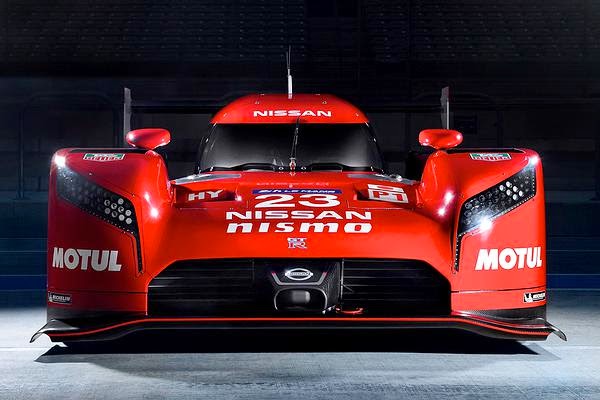
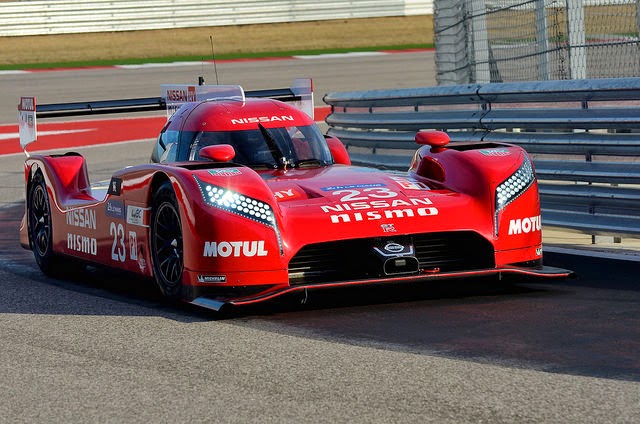
This is the Nissan NISMO entry to the 2015 Le Mans 24 Hour race, the GT-R LM NISMO.
The GT-R LM NISMO is a front-engined, front wheel drive car that is powered by a V6 3-litre twin turbo petrol engine and a kinetic energy recovery system- It is the ultimate GT-R.
Some info on the Nissan LMP1:
Nissan has yet to announce how retrieved energy is stored, but it is understood that it is a flywheel system.




Kia Motors America will unveil an advanced and capable electric all-wheel drive (e-AWD) concept vehicle at the upcoming Chicago Auto Show.
The off-roader was conceived by Kia's California design studio and built for city dwellers seeking the ultimate urban escape. Intended to enable a wide array of outdoor activities from skiing and snowboarding, to camping, hiking and mountain biking, this rugged runabout captures the essence of adventuring at higher elevations with the promise of surefootedness in the wild.


Youtuber Juan del Real shot this video of a Tesla Model X being tested at the former naval air station in Alameda California about 30 miles north of Tesla's factory in Fremont.
Based on the size of the Model S in the background, Jalopnik think the camouflaged prototype looks too small to be a Model X and believe this may in fact be the first sighting of a Model 3.


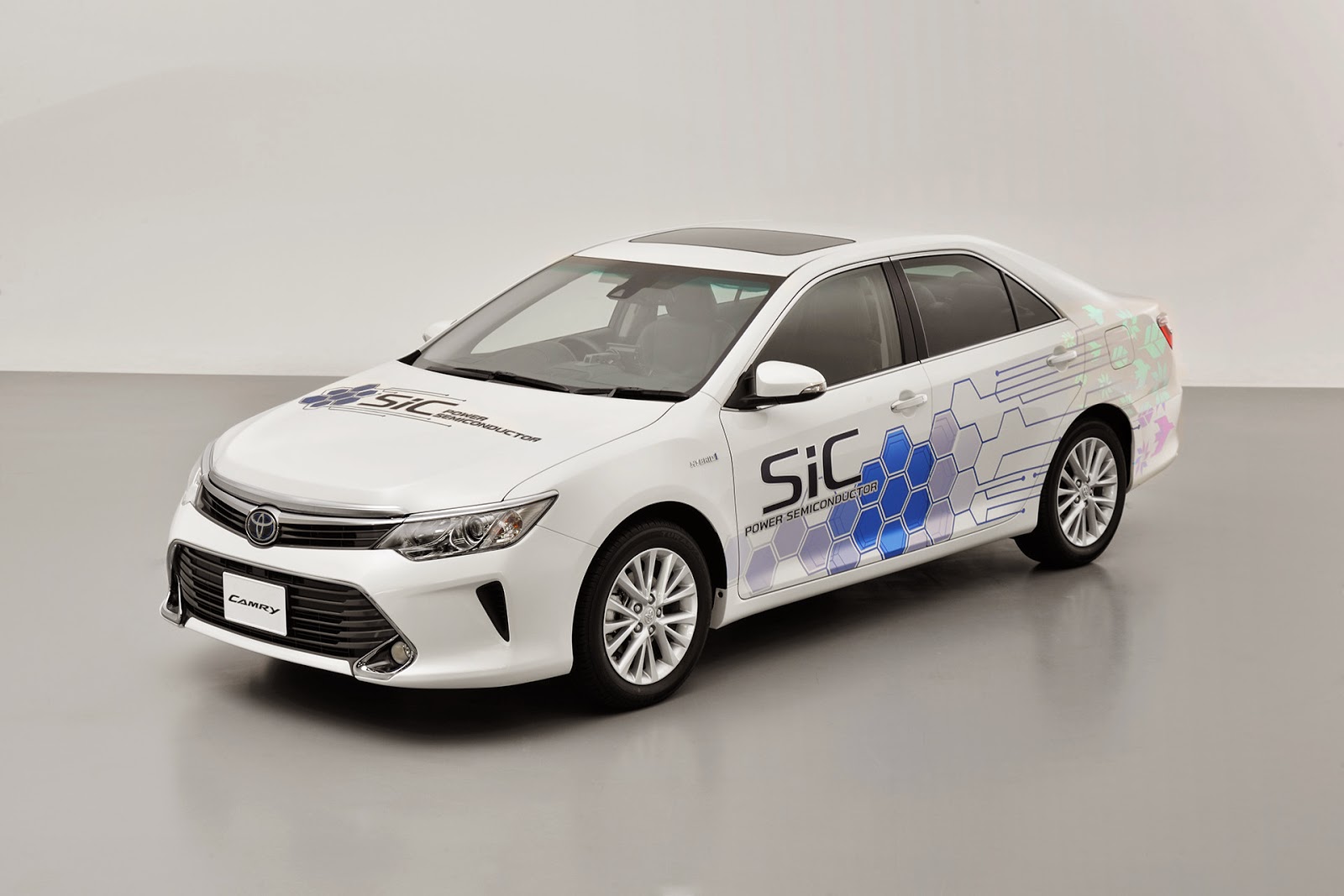
Using a "Camry" hybrid prototype and a fuel cell bus, Toyota Motor Corporation will bring a brand new technology to the streets of Japan for testing this year. The tests will evaluate the performance of silicon carbide (SiC) power semiconductors, which could lead to significant efficiency improvements in hybrids and other vehicles with electric powertrains.
Technology
Power semiconductors are found in power control units (PCUs), which are used to control motor drive power in hybrids and other vehicles with electric powertrains. PCUs play a crucial role in the use of electricity, supplying battery power to the motors during operation and recharging the battery using energy recovered during deceleration.
At present, power semiconductors account for approximately 20 percent of a vehicle's total electrical losses, meaning that raising the efficiency of the power semiconductors is a promising way to increase powertrain efficiency.
By comparison with existing silicon power semiconductors, the newly developed high quality silicon carbide (SiC) power semiconductors create less resistance when electricity flows through them. The technologies behind these SiC power semiconductors were developed jointly by Toyota, Denso Corporation, and Toyota Central R&D Labs., Inc. as part of the results of a broader R&D project* in Japan.
Test vehicles and period
In the Camry hybrid prototype, Toyota is installing SiC power semiconductors (transistors and diodes) in the PCU's internal voltage step-up converter and the inverter that controls the motor. Data gathered will include PCU voltage and current as well as driving speeds, driving patterns, and conditions such as outside temperature. By comparing this information with data from silicon semiconductors currently in use, Toyota will assess the improvement to efficiency achieved by the new SiC power semiconductors. Road testing of the Camry prototype will begin (primarily in Toyota City) in early February 2015, and will continue for about one year.
Similarly, on January 9, 2015, Toyota began collecting operating data from a fuel cell bus currently in regular commercial operation in Toyota City. The bus features SiC diodes in the fuel cell voltage step-up converter, which is used to control the voltage of electricity from the fuel cell stack.
Data from testing will be reflected in development, with the goal of putting the new SiC power semiconductors into practical use as soon as possible.


Following closely on the heals of BMW and Volkswagen announcing a 100 station CCS fast charger network last week, Nissan have plans to install up to 1,700 CHAdeMO fast chargers in the US by 2016.
Since the launch of the Nissan LEAF in late 2010, Nissan has reinforced its commitment to zero emission mobility with investments in EV charging infrastructure to serve the needs of LEAF drivers in markets across the U.S.
Nissan has a multi-pronged strategy to invest with charging partners to install quick charging for owners in the communities where they live and work, as well as at corporate workplaces and Nissan dealerships.
Timeline of (CHAdeMO) quick charging rollout:
"Access to quick chargers that can provide about 80 percent charge to a Nissan LEAF battery in less than 30 minutes has proved to increase our owner satisfaction and get more buyers to consider the benefits of an all-electric car," said Brendan Jones, Nissan's director of Electric Vehicle Sales and Infrastructure Deployment. "Nissan continues to invest heavily with our charging partners to ensure that LEAF owners have easy access to convenient public charging as they seek to maximize the benefits of their cars."
For reference there are currently 140 Tesla Supercharger locations in the USA.


According to Edmunds, General Motors is developing a high performance electric all-wheel drive system for next-gen V-Series Cadillac models and maybe their crossovers. This system could make its way into other GM Alpha-platform-based vehicles such as the Cadillac ATS and Chevrolet Camaro, and possibly a Corvette derivative.
All-wheel drive has become a must-have for high-performance luxury car buyers, and Audi, BMW, Mercedes-Benz and Porsche are ahead of the game with their AWD-equipped vehicles. Cadillac, however, lags behind this trend, having just introduced the 455-horsepower ATS-V and 640-hp CTS-V, both rear-wheel-drive sedans. Cadillac is also lagging in its offering of electrified fuel-efficient models.
An electric all-wheel-drive system, known in the industry by the acronym e-AWD, can potentially boost fuel economy in many future vehicles and help expand their plug-in hybrid offerings, however, the system GM desires is many years in the future.
Joe Slenvak, director of powertrain electrification for North America at Robert Bosch, told Edmunds that adding electric all-wheel drive to the front wheels of a rear-drive car has challenges.
"When you put the electric axle drive in the front, you have a lot of crossmembers and things that are in the cradle that you have to work around. It would be a little bit hard to do (but) I think you could do it," Slenvak said.
Sounds like an application perfectly suited to in-wheel motors.
Slenvak said a vehicle could be retrofitted to add that system. He would not say if Bosch is developing an electric all-wheel-drive system for GM's rear-drive cars.
Source: Edmunds


 The stations will be part of a fast-growing network run by ChargePoint, the nation’s largest, and will be compatible with nearly all electric vehicles on the road.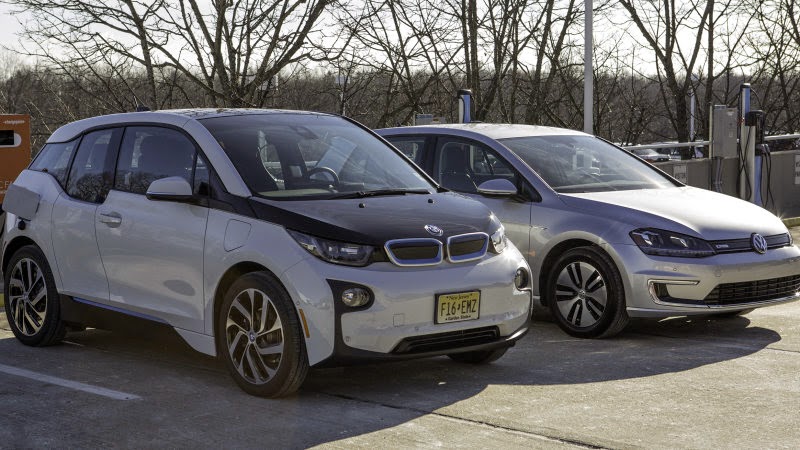
At the 2015 Washington Auto Show, two of the top automakers, BMW of North America and Volkswagen of America, together with ChargePoint, the largest electric vehicle charging network, announced an initiative to create express charging corridors along heavily-traveled routes on the East and West Coasts. Designed to increase the number of fast charging locations, the initiative will help meet the large and growing demand for convenient, publicly available electric vehicle fast chargers, including direct current (DC) Fast charging locations, and support the adoption of electric vehicles in the United States. In the initial phase, the aim is to install nearly 100 DC Fast charging ports across both coasts, with plans to expand the program to increase access to fast charging across the country. These newly installed DC Fast chargers will be added to the growing ChargePoint network of more than 20,000 charging spots in North America.
With more than 280,000 electric vehicles sold in the United States, EV owners need more charging flexibility while on the go. The express charging corridors will provide electric vehicle drivers access to DC Fast chargers along the most heavily populated and highly-trafficked regions on Interstate 95 on the east coast, from Boston to Washington, D.C., and on the west coast covering and connecting the metropolitan areas of Portland, San Francisco, Los Angeles, and San Diego. The installations will occur both within and between relevant metro areas, strategically-spaced at a maximum of 50 miles apart, making it even easier to take long road trips in an EV.
"A robust network of conveniently located DC Fast charging stations will go a long way toward increasing electric vehicle adoption and making electric vehicle ownership even more enjoyable," said Robert Healey, Head of EV Infrastructure at BMW of North America. "The express charging corridors are another important step in the development of the U.S. e-mobility infrastructure that makes longer distance travel a real option for consumers, particularly along the most heavily trafficked portions of both coasts-making the BMW i3 and other electric vehicles even more appealing."
"Volkswagen believes in a holistic approach to e-mobility in order to create a seamless experience for the consumer," said Jörg Sommer, vice president, product marketing and strategy, Volkswagen of America. "The investment in the express charging corridor will provide e-Golf and other electric vehicle owners with the added support to travel their day-to-day and popular long distance routes."
Each fast charging location along the express charging corridors is expected to include up to two 50 kW DC Fast chargers, or 24 kW DC Combo Fast chargers with the SAE Combo connector, used in both BMW and Volkswagen electric vehicles as well as many other electric vehicles that incorporate a DC Fast Charging capability. When charging at a 50 kW station, both the BMW i3 and the Volkswagen e-Golf can charge up to 80 percent in 20 minutes. Both vehicles can charge up to 80 percent in 30 minutes at a 24 kW station. Locations will also include Level 2 chargers, currently the most commonly available public charging stations, which are compatible with all electric vehicles. Level 2 stations can dispense up to 25 miles of range per hour of charging, providing a full charge for the BMW i3 and the VW e-Golf within 3.5 to 4 hours.
The DC Fast charging stations will be part of the ChargePoint network and can be easily accessed with a ChargePoint or ChargeNow card or with the ChargePoint mobile app.
"Our goal at ChargePoint is to get everyone behind the wheel of an EV and provide EV charging everywhere they go," said Pasquale Romano, ChargePoint CEO. "With strategically-placed stations where drivers need them, these express charging corridors will give EV drivers the freedom to go farther and have an EV as their only car without limitation."
Installations have already begun on the west coast, with the first location in San Diego County. There is a target of nearly 100 DC Fast charging ports in the first phase, available by the end of 2015. DC Fast chargers along the express charging corridors are expected to be installed in convenient locations such restaurants, shopping centers, rest stops, and more. ChargePoint will leverage its existing customer base and knowledge on usage to pick strategic locations either where drivers currently charge, or to fill in spaces where there is currently a lack of infrastructure.
With the investment, BMW, Volkswagen and ChargePoint are providing drivers with the ability and confidence to enjoy longer distance driving and recharge their electric vehicles quickly, ultimately leading to greater electric vehicle adoption.


Announced last year, the second sedan manufacturered by Porsche will not be sold until 2018. A source quoted by the German magazine Auto Motor & Sport says the small Panamera could become the first electric car from the German manufacturer.
Apparently, Porsche believe that in four years time battery technology will advance to allow ranges from at least 350 to 400 kilometers.
The E-Pajun is expected to be a four-seater significantly smaller than the Panamera.


