Tasty Tech Eye Candy Of The Week (Dec. 6)
This week, we feature ink made from algae, an electric Porche, a glowing bandaid and a virtual reality system that gives you the feeling of flight.

Charged with Electric Vehicle News and Views
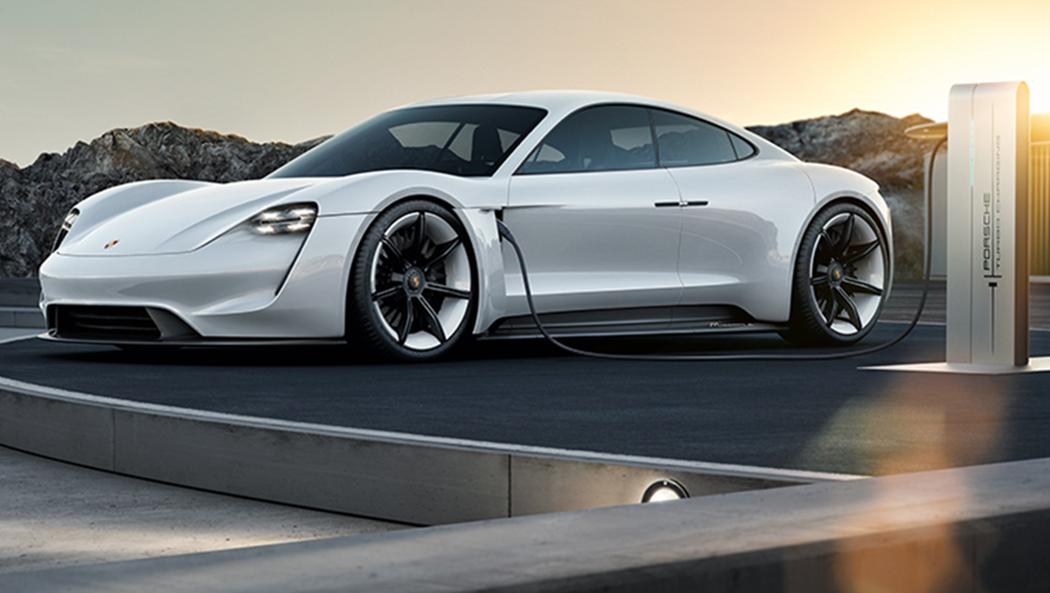
Porsche will spend about 1 billion euros ($1.09 billion) on production facilities at its biggest plant to make its first-ever all-electric sports car.
The Volkswagen-owned manufacturer will create more than 1,000 new jobs at its base in Zuffenhausen in Germany where a new paint shop and assembly line will be set up to build the battery-powered "Mission E" model, Porsche said on Friday.
Porsche's investment in emissions-free drive technology reflects parent VW's growing commitment to increase its electric offerings as it struggles to overcome an emissions scandal.
VW has said the next generation of its VW-badged flagship luxury saloon Phaeton will be electric and it plans to expand the so-called MQB modular production platform to focus more strongly on long-range plug-in hybrids and electric vehicles.
Analysts have warned that VW's admission of rigging diesel emissions tests could cast a shadow over the diesel vehicle industry.
Porsche's Mission E model, due to come to market by the end of the decade, will be more than 600 horsepower and have a range of over 500 km (310 mile).
"We are sending a significant sign for the future of the brand," Chairman Wolfgang Porsche said after a meeting of the supervisory board which approved the investment.
Some 700 million euros will be spent at Zuffenhausen where an existing engine plant and body shop will be extended, and the rest will be invested in Porsche's development center in Weissach, the carmaker said.
Source: Porsche


 At an event in San Francisco, entrepreneurs pitched their ideas for Toyota’s three-wheeled i-Road.
  Car dealers are showing scant enthusiasm for putting consumers into electric cars, despite large fan clubs and governmental pledges.
The new Audi R18 made its world premiere on the occasion of the Audi Sport Finale at the Audi Training Center Munich on Saturday. Audi Sport has fundamentally re-designed the Audi R18 for the 2016 season.
The LMP1 race car that will compete in the Le Mans 24 Hours and in the FIA World Endurance Championship (WEC) in 2016 features innovative aerodynamics; represents the next stage in lightweight design; and has a modified hybrid system with lithium-ion batteries for energy storage, plus an efficiency-optimized TDI engine. The 2015 R18 e-tron quattro racer featured an encapsulated WHP flywheel energy storage system that sat in the cockpit alongside the driver.
The 2016 R18 retains the 4.0L TDI engine. The 2016 R18 will race in the 6MJ class; the 2015 R18 raced in the 4MJ class, up from 2MJ the season before.
Further technical details will come later.
In the 2016 FIA World Endurance Championship (WEC) that will start at Silverstone (Great Britain) on April 17, Audi Sport Team Joest will be fielding two new Audi R18 cars. In the interest of cost efficiency, Audi and its Volkswagen Group sister brand Porsche, have both agreed to each compete in the Le Mans 24 Hours, the WEC season’s pinnacle event, with only two instead of the most recent three cars.


The new Audi R18 made its world premiere on the occasion of the Audi Sport Finale at the Audi Training Center Munich on Saturday. Audi Sport has fundamentally re-designed the Audi R18 for the 2016 season.
The LMP1 race car that will compete in the Le Mans 24 Hours and in the FIA World Endurance Championship (WEC) in 2016 features innovative aerodynamics; represents the next stage in lightweight design; and has a modified hybrid system with lithium-ion batteries for energy storage, plus an efficiency-optimized TDI engine. The 2015 R18 e-tron quattro racer featured an encapsulated WHP flywheel energy storage system that sat in the cockpit alongside the driver.
The 2016 R18 retains the 4.0L TDI engine. The 2016 R18 will race in the 6MJ class; the 2015 R18 raced in the 4MJ class, up from 2MJ the season before.
Further technical details will come later.
In the 2016 FIA World Endurance Championship (WEC) that will start at Silverstone (Great Britain) on April 17, Audi Sport Team Joest will be fielding two new Audi R18 cars. In the interest of cost efficiency, Audi and its Volkswagen Group sister brand Porsche, have both agreed to each compete in the Le Mans 24 Hours, the WEC season’s pinnacle event, with only two instead of the most recent three cars.
No other car currently on the market is able to capture the curiosity of the greater public like the Tesla Model S P85D. It is a means of transport like no other, breaking a few world records in the process.


Bombardier Transportation has successfully completed a 41.6 km catenary-free test run using a Bombardier-built tram, powered entirely by its PRIMOVE battery in combination with BOMBARDIER MITRAC. The test run was conducted in the German city of Mannheim on the Rhein-Neckar-Verkehr GmbH (RNV) network.
RNV began using SuperCaps energy storage systems in 2009, and has integrated this technology into 30 of their trams. This provided sufficient energy for short CFO distances. However, the latest generation of Bombardier’s PRIMOVE battery system has been specifically developed for use with CFO where greater distances need to be covered.
In addition to application in Germany, the PRIMOVE battery and MITRAC propulsion equipment combination has been in successful revenue service on the Hexi line in Nanjing, China since August 2014. Six trams, built by CRRC Puzhen under Bombardier license, operate without overhead cables on 90 per cent of the lines. The batteries are charged seamlessly during passenger service via the pantograph, statically at tram stops, and dynamically during acceleration. On this demanding route, the CFO propulsion system has proven its suitability for almost any tram line worldwide.
The innovative PRIMOVE battery system builds upon Bombardier’s many years of experience with energy storage systems. The system combines high power capacity and exceptional battery life with high reliability and has been designed to maximize performance using the latest developments in nickel manganese cobalt (NMC) Li-Ion cells. The advanced PRIMOVE thermal conditioning unit maintains the battery’s ideal temperature and enables rapid charging and full braking energy recovery while extending their lifetime to up to ten years.


BMW Motorrad has a long tradition in pointing out new ways and thoughts for the topic „mobility on two wheels“. For that, again and again many studies were presented in the past giving views to the future. The experimental vehicle eRR, created as a project with the Technical University of Munich, embodies an idea of an electric powered supersport motorcycle made by BMW Motorrad.
Already a couple of years ago, BMW i showed the BMW Group’s visionary and sustainable approach with the vehicles BMW i3 and i8 and their revolutionary design principles (aluminum chassis and passenger cabin made from carbon fibre) and BMW Motorrad’s C evolution proved, that zero emission, riding fun and practicability do not exclude themselves.
With presenting the experimental vehicle eRR BMW Motorrad goes one step forward and shows the possibilities of an all-electric drive in a supersport motorcycle. Regarding design and chassis technology the eRR leans on the supersport motorcycle S 1000 RR, however using an all-electric drive.
Stephan Schaller, Head of BMW Motorrad, emphasizes: „Since their market launch, the RR is giving the creeps to motorsport athletes. If acceleration, handling or topspeed – the RR is setting standards. However, if acceleration on the first metres, up to 50, 60 kph, is the point, the RR’s 199 bhp have to admit defeat by another BMW product: the C evolution with its electric drive.
We asked ourselves: What happens when combining a sport motorcycle and an electric drive? The experimental vehicle eRR brings the topic zero emission and electric drive on a new, more fascinating level."
BMW Motorrad will announce technical details of the eRR at a later date.



In order to acquire the dominance and leadership in Chinese EV market, Samsung SDI became the first global battery manufacturer to construct an EV battery plant and initiate mass production in China, beating LG Chem who broke ground on a similar plant in China a year ago.
The Xi’an plant has initiated its operation from September. It has finalized battery supply agreements with 10 local personal and commercial vehicle companies and is already delivering the goods. Some of these companies include Yutong, the leader of China’s and also the world’s bus industry and then Foton, the leader of China’s truck industry.
The finalized Samsung SDI Xi’an Plant is a cutting-edge production line that can manufacture high-performance electric vehicle (in standard of pure EVs) batteries for an amount of approximately 40 thousand cars a year. The plant is capable of carrying out the whole production process of EV battery cells and modules. Preparing for increased market demand in the future, Samsung SDI will invest – by adding production line, etc. – 600 million USD into the Xi’an battery plant until 2020 and aim to achieve 1 billion USD in sales.
Samsung SDI CEO Cho Nam Seong said in his welcoming address, “Xi’an is a starting point of Silk Road and is also a focal point of China’s One Belt, One Road initiative.” He added, “To go hand in hand with China’s time-honored tradition and future development strategy, we will bring up Xi’an plant to become the world center of EV battery industry.”
Anqing Ring New Group Chairman Pan Yi Xin said, “By integrating our expertise in the automotive business with Samsung SDI’s advanced technical capability, we will promote Xi’an Plant as the number one production base of EV battery.”


 What you need to know if you’re on a trip or planning one soon, including a new tour of Mongolia and safaris by electric vehicle and boat.
 Today at the Tokyo Motor Show 2015, Nissan Motor Co., Ltd. unveiled a concept vehicle that embodies Nissan's vision of the future of autonomous driving and zero emission EVs: the Nissan IDS Concept.
Presenting at the show, Nissan president and CEO Carlos Ghosn said: "Nissan's forthcoming technologies will revolutionize the relationship between car and driver, and future mobility."
After leading the development and expansion of EV technology, Nissan once again stands at the forefront of automotive technology. By integrating advanced vehicle control and safety technologies with cutting-edge artificial intelligence (AI), Nissan is among the leaders developing practical, real-world applications of autonomous drive technology.
In August 2013, Ghosn said that by 2020 Nissan plans to equip innovative autonomous drive technology on multiple vehicles. Progress is well on track to achieve this goal.
Nissan Intelligent Driving is Nissan's concept of autonomous drive technology and represents what Nissan believes next-generation vehicles should be. "Nissan Intelligent Driving improves a driver's ability to see, think and react. It compensates for human error, which causes more than 90 percent of all car accidents. As a result, time spent behind the wheel is safer, cleaner, more efficient and more fun," continued Ghosn.
By 202X, expect to see Nissan Intelligent Driving technology deployed on cars in cities around the world.
The Nissan IDS experience
Some have compared a future with autonomous drive to living in a world of conveyer belts that simply ferry people from point A to B, but the Nissan IDS Concept promises a very different vision of tomorrow. Even when the driver selects Piloted Drive and turns over driving to the vehicle, the car's performance — from accelerating to braking to cornering — imitates the driver's own style and preferences.
In Manual Drive mode, the driver has control. The linear acceleration and cornering are pure and exhilarating. Yet behind the scenes, the Nissan IDS Concept continues to provide assistance. Sensors continually monitor conditions and assistance is available even while the driver is in control. In the event of imminent danger, Nissan IDS Concept will assist the driver in taking evasive action.
In addition to learning, the Nissan IDS Concept's AI communicates like an attentive partner. From information concerning traffic conditions, the driver's schedule to personal interests, Nissan IDS Concept's AI has what is needed to help create a driving experience that is comfortable, enjoyable and safe.
Design — Together, we ride
"A key point behind the Nissan IDS Concept is communication. For autonomous drive to become reality, as a society we have to consider not only communication between car and driver but also between cars and people. The Nissan IDS Concept's design embodies Nissan's vision of autonomous drive as expressed in the phrase together, we ride," says Mitsunori Morita, Design Director.
Two interiors enable two ways for the driver to enjoy the experience. Together, we ride is clearly demonstrated in the interior design. "The Nissan IDS Concept has different interiors depending on whether the driver opts for Piloted Drive or Manual Drive. This was something that we thought was absolutely necessary to express our idea of autonomous drive," says Morita.
Even though it is a hatchback, the Nissan IDS Concept's long wheelbase enables comfortable seating space for four adults. But the cabin becomes even more spacious when the driver selects Piloted Drive. In this mode, the steering wheel recedes into the center of the instrument panel and a large flat screen comes out. Various driving-related operations are handled by AI, voice and gestures from the driver. The interior, which is comprised of natural materials such as mesh leather, is illuminated by soft light. All four seats rotate slightly inward, facilitating easier conversation. It's like relaxing in a living room.
When the driver selects Manual Drive, the roomy interior transforms to put the driver in control. All seats face forward. The steering wheel, which takes styling cues from reins for horse riding, appears along with driving meters and a heads-up display that shows route and other driving information. Interior lighting switches to blue, stimulating the ability to concentrate. Nissan's use of hollow-structure A-pillars helps ensure excellent visibility by reducing blind spots and also contributes to the feeling of open space.
"In every situation, it is about giving the driver more choices and greater control. And the driver will remain the focus of our technology development efforts," Ghosn said at the show.
The transformation to Manual Drive can be carried out with ease through a switch between the front seats called the PD Commander. This is the only control the driver can physically operate when the car is in Piloted Drive: when the driver is ready to take over driving, a physical action should initiate the change.
Exterior design
For autonomous drive to be widely accepted, people need to fully trust the technology. Through its innovative communication capabilities, the Nissan IDS Concept promotes confidence and a sense of harmony for those outside the car as well. Various exterior lights and displays convey to pedestrians and others the car's awareness of its surroundings and signals its intentions. The car's side body line, for example, is actually an LED that Nissan calls the Intention Indicator. When pedestrians or cyclists are nearby, the strip shines white, signaling that the car is aware of them. Another electronic display, which faces outside from the instrument panel, can flash messages such as "After you" to pedestrians. This natural, harmonious system of communication signals a new future with cars.
Advanced aerodynamic performance for greater driving range
Design Director Mitsunori Morita says: "By the time Nissan Intelligent Driving technology is available on production cars, EVs will be able to go great distances on a single charge. Getting to this point will, of course, require the further evolution of batteries, but aerodynamic performance is also very important. We incorporated our most advanced aerodynamic technology in the design of the Nissan IDS Concept."
The height of the full carbon fiber body was constrained to 1,380 mm, sharply minimizing aerodynamic drag (Cd). Positioning the tires close to the corners of the body maximizes interior space while enabling a wrap-around cabin design. Nissan selected large-diameter wheels for high-performance and sportiness, but used very thin 175-size tires to minimize air and roll resistance. The wheels have a layered design suggestive of thin fins that create tiny vortexes of air flow on the wheel's surface. This design further contributes to smooth air flow.
The icicle pattern on the Nissan IDS Concept's grille symbolizes a pure and clean design — perfect for an EV. Shaped like a stack of ice blocks, the grille pattern appears transparent. The car's bluish satin silver body color heightens the impression of a comfortable and secure cabin space.
Highly evolved EV technology for long-distance driving
At Nissan's annual shareholders meeting in June, Executive Vice President Hideyuki Sakamoto said: "Our zero emission strategy centers on EVs. We are pursuing improved electric powertrain technologies, such as motors, batteries and inverters, which will enable us to mass produce and market EVs that equal or surpass the convenience of gasoline-powered cars."
The Nissan IDS Concept is fitted with a high-capacity 60 kWh battery, and thanks to its outstanding aerodynamics, low stance, flowing form and reduced weight due to its full-carbon-fiber body, the vehicle is designed to also meet the need to drive long distances. Other technologies on the Nissan IDS Concept include Piloted Park that can be operated by smartphone or tablet, and wireless charging technologies. Through these, the driver can leave parking and charging to the car.
Nissan's targets — Zero traffic fatalities and zero emissions
In order for our car-based society to be sustainable, complex issues ranging from sustainable energy supplies to climate change, air pollution and traffic safety must be addressed. At Nissan, we have set zero fatalities and zero emissions as aspirational targets in our mission to help create a sustainable car-based society.
Over 90 percent of traffic accidents are caused by human error. Nissan IDS Concept's extensive system of sensors and AI are designed to provide enhanced safety performance compared to a human driver. This technology brings us a step closer to the goal of zero traffic fatalities.
EVs produce no CO2 emissions and their batteries can store energy from renewable sources and turn it into electricity for homes and buildings. As the number of EVs increases, entire communities will be able to harness their power as part of a sustainable energy plan. Then, as EVs come to play a central role in energy supply, we will come that much closer to becoming a zero emission society.
Nissan believes that the Nissan IDS Concept will evolve into a leading innovation for next generation mobility and our quest for making these "two zeroes" a reality.
Featuring Nissan's most advanced safety, driving-control and EV technology — all taken to a new level by AI — the Nissan IDS Concept is a compelling showcase of a promising future.


Dyson, the U.K. company famous for its bagless vacuum cleaners, has acquired Michigan-based solid-state battery startup Sakti3 for $90 million and announced plans to build an important $1 billion battery factory to mass produce the next generation battery technology.
This is the second important solid-state battery technology acquisition in a short period of time – Bosch recently bought Seeo Inc. to bring their battery technology to market. Solid-state batteries are thought to be a lot safer than common li-ion cells and could have more potential for higher energy density, but we have yet to see a company capable of producing it in large-scale and at an attractive price point.
Sakti3 made the headlines last year when it announced that it had produced a solid-state battery cell with 400 Wh/kg energy density, compared to Tesla’s cells believed to be around 230 Wh/kg.
Dyson had already invested $15 million in Sakti3 before now buying the company.
Founder and CEO Ann Marie Sastry will join Dyson as an executive and lead development of her battery technology for the company. When she first unveiled her technology and was trying to attract investors, Sastry said that the company’s solid-state cells aimed at the electric vehicle industry.
Dyson says that they remain open at licensing the technology and the cells could eventually find their way into electric cars, but for now the plan is to integrate the technology into Dyson’s cordless vacuum cleaners. The company expects to start producing its systems with the new batteries within a year or two.
“If we are to continue to create new and disruptive technology we must develop more advanced core technologies,” said Dyson founder James Dyson. “We have invested nearly $310 million into the research and development of the Dyson digital motor, a technology that now powers our most successful machines. We will do the same with batteries. Sakti3 has developed a breakthrough in battery technology, and together we will make this technology a reality.”
