World’s Largest Ultra-fast EV Charging Station Goes Live
EV charging complex has 25x chargers at 360kW and 5x chargers at 90kW; maintaining a capacity for Ultra-fast charging 30 urban transit buses at the same time
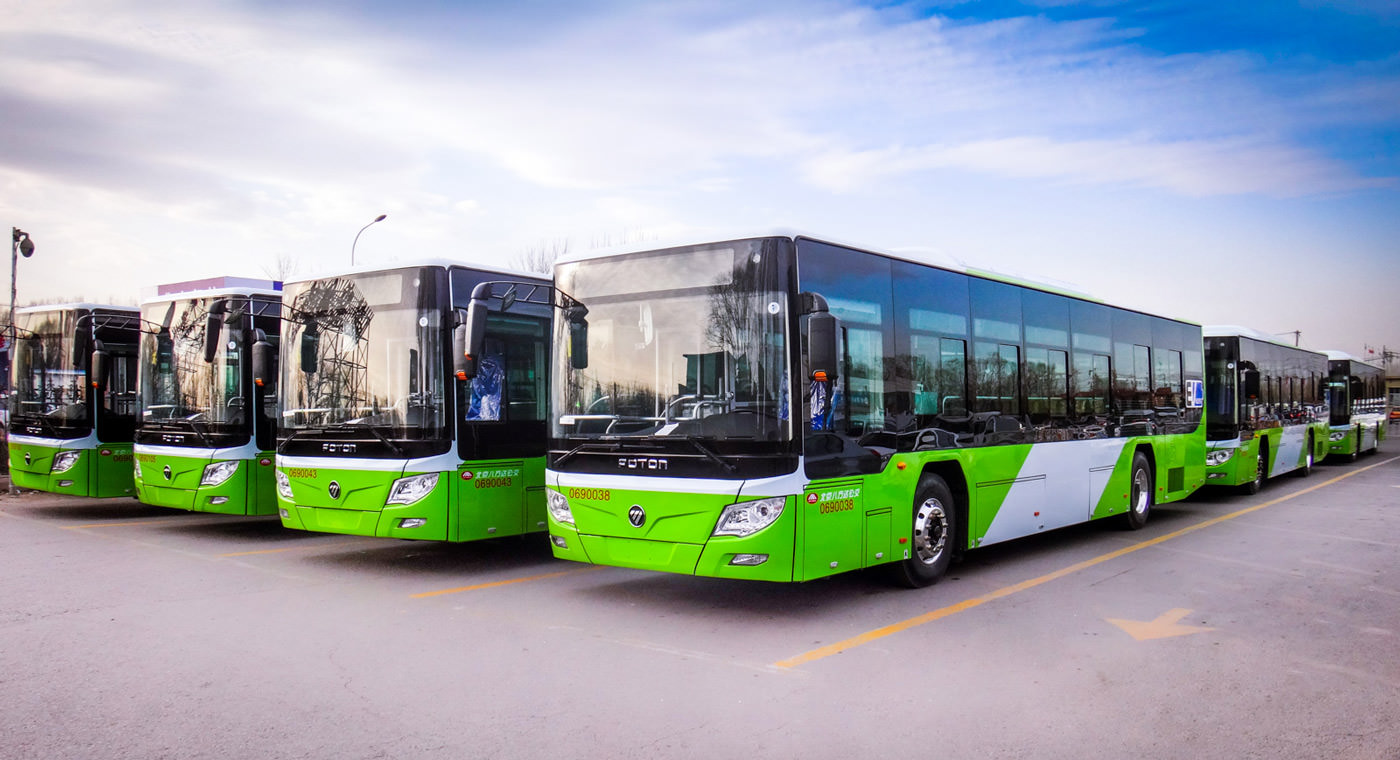
Equipped with Microvast's ultra-fast charging battery, a Foton electric bus stops by a charging point after a few loops of operation. Trained staff plug in the charger and within 10-15 minutes the electric bus's battery is refilled to maximum operating capacity and ready to go again. This now happens everyday in many bus terminals across metropolitan Beijing with the deployment of this cutting edge charging technology. Among all the ultra-fast charging stations, the newly opened charging station in Xiaoying Public Transit Bus Terminal is the largest.
Located in Chaoyang district, Beijing, built by China State Grid, this new charging complex covers an area of 26,500 m2 with its structures covering 1,575m2. Designed to satisfy the growing charging demand especially from the increase of ultra-fast charging electric buses departing from this terminal, this complex provides the infrastructure to charge 30 buses at the same time.
Originally a natural gas hybrid bus fleet, Beijing transit route 13 with Foton buses, like ten plus other major city bus routes departed from Xiaoying Terminal, now completely converted to ultra-fast charging full electric bus fleet. They join hundreds of other E-buses in Beijing already deployed using the same battery technology from Microvast.
After conversion to ultra-fast charging technology, the Route 13 fleet has improved operating efficiency while reducing Beijing's GHG emissions. Each new bus takes only 10-15 minutes to complete recharging the battery. Charging each bus takes place 2-3 times per day, during driver breaks, with several route loops between each charge.
Compared to earlier battery swapping system adopted by Beijing to experiment on improving Slow-charge Battery E-bus's operating efficiency and reduce down-time, the ultra-fast charging "battery + charger" system needs neither the investment and large storage space footprint for extra batteries, nor high cost complex with automated robotic battery pack swapping infrastructure, bringing obvious advantages to customers and utility companies with more rapid ROI.
With future facility and charging point expansions already planned out for 2016-2020, to accommodate more routes converting to fast charge EV, Xiaoying Terminal Charge station will play a greater role in the development of clean energy public transit system for Beijing in the near future.
When the Car Reviewer Buys a Car
Chinese Billionaire Plans Electric Car Plant in Nevada
2016 Audi R18 LMP1 Prototype caught testing @ Sebring [VIDEO]
Following the new Audi R18's world premiere at the Audi Training Center Munich last month, the now battery powered R18 Audi Le Mans Prototype LMP was recently caught testing at Sebring International raceway in Florida USA.
The 2016 R18 retains the 4.0L TDI engine but moves up into the 6MJ class; the 2015 R18 raced in the 4MJ class, up from 2MJ the season before.
1 Million Electric Cars in S. Korea by 2020
Despite Push for Cleaner Cars, Sheer Numbers Could Work Against Climate Benefits
Letters to the Editor
Tasty Tech Eye Candy Of The Week (Dec. 6)
Porsche to invest $1 billion to launch battery-powered Mission E [VIDEO]
Porsche will spend about 1 billion euros ($1.09 billion) on production facilities at its biggest plant to make its first-ever all-electric sports car.
The Volkswagen-owned manufacturer will create more than 1,000 new jobs at its base in Zuffenhausen in Germany where a new paint shop and assembly line will be set up to build the battery-powered "Mission E" model, Porsche said on Friday.
Porsche's investment in emissions-free drive technology reflects parent VW's growing commitment to increase its electric offerings as it struggles to overcome an emissions scandal.
VW has said the next generation of its VW-badged flagship luxury saloon Phaeton will be electric and it plans to expand the so-called MQB modular production platform to focus more strongly on long-range plug-in hybrids and electric vehicles.
Analysts have warned that VW's admission of rigging diesel emissions tests could cast a shadow over the diesel vehicle industry.
Porsche's Mission E model, due to come to market by the end of the decade, will be more than 600 horsepower and have a range of over 500 km (310 mile).
"We are sending a significant sign for the future of the brand," Chairman Wolfgang Porsche said after a meeting of the supervisory board which approved the investment.
Some 700 million euros will be spent at Zuffenhausen where an existing engine plant and body shop will be extended, and the rest will be invested in Porsche's development center in Weissach, the carmaker said.
Source: Porsche
Toyota Asks for Ideas About How to Use an Ultrasmall Vehicle
Biggest Electric Fleet in US Coming to NYC
New York City Aims for a Vast Electric Car Fleet by 2025
A Car Dealers Won’t Sell: It’s Electric
2016 Audi R18 celebrates world premiere in Munich
The new Audi R18 made its world premiere on the occasion of the Audi Sport Finale at the Audi Training Center Munich on Saturday. Audi Sport has fundamentally re-designed the Audi R18 for the 2016 season.
The LMP1 race car that will compete in the Le Mans 24 Hours and in the FIA World Endurance Championship (WEC) in 2016 features innovative aerodynamics; represents the next stage in lightweight design; and has a modified hybrid system with lithium-ion batteries for energy storage, plus an efficiency-optimized TDI engine. The 2015 R18 e-tron quattro racer featured an encapsulated WHP flywheel energy storage system that sat in the cockpit alongside the driver.
The 2016 R18 retains the 4.0L TDI engine. The 2016 R18 will race in the 6MJ class; the 2015 R18 raced in the 4MJ class, up from 2MJ the season before.
Further technical details will come later.
In the 2016 FIA World Endurance Championship (WEC) that will start at Silverstone (Great Britain) on April 17, Audi Sport Team Joest will be fielding two new Audi R18 cars. In the interest of cost efficiency, Audi and its Volkswagen Group sister brand Porsche, have both agreed to each compete in the Le Mans 24 Hours, the WEC season’s pinnacle event, with only two instead of the most recent three cars.
2016 Audi R18 celebrates world premiere in Munich
The new Audi R18 made its world premiere on the occasion of the Audi Sport Finale at the Audi Training Center Munich on Saturday. Audi Sport has fundamentally re-designed the Audi R18 for the 2016 season.
The LMP1 race car that will compete in the Le Mans 24 Hours and in the FIA World Endurance Championship (WEC) in 2016 features innovative aerodynamics; represents the next stage in lightweight design; and has a modified hybrid system with lithium-ion batteries for energy storage, plus an efficiency-optimized TDI engine. The 2015 R18 e-tron quattro racer featured an encapsulated WHP flywheel energy storage system that sat in the cockpit alongside the driver.
The 2016 R18 retains the 4.0L TDI engine. The 2016 R18 will race in the 6MJ class; the 2015 R18 raced in the 4MJ class, up from 2MJ the season before.
Further technical details will come later.
In the 2016 FIA World Endurance Championship (WEC) that will start at Silverstone (Great Britain) on April 17, Audi Sport Team Joest will be fielding two new Audi R18 cars. In the interest of cost efficiency, Audi and its Volkswagen Group sister brand Porsche, have both agreed to each compete in the Le Mans 24 Hours, the WEC season’s pinnacle event, with only two instead of the most recent three cars.
Tesla Model S P85D 0-100km/h & motor sound [VIDEO]
No other car currently on the market is able to capture the curiosity of the greater public like the Tesla Model S P85D. It is a means of transport like no other, breaking a few world records in the process.
Bombardier’s Battery Powered Tram Sets Range Record
Bombardier Transportation has successfully completed a 41.6 km catenary-free test run using a Bombardier-built tram, powered entirely by its PRIMOVE battery in combination with BOMBARDIER MITRAC. The test run was conducted in the German city of Mannheim on the Rhein-Neckar-Verkehr GmbH (RNV) network.
RNV began using SuperCaps energy storage systems in 2009, and has integrated this technology into 30 of their trams. This provided sufficient energy for short CFO distances. However, the latest generation of Bombardier’s PRIMOVE battery system has been specifically developed for use with CFO where greater distances need to be covered.
In addition to application in Germany, the PRIMOVE battery and MITRAC propulsion equipment combination has been in successful revenue service on the Hexi line in Nanjing, China since August 2014. Six trams, built by CRRC Puzhen under Bombardier license, operate without overhead cables on 90 per cent of the lines. The batteries are charged seamlessly during passenger service via the pantograph, statically at tram stops, and dynamically during acceleration. On this demanding route, the CFO propulsion system has proven its suitability for almost any tram line worldwide.
The innovative PRIMOVE battery system builds upon Bombardier’s many years of experience with energy storage systems. The system combines high power capacity and exceptional battery life with high reliability and has been designed to maximize performance using the latest developments in nickel manganese cobalt (NMC) Li-Ion cells. The advanced PRIMOVE thermal conditioning unit maintains the battery’s ideal temperature and enables rapid charging and full braking energy recovery while extending their lifetime to up to ten years.
BMW Reveal eRR Electric Super Bike Concept
BMW Motorrad has a long tradition in pointing out new ways and thoughts for the topic „mobility on two wheels“. For that, again and again many studies were presented in the past giving views to the future. The experimental vehicle eRR, created as a project with the Technical University of Munich, embodies an idea of an electric powered supersport motorcycle made by BMW Motorrad.
Already a couple of years ago, BMW i showed the BMW Group’s visionary and sustainable approach with the vehicles BMW i3 and i8 and their revolutionary design principles (aluminum chassis and passenger cabin made from carbon fibre) and BMW Motorrad’s C evolution proved, that zero emission, riding fun and practicability do not exclude themselves.
With presenting the experimental vehicle eRR BMW Motorrad goes one step forward and shows the possibilities of an all-electric drive in a supersport motorcycle. Regarding design and chassis technology the eRR leans on the supersport motorcycle S 1000 RR, however using an all-electric drive.
Stephan Schaller, Head of BMW Motorrad, emphasizes: „Since their market launch, the RR is giving the creeps to motorsport athletes. If acceleration, handling or topspeed – the RR is setting standards. However, if acceleration on the first metres, up to 50, 60 kph, is the point, the RR’s 199 bhp have to admit defeat by another BMW product: the C evolution with its electric drive.
We asked ourselves: What happens when combining a sport motorcycle and an electric drive? The experimental vehicle eRR brings the topic zero emission and electric drive on a new, more fascinating level."
BMW Motorrad will announce technical details of the eRR at a later date.