Robert Llewellyn takes a first drive in the electric version of the VW UP!
Also includes extensive pondering on the 'Yorkshire connection' as regards the time honoured phrase 'aye -up.'


Charged with Electric Vehicle News and Views
Robert Llewellyn takes a first drive in the electric version of the VW UP!
Also includes extensive pondering on the 'Yorkshire connection' as regards the time honoured phrase 'aye -up.'
Mahindra & Mahindra unveiled its concept electric sports car 'Halo' which it expects to launch commercially in the next three years.
"There is a plan to commercialise Halo, we are working on a bigger powertrain and a final design. It will take about three years to be production ready," Mahindra & Mahindra Executive Director and President Pawan Goenka told reporters at the Indian Auto Expo.
According to the company, the Halo can touch a speed of 0-100 kmph in less than 8 seconds. It has a top speed of 160 kmph with a range of 200 km on full recharge.
"This car has been fully designed and developed in India with all indigenous technology," Mahindra Reva Electric Vehicle CEO Chetan Maini said.
The company also introduced a quick recharge variant of its existing electric car e20, equipped with smart port technology.
The car can be fully recharged in one hour, while a recharge of 15 minutes will give a range of 25 km.


Chinese carmaker BYD will launch London’s first ever all-electric taxi fleet on Tuesday, pulling ahead of global rivals such as Nissan in the race to roll out zero emission cabs by 2018.
Following similar BYD E6 taxi fleets in China, Hong Kong and South America, BYD’s move into London transport comes ahead of a 2018 deadline set by Mayor Boris Johnson for all of the city’s taxis to be zero-emission, which has sparked a battle between manufacturers to develop green vehicles.
The Chinese manufacturer, 9.9 per cent owned by Mr Buffett, will initially launch a fleet of 20 electric cars operated by Thriev, a taxi company, less than two months after supplying the first-ever fully-electric buses to the capital.
“Londoners are typically early adopters to new technology . . . and we are very happy to be first and beat the deadline by a few years. This is where the electric vehicle technology will shine,” Isbrand Ho, managing director of BYD Europe told the Financial Times.
Although the E6 cannot be registered as a ‘Black Cab’ because of the turning circle requirements, Thriev is aiming at the established 50,000-strong mini cab market, which relies heavily on diesel-powered MPVs.
The BYD E6 is powered by a 40kWh battery and should offer a range of around 180 miles on a single charge, according to Isbrand Ho, managing director of BYD’s export division. The E6 was launched as a taxi in Hong Kong last March and a fleet is already operating in Shenzhen, the Netherlands and Columbia.


Kia Motors Corp rolled out an electric version of its Soul compact car on Thursday that the Korean automaker plans to begin selling in some U.S. markets later this year.
The 2015 Soul EV, unveiled at the media kick-off for the 2014 Chicago Auto Show, is Kia's first all-electric, zero-emissions car in the United States and its second "green" car for the U.S. market, joining a hybrid version of the company's best-selling Optima sedan that has been available here since 2011.
The Soul EV is powered by an air-cooled lithium-ion polymer battery and an 81.4 kW, 109-horsepower, liquid-cooled electric motor, which produces a 210 lb.-ft. of torque, according to Kia.
The car can go from 0 to 60 mph (0 to 96 km per hour) in less than 12 seconds, has a top speed of 90 mph (144 km per hour) and can drive 80 to 100 miles (129 to 161 km) on a full charge, the company said. The vehicle can be recharged by plugging into any standard 120v outlet or a conventional 240v EV charger.
The Soul EV will initially be sold in a handful of states, including California, Oregon, New York, New Jersey and Maryland, Kia said. Pricing has not yet been announced.


Speaking to owners during a European tour, Tesla Motors CEO Elon Musk has announced several product developments and company goals.
Musk confirmed plans to release an all-wheel-drive edition of its Model S sedan. The option may be available by the time the Model X arrives on the market, around early 2015.
The company is also working on higher-capacity battery options and new seats that will likely be ready by next year. For current owners, a seat modification will be available to improve comfort.
In the meantime, existing owners will be able to experience the Version 6.0 software update within a few weeks. The revision adds real-time traffic data, along with more control over suspension settings and ride-height adjustment, among other improvements.
Musk expects its "giga factory" to reduce battery costs by at least 30 percent, hopefully as much as 40 percent, with 30 gigawatt-hours of production capacity. Cheaper batteries are likely necessary for the company to meet its goal for a $30,000 mass-market car with a 200-mile range.
Following the completion of its transcontinental charging network in the US, Tesla is currently bringing new Superchargers on line at a rate of five per week. The chargers will eventually charge at a maximum 135 kW current.
While Musk was chatting with owners at the casual town-hall meetings, Consumer Reports was completing its latest brand-perception survey that showed the startup surging into the top five ahead of Subaru, Mercedes-Benz, BMW and other established players.


On January 30, 2014, Tesla Motors embarked on a promotional tour.
The plan was to drive two Model S sedans across the United States, powering them for free on the newly completed cross-continental Supercharger network.
In addition, the team would set the world record for charge time of an electric vehicle driving the across the US.


This episode follows Robert Llewellyn's one day electric car journey from London to Edinburgh in a Nissan Leaf. Using the Ecotricity fast charge network they covered the 407 miles with 8 rapid charge stops in just 13 hours.
In 2011 the BBC's Brian Milligan took 4 days to drive an electric car from London to Edinburgh. In what could only be seen as an anti-EV publicity stunt, Milligan set out to make the 484-mile journey using only publicly available charging infrastructure, making eight stops and spending about 46 hours of his total trip sleeping and waiting for the Mini E to refill its battery.
On day 3 of the BBC trip, David Peilow talked Tesla Motors into loaning him a Roadster to complete the same distance in 1 day. The Roadster stopped twice enroute and handsomely beat the BBC crew but could have potentially completed the trip in one day AND on a single charge.
As the Leaf comes with a Level 3 CHAdeMO charging socket fitted as standard, a Nissan Leaf, using the Ecotricity Fast Charge network, can cover the BBC trip in 1 day so on the third anniversary of the BBC's trip Robert Llewellyn and David Peilow set out to prove it.
In fact we posted a video of a British couple doing 500 miles (800 km) in a day in a Nissan Leaf using the Ecotricity Electric Highway backed by renewable energy.


An all-electric version of Audi's upcoming Q8 sports SUV has been approved for production, according to Autocar citing senior company sources.
The battery-powered version of the Q8 SUV due in 2017 will use battery and electric powertrain technology from the upcoming R8 e-tron supercar, with Audi engineers targeting a practical range of 370 miles (592 km).
The R8 e-tron project was recently reprised, with the updated car getting 400km (248.5 miles) range.
The new Q8 model is aimed directly at the upcoming Tesla Model X SUV, which is due to be launched later this year. Like the Tesla, the Q8 e-tron will will be AWD with electric motors driving the front and rear wheels.
The Q8 e-tron is expected to have a large battery pack, at least equal to the 80kWh pack that will be available in the Tesla. Battery technology is expected to make significant advances by the time the Q8 arrives, which will improve its potential range.
Source: Autocar


Drag racing legend “Big Daddy” Don Garlits, on the 50th anniversary of Garlits’ historic first official 200 mph pass in 1964, will attempt to drive the first battery-electric dragster to exceed 200 mph on a ¼ mile drag strip.
The Quest Dragster will be powered by a 1500 kilowatt array of lithium polymer (LiPo) batteries producing an equivalent horsepower rating of over 2000 HP powering a General Electric DC motor via 3x Zilla controllers.
These specs are very similar to those used by the first electric vehicle to break 200 mph in the quarter mile! The Rocket bike made history May 4, 2012 with a record run of 6.940 at 201.37 mph.
The bike was built by Lawless Industries and Orange County Choppers with Lawless also supplying the electric powertrain for the Quest SR-37 Dragster. Where the bike used A123 high-performance Nanophosphate lithium iron phosphate (LiFePO4) batteries the dragster will use a lithium polymer (LiPo) battery pack supplied by HighTech Systems LLC.
The title of World's fastest Electric Car in the quarter mile is currently held by Dennis Berube's Current Eliminator V dragster with an elapsed time of 7.956 @ 159.85 MPH. This record has stood since December 30th 2007. Power came from Altairnano lithium-titanate batteries via an early version of the same GE 13 inch DC Motor used by the Lawless Rocket and now the Quest SR-37 Dragster.


The BMW i3 was launched last year but is already available in the UK.
Robert Llewellyn took an i3 for a brief spin including drag racing a BMW M3 at Brands Hatch.


Drag Times have uploaded another drag racing video of their Tesla Model S P85, this time against a 2014 Chevrolet Corvette Stingray / Z51 with it's 460 hp normally aspirated Gen V small-block 6.2-liter pushrod V-8 good for 0-60 mph in less than 4 sec.


EVDrive completed development and demonstrated a powersports industry first, an "electric 4-wheel 4-electric-motor torque vectoring technology" called Terra-Torque-Drive™, specifically geared to 4-wheel off-road powersports vehicles, such as for the rapidly growing market segment of side by side Utility Terrain Vehicles or UTVs. After taking recent demo rides in the EVDrive-UTV tech demonstrator, powersports industry insiders, such as UTV OEM reps and UTV racers enthusiastically agree, that the Terra-Torque-Drive™, technology would beat almost all of today's top "gas/mechanical powered" 4wd UTVs. OEMs now have the opportunity to license this unique technology for integration into their own future powersports side by side UTV vehicle offerings.
Approximately 323,000 UTVs were retailed in North America in 2012, according to Power Products Marketing (PPM), a market research firm. PPM found consumer models (for example: Polaris RZR XP900) accounted for around 35% of total sales; Prosumer models (example: Deere XUV825i) garnered around 55% share, and commercial models (example: Bobcat Toolcat) were responsible for about 5% of sales. Industry insiders concur that the new EVDrive technology could apply to all 3 market segments. Compared to the top UTVs sold today, a Terra-Torque-Drive™, powered UTV with EVDrive Range Extender (REX) installed would excel in these areas:
1 - Highest efficiency 4wd drivetrain on any UTV today (least mechanical losses)
2 - Adjustable hill descent control (accomplished via an "electric engine braking" called "regen" putting energy back into the vehicles battery system from each of the 4 wheels)
3 - Dynamic torque vectoring modes both for high and low speed operation, e.g. industry unique "Zero Radius Turning" and high speed active torque vectoring allows for better and safer handling off-road
4 - Torque and power from -100 to +100% can be dynamically sent to any wheel, in either direction, in any combination, at any time.
5 - True Series hybrid with optimized internal combustion engine powered REX to allow for longer range matching or exceeding gas powered UTVs sold today. (REX is a high voltage specialized generator- LPG, gas or diesel powered REX engine easily adaptable, no mechanical connections to vehicle)
6 - 120vac power from onboard battery pack, backed up with the REX for general utility use
7 - Lower cost to maintain and operate - superior fuel economy, estimated average 50-100% better – for short trips, no fuel may be needed at all – plug-in to standard electric car chargers.
8 - Superior straight-line and rough loose material, curvy trail acceleration
9 - Greater river depth traversal possible due to completely sealed liquid cooled e-motors/power electronics.
10 - Stealthy low noise operation in electric only mode e.g. wildlife observation & hunting
11 - Torque vectoring software platform allows new traction capabilities to be supported like "apps" without costly mechanical NRE expenses to the OEM – OEM can provide customers software updates for new capabilities.
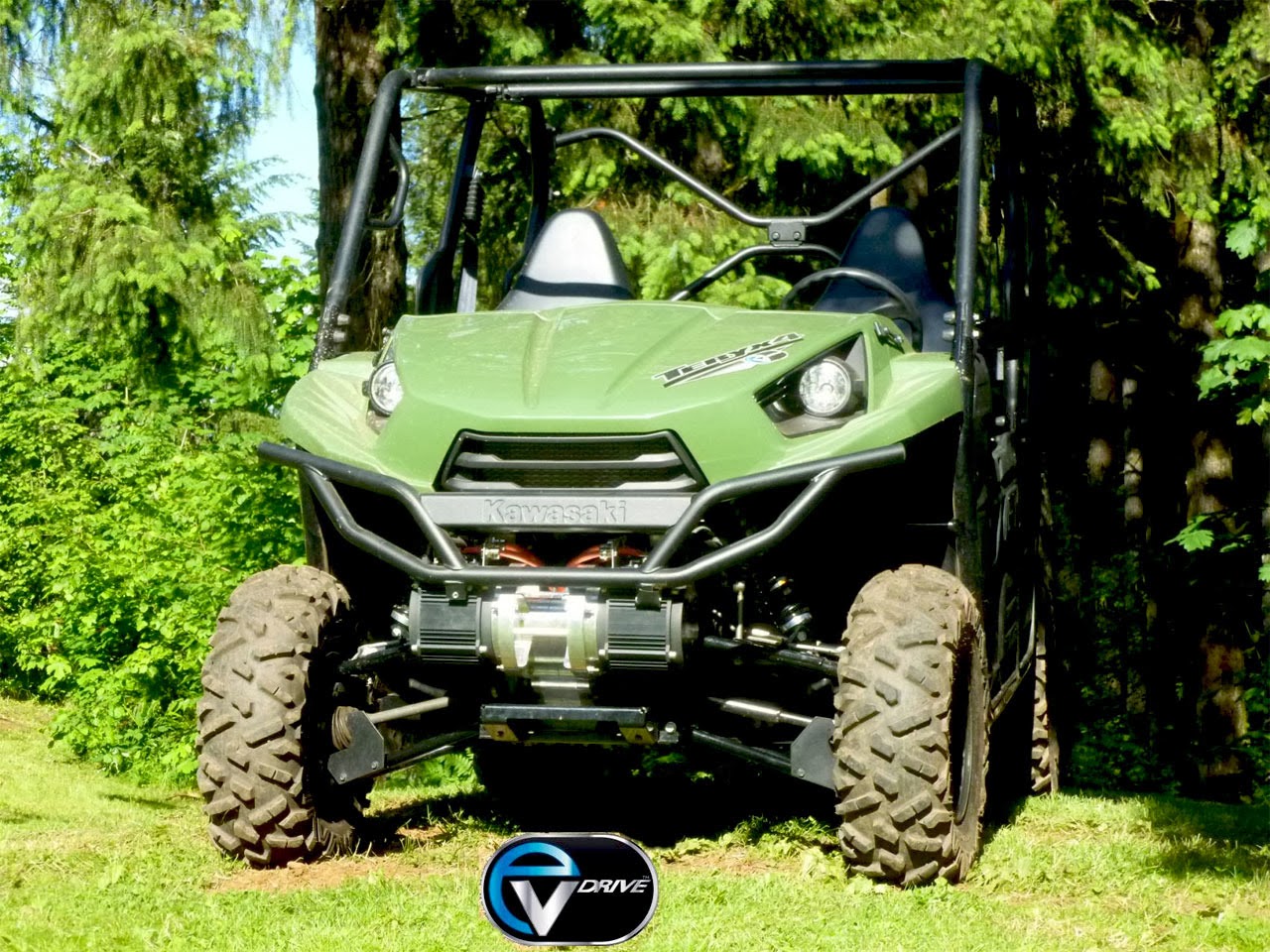
EVDrive chose the 4-seat Kawasaki Teryx4 as a tech demonstration platform because of its short wheelbase, smaller turning radius, and large break over angle to minimize getting hung up on obstacles. EVDrive modified this UTV with complete removal of the gas engine and AWD mechanical drivetrain and replaced with a 160hp peak total version of the Terra-Torque-Drive™. Unlike the stock Kawasaki Teryx4 UTV mechanical AWD drive, no additional mechanical losses are incurred in the Terra-Torque-Drive™, regardless of AWD mode from lack of transmission, driveshafts and differentials. "Off-road UTVs are ideally suited to our torque vectoring technology where only single fixed speed reduction is required per motor-wheel to attain 55-75mph top-speeds with the type of high RPM brushless motor technology we employ," said COO, co-founder, Steve Tice.
The Terra-Torque-Drive™, is a customized version of the general and modular EVDrive-Train architecture™ (http://bit.ly/EVD-Arch) used on all EVDrive conversion projects, with an in-house developed scale-able torque vector software platform added running on the EVDrive VCU (vehicle control unit), which supports new traction modes with inputs from all driver controls plus vehicle sensors such as accelerometers, etc. Some planned traction modes, that go beyond what is currently running on the demonstrator: auto dynamic terrain type posi-traction control, variable inclination angle offset descent control, zero radius turns on incline, emergency 4-wheel panic braking/stop & boulder climbing.
The Terra-Torque-Drive™, powered e-UTV demonstrator uses 4 of the sealed liquid-cooled EVDrive EVD35 35kW/47HP peak drive sub-systems, de-tuned to ~30kW/40HP each or delivering a total of ~160HP/120kW peak. At each motor shaft, ~66 ft-lbs peak torque is delivered. The 4 gearboxes allow ratio changes with off-the-shelf gearsets. With the currently installed single speed gearsets, at the CV joint of each wheel, a whopping 726 ft-lbs peak torque is delivered. This is the kind of torque necessary to perform Zero Radius Turns with a fully loaded vehicle and perhaps even some extreme rock climbing. "With these gearsets, a top speed of 45mph is achieved with acceleration to this speed of less than 4 seconds if you get good traction – at zero speed all 4 wheels will break loose on dry asphalt!" said EVDrive's CTO & co-founder, Bob Simpson.
In the accompanying video to this press release, some of the e-UTV tech demonstrator more technical features are revealed, such as: control touch screen for the Terra-Torque-Drive™, specifically the interface to the in-house developed VCU, shown in accompanying picture links below, and optional engine sound synthesis unit some OEMs expressed interest in, with 2 sounds demonstrated in the video, a gas turbine and V-twin motorcycle sound.
Addition of the15kW REX not only gives the UTV full performance and range to match and exceed top UTVs on the market but also offers a feature the competition does not, that is 120vac of electrical power anywhere you need it. "With the REX sub-system part of the Terra-Torque-Drive™, a hybrid UTV can be a true swiss-army-knife UTV, able to deliver power in remote locations for construction/utility/ranch applications, run silent for hunting/wildlife observation & with full-time 4wd torque vectoring, can deliver off-road handling and performance for sports/recreation, in summary, addressing all needs in the consumer, prosumer and commercial markets," said CEO, Steve Tice.
"Similar to our 25kW REX technology installed in our Series-PHEV BMW325 tech testbed -> http://bit.ly/PHEV-BMW-3-series but smaller, our custom high voltage 15kW-single cylinder (ICE) powered REX for the UTV is located between the rear seats – so with this sub-system, competing against top 4-seat UTVs in range will not be a problem - certainly the performance meets and beats stock UTVs we have tested" said EVDrive's CTO Bob Simpson. The REX gas engine can be modified to run on LPG as well offering additional emissions and operational cost advantages. EVDrive's REX technology supporting the hybrid e-UTV development has been already designed & proven in EVDrive Series PHEV BMW 325i Technology Testbed here shown sealed below rear spare tire floor - no protrusion above stock floor as shown in pictures at link included above.
EV West is partnering with EVDrive to deploy and demonstrate Terra-Digital-Torque-Steer™ all-wheel torque vectoring technology on full-size off-road vehicles. EV West is known for many milestones; e.g. Builders and drivers of the record breaking all-electric BMW 3-series street sedan at the Pikes Peak International Hill climb and builders of first ever electric off-road race car to run the Baja Mexican 1000 race in the National Off Road Racing Association's series.


Tesla Motors expects its China sales to contribute one third of global sales growth this year, a senior executive said, adding that a trademark issue stalling full-entry into China had been resolved.
Veronica Wu, vice president of Tesla's China operations, said the Palo Alto, California-based company planned to open stores in 10-12 Chinese cities by the end of 2014, including its flagship store in Beijing that opened late last year.
Wu, the 43-year-old executive who jumped ship to Tesla from Apple's China unit at the end of last year, said Tesla China had a "very aggressive growth objective".
She said the unit was aiming to contribute "30 to 35 percent" of Tesla's overall global sales growth targeted for 2014.
Wu said the company aimed to double overall total sales this year. She put global sales at 23,000 to 24,000 last year. "I have my work cut out for me," Wu said in an interview. "But I am pretty confident."
Wu discussed Tesla's plans for its Chinese sales and marketing operations at Tesla's flagship store inside an upscale shopping mall in Beijing a day after announcing its pricing strategy.
Tesla said on Thursday that a version of the Tesla Model S, a sleek all-electric battery car which sells for $81,070 in the United States, would retail for 734,000 yuan ($121,300) in China after shipping costs and import duty and other taxes. The company was referring to a Model S with an 85 kilowatt-hour battery pack.
The Beijing-born executive, who worked for Apple's China unit in Beijing from 2006 until she joined Tesla in December, said that given the Tesla car's "quality," the Model S offered "great value".
Wu applauded Beijing's support for electric and plug-in electric hybrid cars.
She said Tesla had also resolved a trademark issue that had long prevented the company from using "Te Si La" - the Chinese name best known among Chinese consumers, which Tesla wanted to use in China.
"We went to court and we won," she said. "The court has given use right to use the name, which is why you see the Chinese name in our store now."
The name had been registered by a local businessman who had refused to give up the trademark. The U.S. company had started offering its popular Model S sedans in China, but with no Chinese language name.
Wu said Tesla had no plans to start local production of its cars in China, at least for the time being.
"Right now we are not considering (that) as yet," the Tesla China chief said.
"The most important task right now, now that we have announced our pricing strategy, is to focus on getting the right car and making sure we have the right service network, and making sure the Chinese customer is happy," she said. "Happy customers are the best advocate of your product, right?"


FedEx Express, a subsidiary of FedEx Corp., and Nissan announced today at the Washington Auto Show that the two companies will begin testing the Nissan e-NV200, a 100 percent electric compact cargo vehicle, under real world conditions in Washington, D.C.
This test marks the first time the vehicle will be running in North America. FedEx Express and Nissan have conducted similar e-NV200 tests with fleets in Japan, Singapore, the United Kingdom and Brazil.
FedEx and Nissan are both committed to reducing the environmental impact of their operations worldwide. Rotating the Nissan e-NV200 into the delivery fleet is part of the FedEx EarthSmart program, a global sustainability platform designed to guide the company's environmental commitment in the communities where it operates. For Nissan, this effort aligns with its "Blue Citizenship" corporate social responsibility program with a focus on increasing the number of vehicles that emit no greenhouse gases by exploring additional vehicle segments where its leading electric vehicle technology may be applied.
FedEx will deploy the Nissan e-NV200 in the Washington, D.C. area, where it will undergo field tests that subject it to the routine requirements of a delivery vehicle. The results will be used to help determine the viability of using an electric vehicle in this role in the U.S. Nissan e-NV200 is scheduled to begin mass production later this year in Europe.
"As a global fleet operator serving 220 countries and territories worldwide, FedEx is committed to improving the efficiency of its vehicles as part of our EarthSmart initiatives," said Mitch Jackson, vice president of Environmental Affairs and Sustainability, FedEx Corporation. "We are pleased to continue our work with Nissan and bring the e-NV200 into test in North America."
"We're eager to work with FedEx and other companies to put the e-NV200 through its paces to continue to build awareness of the capability of electric vehicles and to evaluate how well it meets the needs of the commercial consumer," said Erik Gottfried, Nissan director of Electric Vehicle Sales and Marketing. "We'd also like to explore clever uses of EVs in work environments where carbon emissions of gas-powered vehicles make them impractical or impossible to use."
Nissan's Second Global All-Electric Vehicle
Following Nissan LEAF, e-NV200 will be the second EV that Nissan markets globally. The all-electric compact cargo vehicle strengthens Nissan's leadership in zero emission mobility. The 100 percent electric model offers the same versatility, functionality and roominess as its gasoline-powered sibling. The e-NV200 delivers unique, emission-free and quiet performance thanks to a powertrain based on Nissan LEAF and the same advanced lithium-ion battery. It emits no carbon dioxide, compared to approximately 140 g of CO2/km emitted by gas-powered engines in a similar vehicle. The e-NV200 can be charged up to 80 percent of its full capacity in less than 30 minutes when equipped with a quick charge port and using a fast charger.
With front-wheel drive, the e-NV200 provides rapid and smooth acceleration and excellent handling with a high degree of maneuverability. The electric vehicle delivers immediate torque, which benefits acceleration with a heavy payload from a dead stop. The e-NV200 offers the low cost of ownership that EVs such as LEAF boast—based on fewer maintenance requirements and the reduced cost of charging versus fueling. The smart positioning of the battery ensures a larger cargo area, and the vehicle maintains a low load floor, key considerations for light commercial vehicles.
FedEx: The EV Global Fleet
FedEx Express currently has 167 electric vehicles and 365 hybrid electric vehicles in the United States, France, Germany, Italy, Japan and China, including the units that will be deployed in Brazil starting in January. By the end of this fiscal year (May 31, 2014), the company plans to increase these numbers to 222 and 393, respectively. From 2005 to 2012, the introduction of this type of vehicle in the fleet enabled the company to save nearly 2.4 million liters of fuel.
Initiatives like this, aligned with others, such as matching the right vehicle to the right route, buying vehicles with the right-sized engines and inclusion of light vehicles into the fleet, have allowed FedEx to quickly progress towards its goal of increasing the fuel efficiency of its fleet, which the company revised in the beginning 2013 by increasing its initial improvement target from 20 percent to 30 percent by 2020.


Autoguide.com review the BMW i3.
Fast facts:


.jpg)
In its 2014 Fuel Economy Guide, the United States Environmental Protection Agency puts one car at the top of the list when it comes to fuel efficiency: the 2014 Chevrolet Spark EV.
With an EPA-estimated 82 miles of driving range and a fuel economy equivalent of 119 MPGe, the average driver can save $9,000 in fuel costs over five years compared to the average new vehicle.
Last year’s top ten list of the most fuel-efficient vehicles was comprised entirely of electric vehicles, so it’s not surprising that this year’s ranking is also packed with EVs.
The Spark EV, sold in California and Oregon, is also the first vehicle in the U.S. to offer the SAE International fast-charge connector as a vehicle option. The new combined AC and DC charging, or combo, connector is accessible via a single charge port on the vehicle and allows electricity to flow at a faster rate.
How much faster? DC fast charging charges 80 percent of the Spark EV’s battery in just 20 minutes for over 65 miles of range. By comparison, AC 120V charging, which can be done using a conventional household outlet, takes around 17 hours to fully charge. AC 240V charging reduces recharging time to less than seven hours for a full charge, but it requires a dedicated 240V charging station.
Many major automakers have announced they will adopt the SAE combo fast charge connector standard. Adopting an industry standard for EV charging is an important step in growing the public charging infrastructure.
GM is committed to leading the charge in the U.S. to develop energy alternatives like EVs and biofuels that help reduce dependency on petroleum, improve fuel economy and reduce emissions.
It’s why we were part of the unveiling of the very first public SAE combo DC fast charging station last year at the Fashion Valley Mall in San Diego.
And it’s why our engineers work tirelessly to bring greener vehicles like the Spark EV, Chevrolet Volt, Chevrolet Cruze Diesel, Cadillac ELR and the bi-fuel Chevrolet Impala to market.
If this year’s list of the most fuel-efficient vehicles on the market tells us anything, it’s that EVs are continuing to grow in popularity. And as more and more hit the market, choices for potential buyers will only increase, which means good things for the wallet and the environment.
.jpg)


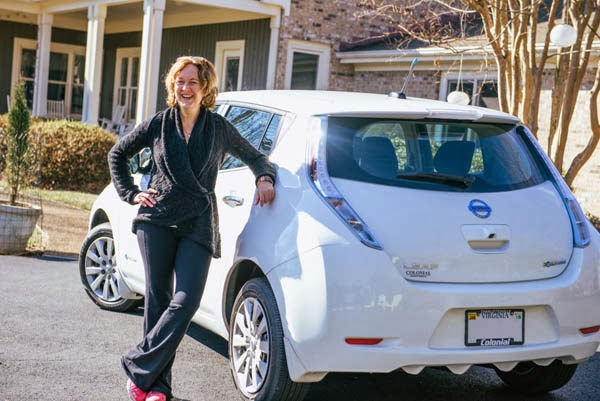
Amy Eichenberger of Charlottesville, Va., became the 99,999th global Nissan LEAF customer when she purchased her 100 percent electric vehicle at Colonial Nissan.
Amy, a 47-year-old mother of two, wasn't even in the market for a new car. Then she spotted a University of Virginia colleague's Nissan LEAF and decided she wanted to know more about the "modern-looking, futuristic and progressive" car.
"As an architect, the style first got my attention, and I loved the concept of zero emissions," Amy said. Amy is a project manager overseeing major capital investments for the University of Virginia in Charlottesville.
Nissan LEAF was the first car Amy test drove, and she loved the zip it had. A Mercedes driver for 10 years, Amy describes herself as "picky." Quality, safety, a "glide ride" and reliability were at the top of Amy's auto shopping list criteria.
She said she had a few initial reservations—primarily around range—so she tested out some gasoline and diesel competitors as well. "I'd been told once I drove a Mercedes I'd never drive anything else again. I don't need fancy, but I do appreciate the solid feel and craftsmanship of a luxury vehicle, and I get that in the LEAF," Amy said.
"The general fuel economy out there is unimpressive and many of them felt tin-canny. I didn't even want to look at anything in the 20 MPG range. I considered the VW Jetta TDI, Toyota Prius, Honda CRV and a couple of Subaru wagons, and I always came back to the Nissan LEAF. Everything else seemed stuck in the past," Amy explained.
Amy ultimately chose a LEAF S in Glacier White. Her commute is about 10 miles to the university each day and most of her errand-running is around the city—well under the LEAF's estimated range of 84 miles on a full charge.
"I have friends I like to visit in Richmond, which I can do in the LEAF with some planning, and in DC, which I'll do in my son's or boyfriend's car. LEAF will meet my needs 98 percent of the time, and I didn't want to let a little range anxiety prevent me from missing out on what I consider a much more progressive and forward-thinking vehicle than any of the alternatives."
Chris Crowley, the dedicated EV salesperson for Colonial Nissan, sold Amy her LEAF. He explained that LEAF buyers are not typical walk-ins. "LEAF buyers generally come in well educated about the vehicle, looking for even more information and wanting to see how it feels and drives. We spend a lot of time talking about driving habits to make sure it meets their needs and reviewing how very much it's like any other vehicle in its capabilities with the added benefit of no fuel bill. Folks like to be green, but you can talk to their pocket books as well," Chris said.
Chris has been with Colonial Nissan for two years and has been the lead EV person for most of that time. He's sold nine LEAFs total with three of those coming in the past three weeks. "LEAF sales have picked up because once we were selling to engineers who were fans of the car and knew exactly how it worked. Now we're selling to a much broader audience, and I think we've benefitted from a few folks who resolved to be greener in the new year."
Nissan LEAF launched in the United States in December 2010. The United States accounts for nearly half of the sales worldwide. The pace of LEAF sales has continued to accelerate. In 2013, Nissan sold 22,610 of the electric vehicles in the United States, more than twice as many as in 2012 and more than 2012 and 2011 Leaf sales combined.
Nissan LEAF traditionally has performed well on the West Coast with notable markets such as San Francisco, Los Angeles and Seattle, but now interest has expanded across the country. New hot markets have emerged such as Atlanta, which has been the No. 1 LEAF market for the past five months.
"With LEAF, we see a high level of organic growth and viral sales where LEAF owners become our best evangelists and salespeople. With electric vehicles, many folks presume a 100 percent electric vehicle won't meet their needs until they chat with a neighbor, co-worker or family friend who loves their LEAF and explain its practicality, and then it goes on their consideration list," said Erik Gottfried, Nissan's director of EV Sales and Marketing. "In fact, we're seeing similar results with the geographic dispersion of sales. With sales high in Atlanta, we now see other Georgia markets such as Macon and Columbus picking up significant momentum, similar to Eugene, Ore., following on the success of Portland."
Nissan LEAF is best-selling EV in history with 48 percent market share of the electric vehicle market globally. As of November 2013, Nissan LEAF drivers have completed an estimated 1 billion zero-emission kilometers, resulting in approximately 165 million kilograms of CO2 saved.
Nissan LEAF offers powerful acceleration, quiet operation, energy efficiency and low cost of maintenance. Nissan has extended the standard warranty for the battery-power holding capacity with its own additional warranty for customer satisfaction and assurance.
After leading the era of electrification in passenger vehicles with the LEAF, in 2014 Nissan will become the first to bring a mass-market all-electric light commercial vehicle to market. The e-NV200 will go on sale in Europe and Japan bringing the benefits of quiet, cost-efficient, zero-emissions mobility to businesses.
In June 2014, Nissan will participate in the 24 Hours of Le Mans with the NISSAN ZEOD RC and aims to set a record for the fastest all-electric, zero-emissions lap of the circuit. Nissan is committed to using the EV platform to break new ground in both the commercial-vehicle and motorsports arenas.


The 2014 Chevrolet Spark EV is the first vehicle in the US to offer DC Fast Charging using DC Fast Charging SAE Combo standard.
With this technology, you'll be able to charge your Spark EV to 80% in just 20 minutes.


We reported almost a year ago that Nissan were “really seriously testing” in-wheel electric motors for the new-generation of electric-powered cars. The automaker's global design chief Shiro Nakamura has again confirmed this during an interview with Motor Authority at the recent Detroit Auto Show.
“It's not just at the concept level...We are making serious progress with in-wheel motors; cost is becoming less of an issue, and at a certain point we would like to use in-wheel motors.”
While Nissan's BladeGlider EV concept has in-wheel motors on the rear axle, Nakamura admitted that Bladeglider has some design attributes (like its narrow front track) that might prove insurmountable for a global product—especially with respect to safety—and that any production car would likely have to be wider in front.
He suggests the ESFLOW EV concept, which from behind looks alot like the Bladegliber and at first glance could easily be mistaken for a 380Z, could be a production direction.
The ESFLOW concept presented at the 2011 Geneva Motor Show was said to have a cruising range on one charge of 240 kilometer (150 mile) and was rear-wheel drive powered by two motors that where placed above the axis of the rear wheels, in a mid-ship position.
These motors independently control the left and right wheels, and so the torque is optimized to ensure outstanding vehicle stability and control as well as efficient power regeneration. The motors produce enough torque in an instant for the ESFLOW to reach 100 kph in under 5 seconds.


The BMW i3 is the first car from the new "i" sub-brand for eco focused Beemers. Can an all-electric BMW car drive like a BMW? We find out.


