Next Generation Nissan Leaf to get 300 km range and new look

The next-generation Nissan Leaf will boast a more conventional hatchback look and an improved 300 km driving range, according to a report from Auto Express.

Nissan bosses are promising new battery technology is on the way, with better energy density for a more usable pure electric vehicle. A figure of about 186 miles (300 kilometres) is likely to be the target.

There’s a good chance Nissan will offer smaller battery packs with less range, like Tesla does with its 60kWh and 85kWh packs. The new battery technology and motor will be shared with Nissan’s luxury brand, Infiniti, too.

Source: AutoExpress

A ‘quick’ test drive in a Tesla Model S P85+

Earlier this week EV News had the pleasure of test driving a Tesla Model S P85+ around the streets of Sydney. It was only a very brief experience compared to the week long test drives we've had with most other EVs, but it was long enough to confirm Tesla Motors electric vehicles are in another league.

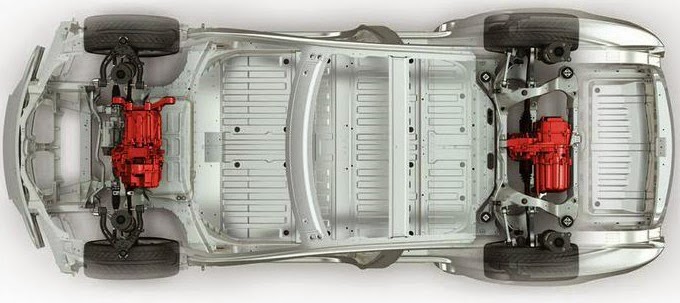
The first thing you notice about the Model S is that it's a big car. All dimensions including wheelbase and track are larger than a Holden Commodore VF. The upshot of this being the Model S has more interior storage space (1,796 L) than the Mitsubishi Outlander PHEV SUV we tested a few weeks ago. The overall size of the wheelbase seems governed by the size of the flat-pack battery enclosure which makes up 700 kg of the vehicles 2,100 kg kerb weight.

For such a heavy car the weight wasn't noticeable while driving, although the test route didn't allow for any high speed loaded cornering. In acceleration the P85 Model S is stunning! Unlike all other EVs I've driven which have synchronous BLDC permanent magnet motors, the asynchronous AC induction motor in the Model S really has a kick in the back off the line. So much so it might be a good idea for Tesla reps to wear a neck brace on test drives.

The BMW i3 I drove in Munich earlier this year was the fastest EV I had previously driven but full acceleration in the i3 didn't really come on strong until over approx 25 km/h. With 310 kw and 600 Nm peak torque from zero RPM from the 3 phase AC induction motor, the P85 Model S launches from a standing start to 100 km/h in just 4 seconds. That's faster than your average Porsche.

As with all EVs, mid-speed acceleration was impressive but with the Tesla, mind blowingly so! The main reason I've been so keen to sample a Model S was because my daily driver has 255 Kw / 500 Nm with a 1600 kg chassis, so on paper the two are broadly comparable. My 5.7 Lt 4 door sedan does 0-100 km/h in around 5 sec which is faster than both a standard Model S 85 (5.6s) the 60 version (6.2s). I've clocked up over 300,000 km in my current car so am fairly familiar with impressive acceleration, yet the Model S P85 absolutely kills it!

I've been trying to get my head around how the Tesla Model S P85's mid-speed acceleration felt twice as fast as my car. The Tesla's 600 Nm multiplied by the 9.73:1 reduction gear ratio gives 5,898 Nm at the rear wheels. Divide that by the 2,100 kg kerb weigh and the Model S has 2.8 Nm /kg. Running the same numbers for my Corvette engined family sedan gives 4,476 Nm (in first gear only) divided by 1,600 kg kerb weigh surprisingly gives the same 2.8 Nm/kg figure.

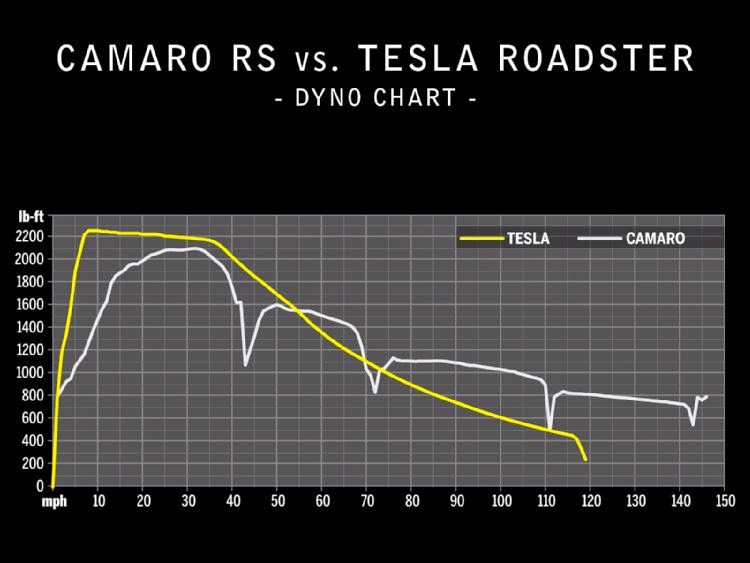
So why does the P85 feel twice as fast at mid speed? The 3 phase AC copper rotor induction motor's torque curve gives a flat 600 Nm between 0 and 5,000 rpm. Like with all EVs this broad torque curve allows the Tesla to have a single speed transmission. This means it's effectively in first gear all the time. So while my ICE powered car, even in 1st gear, doesn't reach peak torque until 4,400 rpm (although it has approx 80% of that from 1,500 rpm), cruising in top gear reduces maximum rear wheel torque to 'only' 1,500 Nm at mid-speeds. By comparison, the Tesla has approx 6,000 Nm available from standstill up to approx 70 km/h.

The bottom line is, at mid-speeds, the Tesla has up to 4x as much peak torque available at the flick of the throttle pedal compared to my ICE car and I can confirm, you can certainly feel the difference. The rep spotted the "Tesla grin" immediately. It's no surprise that Mercedes, Audi and BMW are already working on their own versions of the Model S. I don't think it's much of an exaggeration to say this car is revolutionary!

The Model S P85+ as driven was priced around $190k. A basic P85 option package with the full 310 kw / 600 Nm and 21" wheels is $130,600. Unfortunately luxury tax and other government charges add another $25k bringing the total cost to $155k in Australia.

(dyno torque curve from a Tesla Roadster - the Model S P85 has 2x more torque @ the wheels)

The global market for EV traction motors will be over $25 billion in 2025

The electric vehicle business will approach a massive $500 billion in 2025 with the traction motors being over $25 billion.

Their design, location and integration is changing rapidly. Traction motors propelling land, water and air vehicles along can consist of one inboard motor or - an increasing trend - more than one near the wheels, in the wheels, in the transmission or ganged to get extra power. Integrating is increasing with an increasing number of motor manufacturers making motors with integral controls and sometimes integral gearing. Alternatively they may sell motors to the vehicle manufacturers or to those integrating them into transmission.

In a new report from IDTechEx called "Electric Motors for Hybrid and Pure Electric Vehicles 2015-2025: Land, Water, Air" these complex trends are explained with pie charts, tables, graphs and text and future winning suppliers are identified alongside market forecasts. There are sections on newly important versions such as in-wheel, quadcopter and outboard motor for boats.

Today, with the interest in new traction motor design there is a surge in R&D activities in this area, much of it directed at specific needs such as electric aircraft needing superlative reliability and power to weight ratio. Hybrid vehicles may have the electric motor near the conventional engine or its exhaust and this may mean they need to tolerate temperatures never encountered in pure electric vehicles. Motors for highly price-sensitive markets such as electric bikes, scooters, e-rickshaws and micro EVs (car-like vehicles not homologated as cars so made more primitively) should avoid the price hikes of neodymium and other rare earths in the magnets. In-wheel and near-wheel motors in any vehicle need to be very compact. Sometimes they must be disc-shaped to fit in.

However, fairly common requirements can be high energy efficiency and cost-effectiveness, high torque (3-4 times nominal value) for acceleration and hill climbing and peak power twice the rated value at high speeds. Wide operating torque range is a common and onerous requirement. Overall energy saving over the drive cycle is typically critical. Usually winding and magnet temperature must be kept below 120C and then there are issues of demagnetisation and mechanical strength.

BMW Formula E course cars to be equipped with Qualcomm wireless charging

The all-electric FIA Formula E Championship has today confirmed that its course cars for the inaugural season will be fitted with Qualcomm Halo™ wireless charging technology – an inductive charging system which allows the car’s battery to be charged without the use of cables.

With the final specification of car set to be announced shortly, the championship’s technical team took advantage of today’s final test at Donington Park to trial two BMW i8 and two BMW i3 models with the aim to evaluate them for the series’ official course cars. Earlier this year, the German marque was part of the Global Launch event of the Formula E in London.

All four BMWs have been specifically modified to meet FIA requirements, with one of the BMW i3 models featuring an inductive charging system from Qualcomm Incorporated (NASDAQ: QCOM), with the remaining three vehicles set to be adapted at a later stage. The technology has been developed by San Diego-based Qualcomm Incorporated, one of the official Founding and Technology Partners of the series and a global leader in 3G, 4G and next-generation wireless technologies. The Qualcomm Halo™ technology uses resonant magnetic induction to transfer energy between a ground-based pad and a charging pad fitted to the underside of the vehicle. The cars can then simply park over the base pad for charging to start automatically.

The chosen safety car – which will be officially entitled the Qualcomm Safety Car - will be driven by experienced driver Bruno Correia, whilst the medical and extraction cars will be overseen by FIA Medical Delegate Dr Phil Rayner and his team. The cars will be positioned at the end of the pitlane, charging wirelessly and ready to be rapidly deployed as required during each practice, qualifying and race.

Steve Pazol, GM, Wireless Charging at Qualcomm Incorporated, said: “Qualcomm is honoured to be an integral part of FIA’s Formula E Championship. As electric vehicles become more ubiquitous, charging them wirelessly is an obvious next step in the EV evolution and we are excited to showcase this in Formula E. Motorsport is a known proving ground for new technologies, and in addition to our wireless EV charging technology, Qualcomm will be bringing more of its technologies to bear as the series goes forward.” Alejandro Agag, CEO of Formula E, said: “Qualcomm’s wireless charging system is ground-breaking technology and represents an exciting evolution for charging electric vehicles. Wireless charging has the potential to radically improve the electric vehicle driver experience and Formula E provides the perfect platform in which to develop, test and showcase this exciting new technology.”

Formula E is the FIA’s new fully-electric single-seater championship designed to appeal to a new generation of motorsport fans, whilst accelerating the interest in electric vehicles and promoting sustainability. Competing entirely on city-centre circuits – with races also in China, Malaysia, Uruguay, USA, Monaco, Germany and the UK – it uses cars capable of speeds in excess of 150mph (225kph). Its 10 teams and 20 drivers feature some of the leading international names in motorsport including Alain Prost and Michael Andretti, along with high-profile environmental supporters including Sir Richard Branson.

WORLD FIRST: Electric Racer beats field of petrol powered cars.. twice

With less than 4 weeks to go until the inaugural FIA Formula E race in Beijing China, an electric race car in Australia has already made history.

In what is believed to be a world first, a battery powered Radical SR8 entered by ELMOFO in the NSW SuperSports State Championship has become the first electric car to win a race against petrol vehicles in a sanctioned race event. To prove it was no fluke, it won twice!

Not only did the EV win two of the three races comprising round four of the championship, held 17th August at Wakefield Park Raceway, the ELMOFO Radical, driven by Garth Walden, also set the fastest lap time for the entire meeting (57.6870 sec) beating all other categories which included Formula 3 and Sports Sedans.

The ELMOFO Radical is similar in concept to the current Nürburgring EV lap record, the TMG EV P001 built by Toyota Motorsport GmbH and the TMG EV P002 modified by TOYOTA Racing Development U.S.A. to tackle Pikes Peak in 2013.

The race winning electric Radical SREV was built by Newcastle based Solar PV systems firm Solar Power Australia. The car delivers 280 kw (375 hp) and 570 Nm (428 ft-lbs) of torque almost instantly from its twin sequential BLDC motors. Power is controlled by dual Rinehart Motion Systems inverters which are fed voltage from a 37 kWh lithium ion battery pack controlled by a Batrium BMS. Power is transmitted to the rear wheels via a single speed limited slip differential. Performance specs for the all-electric racer, built on a Radical SR8 chassis, include 0 to 100 km/h (62 mph) in 3.5 seconds, 0 to 160 km/h (100 mph) in 6.5 seconds with a top speed of 265 km/h (165 mph).

The 2014 CAMS NSW SuperSports Championship is mostly a one-make series for Radicals, with a couple of Stohr WF1 single seaters also contesting the series. The ELFOMO team have worked hard over the previous three rounds to debug the car and the wins are a just reward for achieving solid reliability. Since the beginning of the season the car has demonstrated it had raw speed by routinely qualifying on the front row of the grid. In only round 4 of the championship the battery powered racer dominated from the front with Walden blasting well ahead of the pack for the first 4 or 5 laps and then backing off a little to preserve the car.

The ELMOFO team would like to thank Rinehart Motion Systems, AM Racing, Batrium, Garth Walden Racing, Royal Purple and the Supersports Racecar Club Committee who have been very supportive of the car, scheduling some races of a length that the battery powered vehicle could complete to ensure it’s inclusion in the series.

Silicon Valley startup Renovo Motors unveil $529,000 EV supercar [VIDEO]

When they started their company in 2010, the founders of Silicon Valley startup Renovo Motors saw a hole in the market for a pure electric supercar.

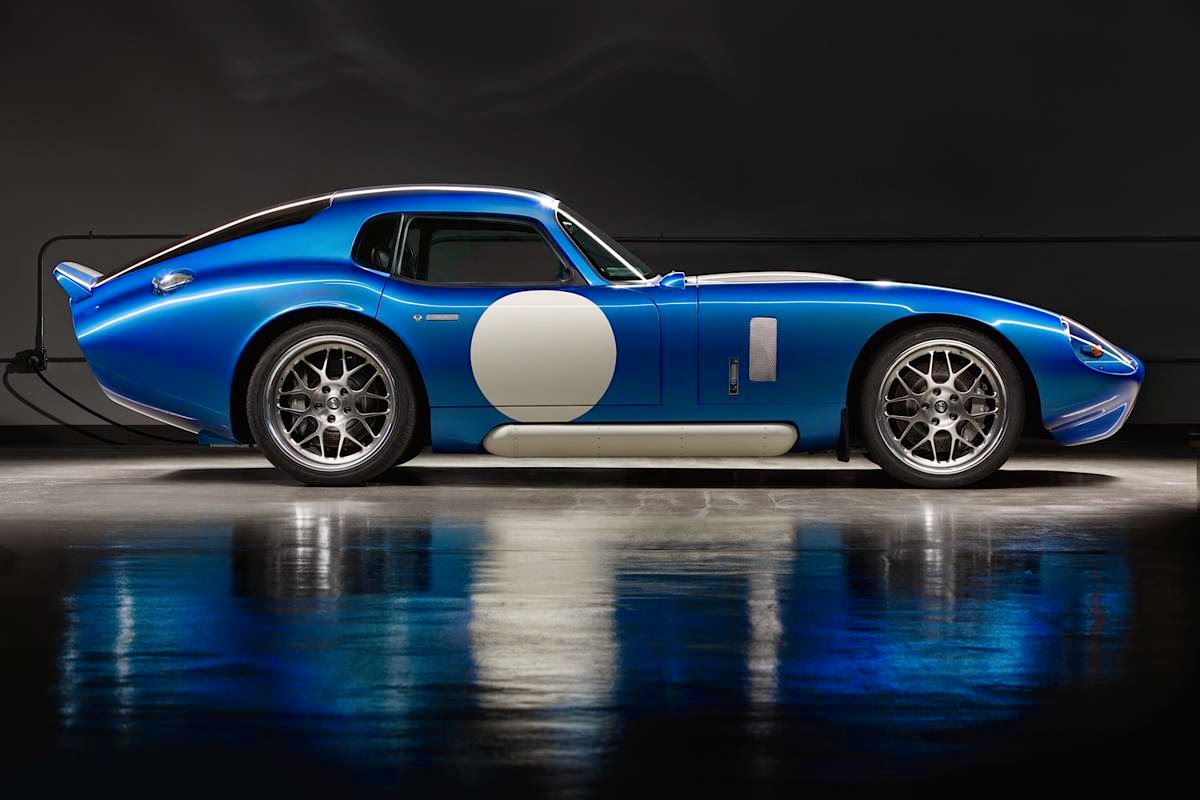
Today they revealed their first product, the $529,000 Renovo Coupe, scheduled to launch in the United States next year.

Performance specs for the all-electric two-seater, built on the Shelby CSX9000 chassis, include 0 to 60 mph in 3.4 seconds, with a top speed of 120 mph. The company says the car will deliver 370 kw (500 hp) and 1,356 Nm (1,000 ft-lbs) of torque almost instantly from its twin sequential axial flux motors. Power is controlled by dual RMS inverters which are fed high-voltage from a 740 volt lithium ion battery pack, with output power transmitted to the rear wheels via a single speed differential.

After developing the car in secrecy for the past four years, Renovo launched the running prototype last weekend at the Pebble Beach Concours d’Elegance. The company plans to begin taking orders for a production run of less than 100 cars, with the first cars due to be delivered in California next year.

Renovo’s founders, Christopher Heiser and Jason Stinson, previously worked at the computer security company Verisign and chipmaker Intel. Though they are new to the industry, they hope to find space in the supercar market alongside venerable names such Ferrari and Lamborghini, and relative newcomers such as Pagani and Koenigsegg.

Though many luxury brands and exotic car companies are starting to offer plug-in hybrids and pure EVs, including Ferrari and McLaren with their LaFerrari and P1, Heiser said in an interview Thursday that no one offers a product like the Renovo Coupe. That includes their Silicon Valley neighbor and inspiration of sorts, Tesla Motors Inc., which stopped selling its Roadster sports car in 2012.

Source: Renovo Motors

Tesla Model S Drive Unit now has Infinite Mile Warranty

Following recent negative reports about Tesla Model S drive unit reliability, Tesla has increased the Model S drive unit warranty to match that of the battery pack. That means the 85 kWh Model S, the most popular model by far, now has an 8 year, infinite mile warranty on both the battery pack and drive unit. There is also no limit on the number of owners during the warranty period. Moreover, the warranty extension will apply retroactively to all Model S vehicles ever produced.

The drive unit is now covered under the same provisions as the existing battery warranty, so owners with an 85 kWh battery will benefit from eight years of coverage with no mileage restrictions, while 60 kWh owners have up to 125,000 miles.

The drive unit issue, described as a grinding or “milling” noise that increases over time, was picked up by Motor Trend Magazine who reported that they had to have a drive unit replaced in their Model S. The issue really hit the headlines when Edmunds reported they are on their 4th drive train.

Tesla had transmission issues with the Roadster. The two-speed transmission designed for the Roadster by a previous supplier proved not to be durable so in 2008 Tesla Motors selected BorgWarner for the production of a single-speed gearbox.

The source of the current 9.73:1 Model S gearbox is not known. Anecdotal evidence suggests the Borg Warner eGearDrives supplied for the the Ford eTransit Connect has quite a high failure rate but as the Model S transmission casting is integrated with the AC Induction motor enclosure and without knowing which component has suffered premature wear, it's too early to attribute blame for the design fault.

When you take into consideration how common transmission failures are within the automotive industry and how high performance the Tesla Model S is, it's not so surprising to find the powertrain needs some mechanical debugging. For example, Subaru have been making the Impresa WRX since 1992 and after two decades in production they're still prone to transmission failure. The only sure way to avoid mechanical transmission issues is to not have one by using direct drive wheel motors.

The standard warranty for Tesla Model S is 4 year, 50,000 mile (80,000 km). In April last year Tesla announced an unlimited "no-fault" battery warranty. Elon Musk says that in hindsight, the infinite warranty should have been policy for the powertrain from the beginning of the Model S program. If they truly believe that electric motors are fundamentally more reliable than gasoline engines, with far fewer moving parts and no oily residue or combustion byproducts to gum up the works, then the warranty policy should reflect that.

Smart electric drive drag race [VIDEO]

The smart fortwo electric drive is a champion of urban mobility. But is it a champion of the drag strip? Against some of the fastest cars in the city?!

Remember, in urban driving top speed means nothing, it's the first 5 meters that count!

Silicon Carbide Power Electronics Can Slash $6,000 From Cost of Tesla Model S

Wide bandgap (WBG) materials such as silicon carbide (SiC) and gallium nitride (GaN) are best positioned to address emerging power electronics performance needs in electric vehicles (EVs), with SiC displacing silicon as early as 2020, according to Lux Research.

As silicon struggles to meet higher performance standards, WBG materials are benefiting critically from evolving battery economics. On Tesla Model S, for example, a 20% power savings can result in gains of over $6,000 in battery cost, or 8% of the vehicle's cost.

"Efficient power electronics is key to a smaller battery size, which in turn has a positive cascading impact on wiring, thermal management, packaging, and weight of electric vehicles," said Pallavi Madakasira, Lux Research Analyst and the lead author of the report titled, "Silicon vs. WBG: Demystifying Prospects of GaN and SiC in the Electrified Vehicle Market."

"In addition to power electronic modules, opportunities from a growing number of consumer applications -- such as infotainment and screens -- will double the number of power electronic components built into a vehicle," she added.

Lux Research analysts evaluated system-level benefits WBG materials are bringing to the automotive industry, and predicted a timeline for commercial roll-outs of WBG-based power electronics. Among their findings:

  • Power saving threshold lower for EVs. At 2% power savings, if battery costs fall below $250/kWh, SiC diodes will be the only economic solution in EVs requiring a large battery, such as the Tesla Model S. However, for plug-in electric vehicles (PHEVs), the threshold power savings needs to be a higher 5%.

  • SiC ahead in road to commercialization. SiC diodes lead GaN in technology readiness and will attain commercialization sooner, based on the current Technology Readiness Level (TRL). Based on the TRL road map, SiC diodes will be adopted in vehicles by 2020.

  • Government funding is driving WBG adoption. The U.S., Japan and the United Kingdom, among others, are funding research and development in power electronics. The U.S. Department of Energy's Advanced Power Electronics and Electric Motors is spending $69 million this year and defining performance and cost targets; the Japanese government funds a joint industry and university R&D program that includes Toyota, Honda and Nissan.
  • New Tesla Roadster coming in 2017

    According to a recent report, Tesla could launch up to four new models by 2018.

    While we already know about the Model X and the Model 3, Autobild is reporting the company is considering a compact city car.

    Little is known about the vehicle - which has been dubbed the Model C - but it would be smaller and more affordable than the Model 3 which is expected to cost approximately $35,000.

    The magazine goes says a new roadster - dubbed Model R - could arrive in 2017. This seems to contradict statements from Tesla CEO Elon Musk who has previously said an all-new Roadster is at least five years off. However, the wait could be worth it as Tesla's vice president of sales, George Blankenship, has previously suggested it could accelerate from 0-60 mph in less than four seconds and have a range in excess of 200 miles (322 km).

    Nissan, Mitsubishi to launch low-cost electric car by 2016

    Nissan Motor and Mitsubishi Motors will work together to develop a minicar-based electric vehicle, aiming to release a new model in fiscal 2016 at the lowest price among major automakers.

    The carmakers have set up a 50-50 joint venture to pursue development.

    Nissan, which released the Leaf electric car in 2010, is the world's largest manufacturer of electric vehicles, with global sales of at least 124,000 units. Mitsubishi has a track record in this area as well, including the minicar-based i-MiEV released in 2009. They plan to co-produce the new car and work together to procure such key components as lithium-ion batteries.

    The i-MiEV is the cheapest electric passenger car on the Japanese market, starting at $26,440. When government subsidies of up to $7,760 are included, it can be purchased for as little as $18,680.

    By basing the new EV on a minicar, Nissan and Mitsubishi expect to sell it for around $15,000 including subsidies, the lowest price among major automakers and similar to gas-fueled compacts.

    Audi planning to challenge Tesla with 500-700 km range EVs

    Audi this week proudly launched their first plug-in hybrid, the A3 Sportback e-tron, a full 17 years after the Prius.

    Auto Bild has revealed Audi plans to catch-up with the competition in automotive electrification with two purely electric Audi SUV, the A2Q and Q6 expected around 2017/18.

    A2Q with up to 500 km electric range

    If the expected advances in battery technology are true, the compact A2Q, expected in 2016, will have 500 km battery range. Seen as a competitor against BMW's i3, Audi will not develop a completely new electric platform but uses the familiar MQB modular architecture of Golf/A3.

    Audi Q6 as Tesla competitor

    The Q6, internally designated within Audi as the Tesla Fighter, is expected to be a coupe-like offshoot of the Q5 and come with 700 km battery range with a launch date around 2017. A larger battery powered Q7/8 is also expected around 2017.

    VW & Bosch working on automated park-and-charge systems for EVs [VIDEO]

    There are only a few minutes before your flight check-in closes, or before your train departs, but you now have to spend precious time hunting for a free space at the airport or station car park. Imagine leaving your vehicle at the main entrance and letting the car do the rest on its own. Researchers from Germany, Italy, the UK and Switzerland are working on this, and successful tests took place at Stuttgart airport earlier this year. €5.6 million of EU funding is invested in the system which will be available in the coming years.

    In the future, more and more people will drive electric cars and will switch from one mode of transport to another – creating the need for more and varied parking options at transport hubs. To prepare for this mobility shift, the V-CHARGE consortium is working on a fully automated parking and charging system for electric cars at public car parks.

    "The idea is that we can actually use technology to give people a better mix of public and private transport", explains Dr Paul Furgale, scientific project manager for V-CHARGE and deputy director of the autonomous systems lab at the Swiss Federal Institute of Technology in Zurich.

    A smartphone app to leave and get back the car

    Drivers will be able to leave their car in front of the car park and use a smartphone app to trigger the parking process. The vehicle will connect with the car park’s server and drive itself to the designated space. While in the garage, the car can also be programmed to go to a charging station. Upon returning, the driver uses the same app to summon the car – fully charged and ready to go.

    Since GPS satellite signals don’t always work inside garages, the scientists have developed a camera-based system based on their expertise in robotics and environment sensing. Safety is at the centre of the project: the car is designed to avoid unexpected obstacles.

    Dr Furgale believes the same technology could be used to develop autonomous parking systems for electric cars on city streets. "That will be more of a challenge", he says. "But once you have the maps in place, the rest of the technology will come together."

    A system to be integrated into production

    In April, the team presented the latest version of the system at Stuttgart airport. This was a success and the researchers are now fine-tuning the technology to tackle more precise manoeuvres and ensure reliability, even in difficult weather conditions.

    The project is set to conclude in 2015, and its results available to be progressively commercialised in the coming years. The functions developed should be cost-effective enough to be integrated into production of electric vehicles. Engineers are working with equipment that is already available today such as ultrasonic sensors and stereo cameras that are used in parking assistance and emergency braking systems.

    BMW i3 Parks Itself without any Driver Input [VIDEO]

    The BMW i3 has an interesting function available as a $1,000 optional extra: Parking Assistant.

    This system allows your car to park itself without your input. It uses a sonar installed in the right side of the car that detects large enough parking spaces when you want it to. After that, all you have to do is stop and keep the parking assist button pressed and the i3 will do everything for you.

    That’s what a crew of journalists from Romania did when BMW invited them over in Austria to try out the new electric car from Munich. However, there’s a twist: this time, no driver was inside the car while the operation was done.

    The man hopping out of the moving i3 is Vali Porcisteanu, a Romanian rally driver. He somehow meddled with the control button and made it stick while he left the ‘premises’.

    The end result is both quite impressive and funny at the same time, seeing the car do all the work by itself, with no one inside.

    GM and LG working on Tesla Model 3 competitor with 200 mile range

    LG Chem CFO Cho Suk-jeh has revealed the company will supply an automaker with a battery that will allow one of their models to travel more than 200 miles (320 km) on a single charge. Suk-jeh declined to say which automaker will use the battery but all indications are pointing to General Motors.

    General Motors executives have said that the automaker is working on an EV that will deliver at least 200 miles of range. The automaker, manufacturer of the Chevrolet Volt, has said it hopes to have the longer-range EV in the market in 2016 to compete with the anticipated Tesla Model III, now scheduled for introduction in late 2016 or early 2017.

    LG Chem presently supplies lithium-ion batteries to GM, Ford, Hyundai, Kia, Volvo and Renault, among others.

    Doug Parks, GM’s vice president for product development, said in an interview last year that General Motors plans to offer an EV with at least 200 miles of range for a price of around $30,000. That's the target all the major automakers are aiming at for their next-generation electric vehicles, he said.

    GM invested $7 million in Battery Start-up Envia Systems in 2011. Unfortunatley the promised 'world record' 400 Watt-­‐ hours/kilogram (Wh/kg) energy density only lasted a few cycles leaving GM to search for more legitimate battery technology partners.

    General Motors and LG Group agreed in 2011 to jointly design and engineer future electric vehicles, expanding a relationship built on LG’s work as the battery cell supplier for the Chevrolet Volt and Opel Ampera extended-range EVs.

    All-electric Kia Soul EV test drive in Seoul

    Kia have uploaded yet another promo video for the Soul EV.

    The Soul EV will is propelled by a liquid-cooled AC synchronous permanent magnet electric motor rated for 109 horsepower and 210 lb-ft of torque. Like most electrics, the motor sends power to the front wheels via a single-speed constant-ratio transmission.

    A 96-cell, 27-kWh lithium-ion polymer battery feeds the motor. It lives under the Soul’s floor, and takes a small bite out of rear seat legroom, which shrinks from 39.1 to 36.0 inches. The standard 120-volt charger, which stows under the cargo floor, takes a bigger bite out of luggage capacity, down 5.1 cubic feet to 19.1.

    The Soul EV can be charged to 80% in as little as 33 minutes using a 50-kW system, and the Soul EV is fitted with three charging ports. Two of the ports are for conventional AC charging, per SAE standard J1772, and the third for CHAdeMo public stations.

    Deliveries began in South Korea in May 2014 with EU and US to follow in the second half of the year. With 200 km range and a price in the $30k range it looks like a solid addition to the EV market.

    QUANT e-Sportlimousine with nanoFLOWCELL drive [VIDEO]

    nanoFLOWCELL AG introduced their QUANT e-Sportlimousine concept at the Geneva Motor Show earlier this year and the company has just announced the car has been approved for road use in Europe.

    The company says this is a critical step because they are "working at top speed" on a production version. nanoFLOWCELL AG chief technical officer Nunzio La Vecchia went on to say "This is a historic moment and a milestone not only for our company but perhaps even for the electro-mobility of the future. For the first time an automobile featuring flow-cell electric drive technology will appear on Germany's roads."

    The heart of the QUANT e-Sportlimousine prototype is the nanoFLOWCELL® battery. It gives the car a driving range of 600 kilometres. The newest product moving the world towards attractive electrical mobility was conceived at the nanoFLOWCELL DigiLab simulation lab at nanoFLOWCELL AG in Zurich, Switzerland. It is still under active development and the results so far are extremely promising.

    Drivetrain:

    All-wheel drive via 4 three-phase induction motors, torque vectoring for optimal drive torque distribution
    Peak power: 680 KW (925 PS); 170 KW (231.2 PS) x 4
    Operating power: 480 KW (653 PS); 120 KW (163.2 PS) x 4

    nanoFLOWCELL:

    nominal voltage: 600 V
    nominal current: 50 A
    tank capacity: 2 x 200 L

    Performance:

    0 - 100 KM/H: 2.8 S
    top speed: 380 + KM/H
    range: projected 400 to 600 KM
    energy consumption: 20 KWH/100 KM

    Dimensions and weight:

    kerb weight with full tanks: 2,300 KG
    wheelbase: 3,198 MM