Tesla Battery Pack – Tear Down [VIDEO]

The eSamba project have acquired a Tesla battery pack to reverse engineer &/or use in the VW Samba Bus EV conversion.

Jehu Garcia's eSamba project is part of a 30-odd episode YouTube series where Jehu has recently experimented with building his own 18650 Lithium Ion battery packs. In this weeks episode the guys tear down a battery pack manufactured by Tesla Motors. It's not clear which vehicle the Tesla battery pack was removed from other than to say the car in question had done approx 5,000 miles.

After a bit of disassembly the Tesla 18650 based modules should give the eSamba project a few new ideas.

Renault all-electric truck hits Paris

As part of its research into goods transport based on sustainable development, Renault Trucks and Guerlain are currently testing an experimental all-electric vehicle operated by Speed Distribution Logistique. This 16 t vehicle will be delivering supplies to Maison de Parfums & Cosmétiques boutiques in Paris over the next two years. It generates no polluting emissions or noise nuisance and will be tested on regular, demanding delivery rounds of over 200 km.

Committed for many years to the principles of sustainable development, Guerlain and the Paris region carrier Speed Distribution Logistique have joined forces with Renault Trucks to test a 16 t all-electric experimental vehicle under actual operating conditions: the 100% electrically-driven Renault Trucks D.

This truck will be carrying out daily deliveries to the Guerlain boutiques in Paris from its distribution centre, covering over 200 km. To operate over such a long route, a first for any electrically-driven vehicle, the Renault Trucks D all-electric will recharge its battery several times during each 24 hour operating cycle. Its route has been planned so that it can carry out two partial recharges during the day and a total recharge between 7 PM and 2 AM.

“The initial tests we’ve carried out using this technology under real operating conditions with our customers have been very satisfying,” explains Christophe Vacquier, Renault Trucks’ project manager. “We are now going further with Guerlain and Speed Distribution Logistique, using the vehicle on 200 km rounds which gives us confidence in the future of this technology.”

The test is scheduled to run until the end of 2015. A full appraisal will then be carried out and added to Renault Trucks’ expertise in the field of electrically-driven medium tonnage vehicles and its customers’ requirements. This will then be used to determine the direction future research will take.

For Alexandre Oulès, director of operations and Philippe Bernard, logistics manager at Guerlain, becoming jointly involved in this unique programme was an obvious choice. For Guerlain has made sustainable development part of its strategy for more than seven years, focused on six major challenges which include a determination to reduce the level of CO2 emissions generated by goods transport. It was also an opportunity to work with Renault Trucks and Speed Distribution Logistique on an innovative project, based on a joint commitment to protect the environment.

Marc Bachini, Speed Distribution Logistique’s founder explains why his company has become involved in this project: “Based on my own convictions, I defined an economic model that respects people and their environment. After having invested in all-electric Renault Maxity delivery vehicles in 2013, this civically-responsible approach naturally led me to pursue this path and incorporate an experimental 16 t all-electric vehicle to be used for warehouse collection. This enabled me to offer Guerlain, a pace-setting company in sustainable development, a totally emission-free delivery cycle.”

The Renault Trucks D all electric: technical characteristics

-GVW: 16.3 tonnes
-Payload: approx.6 tonnes
-Wheelbase: 4,700 mm
-Motor: 103 kW / 400 V LQ 160P asynchronous electric
-Gearbox: ZF 6S800 TSO, manual automated by air activators
-Batteries: 2 Lithium-ion battery packs with a total charge of 170 kWh (battery weight: 2 tonnes)
-Battery recharge: Mains 380 V/64A outlet and braking energy recovery
-Full charging time: approx. 7h
-Operating range: 120 km (without partial recharge)

Tesla’s $35,000 car will be called the Model 3

In an interview with AutoExpress, CEO Elon Musk revealed that the $35,000 vehicle will be called the Model 3 (with three bars to represent it), after Ford put the kibosh on calling it the Model E.

“We were going to call it model E for a while and then Ford sued us saying it wanted to use the Model E".

Musk has repeatedly targeted 2017 as the release window for a smaller vehicle. He's said it will be the third generation after the original Roadster and Model S, and in the interview claims it will have a range of over 200 miles per charge, probably using batteries built in Tesla's planned Gigafactory.

Musk also told the magazine about a range boost upgrade coming for the original Roadster that will give it a modern battery capable of up to 400 miles on a charge, "which will allow you to drive from LA to San Francisco non-stop."

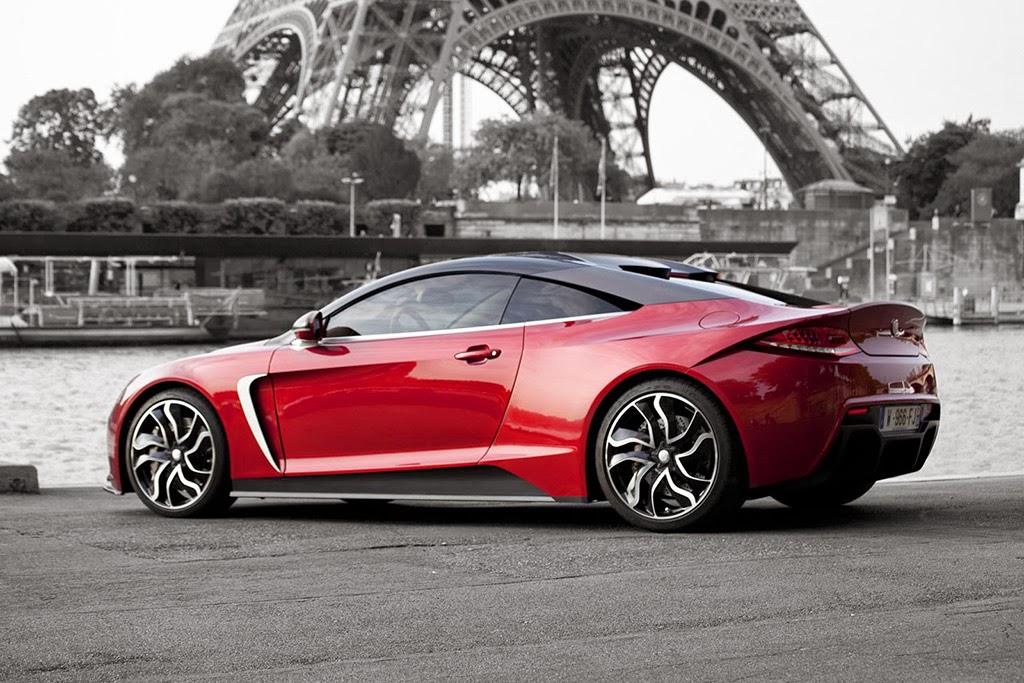
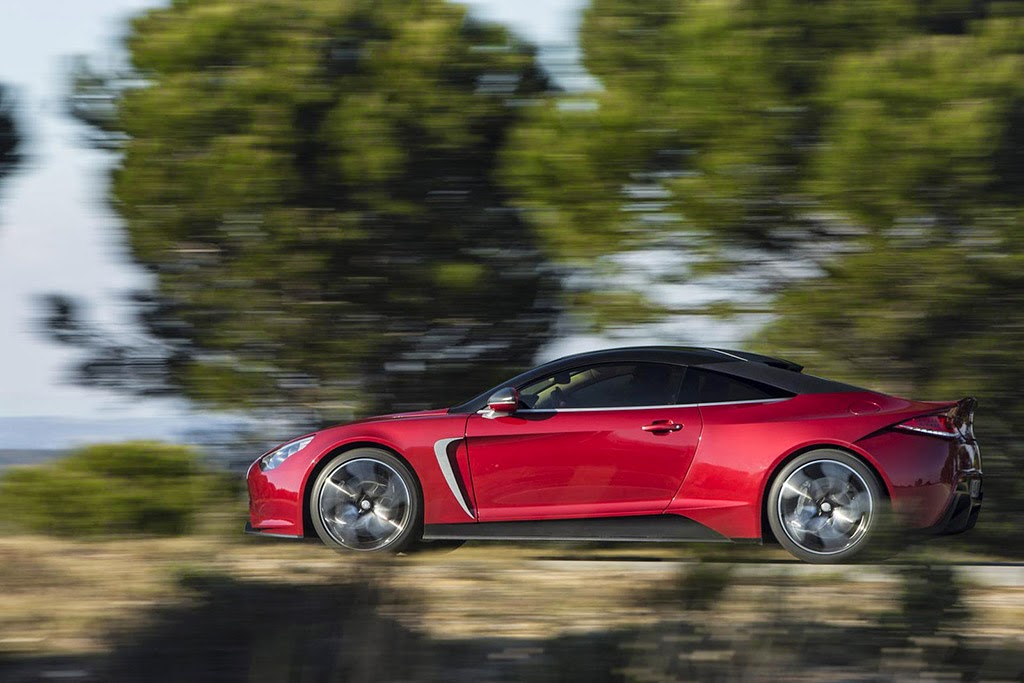
Exagon Furtive-eGT electric supercar ready for production

The Furtive-eGT has been around in concept form since 2010 and a few may even have been delivered, but now Exagon appears ready to go into serial production.

The Exagon Furtive eGT electric supercar is powered by a pair of 300 kW Siemens electric motors that combined have the potential to deliver up to 600 kW / 516 Nm, the car is exceptionally rapid. Power is transferred to the rear wheels and Exagon says throttle response is virtually instantaneous, delivering a 0-100km/h sprint of just 3.5 seconds, faster than a Tesla Roadster.

The car has a top speed of 250km/h and the electric motors are energised by a hefty 53kWh lithium-ion battery which provides a range of around 300km but Exagon will option a small range-extender engine to charge the batteries on the run, which gives the car a theoretical 730km range.

The Exagon Furtive eGT has four seats and features a monocoque light carbon fiber body, which weighs an astonishingly low 124 kg. The manufacturer is also offering a wide selection of personalization options, while the price and availability are set to be announced at a later date.

Tesla Model S P85 Dyno Run gets 436 HP @ the wheels [VIDEO]

Tesla owner Emmanuel Chang had his 2013 Black Tesla Model S P85 dyno tested on a mobile CCMR Dynojet recently at some generic car show.

The Model S P85 is officially rated 416 HP at the motor shaft. This particular combination of dyno and P85 recorded 436 HP at the wheels. (there is usually a significant drivetrain loss between motor and wheels)

A few details regarding this test:

  • 1) The tech couldn't attach a sensor to the motor's crank so "engine rpm" has to be recalculated as he took the wheel RPM (so multiply the RPM by 1000, then by 9.71 *approx*)

  • 2) The dyno maxed out at 2000 lbs·ft but math from the specs indicates 4301 lbs·ft at the wheels.

  • 3) Horsepower and torque number are inaccurate as the car smoked the tires on the dyno's drum so the wheels were not spinning 1:1 for the computer to measure accurately, basically it has slightly more power than what the computer thinks it has.

    Source: TMC

  • Record Breaking Mitsubishi Electric Vehicle Run at Pikes Peak [VIDEO]

    Record Breaking Mitsubishi Electric Vehicle Run at Pikes Peak by Greg Tracy.

    Tracy climbed Pikes Peak in the Mitsubishi I-MiEV Evolution III and shatters Monster Tajima's 2013 Electric Modified Class record by 38 seconds with a 09.08.188 record time.

    Greg Tracy came in 2nd overall beating everyone in the competition except for overall winner Romain Dumas in his Honda powered 2013 Norm racer.

    BMW, Daimler Jointly Developing Wireless Inductive Charging Standard

    Driving pleasure and sustainability are fused together in unprecedented fashion in the all-electric BMW i3 and the BMW i8 plug-in hybrid sports car. Their high-voltage batteries can be recharged quickly and easily by means of the BMW i Wallbox that forms part of the 360° ELECTRIC portfolio. This sophisticated charging station with fast-charge facility for feeding cars with power either at home or at work underlines the all-embracing approach adopted by the BMW i brand when it comes to developing products and services for sustainable mobility of premium calibre.

    In the process, the BMW Group has assumed a pioneering role in this field and is therefore pressing keenly ahead with the development of innovative technologies for making driving with zero tailpipe emissions more and more attractive. Systems for inductive charging of high-voltage batteries are the next step forward for energy supply. The development objective in the medium term is to put reliable, non-wearing and user-friendly solutions for inductive charging into production that have been tailored to both the batteries in the BMW i cars and the high-voltage batteries in future plug-in hybrid models from the BMW Group.

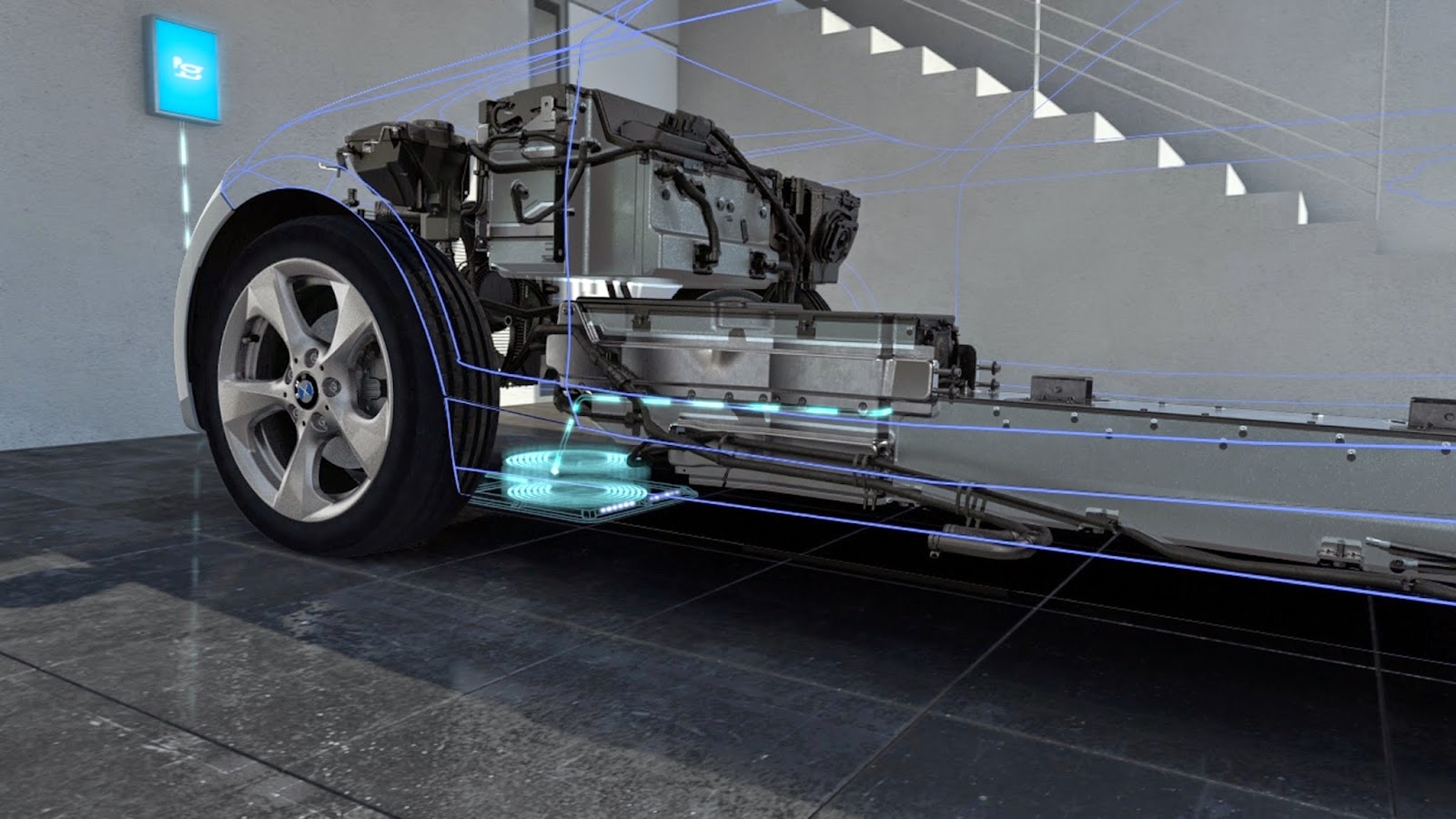
    The crucial advantage of inductive power supply over conventional charging stations is the cable-free connection between the supply point and the vehicle’s high-voltage battery. Carmakers Daimler and the BMW Group have signed an agreement on the joint development and implementation of a standardised technology for inductive charging of electric cars and plug-in hybrid vehicles. The system consists of two components: a secondary coil in the vehicle floor as well as a base plate with integral primary coil that is located underneath the car, for example on the garage floor. The arrangement of the coils, and consequently of the field pattern, is based on a design derived from their circular shape that offers a number of crucial benefits.

    These include the extremely compact and lightweight construction along with effective spatial confinement of the magnetic field. The electrical energy is transmitted via an alternating magnetic field generated between the coils, contact-free, without charging cables and at a charging rate of 3.6 kW. With an efficiency factor of over 90 percent, this method enables the high-voltage batteries in vehicles to be charged efficiently, conveniently and safely.

    A further development target is to minimise the charging time for contactless power transmission. At a charging rate of 3.6 kilowatts, the high-voltage batteries in many plug-in hybrid vehicles can be fully charged in under three hours. It takes less than two hours to charge the BMW i8 using a fully working prototype of an inductive charging station. In order to make allowance for the higher storage capacities of high-voltage batteries in pure-electric vehicles, the future technology standard also foresees the possibility of increasing the charging rate to 7 kW. This ensures that the battery in the BMW i3 could still be fully charged overnight when using the inductive system.

    Inductive charging makes life considerably easier for the driver of an electric or plug-in hybrid vehicle, as there is no need to connect any cables to top up the power reserves. Once it has been correctly positioned above the primary coil, the driver can simply start the charging process at the push of a button using the vehicle’s own operating system. Data is transmitted via a WiFi connection between vehicle and charging station to help the driver even with parking.

    The inductive charging facility can be used regardless of the weather conditions. Not even rain or snow has a negative effect on the power feed as all of the system’s conductive components are protected, which means the primary coil can even be installed outdoors. During charging, ambient electromagnetic radiation is also kept to an absolute minimum. The space between the primary and secondary coils is permanently monitored, allowing charging to be halted instantly if any foreign bodies are detected.

    As with today’s BMW i Wallbox, the inductive power supply systems of the future will also make it possible to activate and monitor the charging process from a smartphone. The relevant smartphone app will let drivers call up the data transmitted online on the battery’s charge status, for instance, or the time remaining until charging is complete.

    TESLA P85 Vs Electric MIATA – 1/4 mile Drag Race [VIDEO]

    A Tesla Model S P85 takes on an Mazda Miata with an Electric Motor Conversion in a 1/4 mile drag race.

    The tube frame and tubbed 2002 Mazda Miata runs 2x 2000 amp Zilla 2K-EHV controllers feeding dual brushed DC NetGain 9-inch motors, a Lenco 2 speed and double GV overdrive.

    The boot mounted battery pack contains 450x LiPo 100C RC car batteries wired 90S5P that are good for 775 peak battery HP @ 375v. For the record run the controllers were set to 170 volt & 1100 amps per motor.

    The Miata runs an incredible 9.27 @ 142 mph to the Tesla's very respectable 12.72 @ 102 mph.

    Telsa Model E To Rival BMW 3 Series On Price

    New Model E from Tesla will look to take on the BMW 3-series and Audi A4.

    The Tesla Model E is expected to go on sale in 2016. The car’s manufacturer said that the price of batteries will play a role in the car’s cost. It claims that the contruction of a Gigafactory will help ease the price of batteries, reports AutoCar.

    Tesla also said that the car will be 20% smaller than the Model S. However, it won’t be completely made out of aluminum like the Models S. The Model E is expected to be priced to compete against other electric car rivals, such as the Audi A4 and the BMW 3-series, AutoCar notes.

    Tesla is currently building 600 examples of the Model S each week at its factory in Freemont and expects Model X sales to add significantly to that total. The factory has a theoretical capacity of 500,000 vehicles per year.

    Mitsubishi MiEV Evolution III Wins Pikes Peak Electric Division & 2nd Outright

    Mitsubishi Motors Corporation (MMC) entered two MiEV Evolution III all-electric racecars, which combine the best of MMC's electric vehicle (EV) and four-wheel drive control technologies, in the Electric Modified Division of the 2014 edition of the world-famous Pikes Peak International Hill Climb (Pikes Peak, June 23 to June 29) in Colorado, United States.

    Race Day was held on Sunday June 29 and after posting the fastest time of 9 minutes 08 seconds 188, Greg Tracy won the Electric Modified Division honors and 2nd overall. Meanwhile, Hiroshi Masuoka set a time of 9 minutes 12 seconds 204, finishing 2nd in the division and 3rd overall, dominating the Electric Modified Division. These Race Day results and the performance of the cars during the event speak volumes about the advanced level of MMC’s EV and four-wheel drive control technologies.

    The race starts at an elevation of 2,862 meters and takes competitors through 156 corners on a 20 km course to the finish on the 4,301 meter summit of Pikes Peak. With an elevation difference of 1,439 meters, atmospheric pressure, temperature, weather and other conditions vary significantly between the start and finish. A feature of the race course is that it is split into three major sections: Bottom at the foot of the mountain, Middle and then Upper near the summit.

    Lined by coniferous trees, the Bottom section starts with its rhythmical series of mid- to high-speed corners but all of a sudden the drivers hit a series of much tighter and difficult turns which demand the utmost care and concentration.

    The Middle section is distinguished by some spectacular scenery with oddly-shaped rocks closely bordering the road. This is a very technical section as shortly after the start a series of tight hairpin bends demand precise handling as the car races along the steeply ascending road.

    The Upper section is a very high-speed course taking competitors through many fast corners between craggy rocks and boulders. With little guard railing at the side of the road, this very difficult section brings with it the risk of plunging over the edge should the car slide off the tarmac. This is why the highest levels of vehicle stability are required over the high-speed parts of the section. At 4,301 meters, the mountain summit is higher than Mt. Fuji and the thin air means that cars powered by internal combustion engines lose power the higher up they go. Electrically powered cars, however, are unaffected by the thin air and so this could prove the key section in setting a really fast overall race time.

    PositionDriverVehicleTime
    1Greg TracyMiEV Evolution III9:08.188
    2Hiroshi MasuokaMiEV Evolution III9:12.204
    3Tajima NobuhiroE-RUNNER Pikes Peak Special9:43.900
    4Ikuo HanawaHER-0212:18.019
    5Janis Horeliks2014 Tesla Roadster 36012:57.536

    ER-A RaceAbout EV sets new speed record 285,31 km/h [VIDEO]

    Metropolia Electric RaceAbout road legal electric vehicle top speed record 285,31 km/h at Lappeenranta airport during Unlimited Racing event on June 28th 2014.

    Driver Janne Laitinen the car recorded 0-100 km/h, 6,3s & 0 - 100 mph, 10,6s.

    The E-RA has a 33 kWh Altairnano lithium-titanate battery which powers four-electric motors that develop a peak output of 383 PS (282 kW / 378 bhp) and 3,200 Nm (2,360 lb-ft) of torque. This enables the 1,700 kg (3,747 lb) prototype to accelerate from 0-100 km/h in approximately six seconds and travel approximately 200 km (124 miles) on a single charge. At top speed the E-RA consumed around 1250 Wh/km measured as energy required from grid to recharge the battery.

    BMW i3 with F1 Technology [VIDEO]

    BMW i3 is one of many cars that now come equipped with F1 technology. The carbon fibre reinforced plastic (CFRP) Monocoque is used to reduce weight and ensure road safety.

    The extensive use of carbon fibre keeps the curb weight down to 1,195 kg which is much lower then either a Nissan Leaf (1,500 kg) or a plug-in hybrid like the Chevy Volt (1,700 kg).

    When combined with the i3's 125 kW BLDC electric motor, which is more powerful than either the Leaf (80 kW) or the Volt (110 kW), the result is a 0-100 km/h time of 7 seconds.

    Toyota i-ROAD: Tokyo Trials [VIDEO]

    Toyota's i-ROAD compact electric personal mobility vehicle takes to the streets in Japan's capital.

    Participants in the limited public trials share their feedback on the ultra-compact, fun to drive i-ROAD, which is available in five colors.

    Driving Tesla Model S P85 on German autobahn [VIDEO]

    Norwegian Tesla owner Bjørn Nyland has uploaded a video demonstrating his Model S at Autobahn speeds.

    A Tesla Model S P85 driven at it's maximum speed of 210 km/h (130 mph) has an estimated range of 154 kms (96 Miles)

    Having recently returned from Munich I can vouch for the fact that driving at 160 km/h (100 mph) in the fast lane is considered slow, they really do drive at 200 km/h routinely on unlimited sections, yet the road toll is actually lower than in many other countries (including Australia).

    Audi Plans Range of High-Performance Electric Cars

    Audi has drawn up blueprints for a wider range of high-performance electric cars to help it take on German rivals and U.S. firm Tesla Motors, according to sources at the carmaker.

    Tesla has managed to stay ahead of the pack with new technology, which has extended driving range and reduced costs. Its success and the excitement about BMW's new "i" electric series have caught the attention of Audi, which some analysts have said risks looking like a laggard in an industry where innovation is a major draw for customers.

    Audi, a unit of Volkswagen, is about to launch its first purely electric car, a battery-powered version of its R8 supercar, which is due to hit European dealerships in 2015. It will offer a driving range of 450 km (280 miles), close to the 502 km of Tesla's top-selling Model S luxury saloon.

    Meanwhile, Audi has scaled up its electric car plans, having devised blueprints for several high-performance electric saloons and sport-utility vehicles, two company sources told Reuters, asking not to be identified because the matter is confidential.

    VW declined to comment. Audi did not return calls seeking comment. The manufacturer has shown various hybrid and purely electric concept cars since about 2009, but the latest blueprints stand a bigger chance of getting the nod for production after it lately overcame range limits.

    "Germany's major carmakers all have their electric car plans ready in the drawer," Hanover-based NordLB analyst Frank Schwope said. "They want to be prepared when demand accelerates," he said. The sources at Audi did not specify how many models were being planned or the scale of any production plans.

    They said, however, that one of the blueprints is for an electric version of a new Q8 SUV that would pit the brand against Tesla's forthcoming Model X. Audi has defined a range target of about 400 km for any future electric model it aims to develop, the sources said.

    Audi's plans will be helped by steps underway to upgrade a production platform dubbed MLB that already underpins larger models across the VW group, such as the Audi A8 saloon and Porsche Cayenne SUV, and would cut costs for electric cars.

    INNOVATIONS

    Sales of electric cars are expected to surge to 2.7 million globally by 2018 from 180,000 last year as more models come to market, battery costs fall and the number of charging stations grows, according to business consultancy Frost & Sullivan. While mid-market battery cars such as the Renault Zoe and Nissan Leaf have missed sales targets, there has been more buoyant demand for premium offerings. Germany's three leading luxury carmakers are all advancing on the electric market.

    Rival BMW has launched its "i" series of electric models, including a 34,950 euro ($47,400) city car, while Mercedes, whose parent Daimler owns a 4.3 percent stake in Tesla, started production in April of its B-Class electric compact.

    Tesla has devised innovations that have cut the cost and raised the safety of battery packs. Its models also recharge more quickly than those of rivals, thanks to its connectors, software and efficient power management.

    But the California-based company is now facing its own challenges related to scaling up further after its success. It said last week it would share its patents with competitors in hopes of speeding up development of electric cars across the industry.

    Tesla executives have also met counterparts from BMW to discuss ways to promote electric cars which analysts say must include steps to create a common infrastructure and share the cost of building recharging stations.

    Audi's electric-car moves highlight a change of tack at VW. In 2012 Audi shelved the R8 e-tron at request of its parent as efforts to expand the model's driving range had stalled at only 215 km.

    Audi, which has since swapped R&D chiefs, has overcome the range limits by increasing the efficiency of the electric drivetrain and curbing on-board power consumption, development chief Ulrich Hackenberg has said.

    "Electric mobility is a key focus of our development strategy," he said in March. "We are ideally prepared for the future with our strategic roadmap and a well-filled development pipeline."

    Nissan & BMW keen to collaborate with Tesla on Supercharger standards

    We recently reported that BMW is keen to collaborate with Tesla on creating possible global vehicle-charging standards, and now Nissan is also interested according to sources.

    “It is obviously clear that everyone would benefit if there was a far more simple way for everyone to charge their cars,” said one executive, who declined to be named as the plans are not yet official.

    Between them, Nissan, the world’s biggest electric-car manufacturer, BMW and Tesla account for about 80 per cent of the world’s battery electric-car sales.

    Tesla has risen from an ambitious San Francisco start-up to account for about a quarter of the world’s electric-car market, and defy naysayers at some of the world’s largest carmakers that said that the vehicles were not commercially viable.

    BMW, which has invested heavily in its electric i range, said that it and Tesla were “strongly committed to the success of electro-mobility”, and used their meeting to discuss ways to “further strengthen” the global electric-vehicle market.

    BMW was informed of Mr Musk’s patent decision at the Wednesday meeting, but both companies stressed that the meeting’s timing was coincidental.

    “Nissan welcomes any initiative to expand the volumes of electric vehicles,” the Japanese manufacturer said. “Nissan is the market leader in EVs and has worked with other manufacturers to help proliferate the technology.”

    Source: FT

    BMW + Tesla superchargers a strategic move?

    On Wednesday Tesla and BMW met, but what specifically was discussed was not published.

    “Both companies are strongly committed to the success of electromobility and discussed how to further strengthen the development of electromobility on an international level,” a BMW spokesman said today in a statement.

    On Thursday, Tesla CEO Elon Musk said his company has been in talks with BMW and other automakers on the topic of promoting EVs and making better use of its German Supercharger charging stations.

    Musk said that Tesla’s intent wasn’t to create a walled garden around it's supercharger network and that the company is more than happy to allow other makers to use its fast chargers.

    There are number of preconditions, though. Firstly, other makers’ cars would need to be able to accept the 135kW output of the Supercharger. Secondly, rival manufacturers would have to contribute to some of the capital cost of the fast charging network.

    The Germany market for long range EVs has some unique requirements. Not only is Tesla offering a special tune-up so that its Model S is capable of 130 MPH to compete against the local Porsches, BMW,s Mercedes and Audis on Germany’s unrestricted, high-speed autobahns. But the extra aerodynamic load resulting from sustained Autobahn speeds means that a huge network of very high powered (read Fast) EV charging stations is essential for the long range EV market to be viable in Germany.

    With BMW, Audi, Porsche & Mercedes all having leaked plans for 400-600km BEVs there will definatly be future demand for a fast charger network in German. Establishing the Tesla fast charger standard in Germany now in partnership with BMW, the undisputed leader in EV investment, could be seen as a strategic move.

    If Tesla doesn't build it, then someone else will!