Renault previews new EV motor

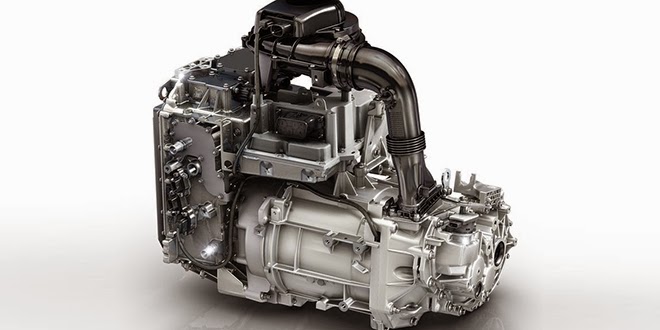
Renault has previewed a new EV motor that it says will enter production in 2015. The synchronous electric motor offers 65 kW of power and 220 Nm (162 lb-ft) of peak torque, and features an integrated Chameleon charger.

Renault designed the new motor with integration, miniaturization and simplification in mind. It uses smaller and fully integrated modules, assembled closely together to minimize the need for power supply cables. The junction box, power electronics and Chameleon charger are all contained within a single Power Electronic Controller. Overall, the size of the motor has been reduced by 10%, while retaining the same level of performance. The motor is now air-cooled, although the Power Electronic Controller still has a liquid cooling system.

The designers improved the efficiency of the charging management process, reducing the consumption of energy and improving charging times.

“The future of mobility calls for the same command of electric motor technology as it does of internal combustion engines,” said Rémi Bastien, Renault’s Director of Innovation Engineering. “We are consequently active on every front, from internal combustion engines to electric motors and alternative energies.”

Electric Car Sales Booming in The Netherlands

Of all cars sold in the first three quarters of 2014 in the Netherlands, 4.3% were electric or hybrid cars. In the last quarter of 2013, the number was even higher: 15%. The main reason for these very high EV sales in the Netherlands is fiscal measures, says Roland Berger Strategy Consultants, who published the figures.

The number of electric and hybrid cars sold in the last quarter of 2013 was 14,842. The best-selling car was the Mitsubishi Outlander, with 8,039 sales. Most EV’s and hybrids sold in the Netherlands are made in Japan: the Toyota Prius and Nissan Leaf are also popular.

The Netherlands wants to have 200,000 EV’s and hybrids on the road by 2020. Currently it has 70,000, almost 1% of the total.

Source: Energy Post

Fully Charged – KIA Soul EV Test Drive [VIDEO]

Robert Llewellyn takes a 560 km (350 mile) test drive in the all new Kia Soul EV.

Kia Motors is using a 360-V lithium-ion battery pack of “class-leading” energy density (200 W·h/kg) in the 2015 Soul EV to give it range of about 200 km (125 mi) on the European Driving Cycle, and “real-world” range of 80-100 mi (129-161 km) in the U.S. The cells and the battery are the same in all regions.

Kia says high-performance anode and gel electrolyte additive materials were developed. The new electrolyte additive allows for better range by more effectively dealing with low and high temperatures. A “special” ceramic separator with improved thermal resistance properties is used.

The cell casings are of polymer pouch type (as opposed to metal), and the battery pack is air-cooled. Standard equipment on the Soul EV includes receptacles for SAE J1772 Level 1 and Level 2 ac charging, as well as CHAdeMO dc fast charging (480 V).

The battery in the 2015 Kia Soul EV is the result of a three-year development program with lithium-ion cell maker SK Innovation. The 192 cells are packaged into eight modules and deliver a total battery capacity of 27 kW·h. The cell cathode is of nickel-rich NCM (nickel-cobalt-manganese) chemistry, with the raw materials for that and other components optimized for energy density, durability, and safety.

Tesla Model S Beats Porsche in Owner-Satisfaction Survey

Tesla drivers were more likely than Porsche owners -- or anyone else -- to say they’d buy their cars again in this year’s edition of the closely watched Consumer Reports buyer survey.

Tesla’s Model S luxury electric sedan topped the U.S. survey a second year in a row, scoring 98 out of a possible 100, after posting a 99 last year. This year’s No. 2 brand, Porsche, scored an average of 87 out of 100 across its model lines. Palo Alto, California-based Tesla, co-founded and led by billionaire Elon Musk, said last month that it expects to sell 50,000 Model S cars next year.

“Not only is the Tesla roomy, comfortable, and a lot of fun to drive, but it also has low operating costs,” Consumer Reports said.

The survey will bolster the 11-year-old carmaker’s image as the leader in the business of making high-end electric cars. Tesla plan to expand sales of the Model S and develop the long-awaited Model X SUV, which is expected in the third quarter of 2015. Tesla stock has gained 52 percent this year.

Sports Cars

The next three most satisfying vehicles in the Consumer Reports Survey, after the Model S, were sports cars: General Motors Chevrolet Corvette Stingray, with a 95 percent satisfaction rating, and Porsche Cayman and Boxster, which tied for third with 91 percent of buyers saying they’d purchase them again.

The survey covered 350,000 vehicles from one to three years old and took into account “attributes such as styling, comfort, features, cargo space, fuel economy, maintenance and repair costs, overall value, and driving dynamics,” Consumer Reports said.

Hybrid, electric and diesel-powered cars outscored gas engines throughout the survey, with the Chevrolet Volt and Toyota Prius leading the compact-car category and Honda Accord Hybrid and Ford's Fusion Energi atop the list of mid-sized sedans.

Germany to Boost Incentives in Push for 1 Million Electric Cars

Chancellor Angela Merkel said Germany will need to provide more incentives to meet a goal of having 1 million electric cars on the country’s roads by 2020.

“There’s a lot to do,” Merkel said today during a press conference in Berlin. “We see that further subsidies are necessary. We must speak with the German states about that.”

Merkel is far behind in her push for 1 million electric autos in part because her government has balked at incentives like those offered in France, where consumers receive as much as 6,300 euros ($7,840) to help cover the higher cost of low-emission vehicles. Germany, which has about 24,000 electric autos on its roads, is considering offering a tax break for zero-emission vehicles sold as company cars.

“We’re far from our goal to establish Germany as a leading market for electro-mobility,” said Matthias Wissmann, president of German auto-industry lobby VDA. “The government needs to act” on plans such as the corporate tax reduction.

The chancellor is trying to reduce emissions by pushing the country’s auto industry to build more electric cars after French, Japanese and American carmakers got off to an early lead. German auto manufacturers will offer 17 electric models by the end of 2014, and another 12 will go on sale next year, according to the VDA.

Charging Stations

Merkel’s cabinet announced plans in September to offer electric-car buyers special privileges, backing a bill that would enable municipalities to offer drivers of battery-powered cars, fuel cell vehicles and some plug-in hybrids free parking and the right to use bus lanes.

The country has 4,800 charging stations, said Henning Kagermann, a former chief executive officer of software maker SAP who is heading the government’s electric-car effort. Transport Minister Alexander Dobrindt said Germany will add 400 stations at rest stops along the autobahn network to make it possible to travel across the country with electric vehicles.

“We need a super-charger infrastructure where you can charge 80 percent of the battery in 15 minutes,” said Stefan Bratzel, director of the Center of Automotive Management at the University of Applied Sciences in Bergisch Gladbach, Germany. “The government can help to establish standards for plugs to make the charging stations accessible for vehicles of all brands. We’re still very much in the wild electro-west.”

BMW i3

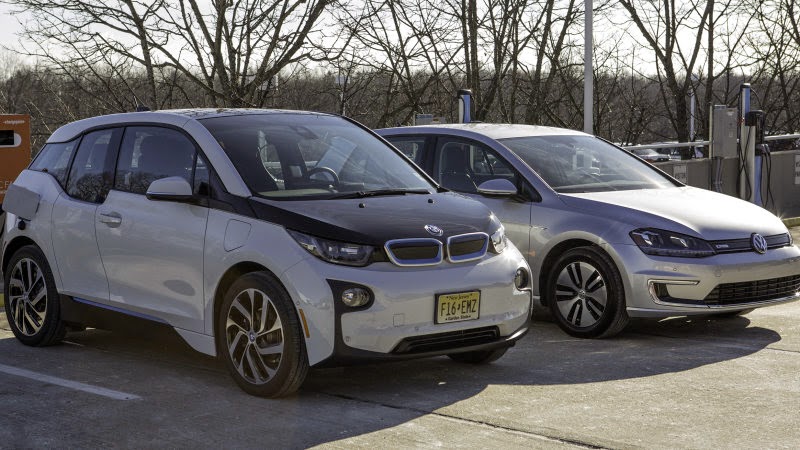
Zero emission vehicles from German automakers include Bayerische Motoren Werke AG’s i3 city car as well as electric versions of Daimler AG’s Smart two-seater and Mercedes-Benz B-Class. Volkswagen AG sells the Up! and Golf with electric motors. The offerings follow the entry into the market of Tesla Motors Inc.’s S Model, Nissan Motor Co.’s Leaf and General Motors Co.’s Volt.

Germany was a transport pioneer when it opened Europe’s first car-only highway in 1921 in Berlin. Its free-wheeling autobahn, which often doesn’t have a speed limit, has spurred a motoring culture, helping BMW, Mercedes and and VW’s Audi and Porsche brands to dominate the market for high-end cars.

The government announced plans today for a conference next summer in Berlin to discuss how the country can make further progress in electro-mobility.

Stohl Racing reveal Peugeot 207 S2000 AWD Electric Rally Car

Stohl Racing surprised at the Motor Show in Essen. The Austrians transplant two electric motors in a Peugeot 207 S2000 and have been approved for use in special stage rallying.

The Peugeot S2000 built by Manfred Stohl is all-wheel-drive via 2x electric motors with a maximum output of 400 kW (544 hp), more impressive is the torque of a whopping 880 Nm which, typical of electric motors, comes on immediately. Zero to 100 km/h takes only 3.0 seconds despite a weight of 1,500 kg.

A highlight is the installation of the battery, which is located between the driver and passenger. This is installed in a special cage construction, but can be changed in service in just five minutes. This is made possible through a specially designed trailer mounted lift.

The range of the electric-S2000 as usual depends on the driving style. Stohl Racing has calculated approx 30 kilometers range with a subsequent return to the Service to change the battery. The rally-e Stohl Mk1 will premiere in the state rally championship soon.

World Record holders Sunswift launch Pozible to fund refit of car for road registration

UNSW’s solar racing team Sunswift has launched a crowd-funding campaign to raise money to rebuild their car for Australian road registration.

The eVe vehicle, which recently smashed a 26-year-old world record for the fastest electric car over 500 km, is seen as a symbol for a new era of sustainable driving. It is covered in zero-emission solar panels and uses a battery storage system that can be charged with the solar cells or by plugging the car into a power outlet.

The world record proved the car is technically capable of covering the maximum distance a normal road user might want to drive in a single day.

The next step in the Sunswift journey is to put eVe within reach of the average driver by converting it from concept car to road-registered coupe.

The team of 60 undergraduate students behind Sunswift is aiming to raise $30,000 – about one-third of the amount they need – using the crowd-funding site Pozible. They plan to source the remaining money and components via sponsors and in-kind contributions from industry partners.

If successful, it will mark the first time a university solar car team has built a vehicle to the stringent standards of the Australian Design Rules – the national motoring standards that govern vehicle safety, anti-theft and emissions.

“Full registration is no humble feat with essentially the whole car needing to be deconstructed and rebuilt,” says project director and engineering student Hayden Smith.

“The car requires front, rear and side impact protection, headlights, windscreen wipers, new raised suspension and new wheels in addition to updated electrical components.

“The interior will also be redesigned to meet safety regulations and offer a level of comfort that would be expected from a commercial car.”

Coinciding with its latest fundraising push, the team has set an ambitious goal of achieving road registration as early as March 2015.

“Having solar cars conquer the roads would mark a huge leap in the race to develop more sustainable transport alternatives, showcasing their potential to be commercialised in the near future,” Sunswift’s chief business officer and student Rob Ireland says.

"However, we can't change the world by ourselves so we're asking for help to make it happen."

Supporters who contribute to the crowd-funding campaign will be offered rewards including 3D printed models of the car, solar cell mantlepiece trophies and one-time advertising space during PR events. The campaign begins on Monday 1 December.

Electric vehicles account for almost 10% of Californian new-car sales

Hybrid electric and plug-in electric vehicle now account for almost 10 percent (9.6%) of all new car sales in California.

Electric vehicles, which registered nearly zero in state-wide new car-sales as recently as three years ago, are now taking a noticeable market share, according to the latest quarterly report released by the California New Car Dealers Association.

CNCDA said 23,648 registrations of various plug-in hybrid models in California from January through September this year accounted for 1.7 percent of all new-vehicle purchases. Registrations of all-electric vehicles, like Nissan’s Leaf, accounted for 20,516 new vehicle sales, or 1.5 percent, during that time.

The combined total of 44,164 for the first nine months of 2014 already tops California’s electric vehicle sales for all of last year. In 2013, combined sales of plug-in hybrids and all-electric vehicles in California topped 42,000, up 500 percent from 2011.

Sales of new, standard hybrid vehicles, another segment where California leads the nation, totalled 89,486 through September this year. That represents 6.4 percent all new cars sold state-wide in the January-September period.

Renault-Nissan sell 200,000th Electric Vehicle [VIDEO]

The Renault-Nissan Alliance has sold its 200,000th electric vehicle and has a leading 58% market share for zero-emission cars.

Together, Renault and Nissan EVs have driven approximately 4 billion zero-emission kilometers – enough to circle the earth 100,000 times. Renault-Nissan’s EVs represent 200 million liters of fuel saved – enough to fill about 80 Olympic-sized swimming pools. Alliance EVs also represent 450 million kg of CO2 that has not been emitted while driving.

The Alliance sold its 200,000th EV in early November, about four years after the launch of the Nissan LEAF, the world’s first mass-market electric vehicle. Nissan LEAF remains the best-selling electric vehicle in history.

From January through the first week of November of this year, the Alliance has sold about 66,500 units—an increase of about 20% from the same period last year. The Alliance sells about two out of three electric vehicles worldwide, including Twizy, Renault’s two-seater urban commuter vehicle and the Nissan e-NV200 van on sale in Europe and Japan.

“Renault and Nissan’s electric vehicles are the zero-emission volume leaders – and, most important, they enjoy high satisfaction rates from customers around the world,” said Carlos Ghosn, Chairman & CEO of the Renault-Nissan Alliance. “Based on positive owner feedback and the increasing demand for cars that run on renewable energy, it’s no surprise that EV sales are accelerating – particularly in regions where charging infrastructure is well developed.”

To capture what the first 200,000 consumers love about their electric vehicles, the Renault-Nissan Alliance is launching a series of videos featuring EV owners on three continents. “I Made the Switch” tells why people bought their electric vehicles and how switching to a zero-emission vehicle has changed their lives. The first video features Chris Beers, a software engineer from Holliston, Massachusetts, USA, one of many Americans who powers his Nissan LEAF with clean solar energy.

USA and Japan lead the world in EV ownership

In the United States, the Alliance’s biggest electric vehicle market, there are more than 750 quick chargers in operation. Nissan is working with its dealers and charging partners to increase that number to 1,100 by mid-2015. The quick chargers are able to charge a LEAF from zero to 80% capacity in about 30 minutes.

This year, Nissan also launched its “No Charge to Charge” program, which provides free access to selected charging stations for two years with the purchase or lease of a new Nissan LEAF. “No Charge to Charge” is currently active in 12 U.S. markets, and Nissan plans to expand to additional markets by mid-2015.

In Japan, the Alliance’s second-biggest EV market, there are more than 2,900 quick chargers in operation. Nissan and Japan’s three other top automakers have pledged to work together to raise that number to 6,000 by March 2015.

In Europe, the UK is the most advanced market in terms of electric vehicle infrastructure. Today, the quick charging network already covers 87% of the UK’s motorways.

Nissan LEAF is the world’s best-selling electric vehicle; Renault led in Europe in October

With six electric vehicle models on the road, the Renault-Nissan Alliance is the only global car group with a full range of 100% electric vehicles – and they can be fully charged with purely renewable energy.

Yokohama, Japan-based Nissan has sold a cumulative 148,700 units worldwide since December 2010, when Nissan LEAF went on sale. Nissan LEAF has collected industry honors including the 2011 World Car of the Year, European Car of the Year 2011 and Car of the Year Japan 2011-2012.The electric vehicle has the highest global customer satisfaction rate for any Nissan vehicle ever.

The top markets for Nissan LEAF are the United States with about 67,000 sales since its launch, Japan with about 46,500 units and Europe with about 31,000 units.

In the United States, LEAF is on track to be the top electric vehicle in 2014, outselling all other electric and plug-in hybrid vehicles. Sales so far this year are up 35%, and Nissan LEAF has enjoyed 21 consecutive record sales months and has already shattered its own yearly U.S. sales record with two months to go. In addition to LEAF, Nissan also sells the e-NV200 van, which went on sale in Europe in June and in Japan in October.

Meanwhile, Boulogne-Billancourt, France-based Renault has sold a cumulative 51,500 electric vehicles worldwide since its first model the Kangoo Z.E. went on sale in October 2011. Kangoo Z.E. was voted International Van of the Year 2012. Renault recently delivered its 5,000th Kangoo Z.E. to La Poste, France’s national postal service and operator of the country’s largest corporate fleet. An additional 5,000 units will be delivered in the coming years.

In addition to Kangoo Z.E. and Twizy, Renault’s zero-emission range also includes the ZOE subcompact and the Fluence Z.E. sedan. In South Korea, the Fluence Z.E. is sold as the SM3 Z.E. under the Renault Samsung Motor badge. Like Nissan LEAF, ZOE enjoys the highest satisfaction rate of Renault’s global product lineup.

Renault’s top markets in Europe - its main electric vehicle market - are France, Germany and the United Kingdom. In October, Renault regained the number one EV position in Europe with a market share of 31%. ZOE was the most popular vehicle with a 23% market share.

Demand for Tesla’s Dual-Motor Vehicles “Off the Charts”

Tesla Motors CEO Elon Musk has weighed in with one of the most useful updates to date on the company's new dual-motor versions of its Model S. The verdict? One month after it was introduced, demand for the all-wheel-drive version of the model isn't lacking. In fact, demand for the new motor system is incredibly robust. Here's what investors need to know.

The P85D is Tesla's halo car

"This is the fastest accelerating four-door production car in the world," Musk explained in a GQ magazine interview published Tuesday, referencing Tesla's new dual-motor option for its flagship 85-kilowatt-hour-battery performance Model S, officially dubbed the P85D.

The new dual-motor system with a motor connected to both the rear and front axle is an upgrade offered for the 85-kWh-battery version of the Model S and now comes standard on the performance version. Tesla's smaller 60-kWh-battery version of the Model S is still only available with the rear-wheel-drive one-motor configuration.

The dual-motor system is helping Tesla set new standards in the automotive industry. Most notably, Tesla showed off how a dual-motor, all-wheel-drive system gives owners all-weather traction without sacrificing efficiency. Tesla's all-wheel-drive system actually boosts range, top speeds, and acceleration times over their rear-wheel drive counterparts running on the same battery. And now with a zero-to-60 acceleration time of just 3.2 seconds, Tesla is making it harder for premium internal-combustion-engine vehicles to compete.

Musk went on to explain in the interview that Tesla built the car to prove a point.

"We wanted to position it as the fastest in order to change the public mind-set. It had to be something dramatic. And getting those few extra 10ths of a second was hard," Musk said. He told GQ that the P85D is Tesla's "halo car," or the car that shows off the strengths of electric vehicles.

Demand is hot

But Tesla's dual-motor system is doing more than just drawing attention to the company. It is apparently convincing a large number of consumers to put in a cash deposit to wait in line for a built-to-order version of their own Model S.

"Demand for the P85D is off the charts," Musk said. "We're seeing a very high proportion of orders for all-wheel drive, either P85D or 85D (which has smaller, equal-sized electric motors front and rear), so 70%-plus of our cars will be dual-motor."

Musk went on to reiterate a common theme: Demand is not a problem for Tesla; ramping up production to meet demand, however, is.

The company is guiding to report record quarterly sales in Q4 and 50% higher annual Model S sales in 2015. But Tesla contends that the company will still not be fully meeting demand, even at these levels.

Tesla said in its third-quarter earnings call that with the help of the additional cost for dual-motor versions of the Model S, it expected Model S average selling to improve going forward. This favorable trend likely plays a role in Tesla's bullishness for its automotive gross profit margin to continue to improve in Q4 and into 2015, though the most important factor influencing Tesla's improving gross profit margin is undoubtedly growing sales of its Model S, which spread fixed costs across a larger number of deliveries.

While Tesla's ability to set standards and its soaring demand are both great for the company, investors should be careful to maintain proper perspective. Given Tesla's $31 billion market capitalization, the market is already betting on Tesla to be wildly successful in the coming years. Furthermore, Tesla's focused product portfolio and strict emphasis on battery-powered vehicles means that missteps could significantly delay its ambitious plans.

On the other hand, it's market-leading pure plays like Tesla with a proven record of execution on growth plans that are probably most likely to exceed market expectations. So, investors who already own shares should think carefully before they sell Tesla stock simply because they think shares are overvalued.

GM to Study Vehicle Sharing with Shanghai Jiao Tong University

General Motors China has signed a memorandum of understanding with Shanghai Jiao Tong University to collaborate on a vehicle sharing program featuring the Chevrolet EN-V 2.0 starting next year.

A fleet of EN-V 2.0 vehicles will be integrated with a multi-modal transportation system alongside bicycles, cars and shuttle buses at the university’s Minhang campus in Shanghai to evaluate the benefits and challenges of a vehicle sharing transportation model.

“The vehicle sharing program with Shanghai Jiao Tong University will allow us to assess the real-world application of the EN-V 2.0 as part of a vehicle sharing system,” said Matt Tsien, GM executive vice president and president of GM China. “We will apply these learnings to the development of future urban mobility transportation solutions, not just for China but for the world.”

"Electric vehicles represent the transportation mode of the future, but the big topic now is how to develop them," according to Yin Chengliang, vice president of the Shanghai Jiao Tong University Automotive Engineering School. "This project will explore a model that integrates electric vehicles with the transportation network and intelligent transportation system."

The Chevrolet EN-V 2.0 is the next generation of GM’s original Electric Networked-Vehicle (EN-V), which made its global debut at Expo 2010 in Shanghai. It can travel up to 40 kilometers on a single charge.

The Shanghai Jiao Tong University collaboration is a continuation of GM’s vision for sustainable urban mobility announced at Expo 2010. Shanghai Jiao Tong University is a comprehensive research-oriented university and one of China’s leading educational institutions. GM and Shanghai Jiao Tong University have collaborated on many automotive, training and development projects over the past two decades.

Porsche Readying Tesla Model S Fighter

The German automaker is currently in the early stages of development for an EV that will target the Tesla Model S and will be a new dedicated fifth model range slotting beneath the existing Panamera. While details on Porsche’s first all-electric production vehicle are mostly being kept under wraps at the moment, it will likely be built on the automaker’s second-generation MSB platform that underpins the current Panamera.

It will have a shorter wheelbase than the existing Panamera sedan but will be a five-door hatchback, similar in style to the Panamera Sport Turismo concept that debuted at the 2012 Paris Motor Show. The company is hoping to keep it around 2,100 kg and its electric powertrain will provide similar performance as the Model S, though Tesla did just announced the more powerful all-wheel drive Model S P85D.

Porsche is aiming for a range of over 450 km and the company is expected to work with Audi, so we expect they will also use solid-state batteries.

Audi Confirm Tesla Model S Rival with 450 km Range for 2017

According to a report by Auto Express, Audi is also looking to join the electric vehicle sedan market with its own offering sporting a 450 km (280-mile) all-electric range.

The vehicle is currently under development according to Audi’s Dr. Ulrich Hackenberg, who also revealed that it will arrive in 2017 as an all-new model.

In the interview, Hackenberg said that he was “able to re-engineer the R8 e-tron project and technology with the team” and confirmed that it will not be a sports car.

The German automaker will use next-generation batteries in order to achieve the 450 km range, technology that is said to have up to five times more energy density than the current batteries used in vehicles such as the Volkswagen e-Golf.

Tesla in talks with BMW over car batteries & component alliance

Tesla Motors is in talks with Germany's BMW over a possible alliance in batteries and light-weight components, Tesla's Chief Executive Elon Musk told German weekly Der Spiegel.

In an interview published on Sunday, Musk described BMW's production of carbon fibre reinforced car body parts as "interesting" and "relatively cost efficient."

BMW uses carbon fibres from its joint venture with materials supplier SGL to make reinforced passenger cell parts for its i3 electric hatchback and i8 plug-in hybrid sports car.

Officials at BMW were not immediately available to comment.

"We are talking about whether we can collaborate in battery technology or charging stations," Musk was quoted as saying in the interview.

There were no further details on the specific nature of the alliance, however BMW and Tesla executives already met in June to discuss the creation of charging stations usable for different types of electric cars.

Rival Daimler, owner of the Mercedes brand, said last month it would continue to collaborate with Tesla even after selling its remaining four percent stake in the U.S. company. Tesla has also worked with Toyota on electric SUVs.

Tesla's billionaire co-founder Musk also told Der Spiegel that he expects Tesla to have a battery production plant in Germany in five to six years.

BMW likely to phase out internal combustion engines over the next 10 years [VIDEO]

During a recent interview with CNBC.com , mutual fund manager Ron Baron of Baron Capital revealed that two of his analysts recently visited BMW in Germany and the BMW financial team believes that a "revolution in the drive train is underway."

"We believe that BMW will likely phase out internal combustion engines over the next 10 years,"
Baron wrote in his most recent quarterly letter to shareholders of his funds.

Almost exactly 12 months ago, BMW product chief Herbert Diess told Autocar "all BMW models will soon need to be sold with some form of electrification." BMW’s head of production for large vehicles, Peter Wolf, told motoring.com.au. “We are planning to have a plug-in hybrid in each and every model series.”

We have also regularly reported on a steady stream on informal announcements from German automakers (Audi, BMW, Mercedes, Porsche) regarding their plans to build a 'Tesla killer', but Wall Street financial analysts concluding a major automaker may abandon the production of ICE power plants within a decade still comes as a revelation. It was only four years ago (December 2010) the first mass market electric vehicle, the Nissan Leaf, began deliveries to retail customers.

Baron, who holds a $250 Million position in Tesla Motors, believes that of all the major automakers, BMW is the only car company with a 'culture' comparable to that of Tesla. Baron believes the rest of the auto industry is resisting the move to electric vehicles. "As a result, they are developing electric expertise so slowly that the lead Tesla has built up through its fast growing staff ... may soon become insurmountable."

He argues automakers don't want electric vehicles to happen because their engine and transmission plants would become stranded assets. Unions don't want EVs to happen because they are easier to assemble which results in fewer jobs and dealers don't want EVs to happen because of direct sales and lack of vehicle servicing. Electric cars have 18 moving parts compared to 2,000 moving parts in a combustion engined car. EVs simply don't wear out or breakdown leading to lost automaker/dealer revenues.

With global auto sales heading towards 100 Million a year, Baron believes that in 15 years time Tesla could be selling 10 Million vehicles a year.

Tesla delays Model X and stock jumps 5%

Tesla Motors on Wednesday announced that its Model X crossover utility vehicle would not be available until the second half of 2015. The model had previously been slated for a 2013 launch.

The Palo Alto, California-based company also reported a loss of $74.7 million in its third quarter. Tesla said it had a loss of $0.60 per share. Earnings, adjusted for stock option expense and non-recurring costs, were $0.02 per share.

The results topped Wall Street expectations. The average estimate of analysts surveyed by Zacks Investment Research was break even on a per-share basis. As a result, Tesla's stock price was up more than 5% in after-hours trading on Wednesday.

The electric car maker posted revenue of $851.8 million in the period, falling short of Street forecasts. Analysts expected $867.7 million, according to Zacks.

Tesla shares have risen 54% since the beginning of the year. In the final minutes of trading on Wednesday, shares hit $230.97, a rise of 31% in the last 12 months.

Model S Achieves Euro NCAP 5-Star Safety Rating [VIDEO]

The Tesla Model S has received a maximum-possible 5-star safety rating from the European New Car Assessment Programme (Euro NCAP).

Model S is one of just a few cars to have ever achieved a 5-star safety rating from both Euro NCAP and the U.S. National Highway Traffic Safety Administration (NHTSA). Additionally, Model S is the only car this year to have achieved both a 5-star Euro NCAP rating and 5 stars in every NHTSA subcategory, including frontal impact, side impact, and rollover. Only two other cars have earned the same recognition since 2011 (when NHTSA introduced its latest rating scheme).

The reason so few models achieve 5-star ratings in both Europe and the U.S. is that each program places emphasis on different safety aspects in the assessment process. NHTSA emphasizes structural and restraint safety, with a deep focus on how well the vehicle can withstand and absorb the energy of an impact while protecting its occupants. It is also primarily concerned with adult occupants. On the other hand, Euro NCAP assesses a wider range of scenarios, including tests for child and pedestrian safety. Unlike for NHTSA, active safety is also an important part of Euro NCAP’s 5-star requirement. Every year, the European organization raises the standard for a 5-star rating to account for technological advances in the industry.

The dual 5-star ratings for Model S validate our holistic approach to safety. We have been engineering passive and active safety systems in parallel, so the car is structurally sound and is also designed to intelligently anticipate and react to potentially dangerous situations.

Structurally, Model S has advantages not seen in conventional cars. It has a low center of gravity because its battery pack, the largest mass in the car, is positioned underneath the passenger compartment, making rollover extremely unlikely. It also has a large front crumple zone because of the lack of an engine, meaning it can absorb more energy from a frontal impact, the most common type of crash resulting in fatalities. Its body is reinforced with aluminum extrusions at strategic locations around the car, and the roof can withstand at least 4 g’s. It was for these reasons that Model S achieved 5 stars in every subcategory when tested by NHTSA in 2013.

This quarter, we started implementing the Model S active safety system in conjunction with the introduction of new Autopilot hardware, consisting of 12 ultrasonic sensors that sense up to 16 feet around the car, a forward-looking camera, a forward radar, and a digitally controlled, high-precision electric brake boost. We specifically selected this hardware to accommodate the progressive introduction of new safety features via software updates over the course of the next several months.

While the features already pushed to the Model S fleet – Lane Departure Warning and Speed Limit Warning – have proven sufficient to merit a 5-star NCAP rating, we will go much further with active safety systems. Features coming soon include Forward and Side Collision Warning and Avoidance, Blind Spot Warning, and Automatic Emergency Braking.

The video shows the Frontal Impact test which takes place at 64 Km/h, 40% of the width of the car striking a deformable barrier. In the side impact, a mobile deformable barrier impacts the driver's door at 50 km/h. In the pole test, the car tested is propelled sideways at 29km/h into a rigid pole.

Electric RaceAbout annual Nordschleife testing [VIDEO]

Electric RaceAbout ran the annual tests on the legendary Nordschleife track in Nürburg Germany in the end of October. E-RA went around the 20,6 km long, so called Sport Auto lap, in 8:01,41 beating its own best time.

Last years visit in Nordschleife gave a lot of inspiration and ideas to E-RA team, how to continue improving the performance and reducing the weaknesses of the car. During the past year, the whole vehicle has been developed, but the most remarkable things were the active rear wing control, suspension and ABS brake system. The Torque Vectoring control system of the motors has also been improved since last year.

This time E-RA was driven by Jesse Krohn, a young Finnish VLN- series professional driver and his comments concerning the performance and strengths of E-RA are similar with our teams earlier test drivers. “The drive ability of the vehicle was good regarding its weight and the acceleration from 100 to 200 km/h was very convincing”, says Jesse, who drove the vehicle for the first time.

The testing period in the end of October lead to the second fastest lap around the Nordschleife track in the street legal electric vehicle group. The unpredictable Eifel mountain range climate did not help the testing and E-RA was on the track only three times in four days.

“The low amount of laps did not help me get accustomed to the vehicle”, says Jesse and continues: “Also, we had to start every lap with cold tires and brakes”.

During the fastest lap, the battery of the vehicle heated up more than the team anticipated and the battery output power had to be limited from halfway of the track to the end. Additional laps would have helped to optimize the vehicle setup - there is still potential for a faster lap-time.

The best time of the EV's on Nordschleife still remains with Mercedes-Benz AMG SLS Electric Drive 7:56,2.

Swiss electric car sets acceleration World Record

An electric racing car developed by students at ETH Zurich and the Lucerne University of Applied Sciences and Arts on Monday set a world record for acceleration, the universities announced.

The “grimsel” car sped from zero to 100 kilometres an hour in just 1.785 seconds, at a military airport in Dübendorf in the canton of Zurich, smashing the the previous record.

The previous record of 2.13 seconds was set by Delft University of Technology in the Netherlands.

Operated by a student team from the Academic Motorsports Club Zurich (AMZ), The grimsel car, reached a speed of 100 km/h in less than 30 metres, ETH Zurich, the Swiss Federal Institute of Technology, said in a news release.

Thirty students from the two swiss universities developed and built the racing car in less than a year.

Weighing just 168 kilograms, the carbon-fibre vehicle generates 200 horsepower through four-wheel drive, ETH said.

Four specially designed wheel hub motors create a total torque of 1,630 Newton metres (Nm), with torque distribution controlled individually for each wheel to maximize acceleration, the university said.

AMZ was founded in 2006 ivy ETH students and produces a prototype racing car to compete in various student formula competitions in Europe every year.

The grimsel car will be presented to the public at “Student Power Day” on November 9th at the ETH Hönggerberg campus, with test rides planned between noon and 2pm.