Audi Ask Sudents to Code Self-Driving Cars

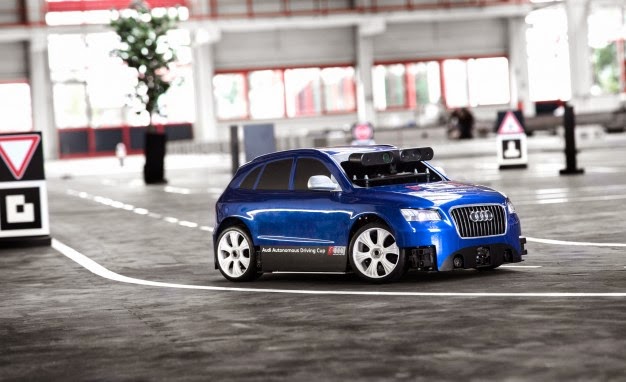
Audi is taking Piloted Driving to a decidedly smaller level, giving 1:8-scale Q5s to 10 student teams who must program their tiny crossovers to compete in the inaugural Autonomous Driving Cup. The whole thing is sort of like DARPA’s off-road competition for (full-size) self-driving cars, only scaled down and conducted indoors.

Audi’s smart play here is asking students, the next generation of automotive engineers, to tackle the most pressing issues facing autonomous-car development—namely, programming the vehicle to not only recognize widely varied road scenarios but also to react accordingly. To ensure that whatever the German students figure out is applicable to Audi’s full-scale Piloted Driving experiments, the tiny Q5s’ software-development environment is said to be identical to that used on real-life Audi prototypes.

The student teams will program their donated micro Q5s to run a large indoor course, on which they’ll encounter traffic (as an awesome aside, this “traffic” consists of small-scale Audi race cars), have to complete parking tasks, avoid accidents, and avoid obstacles. Making things even trickier is speed—the Q5s will accelerate up to 25 mph during the competition—and the sheer volume of complex sensors, which work the same way as the sensors in Audi’s full-size self-driving vehicles.

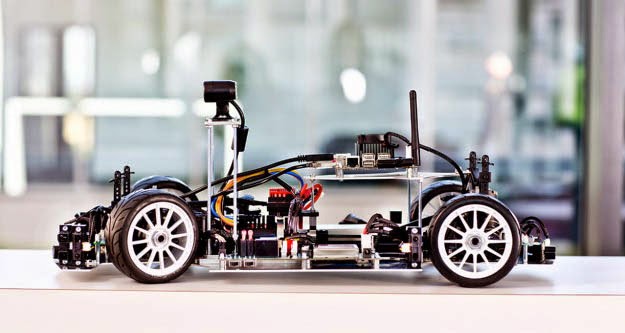
Look closely, and you’ll see a bank of sensors sticking through the little Q5’s windshield; that’s the 2D/3D camera, which is used to help the car discern range, depth of field, and color. Four ultrasonic sensors (similar to parking sensors) located at each corner and six infrared sensors help the vehicle identify its proximity to surroundings and obstacles, while a six-axis gyroscope, wheel-speed sensors, and a steering-angle sensor help the car understand its own movements. Onboard, there’s a 1.7-GHz quad-core processor, 2 GB of RAM, an SD-card slot, and an open-source Arduino control computer.

Audi launch 2nd Generation Audi R8 e-tron @ Geneva

The second generation of the Audi R8 forms the basis for two models. Audi has made major engineering developments in its high-performance electric sports car, the R8 e-tron. The latest evolution of the vehicle takes up the multimaterial Audi Space Frame from the new series-production model.

The supporting structure was enhanced by a CFRP rear-section module comprising the luggage compartment. The walls of the CFRP luggage compartment well are corrugated. This way, in the event of a rear-end collision, more energy can be absorbed despite the reduced material weight.

Thanks to targeted modifications to the outer shell and on the wheels, the Audi R8 e tron achieves an aerodynamic drag coefficient (cd) value of 0.28. In terms of performance and range, the car enters entirely new dimensions.

The large T-shaped battery is structurally integrated into the center tunnel and behind the occupant cell – optimally positioned in the car. It supports the dynamics of the R8 e-tron with its low center of gravity. Audi produces the high-voltage battery itself, for the first time based on a newly developed lithium-ion technology which was specially conceived for a purely electric vehicle drive. In comparison to the first technology platform, the battery capacity has grown from 49 kWh to approximately 92 kWh. This progress was possible without changing the package.

The R8 e-tron achieves an electric range of 450 kilometers (279.6 mi) instead of a previous 215 kilometers (133.6 mi) with an energy density that has been increased from 84 Wh/kg to 154 Wh/kg and some other modifications to the car. The electrically powered high-performance sports car has the Combined Charging System (CCS) on board, which allows charging with direct and alternating current. Using this system, it is possible to fully charge the battery in significantly less than two hours.

The power is now twice 170 kW and the maximum torque twice 460 Nm (339.3 lb-ft). The R8 e-tron accelerates from 0 to 100 km/h (62.1 mph) in 3.9 seconds on its way to an electronically restricted top speed of 210 km/h (130.5 mph) or 250 km/h (155.3 mph). Intelligent energy management and an electromechanical brake system enable high energy recuperation rates. Targeted torque vectoring – needs-based distribution of power transmission between the rear wheels – ensures maximum stability and dynamism.

Audi uses the electrical high-performance sports car primarily as a mobile high-tech laboratory. Accordingly, the findings from the R8 e-tron help in creating a vehicle with a sedan character. Upon customer request, the R8 e-tron will be available for order in 2015 as an electrically powered sports car in supreme hand-built quality.

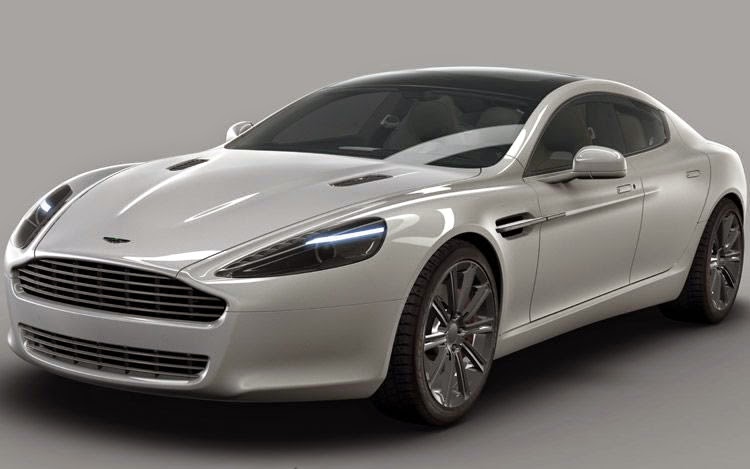
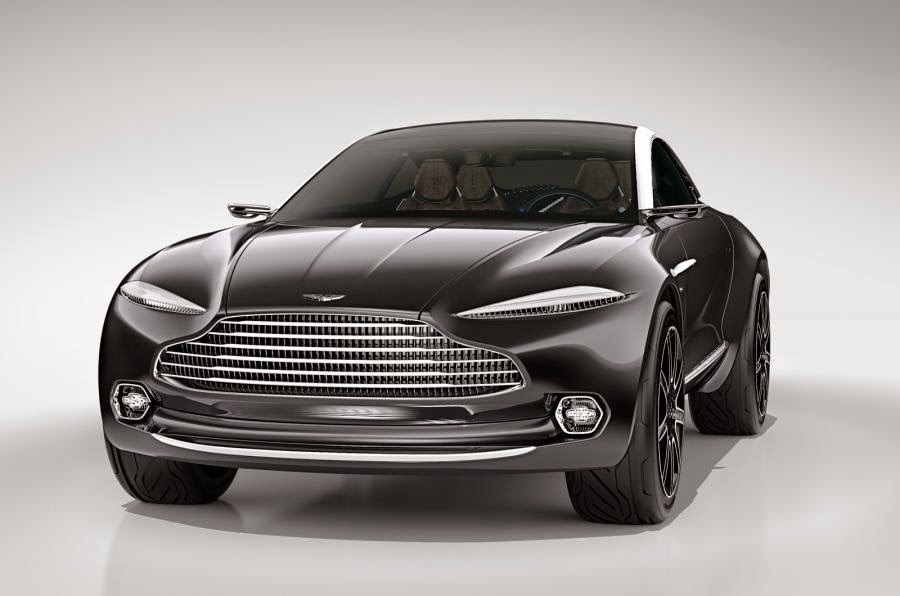
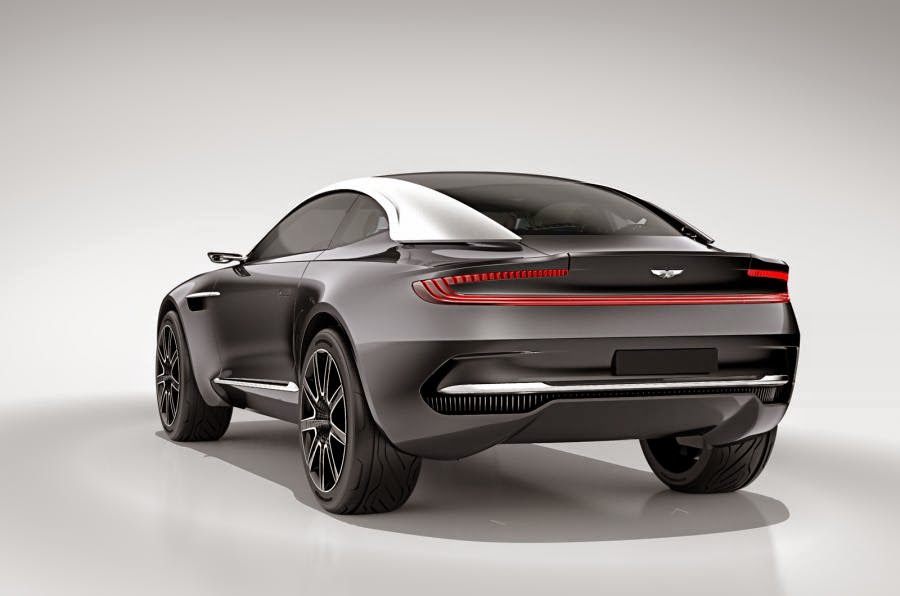
Aston Martin début all-electric all-wheel-drive DBX Concept

Aston Martin has surprise all at the 2015 Geneva Motor Show with the debut of an all electric DBX Concept.

Aston Martin is calling the DBX Concept a high luxury GT that fits the description of a crossover coupe. Far from a production ready vehicle, the concept is just a design study for the time being, but Aston does admit there is a market for such a vehicle.

The DBX Concept is an all-wheel drive crossover high luxury GT that uses in-board electric wheel motors at all four corners powered by lithium sulphur cells. Steering is a drive-by-wire system and both the driver and passenger have head-up displays surrounded by auto-dimming ‘smart glass’.

The DBX Concept can accommodate four adults and all the cargo they could ever want since there is a traditional rear cargo area as well as a front trunk occupying the place usually reserved for a ICE.

Souce: Autocar

2015 Audi R8 e-tron confirmed with 450 km range

The 2015 Audi R8 e-tron electric supercar will have 340 kW of power and a remarkable 920 Nm of torque, sprint from 0-100 km/h in 3.9 seconds and offer a range in excess of 450 km.

The second-generation of Audi’s halo product will have more than doubles the range over the original small-batch model thanks to an increase in battery capacity from 49 kWh to approximately 92 kWh. Energy density has increased from 84 Wh/kg to 154 Wh/kg apparently without affecting packaging.

The battery powered R8 has a Combined Charging System (CCS) on board, which allows charging with direct and alternating current. Using this system, it is possible to fully charge the battery in significantly less than two hours.

The rear wheels are powered by two electric motors with specs uprated from 381 HP (280 kW) and 820 Nm (605 lb-ft) to 462 HP (340 kW) and 920 Nm (679 lb-ft). It's enough electric power to provide the Audi R8 e-tron 2.0 with a 0-62 mph (0-100 km/h) time of 3.9 seconds before hitting an electronically-capped top speed of 155 mph (250 km/h).

Audi says the new R8 e-tron serves "primarily as a mobile high-tech laboratory" that will eventually feed into technology used in a high-volume sedan — but in the meantime, if you've got the time and the money, the Germans are willing to build you one by hand. Hopefully we'll see the car on display in Geneva next week.

Electric Jaguar F-Pace crossover Due 2018

Jaguar Land Rover is developing an electric drivetrain that will debut in a future variant of the upcoming Jaguar F-Pace SUV.

Unnamed sources within the British automotive industry have told Autocar that Jaguar Land Rover is currently working on an electric vehicle with a range of around 480 kilometres.

A key rival for the electric Jaguar F-Pace will be the upcoming Tesla Model X and one of the key reasons behind the development of the car is increasingly changing legislation. In the United States for example, eight states including California have adopted new Zero Emission Vehicle legislation which stipulate that between 2018 and 2025, sales of zero emission cars will reach 15.4 per cent from 5 per cent. All told, it is hoped that the effort will result in 3.3 million zero emission vehicles being on U.S. streets in the next 10 years

With this in mind, it is speculated that the all-electric Jaguar could arrive for the 2018 model year. The British marque will apparently draw on its engineering experience from the hybrid Jaguar C-X75 supercar which was developed alongside Williams Advanced Engineering. The C-X75 combined a twin-charged (supercharged and turbocharged) 1.6-litre four-cylinder delivering 502 hp at 10,000 rpm and mated to four electric motors with one at each axle.

Source: Autocar

Japan Has More EV Chargers Than Petrol Stations

There are more electric-car charging points in Japan than there are petrol stations.

That surprising discovery comes from Nissan Motor Co., which reported that the number of power points in Japan, including fast-chargers and those in homes, has surged to 40,000, surpassing the nation’s 34,000 gas stations.

The figure shows that in the relatively brief time since electric vehicles were introduced, the infrastructure to support them has become bigger than what the oil industry built over decades in the world’s third-biggest economy -- at least by this one measure.

Why that matters is obvious. Nissan’s battery-powered Leaf can travel 84 miles (135 kilometers) on a charge, and the anxiety of being stuck away from home without power has restrained consumer demand. As the charging network expands and batteries become more powerful, that concern will wane.

“An important element of the continued market growth is the development of the charging infrastructure,” Joseph G. Peter, Nissan chief financial officer, told analysts on a conference call.

As charging stations become more common, electric-car support services are also emerging. Open Charge Map, for example, operates an online listing of public charging points worldwide. A mobile app combines the data with GPS technology to guide drivers to the nearest site.

Of course, gas stations typically have multiple pumps and can serve more vehicles in a day than an electric-car charging point.

Private Chargers

Also, one criticism of Nissan’s number is that many of those charging sites are in private garages. Considering the emerging so-called sharing economy, such as the online home-sharing service operated by Airbnb Inc., homeowners may soon be willing to make their chargers available to other drivers.

And more charging locations are being built all the time. Automakers have recognized that oil companies are unlikely to install plugs next to gasoline pumps, and are building their own networks.

Tesla Motors Inc. has its own network of charging stations, and Bayerische Motoren Werke AG and Volkswagen AG announced in January that they are joining the network operated by ChargePoint Inc., and plan to build as many as 100 fast chargers along the busiest corridors of the U.S. coasts, from Portland to San Diego in the west and from Boston to Washington, in the east.

Free Charging

Utilities are joining in. Great Plains Energy Inc., the Kansas City, Missouri-based utility holding company, announced in January plans to build a network of more than 1,000 charging stations in the region by mid-2015. Charging will even be free to everyone for the first two years.

Given that there are only about 9,000 public charging stations in the entire U.S., the initiative gives Kansas City, the nation’s 29th largest metropolitan area, a chance to become the nation’s electric car capital with as much as 10 percent of the nation’s chargers.

Kansas City may not be able to retain that position. PG&E Corp., owner of California’s biggest utility, asked regulators Feb. 9 for permission to build a network of about 25,000 chargers in public areas over a five-year period.

GM will build Chevy Bolt in Michigan in late 2016

General Motors Co plans to begin building its new Chevrolet Bolt electric car in October 2016 at an underused small-car plant north of Detroit, two supplier sources said.

Despite the hype surrounding the car's unveiling last month at the Detroit auto show, the sources said, GM's production target for the Bolt is relatively modest, at about 25,000-30,000 cars a year.

Last year, GM sold 18,800 Chevrolet Volt hybrid electric cars. The Volt, priced from around $35,000, uses a small gasoline engine to increase range.

GM has said the Bolt's target price was $30,000. A GM source familiar with Chevrolet's plans said the price would actually be "in the mid-$30,000s" but federal and state incentives to purchase "green cars" would reduce the consumer's final cost to $30,000.

The Bolt is expected to go on sale in early 2017 and will have a range between charges of more than 200 miles.

The Bolt will compete with Tesla Motors Inc's similarly priced Model 3, planned to debut in calendar 2017, as well as the Nissan Leaf, which sold just over 30,000 last year.

The supplier sources said the Bolt and a companion model for GM's Opel subsidiary in Europe will be assembled at GM's plant in Orion Township. The GM source said the company has not yet reached a final decision on whether the Opel model will be assembled in Orion Township.

The factory now makes the Chevrolet Sonic and Buick Verano and has been operating at well below capacity as small-car sales have suffered from falling gasoline prices.

The Bolt is being developed on GM's Gamma global small-car platform, according to the supplier sources. The same basic set of components will provide the base for the next-generation Sonic, also due in late 2016, they said.

The GM source asked not to be named and an official company spokesman declined to comment.

Kia Soul e-AWD concept to be unveiled in Chicago

Kia Motors America will unveil an advanced and capable electric all-wheel drive (e-AWD) concept vehicle at the upcoming Chicago Auto Show.

The off-roader was conceived by Kia's California design studio and built for city dwellers seeking the ultimate urban escape. Intended to enable a wide array of outdoor activities from skiing and snowboarding, to camping, hiking and mountain biking, this rugged runabout captures the essence of adventuring at higher elevations with the promise of surefootedness in the wild.

Tesla Model X Caught Testing [VIDEO]

Youtuber Juan del Real shot this video of a Tesla Model X being tested at the former naval air station in Alameda California about 30 miles north of Tesla's factory in Fremont.

Based on the size of the Model S in the background, Jalopnik think the camouflaged prototype looks too small to be a Model X and believe this may in fact be the first sighting of a Model 3.

Supercharger Wars are Go: Nissan to have 1700 CHAdeMO chargers in US by 2016

Following closely on the heals of BMW and Volkswagen announcing a 100 station CCS fast charger network last week, Nissan have plans to install up to 1,700 CHAdeMO fast chargers in the US by 2016.

Since the launch of the Nissan LEAF in late 2010, Nissan has reinforced its commitment to zero emission mobility with investments in EV charging infrastructure to serve the needs of LEAF drivers in markets across the U.S.

Nissan has a multi-pronged strategy to invest with charging partners to install quick charging for owners in the communities where they live and work, as well as at corporate workplaces and Nissan dealerships.

Timeline of (CHAdeMO) quick charging rollout:

  • January 2013: Approximately 160 CHAdeMO chargers chargers installed nationwide.
  • January 2015: More than 800 total U.S. quick chargers installed and active.
  • April 1, 2015: 1,100 quick chargers expected nationwide.
  • April 1, 2016: 1,700 quick chargers projected.

    "Access to quick chargers that can provide about 80 percent charge to a Nissan LEAF battery in less than 30 minutes has proved to increase our owner satisfaction and get more buyers to consider the benefits of an all-electric car," said Brendan Jones, Nissan's director of Electric Vehicle Sales and Infrastructure Deployment. "Nissan continues to invest heavily with our charging partners to ensure that LEAF owners have easy access to convenient public charging as they seek to maximize the benefits of their cars."

    For reference there are currently 140 Tesla Supercharger locations in the USA.

  • BMW, Volkswagen and ChargePoint Join Forces to Instal DC Fast Charging Network on East and West Coasts

    At the 2015 Washington Auto Show, two of the top automakers, BMW of North America and Volkswagen of America, together with ChargePoint, the largest electric vehicle charging network, announced an initiative to create express charging corridors along heavily-traveled routes on the East and West Coasts. Designed to increase the number of fast charging locations, the initiative will help meet the large and growing demand for convenient, publicly available electric vehicle fast chargers, including direct current (DC) Fast charging locations, and support the adoption of electric vehicles in the United States. In the initial phase, the aim is to install nearly 100 DC Fast charging ports across both coasts, with plans to expand the program to increase access to fast charging across the country. These newly installed DC Fast chargers will be added to the growing ChargePoint network of more than 20,000 charging spots in North America.

    With more than 280,000 electric vehicles sold in the United States, EV owners need more charging flexibility while on the go. The express charging corridors will provide electric vehicle drivers access to DC Fast chargers along the most heavily populated and highly-trafficked regions on Interstate 95 on the east coast, from Boston to Washington, D.C., and on the west coast covering and connecting the metropolitan areas of Portland, San Francisco, Los Angeles, and San Diego. The installations will occur both within and between relevant metro areas, strategically-spaced at a maximum of 50 miles apart, making it even easier to take long road trips in an EV.

    "A robust network of conveniently located DC Fast charging stations will go a long way toward increasing electric vehicle adoption and making electric vehicle ownership even more enjoyable," said Robert Healey, Head of EV Infrastructure at BMW of North America. "The express charging corridors are another important step in the development of the U.S. e-mobility infrastructure that makes longer distance travel a real option for consumers, particularly along the most heavily trafficked portions of both coasts-making the BMW i3 and other electric vehicles even more appealing."

    "Volkswagen believes in a holistic approach to e-mobility in order to create a seamless experience for the consumer," said Jörg Sommer, vice president, product marketing and strategy, Volkswagen of America. "The investment in the express charging corridor will provide e-Golf and other electric vehicle owners with the added support to travel their day-to-day and popular long distance routes."

    Each fast charging location along the express charging corridors is expected to include up to two 50 kW DC Fast chargers, or 24 kW DC Combo Fast chargers with the SAE Combo connector, used in both BMW and Volkswagen electric vehicles as well as many other electric vehicles that incorporate a DC Fast Charging capability. When charging at a 50 kW station, both the BMW i3 and the Volkswagen e-Golf can charge up to 80 percent in 20 minutes. Both vehicles can charge up to 80 percent in 30 minutes at a 24 kW station. Locations will also include Level 2 chargers, currently the most commonly available public charging stations, which are compatible with all electric vehicles. Level 2 stations can dispense up to 25 miles of range per hour of charging, providing a full charge for the BMW i3 and the VW e-Golf within 3.5 to 4 hours.

    The DC Fast charging stations will be part of the ChargePoint network and can be easily accessed with a ChargePoint or ChargeNow card or with the ChargePoint mobile app.

    "Our goal at ChargePoint is to get everyone behind the wheel of an EV and provide EV charging everywhere they go," said Pasquale Romano, ChargePoint CEO. "With strategically-placed stations where drivers need them, these express charging corridors will give EV drivers the freedom to go farther and have an EV as their only car without limitation."

    Installations have already begun on the west coast, with the first location in San Diego County. There is a target of nearly 100 DC Fast charging ports in the first phase, available by the end of 2015. DC Fast chargers along the express charging corridors are expected to be installed in convenient locations such restaurants, shopping centers, rest stops, and more. ChargePoint will leverage its existing customer base and knowledge on usage to pick strategic locations either where drivers currently charge, or to fill in spaces where there is currently a lack of infrastructure.

    With the investment, BMW, Volkswagen and ChargePoint are providing drivers with the ability and confidence to enjoy longer distance driving and recharge their electric vehicles quickly, ultimately leading to greater electric vehicle adoption.

    Porsche Pajun Due in 2018/19 as a pure electric car

    Announced last year, the second sedan manufacturered by Porsche will not be sold until 2018. A source quoted by the German magazine Auto Motor & Sport says the small Panamera could become the first electric car from the German manufacturer.

    Apparently, Porsche believe that in four years time battery technology will advance to allow ranges from at least 350 to 400 kilometers.

    The E-Pajun is expected to be a four-seater significantly smaller than the Panamera.

    BMW sell almost 18,000 “i” vehicles in 2014 and ramp up production

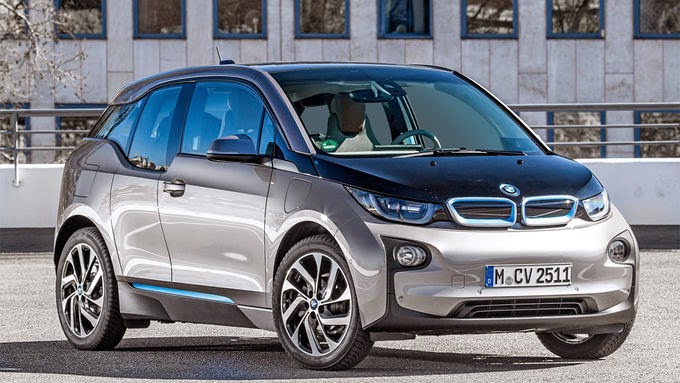
    Around 17,800 customers have taken delivery of a BMW i vehicle in 2014. Global deliveries of the BMW i3 total 16,052; nearly three-quarters of those sales occurred in the second half of the year, following the vehicle’s late-spring market launch in several major markets including the USA. The keys to a total of 1,741 BMW i8s have been handed over to customers since it went on sale in the summer.

    Due to the success of the BMW i vehicles, their production continues to ramp up. Harald Krüger, Member of the Board of Management of BMW AG responsible for Production said,

    “Our production lines in Leipzig are highly flexible and we have switched more production to the i8 to reduce customer waiting times to a better level. Meanwhile, more than 100 BMW i3’s leave the plant each day. The BMW Group is the first automotive company to manufacture using significant quantities of carbon fibre in series production and the success of these cars speaks for itself.”

    BMW plans to offer plug-in hybrid versions of all their main models including Mini and Rolls Royce brands.

    Source: BMW

    Chevrolet unveils Bolt EV Concept; 320 km range for $30,000

    Chevrolet today made a significant statement on its commitment to electrification with the introduction of the Bolt EV concept – a vision for an affordable, long-range all-electric vehicle designed to offer more than 200 miles of range starting around $30,000.

    “The Bolt EV concept is a game-changing electric vehicle designed for attainability, not exclusivity,” said General Motors CEO Mary Barra. “Chevrolet believes electrification is a pillar of future transportation and needs to be affordable for a wider segment of customers.”

    Leveraging the electrification prowess established by Volt and Spark EV, the Bolt EV concept is designed to offer long-range performance in all 50 states and many global markets.

    Drivers will be able to select operating modes designed around preferred driving styles such as daily commuting and spirited weekend cruising, for uncompromising electric driving. The modes adjust accelerator pedal mapping, vehicle ride height and suspension tuning. The Bolt EV concept is also designed to support DC fast charging.

    “We have made tremendous strides in technologies that make it easier and more affordable for Chevrolet customers to integrate an all-electric vehicle in their daily lives,” said Barra. “The Bolt EV concept demonstrates General Motors’ commitment to electrification and the capabilities of our advanced EV technology.”

    The Bolt EV concept also pushes the envelope for crossover aesthetics. Its unique proportion, with practically no front or rear overhang, makes the most of interior space and was designed to create a roomy environment for four that feels expansive. Lightweight materials, including aluminum, magnesium, carbon fiber and even woven mesh, complement the design, while driving down the curb weight to help maximize range. Aero-optimizing features such as vented rear fenders also help contribute to range.

    “Form and function have never meshed so well together,” said Ed Welburn, vice president, GM Global Design. “No compromises were made when it came to aesthetics and the elements that contribute to the Bolt EV concept’s range, resulting in a unique proportion that’s sleek, efficient and obviously a Chevrolet.”

    The Bolt EV concept’s airy interior ambience is enhanced with bold use of glass all around – as well as a full-length, frosted glass roof with unique, faceted design elements. A high beltline sweeps upward with the D-pillar, culminating in an integrated roof spoiler, for a lean, athletic stance. An advanced nano-composite rear hatch and wraparound rear window give the Bolt EV concept a distinctive appearance and flood the interior with more natural light.

    High-intensity, efficient light-emitting diode (LED) headlamp and taillamp elements are housed behind jewel-like faceted lenses in which translucent elements illuminate evenly to create the signature lighting effect.

    Inside, the Bolt EV concept has a large feel reinforced by generous headroom and legroom dimensions. A flat, flow-through floor adds to the roominess, while a contemporary, light color scheme adds to the feeling of an open, airy cabin and conveys warmth.

    The cabin’s airy, high-tech environment is reinforced with lightweight, slim-architecture seats mounted on exposed aluminum pedestals that create a floating effect. The minimalist center console “floats,” too, suspended from the front seats.

    “The Bolt EV concept’s interior is intended as a sanctuary, with materials and technologies that reinforce the airy ambience and help contribute to the vehicle’s overall efficiency,” said Welburn. “It also incorporates technology in a subtler and simpler manner, for a more soothing driving experience – particularly in busy, urban environments.”

    Chevrolet’s signature dual-cockpit interior layout incorporates easy-to-use technology designed to make the driving experience easier and more enjoyable. It wraps into the door panels and features a frosted and translucent appearance – and a subtle glow at night.

    The concept’s technological intuitiveness can be accessed via a smartphone with the concept Bolt EV Connect app, which is designed to:

  • Allow a smartphone to perform as the key fob
  • Allow ride-sharing management, including reservations, vehicle location, digital key and even payment processing via the smartphone
  • Incorporate the concept automatic park-and-retrieval technology, which enables the driver to exit the vehicle and tell the Bolt EV concept to park itself – and when errands are completed, the Bolt EV concept can be summoned to return to the owner’s location.

    A large, color 10-inch-diagonal capacitive-touch screen, with interface features, complements the concept Bolt EV Connect app. It even allows the projection of all the application and other smartphone data onto the screen.

  • Bustech lands $176m deal to build electric buses for Malaysia

    Australian bus manufacturer, Bustech has been chosen as the lead design and manufacturing partner for a $170 million electric bus project.

    Announcing the project, Bustech CEO Michael McGee said the project would position Bustech as an innovative regional leader in the use of renewable energy for buses.

    “The E-Bus project is an international research and development project co-funded by the Malaysian and Australian players and governments, which aims to develop an electric bus for trial operations in Malaysia,” he said.

    Bustech, part of Transit Australia Group, has partnered with the Malaysia Automotive Institute (MAI) (a Malaysian government body), Swinburne University of Technology and AutoCRC and a private Malaysian company to develop and test the E-Bus project in Malaysia.

    Swinburne University is providing the electric bus technology to the project and will work closely with Bustech throughout the trials of the prototype vehicle.

    On the Gold Coast to inspect the Bustech facility, Malaysian Automotive Institute CEO M Madani Sahari said if successful, the electric bus could be exported to other countries.

    “This partnership is a win-win for both Australia and Malaysia because it develops opportunities that have benefits for both countries,” he said.

    Mr Sahari said that Malaysian industry was spending 500 million ringgit ($AUD170 million) on establishing an electric bus public transport system, including infrastructure such as charging stations.

    Transit Australia Group is working closely with a Malaysian manufacturer in exploring opportunities to commercialise the technology.

    AutoCRC, whose role it is to identify and develop opportunities for the Australian automotive industry, helped broker the deal by bringing the MAI and Bustech together.

    AutoCRC research director Gary White said Bustech was well-suited to the project, with high-end capabilities in the manufacturing process.

    “Our long-term vision at AutoCRC is to re-build manufacturing in Australia and this project is a perfect illustration, with Bustech’s manufacturing facility capable of delivering high-quality, innovative products,” Dr White said.

    The first bus is planned to roll off the production line in July 2015, with trials to begin in September.

    Audi aims to launch two electric vehicles by 2018

    Volkswagen's premium Audi division aims to bring two purely electric vehicles to market by 2018 as it tries to catch up with rivals such as Tesla Motors and BMW.

    Audi's Chief Executive Rupert Stadler told German daily Frankfurter Allgemeine Zeitung (FAZ) in an interview to be published on Saturday that the launch of an electric sports car and a sports activity vehicle (SAV) were under way.

    The SAV would be a four-wheel drive with a range of more than 500 km (310 miles) per battery load, Stadler said.

    He also told FAZ that Audi's push to develop electronic drive and digital technologies would mean the division adding 2 billion euros ($2.4 billion) to its investments by 2019. Audi's investment budget through 2018 amounts to 22 billion.

    Tesla Roadster 3.0 adds 70 kWh Battery and 640 km Range

    Tesla Motors have announced a new extended-range upgrade for the Roadster — the Lotus-based two-door that preceded the Model S sedan.

    The upgrade includes a battery swap, a retrofit aerodynamics kit to reduce drag by 15% plus new tires and wheel bearings to decrease rolling resistance by 20%. The upgrades are expected to yield a 40 to 50 percent improvement in range, breaking the 400-mile mark.

    Battery technology has continued a steady improvement in recent years, as has Tesla's experience in optimizing total vehicle efficiency through Model S development. Tesla have long been excited to apply this learning back to their first vehicle, and aim to do just that with the prototype Roadster 3.0 package. It consists of three main improvement areas.

    1. Batteries
    The original Roadster battery was the very first lithium ion battery put into production in any vehicle. It was state of the art in 2008, but cell technology has improved substantially since then. Tesla have identified a new cell that has 31% more energy than the original Roadster cell. Using this new cell they have created a battery pack that delivers roughly 70 kWh in the same package as the original battery.

    2. Aerodynamics
    The original Roadster had a drag coefficient (Cd) of 0.36. Using modern computational methods Tesla engineers 'expect' to make a 15% improvement, dropping the total Cd down to 0.31 with a retrofit aero kit.

    3. Rolling Resistance
    The original Roadster tires have a rolling resistance coefficient (Crr) of 11.0 kg/ton. New tires for the Roadster 3.0 have a Crr of roughly 8.9 kg/ton, about a 20% improvement. They are also making improvements in the wheel bearings and residual brake drag that further reduce overall rolling resistance of the car.

    Combining all of these improvements Tesla 'expect to achieve a predicted 40-50% improvement on range between the original Roadster and Roadster 3.0. There is a set of speeds and driving conditions where we can confidently drive the Roadster 3.0 over 400 miles (640 km). Tesla will be demonstrating this in the real world during a non-stop drive from San Francisco to Los Angeles in the early weeks of 2015.

    Appointments for upgrading Roadsters will be taken this spring once the new battery pack finishes safety validation. Tesla are confident that this will not be the last update the Roadster will receive in the many years to come.

    Mercedes Developing Electric Vehicle Platform

    Mercedes-Benz is in the early stages of developing a new platform to underpin a range of electric vehicles.

    The platform, tentatively called Ecoluxe, is part of an ambitious €2 billion project that Mercedes executives are allegedly about to approve. The guidelines call for a platform that is light in order to offset the bulk of the battery pack and modular so that it can underpin both long and short wheelbase vehicles. Mercedes is currently planning on building four body styles on the Ecoluxe platform, though additional variants could be added later in the production run.

    German magazine Auto Bild reports that all cars built on the Ecoluxe platform will feature rear-wheel drive and an innovative four-wheel steering system. The first model, which has not been given a name yet, will pack the equivalent of 544 horsepower in standard S form or 603 hp in GT tune. A high-capacity battery pack located under the passenger compartment will give the car a maximum driving range of at least 450 km.

    The first model underpinned by the Ecoluxe platform is scheduled to hit the market in either 2019 or 2020

    BMW say Auto Industry Switch to Electric Cars Not Far In Future

    BMW gives the signal of change in the auto industry saying that the moment to move to electric cars is not that far in future.

    The evolution of electricity storage technologies will ensure the appearance of more efficient batteries and the launch of electric cars with ranges comparable to that of fossil fuel cars. BMW officials think that moment will soon be upon us.

    One of the core people in BMW’s organization chart, Ian Robertson, said that electric cars that run on hydrogen fuel cells may be the solution for the future of the automotive industry. But this is very unlikely to happen because the technologies that will enable more efficient energy storage in “normal” batteries will evolve and will radically transform ranges and load times of conventional electric cars.

    “We’ve said we’ll continue to invest in hydrogen and that will result in a small number of production test vehicles being made to prove the technology works. The real issues lie not around what we can do, though, but whether the infrastructure can be built up to supply hydrogen in the marketplace cost-effectively.” said Robertson arguing that the current lithium-ion batteries will slowly be replaced by more efficient technology.

    “Advances in lithium ion technology are set to be followed by a switch to lithium air and then solid-state batteries. These advances over the next 10 years could see charging time and range worries disappear,” Robertson thinks.

    Solid-State Batteries are one of the solutions proposed by technology companies. This battery is based on solid electrolytes instead of liquid electrolyte from today’s batteries. This technique allows using conventional electrodes and they are changed with some Lithium Metal. In this configuration, a battery can store two to three times more energy and provides short charge times, thus improving the level of safety: the battery does not contain the flammable liquid presently found on any battery on the market today.

    With regards to the pace of adopting electric cars, BMW official believe that it will be accelerated by the manufacturers which, at one time, will redirect investments from classical combustion engines toward the electrical ones.

    “At some point in the future the technologies will switch over. When the crossover comes and the focus becomes electricity, the rate of learning will accelerate even faster. Relatively, that time is not far away” concludes Ian Robertson.