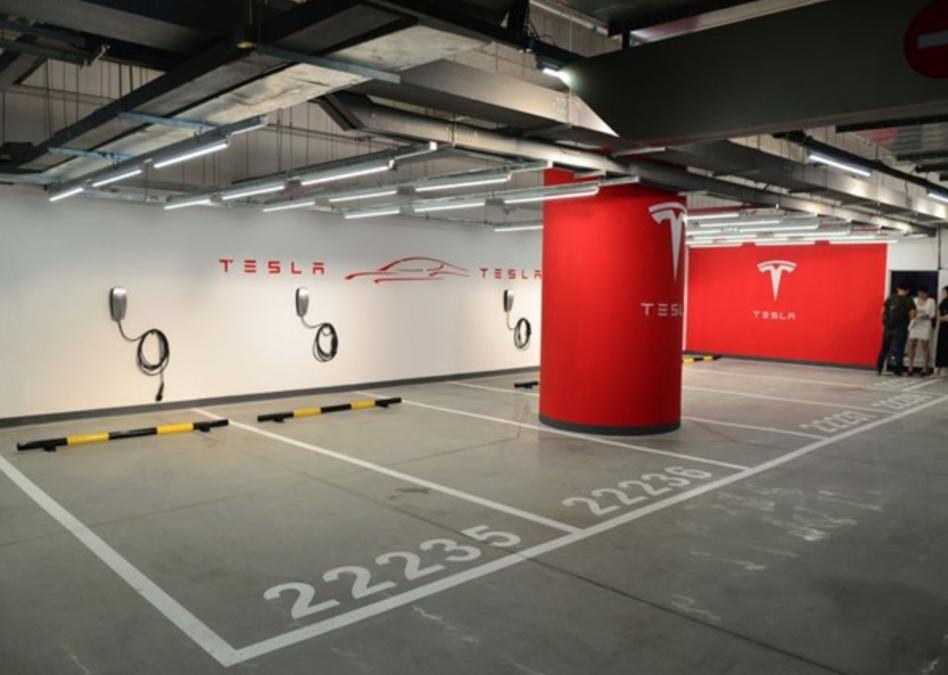
Tesla Motors has introduced its ‘destination charging’ program into Australia, with over 10 sites established. Model S owners who frequent longer trips will benefit from the destination charging program, where owners can charge at no cost.
Tesla destination charging program provides ‘high power wall units’ at key destinations for Model S owners to charge while away from home for long periods.
The wall units can provide as much as 40 amp of power to Model S and are also provided with Model S for home installation, making the device familiar to owners.
With up to 500 km of rated range, the majority of charging with Model S is done at the home, but now the destination charging will provide locations where there are longer or overnight stops.
Locations include key hotels such as Park Hyatt Sydney, The Darling, Hotel Realm Canberra, The Observatory in Port Macquarie and to fulfil the winter snow travelers Rundells Alpine Lodge Dinner Plain.
In addition, key shopping centres such as Westfield Chatswood and Chadstone have been utilised, with premium parking locations and wall units available to Model S owners.
Tesla Motors has also partnered with Secure Parking to enable a safe location for Model S owners to park and charge whilst at work or out in town. These locations are located across Brisbane, Sydney and Melbourne.
“This expanding network of destination charging is a great replication of the convenience our owners receive when charging at home. Along with the developing Supercharger network, our owners will be able to cover long distances with the knowledge they have a charging solution,” says Australian Tesla spokesperson, Heath Walker.
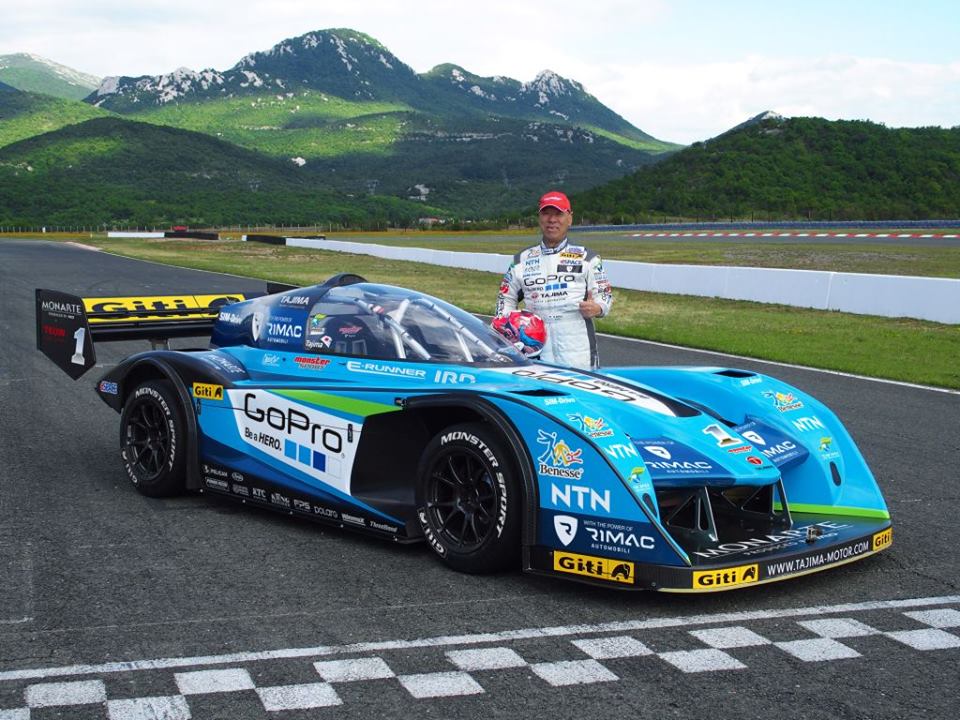
Team APEV with MONSTER SPORT, led by the racing legend Nobuhiro “Monster” Tajima, teamed up with Rimac Automobili. As a result, 2015 Pikes Peak International Hill Climb Race will have a new 1.1 MW beast at the starting line, the Tajima Rimac E-Runner Concept_One.
Rimac Automobili are once again showing their vigorous racing DNA taking the challenge in one of the most prestigious races in the world. Mr. Tajima’s decades long experience in racing and Rimac Automobili’s state of the art technology and know-how brought to life a staggering creation, the Tajima Rimac E-Runner Concept_One. It is powered by four independent electric motors, giving the car a total power of over 1,1 MW (1,475 HP). That is more than twice the power Mr. Tajima had in his 2014 car when he broke his own Pikes Peak record, stopping the clock at 9:43,90.
There are no gearboxes or differentials on this car. The power of each independent motor is transferred to each wheel by an innovative chain drive system developed specifically for this project, which saves a lot of weight and space. Embracing the Rimac Automobili technology, the Tajima Rimac E-Runner Concept_One features an adapted racing version of the Rimac All Wheel Torque Vectoring system, first implemented in the Rimac Concept_One.
The Rimac AWTV controls the torque of each motor 100 times a second. The system can vary the torque on each wheel depending on the steering angle, speed, longitudinal and lateral forces, yaw-rates and number of other variables. The ECU runs the collected sensor-data through complex mathematical algorithms which calculate the optimum torque distribution on a millisecond-level. This enables the vehicle to take full advantage of the tires, squeezing the maximum out of their potential and giving the driver the desired vehicle dynamics at any given moment. Mr Tajima will thus have both the 1,1 MW of power and maximum grip in each of the Pikes Peak’s 156 corners.
“We measured 0-100 km/h in 2,2 seconds. 200 km/h comes in 5,4 seconds from a standstill. Cornering forces and stopping numbers are also impressive, but let’s not spoil the surprise. We are quite confident that Tajima Rimac E-Runner Concept_One will break previous year’s record. He is a great driver with tons of experience. Interesting fact – he raced Pikes Peak his first time a year before I was born. 28 years later, we work alongside to push the limits further. With the support of our best engineers and technicians, our technology, powertrain, battery-system and Torque Vectoring, he will be able to push the boundaries of electric race cars to a whole new level. Working with Mr. Tajima and his team is an amazing experience of which we enjoy every second.” reveals Mr. Rimac.
“The Pikes Peak is one of most difficult hill climbs in the world, because it is held on a public road, not a race track. The conditions are constantly changing. We want to develop technology and gather experience from the Pikes Peak race for development of better, safer, and zero emission road cars. This is my aim. Rimac Automobili is a quite young company but their mind and their spirit are fantastic. The level of technology, professionalism and vertical integration that this company has managed to achieve in such a short time amazed me. I am very happy because Rimac Automobili is simply the best partner for Team APEV.” said Mr. Tajima after the initial testing in Croatia.
The Pikes Peak hill climb is 19,9 km long and ends up at 4,301 m above sea level. Petrol engines have oxygen starvation problem at that altitude - the power of the engine decreases over 40 percent. However, electric motors don’t use oxygen, so Mr. Tajima will have the full power of all four electric motors available from start until the finish line.
Pikes Peak race
The Pikes Peak International Hill Climb race in Colorado has taken place since 1916. On average it features around 130 competitors from all over the world. This year the event is starting with practice sessions on Tuesday, June 23rd, culminating on race day, Sunday June 28th. The track is 19,99 km (12,42 miles) long, has 156 turns climbing 1,440 m (4,720 ft) from the start at Mile7 of the Pikes Peak Highway, to the finish at 4,300 m (14,110 ft).
Tajima Rimac E-Runner Concept_One
Technical data:
All-wheel drive
Four independent Rimac permanent magnet electric motors
Rimac All Wheel Torque Vectoring
Maximum power: 1100 kW
Maximum torque: 1500 Nm
Maximum regenerative braking: 400 kW
57 kWh Rimac Automobili battery pack
Four chain driven single reduction Rimac transmission systems
Monster Sport aluminum alloy tubular space frame with carbon-fiber body
Electrically assisted power steering
Adjustable shock absorbers
Ventilated brake discs Ø370 mm front and rear + Rimac regenerative braking system
Daimler and telecommunications giant Qualcomm Technologies have announced a partnership to develop new wireless charging technologies for vehicles and phones.
The alliance will focus on “mobile technologies that enhance in-car experiences and vehicle performance,” as well as Qualcomm's Halo Wireless Electric Vehicle (WEVC) technology, with the overall aim of introducing an induction charging system into future Mercedes models.
Possible candidates for the technology could include the next-generation Mercedes-Benz S-Class, currently powered by a plug-in hybrid 3.0-litre twin-turbo V6, or even the small-sized B-Class Electric Drive.
Qualcomm, more widely known for producing a range of high-end smartphone processors, started developing the technology in 2011 and WEVC trials have been underway in the United Kingdom since 2012, with the technology working similarly to wireless phone charging.
A Vehicle Charging Unit (VCU) is installed in the floor of a garage or car park, which sends power wirelessly to a similar unit installed in the car, which sends power to the electric vehicle batteries.
Currently the technology only allows for stationary charging, but development is underway on dynamic charging that will work by installing multiple VCUs underneath roads capable of charging cars on the move.
The implementation of dynamic charging could cut the cost of electric vehicle manufacturing by reducing the need for large, range-extending batteries.
Additionally, Qualcomm's WiPower technology will be implemented to allow full wireless charging on a smaller scale, for compatible smartphones and tablets inside the vehicle.
Daimler AG group research and Mercedes development board member Thomas Weber said the new partnership will bear fruit for both companies.
“It's important that we remain on the cutting edge of technology and continue to deliver unparalleled experiences to our customers,” he said.
“With this in mind, we are eager to jointly explore possible fields of future cooperation with an internationally leading tech-firm like Qualcomm.”
Qualcomm Incorporated President Derek Aberle said integration of vehicle and mobile communications is the way of the future.
“The automobile has become an extension of always-on connectivity, and as such, we're continuously utilising our expertise in wireless mobility to deliver in-car experiences comparable to the ease and convenience of smartphones,” he said.
Last year, German luxury rival brand BMW announced it would team up with Daimler to research and explore the possibilities of similar technology, and Volvo has also previously revealed it is looking at the cordless tech and Toyota signed a deal with WiTricity in late 2013.
Californian Electric car specialist Tesla has also tested the potential of such systems, but dismissed them saying too much power was wasted in the transfer process.
Rimac Automotive have released a tease video of a track test session. The car featured has been built by Rimac for Monster Tajima, who will contest the 2016 Pikes Peak International Hill Climb with the vehicle.
Bosch's engineers took a pair of Model S and fitted them with autonomous technology to allow them to drive themselves.
That technology consisted of 50 new components, including (brace yourselves) a front stereo video camera to watch the road markings and identify obstacles, six (non-Bosch) LiDAR laser scanners for 360º coverage around the car, two long-range (200m) and four mid-range (120m) radar sensors facing forwards and backwards, inertial sensors, a GNSS GPS navigation antenna, backup braking (both Bosch’s iBooster and ESP boxes) and ECU systems and a massive great PC in the back to hold hi-res maps and crunch the incoming data via bespoke algorithms.
In total, 1400 human-hours, 1300 metres of cable and an estimated €200,000 went into the car.
The result looks almost like a normal Model S - no pirhouetting Velodyne ‘Christmas tree’ on the roof here, just a few dark panels, a flying saucer GNSS antenna on the back and some industrial-looking buttons - and it’s so effective that it’s almost prosaic.
At the winding Boxberg test track, a Ford Fiesta drove around in front of us to show how smart the Tesla now is. Stopping quickly, driving at snail’s pace, accelerating into the distance: the Tesla reacted to the lot in a considered, sedate, measured manner. (Bosch tells us it can also swap lanes, overtake and merge with traffic on its own, but we didn’t get to check that out.)
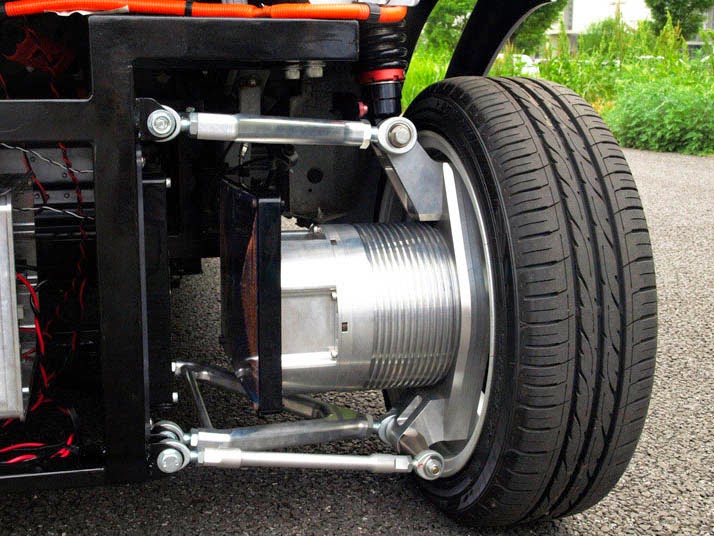
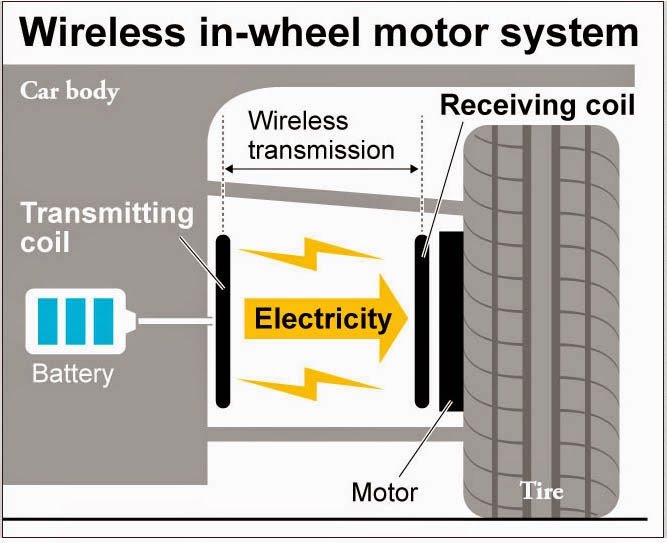
Japanese researchers have successfully developed the world’s first in-wheel motor system for electric vehicles that transmits power wirelessly to run motors incorporated in each wheel.
Hiroshi Fujimoto, an associate professor at the University of Tokyo specializing in electric vehicle control, and other researchers ran a vehicle equipped with the new system that transmits electricity wirelessly from an onboard power source to a coil attached to the wheel hubs.
“This technology will pave the way for the development of advanced electric vehicles, including those that receive electricity wirelessly from transmitting coils that are embedded under road surfaces,” Fujimoto said. “It can be also applied to fuel-cell vehicles and industrial machinery.”
The in-wheel motor, also known as wheel hub motor, is an electric motor that is incorporated into the hub of a vehicle's wheels to directly drive each wheel.
Compared with conventional electric vehicles, the in-wheel motor model does not require a drive shaft, a component that takes power from a single source and mechanically transfers it to all the wheels to drive them. Thus, a car using the system could be built lighter and require less energy.
Acceleration and braking for each wheel can also be controlled, which would help prevent mishaps such as skids.
Current cars using in-wheel motors need wires to transmit electricity. The complex wiring distribution and its susceptibility to shorting out have remained a hurdle in developing such a vehicle for practical use.
The research team’s wireless system transmits the electricity stored in the vehicle’s batteries through a transmitting coil to a receiving coil in the wheel hub, a distance of 10 centimeters.
The researchers successfully ran a motor using a maximum of 3 kilowatts of electricity and sent control information to each wheel using standardized Bluetooth wireless technology.
The rear-wheel-drive prototype car can, in theory, run at maximum 75 kph, the researchers said.
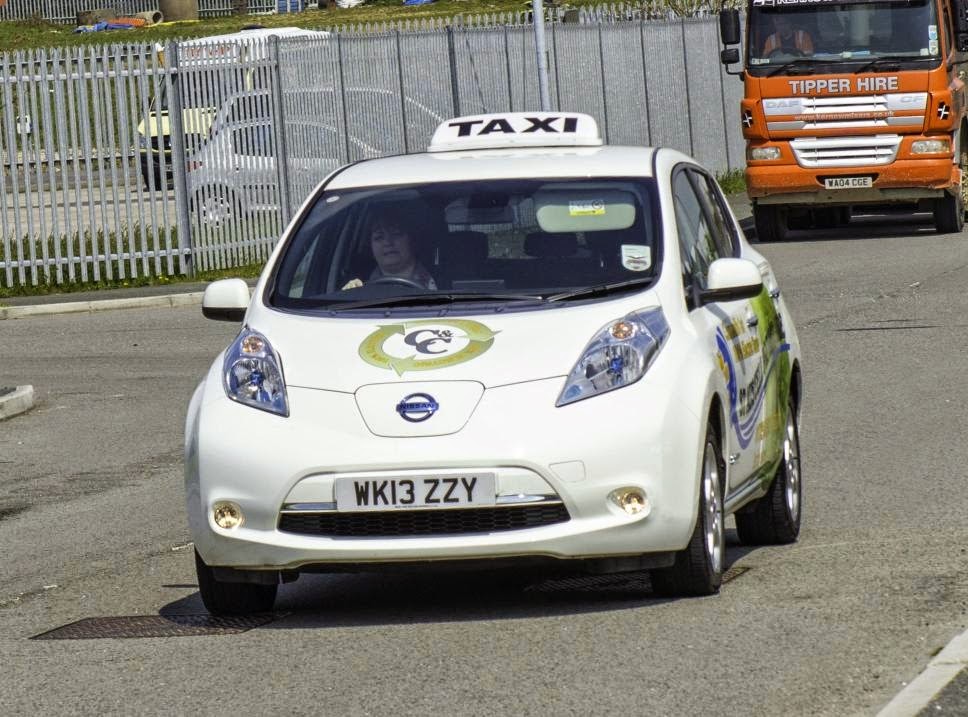
A Nissan LEAF taxi in Cornwall has clocked up its 100,000th mile (160,000 km) since entering service with C&C Taxis in 2013.
‘Wizzy’ as it was named by operators at St Austell-based C&C Taxis, hit the milestone in the course of more than 25,000 pure electric paying fares and having been rapid charged over 1,700 times yet retains near full battery health and is still on its first set of brake pads.
Inspired by Wizzy’s performance, C&C Taxis now operates five further 100% electric Nissan LEAFs and an all-electric Nissan e-NV200 Combi.
Mark Richards, fleet manager at C&C Taxis, estimates that each vehicle saves the business around £8,500 per year in fuel bills and maintenance costs.
"When we speak to other taxi operators they often tell us range and battery life are the biggest factors preventing them from considering an electric taxi," he said. "Then, when we tell them Wizzy’s done 100,000 miles and still has full battery health, they’re left speechless.”
“It’s no exaggeration to say Wizzy has transformed our business. We took a gamble when we bought her but she’ll have paid for herself in just 24 months and the savings we’re now making across the fleet are phenomenal,” he added.
Power Plaza Co Ltd, a South Korea-based firm, showed an electric vehicle (EV) concept that can travel 571km (approx 354.8 miles) at a speed of 60km/h (approx 37.3 mph) per charge.
The EV, "Yebbujana R," was exhibited at the 28th International Electric Vehicle Symposium and Exhibition (EVS 28), an international symposium/trade show on EVs, which took place from May 3 to 6, 2015. The company plans to release the EV at the end of 2016 in South Korea at a price of US$40,000.
The EV uses cylindrical lithium-ion battery cells called "18650." The total capacity of the cells is 54kWh. A carbon fiber-reinforced plastic (CFRP) was applied to the body of the EV to reduce weight, realizing a drive range longer than 500km. The mass of the body is 745kg. According to Power Plaza, the auto body consists of an underpiece, hood, doors, rear, etc, and all of them are made of CFRP.
As a driving motor, an 80kW motor manufactured by Robert Bosch GmbH was employed. The maximum speed of the EV is 198km/h, and it takes 4.6 seconds to reach a speed of 100km/h from zero.
Established in 1991, Power Plaza has been dealing with switching power modules and developing EVs under its own brand. Thus far, it has developed six kinds of EVs (1t and 0.5t pickup trucks and four passenger cars) and launched them into the market. So, the Yebbujana R is the company's seventh EV.
As we reported a month ago, Bosch has confirmed they are working with Tesla to develop automated driving systems for production vehicles.
Spotting a test vehicle, equipped as they are with measurement devices, sensors, and instruments, is usually pretty easy. But that’s not the case for the new Model S Teslas that recently joined the Bosch fleet. Both these test vehicles are helping engineers further refine automated driving. But at first glance, it’s hard to tell them apart from production models. “Bosch is developing automated driving for production vehicles of all kinds,” says Dr. Dirk Hoheisel, member of the Bosch board of management. The new test vehicles are evidence of the progress Bosch has already made in integrating the necessary systems and components. Those attending the 62nd International Automotive Press Briefing can see this for themselves in Boxberg, Germany, from May 19 to 21, 2015
Fit for highly automated driving after 1,400 hours of work
To make the test vehicles ready for automated driving, they first had to be retrofitted. Fifty new Bosch components were installed in each car. They included a stereo video camera (SVC), which the car uses to recognize lanes, traffic signs, and clear spaces. The Bosch SVC is the smallest stereo camera system for automotive applications currently available in the market. Its compact design makes it easy to integrate into vehicles. In addition to the camera, 1,300 meters of cable were laid in each car and fixed in place with 400 cable ties. “After some 1,400 hours of work on each of them, the test vehicles are ready for highly automated driving,” Hoheisel says. Thanks to Bosch technology, the two Teslas can now autonomously drive from on-ramp to off-ramp without the driver needing to constantly monitor them.
This transfer of responsibility from the driver to the vehicle explains why so much time and effort is necessary for the retrofit. Highly automated vehicles must be capable of operating safely even if a component fails. The only way to achieve such operational reliability is by a design strategy that includes redundancy in safety-critical systems such as braking and steering. For example, both test vehicles feature both the iBooster electromechanical brake booster and the ESP braking control system. These Bosch components can brake the car independently of each other, without any need for driver intervention. “For Bosch, the principle here is safety first,” Hoheisel says. Back-up systems are also available for the two test vehicles’ power supply and vital ECUs.
Several thousand test kilometers driven without a hitch
Since 2011, Bosch has had two teams – on two continents – working on automated driving. At the Abstatt location in Germany, Bosch engineers are working on system integration. Their colleagues at Palo Alto in California’s Silicon Valley are driving forward work on function development. The two teams receive support from roughly 2,000 driver-assistance engineers who work for Bosch around the world. To make it as easy as possible for the two teams to share their results, Bosch uses identical test vehicles. Hoheisel explains why Bosch opted for two all-electric Model S vehicles made by the U.S. automaker Tesla: “They combine two automotive industry trends: electrification and automation.” This presents a particular challenge, he says, but one that Bosch relishes.
Bosch started testing automated driving on public roads at the beginning of 2013. So far, it has been using test vehicles based on the BMW 325d Touring. Engineers have successfully driven them for several thousand kilometers on freeways – both the A81 near Stuttgart and the I280 in California. Before the first test drives, the German certification authority TÜV Süd reviewed the safety concept that Bosch had prepared specially for the purpose. And even though the technology on board the vehicles is designed to handle any situation in freeway traffic, the drivers at the wheel have been specially trained. Bosch’s test drivers not only know the safety precautions inside out, but have also completed a multi-day training course.
The 2016 BYD e6 will have 400 km (250 miles) range thanks to an increase in battery capacity to 82 kWh, according to a document from China’s Ministry of Industry and Information Technology.
Compared with the current model, the 2016 e6 will be 40 kg heavier from 2380 kg to 2420 kg with range increased by 100 km from 300 km to 400 km.
The 82 kWh battery pack, up from 60 kWh in the current model, is 100kg heavier (700 kg) with a claimed cell energy density of approx 150 Wh per kilogram.
The e6 was originally launched five years ago in May 2010. The first batch of 60 e6s were delivered to a taxi company in Shenzhen. Deliveries to individual buyers started in 2011 with annual sales of 1,544 in 2013 and 3,560 in 2014.
The 2016 e6 will be launched in late 2015. Prices will remain unchanged between 300,000 Yuan and 370,000 Yuan before rebates.
The BMW Group is partnering with logistics company SCHERM Group to deploy a 40-ton pure-electric truck in the city this summer and become the first automobile manufacturer in Germany to use an electric truck of this size to transport materials on public roads.
The innovative traction vehicle, which is licensed for use on public roads, will be deployed as of this summer for just-in-time material transport over short distances. The electric truck will drive between the logistics company SCHERM Group and the BMW Group Plant Munich eight times a day, covering a distance of almost two kilometres one-way. Thanks to its alternative drive train, the truck is quiet, CO2-free in traffic and generates virtually no particle pollution for the environment. This is also reflected in the vehicle’s overall assessment in comparison with a truck with diesel engine: The environmentally friendly truck will generate 11.8 tons less CO2 per year – equivalent to a BMW 320d Efficient Dynamics driving almost three times around the world.
“Just under two years ago, our BMW i brand put sustainable mobility on the road. This pure electric truck signals that we are constantly working on innovative solutions and tackling logistics challenges,” says Hermann Bohrer, director of BMW Group Plant Munich. “We are therefore delighted with the cooperation with SCHERM.”
The BMW Group and SCHERM Group are investing a six-figure amount in the pilot project, which will initially span one year. If the vehicle proves itself in everyday driving conditions, both partners will seek to expand the project.
“After a long search, we have found an electro-mobility solution for the transport sector,” explains Rainer Zoellner, “e-truck” project manager at SCHERM Group. “We are certain to gain valuable experience with the BMW Group from this pilot project.”
The BMW Group pursues a holistic approach focused on implementing sustainability throughout the value chain. In addition to future-oriented mobility solutions, issues such as corporate environmental protection, efficient use of resources and reduction of CO2 emissions are firmly rooted in company strategy. Since 2014, the BMW Group has sourced more than half its global electricity needs from renewables.
SCHERM Group is an international systems provider offering solutions for the logistics, transport, real estate and service sectors. As a provider of services for the entire value chain, the company employs a workforce of around 2,000 employees at 14 locations and on a mobile basis in around 500 company-owned trucks. Sustainability is an important factor the company has defined as a fundamental value.
Aston Martin has announced a production version of the all electric DBX SUV concept will enter production and be on sale by 2019.
In a statement issued last night, Aston’s boss Andy Palmer announced his company had raised the £200m from its two majority shareholders to begin work on creating a production version of last month’s Geneva motor show concept.
“The additional investment announced today will allow us to realise the DBX and other new luxury vehicles that will form the strongest and most diverse portfolio in our history”. Said the Aston CEO.
The DBX Concept is an all-wheel drive crossover high luxury GT that uses in-board electric wheel motors at all four corners powered by lithium sulphur cells. Steering is a drive-by-wire system and both the driver and passenger have head-up displays surrounded by auto-dimming ‘smart glass’.
In February 2015 Robert Llewellyn drove a Tesla Model S P85 from Oslo, Norway to London, England, a distance of 2,000 km (1,300 miles), using free Tesla superchargers virtually the entire distance.
Chevrolet has created a vision of what it thinks a full autonomous all-electric vehicle of the future might look like.
Created by GM’s Pan Asia Technical Automotive Center the Chevrolet-FNR is an autonomous electric concept vehicle that boasts a futuristic capsule design. It has crystal laser headlights and taillights, dragonfly dual swing doors.
The Chevrolet-FNR features an extremely aero design focused on low drag powered by AWD magnetic hubless electric wheel motors along with autonomous wireless charging. A laundry list of imaginary specification like range and power output has been provided.
The Chevrolet-FNR is loaded with a range of sensors like roof-mounted radar that can map out the environment to enable driverless operation, Chevy Intelligent Assistant and iris recognition start. The Chevrolet-FNR can also serve as a “personal assistant” to map out the best route to the driver’s preferred destination.
In self-driving mode, the vehicle's front seats can swivel 180 degrees to face the rear seats, creating a more intimate setting. The driver can switch to manual mode through the gesture control feature.
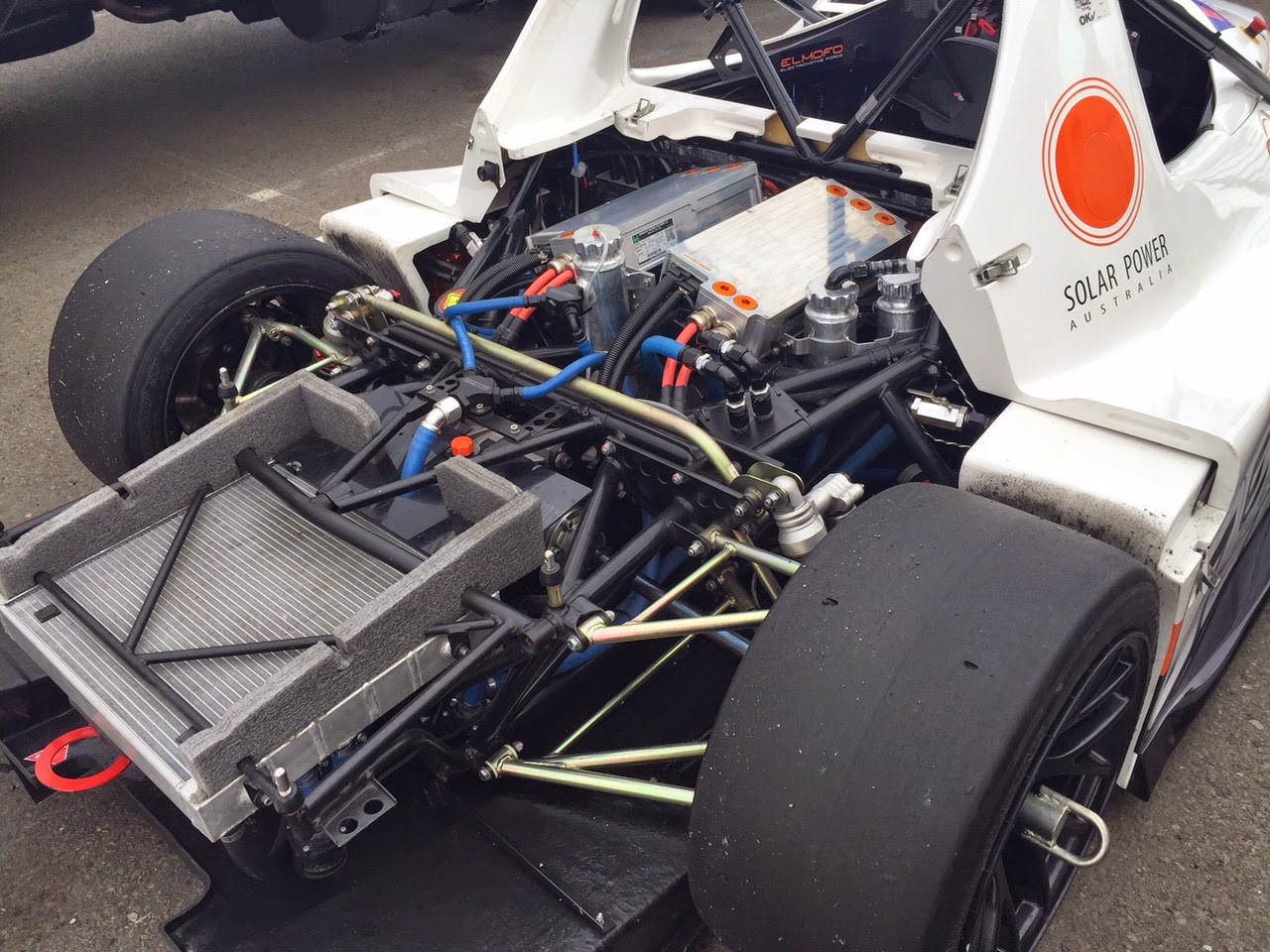
In a demonstration run during the Mighty Car Mods Nationals at Sydney Dragway the ELMOFO Electric Radical made it's maiden run down the quarter mile achieveing at time of 10.922 seconds @ 131.25 Mph (211.24 km/h).
The EV Radical SR8 is designed for circuit racing and has the distinction of being the first electric car to win a race against petrol vehicles in a sanctioned event. The ELFOMO Racer has a peak output of 300 Kw / 600 Nm from twin Remy based BLDC permanent magnet motors with energy fed from a 30 kWh KoKam Li-Po battery pack via two RMS inverters.
This was the cars first run down a quarter mile and the 10s time was achieved with worn rain tires and gearing more suitable to circuit racing (top speed of 270 km/h). With lower gearing and heated slick tires ELMOFO could be knocking on the door of a 9 second pass. Even with the current set-up, ANDRA officials started to warn the team the car is close to requiring a parachute if it runs much faster.
Finnish startup Toroidion has launched their all-electric megacar at the Top Marque show in Monaco. The Toroidion has 1341 hp total and a swappable battery.
With 2x 200 kw at the front and 2x 300 kw direct drive in-board wheel motors at the rear, the Toroidion 1MW Concept, built by designer Pasi Pennanen, was created to be an electric car that can compete in the GT classes at the 24 Hours of Le Mans.
The Modular Robotic Vehicle, or MRV, was developed at NASA’s Johnson Space Center in order to advance technologies that have applications for future vehicles both in space and on Earth. With seating for two people, MRV is a fully electric vehicle well-suited for busy urban environments.
One of NASA’s key purposes for the project was to have access to a technology development platform. “This work allowed us to develop some technologies we felt were needed for our future rovers,” said Justin Ridley, Johnson Space Flight Center. “These include redundant by-wire systems, liquid cooling, motor technology, advanced vehicle control algorithms. We were able to learn a lot about these and other technologies by building this vehicle.”
Just as NASA helped pioneer fly-by-wire technology in aircraft in the 1970s, MRV is an attempt to bring that technology to the ground in modern automobiles. With no mechanical linkages to the propulsion, steering, or brake actuators, the driver of an MRV relies completely on control inputs being converted to electrical signals and then transmitted by wires to the vehicle’s motors. A turn of the steering wheel, for instance, is recorded by sensors and sent to computers at the rear of the vehicle. These computers interpret that signal and instruct motors at one or all four of the wheels to move at the appropriate rate, causing the vehicle to turn as commanded. Due to a force feedback system in the steering wheel, the driver feels the same resistance and sensations as a typical automobile.
Not having a mechanical linkage between the driver and the steering wheel introduces new risks not seen on conventional automobiles. A failed computer, or cut wire, could cause a loss of steering and the driver to lose control. Because of this, a fully redundant, fail-operational architecture was developed for the MRV. Should the steer-ing motor fail, the computer system responds immediately by sending signals to a second, redundant motor. Should that computer fail, a second computer is ready to take over vehicle control. This redundancy is paramount to safe operations of a by-wire system.
MRV’s redundant drive-by-wire architecture allows for advanced safety and dynamic control schemes. These can be implemented with a driver operating either within the vehicle or by remote interface. In the future this system can be expanded to allow for autonomous driving
MRV is driven by four independent wheel modules called e-corners. Each e-corner consists of a redundant steering actuator, a passive trailing arm suspension, an in-wheel pro-pulsion motor, and a motor-driven friction braking system.
Each e-corner can be controlled independently and rotated ±180 degrees about its axis. This allows for a suite of driving modes allowing MRV to maneuver unlike any traditional vehicle on the road. In addition to conventional front two wheel steering, the back wheels can also articulate allowing for turning radiuses as tight as zero. The driving mode can be switched so that all four wheels point and move in the same direction achieving an omni-directional, crab-like motion. This makes a maneuver such as parallel parking as easy as driving next to an available spot, stopping, and then operating sideways to slip directly in between two cars.
“This two-seater vehicle was designed to meet the growing challenges and demands of urban transportation,” said Mason Markee, also with Johnson. “The MRV would be ideal for daily transportation in an urban environment with a designed top speed of 70 km/hr and range of 100 km of city driving on a single charge of the battery. The size and maneuverability of MRV gives it an advantage in navigating and parking in tight quarters.”
The driver controls MRV with a conventional looking steering wheel and accelerator/brake pedal assembly. Both of these interfaces were specially designed to mimic the feel of the mechanical/hydraulic systems that people are used to feeling when driving their own cars. Each device includes its own redundancy to protect for electrical failures within the systems. A multi-axis joystick is available to allow additional control in some of the more advanced drive modes. A configurable display allows for changing of drive modes and gives the user critical vehicle information and health and status indicators.
Each propulsion motor is located inside the wheel and capable of producing 190 ft-lbs of torque. An active thermal control loop maintains temperatures of these high powered motors. A separate thermal loop cools the avionics, includ-ing custom lithium-ion battery packs.
“While the vehicle as a whole is designed around oper-ating in an urban environment, the core technologies are advancements used in many of our robotic systems and rovers,” explained Mason. “Actuators, motor controllers, sensors, batteries, BMS, component cooling, sealing, and software are all examples of technologies that are being devel oped and tested in MRV that will be used in next generation rover systems.”
The technologies developed in MRV have direct appli-cation in future manned vehicles undertaking missions on the surface of Earth’s moon, on Mars, or even an asteroid. Additionally, MRV provides a platform to learn lessons that could drive the next generation of automobiles.
Tesla Motors introduces the All-wheel drive Model S 70D. Uniting exceptional performance and drive experience features, the newest Model S offers great value at a compelling price. Starting at $102,400 RRP plus luxury car tax, on-road costs and stamp duty, Model S 70D includes dual motor all-wheel drive technology, a NEDC-rated 440 km of range, and a 0-100 time of 5.4 seconds.
In addition to dual motor, 70D comes standard with Autopilot Hardware, Navigation, and Supercharging. And, as with every Model S, 70D will run on the new software 6.2 and owners will continue to receive free over-the-air updates that will add additional functionality, enhanced performance, and improved user experience over time.
To make room for the 70D, Tesla is eliminating the 60, which had been its cheapest Model S since the sedan’s 2012 launch. Starting at $76,170 before any government incentives, the 70D will cost $5,000 more than a basic 60, though it includes use of Tesla's proprietary Superchargers, which was previously a $2,000 option.
Model S70D will be able to travel 440 km (275 miles) between charges and deliver 380 kw (514 hp) to all four wheels from two electric motors -- up from 375 km (233 miles) of range and 280 kw (380 hp) for today’s basic rear-drive Model S, called the 60.









.jpg)