VW Develops Self-Parking Self-Charging Electric Vehicle [VIDEO]

Volkswagen have launched an EU research project called 'V-Charge' to look into the near future of automated parking. Six national and international partners are jointly developing new technologies with a focus on automating the search for a parking space and on the wireless charging of electric vehicles.

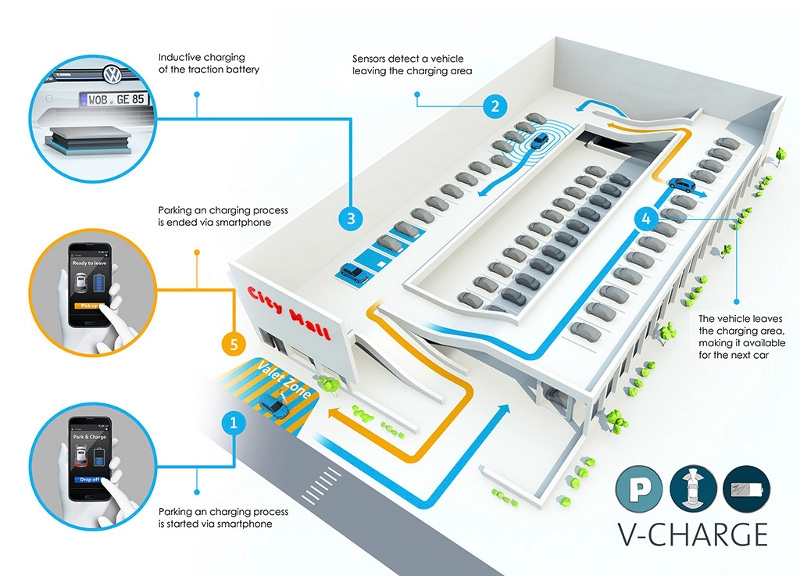
The test vehicles not only automatically looks for an empty parking space, but can also finds an empty space with charging infrastructure and inductively charges its battery. Once the charging process is finished, it automatically frees up the charging bay for another electric vehicle and looks for a conventional parking space. 'V-Charge' stands for Valet Charge and is pointing the way to the future of automated parking.

In the USA especially, convenient valet parking is a big hit: you pull up in your car right outside your destination, valet service personnel park it for you and have it brought around again as and when you need it. There is no more time-wasting search for a parking place. The V-Charge project picks up on this idea. Its development goal is fully automated searching for a parking space ('valet parking') within defined zones, such as in multi-storey car parks.

There are many scenarios that illustrate the advantages of the V-Charge concept. Take one practical everyday example: a commuter notices that he is possibly going to be late and is thus running the risk of missing an important meeting at his company. With V-Charge he is able to pull up right in front of the main entrance, get out and establish the link to his vehicle via the associated smartphone application. Operating fully automatically, the vehicle has a digital map relayed to it and within the parking area or multi-storey car park autonomously navigates to a parking space. If it is an electric vehicle, the system additionally prioritises a parking bay with an automatic charging facility. Pedestrians, cyclists and other vehicles are identified by the cameras and ultrasound sensors integrated within the vehicle. Therefore, the vehicle is allowed to travel in so-called 'mixed traffic'. The selected parking area neither has to be an enclosed domain nor is any complex technical equipment required.

As the electric vehicle nears its destination, the system recognises via local sensors whether the allocated parking space is taken. If it is empty, the fully automatic parking manoeuvre begins and positions the vehicle exactly above the inductive charging spot. When the charging process is complete, the vehicle automatically moves to another parking space, leaving the charging station free for another electric car. When the driver returns to the multi-storey car park, he calls the vehicle back to the starting point via the V-Charge app. The vehicle moves to the defined pick-up location, with the driver not needing to set foot in the parking area or multi-storey car park.

Taking the lead in the international research consortium is the Swiss Federal Institute of Technology (ETH) in Zurich. It is responsible for visual localisation, movement planning and vehicle control (Autonomous Systems Lab division), camera calibration, 3D reconstruction from images and obstacle detection (Computer Vision and Geometry Lab division). Braunschweig Technical University works on the issues of car park management and the vehicle's communication with the technical surroundings (vehicle-to-infrastructure 'V2I'), Robert Bosch GmbH contributes its expertise in the field of sensor technology, Parma University looks after object recognition and Oxford University handles the development of detailed navigation maps of the parking area (semantic mapping concepts). As the sixth partner in the consortium, Volkswagen is providing the platform equipment, safety and control modules, as well as systems for static monitoring of surroundings, object recognition and automated parking.

The test vehicle: a network of technical sensory organs
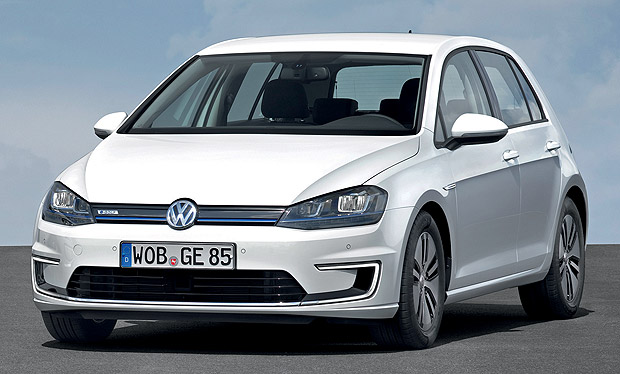
The technical prerequisites largely already exist. During the introductory stage, for instance, it was possible to utilise sensor and camera technologies that are already being used in today's production vehicles. A dense network of sensory devices enables autonomous operation of the V-Charge test vehicle, which is based on a Volkswagen e Golf1. Four wide-angle cameras and two 3D cameras, twelve ultrasound sensors, digital maps and the so-called 'Car2X' technology for the vehicle's communication with the infrastructure ensure that the vehicle's surroundings are reliably detected and recognised. Pedestrians, vehicles and obstacles get identified, parking spaces recognised and measured and then this stream of data is put together in real time to form an overall picture – the task that the technical 'sensory organs' have to fulfil is complex and extremely varied.

As continual tests run as part of the research project show, V-Charge is already functional today. GPS-independent indoor localisation, centimetre-exact parking space measurement and 360-degree recognition of surroundings all function reliably, as do the system's reactions to pedestrians and vehicles and the way in which it takes account of traffic moving in line with or across the vehicle's path.

2005: a Volkswagen Touareg called 'Stanley' makes the first move towards autonomy
At Volkswagen automatic motoring moved from being a vision to a field of research at an early stage. 'Stanley' – a Touareg converted in cooperation with Stanford University in California and the Volkswagen Electronics Research Laboratory (USA) into a laboratory that could drive autonomously – was already winning the Grand Challenge competition for robot vehicles as far back as 2005. The next stage of development, in 2007, was the Passat 'Junior', which even then was finding its way through the big-city jungle without a driver – and doing so with such success that it took second place in the Urban Challenge for autonomous vehicles.

Given the working titles 'PAUL' and 'iCar', two further Passat research vehicles also demonstrated their autonomous capabilities that same year. While, thanks to intelligent parking assistance with no driver involvement, 'PAUL' slips into spaces perpendicular to the carriageway, the 'intelligent car' makes life easier for the driver in stop-and-go situations and on long monotonous journeys by automatically braking and keeping the appropriate distance.

In 2011, the 'eT – follow me!' microvan was launched as the ideal vehicle for delivery services. One real-life scenario: If the driver walks from house to house along a street delivering letters, for example, 'eT' follows him on quiet electric paws like a well-trained dog to ensure his mailbag is constantly replenished ('FollowMe' function) – or stays on his spot like a good boy until receiving the electronic 'come to me' call.

Also taking to the stage of autonomous motoring in 2011 was the 'HAVE-IT' (Highly Automated Vehicles for Intelligent Transport), a Volkswagen AG contribution to the research project of the same name funded by the European Commission. The Wolfsburg engineers had developed for the Passat Variant a 'temporary autopilot', which set the best possible degree of automation for driving on motorways and similar roads based on the driving situation, surroundings, the driver's condition and the system status.

Electric truck takes up delivery duties for BMW in Munich

100% electric trucks from the BMW Group and the SCHERM group will be in service from today in Munich. This means the BMW Group will be the first automobile manufacturer in Europe to use a 40-ton electric truck for material transport on public roads. It was launched at the BMW Group Plant in Munich by Bavaria’s Minister of Economic Affairs, Ilse Aigner.

The electric 40-ton truck – a model from the Dutch manufacturer Terberg – has successfully completed its first test drives. On 7 July, the car will go into regular operation and travel eight times a day between the SCHERM group logistics centre and the BMW Group plant in Munich. It will transport different vehicle components, such as shock absorbers, springs and steering systems.

The electric truck by the BMW Group and the SCHERM group will be exclusively charged with electricity from renewable sources. The combination of this and the alternative driveline means the 40-ton truck helps the environment while it is on the road – it’s CO2-free, quiet and generates almost no fine particle pollution. Compared to a diesel engine truck, the electric truck will save 11.8 tons of CO2 annually. This is equivalent to the distance a BMW 320d Efficient Dynamics would travel when going around the world almost three times.

The truck battery takes three to four hours to charge. When fully charged, the vehicle has a range of up to 100 kilometres. Thus, the electric truck can theoretically complete a full production day without any additional recharging.

Bavaria’s Minister for Economic Affairs, Ilse Aigner: “Bavaria is a leading industrial and research location. It is crucial that the Bavarian economy is also at the forefront in electric mobility. BMW is making an important contribution to this and is showing that you can succeed on the global market with sustainable products made by innovative companies.”

Hermann Bohrer, Head of the BMW Group Plant in Munich: “With our electric truck, we are sending another strong signal for sustainable urban mobility. We are contributing to reducing emissions in the city and are proud to be the first automotive manufacturer in Europe to use an electric truck of this size to transport materials on public roads.” Thus, the innovative truck is another valuable contribution to sustainable production.

Jürgen Maidl, Head of Logistics at BMW Group, emphasised the potential of the electric truck. “With this project we will gain valuable information on what will be possible with electric trucks in the future for city logistics. The BMW Group, along with our partner the SCHERM Group, is once again bravely embarking on a new journey and delivering pioneering work.”

Kurt J. F. Scherm, CEO of the SCHERM group underlined: “As a supplier of transport solutions, it is especially important to us to offer sustainable transport. The electric truck is the first step towards CO2-reduced transport logistics. In addition, this innovative truck is charged with 100% green energy.“

Urban mobility – and for the BMW Group this also includes urban logistics and transport — is a topic with great future potential. Since the end of 2013, the BMW i brand has been on the market. In addition, the company has launched its successful car-sharing programme DriveNow and established it in international cities. The BMW i3 vehicles are currently being introduced into the DriveNow fleets step by step.

Nissan Leaf to get 200 km range by August

Nissan plans a midcycle update as early as August that aims to deliver a big increase in the Leaf's driving range.

The improvements will come from increasing the battery capacity from the current 24-kilowatt-hour power pack to 30 kWh. The increase will boost range to 200 km (125 miles).

CEO Carlos Ghosn outlined future EV steps at the company's annual shareholders meeting Tuesday, June 23. Nissan is developing a lighter, thinner, cheaper battery to enable driving ranges comparable with gasoline vehicles in the "near future," he said.

Next to him on stage, Nissan displayed a Leaf equipped with a prototype next-generation electric drivetrain. That technology, which is under development and being tested, achieves a range of more than 500 kilometers (310 miles).

Ghosn said the goal of the next-generation battery is to eliminate range anxiety by providing enough cushion for people to complete their daily drive and "return home with ample charge."

A video simulation showed the car charging up to a range of more than 310 miles and ending the day with a drivable range of 160 miles still in reserve.

Yet even before that next-generation battery hits the market, Nissan plans an interim upgrade for its flagship green car. "We will not wait for its completion to move forward," Ghosn said.

VW ‘close to battery breakthrough’ next-gen e-Golf to get 300km range

Volkswagen is closing in on a new battery technology that will bring “a quantum leap for the electric car”, according to the firm’s boss Martin Winterkorn.

Winterkorn told German tabloid newspaper Bild, "VW is researching a super-battery in Silicon Valley in California, that is cheaper, smaller and more powerful. An electric Volkswagen that can travel 300km (186 miles) on electricity is in sight. It will be a quantum leap for the electric car.”

As we reported back in December, VW acquired a 5% holding in QuantumScape, a San Jose-based early-stage battery startup that has been working on commercializing solid-state battery technology from Stanford University.

Volkswagen was due to decide in the first half of this year whether QuantumScape's battery technology is ready for use in its electric cars.

Drive e0 PP03 Becomes First Electric Car to Qualify P1 @ Pikes Peak

The Drive e0 PP03 one megawatt AWD battery electric racer driven by Kiwi Rhys Millen has become the first electric vehicle to qualify P1 overall at the 93rd running of the Pikes Peak International Hill Climb.

The 2015 event could go in history as the first outright win by a battery electric race car.

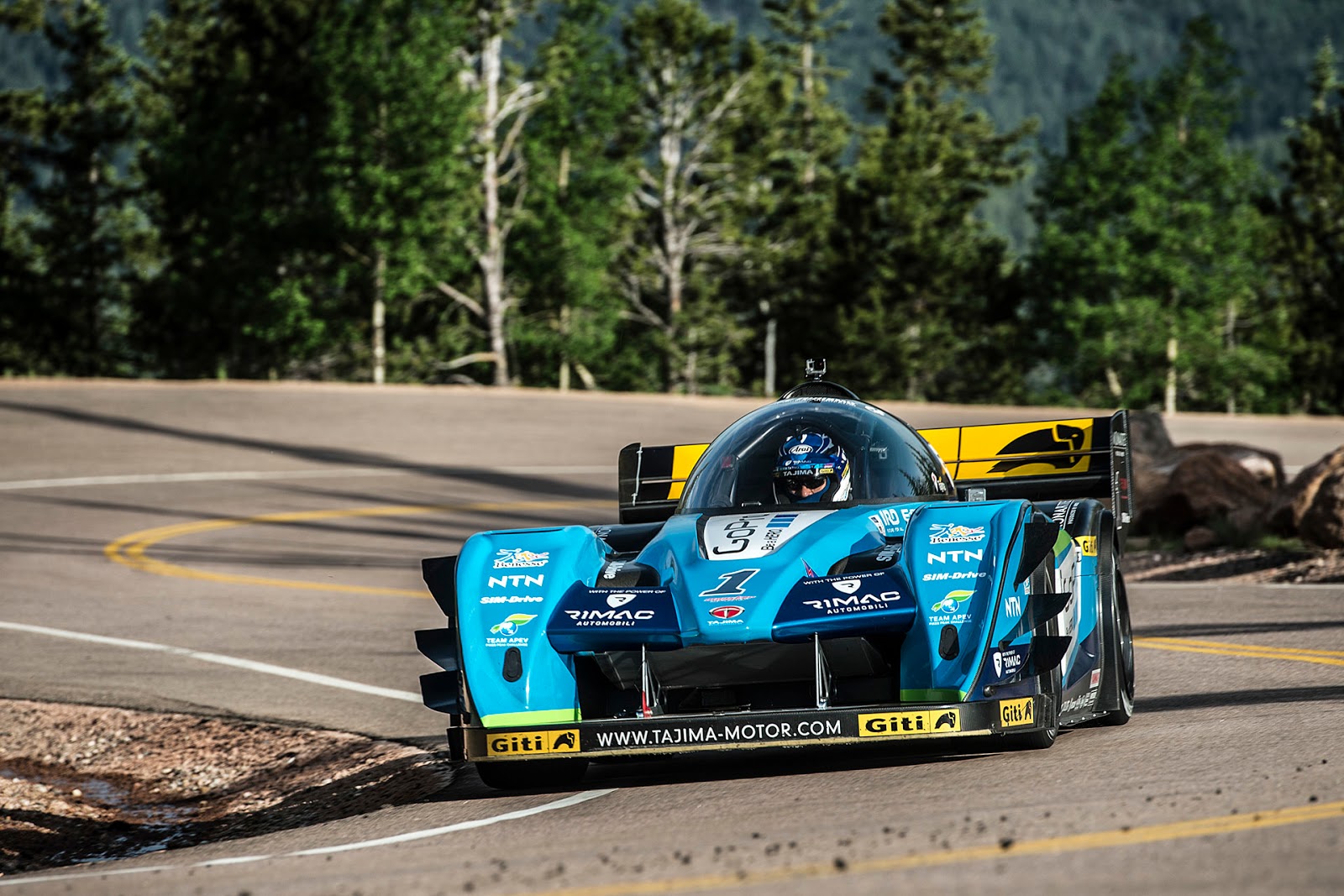
With Mitsubishi's EV works team, who funished 2nd and 3rd outright in 2014, absent for this years race, the competition is between two Megawatt class EV teams. Multiple champion Nobuhiro Tajima has teamed up with Rimac Automobili to build a 1.1 MW AWD racer while Rhys Millen drives for Latvian team Drive e0 with the 1 MW AWD special.

Racing starts @ 8 AM MDT (Mountain Daylight Time - GMT -6 Hrs) Sunday 28th June.

Chevy Bolt testing confirms 320 km range target [VIDEO]

General Motors engineers say early testing of its upcoming Chevrolet Bolt EV is affirming their estimates that the car will have a range of 320 km (200 miles) between charges.

The automaker has produced 55 prototypes of the all-electric vehicle at plants in Seoul, South Korea, and Orion Township. They have been driven hard throughout GM's Milford Proving Grounds and early results are positive, engineers say.

"We have experienced 200 miles. We're pretty confident in that," said Pam Fletcher, GM executive chief engineer for electrified vehicles. "You can imagine we're going to eke out every mile of range we can."

Chevy unveiled the Bolt (that’s “Bolt” with a “B,” not to be confused with the existing plug-in hybrid Chevy Volt) concept at the Detroit Auto Show back in January, the hand-built prototypes have been testing since April. Vowing a 320 km (200-mile) range and a price tag of $30,000 after incentives, the Bolt is expected to enter production sometime in 2017.

Pam Fletcher, the chief executive engineer for electric vehicles at General Motors, also emphasized on Wednesday that GM’s electrification technology and manufacturing is U.S.-based. “Chevrolet’s electrification technology is very much grounded here in the U.S.,” Fletcher said in a video posted on GM’s site. She mentioned that the battery packs and electric drive units for the Volt are manufactured in Michigan and the electric motors are made in the U.S. “It’s a really a terrific story for technology and manufacturing and electrification in this country,” she said.

Chevrolet has committed to pricing the Bolt at about $30,000 after the $7,500 tax credit.

TNT Introduce Electric Delivery Vans In The Netherlands

TNT is deploying seven new 3.5 tonne electric express delivery vehicles for its operations in and around Amsterdam and Rotterdam, The Netherlands, as a partner of FREVUE (Freight Electric Vehicles in Urban Europe), an urban e-mobility project supported by the European Commission. FREVUE seeks to demonstrate to industry, consumers and policy makers how electric vehicles can meet the growing need for sustainable urban logistics.

TNT’s new e-Ducato vehicles purchased from BD Auto replace the standard diesel vehicles previously operating in Rotterdam and Amsterdam and will enable to save 24,000 litres of diesel and 76 tonnes of CO2 equivalent emissions each year. They provide a range of 200 km and a loading volume of 13m3.

Erik Uljee, Managing Director, TNT Benelux, said: “The partnership with FREVUE is part of TNT’s corporate responsibility agenda and meets the objective of our Outlook strategy to increase efficiency and productivity. To support zero emission transport in city centres, the authorities extend certain privileges to TNT such as exemptions from parking bans and access to closed areas outside loading and unloading times. With the three vehicles in Rotterdam and four in Amsterdam, TNT’s electric fleet in the Netherlands is nine in total.”

Pex Langenberg, Vice Mayor of the City of Rotterdam, said: “It is the ambition of the City of Rotterdam to have a zero emission freight transport in the inner city by 2020. This is formalised in the Green Deal Zero Emission. We welcome the new electric freight vehicles as they will help to make the air in the city centre cleaner and decrease noise pollution.”

The city of Amsterdam welcomes the emission-free TNT trucks in line with its plans to step up improvements in sustainability as outlined in the Sustainability Agenda Amsterdam. Amsterdam is dedicated to remaining the frontrunner in electric transport and wants to be the zero emission city in 2025. Within the city, all the transport – including public transport and taxis – must preferably be zero emission by then.

By 2020 all BMW’s will be AWD range-extender electric cars

BMW have embarked on a radical engineering overhaul which could see all future models from the 3-series upwards, including the Rolls-Royce range, become all-wheel-drive range-extender electric cars.

The days of spot-welded steel bodies and engines that drive the rear wheels via conventional transmissions are set to be consigned to history. BMW’s plan to make all of its cars from the 3-series upwards plug-in hybrids has forced the company’s engineers to rethink the make-up of its cars from first principles.

The first move is to radically reduce the weight of future bodyshells to help offset the extra weight of battery packs. Work on BMW’s bodyshell of the future is already well advanced, and the first generation of the mixed-materials structure will be seen this coming summer, underpinning the next-generation 7-series.

It is expected to take another generation of the 3-series, expected in 2018, before BMW is ready to switch its mainstream car to this kind of carbonfibre-intensive construction. That’s partly because it will take some years to reduce the cost of this kind of construction.

The next phase in BMW's reengineering is a rethink of the powertrain. The final concept — demonstrated in Nov 2014 with a 500 kw AWD 5-series GT xDrive plug-in hybrid — is similar in basic principle to the series hybrid system that propels the Chevrolet Volt.

Where the Chevy Volt has an ICE powered generator/motor + a traction motor in a single front-wheel-drive transverse gearbox assembly, BMW will retain it's famous rear-wheel-drive bias by splitting that combination and putting the main traction motor on the rear axle while the front axle can still be driven by the ICE powered motor/generator. This also means that on-demand four-wheel drive will be available on all future BMWs.

As seen in the BMW i8, a large battery will occupy the centre tunnel and some of the space usually occupied by the fuel tank. The front-mounted engine acts as a generator in most driving situations, creating electricity to help drive the electric motors.

The front electric motor is key to the new powertrain

In normal use, the front electric motor drives the front wheels via a still-secret new type of transmission. At speeds above 80 km/h or so, the engine ‘assists’ the electric motor by attaching itself to the new transmission via a mechanical planetary system to help drive the front wheels at motorway speeds in parallel mode much like a Chevy Volt or Mitsubishi Outlander PHEV. The combustion engine expected to be driving the front wheels only 10 per cent of the time on a typical journey.

BMW won’t reveal the details of this new combined electric motor and transmission system, but we speculate BMW, like Renault and Bugatti, may be considering a disc-shaped Axial Flux electric motor mounted within the gearbox housing.

The new transmission is unlikely to have more than three ratios and could be a mechanical planetary system. It is likely to be less expensive than today’s eight and nine-speed autos and dual-clutch transmissions.

Because the new-generation engine runs as a lean-burn generator for 90 per cent of the time and the twin electric motors provide significant torque, demands on the engine are much reduced. So it probably doesn’t need a turbocharger, the accompanying intercooler system or the Valvetronic system.

The emissions control system should also be less complex and expensive, all of which greatly reduces the cost of the unit. The engine is likely to be significantly lighter, too.

The battery pack can be larger. It will fit neatly in space freed up by the removal of the propshaft and the use of a smaller fuel tank. Braking assistance from electric motors means the mechanical brakes can be smaller, lighter and cheaper.

The multi-material bodyshell will be at least 100kg lighter than that of today’s 3-series, partly offsetting the battery’s weight.

This new hybrid powertrain offers part-time and permanent all-wheel drive and can be scaled across all models. So although the new, simplified generator motors might come in different sizes and capacities — and the battery pack will come in different sizes — this powertrain can largely be shared between everything from a 3-series to an X5 to a Rolls-Royce Phantom. This will save BMW a huge amount of money in production and research and development costs.

BMW is rumoured to already be testing a four-seater with some of the above technology. Weighing less than 1,200 kg with a drag co-efficient of 0.18, the BMW prototype consumes only 0.4 liters per 100 kilometers or 706 miles per imperial gallon (588 miles per US gallon).

Source: Autocar

Close-up: Audi R8 e-tron Powertrain [VIDEO]

340 kW of power, 0 to 100 km/h in 3.9 seconds and a driving range of up to 450 km

Visually, the 4.40 meter (14.4 ft) long Audi R8 e-tron is recognizable by its unique lighting solutions on the air inlets, front apron and sideblades. Its exterior skin, painted in Magnetic Blue, combines body parts made of aluminum and carbon fiber reinforced polymer (CFRP), such as the front and rear lids. Thanks to aerodynamic modifications to its cooling air inlet, rear spoiler, diffuser, underbody and sideblades, the drag coefficient (Cd) of the R8 e-tron is just 0.28. Its Audi Space Frame (ASF) is based on the multimaterial design of the V10 version, which is extended by a rear body module made of CFRP. Despite its low weight, the corrugated bulkheads that conceal the luggage compartment can absorb a lot of energy in a rear-end collision.

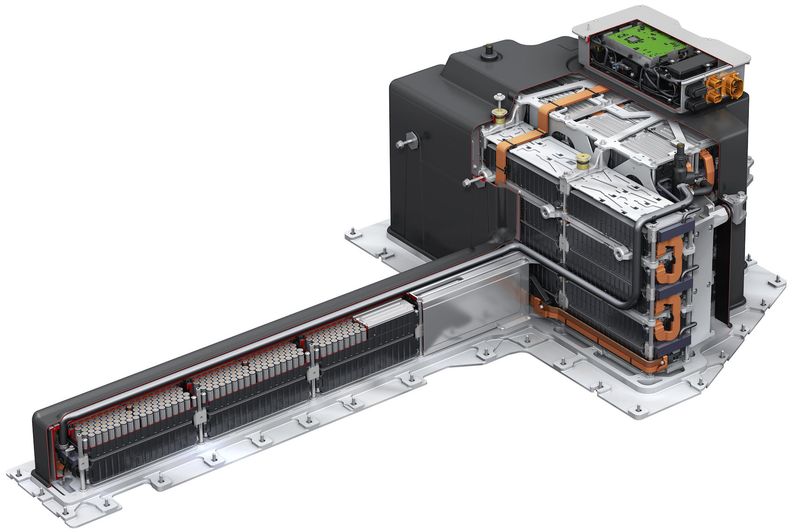
The T-shaped battery is structurally integrated in the middle tunnel and is mounted behind the occupant cell – this location offers a low center of gravity and an axle load distribution of 40:60 (front/rear). The high-voltage battery is based on lithium-ion technology. The liquid-cooled lithium-ion battery consists of 52 modules. Compared to the first e-tron technology platform, the energy capacity of the new 595 kg (1311.8 lb) battery system was boosted from around 48.6 kWh to 90.3 kWh without requiring any package modifications.

Thanks to the high energy density, which was increased from 84 to 152 Wh/kg, the R8 e-tron can be driven up to 450 km (279.6 mi) on just one battery charge – previously it was 215 km (133.6 mi). In the Combined Charging System (CCS) for charging with DC or AC electricity, the battery can be fully charged in well under two hours. The driver can control this process remotely by smartphone, if the user has installed the relevant Audi connect app.

920 Nm (678.6 lb-ft) of torque

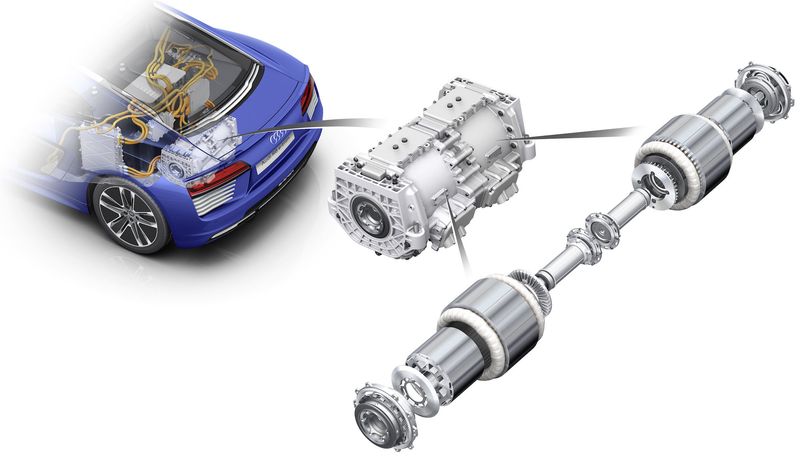
The two electric motors on the rear axle each output 170 kW and 460 Nm (339.3 lb-ft) of torque. The R8 e-tron, which weighs just 1,841 kg (4058.7 lb) empty (without driver), sprints from 0 to 100 km/h (62.1 mph) in 3.9 seconds and can accelerate to an electronically governed top speed of 250 km/h (155.3 mph) while developing its unique e-sound. Targeted Torque Vectoring – a need-based distribution of drive power between the rear wheels – gives the car maximum stability and dynamism.

Intelligent energy management and an electromechanical brake system at the rear axle ensure high rates of energy recuperation. The suspension springs consist of glass fiber reinforced polymer (GFRP), and the anti-roll bar is made of CFRP.

The R8 e-tron rides on aerodynamically optimized, high-gloss 19-inch aero wheels that were specially developed for this car. At the front axle, size 225/40R19 tires enable precise steering response. Size 275/40R19 tires transfer the torque of the electric motors to the road. The tires were specially developed for the requirements of an electric supercar, and they combine sporty driving properties with efficient rolling resistance values. Extremely sporty 20-inch wheels of the production R8 are available via the Audi Genuine Accessories program.

In the finely crafted interior, the R8 e-tron offers illuminated door sill trims, folding bucket seats and a specially configured Audi virtual cockpit. A heat pump removes waste heat from electrical components for thermal management and for interior climate control – an important efficiency module of the overall concept.

Audi also uses the latest development stage of the R8 e-tron as a high-tech laboratory – it also continues to play an important role in developing electric mobility of the future. The R8 e-tron will be produced in the small-scale production facility of quattro GmbH at the Audi Neckarsulm site in the Böllinger Höfe.

450 km (279.6 mi) range on a fully charged battery

The new battery cells are primarily responsible for the new performance and driving range of the Audi R8 e-tron. Audi has systematically adapted its high-voltage battery system to the specific needs of electric cars – the primary focus was on achieving an optimal ratio between power and energy. The results: The R8 e-tron has a significantly longer driving range and even more power than the previous model. In developing the high-voltage battery, the brand with the four rings followed the principle of maximum flexibility without losing sight of synergies in electrification. Its flexible cell module concept makes the Audi brand well-equipped for all future market developments, while the modular concept also guarantees Group-wide use across different car models.

The battery operates with 385 volts of nominal voltage, and its new cell module concept achieves excellent performance. The battery’s energy density grew from 84 watt-hours per kilogram (Wh/kg) to 152 Wh/kg, and its nominal capacity from 48.6 kWh to 90.3 kWh. Its driving range on a full charge has more than doubled – from 215 km (133.6 mi) to as much as 450 km (279.6 mi). These values make Audi the leader among the competition.

The battery system of the Audi R8 e-tron takes on the shape of a “T”. It measures 235 cm (92.5 in) long, 136 cm (53.5 in) wide and 70 cm (27.6 in) high, including the junction box on the cross-bar of the “T”. This junction box is responsible for monitoring, switching and transmitting an electrical current of over 1,200 amperes. The highly complex battery system consists of over 10,000 individual parts.

The 7,488 cells are packed in 52 modules of 144 cells each. Each module weighs 7.8 kg (17.2 lb). They are arranged on two and five levels (“floors”) in the tunnel battery and in the rear battery. Aluminum plates separate the “floors” from one another while creating the supporting structure for the battery.

Coolant circulates in a cooling system of aluminum shells. In a crash, high-strength floor plates and impact plates redirect the crash forces into the multimaterial ASF (Audi Space Frame) of the R8 e-tron in a defined way.

40:60: axle load distribution

The 595 kg (1311.8 lb) battery system is joined to the ASF with bolts in the middle tunnel and behind the occupant cell, making it an integral part of the vehicle structure. Its mounting position results in a low center of gravity and an axle load distribution of 40:60 (front/rear), which is ideal for a mid-engine sports car.

The Combo 2 charging interface of the Combined Charging System in the Audi R8 e-tron enables charging with AC or DC electricity. When charging with AC from an industrial electrical outlet with 7.2 kW of charging power, a full charge is reached in just around 12 hours. Charging with DC electricity shortens the time – to just 95 minutes at a charging power of 50 kW. Audi is demonstrating charging equipment that can charge this battery system with up to 150 kW of charging power. For the driver of the R8 e-tron, this means that a driving range of around 150 km (93.2 mi) can be attained after just 15 minutes of charging time. The customer can manage charging remotely as well – using a smartphone on which the customer has installed the relevant Audi connect app.

Tesla rolls out destination charging in Australian hotels, malls

Tesla Motors has introduced its ‘destination charging’ program into Australia, with over 10 sites established. Model S owners who frequent longer trips will benefit from the destination charging program, where owners can charge at no cost.

Tesla destination charging program provides ‘high power wall units’ at key destinations for Model S owners to charge while away from home for long periods.

The wall units can provide as much as 40 amp of power to Model S and are also provided with Model S for home installation, making the device familiar to owners.

With up to 500 km of rated range, the majority of charging with Model S is done at the home, but now the destination charging will provide locations where there are longer or overnight stops.

Locations include key hotels such as Park Hyatt Sydney, The Darling, Hotel Realm Canberra, The Observatory in Port Macquarie and to fulfil the winter snow travelers Rundells Alpine Lodge Dinner Plain.

In addition, key shopping centres such as Westfield Chatswood and Chadstone have been utilised, with premium parking locations and wall units available to Model S owners.

Tesla Motors has also partnered with Secure Parking to enable a safe location for Model S owners to park and charge whilst at work or out in town. These locations are located across Brisbane, Sydney and Melbourne.

“This expanding network of destination charging is a great replication of the convenience our owners receive when charging at home. Along with the developing Supercharger network, our owners will be able to cover long distances with the knowledge they have a charging solution,” says Australian Tesla spokesperson, Heath Walker.

It’s official: Tajima teams up with Rimac for Pikes Peak 2015

Team APEV with MONSTER SPORT, led by the racing legend Nobuhiro “Monster” Tajima, teamed up with Rimac Automobili. As a result, 2015 Pikes Peak International Hill Climb Race will have a new 1.1 MW beast at the starting line, the Tajima Rimac E-Runner Concept_One.

Rimac Automobili are once again showing their vigorous racing DNA taking the challenge in one of the most prestigious races in the world. Mr. Tajima’s decades long experience in racing and Rimac Automobili’s state of the art technology and know-how brought to life a staggering creation, the Tajima Rimac E-Runner Concept_One. It is powered by four independent electric motors, giving the car a total power of over 1,1 MW (1,475 HP). That is more than twice the power Mr. Tajima had in his 2014 car when he broke his own Pikes Peak record, stopping the clock at 9:43,90.

There are no gearboxes or differentials on this car. The power of each independent motor is transferred to each wheel by an innovative chain drive system developed specifically for this project, which saves a lot of weight and space. Embracing the Rimac Automobili technology, the Tajima Rimac E-Runner Concept_One features an adapted racing version of the Rimac All Wheel Torque Vectoring system, first implemented in the Rimac Concept_One.

The Rimac AWTV controls the torque of each motor 100 times a second. The system can vary the torque on each wheel depending on the steering angle, speed, longitudinal and lateral forces, yaw-rates and number of other variables. The ECU runs the collected sensor-data through complex mathematical algorithms which calculate the optimum torque distribution on a millisecond-level. This enables the vehicle to take full advantage of the tires, squeezing the maximum out of their potential and giving the driver the desired vehicle dynamics at any given moment. Mr Tajima will thus have both the 1,1 MW of power and maximum grip in each of the Pikes Peak’s 156 corners.

“We measured 0-100 km/h in 2,2 seconds. 200 km/h comes in 5,4 seconds from a standstill. Cornering forces and stopping numbers are also impressive, but let’s not spoil the surprise. We are quite confident that Tajima Rimac E-Runner Concept_One will break previous year’s record. He is a great driver with tons of experience. Interesting fact – he raced Pikes Peak his first time a year before I was born. 28 years later, we work alongside to push the limits further. With the support of our best engineers and technicians, our technology, powertrain, battery-system and Torque Vectoring, he will be able to push the boundaries of electric race cars to a whole new level. Working with Mr. Tajima and his team is an amazing experience of which we enjoy every second.” reveals Mr. Rimac.

“The Pikes Peak is one of most difficult hill climbs in the world, because it is held on a public road, not a race track. The conditions are constantly changing. We want to develop technology and gather experience from the Pikes Peak race for development of better, safer, and zero emission road cars. This is my aim. Rimac Automobili is a quite young company but their mind and their spirit are fantastic. The level of technology, professionalism and vertical integration that this company has managed to achieve in such a short time amazed me. I am very happy because Rimac Automobili is simply the best partner for Team APEV.” said Mr. Tajima after the initial testing in Croatia.

The Pikes Peak hill climb is 19,9 km long and ends up at 4,301 m above sea level. Petrol engines have oxygen starvation problem at that altitude - the power of the engine decreases over 40 percent. However, electric motors don’t use oxygen, so Mr. Tajima will have the full power of all four electric motors available from start until the finish line.

Pikes Peak race

The Pikes Peak International Hill Climb race in Colorado has taken place since 1916. On average it features around 130 competitors from all over the world. This year the event is starting with practice sessions on Tuesday, June 23rd, culminating on race day, Sunday June 28th. The track is 19,99 km (12,42 miles) long, has 156 turns climbing 1,440 m (4,720 ft) from the start at Mile7 of the Pikes Peak Highway, to the finish at 4,300 m (14,110 ft).

Tajima Rimac E-Runner Concept_One

Technical data:

  • All-wheel drive
  • Four independent Rimac permanent magnet electric motors
  • Rimac All Wheel Torque Vectoring
  • Maximum power: 1100 kW
  • Maximum torque: 1500 Nm
  • Maximum regenerative braking: 400 kW
  • 57 kWh Rimac Automobili battery pack
  • Four chain driven single reduction Rimac transmission systems
  • Monster Sport aluminum alloy tubular space frame with carbon-fiber body
  • Electrically assisted power steering
  • Adjustable shock absorbers
  • Ventilated brake discs Ø370 mm front and rear + Rimac regenerative braking system
  • 340/710 R18 slick tyres / 13” × 18” wheels
  • Kerb weight: 1500 kg
  • 0-100 km/h 2,2 s
  • Top speed: 270 km/h
  • Daimler and Qualcomm to develop wireless charging for EVs

    Daimler and telecommunications giant Qualcomm Technologies have announced a partnership to develop new wireless charging technologies for vehicles and phones.

    The alliance will focus on “mobile technologies that enhance in-car experiences and vehicle performance,” as well as Qualcomm's Halo Wireless Electric Vehicle (WEVC) technology, with the overall aim of introducing an induction charging system into future Mercedes models.

    Possible candidates for the technology could include the next-generation Mercedes-Benz S-Class, currently powered by a plug-in hybrid 3.0-litre twin-turbo V6, or even the small-sized B-Class Electric Drive.

    Qualcomm, more widely known for producing a range of high-end smartphone processors, started developing the technology in 2011 and WEVC trials have been underway in the United Kingdom since 2012, with the technology working similarly to wireless phone charging.

    A Vehicle Charging Unit (VCU) is installed in the floor of a garage or car park, which sends power wirelessly to a similar unit installed in the car, which sends power to the electric vehicle batteries.

    Currently the technology only allows for stationary charging, but development is underway on dynamic charging that will work by installing multiple VCUs underneath roads capable of charging cars on the move.

    The implementation of dynamic charging could cut the cost of electric vehicle manufacturing by reducing the need for large, range-extending batteries.

    Additionally, Qualcomm's WiPower technology will be implemented to allow full wireless charging on a smaller scale, for compatible smartphones and tablets inside the vehicle.

    Daimler AG group research and Mercedes development board member Thomas Weber said the new partnership will bear fruit for both companies.

    “It's important that we remain on the cutting edge of technology and continue to deliver unparalleled experiences to our customers,” he said.

    “With this in mind, we are eager to jointly explore possible fields of future cooperation with an internationally leading tech-firm like Qualcomm.”

    Qualcomm Incorporated President Derek Aberle said integration of vehicle and mobile communications is the way of the future.

    “The automobile has become an extension of always-on connectivity, and as such, we're continuously utilising our expertise in wireless mobility to deliver in-car experiences comparable to the ease and convenience of smartphones,” he said.

    Last year, German luxury rival brand BMW announced it would team up with Daimler to research and explore the possibilities of similar technology, and Volvo has also previously revealed it is looking at the cordless tech and Toyota signed a deal with WiTricity in late 2013.

    Californian Electric car specialist Tesla has also tested the potential of such systems, but dismissed them saying too much power was wasted in the transfer process.

    Bosch test robotic Tesla Model S around German test track [VIDEO]

    Bosch's engineers took a pair of Model S and fitted them with autonomous technology to allow them to drive themselves.

    That technology consisted of 50 new components, including (brace yourselves) a front stereo video camera to watch the road markings and identify obstacles, six (non-Bosch) LiDAR laser scanners for 360º coverage around the car, two long-range (200m) and four mid-range (120m) radar sensors facing forwards and backwards, inertial sensors, a GNSS GPS navigation antenna, backup braking (both Bosch’s iBooster and ESP boxes) and ECU systems and a massive great PC in the back to hold hi-res maps and crunch the incoming data via bespoke algorithms.

    In total, 1400 human-hours, 1300 metres of cable and an estimated €200,000 went into the car.

    The result looks almost like a normal Model S - no pirhouetting Velodyne ‘Christmas tree’ on the roof here, just a few dark panels, a flying saucer GNSS antenna on the back and some industrial-looking buttons - and it’s so effective that it’s almost prosaic.

    At the winding Boxberg test track, a Ford Fiesta drove around in front of us to show how smart the Tesla now is. Stopping quickly, driving at snail’s pace, accelerating into the distance: the Tesla reacted to the lot in a considered, sedate, measured manner. (Bosch tells us it can also swap lanes, overtake and merge with traffic on its own, but we didn’t get to check that out.)

    [Stuff]

    Wireless in-wheel motor system developed for electric vehicles

    Japanese researchers have successfully developed the world’s first in-wheel motor system for electric vehicles that transmits power wirelessly to run motors incorporated in each wheel.

    Hiroshi Fujimoto, an associate professor at the University of Tokyo specializing in electric vehicle control, and other researchers ran a vehicle equipped with the new system that transmits electricity wirelessly from an onboard power source to a coil attached to the wheel hubs.

    “This technology will pave the way for the development of advanced electric vehicles, including those that receive electricity wirelessly from transmitting coils that are embedded under road surfaces,” Fujimoto said. “It can be also applied to fuel-cell vehicles and industrial machinery.”

    The in-wheel motor, also known as wheel hub motor, is an electric motor that is incorporated into the hub of a vehicle's wheels to directly drive each wheel.

    Compared with conventional electric vehicles, the in-wheel motor model does not require a drive shaft, a component that takes power from a single source and mechanically transfers it to all the wheels to drive them. Thus, a car using the system could be built lighter and require less energy.

    Acceleration and braking for each wheel can also be controlled, which would help prevent mishaps such as skids.

    Current cars using in-wheel motors need wires to transmit electricity. The complex wiring distribution and its susceptibility to shorting out have remained a hurdle in developing such a vehicle for practical use.

    The research team’s wireless system transmits the electricity stored in the vehicle’s batteries through a transmitting coil to a receiving coil in the wheel hub, a distance of 10 centimeters.

    The researchers successfully ran a motor using a maximum of 3 kilowatts of electricity and sent control information to each wheel using standardized Bluetooth wireless technology.

    The rear-wheel-drive prototype car can, in theory, run at maximum 75 kph, the researchers said.

    Nissan Leaf Taxi passes 160,000 km and still on 1st set of brake pads!

    A Nissan LEAF taxi in Cornwall has clocked up its 100,000th mile (160,000 km) since entering service with C&C Taxis in 2013.

    ‘Wizzy’ as it was named by operators at St Austell-based C&C Taxis, hit the milestone in the course of more than 25,000 pure electric paying fares and having been rapid charged over 1,700 times yet retains near full battery health and is still on its first set of brake pads.

    Inspired by Wizzy’s performance, C&C Taxis now operates five further 100% electric Nissan LEAFs and an all-electric Nissan e-NV200 Combi.

    Mark Richards, fleet manager at C&C Taxis, estimates that each vehicle saves the business around £8,500 per year in fuel bills and maintenance costs.

    "When we speak to other taxi operators they often tell us range and battery life are the biggest factors preventing them from considering an electric taxi," he said. "Then, when we tell them Wizzy’s done 100,000 miles and still has full battery health, they’re left speechless.”

    “It’s no exaggeration to say Wizzy has transformed our business. We took a gamble when we bought her but she’ll have paid for herself in just 24 months and the savings we’re now making across the fleet are phenomenal,” he added.

    Korean Firm to Launch EV sports car with 570 km range in 2016

    Power Plaza Co Ltd, a South Korea-based firm, showed an electric vehicle (EV) concept that can travel 571km (approx 354.8 miles) at a speed of 60km/h (approx 37.3 mph) per charge.

    The EV, "Yebbujana R," was exhibited at the 28th International Electric Vehicle Symposium and Exhibition (EVS 28), an international symposium/trade show on EVs, which took place from May 3 to 6, 2015. The company plans to release the EV at the end of 2016 in South Korea at a price of US$40,000.

    The EV uses cylindrical lithium-ion battery cells called "18650." The total capacity of the cells is 54kWh. A carbon fiber-reinforced plastic (CFRP) was applied to the body of the EV to reduce weight, realizing a drive range longer than 500km. The mass of the body is 745kg. According to Power Plaza, the auto body consists of an underpiece, hood, doors, rear, etc, and all of them are made of CFRP.

    As a driving motor, an 80kW motor manufactured by Robert Bosch GmbH was employed. The maximum speed of the EV is 198km/h, and it takes 4.6 seconds to reach a speed of 100km/h from zero.

    Established in 1991, Power Plaza has been dealing with switching power modules and developing EVs under its own brand. Thus far, it has developed six kinds of EVs (1t and 0.5t pickup trucks and four passenger cars) and launched them into the market. So, the Yebbujana R is the company's seventh EV.

    Bosch choose Tesla Model S for autonomous drive testing [VIDEO]

    As we reported a month ago, Bosch has confirmed they are working with Tesla to develop automated driving systems for production vehicles.

    Spotting a test vehicle, equipped as they are with measurement devices, sensors, and instruments, is usually pretty easy. But that’s not the case for the new Model S Teslas that recently joined the Bosch fleet. Both these test vehicles are helping engineers further refine automated driving. But at first glance, it’s hard to tell them apart from production models. “Bosch is developing automated driving for production vehicles of all kinds,” says Dr. Dirk Hoheisel, member of the Bosch board of management. The new test vehicles are evidence of the progress Bosch has already made in integrating the necessary systems and components. Those attending the 62nd International Automotive Press Briefing can see this for themselves in Boxberg, Germany, from May 19 to 21, 2015

    Fit for highly automated driving after 1,400 hours of work

    To make the test vehicles ready for automated driving, they first had to be retrofitted. Fifty new Bosch components were installed in each car. They included a stereo video camera (SVC), which the car uses to recognize lanes, traffic signs, and clear spaces. The Bosch SVC is the smallest stereo camera system for automotive applications currently available in the market. Its compact design makes it easy to integrate into vehicles. In addition to the camera, 1,300 meters of cable were laid in each car and fixed in place with 400 cable ties. “After some 1,400 hours of work on each of them, the test vehicles are ready for highly automated driving,” Hoheisel says. Thanks to Bosch technology, the two Teslas can now autonomously drive from on-ramp to off-ramp without the driver needing to constantly monitor them.

    This transfer of responsibility from the driver to the vehicle explains why so much time and effort is necessary for the retrofit. Highly automated vehicles must be capable of operating safely even if a component fails. The only way to achieve such operational reliability is by a design strategy that includes redundancy in safety-critical systems such as braking and steering. For example, both test vehicles feature both the iBooster electromechanical brake booster and the ESP braking control system. These Bosch components can brake the car independently of each other, without any need for driver intervention. “For Bosch, the principle here is safety first,” Hoheisel says. Back-up systems are also available for the two test vehicles’ power supply and vital ECUs.

    Several thousand test kilometers driven without a hitch

    Since 2011, Bosch has had two teams – on two continents – working on automated driving. At the Abstatt location in Germany, Bosch engineers are working on system integration. Their colleagues at Palo Alto in California’s Silicon Valley are driving forward work on function development. The two teams receive support from roughly 2,000 driver-assistance engineers who work for Bosch around the world. To make it as easy as possible for the two teams to share their results, Bosch uses identical test vehicles. Hoheisel explains why Bosch opted for two all-electric Model S vehicles made by the U.S. automaker Tesla: “They combine two automotive industry trends: electrification and automation.” This presents a particular challenge, he says, but one that Bosch relishes.

    Bosch started testing automated driving on public roads at the beginning of 2013. So far, it has been using test vehicles based on the BMW 325d Touring. Engineers have successfully driven them for several thousand kilometers on freeways – both the A81 near Stuttgart and the I280 in California. Before the first test drives, the German certification authority TÜV Süd reviewed the safety concept that Bosch had prepared specially for the purpose. And even though the technology on board the vehicles is designed to handle any situation in freeway traffic, the drivers at the wheel have been specially trained. Bosch’s test drivers not only know the safety precautions inside out, but have also completed a multi-day training course.

    2016 BYD e6 to get 82 kWh battery and 400 km Range

    The 2016 BYD e6 will have 400 km (250 miles) range thanks to an increase in battery capacity to 82 kWh, according to a document from China’s Ministry of Industry and Information Technology.

    Compared with the current model, the 2016 e6 will be 40 kg heavier from 2380 kg to 2420 kg with range increased by 100 km from 300 km to 400 km.

    The 82 kWh battery pack, up from 60 kWh in the current model, is 100kg heavier (700 kg) with a claimed cell energy density of approx 150 Wh per kilogram.

    The e6 was originally launched five years ago in May 2010. The first batch of 60 e6s were delivered to a taxi company in Shenzhen. Deliveries to individual buyers started in 2011 with annual sales of 1,544 in 2013 and 3,560 in 2014.

    The 2016 e6 will be launched in late 2015. Prices will remain unchanged between 300,000 Yuan and 370,000 Yuan before rebates.