Why VW diesel buyback pays owners to keep their cars for two more years

2015 Volkswagen Golf TDI SEIf all goes according to plan, more than 450,000 owners of Volkswagen and Audi sedans, wagons, and hatchbacks with 2.0-liter TDI diesel vehicles from the 2009 through 2015 model years will start to receive buyback offers from VW late this year. Many owners have already indicated that they plan to take the buyout, some as soon as possible. But it...

Volkswagen planning a multi-billion euro battery factory

Volkswagen is considering building a multi-billion-euro battery factory as part of a major expansion of its electric-car portfolio, Handelsblatt has learned from company sources.

The factory would allow VW to operate independently of Asian firms like Panasonic, LG and Samsung that have dominated the battery market to date.

VW Chief Executive Matthias Müller and his team are currently working on a new strategy to increase electric car sales in the coming 10 years to 1 million. The non-executive supervisory board will consider the plans before the Wolfsburg-based firm’s annual meeting on June 22.

The aim of the new plans in part is also to put the recent “Dieselgate” scandal over cheating emissions tests behind it. The hope is that focusing on battery technology and electric cars can help the beleaguered company make a fresh start and improve its negative image.

Building a new battery factory would also allow VW to take a leadership role in the development of the new technology. The company’s executive board looks likely to approve the plan, which is also supported in principle by the works council and the state of Lower Saxony, its major shareholder, sources said.

VW invested in solid-state battery startup QuantumScape in late 2014 and have publicly stated they expect the technology can deliver 700 km range. VW is also targeting a 66 percent cost reduction by using a single battery module design for all of its electrified vehicles.

“We want to launch a major initiative, one that will put us at the top of the industry,” said one insider familiar with the plans.

To date one of the main reasons established automakers have been reluctant to move into high volume EV manufacture is having to outsource battery production. Where the largest cost component in an internal combustion car is the engine itself, which virtually all automakers build in-house, in an EV it is the battery that is the most expensive component. Automakers need to vertically integrate battery production into their manufacturing process in order to make EVs profitable.

VW Push for All-Electric Rallycross Supercars

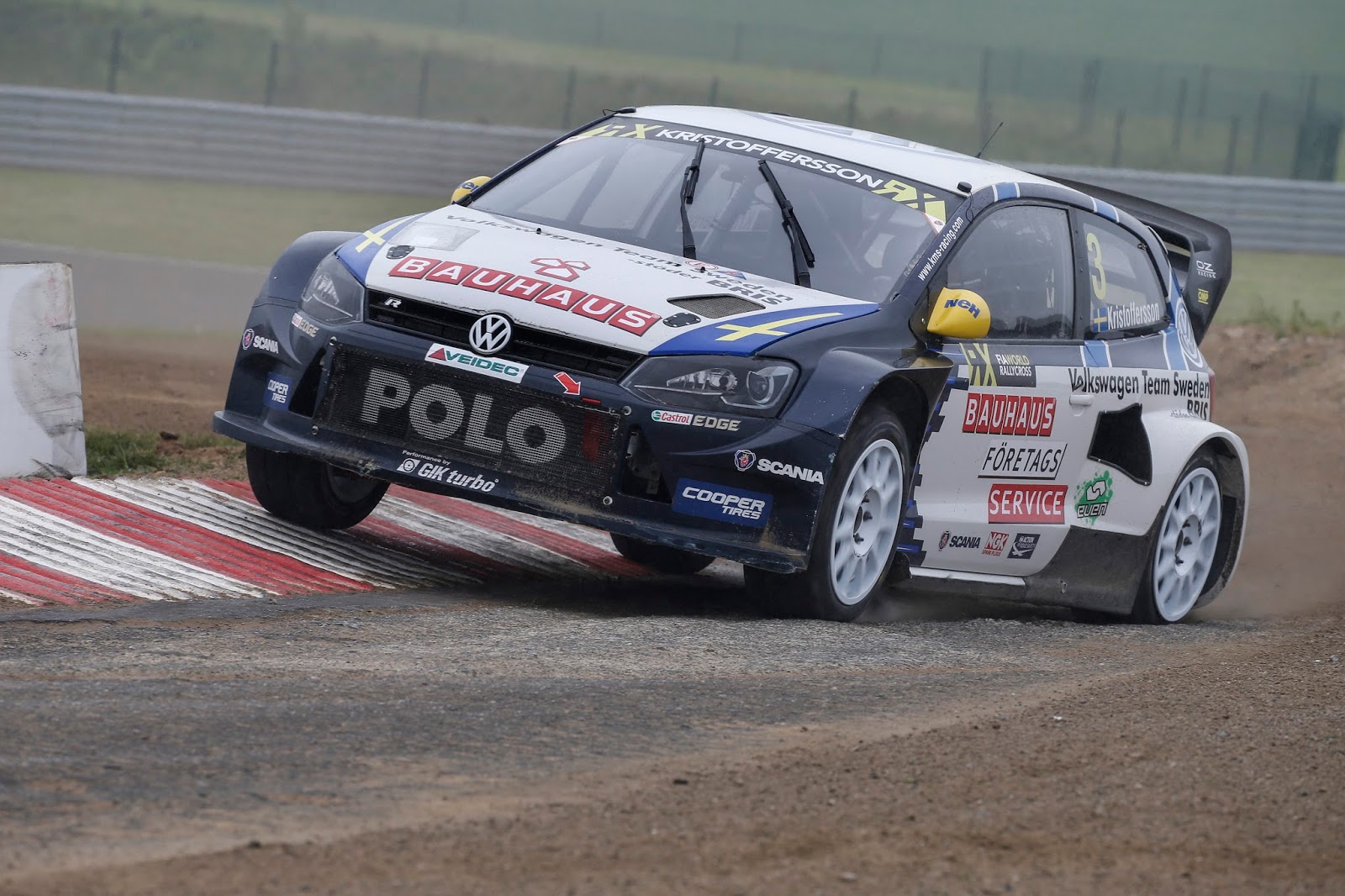
Volkswagen is considering the development of an all-electric rallycross supercar.

The German firm's head of technology Frank Welsch says the short, sharp format of rallycross events offers the perfect showcase for advances in electric car technology.

“I can certainly imagine a championship done with all-electric cars,” Welsch told Autocar. “The races are around six minutes long, which allows for short, intense bursts of competition and then charging.”

VW already competes in Red Bull Global Rallycross with factory Beetle GRCs and in FIA World Rallycross with Polo RXs. Both cars squeeze around 560 HP out of their tiny engines and reach 100km/h in just 2 seconds.

“Today these cars are super-powerful, have torque from hell and use all-wheel drive,” said Welsch. “Electric drivetrains could deliver that.”

Welsch went on to say that “If the championship moved that way it would be perfect for us.”

Germany wants to put 2 billion euros into encouraging electric cars

German Economy Minister Sigmar Gabriel wants to commit two billion euros ($2.17 billion) to encourage more people to buy electric cars, the newspaper Die Zeit reported on Wednesday.

Buyers of electric cars would receive a subsidy from the government, the newspaper said, giving no further details.

Gabriel also wants to expand charging stations and encourage federal offices to use electric cars - an initiative that will be funded under the current German budget without tax increases, he said.

The German government aims to put one million electric cars on the roads by 2020. Among the country's carmakers, BMW, Mercedes and Volkswagen now produce all-electric cars; Audi, Mercedes and Porsche have plans to build one.

Sales of electric cars totaled some 19,000 in 2014, but at the end of 2014 Germany had only 2,400 charging stations and around 100 fast-charging points.

Calls for supporting electric cars grew at the end of last year after the Volkswagen emissions scandal. Both Gabriel and his fellow Social Democrat Environment Minster Barbara Hendricks have called for a quota for electric cars.

VW announce Electric Phaeton sedan

In the wake of the ongoing diesel-emissions scandal, Volkswagen has announced that an all-electric Volkswagen Phaeton sedan is in the product pipeline.

"The Volkswagen Phaeton has embodied the brand's technological competence and brand ambition from the first generation onward," Volkswagen AG said in a statement. "The future generation of the Phaeton will once again be the flagship for the brand's profile over the next decade."

The Phaeton EV will lead a new VW product portfolio that features "plug-in hybrids with an even greater range, high-volume electric vehicles with a radius of up to 300 kilometers (186 miles), a 48-volt power supply system (mild hybrids) as well as ever more efficient diesel, petrol and CNG concepts," VW said.

VW talking up its zero emissions technology is no surprise, with the Porsche Mission E and Audi E-tron Quattro proving the requisite technology is being developed within the group.

Wolfsburg insiders with knowledge of Volkswagen's future model plans suggest it will share its platform architecture, electric drive system and battery technology with the upcoming Audi Q6 etron – as previewed by the etron Quattro concept at the recent Frankfurt auto show.The four-wheel drive etron Quattro uses three motors – one mounted up front sending drive to the front wheels and the remaining two sited at the rear acting on the rear wheels. Nominal power is put at 230kW, although a boosting function made available in the more sportier of two drive modes temporarily increases its maximum output to 370kW. It is accompanied by peak torque of 800Nm.

Energy to run the etron Quattro's electric motors is drawn from a liquid cooled 95kWh battery bolted to the floor below the passenger compartment. Hinting at its modular nature, Audi says the lithium-ion unit is suitable for other future electric models.

On a full charge, the battery is claimed to provide the new Audi with a range of over 500km based on the criteria used in the New European Driving Cycle (NEDC) test procedure.

Volkswagen e-Golf vs. BMW i3 REx [VIDEO]

Polish blogger Marek Wieruszewski reviews the Volkswagen e-Golf and the BMW i3 REx.

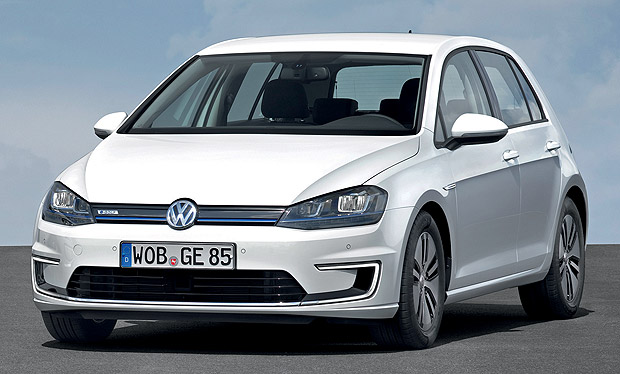
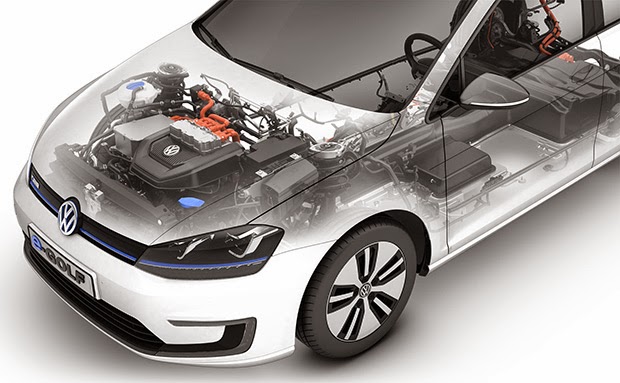
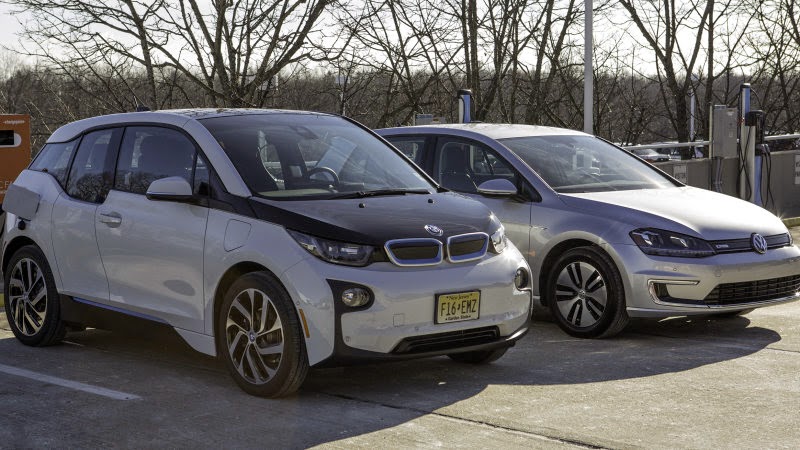
The Volkswagen e-Golf has a claimed range of up to 200 kilometres while the BMW i3 can squeeze up to around 160 kilometers, but it can be equipped with a petrol range-extender, which doubles its range.

VW Develops Self-Parking Self-Charging Electric Vehicle [VIDEO]

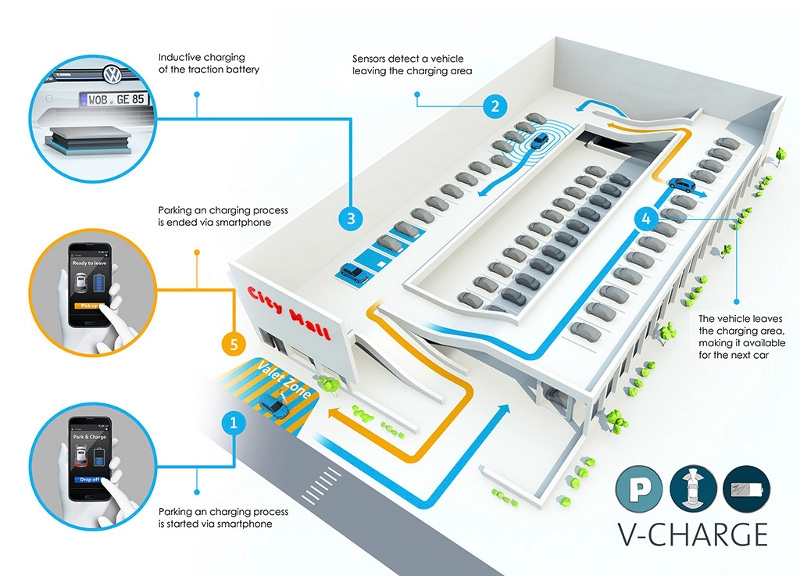
Volkswagen have launched an EU research project called 'V-Charge' to look into the near future of automated parking. Six national and international partners are jointly developing new technologies with a focus on automating the search for a parking space and on the wireless charging of electric vehicles.

The test vehicles not only automatically looks for an empty parking space, but can also finds an empty space with charging infrastructure and inductively charges its battery. Once the charging process is finished, it automatically frees up the charging bay for another electric vehicle and looks for a conventional parking space. 'V-Charge' stands for Valet Charge and is pointing the way to the future of automated parking.

In the USA especially, convenient valet parking is a big hit: you pull up in your car right outside your destination, valet service personnel park it for you and have it brought around again as and when you need it. There is no more time-wasting search for a parking place. The V-Charge project picks up on this idea. Its development goal is fully automated searching for a parking space ('valet parking') within defined zones, such as in multi-storey car parks.

There are many scenarios that illustrate the advantages of the V-Charge concept. Take one practical everyday example: a commuter notices that he is possibly going to be late and is thus running the risk of missing an important meeting at his company. With V-Charge he is able to pull up right in front of the main entrance, get out and establish the link to his vehicle via the associated smartphone application. Operating fully automatically, the vehicle has a digital map relayed to it and within the parking area or multi-storey car park autonomously navigates to a parking space. If it is an electric vehicle, the system additionally prioritises a parking bay with an automatic charging facility. Pedestrians, cyclists and other vehicles are identified by the cameras and ultrasound sensors integrated within the vehicle. Therefore, the vehicle is allowed to travel in so-called 'mixed traffic'. The selected parking area neither has to be an enclosed domain nor is any complex technical equipment required.

As the electric vehicle nears its destination, the system recognises via local sensors whether the allocated parking space is taken. If it is empty, the fully automatic parking manoeuvre begins and positions the vehicle exactly above the inductive charging spot. When the charging process is complete, the vehicle automatically moves to another parking space, leaving the charging station free for another electric car. When the driver returns to the multi-storey car park, he calls the vehicle back to the starting point via the V-Charge app. The vehicle moves to the defined pick-up location, with the driver not needing to set foot in the parking area or multi-storey car park.

Taking the lead in the international research consortium is the Swiss Federal Institute of Technology (ETH) in Zurich. It is responsible for visual localisation, movement planning and vehicle control (Autonomous Systems Lab division), camera calibration, 3D reconstruction from images and obstacle detection (Computer Vision and Geometry Lab division). Braunschweig Technical University works on the issues of car park management and the vehicle's communication with the technical surroundings (vehicle-to-infrastructure 'V2I'), Robert Bosch GmbH contributes its expertise in the field of sensor technology, Parma University looks after object recognition and Oxford University handles the development of detailed navigation maps of the parking area (semantic mapping concepts). As the sixth partner in the consortium, Volkswagen is providing the platform equipment, safety and control modules, as well as systems for static monitoring of surroundings, object recognition and automated parking.

The test vehicle: a network of technical sensory organs
The technical prerequisites largely already exist. During the introductory stage, for instance, it was possible to utilise sensor and camera technologies that are already being used in today's production vehicles. A dense network of sensory devices enables autonomous operation of the V-Charge test vehicle, which is based on a Volkswagen e Golf1. Four wide-angle cameras and two 3D cameras, twelve ultrasound sensors, digital maps and the so-called 'Car2X' technology for the vehicle's communication with the infrastructure ensure that the vehicle's surroundings are reliably detected and recognised. Pedestrians, vehicles and obstacles get identified, parking spaces recognised and measured and then this stream of data is put together in real time to form an overall picture – the task that the technical 'sensory organs' have to fulfil is complex and extremely varied.

As continual tests run as part of the research project show, V-Charge is already functional today. GPS-independent indoor localisation, centimetre-exact parking space measurement and 360-degree recognition of surroundings all function reliably, as do the system's reactions to pedestrians and vehicles and the way in which it takes account of traffic moving in line with or across the vehicle's path.

2005: a Volkswagen Touareg called 'Stanley' makes the first move towards autonomy
At Volkswagen automatic motoring moved from being a vision to a field of research at an early stage. 'Stanley' – a Touareg converted in cooperation with Stanford University in California and the Volkswagen Electronics Research Laboratory (USA) into a laboratory that could drive autonomously – was already winning the Grand Challenge competition for robot vehicles as far back as 2005. The next stage of development, in 2007, was the Passat 'Junior', which even then was finding its way through the big-city jungle without a driver – and doing so with such success that it took second place in the Urban Challenge for autonomous vehicles.

Given the working titles 'PAUL' and 'iCar', two further Passat research vehicles also demonstrated their autonomous capabilities that same year. While, thanks to intelligent parking assistance with no driver involvement, 'PAUL' slips into spaces perpendicular to the carriageway, the 'intelligent car' makes life easier for the driver in stop-and-go situations and on long monotonous journeys by automatically braking and keeping the appropriate distance.

In 2011, the 'eT – follow me!' microvan was launched as the ideal vehicle for delivery services. One real-life scenario: If the driver walks from house to house along a street delivering letters, for example, 'eT' follows him on quiet electric paws like a well-trained dog to ensure his mailbag is constantly replenished ('FollowMe' function) – or stays on his spot like a good boy until receiving the electronic 'come to me' call.

Also taking to the stage of autonomous motoring in 2011 was the 'HAVE-IT' (Highly Automated Vehicles for Intelligent Transport), a Volkswagen AG contribution to the research project of the same name funded by the European Commission. The Wolfsburg engineers had developed for the Passat Variant a 'temporary autopilot', which set the best possible degree of automation for driving on motorways and similar roads based on the driving situation, surroundings, the driver's condition and the system status.

VW ‘close to battery breakthrough’ next-gen e-Golf to get 300km range

Volkswagen is closing in on a new battery technology that will bring “a quantum leap for the electric car”, according to the firm’s boss Martin Winterkorn.

Winterkorn told German tabloid newspaper Bild, "VW is researching a super-battery in Silicon Valley in California, that is cheaper, smaller and more powerful. An electric Volkswagen that can travel 300km (186 miles) on electricity is in sight. It will be a quantum leap for the electric car.”

As we reported back in December, VW acquired a 5% holding in QuantumScape, a San Jose-based early-stage battery startup that has been working on commercializing solid-state battery technology from Stanford University.

Volkswagen was due to decide in the first half of this year whether QuantumScape's battery technology is ready for use in its electric cars.

Volkswagen premiere the Golf GTE Sport: Plug-in hybrid sports car

VW presented the Golf GTE Sport in a world premiere at the legendary GTI event at Lake Wörthersee on 14 May 2015, Volkswagen is catapulting the GT tradition into the future. The high-tech Golf that is largely made of carbon is powered by a total of three motors – combined in a plug-in hybrid drive with system power of 295 kW / 400 PS. The concept car breaks down traditional barriers between road and motorsport vehicles. Its progressive hybrid system in combination with the high-tech all-wheel drive, a lightweight body, optimum aerodynamic downforce, precision running gear based on the design of the current Golf GTE, a new motor racing cockpit (including visualisation of the racing line) and an unusual seating concept (two monocoque-like interior areas) enable breathtaking performance on the racetrack. At the press of a button, however, the concept car is able to cover a distance of up to 50 kilometres on electric power alone and hence with zero emissions.

Drive system from motorsport and research

World Rally Car TSI engine. The 1.6 litre TSI (turbocharged direct-injection engine) adapted from the superb Polo R WRC (World Rally Car) is accommodated in the engine compartment at the front of the car. It delivers 220 kW / 299 PS and maximum torque of 400 Nm. Volkswagen has already won the World Rally Championship twice with this engine. In the Golf GTE Sport the four-cylinder masterpiece is assisted by two electric motors. The engineers positioned the first electric motor at the front (in the housing of the 6-speed dual-clutch gearbox). It develops 85 kW / 115 PS and maximum torque of 330 Nm. The second electric motor is located at the rear with the same power output but torque of 270 Nm. The total torque of the drive system is 670 Nm. Whenever possible, the concept car is powered solely by electricity without producing any emissions. In sporty "GTE mode" all three motors work together, giving the all-wheel-drive Golf GTE Sport a standstill to 100 km/h time of 4.3 seconds and a top speed of 280 km/h. In the NEDC cycle for plug-in hybrid vehicles the sports car consumes just 2.0 l/100 km/h.

Pure-bred sports car.

Balanced for the Nürburgring north loop. The concept of the Golf GTE Sport has been designed so that the car is at home in both normal road traffic and racetrack conditions. Accordingly, the drive, suspension, body and interior all follow the principle of a pure-bred sports car. The drive system offers maximum agility, the suspension displays maximum neutrality in interaction with the all-wheel drive, the carbon body is lightweight and with its balanced aerodynamics it virtually adheres to the road. The driver ergonomics bridge the gap to motor racing, and with optimum weight distribution and a low centre of gravity the overall package ensures that a lap around racetracks such as the north loop of the Nürburgring is a unique driving experience.

Interior rings in a new sports car era

Two-seater race car. The driver and passenger board the two-seater interior of the Golf GTE Sport through doors that swing right up in the style of the XL 1. The doors extend a long way up into the roof and down into the side sills, resulting in convenient boarding when they are opened upwards. The interior in carbon and microfibre consists of two completely separate areas for the driver and passenger. Like in motorsport vehicles, they sit quite a long way to the back on racing bucket seats with five-point belts. Accordingly, the steering column that is entirely clad in carbon projects a long way into the interior where it appears to float – a further characteristic feature of a rally car or touring-car racer. The functional elements are operated via controllers and buttons in the cocoon-like interior trim. The gearbox of the Golf GTE Sport can also be operated manually with shift paddles on the motorsport steering wheel.

Instruments on three levels. The instruments featuring a completely new design have been specially coordinated for the configuration of the driver's workspace. The Volkswagen interface designers opted for three transparent displays arranged behind one another on which all relevant information is displayed. On the smallest display at the front (closest to the driver) information such as the selected gear and the recuperation status is displayed; information that is only sporadically checked from the corner of the eye whilst driving. The centre display has secondary yet more complex information such as the power currently delivered by the drive (power meter) and the boost intensity of the plug-in system (electric boost). Information such as the current speed and the range are constantly in the driver's field of vision on the third and largest display. In addition, in "GTE mode" not only is the current lap displayed (e.g. 9 of 16), but there is also a virtual indicator of the ideal driving line – valuable assistance for safe and fast driving on complex racetracks such as the aforementioned Nürburgring north loop.

Ergonomic perfection. The clearly arranged multifunction switch for starting and stopping the hybrid drive and controlling the 6-speed DSG is ideally positioned to the right of the driver for easy access. Right next to it there is a control panel for further vehicle functions; these include a button for activating a fire extinguishing system similar to that used in motorsport. Furthermore, the passenger is also supplied with data via a display in his interior segment. In "Info Mode" the current speed, the gear currently engaged and the engine speed can be displayed. If the passenger switches to "Data Mode" he can call up the vehicle acceleration and lateral force figures (g- forces). It is not only the use of carbon, but rather a general lightweight design that saves weight in the interior. For example, the loops for opening the doors are made of the same synthetic fibre as the five-point belts. Moreover, extremely elaborate ergonomics prevail in every detail. The operating mode switch for selecting "E- Mode", "GTE-Mode" or "Hybrid-Mode", for example, is situated in the roof, like in a jet plane.

Body design and concept

Extremely lightweight. The body of the Golf GTE Sport is largely made of lightweight carbon. As both a brand and a group, Volkswagen is a trailblazer in the industrial use of this material. For example, like the exterior of the Bugatti Veyron 16.4, the body of the Volkswagen XL1 is also made of carbon. The high-strength carbon body of the Golf GTE Sport therefore weighs much less than a comparable steel body.

Side profile. The design concept of the Golf GTE Sport manifests itself in the car's striking silhouette. Here, Volkswagen is continuing the idea of C-pillars with a two-level design originating from the 2007 Golf GTI W12-650, which has been constantly further perfected in various concept cars. On the Golf GTE Sport that is now being presented, this C-pillar concept, which is unique worldwide, has reached a degree of perfection that allows it to leave the show car stage and – as a design vision – bridge the gap to the Golf GT models of the future. The basic styling of these pillars (like the string of a bow taut with an arrow) follows the unmistakable Golf design, but at the same time feature some completely new C-pillar details: behind the level visible from outside a second one opens up. The airstream flows between these two levels and is contributing to the aerodynamic downforce and to the cooling of the rear brake system. Stylistically, this concept means that the rear section (like the front section) is extremely wide. By contrast, the passenger cell between the A-pillar and the interior part of the C-pillar becomes narrower when viewed from the front to the rear – an avant-garde interplay of extremely powerful shapes.

Doors and sills fold upwards. As described, the concept car painted in pearlescent "White Club" has two gullwing doors that swing forwards. The upper part that extends a long way into the roof is entirely made of dark visible carbon. A large part of the side sill is integrated in the door cutout. The three-dimensional body of the sill is enhanced at the top in the door section with an area in dark visible carbon. Further features on the side profile in visible carbon are the door mirror caps, the door window frames and the lower sill area. This part of the sill is designed as a splitter, i.e. a thin and sharp aerodynamic element, a feature familiar in motorsport. The side sill is framed by the new 20-inch alloy wheels fitted with tyres in format 235 at the front and 275 at the rear.

Front. With the front section of the Golf GTE Sport the Volkswagen design team is impressively illustrating how the Golf GT models could develop in future. On the concept car, the designers removed the striking blue radiator grille line of the Golf GTE production model from the grille and positioned it below the bonnet as a blue crossbar running across the whole width of the front. Below it, three further crossbars in black chrome look extend across the centre air inlet. The high-gloss black air inlet grille itself has the honeycomb structure typical of GT models. A further air inlet below the crossbars is framed at the top and to the sides by a striking aerodynamic element (also made of carbon). A double spoiler, also designed as a splitter, rounds off the front. Here, too, carbon is used.

LED headlights and daytime running lights. All electric and plug- in hybrid models from Volkswagen have C-shaped LED daytime running lights as a distinctive feature, and the Golf GTE Sport is no exception. Here, they frame the whole radiator grille unit at the sides, and in the top area there is an almost seamless transition from the LED daytime running lights to the extremely narrow and sharp LED headlights.

Rear. Never before has Volkswagen realised such a charismatic and sporty rear for a Golf. Here, too, the two levels of the C-pillars are a defining stylistic feature giving the Golf GTE Sport a very wide and powerful appearance from the rear. The extended outer levels of the C-pillars at the rear – like the tail unit of an aeroplane – elongate the car together with the large roof spoiler. Typically Golf: the striking tailgate with a vertical downward angle at the level of the redesigned LED rear lights. At the top, the tailgate is limited by a black carbon roof spoiler – a wing that seems to hover in front of the tailgate at a distance of a few millimetres to the roof. The C-pillars that taper at an angle to the rear and the bumper merge into one another, with the latter projecting far above the line of the tailgate. As an imaginary continuation of the side strip made of visible carbon (above the sill), the top edge of the bumper also features visible carbon. Below this is an area painted in the body colour (with air outlets on the outside). The last level is a large diffuser made of visible carbon with the splitter that is also continued here. The round stainless steel trims of the twin-pipe exhaust system are integrated in the middle of the diffuser.

Drive – plug-in hybrid and electric propshaft

E-Mode – setting off on electric power. No Golf has ever had three motors before. But this one does. As described at the beginning, the combustion engine fitted by Volkswagen is a turbocharged 1.6-litre four-cylinder direct-injection engine (TSI) that produces 220 kW / 299 PS of power and a maximum torque of 400 Nm. The electric components consist of the lithium-ion battery and two electric motors. The front electric motor is integrated in the housing of the 6- speed DSG (DQ400E). Both electric motors have a power output of 85 kW. The total available system power is 295 kW / 400 PS. If necessary, the system drive power can be distributed to all four wheels thanks to the rear electric motor and an "electric propshaft". In normal operation the Golf GTE Sport drives just as quietly as the production Golf GTE that is already marketed. In "E-Mode" it is setting off purely electrically. In this case the concept car uses the battery that can be charged externally (but also whilst driving) to cruise without producing any emissions. It can cover up to 50 kilometres on a battery charge. When a defined minimum battery charge is reached, the 1.6 TSI is automatically switched on and the Golf GTE Sport drives in "Hybrid" mode. As soon as the battery reaches a certain charge level again, "E-Mode" can be reactivated at any time via a switch in the overhead console. In "E-Mode", the rear axle electric motor is first and foremost responsible for propulsion. When high demands are made on performance, the front electric motor is also activated to provide support.

Hybrid mode – silent coasting. As soon as the drive system or the driver deactivates "E-Mode", the Golf GTE Sport becomes a classic full hybrid with regenerative braking charging the battery and automatic utilisation of the right combination of TSI and/or electric motors according to the specific drive situation. When the driver releases the accelerator pedal, and the battery is sufficiently charged, all drive sources are shut off. This is referred to as "coasting". If the driver releases the accelerator pedal or brakes, and the battery is insufficiently charged, the two electric motors operate as generators and charge the lithium-ion battery with the energy recovered from braking. With the dual mode "Battery Hold" or "Battery Charge" the battery's energy content can be deliberately kept constant by the driver ("Hold") or increased ("Charge"). When the 1.6 TSI engine is the sole source of propulsion, the concept car is a pure front-wheel drive car.

GTE-Mode – the power of three hearts. The switch on board the Golf GTE Sport that is most important for dynamic performance is located in the overhead console. It bears the letters "GTE". When the driver operates this switch, the character of the Golf GTE Sport's drivetrain changes drastically in an instant because now the full system power of 400 PS is available. The turbocharged 299 PS petrol engine alone delivers immense propulsive power, and at this high level the electric drive components of the Golf GTE Sport assume an additional boost function. The boost effect is so strong that the drive unit would also perform well if used in professional touring car races: the Golf GTE Sport sprints to 50 km/h in 1.8 seconds, reaches 100 km/h in 4.3 seconds, and the maximum speed permitted in Austria, i.e. 130 km/h, in 6.5 seconds. On German motorways, the concept car reaches 200 km/h in 15.9 seconds. In "GTE-Mode" all four wheels of the Golf are driven.

All-wheel drive – "electric propshaft". In "GTE-Mode" and as soon as the situation necessitates it, the drive power of the Golf GTE Sport is distributed to both axles. In this case (and if battery charge is low), the front electric motor – which is now being supplied with kinetic energy via the TSI – acts solely as a generator and a source of electricity for its counterpart at the rear axle. Since the energy for driving the rear axle flows by wire and not mechanically here, this is referred to as an "electric propshaft". Because the TSI drives the rear electric motor via the front electric motor, the all-wheel drive system also operates when the battery's charge state is low – an invaluable advantage in terms of driving dynamics. The importance of the implementation of the "electric propshaft" for Volkswagen with regard to series production is demonstrated by the fact that the company has had the German equivalent of this designation protected under copyright law.

VW Looking to Reduce Battery Costs by 66% with Singe Cell Design

Volkswagen Group may shift to a single lithium ion battery cell design for all of its electrified vehicles.

Heinz-Jakob Neusser, VW's board member in charge of development, says the group is targeting a 66 percent cost reduction with a design that would be packaged into modules customized for each vehicle.

"We have a clear understanding in the group of a common cell," Neusser said during a roundtable at the auto show here. "That means each member of the group, each brand, uses the same cell. Otherwise, we cannot get the synergies out of this development."

Volkswagen currently uses multiple types of lithium ion cells. For example, Panasonic supplies cells for the e-Golf, Golf GTE plug-in hybrid and Audi A3 e-tron, while Samsung supplies cells for the upcoming Passat GTE and Audi electrified vehicles.

A single design would enable greater utilization of the group's battery module assembly plant in Braunschweig, Germany. Multiple suppliers could be used to source the single cell design, a spokesman said.

Volkswagen plans to decide in the first half of this year whether new battery technology under development at U.S. startup QuantumScape Corp. is ready for use in its electric cars.

Source: ANE

Electric vehicles account for over 20% of Norway’s new-car sales

Plug-in electric car sales in Norway continue at just above 20% (21.03%) with 2,235 registrations in February 2015. Battery only electric vehicles now account for 18% of national car sales.

The over-all #1 selling car in Norway for the second month running is the VW e-Golf with 839 units. Sales of the Volkswagen e-Golf in Feb were almost double the top selling fossil fuelled car, the Toyota RAV4 with 450 sales.

The e-Golf accounts for almost 40% of all EV sales in Norway YTD (1,718) selling 3x more than second place Nissan Leaf (556) and 4x more cars sold than the third placed Tesla Model S (392).

The e-Golf and GTE Plug-in variants now account for 70% of all Volkswagen sales in Norway.


PlNorwayFeb.YTD '15%'14Pl
1Volkswagen e-Golf8391.718395
2Nissan Leaf247556121
3Tesla Model S32139292
4Mitsu Outlander PHEV e)15038496
5Volkswagen e-Up! e)16033173
6BMW i312622754
7Audi A3 e-Tron134188421
8Kia Soul EV4513737
9Renault Zoe5413338
10
11
Mitsubishi I-Miev
Peugeot iOn
32
54
130
114
3
3
9
11
12Volvo V60 Plug-In2757114
13
14
15
16
17
Nissan e-NV200 / Evalia e)
Mercedes B-Class ED e)
BMW i8
Toyota Prius Plug-In
Opel Ampera 
20
20
4
2
53
22
10
5
2
1
0
0
0
0
15
N/A
20
17
21

TOTAL2.2354.459100


Source: EV Sales Bestsellingcarblog

VW to Decide on New 700 km Range Battery Technology by July

Volkswagen plans to decide in the first half of this year whether new battery technology under development at U.S. startup QuantumScape Corp. is ready for use in its electric cars.

The technology’s potential to boost the range of battery-powered vehicles is compelling and tests are progressing, VW Chief Executive Officer Martin Winterkorn said outside a press conference in Stuttgart, Germany, on Tuesday.

“I was there last year,” Winterkorn said. “Progress has been made,” and the company will be able to determine how to proceed by July.

VW acquired a 5 percent holding in QuantumScape and has options to raise the stake, people familiar with the matter said in December. The German carmaker is considering using the energy-storage technology, which is fireproof, for vehicles from the namesake brand as well as at the luxury Porsche and Audi divisions, the people said.

700 km range

Winterkorn said in November that he sees “great potential” in the new power-storage technology, which may expand an electric vehicle’s driving distance between recharges to as much as 700 kilometers (430 miles). That’s more than three times the range of the battery-powered version of the VW Golf. Tesla’s Model S has a range of 270 miles, according to its website.

Closely held QuantumScape, founded in 2010 by former Stanford University researchers, is working on solid-state batteries as an alternative to liquid electrolytes such as the lithium-ion technology used in many electric cars today. Solid electrolytes are burn resistant and could potentially store more energy and provide more power to extend the range of electric vehicles.

BMW, Volkswagen and ChargePoint Join Forces to Instal DC Fast Charging Network on East and West Coasts

At the 2015 Washington Auto Show, two of the top automakers, BMW of North America and Volkswagen of America, together with ChargePoint, the largest electric vehicle charging network, announced an initiative to create express charging corridors along heavily-traveled routes on the East and West Coasts. Designed to increase the number of fast charging locations, the initiative will help meet the large and growing demand for convenient, publicly available electric vehicle fast chargers, including direct current (DC) Fast charging locations, and support the adoption of electric vehicles in the United States. In the initial phase, the aim is to install nearly 100 DC Fast charging ports across both coasts, with plans to expand the program to increase access to fast charging across the country. These newly installed DC Fast chargers will be added to the growing ChargePoint network of more than 20,000 charging spots in North America.

With more than 280,000 electric vehicles sold in the United States, EV owners need more charging flexibility while on the go. The express charging corridors will provide electric vehicle drivers access to DC Fast chargers along the most heavily populated and highly-trafficked regions on Interstate 95 on the east coast, from Boston to Washington, D.C., and on the west coast covering and connecting the metropolitan areas of Portland, San Francisco, Los Angeles, and San Diego. The installations will occur both within and between relevant metro areas, strategically-spaced at a maximum of 50 miles apart, making it even easier to take long road trips in an EV.

"A robust network of conveniently located DC Fast charging stations will go a long way toward increasing electric vehicle adoption and making electric vehicle ownership even more enjoyable," said Robert Healey, Head of EV Infrastructure at BMW of North America. "The express charging corridors are another important step in the development of the U.S. e-mobility infrastructure that makes longer distance travel a real option for consumers, particularly along the most heavily trafficked portions of both coasts-making the BMW i3 and other electric vehicles even more appealing."

"Volkswagen believes in a holistic approach to e-mobility in order to create a seamless experience for the consumer," said Jörg Sommer, vice president, product marketing and strategy, Volkswagen of America. "The investment in the express charging corridor will provide e-Golf and other electric vehicle owners with the added support to travel their day-to-day and popular long distance routes."

Each fast charging location along the express charging corridors is expected to include up to two 50 kW DC Fast chargers, or 24 kW DC Combo Fast chargers with the SAE Combo connector, used in both BMW and Volkswagen electric vehicles as well as many other electric vehicles that incorporate a DC Fast Charging capability. When charging at a 50 kW station, both the BMW i3 and the Volkswagen e-Golf can charge up to 80 percent in 20 minutes. Both vehicles can charge up to 80 percent in 30 minutes at a 24 kW station. Locations will also include Level 2 chargers, currently the most commonly available public charging stations, which are compatible with all electric vehicles. Level 2 stations can dispense up to 25 miles of range per hour of charging, providing a full charge for the BMW i3 and the VW e-Golf within 3.5 to 4 hours.

The DC Fast charging stations will be part of the ChargePoint network and can be easily accessed with a ChargePoint or ChargeNow card or with the ChargePoint mobile app.

"Our goal at ChargePoint is to get everyone behind the wheel of an EV and provide EV charging everywhere they go," said Pasquale Romano, ChargePoint CEO. "With strategically-placed stations where drivers need them, these express charging corridors will give EV drivers the freedom to go farther and have an EV as their only car without limitation."

Installations have already begun on the west coast, with the first location in San Diego County. There is a target of nearly 100 DC Fast charging ports in the first phase, available by the end of 2015. DC Fast chargers along the express charging corridors are expected to be installed in convenient locations such restaurants, shopping centers, rest stops, and more. ChargePoint will leverage its existing customer base and knowledge on usage to pick strategic locations either where drivers currently charge, or to fill in spaces where there is currently a lack of infrastructure.

With the investment, BMW, Volkswagen and ChargePoint are providing drivers with the ability and confidence to enjoy longer distance driving and recharge their electric vehicles quickly, ultimately leading to greater electric vehicle adoption.

VW buys stake in solid-state battery startup aiming to triple EV range

Volkswagen bought a stake in battery startup QuantumScape with the aim of developing technology that can more than triple the range of its electric cars, according to people familiar with the matter.

VW is considering using the energy-storage technology, which is fireproof, for vehicles from the namesake brand as well as Porsche and Audi, said the people, who asked not to be identified because the plans are private. Tests to show the system is viable for cars are due to be completed in mid-2015, they said. The VW of America unit bought a 5 percent holding and has options to raise the stake.

Peter Thul, a spokesman at Wolfsburg, Germany-based VW, declined to comment on any investment. Calls to the main switchboard and an e-mail to San Jose-based QuantumScape seeking comment weren’t answered. Financial details of the company weren’t available.

Solid-State Technology

QuantumScape is an early-stage battery startup that has been working on commercializing technology from Stanford University. It was was founded and is being led by Infinera co-founder and CEO Jagdeep Singh, and is backed by Kleiner Perkins Caufield & Byers and Khosla Ventures.

Licensing technology from Stanford, the company has been looking to create batteries that are energy dense as well as safer than standard lithium ion batteries. The company’s technology uses a new method for stacking trace amounts of materials together, which can lead to high energy and power densities, and also higher cycle life than traditional lithium ion batteries.

“I see great potential in this new technology, possibly boosting the range to as much as 700 kilometers (430 miles),” VW Chief Executive Officer Martin Winterkorn said in a Nov. 6 speech at Stanford University in California. That’s more than three times the range of the battery-powered version of the VW Golf. Tesla’s Model S has a range of 265 miles, according to its website.

Electric Car technology is critical for meeting tightening emissions regulations, especially for luxury-car manufacturers such as VW, BMW and Mercedes-Benz. Volkswagen’s increased focus on electric cars would put pressure on Tesla to maintain its sales lead.

The German automaker employs about 44,000 research and development engineers and spends $13 billion a year on new technology. Tesla’s entire workforce totaled about 5,800 employees at the end of 2013, and research and development expenses were $280 million in the first nine months of 2014.

“Electro-chemistry is a field of the greatest importance internationally and across industries,” and is “a field where we can and must achieve progress,” Winterkorn said in the speech. In July, he said the company had invested in a battery-technology company without providing details.

Porsche Readying Tesla Model S Fighter

The German automaker is currently in the early stages of development for an EV that will target the Tesla Model S and will be a new dedicated fifth model range slotting beneath the existing Panamera. While details on Porsche’s first all-electric production vehicle are mostly being kept under wraps at the moment, it will likely be built on the automaker’s second-generation MSB platform that underpins the current Panamera.

It will have a shorter wheelbase than the existing Panamera sedan but will be a five-door hatchback, similar in style to the Panamera Sport Turismo concept that debuted at the 2012 Paris Motor Show. The company is hoping to keep it around 2,100 kg and its electric powertrain will provide similar performance as the Model S, though Tesla did just announced the more powerful all-wheel drive Model S P85D.

Porsche is aiming for a range of over 450 km and the company is expected to work with Audi, so we expect they will also use solid-state batteries.

VW Chairman thinks solid-state batteries can deliver 700 km range

Following persistent news leaks from 'highly placed insiders' about an all-electric version of Audi's upcoming Q8 sports SUV with 700 km battery range, VW Chairman Prof. Dr. Martin Winterkorn, has hinted at the battery technology Audi may use to achieve that range.

In a speech at Stanford University, during the award of the 3rd Science Award for Electrochemistry, Dr Winterkorn said he sees great potential in solid-state batteries.

"Increasing the specific energy of lithium-ion cells to as much as 380 Wh/l will reduce driving range drawbacks.

With a higher nickel content, much more will be feasible.

But we also need to intensify basic research into batteries with an even greater specific energy, such as solid-state batteries.

I see great potential in this new technology, possibly boosting the range to as much as 700 kilometers (1,000 Wh/l)."

In March we reported that VW were bench testing new battery chemistry capable of providing "between three and four times the power" from a given capacity. This would mean up to 80kWh from a similar volume occupied by the current Golf Blue-e-motion's 26.5kWh battery pack.

Dr Heinz-Jakob Neusser, VW board member responsible for development, speaking at the Geneva motor show, refused to name the battery chemistry, but doesn’t deny it is a lithium-air unit, which are capable of delivering huge amounts of power, but are in the very early stages of development.

Given Dr Winterkorn's statement that current energy density with lithium-ion batteries, which allow a range of 190 kilometers, is 260 Wh/l and in the same speech he references solid-state batteries @ 1,000 wh/l, a 4x increase, I think it becomes clear this is the chemistry VW are bench testing.

The Science Award Electrochemistry was initiated by BASF and Volkswagen in 2012. The aim being to foster exceptional scientific and engineering achievements in electrochemistry and to provide an incentive for the development of high-performance energy storage.

Source: VW

Volkswagen to launch over 20 electric vehicles in China by 2018

Volkswagen AG said on Tuesday it would launch more than 20 models of battery-driven cars in China over the next few years.

"In the near future, Volkswagen will be offering Chinese drivers over 20 NEVs, from small cars to large-sized SUVs, from plug-in hybrids to pure electric cars," Jochem Heizmann, head of Volkswagen Group China, said.

Heizmann was speaking to reporters in Shanghai, where the German carmaker is launching a week-long campaign to promote e-mobility in China's financial hub.

Volkswagen lags global rivals including BMW, Tesla Motors and Nissan in selling pure electric cars in China.

Volkswagen has previously said it plans to introduce into China more than 15 electric or plug-in hybrid cars for Volkswagen and other brands it owns by 2018, many of which will be locally produced.

China, suffering from worsening pollution, has stepped up efforts to promote use of electric cars, having rolled out incentive policies and tougher fuel-efficiency and emission rules. Beijing has set an aggressive target of putting 5 million green vehicles on Chinese roads by 2020.

Nissan BMW Renault and VW unite to form Rapid Charge Network

A partnership of Battery Electric Vehicle (BEV) manufacturers have joined forces through the European Union's TEN-T programme to create a multi-standard and inter-operable charging network through the United Kingdom and Ireland.

As well as helping to finance the scheme, the consortium is providing other members of the project with the benefit of its extensive experience in the BEV field.

This is the first time leading BEV companies Renault, Nissan, BMW and Volkswagen have united to accelerate the growth of EV charging infrastructure, seen as a key enabler towards making zero-emission mobility a market reality. The project, managed by Zero Carbon Futures in North East England also draws on the network expertise of ESB, one of Ireland's foremost energy company and leader of a previous TEN-T project completed this summer, and Newcastle University.

When complete, the UK Rapid Charge Network (RCN) will comprise more than 70 multi standard rapid chargers covering some 1,100km of major trunk routes and providing EV-friendly links to five seaports and five international airports.

Running on two priority road axis on the mainland, the UK RCN will link major ports and cities including Stranraer, Liverpool, Holyhead, Birmingham, Felixstowe, Leeds and Kingston upon Hull while there will also be networks embracing Dublin, Ireland and Belfast, Northern Ireland.

Significantly, the rapid chargers are the latest state-of-the-art multi-standard units and are compatible with cars using 44kW CCS, 44kW CHAdeMO or 43kW AC systems. This will ensure that EV drivers travelling in the UK can undertake long journeys secure in the knowledge that they will never be far from a rapid charger.

Ten rapid chargers have been already installed with a further 28 sites soon to be commissioned.

The UK RCN is part of the European Union-financed Trans European Transport Network (TEN-T) and represents a substantial partnership investment of €7,358,000, half of which is being funded by the EU.

A significant portion of the BEV manufacturers' contribution to the overall costs will be used to fund a research program, led by Newcastle University. This will aim to confirm the benefits of such an advanced inter-operable EV rapid charging network.

Strategic information gathered from users, including customer charging behaviour and changes in mobility patterns, will help plan the roll-out future rapid charging infrastructure in member states across Europe.

Fully Charged VW Golf GTE Plug-In Hybrid [VIDEO]

Robert Llewellyn takes a brief test drive of the soon to be launched Volkswagen Golf GTE, the first plug in hybrid Golf.

With a 1.4 litre TSI petrol engine, 100 HP electric motor coupled to a 6 speed DSG gearbox and 8.8 kWh battery pack, the GTE can cover 0 - 100 km/h in 7.6 sec and returns 1.5L/100km.