Bloomberg's Matt Miller is at it again, making a career move out of shorting Tesla Motors.
We've seen Miller's tabloid style video reports on Tesla before. It could only be classed as 'light entertainment' at best!


Charged with Electric Vehicle News and Views
Bloomberg's Matt Miller is at it again, making a career move out of shorting Tesla Motors.
We've seen Miller's tabloid style video reports on Tesla before. It could only be classed as 'light entertainment' at best!
Speaking to owners during a European tour, Tesla Motors CEO Elon Musk has announced several product developments and company goals.
Musk confirmed plans to release an all-wheel-drive edition of its Model S sedan. The option may be available by the time the Model X arrives on the market, around early 2015.
The company is also working on higher-capacity battery options and new seats that will likely be ready by next year. For current owners, a seat modification will be available to improve comfort.
In the meantime, existing owners will be able to experience the Version 6.0 software update within a few weeks. The revision adds real-time traffic data, along with more control over suspension settings and ride-height adjustment, among other improvements.
Musk expects its "giga factory" to reduce battery costs by at least 30 percent, hopefully as much as 40 percent, with 30 gigawatt-hours of production capacity. Cheaper batteries are likely necessary for the company to meet its goal for a $30,000 mass-market car with a 200-mile range.
Following the completion of its transcontinental charging network in the US, Tesla is currently bringing new Superchargers on line at a rate of five per week. The chargers will eventually charge at a maximum 135 kW current.
While Musk was chatting with owners at the casual town-hall meetings, Consumer Reports was completing its latest brand-perception survey that showed the startup surging into the top five ahead of Subaru, Mercedes-Benz, BMW and other established players.


On January 30, 2014, Tesla Motors embarked on a promotional tour.
The plan was to drive two Model S sedans across the United States, powering them for free on the newly completed cross-continental Supercharger network.
In addition, the team would set the world record for charge time of an electric vehicle driving the across the US.


Drag Times have uploaded another drag racing video of their Tesla Model S P85, this time against a 2014 Chevrolet Corvette Stingray / Z51 with it's 460 hp normally aspirated Gen V small-block 6.2-liter pushrod V-8 good for 0-60 mph in less than 4 sec.


Tesla Motors expects its China sales to contribute one third of global sales growth this year, a senior executive said, adding that a trademark issue stalling full-entry into China had been resolved.
Veronica Wu, vice president of Tesla's China operations, said the Palo Alto, California-based company planned to open stores in 10-12 Chinese cities by the end of 2014, including its flagship store in Beijing that opened late last year.
Wu, the 43-year-old executive who jumped ship to Tesla from Apple's China unit at the end of last year, said Tesla China had a "very aggressive growth objective".
She said the unit was aiming to contribute "30 to 35 percent" of Tesla's overall global sales growth targeted for 2014.
Wu said the company aimed to double overall total sales this year. She put global sales at 23,000 to 24,000 last year. "I have my work cut out for me," Wu said in an interview. "But I am pretty confident."
Wu discussed Tesla's plans for its Chinese sales and marketing operations at Tesla's flagship store inside an upscale shopping mall in Beijing a day after announcing its pricing strategy.
Tesla said on Thursday that a version of the Tesla Model S, a sleek all-electric battery car which sells for $81,070 in the United States, would retail for 734,000 yuan ($121,300) in China after shipping costs and import duty and other taxes. The company was referring to a Model S with an 85 kilowatt-hour battery pack.
The Beijing-born executive, who worked for Apple's China unit in Beijing from 2006 until she joined Tesla in December, said that given the Tesla car's "quality," the Model S offered "great value".
Wu applauded Beijing's support for electric and plug-in electric hybrid cars.
She said Tesla had also resolved a trademark issue that had long prevented the company from using "Te Si La" - the Chinese name best known among Chinese consumers, which Tesla wanted to use in China.
"We went to court and we won," she said. "The court has given use right to use the name, which is why you see the Chinese name in our store now."
The name had been registered by a local businessman who had refused to give up the trademark. The U.S. company had started offering its popular Model S sedans in China, but with no Chinese language name.
Wu said Tesla had no plans to start local production of its cars in China, at least for the time being.
"Right now we are not considering (that) as yet," the Tesla China chief said.
"The most important task right now, now that we have announced our pricing strategy, is to focus on getting the right car and making sure we have the right service network, and making sure the Chinese customer is happy," she said. "Happy customers are the best advocate of your product, right?"


Tesla Motors have confirmed the company will return to Australia by June to launch the RHD Model S and its own network of Apple-style stores.
Having wound back its Australian operations following the end of its Roadster the US brand will begin deliveries of the Model S in the second quarter of 2014.
Speaking at the 2014 Detroit motor show, a spokesperson for the automaker said orders had already been taken.
They also confirmed plans are underway to establish a network of Tesla-owned stores in Australia, rather than traditional car dealerships. The Tesla store concept has been developed by the same man behind the Apple Store, George Blankenship.
The stores are usually based in shopping districts rather than traditional automotive areas and are owned by Tesla rather than being franchised to dealers.
The company’s next car, the Model X SUV, won’t arrive in Australia until 2015 at the earliest. Tesla declined to comment on price but it is expected the Model S may be priced around AUD$200,000.


Tesla Motors said Tuesday it sold 6,900 Model S electric cars in the last three months of 2013 — 20 percent above the previous forecast.
On news that the company delivered 6,900 Model S cars in the fourth quarter, Tesla’s shares spiked 15.74 % in regular trading, and another 3.56 % in after-hours trading.
Palo Alto, Calif.-based Tesla had forecast just under 6,000 Model S sales in the fourth quarter. Tesla delivered about 22,400 Model S vehicles for all of 2013.
Diarmuid O'Connell, vice president of development for Tesla, said demand remains strong for the vehicle, but the company continues to wage battles with franchised auto dealers in different states. Tesla sells its vehicles directly to consumers, not using franchised dealers, which has drawn attacks from many of the dealer groups around the country.
Mr. O'Connell said Tesla is now fighting new political battles in Ohio and New Jersey, and expects a battle in Georgia. Last year, Tesla waged fights in Texas, Virginia, North Carolina and New York.
"We have had some success when we have been able to shed some light on the issue," he said. "But dealers in some states have not changed their point of view" on Tesla's sales system.
Tesla said it is still on target to deliver the first Model X sport-utility vehicle by the end of the year, but the company didn't give any other updates on the vehicle. Currently, the Model S is its only model.


The National Highway Traffic Safety Administration (NHTSA) has reaffirmed the 5-star safety rating of the Tesla Model S overall and in all subcategories for Model Year 2014, confirming the highest safety rating in America.
While Tesla is awaiting feedback from NHTSA regarding their investigation of recent fire incidents, the German Federal Motor Transport Authority, Kraftfahrt-Bundesamt (KBA), recently concluded its review of the incidents, finding no manufacturer-related defects or need for further action.
It is worth noting that a Tesla vehicle is over five times less likely to experience a fire than the average gasoline car and that there have been zero serious injuries or deaths for any reason ever, fire or otherwise, in a Model S.
Over the course of more than 100 million miles driven in almost every possible terrain, weather and crash conditions, the Tesla Model S has consistently protected its driver and passengers, achieving the best safety track record of any car on the road.


Tesla’s Model S is the top-selling all-electric car in Canada.
Consumer research by IHS shows that within its release year, the Model S captured a staggering 20% of the electric vehicle market share. Over the course of the next year (2013), it more than doubled to 43%, outselling all other OEMs. It is important to note that with such tremendous gains, Tesla did not necessarily conquest customers from other electric vehicle OEMs, but instead, brought new customers from outside the electric vehicle market to grow the current EV customer base.
Current EV competition includes the Nissan Leaf, Mitsubishi Imiev, Smart Fortwo, Ford focus EV, Toyota Rav4 EV and the Chevrolet Spark. This new option has helped the overall electric vehicle market volume more than double from 2012 to 2013 showing signs of continual rapid growth with Tesla leading the way. In short, Tesla's Model S has helped to boost the electric vehicle market in a big way. Perhaps now with strong customer loyalty, Tesla Motors can begin conquesting existing electric vehicle customers from other OEMs through the release of a family of Tesla vehicles.


It's good to see Bloomberg reporter Matt Miller talking UP Tesla stock for a change.
We've previously posted video of Miller trying to make a case that BMW and Audi are going to squeeze out Tesla at the top-end of the market, but the analysis was fairly poor.


Business Insider's Alex Davies compares the Chevy Volt to the Tesla Model S and gives a very brief non-technical summary.


Electric car sales in Norway have set yet another record. According to OGV battery electric vehicles sales increased sharply with 1434 new EVs being sold in November giving them an 11.9% market share amongst passenger car sales. This is a 357% increase on the same month last year when EVs accounted for only 2.6% of the market.
After topped the list of new car registrations in Norway in September, the top selling electric car for November is the Tesla Model S with 527 sold, accounting for 4.4% market share on it's own and second over-all of all cars sold behind the VW Golf.
After leading the market for the first time last month, the second most popular EV is the Nissan Leaf with 512 sold and 4.2% market share.
In fact EVs are so in demand in Norway another 249 used EVs were imported in November bring the total to 1683 electric cars.


Japanese electronic component makers are looking beyond a fickle smartphone market that once lured them with rocketing growth, tying their fortunes more closely to the most resilient of Japan's big industries: automobiles.
Component makers such as Murata Manufacturing Co Ltd and TDK Corp are capitalising on rising demand for electronics like those that make cars safer with automatic braking or less polluting with engine controllers.
In contrast, Murata and others are having an up-and-down ride shipping components for Apple Inc's iPhones, while declining smartphone orders were a factor in January when TDK slashed its full-year operating profit forecast.
The auto industry offers a stable alternative, especially because of the enduring prominence of compatriot automakers such as global leader Toyota Motor Co. The value of electronic components per car will grow 26 percent over the decade to 2022, according to Fuji Chimera Research Institute.
But the payoff may not be as quick and will favour those with a longer history in the business.
"TDK and Murata were early to start working in automobiles and are strong there," said Manabu Akizuki, executive director at Nomura Securities. "Moving into automobiles is not so difficult but it takes 10 years to bear fruit."
Murata is the world's largest maker of ceramic capacitors used to control power supplies in electronic gadgets. It gets 40 percent of its sales from smartphones, including the iPhone for which it has been a major supplier since 2010.
Orders were hit earlier this year when Apple curbed output of the iPhone 5. It now aims to rely less on smartphones and boost autos' share of sales to 20 percent from 15 percent.
"Once we have products in place to expand our sales of power-supply parts, we expect to be able to generate growth that can match (that of our components for) smartphones," President Tsuneo Murata said in an interview last month.
Global smartphone demand is growing 30-40 percent a year, but this is likely to slow to 10-20 percent after about two years, he said.
Others in the industry also bemoan smartphone volatility.
"In December, (orders for the iPhone) were cut in half," said one senior executive who declined to be named. "Then they fell by half again. At that time, I thought: 'We'd be better off not doing this. The inventories just pile up.' It took four or five months to work them off. A smaller company would've gone under."
Murata has acquired several companies to bolster its position in autos, including Finnish microelectro-mechanical sensor maker VTI Technologies, bought in 2012 for 20 billion yen ($200 million). The sensors, which detect a car's movements, are used in stability control systems to prevent skidding that can cause accidents.
HYBRID AND ELECTRIC CARS
Hybrid and electric vehicles such as Tesla Motors Inc's all-electric Model S have multiplied the opportunities for electronics manufacturers, especially battery makers Panasonic Corp and Hitachi Ltd.
Batteries, motors, car navigation systems and other electronics account for 50 percent of the value of an electric-powered vehicle compared with 20 percent for a gasoline-powered car, according to estimates from the Ministry of Economy, Trade and Industry.
"The value of electronic materials and parts per vehicle will increase by factors of 10 with electric-powered vehicles," said Moritaka Kamiya, head of TDK's auto sales division.
TDK, which began supplying magnets for windshield wiper motors in the 1960s, bought German electronic parts maker Epcos for 200 billion yen in 2009. That saddled it with a declining business supplying parts for Nokia Oyj mobile phones, but also gave it sensors for car air conditioners and expertise in component modules, which offer higher margins than parts sold separately.
Other electronic components makers targeting the auto sector include Rohm Co Ltd. It increased its share of revenue from autos by 2 percentage points to 25.6 percent in the fiscal first half, and in September announced a tie-up with Freescale Semiconductor Ltd's Japan unit to boost its overseas business.
Nidec Corp, like TDK, has seen its hard disk drive component business shrink because of declining PC demand. In consequence, it has shifted focus to automotive uses such as windshield wipers and power steering.
The investment necessary to enter the market is substantial, says Nomura's Akizuki, but the stakes promise to be considerable.
The total market for automotive electronics will almost double to 26 trillion yen in 2022 from 14 trillion yen in 2012, according to Fuji Chimera Research Institute.
"There isn't the sharp growth and contraction that smartphones have, but it will steadily increase," said Shoji Sato, executive director at Morgan Stanley MUFG Securities.


U.S. safety regulators have opened a preliminary evaluation into two fires in Tesla Model S electric cars.
The National Highway Traffic Administration says fires broke out in two of the cars' batteries after the undercarriage hit road debris. The debris damaged the batteries and caused a thermal reaction and fires. No one was hurt in the fires.
The probe affects more than 13,000 cars sold in the U.S. The agency says it wants to examine risks from the undercarriage getting hit.
Tesla's batteries are located beneath the passenger compartment and protected by a quarter-inch-thick metal shield.
Tesla says it asked the government to investigate even though its cars catch fire at a far lower rate than gas-powered vehicles.
In 2011 the NHTSA opened a similar preliminary evaluation into the Chevy Volt following a severe-impact lab test on a battery pack that resulted in an electrical fire six days later.
This led to GM adding further enhancements to the vehicle structure and battery coolant system in the Chevrolet Volt that would further protect the battery from the possibility of an electrical fire.
Only 3 months ago the NHTSA awarded the Tesla Model S Five Star ratings in all NHTSA crash tests.
Source: NHTSA


The guys from Everyday Driver climb into a loaded P85+ model to see if the S lives up to all the hype, and where it excels.
They also give the 17" Touch Screen Interface a good demonstration.


Katie Fehrenbacher recently interviewed Tesla’s Chief Designer Franz von Holzhausen to discuss the process of how Tesla started with a clean sheet to design the Model S from the ground up as a dedicated electric car.
For established carmakers, car design is a very iterative process with decades of work to build from. Tesla Motors had no such history to work with, but that wasn't necessarily a bad thing according to Holzhausen.


It's no secret that the Tesla Model S is the newest "must-have" toy among America's most affluent citizens. But a shocking analysis from Edmunds.com finds that in some of the country's richest communities, the Model S sells better than any other car on the market.
According to Edmunds.com's analysis of new car registration data from Polk, the Model S is the top-selling vehicle this year in eight of America's 25 wealthiest ZIP Codes. The analysis further finds that all eight communities are located in California. Leading the way is Atherton, CA, where the Model S accounts for 15.4 percent of all new car registrations within its borders. According to Forbes, Atherton, which sits adjacent to Tesla's Palo Alto headquarters, is the wealthiest zip code in America, with a median home price of $6,665,000.
While the analysis shows that the richest populations are snatching up Teslas now, Edmunds.com says that the data offers hints about Tesla's potential to appeal to a broader range of buyers.
"It's a classic pattern for any retail product, including cars: the wealthy and influential buyers set a trend, and the mainstream aspires to follow," says Edmunds.com Sr. Analyst Jessica Caldwell. "As Tesla increases the number of models and improves its price points, it could find itself in demand by more than just those in these wealthy enclaves. After all, luxury car companies typically find the most volume in their entry-level vehicles."
Tesla has made it clear that its next frontier is to make its vehicles more affordable to the mass market. In May, Tesla CEO Elon Musk shared that he hopes to offer a vehicle to car shoppers for under $40,000 within the next four years.
If Tesla does plan to break through to new buyers, it will have to expand its appeal outside of California's borders. Edmunds.com's analysis found that Tesla's market share exceeds 1.0 percent in only one of the non-California zip codes ranked in the top 25 by Forbes (#19 Water Mill, NY with 1.2% of all new car registrations in 2013, through August). The Model S national market share sits at just 0.1 percent.


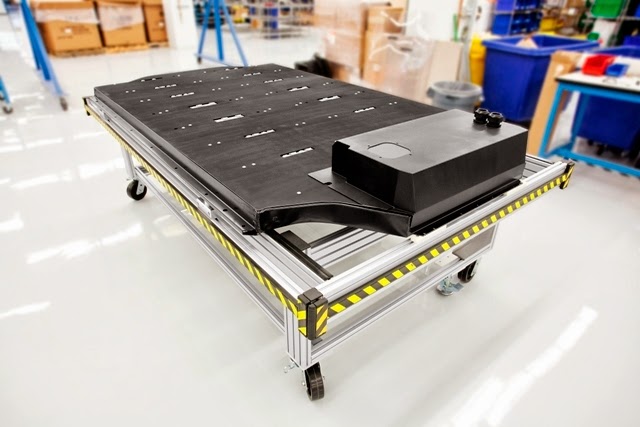
Tesla Motors is considering plans to create a "giga factory" to manufacture electric vehicle battery packs for the automaker's consumption, Tesla CEO Elon Musk said.
Musk said Tesla's long-term ambitions to build 500,000 electric vehicles annually could chew up the vast majority of current lithium ion battery supplies globally for all industries, including computers and cell phones.
Musk said the Tesla plant would be "something comparable to all lithium ion production in the world, in one factory."
Musk declined to give a timeframe for the plant, but with the smaller Gen III cars slated to arrive in 2017 with a $35,000 price point, Tesla production should ramp up rapidly.
"If we were to produce 500,000 cars, we need cell capacity commensurate with that. That might be more, or at least on par with, all lithium ion production in the world today. We're in the process of figuring that out. There might need to be some giga-factory built," Musk said in a conference call with analysts.
Musk foresees such a plant that would take "raw materials to finished packs, with partners, in North America.
"Raw materials are not an issue. I would not worry about lithium supply. The main constituents, by weight, are nickel, cobalt, aluminum, then lithium," Musk said, adding that the plant would be, "a green factory, a lot of solar power. No toxic elements are going to come out of this plant."
Tesla recently inked a deal with Panasonic to update and expand their 2011 arrangement to now supply nearly 2 billion cells over the course of four years.


Speaking in Dublin, Tesla Motors founder Elon Musk said that a right-hand-drive version of the Model S, appropriate for the roads of England and Ireland, as well as for Australia, should be ready for production by the end of March 2014.
It is understood that Tesla has scheduled an initial production run of 500 Model S cars bound for right-hand-drive markets, including the UK, Hong Kong, Japan and Australia. Tesla has told buyers it expects Australian deliveries of right-hand-drive Model S sedans to begin sometime between March and June.
Tesla already has an Australian presence, with a store and service centre in Sydney, although neither is open to the public. The workshop functions to serve existing Tesla Roadster owners in Australia,
Tesla has been inviting Australian applications for Model S purchases for some time; securing a vehicle from the general production run requires a refundable AU$6,000 deposit, while ordering a top-spec Signature model won't leave you with any change from AU$40,000.


Daimler would like to expand its cooperation with Tesla Motors, a top Daimler executive said on Thursday.
"I told my guys, go back to Tesla and look for other opportunities" to work together, Bodo Uebber, Daimler's chief financial officer, said at a press briefing. "We want to look for more cooperation."
Tesla is supplying electric motors and batteries to Daimler for its Smart Fortwo EV and the new Mercedes-Benz B-Class EV that goes on sale next year in the United States and Europe.
"We could use more" from Tesla, Uebber said, without providing specifics. Daimler holds a 4.3 percent stake in Tesla, which also provides EV components to Toyota Motor Corp.
Uebber said Daimler, which just launched its new CLA compact sedan and is preparing to add a second model, the GLA compact crossover, in early 2014, is already reviewing plans for its next generation of small vehicles, due around 2018.
Daimler is discussing "different strategies" for building the next-generation compacts in Mexico with partner Renault-Nissan , "but no decision has been made," Uebber said.
He said the CLA, the GLA and at least one more derivative in 2015 from the company's MFA modular platform were crucial to Daimler's growth, especially in the United States and China.
"We are a late comer" to the small premium segment, he said, but "we need compact cars to get a broader, younger customer base."


