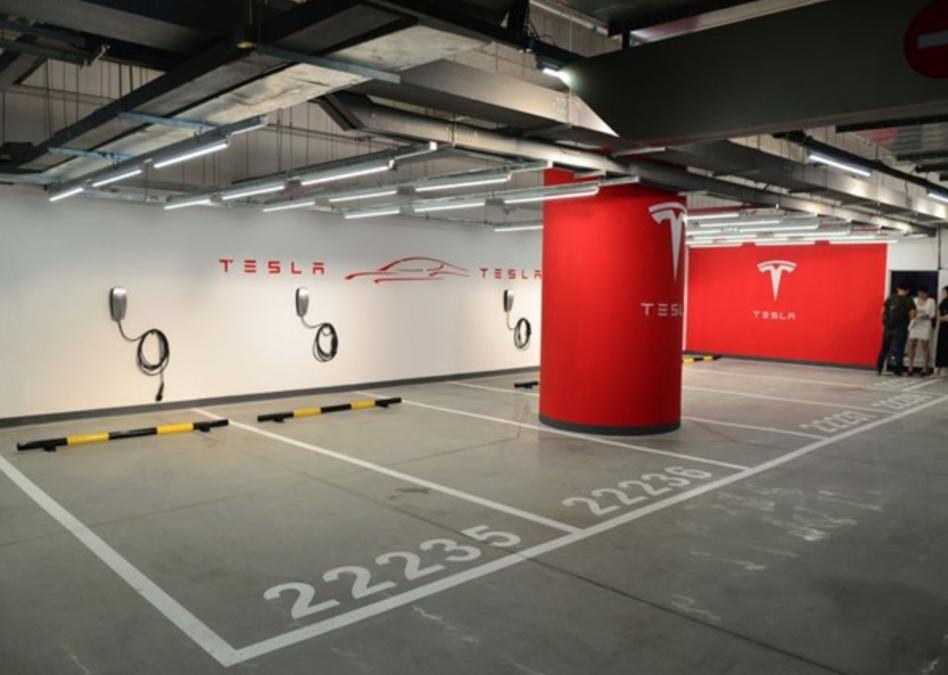
Tesla rolls out destination charging in Australian hotels, malls

Tesla Motors has introduced its ‘destination charging’ program into Australia, with over 10 sites established. Model S owners who frequent longer trips will benefit from the destination charging program, where owners can charge at no cost.

Tesla destination charging program provides ‘high power wall units’ at key destinations for Model S owners to charge while away from home for long periods.

The wall units can provide as much as 40 amp of power to Model S and are also provided with Model S for home installation, making the device familiar to owners.

With up to 500 km of rated range, the majority of charging with Model S is done at the home, but now the destination charging will provide locations where there are longer or overnight stops.

Locations include key hotels such as Park Hyatt Sydney, The Darling, Hotel Realm Canberra, The Observatory in Port Macquarie and to fulfil the winter snow travelers Rundells Alpine Lodge Dinner Plain.

In addition, key shopping centres such as Westfield Chatswood and Chadstone have been utilised, with premium parking locations and wall units available to Model S owners.

Tesla Motors has also partnered with Secure Parking to enable a safe location for Model S owners to park and charge whilst at work or out in town. These locations are located across Brisbane, Sydney and Melbourne.

“This expanding network of destination charging is a great replication of the convenience our owners receive when charging at home. Along with the developing Supercharger network, our owners will be able to cover long distances with the knowledge they have a charging solution,” says Australian Tesla spokesperson, Heath Walker.

Bosch test robotic Tesla Model S around German test track [VIDEO]

Bosch's engineers took a pair of Model S and fitted them with autonomous technology to allow them to drive themselves.

That technology consisted of 50 new components, including (brace yourselves) a front stereo video camera to watch the road markings and identify obstacles, six (non-Bosch) LiDAR laser scanners for 360º coverage around the car, two long-range (200m) and four mid-range (120m) radar sensors facing forwards and backwards, inertial sensors, a GNSS GPS navigation antenna, backup braking (both Bosch’s iBooster and ESP boxes) and ECU systems and a massive great PC in the back to hold hi-res maps and crunch the incoming data via bespoke algorithms.

In total, 1400 human-hours, 1300 metres of cable and an estimated €200,000 went into the car.

The result looks almost like a normal Model S - no pirhouetting Velodyne ‘Christmas tree’ on the roof here, just a few dark panels, a flying saucer GNSS antenna on the back and some industrial-looking buttons - and it’s so effective that it’s almost prosaic.

At the winding Boxberg test track, a Ford Fiesta drove around in front of us to show how smart the Tesla now is. Stopping quickly, driving at snail’s pace, accelerating into the distance: the Tesla reacted to the lot in a considered, sedate, measured manner. (Bosch tells us it can also swap lanes, overtake and merge with traffic on its own, but we didn’t get to check that out.)

[Stuff]

Bosch choose Tesla Model S for autonomous drive testing [VIDEO]

As we reported a month ago, Bosch has confirmed they are working with Tesla to develop automated driving systems for production vehicles.

Spotting a test vehicle, equipped as they are with measurement devices, sensors, and instruments, is usually pretty easy. But that’s not the case for the new Model S Teslas that recently joined the Bosch fleet. Both these test vehicles are helping engineers further refine automated driving. But at first glance, it’s hard to tell them apart from production models. “Bosch is developing automated driving for production vehicles of all kinds,” says Dr. Dirk Hoheisel, member of the Bosch board of management. The new test vehicles are evidence of the progress Bosch has already made in integrating the necessary systems and components. Those attending the 62nd International Automotive Press Briefing can see this for themselves in Boxberg, Germany, from May 19 to 21, 2015

Fit for highly automated driving after 1,400 hours of work

To make the test vehicles ready for automated driving, they first had to be retrofitted. Fifty new Bosch components were installed in each car. They included a stereo video camera (SVC), which the car uses to recognize lanes, traffic signs, and clear spaces. The Bosch SVC is the smallest stereo camera system for automotive applications currently available in the market. Its compact design makes it easy to integrate into vehicles. In addition to the camera, 1,300 meters of cable were laid in each car and fixed in place with 400 cable ties. “After some 1,400 hours of work on each of them, the test vehicles are ready for highly automated driving,” Hoheisel says. Thanks to Bosch technology, the two Teslas can now autonomously drive from on-ramp to off-ramp without the driver needing to constantly monitor them.

This transfer of responsibility from the driver to the vehicle explains why so much time and effort is necessary for the retrofit. Highly automated vehicles must be capable of operating safely even if a component fails. The only way to achieve such operational reliability is by a design strategy that includes redundancy in safety-critical systems such as braking and steering. For example, both test vehicles feature both the iBooster electromechanical brake booster and the ESP braking control system. These Bosch components can brake the car independently of each other, without any need for driver intervention. “For Bosch, the principle here is safety first,” Hoheisel says. Back-up systems are also available for the two test vehicles’ power supply and vital ECUs.

Several thousand test kilometers driven without a hitch

Since 2011, Bosch has had two teams – on two continents – working on automated driving. At the Abstatt location in Germany, Bosch engineers are working on system integration. Their colleagues at Palo Alto in California’s Silicon Valley are driving forward work on function development. The two teams receive support from roughly 2,000 driver-assistance engineers who work for Bosch around the world. To make it as easy as possible for the two teams to share their results, Bosch uses identical test vehicles. Hoheisel explains why Bosch opted for two all-electric Model S vehicles made by the U.S. automaker Tesla: “They combine two automotive industry trends: electrification and automation.” This presents a particular challenge, he says, but one that Bosch relishes.

Bosch started testing automated driving on public roads at the beginning of 2013. So far, it has been using test vehicles based on the BMW 325d Touring. Engineers have successfully driven them for several thousand kilometers on freeways – both the A81 near Stuttgart and the I280 in California. Before the first test drives, the German certification authority TÜV Süd reviewed the safety concept that Bosch had prepared specially for the purpose. And even though the technology on board the vehicles is designed to handle any situation in freeway traffic, the drivers at the wheel have been specially trained. Bosch’s test drivers not only know the safety precautions inside out, but have also completed a multi-day training course.

Tesla launch 500 hp AWD 70 kWh Model S70D

Tesla Motors introduces the All-wheel drive Model S 70D. Uniting exceptional performance and drive experience features, the newest Model S offers great value at a compelling price. Starting at $102,400 RRP plus luxury car tax, on-road costs and stamp duty, Model S 70D includes dual motor all-wheel drive technology, a NEDC-rated 440 km of range, and a 0-100 time of 5.4 seconds.

In addition to dual motor, 70D comes standard with Autopilot Hardware, Navigation, and Supercharging. And, as with every Model S, 70D will run on the new software 6.2 and owners will continue to receive free over-the-air updates that will add additional functionality, enhanced performance, and improved user experience over time.

To make room for the 70D, Tesla is eliminating the 60, which had been its cheapest Model S since the sedan’s 2012 launch. Starting at $76,170 before any government incentives, the 70D will cost $5,000 more than a basic 60, though it includes use of Tesla's proprietary Superchargers, which was previously a $2,000 option.

Model S70D will be able to travel 440 km (275 miles) between charges and deliver 380 kw (514 hp) to all four wheels from two electric motors -- up from 375 km (233 miles) of range and 280 kw (380 hp) for today’s basic rear-drive Model S, called the 60.

Model S 70 D standard features include:

  • All-wheel drive Dual Motor
  • 70 kWh battery with NEDC-rated 440 km range
  • 0-100 km/h acceleration in 5.4 seconds
  • 225 km/h top speed
  • Autopilot Hardware
  • Navigation
  • Supercharging
  • Trip planner and range assurance
  • Lane departure warning
  • Parking sensors
  • Automatic emergency braking
  • Automatic Keyless Entry

Tesla sells record 10,030 cars in Q1, up 55% year over year

Tesla Motors delivered a record 10,030 cars in the first quarter of 2015, a 55% increase compared with the number of deliveries in the first quarter of last year.

The company said going forward it will publish the number of new car deliveries within three days of quarter end as inaccurate sources of information have sometimes been used by others in publishing the number of vehicle deliveries.

The company expects to deliver about 55,000 cars globally in 2015, an increase of about 74 percent.

Tesla Motors is also set to offer upgrades including hands-free steering on its Model S sedan in three months, about a year ahead of other automakers.

Up to Thursday's close of $191, the stock had fallen 14.1 percent this year.

Electric vehicles account for over 20% of Norway’s new-car sales

Plug-in electric car sales in Norway continue at just above 20% (21.03%) with 2,235 registrations in February 2015. Battery only electric vehicles now account for 18% of national car sales.

The over-all #1 selling car in Norway for the second month running is the VW e-Golf with 839 units. Sales of the Volkswagen e-Golf in Feb were almost double the top selling fossil fuelled car, the Toyota RAV4 with 450 sales.

The e-Golf accounts for almost 40% of all EV sales in Norway YTD (1,718) selling 3x more than second place Nissan Leaf (556) and 4x more cars sold than the third placed Tesla Model S (392).

The e-Golf and GTE Plug-in variants now account for 70% of all Volkswagen sales in Norway.


PlNorwayFeb.YTD '15%'14Pl
1Volkswagen e-Golf8391.718395
2Nissan Leaf247556121
3Tesla Model S32139292
4Mitsu Outlander PHEV e)15038496
5Volkswagen e-Up! e)16033173
6BMW i312622754
7Audi A3 e-Tron134188421
8Kia Soul EV4513737
9Renault Zoe5413338
10
11
Mitsubishi I-Miev
Peugeot iOn
32
54
130
114
3
3
9
11
12Volvo V60 Plug-In2757114
13
14
15
16
17
Nissan e-NV200 / Evalia e)
Mercedes B-Class ED e)
BMW i8
Toyota Prius Plug-In
Opel Ampera 
20
20
4
2
53
22
10
5
2
1
0
0
0
0
15
N/A
20
17
21

TOTAL2.2354.459100


Source: EV Sales Bestsellingcarblog

Japan Has More EV Chargers Than Petrol Stations

There are more electric-car charging points in Japan than there are petrol stations.

That surprising discovery comes from Nissan Motor Co., which reported that the number of power points in Japan, including fast-chargers and those in homes, has surged to 40,000, surpassing the nation’s 34,000 gas stations.

The figure shows that in the relatively brief time since electric vehicles were introduced, the infrastructure to support them has become bigger than what the oil industry built over decades in the world’s third-biggest economy -- at least by this one measure.

Why that matters is obvious. Nissan’s battery-powered Leaf can travel 84 miles (135 kilometers) on a charge, and the anxiety of being stuck away from home without power has restrained consumer demand. As the charging network expands and batteries become more powerful, that concern will wane.

“An important element of the continued market growth is the development of the charging infrastructure,” Joseph G. Peter, Nissan chief financial officer, told analysts on a conference call.

As charging stations become more common, electric-car support services are also emerging. Open Charge Map, for example, operates an online listing of public charging points worldwide. A mobile app combines the data with GPS technology to guide drivers to the nearest site.

Of course, gas stations typically have multiple pumps and can serve more vehicles in a day than an electric-car charging point.

Private Chargers

Also, one criticism of Nissan’s number is that many of those charging sites are in private garages. Considering the emerging so-called sharing economy, such as the online home-sharing service operated by Airbnb Inc., homeowners may soon be willing to make their chargers available to other drivers.

And more charging locations are being built all the time. Automakers have recognized that oil companies are unlikely to install plugs next to gasoline pumps, and are building their own networks.

Tesla Motors Inc. has its own network of charging stations, and Bayerische Motoren Werke AG and Volkswagen AG announced in January that they are joining the network operated by ChargePoint Inc., and plan to build as many as 100 fast chargers along the busiest corridors of the U.S. coasts, from Portland to San Diego in the west and from Boston to Washington, in the east.

Free Charging

Utilities are joining in. Great Plains Energy Inc., the Kansas City, Missouri-based utility holding company, announced in January plans to build a network of more than 1,000 charging stations in the region by mid-2015. Charging will even be free to everyone for the first two years.

Given that there are only about 9,000 public charging stations in the entire U.S., the initiative gives Kansas City, the nation’s 29th largest metropolitan area, a chance to become the nation’s electric car capital with as much as 10 percent of the nation’s chargers.

Kansas City may not be able to retain that position. PG&E Corp., owner of California’s biggest utility, asked regulators Feb. 9 for permission to build a network of about 25,000 chargers in public areas over a five-year period.

Samsung SDI to supply 40% of Tesla batteries

Tesla Motors and Samsung SDI are in talks over whether to expand their partnership in batteries for electric cars, industry officials said Sunday.

"With Tesla seeking to diversify its battery sourcing channels beyond its key partner Panasonic, Samsung SDI will have greater room to supply more electric vehicle (EV) batteries to Tesla," said an official who declined to be named.

Samsung SDI is expected to account for about 8 percent of Tesla battery demand this year, worth 36 billion won. It expects to raise that portion to 40 percent in 2016, with sales to the American company rising to 254 billion won.

"From next year to 2018, Samsung SDI may handle 40 percent of Tesla demand," said another source directly involved with the issue.

Samsung SDI said nothing has been decided.

Samsung SDI's target for EV batteries is considered as rather aggressive. But optimists say EVs remain economically-viable with gas at $2 per gallon.

Even with plunging oil prices, analysts say the economics for EVs is well supported as they are still at parity with conventional vehicles after 5 years of ownership at the current gas price level.

Tesla CEO Elon Musk expects to sell "a few million EVs a year by 2025. The company will soon start building two new factories, one each in Europe and Asia.

To that extent, Tesla needs additional battery partners.

"We expect more development from Tesla's Gigafactory planned for 2020. Some of the battery demand within the project could be allocated to different partners, for which we believe Samsung SDI remains well positioned on the basis of both technology and capacity," said Mark Newman at Bernstein Research.

"For Samsung SDI, a meaningful development in regard to partnership with Tesla would first help sentiment in terms of earnings impact," he said.

Research firm Navigant Research said 2014 global EV sales were estimated at 2.7 million, accounting for 3.3% of global light vehicle sales for the year.

Samsung SDI's share of the EV battery market stood at around 7.2 percent last year, driven mostly by the strong performance of the BMW i3.

Tesla Model X Caught Testing [VIDEO]

Youtuber Juan del Real shot this video of a Tesla Model X being tested at the former naval air station in Alameda California about 30 miles north of Tesla's factory in Fremont.

Based on the size of the Model S in the background, Jalopnik think the camouflaged prototype looks too small to be a Model X and believe this may in fact be the first sighting of a Model 3.

Tesla Roadster 3.0 adds 70 kWh Battery and 640 km Range

Tesla Motors have announced a new extended-range upgrade for the Roadster — the Lotus-based two-door that preceded the Model S sedan.

The upgrade includes a battery swap, a retrofit aerodynamics kit to reduce drag by 15% plus new tires and wheel bearings to decrease rolling resistance by 20%. The upgrades are expected to yield a 40 to 50 percent improvement in range, breaking the 400-mile mark.

Battery technology has continued a steady improvement in recent years, as has Tesla's experience in optimizing total vehicle efficiency through Model S development. Tesla have long been excited to apply this learning back to their first vehicle, and aim to do just that with the prototype Roadster 3.0 package. It consists of three main improvement areas.

1. Batteries
The original Roadster battery was the very first lithium ion battery put into production in any vehicle. It was state of the art in 2008, but cell technology has improved substantially since then. Tesla have identified a new cell that has 31% more energy than the original Roadster cell. Using this new cell they have created a battery pack that delivers roughly 70 kWh in the same package as the original battery.

2. Aerodynamics
The original Roadster had a drag coefficient (Cd) of 0.36. Using modern computational methods Tesla engineers 'expect' to make a 15% improvement, dropping the total Cd down to 0.31 with a retrofit aero kit.

3. Rolling Resistance
The original Roadster tires have a rolling resistance coefficient (Crr) of 11.0 kg/ton. New tires for the Roadster 3.0 have a Crr of roughly 8.9 kg/ton, about a 20% improvement. They are also making improvements in the wheel bearings and residual brake drag that further reduce overall rolling resistance of the car.

Combining all of these improvements Tesla 'expect to achieve a predicted 40-50% improvement on range between the original Roadster and Roadster 3.0. There is a set of speeds and driving conditions where we can confidently drive the Roadster 3.0 over 400 miles (640 km). Tesla will be demonstrating this in the real world during a non-stop drive from San Francisco to Los Angeles in the early weeks of 2015.

Appointments for upgrading Roadsters will be taken this spring once the new battery pack finishes safety validation. Tesla are confident that this will not be the last update the Roadster will receive in the many years to come.

Tesla Model S Beats Porsche in Owner-Satisfaction Survey

Tesla drivers were more likely than Porsche owners -- or anyone else -- to say they’d buy their cars again in this year’s edition of the closely watched Consumer Reports buyer survey.

Tesla’s Model S luxury electric sedan topped the U.S. survey a second year in a row, scoring 98 out of a possible 100, after posting a 99 last year. This year’s No. 2 brand, Porsche, scored an average of 87 out of 100 across its model lines. Palo Alto, California-based Tesla, co-founded and led by billionaire Elon Musk, said last month that it expects to sell 50,000 Model S cars next year.

“Not only is the Tesla roomy, comfortable, and a lot of fun to drive, but it also has low operating costs,” Consumer Reports said.

The survey will bolster the 11-year-old carmaker’s image as the leader in the business of making high-end electric cars. Tesla plan to expand sales of the Model S and develop the long-awaited Model X SUV, which is expected in the third quarter of 2015. Tesla stock has gained 52 percent this year.

Sports Cars

The next three most satisfying vehicles in the Consumer Reports Survey, after the Model S, were sports cars: General Motors Chevrolet Corvette Stingray, with a 95 percent satisfaction rating, and Porsche Cayman and Boxster, which tied for third with 91 percent of buyers saying they’d purchase them again.

The survey covered 350,000 vehicles from one to three years old and took into account “attributes such as styling, comfort, features, cargo space, fuel economy, maintenance and repair costs, overall value, and driving dynamics,” Consumer Reports said.

Hybrid, electric and diesel-powered cars outscored gas engines throughout the survey, with the Chevrolet Volt and Toyota Prius leading the compact-car category and Honda Accord Hybrid and Ford's Fusion Energi atop the list of mid-sized sedans.

Demand for Tesla’s Dual-Motor Vehicles “Off the Charts”

Tesla Motors CEO Elon Musk has weighed in with one of the most useful updates to date on the company's new dual-motor versions of its Model S. The verdict? One month after it was introduced, demand for the all-wheel-drive version of the model isn't lacking. In fact, demand for the new motor system is incredibly robust. Here's what investors need to know.

The P85D is Tesla's halo car

"This is the fastest accelerating four-door production car in the world," Musk explained in a GQ magazine interview published Tuesday, referencing Tesla's new dual-motor option for its flagship 85-kilowatt-hour-battery performance Model S, officially dubbed the P85D.

The new dual-motor system with a motor connected to both the rear and front axle is an upgrade offered for the 85-kWh-battery version of the Model S and now comes standard on the performance version. Tesla's smaller 60-kWh-battery version of the Model S is still only available with the rear-wheel-drive one-motor configuration.

The dual-motor system is helping Tesla set new standards in the automotive industry. Most notably, Tesla showed off how a dual-motor, all-wheel-drive system gives owners all-weather traction without sacrificing efficiency. Tesla's all-wheel-drive system actually boosts range, top speeds, and acceleration times over their rear-wheel drive counterparts running on the same battery. And now with a zero-to-60 acceleration time of just 3.2 seconds, Tesla is making it harder for premium internal-combustion-engine vehicles to compete.

Musk went on to explain in the interview that Tesla built the car to prove a point.

"We wanted to position it as the fastest in order to change the public mind-set. It had to be something dramatic. And getting those few extra 10ths of a second was hard," Musk said. He told GQ that the P85D is Tesla's "halo car," or the car that shows off the strengths of electric vehicles.

Demand is hot

But Tesla's dual-motor system is doing more than just drawing attention to the company. It is apparently convincing a large number of consumers to put in a cash deposit to wait in line for a built-to-order version of their own Model S.

"Demand for the P85D is off the charts," Musk said. "We're seeing a very high proportion of orders for all-wheel drive, either P85D or 85D (which has smaller, equal-sized electric motors front and rear), so 70%-plus of our cars will be dual-motor."

Musk went on to reiterate a common theme: Demand is not a problem for Tesla; ramping up production to meet demand, however, is.

The company is guiding to report record quarterly sales in Q4 and 50% higher annual Model S sales in 2015. But Tesla contends that the company will still not be fully meeting demand, even at these levels.

Tesla said in its third-quarter earnings call that with the help of the additional cost for dual-motor versions of the Model S, it expected Model S average selling to improve going forward. This favorable trend likely plays a role in Tesla's bullishness for its automotive gross profit margin to continue to improve in Q4 and into 2015, though the most important factor influencing Tesla's improving gross profit margin is undoubtedly growing sales of its Model S, which spread fixed costs across a larger number of deliveries.

While Tesla's ability to set standards and its soaring demand are both great for the company, investors should be careful to maintain proper perspective. Given Tesla's $31 billion market capitalization, the market is already betting on Tesla to be wildly successful in the coming years. Furthermore, Tesla's focused product portfolio and strict emphasis on battery-powered vehicles means that missteps could significantly delay its ambitious plans.

On the other hand, it's market-leading pure plays like Tesla with a proven record of execution on growth plans that are probably most likely to exceed market expectations. So, investors who already own shares should think carefully before they sell Tesla stock simply because they think shares are overvalued.

Porsche Readying Tesla Model S Fighter

The German automaker is currently in the early stages of development for an EV that will target the Tesla Model S and will be a new dedicated fifth model range slotting beneath the existing Panamera. While details on Porsche’s first all-electric production vehicle are mostly being kept under wraps at the moment, it will likely be built on the automaker’s second-generation MSB platform that underpins the current Panamera.

It will have a shorter wheelbase than the existing Panamera sedan but will be a five-door hatchback, similar in style to the Panamera Sport Turismo concept that debuted at the 2012 Paris Motor Show. The company is hoping to keep it around 2,100 kg and its electric powertrain will provide similar performance as the Model S, though Tesla did just announced the more powerful all-wheel drive Model S P85D.

Porsche is aiming for a range of over 450 km and the company is expected to work with Audi, so we expect they will also use solid-state batteries.

Audi Confirm Tesla Model S Rival with 450 km Range for 2017

According to a report by Auto Express, Audi is also looking to join the electric vehicle sedan market with its own offering sporting a 450 km (280-mile) all-electric range.

The vehicle is currently under development according to Audi’s Dr. Ulrich Hackenberg, who also revealed that it will arrive in 2017 as an all-new model.

In the interview, Hackenberg said that he was “able to re-engineer the R8 e-tron project and technology with the team” and confirmed that it will not be a sports car.

The German automaker will use next-generation batteries in order to achieve the 450 km range, technology that is said to have up to five times more energy density than the current batteries used in vehicles such as the Volkswagen e-Golf.

Tesla in talks with BMW over car batteries & component alliance

Tesla Motors is in talks with Germany's BMW over a possible alliance in batteries and light-weight components, Tesla's Chief Executive Elon Musk told German weekly Der Spiegel.

In an interview published on Sunday, Musk described BMW's production of carbon fibre reinforced car body parts as "interesting" and "relatively cost efficient."

BMW uses carbon fibres from its joint venture with materials supplier SGL to make reinforced passenger cell parts for its i3 electric hatchback and i8 plug-in hybrid sports car.

Officials at BMW were not immediately available to comment.

"We are talking about whether we can collaborate in battery technology or charging stations," Musk was quoted as saying in the interview.

There were no further details on the specific nature of the alliance, however BMW and Tesla executives already met in June to discuss the creation of charging stations usable for different types of electric cars.

Rival Daimler, owner of the Mercedes brand, said last month it would continue to collaborate with Tesla even after selling its remaining four percent stake in the U.S. company. Tesla has also worked with Toyota on electric SUVs.

Tesla's billionaire co-founder Musk also told Der Spiegel that he expects Tesla to have a battery production plant in Germany in five to six years.

BMW likely to phase out internal combustion engines over the next 10 years [VIDEO]

During a recent interview with CNBC.com , mutual fund manager Ron Baron of Baron Capital revealed that two of his analysts recently visited BMW in Germany and the BMW financial team believes that a "revolution in the drive train is underway."

"We believe that BMW will likely phase out internal combustion engines over the next 10 years,"
Baron wrote in his most recent quarterly letter to shareholders of his funds.

Almost exactly 12 months ago, BMW product chief Herbert Diess told Autocar "all BMW models will soon need to be sold with some form of electrification." BMW’s head of production for large vehicles, Peter Wolf, told motoring.com.au. “We are planning to have a plug-in hybrid in each and every model series.”

We have also regularly reported on a steady stream on informal announcements from German automakers (Audi, BMW, Mercedes, Porsche) regarding their plans to build a 'Tesla killer', but Wall Street financial analysts concluding a major automaker may abandon the production of ICE power plants within a decade still comes as a revelation. It was only four years ago (December 2010) the first mass market electric vehicle, the Nissan Leaf, began deliveries to retail customers.

Baron, who holds a $250 Million position in Tesla Motors, believes that of all the major automakers, BMW is the only car company with a 'culture' comparable to that of Tesla. Baron believes the rest of the auto industry is resisting the move to electric vehicles. "As a result, they are developing electric expertise so slowly that the lead Tesla has built up through its fast growing staff ... may soon become insurmountable."

He argues automakers don't want electric vehicles to happen because their engine and transmission plants would become stranded assets. Unions don't want EVs to happen because they are easier to assemble which results in fewer jobs and dealers don't want EVs to happen because of direct sales and lack of vehicle servicing. Electric cars have 18 moving parts compared to 2,000 moving parts in a combustion engined car. EVs simply don't wear out or breakdown leading to lost automaker/dealer revenues.

With global auto sales heading towards 100 Million a year, Baron believes that in 15 years time Tesla could be selling 10 Million vehicles a year.