Peugeot to unveil 208 HYbrid FE concept at Frankfurt

At the Frankfurt Motor Show, PEUGEOT and Total will unveil their technological concept, the 208 HYbrid FE, a full petrol hybrid with exceptional characteristics and without a Plug-in energy source.

The Research and Development teams the two partners rose brilliantly to the challenge proposed by establishing a remarkable level of performance, based on a production PEUGEOT 208 hatchback: 0 to 100km/h / 0 to 62mph in 8.0 seconds and CO2 of just 49g/km over the official NEDC European Drive Cycle (Combined Cycle figure). Numerous innovations are implemented in several areas:

  • Aerodynamic properties: improvements of 25% for the CdA,
  • Weight: reduction of 20%,
  • Powertrain: 10% improvement in fuel economy,
  • Hybridisation: recovery of 25% of the energy over one drive cycle.

    The 208 HYbrid FE project combines ideas which until now acted against each other - Fuel Economy and Fun&Efficient, reason and driving pleasure - giving a preview of the vehicles of tomorrow.

    "The 208 HYbrid FE project is essential as it explores solutions for reaching the bar of 2l/100km. It also showcases our R&D work with our historic partner Total. Together, we are developing more economical vehicles, we are winning victories all over the world. Together, we are making good progress." Maxime Picat, Director General, Automobiles Peugeot

    "With the 208 HYbrid FE, PEUGEOT and Total are combining their expertise to offer the technical solutions of tomorrow. Energy efficiency is a strategic aspect for our Group as it is at the heart of the expectations of our customers, who wish to enjoy the benefits of efficiency and yet retain driving pleasure. It is also a response to contemporary environmental challenges and the means of preserving fossil fuels, which are precious resources." Philippe Boisseau, member of the Executive Committee, President of Marketing & Services and New Energies department at Total

    Since 1995, PEUGEOT and Total have been working extensively together to significantly increase fuel economy, improve CO2 emissions and the TCO (Total Cost of Ownership) of motor vehicles. For PEUGEOT, this is a long-standing environmental policy. With this commitment, in 2013 the Marque is reducing still further the weighted average emissions of CO2 of its European ranges: by the end of May it was 116.3g/km, compared to 121.5g/km in 2012.

    Total's researchers are continually working on developing future motor vehicle fuels and lubricants.

    The Group provides PEUGEOT and its networks worldwide with FE (Fuel Economy) lubricants: by reducing friction in the combustion engine, these lubricants have contributed to a 5% reduction in CO2 emissions in the last ten years with PEUGEOT engines. The Total Excellium top-of-the-range fuels also contribute to improving fuel economy.

    The objective of the 208 HYbrid FE is to combine real driving pleasure with low CO2 emissions. More precisely, the intention is to halve the CO2 emissions of the PEUGEOT 208, equipped with the 1.0- litre VTi 68 and to provide it with acceleration comparable to a performance hatchback, so quite a challenge!

    The challenge is made all the greater for the teams of the 208 HYbrid FE project as the production PEUGEOT 208 is already renowned for its weight-saving design and its latest-generation engines that allow it to offer a high-level driving experience.

    To rise to this challenge, Total and PEUGEOT therefore combined their capacity for innovation in all areas capitalising on the virtuous circle initiated by the hatchback.

    "The goal of 49g and acceleration from rest in 8.0 seconds is as difficult to achieve as victory on the other side of the world. The small team consisting of the best experts in each of the areas brought all of its creativity and enthusiasm into play, and we did it!" Bruno Famin, Director, PEUGEOT Sport

    The 208 HYbrid FE, all part of the Marque's hybrid strategy
    The policy goal in terms of CO2 is ambitious. It involves achieving 95g/km on weighted average of the new vehicles sold in Europe in 2020. To rise to this challenge without sacrificing driving pleasure, PEUGEOT is investing in several technologies which are already present on its vehicles and achieving substantial progress: continuous improvement of the efficiency of the internal combustion engines, down-sizing strategy, widespread use of the Stop & Start, electric drive ...

    The HYbrid4 diesel-electric hybridisation, is part of this process. Launched as a world first by PEUGEOT on the 3008 Crossover, it has since been extended to the 508 RXH and the 508 Saloon. Over 28,000 customers of the HYbrid4 technology have discovered an new driving pleasure which combines performance, simplicity of use, silent-driving and reducing environmental impact with CO2 emissions from 88g/km.

    With the 2008 HYbrid Air, PEUGEOT is innovating once more in the interests of the environment and of its customers in all of its markets. In fact, this breakthrough technology combines petrol and compressed air to fulfil customer expectations and rise to the challenges facing the motor industry.

    On the current generation of B segment vehicles, the HYbrid Air considerably improves fuel economy and reduces CO2 emissions. In fact, on completion of the homologated Drive Cycle tests, the figures are set at just 2.9l/100km (97.4mpg) and 69g/km. This technology is a key step towards the goal of reducing fuel consumption to just 2.0l/100km (141.2mpg).

    The 208 HYbrid FE combines innovations which will make it possible to achieve this record figure.

    PEUGEOT style, naturally efficient
    Fluidity is part of the Marque's stylistic heritage, it is in its DNA. On the 208 HYbrid FE, the aerodynamics experts took the exercise to an extreme. So, the Cd improves by 25%, to a value slightly lower than 0.25 and a real feat on a conventional vehicle where the passenger space and boot are maintained!

    To achieve this, the air is parted by the 'floating grille' redesigned for permeability and reduced by 40% to just 5dm². In fact, as the engine has been modified for efficiency, it duly requires less cooling.

    On the body sides, any flow disrupting components has been eliminated to help improve the aero performance. The tyres, specially developed by Michelin, are of the Tall&Narrow type, ie: of large diameter and narrow width. They are fitted on 19" alloy wheels on which the carbon aerodynamic flaps fill the space between each spoke.

    Cameras provide the rear vision, the image being reproduced on board on the interior mirror reminiscent of sporting disciplines like endurance racing. The rear track also contributes to this efficiency by being narrower by 40mm, further reducing the Cd. Finally, the design of the roof extends in an almost horizontal movement leading into the tailgate spoiler.

    The rear aspect, with chamfered edges, has an air deflector in its lower section. It deflects the airflow which passes under the vehicle without hindrance due to the completely flat floor.

    Finally, to reduce its environmental footprint as much as possible, the LED lamps of the 208 HYbrid FE have thin vertical fins, inspired by the Onyx Concept supercar. These features minimise the air flow turbulence.

    A considerable reduction in weight: 20%
    When it was launched, the PEUGEOT 208 hatchback shook up the segment, notably due to its light weight - from only 975kg at the Access level. This performance is remarkable, but in the future vehicles will need to be even lighter while still providing the high levels of comfort and safety.

    "Reducing the weight was a primary area of consideration. To achieve the 20% reduction in the weight of the vehicle we carried out a study part by part and equipped the 208 HYbrid FE with the most innovative materials from Hutchinson, CCP Composites and Total's Polymers activity. This process is even more virtuous as it does not sacrifice any of the safety and comfort used in the vehicle while introducing real innovations." Philippe Girard, Scientific Department Representative, Total Composite materials

    The 208 HYbrid FE benefits from the latest material innovations developed by the Polymers Division of the Refining-Chemicals department at Total, as well as by its two subsidiaries CCP Composites and Hutchinson.

    Taken from the end of the assembly line, the 208 retains its metal structure. Composite components replace bodywork panels and the floor, further reducing the weight of the body shell from 295 to 227kg. The one-piece outer skin (weighing just 20kg), the flat base (8kg), the door panels (c2kg) and the lower front panel are made from carbon fibre. The bonnet (5kg) and the wings (c2.1kg) are constructed from a composite VER/Carbon, a material which is half the weight but with comparable structural properties. It is obtained from a new type of resin which can be used untreated, painted or colour-dyed.

    Finally, with the exception of the door windows, the glazing uses polycarbonate to further save 5kg.

    The 208 HYbrid FE innovates in its use as this material has up until now be reserved for headlight lenses. It reduces the weight by more than 50% compared to conventional glass.

    Innovative suspension and wheels
    The 208 HYbrid FE rests on innovative pseudo MacPherson suspension with a 'glass fibre resin' composite transverse located blade. It replaces several components: suspension springs, lower wishbones and anti-roll bar. The front blade also has varying flexibility along its length. Designed and produced by Hutchinson, using these two blades saves 20kg.

    Due to their dimensions, the 145/65 R19 wheels themselves reduce the rolling resistance by 20%. They also require less effort on the steering wheel to direct them, making steering assistance superfluous: saving in space under the bonnet, fuel consumption and extra weight. The wheels are fitted onto low friction bearings assisted by special Total grease.

    The wheel rims house large brake discs 380mm in diameter and 9.6mm thick. They are rigged with two-piston callipers, 44.5mm at the front and 31.8mm at the rear.

    On braking, the reduced effort on the pedal and the intervention of the electric motor mean that the supplementary braking assistance can be eliminated.

    A passenger compartment for five occupants
    The 208 HYbrid FE needed to retain the interior features of the production hatchback model. The result proves it: a very economical vehicle that can comfortably accommodate five people and their luggage. Only the air conditioning is eliminated due to its impact on fuel consumption.

    The composite door trim pads are developed by Total's Polymers Division using Polypropylene reinforced with natural fibres. Its excellent structure, rigidity and impact absorption properties are accompanied by a reduction in weight of up to 15% and mean a reduction in the carbon footprint of these components. The centre console and vent trims are of VER resin (CCP Composites) left untreated to offer an appearance not previously seen before. In fact, their slightly amber honey colour reveals the natural fibres through transparency.

    The weight reduction techniques have also been applied to the petrol engine and the gearbox.

    An efficient and high-performance power train
    The 208 HYbrid FE is driven by a petrol-electric hybrid powertrain, which combines development of the latest generation of 3-cylinder engine with a battery and an electric motor taken from PEUGEOT Sport's Endurance programme. Special engine management and special software control the entire drive train. Overall, the efficiency of the powertrain increases by an impressive 10%.

    "The challenge of this project consisted of combining engine optimisations (reciprocating gears, cylinder head, etc.) and optimising the flow of energy between the internal combustion engine and the electric motor. All of the solutions can potentially be carried over to production." Julien Lidsky, Manager, 208 HYbrid FE Powertrain, PEUGEOT Sport

    1.2-litre VTi-FE petrol engine of high efficiency
    The 3-cylinder engine has undergone several modifications: optimisation of the engine operational cycle, reduction of friction losses, thermomanagement... All of these advances lead to fuel economy improvements by 10% yet with power maintained at 68bhp (50kW).

    The Miller Cycle is accentuated and the compression ratio modified from 11:1 to 16:1 to increase the engine's thermodynamic efficiency. This can lead to self-ignition of the mixture (or knock), which is potentially destructive. To prevent this, several actions were taken.

    So, the rate of unburned elements in the combustion chamber is reduced by valves of increased diameter, redesigned exhaust pipes, a redesigned manifold, and an adapted valve lift pattern. Furthermore, the heat exchanges are optimised in the cylinder block due to coolant passages arranged between the cylinders. The coolant now passes through the cylinder head along its entire length to recover the heat around each source: combustion chambers, between injectors and spark plugs.

    The engine adopts direct injection which, by means of very precise phasing with the closing of the cylinder, maximises the benefit of each molecule of fuel. The variable setting at the inlet and at the exhaust extends the range of optimum efficiency to the entire engine speed range, both at full load and partial load.

    However, not all of these various developments favour power at high engine speed. So, the capacity is modified to 1,233cm3 by increasing the bore and the stroke (75mm x 93mm) to maintain the declared 68bhp (50kW). On the other hand, this progress benefits the maximum torque produced which increases by 25%.

    All of the moving components are specific to the 208 HYbrid FE. The nitrated steel crankshaft, the titanium con rods and the aluminium-copper alloy pistons are cut from solid. So, their weight is reduced in spite of the increase in capacity; the con rods and Gudgeon pins being halved.

    The friction losses are a challenge as they represent approximately 1/5th of the power consumed by an engine. On the 208 HYbrid FE, they are reduced by approximately 40% notably by the crankshaft, the pistons and the Gudgeon pin, the piston rings and the camshaft followers. These components are given a diamond-like Carbon coating and are geometrically optimised.

    The weight of the cylinder head, also cut from a solid block, is halved due to the reduced thicknesses permitted by its design and the characteristics of the aluminium used. The coolant circuit and the inlet line are made by rapid prototyping of resins charged with glass fibres or carbon. To do this, the laser beam of a 3D printer fuses successive layers of aluminium powder. This produces a functional component quickly and more cheaply in the context of individual specialised manufacture.

    Produced using the same process, the piston base jets serve here both to cool them on use under load and to heat the oil as quickly as possible on starting.

    This virtuous circle affects all of the areas explored by this technological demonstrator. So, the size of the radiator is reduced, benefiting the aerodynamic properties. The alternator, the starter and the reverse gear are eliminated, reducing the weight, mechanical losses, but also in its overall dimensions.

    Piloted transmission
    The base of the production piloted manual gearbox is retained for its high efficiency and its integrated actuators. The casings cut from a solid block houses a cascade of gears to connect the electric engine to the differential crown wheel. To reduce friction losses, the teeth of the gears are given a tungsten carbide chrome coating.

    The greasing is redesigned to reduce the volume of lubricant necessary and prevent splashing over the gears, which also consumes energy. Now, the lubricant is moved to the highest point by the final drive crown wheel before circulating through gravity over the entire mechanism. The prototype gearbox oil is developed by Total Lubricants based on bio-sourced oils, of 75W grade with a very high viscosity index (higher than 250). This produces a 3% reduction in consumption, and becomes a preview of the lubricants of the future.

    Taken directly from a competition environment, a fluid grease of low density also reduces the quantity deemed necessary. Its longevity is assured by operation at a lower temperature due to a reduction in friction and finally, the hub bearings adopt a special fluid grease, which adheres but limits friction losses.

    Fuel and lubricant
    The 208 HYbrid FE passes the CO2 emissions cycle with a benchmark Super 95 fuel. The performance additives of the Excellium type, developed by Total Additives and Special Fuels, would alone reduce the CO2 emissions of this engine by more than one additional gramme per kilometre.

    "The 208 HYbrid FE offers a convergence of innovations from the laboratories of Total. Today, the group's researchers are developing biofuels, energy saving lubricants (Fuel-Eco lubricants) and special additives all contributing to improving fuel economy. In France, close to 250 researchers are working on developing the products of tomorrow." Philippe Montantême, Senior Vice President Marketing and Research Strategy, Marketing & Services department at Total

    A special engine oil of extremely low viscosity has been developed by Total Lubricants using ultrafluid based oils and by the addition of friction reducing agents containing molybdenum. Of grade 0W12, this oil develops its properties very rapidly with a shorter temperature rise time. Optimised as regards friction, it retains, both when hot and when cold, an advantage compared to the best products on the market. Thus improving fuel economy, here again a few more grammes are saved!

    A hybridisation taken from endurance experience
    The project has benefited from the expertise of PEUGEOT Sport with its experience acquired in endurance competition. So, the electric motor and the battery are those developed for the PEUGEOT 908 HYbrid4 endurance race car.

    "The hybridisation developed for the 908 HYbrid4 is state-of-the-art in this domain. The work consisted of integrating it within the power train of the 208 to recover as much energy as possible on braking and using its full potential on acceleration." Pierre Lebrene, Manager, 208 HYbrid FE Energy Recovery System, PEUGEOT Sport

    A special architecture The electric machine combines power and lightness as, at only 7kg, it develops 30kW as a motor and 100kW as a brake generator. In both modes, its torque reaches a maximum of 30Nm. Proportional to the speed of the vehicle, its maximum speed is 40,000rpm. This electric motor provides the reverse gear function, by inverting the direction of rotation, and the starter function. It also provides access to ZEV driving, purely electric.

    The Lithium-ion battery, which has a capacity of two usable MJ or 0.56kWh, consists of 0.56 cells of 90V each. They are arranged in groups, which permits the ability to isolate one if deemed necessary.

    To ensure that this strategic unit is cooled correctly, Total has developed a special oil for circulating in the dedicated radiator.

    Weighing 25kg, it is installed, with the 20-litre petrol tank, on a subframe which is bolted underneath the vehicle directly below the rear bench seat. Here, sporting experience is demonstrated with improved weight distribution. For the inverter and the ECU, these are installed under the bonnet in the space left free by the braking assistance. The hybridisation has no effect on the interior packaging, so the inside the vehicle the passenger space is maintained.

    The principle of operation
    During deceleration phases, whether by releasing the accelerator pedal or through braking, the vehicle is slowed down primarily by the electric motor. The hydraulic braking only comes into operation at the end of braking phase to maximise the recovery of the energy available. Over one homologation cycle, this recovery is 25%. Then, on acceleration, this energy is returned and assists the petrol engine according to various parameters: acceleration dictated by the driver and the gear selected.

    The 208 HYbrid FE, Fun&Efficient and Fuel Efficiency
    The PEUGEOT and Total teams, who have been working for months on creating this technological demonstrator, can be justifiably proud.

    Up until now, there have been low consumption vehicles and high performance vehicles. For the first time, these two qualities are combined in the same vehicle.

    The emissions of CO2 are just 49g/km. The different areas divide up the reduction of 50g/km as follows:

  • weight reduction, aerodynamic properties and tyres: 40% that is 20g,
  • hybridisation: 40% that is 20g,
  • engine and gearbox: 20% that is 10g.

    The performance aspect, which improves from 14 to 8 seconds over the 0 to 100km/h / 0-62mph exercise is also contributed to by:

  • weight reduction, aerodynamic properties and tyres: 4 seconds,
  • hybridisation: 2 seconds.

    The 208 HYbrid FE proves itself beyond the figures. Due to the virtuous circle in which the two partners became involved, the driver enjoys new experiences at the wheel of this technological demonstrator: acceleration worthy of a GTi with mixed fuel economy of 2.1 1/100km (112mpg). Without any loss of comfort or ease of use, the driver will rediscover a direct link with the road due to the elimination of the powered, energy-consuming assistance.

    "At the beginning of the project, the objective seemed very ambitious, of a very high level. It was! The two partners, PEUGEOT and Total, achieved it by combining their technological expertise. PEUGEOT Sport has contributed its expertise to the project and has identified new areas of development. Production and competition are progressing together." Christophe Mary, Technical Manager of the 208 HYbrid FE project, PEUGEOT Sport

    The 208 HYbrid FE proves that the emotional aspect will always have its place in a PEUGEOT vehicle, even in an increasingly restrictive energy and environmental context. PEUGEOT and Total are the major players in a modern vision of the motor vehicle.

  • Toyota to add Wireless Charging to Plug-In Prius

    During the recent Toyota Hybrid World Tour Satoshi Ogiso, Managing Officer of Toyota Motor Corporation said Toyota will begin verification of wireless/inductive charging system system in Japan, the US and Europe in 2014.

    We have been listening very carefully to Prius PHV owners over the past two years… and are considering their requests for additional all-electric range.

    We have also heard from these owners, that they would like a more convenient charging operation. In response, we are developing a new wireless/inductive charging system that produces resonance between an on-floor coil and an onboard coil to recharge the battery without the fuss of a cable.

    We will begin verification of the system in Japan, the US and Europe in 2014.

    Nissan recently said they are working on an open source wireless induction charging system and that five future Nissan-brand EVs will use inductive charging.

    Source: Toyota

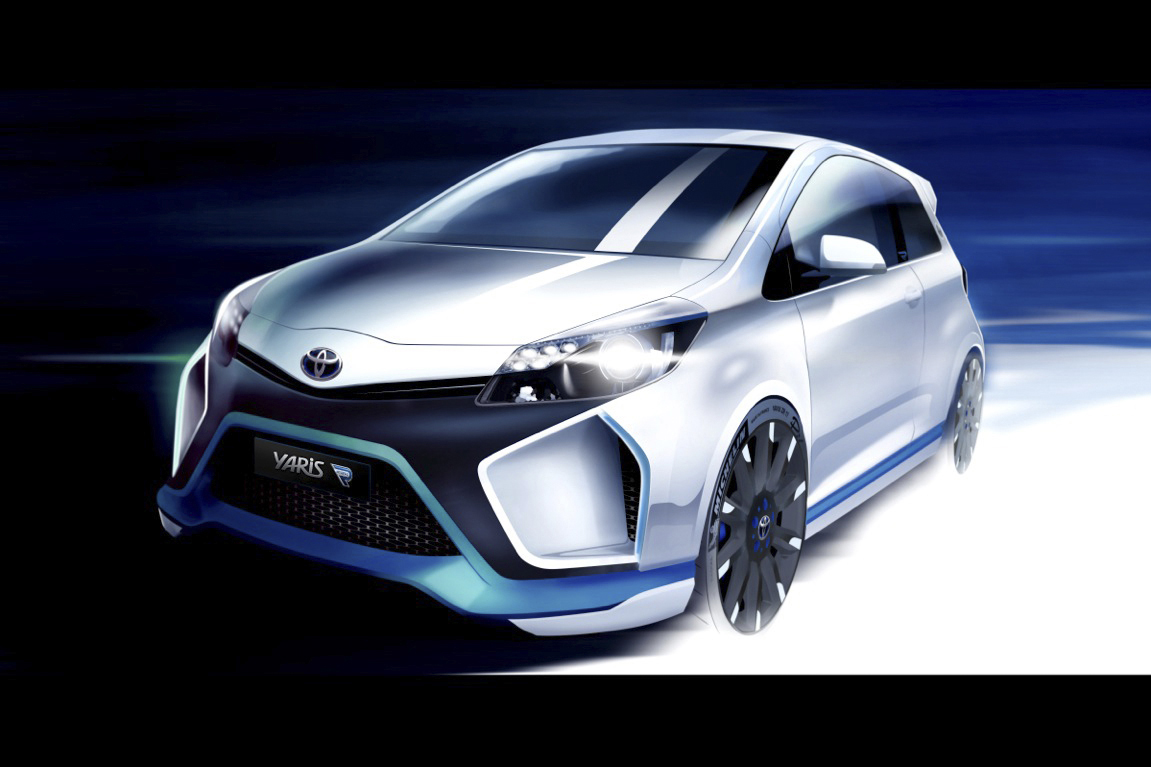
    Toyota Reveal 420hp AWD Yaris Hybrid-R Powertrain Details

    Based on the Yaris 3-door, the Yaris Hybrid R concept hybrid powertrain configuration combines the powerful 1.6l petrol Global Race Engine with two powerful electric motors to provide an ‘intelligent’ electric four-wheel drive capability.

    The front wheels are driven by a 300hp 4-cylinder 1.6 turbo engine with direct injection specifically developed by Toyota Motorsport GmbH (TMG) according to the rules of the International Automobile Federation (FIA) for a Global Race Engine to be utilised in various motorsport disciplines.

    At the rear, each wheel is individually powered by a 60hp electric motor – the same as those used in the standard Yaris Hybrid.

    Taken together, the hybrid powertrain system develops a total system output of up to 420 hp. The two electric motors work as electric generators during the braking phase, and supplement the petrol engine during the accelerating phases.

    Super-capacitor

    Just like in the TS030 HYBRID, the energy recovered during the braking phase is stored in a super capacitor. Compared to the standard NiMh hybrid battery, the super capacitor has a higher power density and a fast power charge / discharge speed. It is perfectly suited to the requirements of sporty driving on track, which requires brief and immediate bursts of power.

    Nevertheless, level of power depends on the duration of energy delivery desired. In road mode, the super-capacitor releases the energy recovered under braking for a maximum duration of 10 seconds per charge and the total power of the two electric motors is reduced to 40 hp. In track mode, the rear electric motors reach a combined maximum power of 120hp for up to 5 seconds per charge, reflecting the higher frequency of braking and acceleration events during circuit driving.

    Advanced traction control

    A 3rd 60hp electric motor, located between the engine and the 6 gear sequential transmission, operates as a generator in two different cases: during deceleration to feed the super capacitor and during acceleration to directly power the rear electric motors.

    The latter will only happen when the engine power and torque exceed the grip potential of the front wheels. The generator behaves like an advanced traction control system, redirecting the torque as electric energy to the rear wheels, to boost the acceleration and improve the handling rather than to simply limit the engine power.

    Torque vectoring

    Rear electric motors - one per wheel – can greatly influence the Yaris Hybrid-R handling characteristics during cornering by altering the distribution of torque between the left and right rear wheels.

    Each motor can be used independently as a generator or a motor to achieve the same effect as an intelligent torque vectoring differential.

    Depending on the radius of the curve, the system can send more torque to the outside rear wheel allowing higher cornering speeds into the corner (middle-speed curves), apply more braking force to the inside wheel (fast curves), or even brake and accelerate each wheel independently (slow curves) to adjust the yaw effect for a better line, to limit steering angle, and understeer.

    BMW i8 Faster than an M3 using one-third less fuel than a Toyota Prius

    At a driving event at the BMW Group’s Miramas test track in France, the BMW i presented a prototype of its second production vehicle, the BMW i8. BMW i is synonymous with visionary mobility concepts and a new definition of premium quality that is strongly focused on sustainability. Following the world debut of the first production model, the BMW i3, the BMW Group’s next step will be to extend this revolutionary answer to the future challenges facing personal mobility to the sports car segment in the BMW i8. This plug-in hybrid model is the most progressive sports car of our time, extending the basic BMW i philosophy of sustainability to a new vehicle segment.

    The BMW i8 fulfills the promise of The Ultimate Driving MachineTM in a revolutionary and mold-breaking form. This is reflected in a highly emotive design, dynamic sports car performance, and fuel efficiency and emissions figures worthy of a small car. Pairing an exceptionally lightweight, aerodynamically optimized body with cutting-edge BMW eDrive technology, a compact, turbocharged 1.5-liter BMW TwinPower Turbo gasoline engine and intelligent energy management, the BMW i8 marks the next stage in the evolution of the Efficient Dynamics strategy. Its revolutionary approach achieves an unprecedented balance between performance and fuel efficiency. Thanks to its carbon-fiber-reinforced plastic (CFRP) passenger cell, the BMW i8 sets new standards for a plug-in hybrid vehicle in terms of low weight. It can operate solely on electric power, which means no tailpipe emissions, and offers the dynamic performance of a sports car, with an expected 0 – 60 mph sprint time under 4.5 seconds.

    The BMW i8 was designed from the outset as a plug-in hybrid sports car, with the emphasis on agile performance and outstanding efficiency. Its characteristic BMW i LifeDrive architecture provides the best possible basis for lightweight design. Its main components are the aluminum Drive module, which incorporates the internal combustion engine and electric motor, the battery, the power electronics and the chassis components, along with structural and crash functions, and the Life module, which essentially comprises the 2+2-seater CFRP passenger cell. This architecture also gives the BMW i8 a very low center of gravity and a near-perfect 50:50 axle load ratio, both of which increase its agility.

    The BMW i8’s plug-in hybrid system is specific to this model. Developed and produced by the BMW Group, it marks the next step in the evolution of the Efficient Dynamics programme. A compact three-cylinder petrol engine with BMW TwinPower Turbo technology is combined with an electric drive system and a lithium-ion battery which can be recharged at a standard household power socket. The 231 hp (170 kW) gasoline engine sends its power to the rear wheels, while the 131 hp (96 kW) electric motor powers the front wheels. This configuration offers all-electric driving capability with a range of up to approx. 22 miles (35 kilometers) and a top speed of approximately 75 mph (120 km/h). With both drive systems engaged, it also offers road-hugging all-wheel-drive performance with powerful acceleration and dynamic torque vectoring during sporty cornering. The more powerful of the two powerplants drives the rear wheels. The hybrid system supplements this with power from the electric motor to deliver typical BMW driving pleasure combined with groundbreaking efficiency. Calculated using the EU test cycle for plug-in hybrid vehicles, the average fuel efficiency of the BMW i8 at model launch will be less than 2.5 liters/100 km, which equates to approximately 95 miles per US gallon, with CO2 emissions of less than 59 grams per kilometer.

    Optimal balance between performance and fuel economy: BMW i8 as an exciting evolution of the Efficient Dynamics strategy.

    It is now more than a decade since the BMW Group launched its Efficient Dynamics vehicle development strategy, whose aim is to significantly improve both the performance and the efficiency of new BMW Group models. Efficient Dynamics combines evolutionary advances in existing technologies with the development of new and revolutionary drive concepts. Efficient Dynamics solutions include efficient lightweight design and aerodynamic concepts, high-performance drive systems based on TwinPower Turbo technology and BMW eDrive, and intelligent management of all energy flows within the vehicle. The new, revolutionary technology now being introduced on models from BMW i will subsequently find its way into the vehicles of the BMW Group’s core brands.

    BMW i is also setting benchmarks in the quest for zero CO2 emissions in urban driving. The research and development work carried out since 2007 as part of project i has laid the foundations for revolutionary mobility solutions strongly influenced by environmental, economic and social change around the world. The BMW Group is pursuing an integrated approach, as embodied in the BMW i brand, which aims to achieve the necessary balance between individual needs and the global mobility requirements of the future. The BMW i focus is squarely on all-electric and plug-in hybrid mobility. Groundbreaking design, intelligent lightweight engineering, typical BMW driving pleasure coupled with zero tailpipe emissions, intelligent energy management and resource- and energy-saving production processes are all combined into an innovative premium-quality package.

    LifeDrive architecture with an aluminum chassis for the powertrain and a CFRP passenger cell: for more excitement, lower weight and optimized drag.

    The LifeDrive architecture specially developed for BMW i vehicles offers the ideal platform for turning the tide of spiraling weight while at the same time achieving distinctive styling exclusive to BMW i. With a length of 184.6 inches (4,689 mm), a width of 76.5 inches (1,942 mm) and a height of 50.9 inches (1,293 mm), the BMW i8 has the proportions of a sports car. Its dynamic personality is also stressed by a long bonnet, conspicuous aerodynamic features, an elongated roofline, short overhangs and a long wheelbase of 110.2 inches (2,800 mm). Characteristic BMW i form language wraps up this groundbreaking combination of sporty performance and efficiency in a charismatic 2+2-seater design.

    The BMW i8 combines a drag coefficient (Cd value) of 0.26 with outstanding aerodynamic balance. The finely honed air flow around all parts of the vehicle body makes for an excellent lift/drag ratio, resulting in superb driving dynamics and stability.

    Intelligent lightweight design – from the overall concept down to the smallest detail.

    With its combination of the aluminum Drive module and the CFRP passenger cell (Life module), the BMW i8 is also an excellent example of intelligent lightweight design – one of the guiding principles of the Efficient Dynamics strategy. Use of the lightweight high-tech material CFRP, which also offers excellent crash performance, brings weight savings of 50 percent over steel and around 30 percent over aluminum, with equivalent or improved strength. These savings offset the additional weight of the electric motor and the high-voltage battery, giving the BMW i8 a curb weight of less than 3,285 lbs (1,490 kilograms). The LifeDrive architecture also brings benefits in terms of weight distribution. The battery pack is situated low down in the middle of the vehicle, resulting in a low and central center of gravity, which improves safety. No other current model of a BMW Group brand has such a low center of gravity.

    The front-rear axle load distribution maximizes agility with a near-perfect 50:50 axle load ratio. The compact electric motor, together with the transmission and power electronics, are situated in close proximity to the electrically powered front axle. The turbocharged gasoline engine, which is located together with its transmission in the rear of the BMW i8, likewise sends its power to the road via the shortest possible route, i.e. through the rear wheels. As a finishing touch to this excellent weight distribution, the lithium-ion battery pack is centrally located in the vehicle, slightly forward of the mid-point. In terms of crash safety, this is an ideal location for the battery, which is integrated in an aluminum housing.

    The doors comprise a CFRP inner structure and an aluminum outer skin. This reduces the weight of the door by 50 percent compared with a conventional design. The high-quality, naturally tanned leather of the seats highlights the “next premium”, sustainable philosophy of BMW i. The magnesium instrument panel support saves weight on two fronts – firstly through intelligent design, leading to around 30 percent weight savings compared, for example, with the BMW 6 Series. In addition, the high structural rigidity provides a strengthening effect which allows the number of components to be reduced, thereby lowering weight by a further 10 percent. Innovative foam plastic technology used in the air conditioning ducts brings 60 percent weight savings over conventional components, while also improving acoustics thanks to its sound-absorbing properties.

    The fact that the power electronics and electric motor are directly connected reduces the amount of wiring required, while partial use of aluminum wiring brings further weight reductions. Lightweight design is also a feature of the BMW i8’s chassis systems – including the wheels, where the standard-fitted 20-inch forged aluminum wheels combine aerodynamic design with weight savings. The rigorous application of the lightweight design strategy even extends to aluminum screws and bolts, which are around 45 percent lighter than corresponding steel components, with the same strength and functionality.

    The BMW i8 is also the world’s first volume-produced vehicle to be equipped with chemically hardened glass. This innovative technology, to date used mainly in Smartphone manufacturing, results in very high strength. The partition between the passenger compartment and boot of the BMW i8 consists of two layers of chemically hardened glass, each of which is just 0.7 millimeters thick, with acoustic sheeting sandwiched between. In addition to excellent acoustic properties, a further advantage of this solution is weight savings of around 50 percent compared with conventional laminated glass.

    For maximum driving pleasure and efficiency: BMW TwinPower Turbo engine and electric motor developed by the BMW Group.

    The plug-in hybrid system of the BMW i8, which comprises a BMW TwinPower Turbo engine combined with BMW eDrive technology, offers the best of both worlds: excellent potential for improved efficiency and exciting, sporty driving characteristics. The BMW Group has developed not only the internal combustion engine and electric motor in-house but also the power electronics and the battery. This ensures that all these components offer high product and quality standards, based on the outstanding capabilities of the BMW Group in the field of powertrain research and development.

    The revolutionary character of the BMW i8 is emphasized by a further innovation: the use of a new internal combustion engine which is making its debut in this model. The BMW i8 is the first BMW production model to be powered by a three-cylinder gasoline engine. This highly turbocharged unit is equipped with latest-generation BMW TwinPower Turbo technology. It is exceptionally compact and develops maximum power of 231 hp (170 kW). The resulting specific output of 154 hp (113 kW) per liter of displacement is on a par with high-performance sports car engines and is the highest of any engine produced by the BMW Group.

    The new three-cylinder engine derives its typical characteristics from the BMW inline six-cylinder engines, to which it is closely related and which are noted for their eager power delivery, revving ability and refinement. The three-cylinder’s BMW TwinPower Turbo technology comprises a high-performance turbocharging system and direct gasoline injection with high-precision injectors positioned between the valves, along with VALVETRONIC throttle-less load control, which improves efficiency and response thanks to seamlessly variable valve lift control. Like a six-cylinder engine, the three-cylinder unit is free of first and second order inertial forces. The low roll torque, a typical feature of a three-cylinder design, is further reduced by a balancer shaft, while a multi-stage damper integrated in the automatic transmission ensures very smooth and refined running at low rpm. BMW TwinPower Turbo technology and low internal friction improve both fuel consumption and torque characteristics. Accelerator response is sharp and the three-cylinder unit quickly reaches its maximum torque of 236 lb-ft (320 Nm).

    The BMW i8’s second power source is a hybrid synchronous electric motor specially developed and produced by the BMW Group for BMW i. The electric motor develops maximum power of 131 hp (96 kW) and produces its maximum torque of around 236 lb-ft (320 Nm) from standstill. Typical of an electric motor, responsive power is instantly available when starting and this continues into the higher load ranges. The linear power delivery, which extends right up to the high end of the rpm range, is down to a special motor design principle exclusive to BMW i. BMW eDrive technology refines and improves on the principle of the permanently excited synchronous motor via a special arrangement and size of the torque-producing components. This results in a self-magnetising effect normally confined to reluctance motors. This additional excitation ensures that the electromechanical field generated when current is applied remains stable even at high rpm.

    As well as providing a power boost to assist the gasoline engine during acceleration, the electric motor can also power the vehicle by itself. Top speed is approximately 75 mph (120 km/h). The BMW i8 has a maximum driving range in this emission-free, virtually soundless, all-electric mode of up to 22 miles (35 kilometers). The motor derives its energy from the lithium-ion battery which is centrally mounted underneath the floor of the vehicle. The model-specific version of the high-voltage battery was developed and produced by the BMW Group. It has a liquid cooling system and can be recharged at a conventional household power socket, at a BMW i Wallbox or at a public charging station. In the US a full recharge takes approximately 3½ hours from a conventional 120 volt, 12 amp household circuit or approximately 1½ hours from a 220 volt Level 2 charger.

    The BMW i8’s vehicle concept and powertrain control system mark it out as a progressive, revolutionary sports car. The BMW i8 always achieves the optimal balance between performance and efficiency, whatever the driving situation. When power demands allow, the high-voltage battery is recharged by the electric motor. The high-voltage starter-generator, responsible for starting the engine, can also be used as a generator to charge the battery, the necessary power being provided by the BMW TwinPower Turbo engine. The battery can also be recharged via the electric motor during overrun. These various processes help to prevent depletion of the BMW i8’s battery in order to maintain the electric drive power. The all-electric driving range is sufficient to cover most urban driving requirements. Out of town, the BMW i8 offers impressively sporty performance which is also very efficient thanks to the power-boosting support for the gasoline engine from the electric motor. With such versatility, the BMW i8 belongs to a new generation of sports cars which unites exciting performance with cutting-edge efficiency – to enhance both driving pleasure and sustainability.

    Driving Experience Control and eDrive button: a choice of efficiency and performance characteristics – at the touch of a button.

    The rear wheels of the BMW i8 are driven by the gasoline engine via a six-speed automatic transmission. The front wheels are driven by the electric motor via an integrated two-stage automatic transmission. Combined maximum power and torque of 362 hp (266 kW) and 420 lb-ft (570 Nm) meters respectively provide all-wheel-drive performance which is as dynamic as it is efficient. The BMW i8’s intelligent powertrain control system ensures perfect coordination of both power sources. The variable power-sharing between the internal combustion engine and the electric motor makes the driver aware of the sporty temperament of the BMW i8 at all times, while at the same time maximizing the energy efficiency of the overall system. Utilizing both power sources, the 0 – 60 mph acceleration time is expected to be less than 4.5 seconds. Linear acceleration is maintained even at higher speeds since the interplay between the two power sources efficiently absorbs any power flow interruptions when shifting gears. The BMW i8 has an electronically controlled top speed of 155 mph (250 km/h), which can be reached and maintained when the vehicle operates solely on the gasoline engine. Variable front-rear power splitting in line with changing driving conditions makes for excitingly dynamic cornering. On entering the corner, the power split is biased towards the rear wheels to improve turning precision. For more vigorous acceleration out of the corner, the powertrain controller returns to the default split as soon as the steering angle becomes smaller again. The BMW i8 also offers the driver unusual scope to adjust the drive and suspension settings of the vehicle in order to adapt the driving experience to his or her individual preferences. As well as the electronic gear selector for the automatic transmission, the driver can also use the Driving Experience Control switch – a familiar feature of the latest BMW models – or, exclusively to the BMW i8, the eDrive button.

    Using the gear selector, the driver can either select position D for automated gear selection or can switch to SPORT mode. SPORT mode offers manual gear selection and at the same time switches to very sporty drive and suspension settings. In SPORT mode, the engine and electric motor deliver extra-sharp performance, accelerator response is faster and the power boost from the electric motor is maximized. And to keep the battery topped up, SPORT mode also activates maximum energy recuperation during overrun and braking: for this, the electric motor’s generator function, which recharges the battery using kinetic energy, switches to a more powerful setting. At the same time, gear change times are shortened and an extra-sporty setting is selected for the standard-fitted Dynamic Damper Control. Also in this mode, the programmable instrument cluster supplies further driving-related information in addition to the rev counter display.

    The Driving Experience Control switch on the center console offers a choice of two settings. On starting, COMFORT mode is activated, which offers a balance between sporty performance and fuel efficiency, with unrestricted access to all convenience functions. Alternatively, at the touch of a button, ECO PRO mode can be engaged, which, on the BMW i8 as on other models, supports an efficiency-optimised driving style. The powertrain controller coordinates the cooperation between the gasoline engine and the electric motor for maximum fuel economy. On deceleration, the intelligent energy management system automatically decides, in line with the driving situation and vehicle status, whether to recuperate braking energy or to coast with the powertrain disengaged. At the same time, ECO PRO mode also programs electrical convenience functions such as the air conditioning, seat heating and heated mirrors to operate at minimum power consumption – but without compromising safety. The maximum driving range of the BMW i8 on a full fuel tank and with a fully charged battery is over 310 miles (500 km) in COMFORT mode. In ECO PRO mode, this can be increased by up to 20 percent. The BMW i8’s ECO PRO mode can also be used during all-electric operation. The vehicle is then powered solely by the electric motor. Only if the battery charge drops below a given level, or under sudden intense throttle application such as kickdown, is the internal combustion engine automatically activated. The driving mode selected at a given moment is indicated to the driver on the programmable instrument cluster by a distinctive color and by a different, mode-specific set of driving information. The three-dimensional appearance of the display adds to the futuristic look and feel of the vehicle as a whole.

    High-quality chassis technology, DSC and Dynamic Damper Control as standard.

    The high-end chassis and suspension technology of the BMW i8 is based on a double-track control arm front axle and a five-link rear axle, whose aluminum components and geometry are specially configured for intelligent weight savings. The electromechanical power steering offers easy manoeuvring in town and typical sports car-style high-speed steering precision. Also standard is Dynamic Damper Control: the electronically operated dampers change their characteristics according to the selected driving mode to deliver the desired vehicle dynamics. The DSC (Dynamic Stability Control) stability system includes the Anti-lock Braking System (ABS), Cornering Brake Control (CBC), Dynamic Brake Control (DBC), Brake Assist, Brake Standby, Start-Off Assistant, Fading Compensation and the Brake Drying function. The push button-activated Dynamic Traction Control (DTC) system raises the DSC thresholds, allowing some controlled drive wheel slippage for easier start-off on snow or loose ground, or for extra-dynamic cornering.

    The extraordinary BMW i8 will make its world debut at the Frankfurt Motor Show and arrive in BMW showrooms in 2014.

    Toyota launches Corolla hybrid models in Japan

    Toyota have released a hybrid versions of its flagship Corolla model in Japan on Tuesday now that the cutting-edge vehicles are becoming the main battleground of the Japanese car market.

    Until now, the automaker has offered hybrid versions of its more expensive cars, in addition to hybrid-only models. But now a mass-market model is part of the lineup.

    hybrid versions of the Corolla Axio sedan and Corolla Fielder station wagon were released in Japan. In addition, there will be a special Corolla Fielder Hybrid G Aerotourer·WxB grade. Monthly sales target for Japan are 1,000 units of the Corolla Axio hybrid and 1,500 units of the Corolla Fielder hybrid.

    Both models are powered by a 1.5-liter Atkinson-cycle engine that develops 74 HP (54 kW) and 111 Nm (81 lb-ft) of torque. It is backed up by an electric motor that has a maximum output of 61 HP (45 kW) and 169 Nm (124 lb-ft) of torque. This enables the model to have a combined output of 100 HP (73 kW) and a fuel economy rating of 3.0 L/100km (77.6 mpg US / 93.2 mpg UK) in the JC08 test cycle.

    The NiMH hybrid battery is placed under the rear seat for more efficient use of interior space. Rear seat knee space is 640 mm, achieving comfort on par with gasoline-engine vehicles. Luggage space is also comparable to gasoline-engine vehicles, with the Corolla Axio possessing 461 liters and the Corolla Fielder possessing 407 liters when carrying five passengers and 872 liters when carrying two passengers.

    Suspension and shock absorber settings were adjusted to accommodate the increased weight and lower center of gravity of the hybrid system. The use of additional sound insulation material and noise-reducing windshield glass further enhances cabin quietness.

    Two drive modes come standard: the Eco-Drive Mode that gives highest priority to fuel economy and the EV Drive Mode for using only the electric motor.

    Starting price for the Axio Hybrid is ¥1,925,000 (US$19,589); starting price for the Fielder Hybrid is ¥2,085,000 (US$21,217).

    Acura NSX Hybrid Prototype Laps Mid-Ohio Race Circuit [VIDEO]

    It's not finished. But it is complete. The Acura NSX concept has moved to prototype and added an essential piece, a driver. The prototype NSX supercar took to the racetrack just prior to the Honda Indy 200 IndyCar Series race at Mid-Ohio Sports Car Course in Lexington, Ohio.

    Utilizing a unique 2 Electric Motor DriveUnit with a bilateral torque adjustable control system, the new hybrid all-wheel-drive system can instantly generate negative or positive torque to the front wheels during cornering, which Honda anticipates will deliver handling performance unmatched by previous AWD systems.

    In addition to the handling benefits of the Sport Hybrid SH-AWD system, a powerful next-generation VTEC V-6 engine with direct-injection, works in concert with a dual clutch transmission and a third electric traction motor integrated within the transmission housing, to create supercar acceleration while offering outstanding efficiency.

    This Sport Hybrid SH-AWD system will make the NSX the ultimate expression of, "the synergy between man and machine," added Ito. "The NSX will make the driver one with the car to enhance dynamic driving abilities without getting in the way."

    Honda (UK) has opened a pre-order bank for the hotly anticipated supercar. For a deposit of £5,000 potential owners can be among the first in the UK to get behind the wheel of the brand new NSX when it hits showrooms in 2015.

    Cadillac ELR Goes Ultrasonic in Pursuit of High Quality

    Ultrasonic welding, a high-tech manufacturing process used in the aerospace and medical industries, is helping ensure high quality for the new Cadillac ELR extended-range electric luxury coupe that goes on sale in North America in early 2014.

    Ultrasonic welding’s key advantage is exceptional and predictable quality and performance from one battery pack to the next. Every ELR battery, for example, has close to 200 ultrasonic welds. Each is required to meet stringent quality requirements, enabling Cadillac to offer an eight-year/100,000-mile battery system warranty.

    Short cycle times, low capital costs and manufacturing flexibility through the use of automation are other advantages of ultrasonic welding.

    “Ultrasonic welding is a far superior joining technology in applications where it can be deployed,” said Jay Baron, president and CEO of the Center for Automotive Research in Ann Arbor, Mich. “Cadillac’s innovative process will produce batteries with superior quality compared with traditional methods – and do it more efficiently. This is one example of technology development that is becoming pervasive in today’s world class vehicles.”

    General Motors’ Brownstown Battery Assembly plant near Detroit, uses ultrasonic welding to join metal electrode tabs on ELR’s advanced 16.5-kWh lithium-ion battery system, and does it with a proprietary quality monitoring process. Brownstown uses an automated system to execute millions of these welds each year.

    Ultrasonic welding uses specialized tools called an anvil and horn to apply rapid mechanical vibrations to the battery’s copper and aluminum electrodes. This creates heat through friction, resulting in a weld that does not require melting-point temperatures or joining material such as adhesives, soldering or fasteners.

    An integrated camera vision system is used to shoot a reference image of the weld area prior to the operation to achieve pinpoint accuracy. Quality operators check electrode tabs before and after welding, and the system monitors dozens of signal processing features during each weld.

    The battery-specific welding process is a result of collaboration among General Motors’ Manufacturing Systems Research Lab and Advanced Propulsion Center and the Brownstown plant. GM first applied the process on the award-winning Chevrolet Volt – its groundbreaking extended-range electric vehicle – and further refined it for ELR.

    “This effort is an outstanding example of teamwork between research and manufacturing engineering,” said Catherine Clegg, GM vice president of Global Manufacturing Engineering. “It has helped integrate the use of highly technical, complex technology into a sustainable manufacturing process, which means we can consistently deliver high-quality batteries to our customers for the Cadillac ELR.”

    The ELR’s T-shaped battery pack is located along the centerline of the vehicle, between the front and rear wheels for optimal weight distribution. The 5.5-foot-long (1.6 m), 435-pound (198 kg) pack supplies energy to an advanced electric drive unit capable of 295 lb-ft of instant torque (400 Nm) to propel the vehicle. Using only the energy stored in the battery, the ELR will deliver a GM-estimated range of about 35 miles (56 km) of pure electric driving, depending on terrain, driving techniques and temperature.

    Charging the ELR’s battery can be done with a 120V electrical outlet or a dedicated 240V charging station. The vehicle can be completely recharged in about 4.5 hours using a 240V outlet, depending on the outside temperature.

    The Cadillac ELR is built at GM’s Detroit-Hamtramck Assembly Plant, one of the few high-volume electric vehicle manufacturing facilities based in the U.S. Its battery pack is built from cell to pack at Brownstown and shipped to Detroit-Hamtramck for assembly into the vehicle.

    Toyota Hybrid Racing outlines plans for 2013 season

    Toyota Racing can confirm its plans for the remainder of the FIA World Endurance Championship season.

    The team will split its efforts between the ongoing 2013 WEC season and the development of its 2014 car in order to make best use of the available resources.

    As a consequence, the #8 of Anthony Davidson, Sébastien Buemi and Stéphane Sarrazin, which is the lead TS030 HYBRID in the championship, will compete in Sao Paulo (1 September) and Austin (22 September).

    Alex Wurz and Nicolas Lapierre will focus on 2014 development with testing and simulation sessions while Kazuki Nakajima will continue the defence of his Super Formula title whilst also racing in Super GT.

    A decision regarding the team’s line-up at the remaining WEC rounds will be announced in due course.

    Acura NSX Prototype to Lap Mid-Ohio Prior to Honda Indy 200

    Acura today released an image of a prototype NSX supercar, announcing that the running prototype will take to the racetrack just prior to the Honda Indy 200 IndyCar Series race at Mid-Ohio Sports Car Course in Lexington, Ohio. The NSX prototype with custom graphics will lap the road course in advance of the race on August 4, 2013. The race will be broadcast live by NBC Sports Network starting at 3 p.m. EDT.

    Global development of the NSX, slated for launch in 2015, is being led by engineers at Honda R&D Americas, Inc. in Raymond, Ohio. Additionally, it was announced in May that the next-generation Acura supercar will be produced at the newly established Performance Manufacturing Center in nearby Marysville, Ohio.

    The prototype model maintains the styling and proportions of the NSX Concept that debuted at the 2012 North American International Auto Show in Detroit, while packaging the production vehicle's mid-mounted V-6 engine mated to Acura's innovative new three-motor Sport Hybrid SH-AWD (Super Handling All Wheel Drive) system.

    Next Mitsubishi Evo to be 500 hp hybrid Nissan GT-R rival

    The next-gen Mitsubishi Evo will allegedly feature a hybrid setup good enough for about 500 bhp (373 kW).

    The standard Lancer will be globally launched sometime next year, while a plug-in hybrid model is already in the works. In addition, Autocar says Mitsubishi executives are also analyzing the prospects of a high-performance gasoline-electric variant with technology derived from the MiEV Evolution II Pikes Peak.

    Although it's in an early development stage, the new Evo is expected to offer better all-wheel drive performance than its predecessor, as well lower CO2 emissions and the possibility of running on electric power. If green-lighted for production, the car's styling could be influenced from the 2008 Concept-RA.

    Before a new Evo is out, Mitsubishi is planning a Lancer PHEV with a 2.0-liter gasoline engine working together with two 80 bhp (60 kW) electric motors. The setup should enable the car to return at least 150 mpg UK (125 mpg US or 1.8 liters / 100 km) with CO2 emissions of 50 g/km and a 40-mile (64 km) electric range.

    Source: autocar.co.uk

    SIX Porsche 918 Hybrid Spyder On the Road in Monaco [VIDEO]

    While cruising around Monaco, Youtuber Marchettino stumbled upon a convoy of several Porsche 918 Spyders!

    Technical data - 2014 Porsche 918 Spyder

  • Engine: two electric engines and a 4.6L petrol V6 with a total of 875hp / 750nm
  • Performance: 0-100 kph (0-60 mph) sprint in 2.8s and a top speed of 340kph (211 mph)
  • Curb Weight: 1675kg
  • Price: 781.000€ and limited to 918 units
  • Volkswagen XL1 achieves ‘only’ 160 MPG not 314 MPG [VIDEO]

    Volkswagen made big claims about the efficiency of their purpose-built XL1 diesel-hybrid. They claimed the car was good for 314 mpg, which equates to 0.9 l/100km in the Metric system. However, at a recent test drive event organized by VW, a handful of journalists were given the chance to drive the mid-engined XL1.

    The Automobile Magazine representative at the event averaged "only" around 160 mpg or 1.47 l/100km, which is still a hugely impressive figure but not the EU-certified314 mpg originally promised.

    It's not all bad news. Autocar were also at the event and report that on an early test drive, which including crossing a mountain range, the most economical drivers achieved a real 188 mpg and conclude there’s surely potential for 200 mpg on a long motorway run.

    The upshot is that the plug-in hybrid XL1 is probably still the most economical and most aerodynamically efficient production car of all time.

    Volkswagen XL1 and e-up! to run @ Silvretta E-Car Rally

    Volkswagen will be lining up at the start of this year’s Silvretta E-Car Rally with two innovative vehicles: one is the XL1, the most efficient production car in the world, which is equipped with a plug-in diesel hybrid engine. The other is the e-up!, the first electric vehicle from Volkswagen to be produced in high volume. Volkswagen is showing in this way that these alternative drive systems are capable of excellent performance on Alpine roads as well.

    The new e-up! is taking part in the Silvretta E-Car Rally in the Austrian Montafon region for the first time. With its Alpine route profile, the rally is both a test of reliability and highly demanding, as the challenge is to recover large amounts of the power used on the long uphill climbs through battery regeneration on the subsequent downhill sections.

    With a totally electric drive system the e-up! provides an entry point to a new pioneering Volkswagen vehicle concept and with four seats guarantees scope for full utilisation. It is a car for everyday use, with impressively high torque of 210 Nm. Practically silent and with no loss of traction during gearshifts, the e-up! is powered by an electric motor that delivers a maximum output of 60 kW / 82 PS. It thus accelerates from 0 to 100 km/h in 12.4 seconds and achieves a top speed of 130 km/h. With its 18.7 kWh lithium-ion battery it has a reach according to NEDC of up to 160 kilometres. This means impressively low energy costs of less than €3 per 100 kilometres.

    The e-up! can be charged with 2.3 kW plugged into any standard 230V socket, with 3.6 kW via a home-installed wall box or with up to 40 kW plugged into a DC fast-charging station via the optional CSS (combined charging system). In the latter case, the battery is 80 per cent charged in under 30 minutes. The power connection point for charging the battery is concealed as usual under the fuel cap. In the ideal scenario the e-up! will be charged using electricity from regenerative sources and will then be running 100% CO2 neutral.

    The e-up! differentiates itself from the basic up! model through a high-quality, aerodynamically optimised design. One striking identifying feature externally is the curved arrangement of the LED daytime running lights in the bumper. The front section, sills and underbody have also been aerodynamically enhanced. Burnished 15-inch alloy wheels with low rolling resistance tyres, Volkswagen emblems on a blue background and e-up! lettering on the hatch and the front doors make the fully electric four-seater instantly unmistakable.

    Only a premium level of trim is being offered for the e-up! In addition to the high up! specification it includes ‘maps+more’ navigation, Climatronic climate control and multi-function display, heated windscreen, heated seats and tinted rear windows. The mobile online ‘Car Net’ services, which can be controlled via smartphone, appear in the e-up! for the first time in the New Small Family and also form part of the car’s standard specification.

    The interior is characterised by light grey seat covers with blue fell seams, a design specific to the e-up! The purposeful use of leather and chrome trim conveys a purist overall impression – in keeping with a fully-fledged, urbane electric car’s vehicle concept.

    The entry-level price of the e-up! in Germany as an already well-equipped base model inclusive of battery is €26,900. This autumn at the IAA (International Motor Show) in Frankfurt, Volkswagen will announce further details on how the vehicle is to be marketed, including, for example, leasing and flexible car hire packages.

    Plug-In EVs report strong June sales month in US

    Electric vehicles had their strongest month in June this year as major automakers cut prices and added hefty incentives to boost sales.

    General Motors reported sales jumped by 53 percent to 2,698 in June, up over the 1,760 in June 2012 after it offered incentives worth as much as $5,000 off 2012 models and $4,000 off 2013 models. For the first half of 2013, sales are up 11.8 percent.

    Nissan said sales of its all-electric Leaf were up 315 percent over June 2012 to 2,225, for its second-best ever month. Nissan has now sold 9,849 in the first half of 2013, more than the 9,819 it sold in all of 2012. In January, Nissan said it was cutting the price of the entry-level Leaf 18 percent to $28,800 for the 2013 model as it launched U.S. production.

    Honda had its best-ever month in June with 208 Fit EVs sold, after selling 83 in the first five months of the year. Honda announced in May that it has cut the monthly lease payment on its Fit EV from $389 to $259 and also is cutting the payment for those who already had leased the vehicle. Honda sold just 93 last year.

    Honda started sales in July 2012 of the Fit EV and said it plans to sell just 1,100 over two years, citing capacity constraints. The company has 200 dealers selling the Fit EV and said it plans steadier availability. Honda spokeswoman Jessica Fini said after the lease price was cut, “basically everything on the ground sold,” but she emphasized that the company still has inventory to sell.

    GM plans to keep the same incentives in place for at least another month. GM is offering $5,000 off the 2012, and $4,000 off the 2013, and a $269 lease for 36 months with $2,399 due at signing. More than 40 percent of Volts are sold in California, followed by Michigan in second.

    Malcho said GM has increased its incentives to stay competitive in the electric vehicle market. The company also wants to clear out some inventory before it begins building 2014 Volts later this summer.

    In January, Ford Motor Co. dropped the price of the lease for a Focus EV from about $350 a month to $285, plus $930 due at signing. Ford reduced the base price of the EV Focus by $2,000 to $37,995. But Ford EV sales have remained very modest. Ford sold 157 Focus EVs in May to 723 for the first five months of the year. By contrast Ford has sold 8,177 hybrids in the first five months of the year.

    2014 Formula One exhaust energy recovery system explained

    In an effort to reduce fuel consumption in Formula One by up to 35% the FIA have introduced wholesale changes to the technical regulations to significantly increased energy harvesting for the 2014 season.

    In addition to doubling to power of the Kinetic Energy Recovery System (KERS), first introduced in 2009, from 60 kw to 120 kw and increasing kinetic energy storage by five times from 0.4 MJ/lap to Max 2MJ/lap, a new method of heat-based Energy Recovery System has been introduced.

    The regulations refer to the two devices as the ‘Motor Generator Unit – Kinetic’ (MGU-K) and ‘Motor Generator Unit – Heat’ (MGU-H). The latter uses heat energy from the turbo to generate electrical energy.

    The MGU-H unit captures waste heat as it is dispelled from the exhaust turbocharger via an electric generator attached to the turbocharger shaft. This waste heat energy is stored as an electrical charge adding an additional 2MJ/lap to KERS resulting in 10x - 4MJ compared to 400 kJ - as much electric power boost per lap compared to 2013 KERS.

    2014 V6 Engine Q & A with MERCEDES AMG PETRONAS

    What can you tell us about the 2014 engine?

    First of all, let’s mention the rules rather than the engine. For 2014, the rules specify a maximum race fuel allowance of 100 kg – compared to a typical race fuel load of around 150 kg today, although that’s not fixed by the rules.

    That means we have one third less fuel to complete the same race distance with – and we want to do it at the same speed. So we need a powertrain that’s 30% more energy efficient.

    And that’s where the new engine comes in?

    Well, it’s not really just an engine any more. Without getting too technical, Article 1.22 of the Technical Regulations now refers to what’s called a ‘Power Unit’. This comprises an ICE (Internal Combustion Engine), an ERS (Energy Recovery System) and all the ancillaries needed to make them work.

    But why a Power Unit? Well, today’s V8 essentially features a “bolt-on” KERS Hybrid system that was added during the engine’s life. The 2014 Power Unit has been designed with integrated hybrid systems from the very beginning.

    Interesting. F1 loves jargon, so ICE and ERS sound just perfect. What do they mean?

    The ICE is the traditional engine in the Power Unit package. 1.6 litre capacity, turbocharged, and with direct fuel injection at a pressure of up to 100 bar. Where the current engines rev to 18,000 rpm, the ICE is limited to 15,000 rpm from 2014.

    As for ERS, it’s like KERS on steroids: not only can we still harvest energy from and deploy energy to the rear axle, we can now do the same from the turbocharger; the kinetic machine is called MGUK (Motor Generator Unit Kinetic) and the machine on the turbo an MGUH (‘h’ for heat).

    In total, we are allowed to harvest and deploy energy at twice the power to the rear axle – so 161 hp compared to 80.5 hp today. And we are allowed to deploy ten times as much energy – 4MJ compared to 400 kJ. Simply put, that means a bigger power boost for a higher percentage of the lap.

    And that’s what helps improve the efficiency?

    Exactly. Part of the efficiency gain comes from the ICE, which runs at lower speeds with fewer moving parts than the V8 and the benefit of turbocharging; but the other part is to be found in the ERS.

    Today, the fuel energy we combust in the engine then has one possible energy journey to improve system efficiency, via the KERS system.

    In 2014, there will be up to seven possible energy journeys to keep energy within the vehicle rather than wasting it through the exhausts and brakes.

    Sound pretty impressive. Will it be exciting for the fans?

    We believe so. The target is to achieve the same power output of around 750 hp but to do so using around 30% less fuel.

    In terms of sound, the engine note is not as loud as the current V8 because of two factors: the lower engine speed and the fact that the turbocharger sits in the exhaust flow, recovering energy from it that would otherwise be lost as heat and sound.

    But because of the mechanical balance of a V6 engine, it also sounds sweeter. And we’re confident that fans will find it pretty exciting when they hear it at the track.

    What impact will it have on the racing?

    First of all, the engine is going to produce a lot more torque than the current V8 and over a wider power band.

    That means the car is going to be grip limited on corner exit, in technical terms; in layman’s terms, they’re going to be a handful for the drivers.

    The next point is that it will reward the most intelligent drivers - the fastest way to finish a race will not always be straightforward and the cleverest drivers will probably adapt fastest to the new challenges.

    So will we see F1 turned into an economy run – or cars running out of fuel in the latter stages?

    Unlikely. Managing fuel consumption is already a critical part of F1 and it will remain so in 2014; for example, did you know that our V8 can complete a race distance today using 11.6% less fuel than it did in 2006?

    Today, teams are very good at monitoring fuel consumption: we track each injection of fuel into each cylinder so we know exactly how much fuel is being used. And there are over five million injections in an average race!

    Ultimately, the smartest driver in the quickest car will be successful in 2014, which remains true to the fundamental challenge of Formula One. What we’re really doing is putting the ‘motor’ back into ‘motorsport’.

    Cadillac ELR suspension and steering systems in detail [VIDEO]

    Drivers expect hybrid and electric cars to have advanced battery and drive systems that make smart use of energy. Cadillac’s upcoming electrified luxury coupe, the 2014 ELR, is designed to exceed those expectations by also providing engaging, responsive driving dynamics enabled by advanced suspension and steering systems.

    The technologies include front HiPer Strut suspension, rear compound crank with Watt’s link suspension, a premium ZF electric power steering system and ZF-Sachs continuous damping control.

    “ELR’s methodical use of advanced suspension and steering technologies front and rear has resulted in the quiet cabin, agile handling and superior ride that Cadillac customers have come to expect,” said Chris Thomason, ELR vehicle chief engineer. “ELR will redefine for many people what the electric car driving experience is all about. Not only does it make smart use of energy, it makes energy-efficient driving fun and luxurious.”

    ELR’s industry-leading Extended-Range Electric Vehicle (EREV) propulsion system delivers 295 lb-ft (400 Nm) of instantly available torque. In driver-selectable Sport mode, the reconfigured accelerator pedal provides quicker torque application and more sensitive feedback through altered suspension and steering settings. ELR also offers Tour, Hold and Mountain driving modes.

    With so much torque available, engineers relied on a HiPer Strut front suspension to eliminate torque steer and increase front axle grip while cornering due to optimized tire contact with the road. The HiPer Strut also contributes to ELR’s precise, communicative and linear steering feel, and reduces unwanted steering system disturbances over rough roads and bumps for an overall smoother ride.

    In its rear suspension, ELR uses a Watt’s link design to center the car’s rear axle during turns to provide a more balanced driving experience. When cornering, the Watt’s link provides greater lateral stiffness that results in more positive vehicle response to steering inputs and helps keep the rear suspension aligned with the front suspension. When the ELR is traveling on a straightaway, the Watt’s link allows the suspension to travel up and down freely to make the ride more comfortable.

    ELR’s premium electric power steering system is designed to provide excellent feedback while saving fuel. The rack-mounted, dual-pinion system – one for steering and one for power assist – consumes energy only when the vehicle is actively steered. A combined electric motor and sensing unit monitors steering angle and delivers appropriate assist to the steering gear at all times, correcting for crowned road surfaces and cross-winds. This helps reduce driver fatigue.

    In driver-selectable Sport mode, ELR’s steering gear provides increased on-center sharpness and steering sensitivity for dynamic steering. In the more relaxed Tour mode, it allows precise control with less driver steering efforts.

    ELR’s continuous damping control monitors sensors throughout the vehicle, vehicle speed and the driver’s input, and adjusts damping accordingly for each 20-inch wheel every two milliseconds to maintain optimal vehicle ride control over varying road surfaces and profiles. This reduces and controls vehicle roll, pitch and vertical motions for a flat “sky-hook” ride performance, and instantly responds to cornering maneuvers by automatically adjusting the dampers to a firmer level for superior handling and stability. When driving on smooth roads, the dampers are automatically adjusted to the softest setting to provide increased isolation and ride comfort.

    An isolated four-mount front cradle contributes to the ELR’s overall quietness, noise and vibration performance, and ride-and-handling dynamics. Specifically tuned mounts are tailored to the engine’s inherent torque axis, decreasing the transfer of vibration and noise into the cabin.

    Now in its final months of pre-launch engineering testing, the ELR is slated to reach showrooms in the U.S. by early 2014. ELR is the first car by a full-line luxury brand to offer Extended Range Electric Vehicle technology. The EREV propulsion technology provides full driving range exceeding 300 miles (480 km), combining pure electric driving and an efficient, range-extending generator.