VW Says Germany’s 1 Million Electric-Car Goal Achievable

Volkswagen says the German government’s goal to have 1 million electric cars on the country’s roads by 2020 can be achieved if partly battery-powered cars like hybrids are taken into account.

“We will make our contribution toward this goal,” Volkswagen Chief Executive Officer Martin Winterkorn said today at a panel discussion at a ceremony near chemical producer BASF SE’s headquarters in Ludwigshafen, Germany.

Plug-in hybrids “offer the biggest market potential,” and should help with a roll out of electric mobility on a larger scale, Winterkorn said.

The CEO reiterated Wolfsburg, Germany-based Volkswagen’s plan to offer as many as 40 electric or hybrid models in the event that demand for low-emission cars takes off. The manufacturer will produce 14 vehicles with alternative drive through next year after introducing electric versions of the Golf hatchback and Up! city car at the Frankfurt auto show last month. Volkswagen also showed new plug-in hybrid versions of the Porsche brand’s Panamera four-door coupe and Audi’s A3 compact.

VW’s move echoes initiatives by peers such as Nissan and General Motors to promote purely electric and hybrid cars, which help automakers comply with tightening fleetwide emission regulations across the globe.

VW’s e-Up! went on sale in Germany this month for 26,900 euros ($37,000). The model is “deliberately positioned” against the battery-powered i3 city car that Munich-based BMW is bringing out, Rudolf Krebs, head of electric-powertrain technology at VW, said on Sept. 4.

BMW, the world’s biggest luxury-vehicle manufacturer, presented the i3 in Frankfurt last month, as well as a plug-in hybrid version of the X5 sport-utility vehicle. The i3, priced at 34,950 euros, will enter showrooms in Germany in November.

Plug-in hybrids have the most potential and BMW plans to eventually offer one in every model line, Herbert Diess, the automaker’s development chief, said in an interview last month. Cars with electromobility will make up 5 percent to 10 percent of the market by 2020 from well under 1 percent now, Diess said.

Other alternative-drive vehicles shown at the Frankfurt auto show included an all-electric Mercedes-Benz B-Class crossover from Daimler that will use a drivetrain supplied by Palo Alto, California-based Tesla Motors, and a hybrid coupe prototype from Volvo Car Group.

Audi are World Endurance Champions in Japan

Audi has defended its titles early in the FIA World Endurance Championship (WEC) in Japan. The success with the R18 e-tron quattro was achieved by Audi Sport Team Joest in odd circumstances: Heavy rain at Fuji meant that not a single lap could be completed under the Green Flag. In the end, the leaders of the standings, Loïc Duval/Tom Kristensen/Allan McNish (F/DK/GB), as the best Audi team took second place overall in the race, their team-mates Marcel Fässler/André Lotterer/Benoît Tréluyer (CH/D/F) were classified in fourth place in the LMP1 category. Consequently, the drivers’ classification will be decided between the two Audi squads at the remaining rounds.

At the sixth of eight WEC rounds, difficult weather conditions prevailed. Steady rain had prompted race control to start the endurance race behind the safety car. But the 4.563-kilometer track at the foot of Mount Fuji was too wet for the race to be released in these conditions, so the stewards of the meeting interrupted the race after eight laps. A resumption behind the safety car after two and a half hours ended in another interruption 22 minutes later. Another two hours later, the participants again started behind the safety car before the race was finally stopped after just one lap. The stewards decided that force majeure had prevented a regular course of the race. As a result, the drivers, due to the shorter race distance, were awarded half the points equating to their positions – even if they had not been in the cockpit at all. With two remaining rounds, Audi is out of reach in the manufacturers’ World Championship with a 66.5-point advantage.

As the best Audi squad in the race, the leaders of the standings, Loïc Duval/Tom Kristensen/Allan McNish, who had started from position four, achieved second place. They extended their lead in the Championship to 40.75 points. Among other things, the Audi designated as car number ‘2’ benefited from the fact that the number ‘8’ Toyota, which had qualified in position two, could not assume its place on the grid. As a result, the car had to start from the pit lane and was unable to overtake under safety car conditions.

The number ‘1’ Audi suffered misfortune. André Lotterer/Marcel Fässler/Benoît Tréluyer initially led the race from position one on the grid. When debris impaired the intake duct of the engine Audi Sport Team Joest decided to perform a repair for safety reasons. The team used a second caution period to do so when there were prospects for a weather improvement and thus a resumption of the race. However, since this did not occur and the rain became heavier again, last year’s World Champions had to settle for fourth place in their class and 26th place overall. For the first time in almost exactly one year, the Audi LMP sports cars thus had to formally admit defeat. At Shanghai, the next WEC round will be on the agenda in three weeks from now. There, Audi could have another reason to celebrate, as an early title decision in the drivers’ classification is probable in China.

Nissan ZEOD RC makes its first public run at Fuji Speedway [VIDEO]

Japanese fans will have the first opportunity to see the revolutionary Nissan ZEOD RC in action when the car makes its public on-track debut at this year's Fuji Speedway round of the FIA World Endurance Championship.

Running in pure electric mode, the Nissan ZEOD RC will undertake demonstration runs on October 18, 19 and 20 – all three days of the Japanese round of the WEC. The Fuji demonstration was announced today at the Nissan 360 global media event in California.

The ZEOD RC (Zero Emission On Demand Racing Car) will make its race debut at next year's Le Mans 24 Hour. The global leader in electric vehicles for the road, Nissan will trial variants of new electric drive train technologies as part of its intended future return to LM P1 competition to challenge for overall victory at the world's most prestigious endurance race.

The Nissan ZEOD RC will kick off its testing and development program soon in the UK with inaugural Nissan PlayStation GT Academy winner Lucas Ordóñez behind the wheel.

Ordóñez and Krumm were teammates at Le Mans this year where they scored third place in the LM P2 class with 2011 GT Academy winner, Jann Mardenborough.

Nissan is also enjoying a highly successful season in the FIA World Endurance Championship in the LM P2 class with pole position and victory at the first four rounds of the season at Silverstone, Spa-Francorchamps and Le Mans and Interlagos.

"One of our goals with the Nissan ZEOD RC is to draw back the curtain for fans so they can see what goes on behind the scenes in the development of such a unique race car," said Nissan's Global Motorsport Director, Darren Cox.

"As part of that philosophy, we thought it would be quite fitting that rather than just test behind closed doors, we give the fans the chance to see the car in action.

"To be able to do that at such a great venue like Fuji Speedway only 90 minutes away from the home of Nismo in Yokohama was too good to pass up.

"We'll be on track with many of the cars from the WEC at Le Mans next year so our demonstration runs will also give us some initial comparison data as well."

After the Fuji events, the Nissan ZEOD RC will continue its development program in Europe with Lucas Ordóñez returning to the driver seat. The car is scheduled to make its race debut at next year's Le Mans 24 Hour where it will occupy Garage 56 – an additional entry reserved by the Automobile Club de l'Ouest for cars using new and innovative technology not previously seen in the French endurance classic.

"Nissan has become a global leader in the development of zero emission automotive technology and the Nissan ZEOD RC will allow us to further develop those capabilities using the toughest endurance race in the world as a mobile test bed to test the potential of our planned LM P1 power train," said Andy Palmer, Executive Vice President and Executive Committee member at Nissan Motor Company Limited.

"The ZEOD RC program is designed to develop multiple technologies to evaluate how they could be used for a future LM P1 class return of Nissan at the Le Mans 24 Hour."

Nissan is already a global leader in the development of electric vehicles for the road. Launched in 2010, the Nissan LEAF has become the world's best-selling all-electric car. The LEAF won the 2010 Green Car Vision Award, the 2011 European Car of the Year, the 2011 World Car of the Year, and the 2011–2012 Car of the Year Japan.

Nissan launched the Nissan LEAF RC in 2011 – a race car prototype powered by the same 107-hp electric motor that is used in the road car.

The Nissan ZEOD RC is the next step in the electrification of motorsport. The new car will turn speeds faster than GTE class cars running purely on electric power with zero emissions.

2014 Toyota Prius Plug-In to Start Under $30,000

Toyota is cutting the price of its Prius plug-in hybrid electric vehicle by more than $2,000, making it the latest automaker to cut prices of electric vehicles.

Toyota reduced the price on the 2014 Prius Plug-in hybrid by $2,010 to $29,990, a 6 percent price cut.

The automaker is also cutting the price on its 2014 Prius Plug-in Advanced model by $4,620 to $34,905, an 11 percent price reduction. That model has more features including navigation and infotainment, heated front seats and a heads-up display.

Moe Durand, a Toyota spokesman, said the new pricing was a reflection of its competitors’ moves.

“It’s dictated by market conditions. When somebody starts that trend of allowing a little softer prices, market demand can determine price,” Durand said.

Toyota has sold 8,000 plug-ins in the first nine months, behind its target of 12,000 for the year. Durand said the automaker has been offering some “considerable” incentives on the 2013 model to help boost sales, but acknowledged it was behind were it had hoped to be at this point. Incentives vary by region.

Toyota’s price cuts come nearly two months after General Motors Co. said in August it was cutting the price of its plug-in hybrid Chevrolet Volt by $5,000. The Detroit-based automaker cut the base price 12.5 percent, from $39,995 to $34,995. The price cut came shortly after the automaker announced a $5,000 incentive on the 2012 Volt and $4,000 on the 2013 model.

The first Volt, a 2010 model, cost $41,000. Sales jumped in August to their highest level ever to 3,351 vehicles.

In July, Ford Motor Co. said it would reduce the price of its low-selling Focus EV by $4,000 for the 2014 model year to $35,200.

Ford also offered lease discounts of more than $10,000 and $2,000 off the base price for cash purchases.

Sales of Nissan’s all-electric Leaf have jumped since the Japanese automaker dropped the base price by 18 percent, to $28,800 for the 2013 model year. Nissan also added extra cargo room, and for higher-end trims, an on-board charger that reduces electric charging times by half.

Honda Motor Co. said in May it was cutting the monthly lease price of its Fit EV from $389 to $259 a month, and reducing by $130 a month the cost of existing Fit EV leases. The revised lease has unlimited mileage.

Most of the vehicles are eligible for a $7,500 federal tax credit. The Prius with a smaller battery pack is eligible for a $2,500 federal tax credit.

Porsche 918 Spyder: Engine Technology [VIDEO]

The Porsche 918 Spyder is a plug-in hybrid with four driving modes, two electric motors, and a 4.6 liter mid-mounted V8 engine. E-Drive is an all-electric mode primarily for city driving, with a range of up to 20 miles and a top speed of only 93 mph.

There are also three different “hybrid” modes (Hybrid, Sport, and Race) that use varying degrees of power from both the V8 engine and two electric motors. Hybrid mode is obviously on the more fuel-frugal end, with the engine and electric motors working to optimize fuel economy. Meanwhile Race mode is reserved for on-track shenanigans, with a special sub-mode called “Hot Lap” which unleashes the full fury of the 918 Spyder, with the electric motors providing even more of a power boost.

The 918 Spyder also has a carbon fiber-reinforced monocoque for a curb weight of just over 1,632 kg. But really, it’s all about the cutting edge drivetrain, and while it may remain prohibitively expensive for now, there’s no doubt Porsche is working to bring more economy-minded plug-in hybrids to the roads. The 918 Spyder is merely the R&D test bed.

Mitsubishi Outlander PHEV competes in cross country rally

Mitsubishi Motors Corporation remains convinced of the virtues of motor sports to improve the breed and whilst the glorious days of the Dakar Rally and the World Rally Championship are long gone for Mitsubishi, the achievements of the innovative i-MiEV Evo electric monoposto racer at Pikes Peak still prove the point – especially for pioneering technologies.

In the case of the bigger SUV/crossover Outlander, cross country was deemed better suited – more so as it would be an unusual showcase for Outlander PHEV and its unique Plug-in Hybrid Electric drivetrain.

A pre-production Outlander PHEV was entered in the 2013 Asia Cross Country Rally (or “AXCR”) which took place August 10th – 16th between Thailand and Laos, post-event celebrations starting today in Japan.

An officially FIA sanctioned race, the AXCR is an Asian take at a Dakar-type of extreme cross country rallying, which started this year from Pattaya and finished in Pakse, in the southern part of Laos.

Over 6 days, competitors drove over 2,000km on various road surfaces and conditions including mountain roads, muddy jungle, river crossing, etc,…, making it a true challenge in terms of driving performance and endurance.

A reliable choice

Out of a total of 20 entries in the four-wheeled category (of which 19 finished), the Outlander PHEV attracted quite some attention as it was the only plug-in hybrid vehicle to participate, most competitors behind heavy-duty Diesel-powered pickup trucks.

Entered by a private team (“Two and Four Motor Sports”), backed by Mitsubishi Motors, the sole Outlander PHEV finished 17th overall with no failure: quite a success for what was essentially a standard car – including the Twin Motor 4WD plug-in hybrid electric drivetrain, as well as the Super All Wheel Control (S-AWC) system – the only modifications being the regular cross-country racing routine of upgraded shock absorbers and springs, roll cage, underfloor protection, exhaust and snorkel duct, etc,…

World markets

Completing such a tough rally with no problem whatesoever confirmed the durability as well as the dynamic performance of Outlander PHEV just a few months before it starts its commercial career in world markets.

Mitsubishi will launch Outlander PHEV sequentially, starting with selected PHEV markets (The Netherlands, Nordic countries, etc,…) from October 2013 onwards.

The other European markets will gradually follow from November 2013 to Q1 2014.

VW working on Ducati powered XL Sport Project

Volkswagen really don't seem to 'get it'! The chairman of the supervisory board at Volkswagen Group, Ferdinand Piëch, revealed during a lecture at the Vienna University of Technology that VW are working on a racing version of the XL1 to be powered by a 1.2 Liter two cylinder Ducati 1199 Panigale R superbike engine.

Instead of ditching the XL1's 47 hp two-cylinder diesel engine and showcasing their recently launched EV strategy by installing a high performance 200 kw electric motor into the low drag carbon fiber XL1 chassis, something that might give a Tesla Roadster a runs for it's money, VW decide to stay old school and take a huge step backwards by off-loading the XL1's entire hybrid system to bring the XL Sport's down to 795 kg.

Not only does the 190 hp / 123 Nm Ducati motorcycle engine has less power and torque than a standard Tesla Roaster, and significantly less than a Roadster Sport (300 hp / 400 Nm) but the V-Twin's peak torque is at 9,000 rpm instead of from 0 rpm like the Tesla. While the XL Sport may have a weight advantage over a Roadster (1,235 kg), it'll still be significantly slower 0-100 km/h and will be about as technically advanced as a motorcycle engine powered Locost Britsh kit car, or even the Piontek Sportech kit car chassis the Tesla powertrain was originally developed in.

BMW Plan PHEV Version of it’s Entire Model Range

Not only have BMW invested a total of €600 million ($811 million) in it's i3 and i8 electric vehicle production network, a spokesman this week spelled out BMW’s commitment to electrification in no uncertain terms.

“We are planning to have a plug-in hybrid in each and every model series,” BMW’s head of production for large vehicles, Peter Wolf, told motoring.com.au this week. “So far we have the 3, 5 and 7 Series as full hybrids, and at the other end of the bookshelf the i3 and the i8. We are planning to work on that with the X5 eDrive, but at this stage, the plug-in is a completely new concept, and the battery is very specific [to the X5].”

BMW showed off the X5 eDrive concept at the recent Frankfurt motor show, and officially launched it this week. The large SAV (not an SUV, mind you) has an intelligent all-wheel-drive system, a four-cylinder gas engine, a 70 kW electric motor and a 19-mile electric range.

Wolf said that the X5 eDrive is close to production-ready, but wouldn’t give an actual date: “We can’t tell [you] anything about what is the start of production, but we are working on such a concept [and] we are very far [along]. But it’s not a part of next year.”

Source: motoring.com.au

Highlights from WEC Six Hours of Circuit of the Americas [VIDEO]

TOYOTA Racing fought a race-long battle for victory in the Six Hours of the Circuit of the Americas before taking second place in the fifth round of the FIA World Endurance Championship.

After six hours of intense racing in hot temperatures, the #8 crossed the finishing line just 23.617 seconds behind the race winner.

The TS030 HYBRID was able to get strong performance from the same set of tyres over two stints. This, combined with quick pit stops, reduced the amount of time the #8 needed to spend in the pits.

The next round is TOYOTA Racing's home race, the Six Hours of Fuji on 20 October where the team will have two cars competing as the #7 of Alex Wurz, Nicolas Lapierre and Kazuki Nakajima returns to action.

Vauxhall Cut Ampera Price by £3500

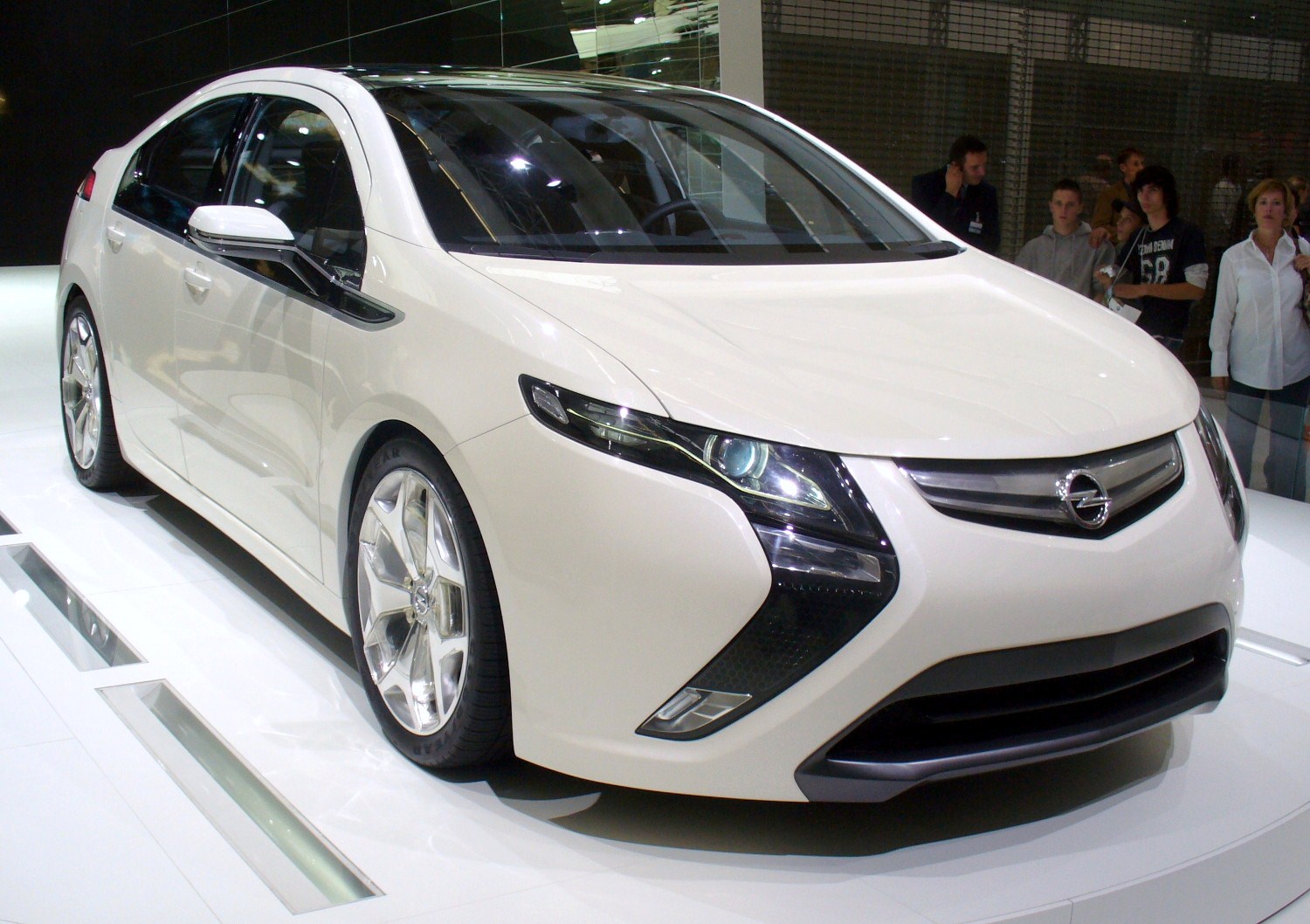
Vauxhall Ampera prices have been cut by £3500, dropping the entry-level price for the innovative petrol-electric range-extender to £28,750, after a £5000 government grant.

Vauxhall/Opel CEO Dr. Karl-Thomas Neumann denied claims that Ampera prices had been slashed because sales were slow. He said: 'The Ampera has sold more than 5000 units and accounts for more than half electric car sales in Europe. That’s disappointing for the electric car market, not for the Ampera.'

The revolutionary plug-in electric car has struggled to fulfil its sales promise, partly because the recession has deterred buyers from adopting less-conventional technology.

Neumann went on to say that GM is 'still convinced that the range-extender is the best electric car concept'. The system works by relying on a standard combustion engine to generate energy for the electric motors that power the car, resulting in a pure-electric range of up to 50 miles and a total touring range of 300 miles with use of the petrol engine.

GM vice-president Steve Girsky also said that the range-extender technology would continue to be used, but that new models with the powertrain were unlikely to happen until 'the technology has advanced a bit further and come down in price'.

Opel cuts Ampera price by 17 percent in Germany

General Motors' European brand Opel has announced a 17 percent cut in the price of its Ampera electric car in Germany at this week's Frankfurt car show, where rivals will be showing off their electric models for the first time.

"Effective immediately, we are lowering the price of an Ampera to 38,300 euros ($50,400), which is a cut of almost 8,000 euros in Germany," Opel Chief Executive Karl-Thomas Neumann told an industry conference on Monday.

Speaking to reporters, Neumann said it was no coincidence that the price cut coincided with the premiere of key competitor models like the electric version of the Volkswagen Golf hatchback and Up minicar.

"We see a tremendous chance given all the talk about electro-mobility and we want to remind people that we have been in the market already for one and a half years," he said.

Price cuts will also be made in other markets, but due to differing tax laws, the price-tag and the size of the reduction will be different from country to country, a company spokesman said.

Opel's finance chief Michael Lohscheller said the price cut would not have any impact on its target of a slightly narrower loss for Opel this year given the relatively low sales figures.

He also said that a better-than-expected first half would not mean it would upgrade its outlook either. "The second half is traditionally weaker than the first half in the auto industry due to seasonal effects. We're sticking to our full-year guidance," Opel CFO told Reuters on the sidelines of the conference.

Only 828 new Ampera cars were registered in Germany last year out of a market of 3.08 million vehicles, according to official figures from the KBA motor vehicle agency.

Electrification meets performance in new generation of hybrids

Faced with tougher European regulations on pollution, but a constant desire among affluent drivers for speed and panache, many carmakers have reached the same solution: luxury hybrids.

Pricy new models are heading for production from BMW, Daimler AG's Mercedes-Benz and Tata Group's Land Rover, among others, - some with gasoline engines, some with diesels, but all with electric motors and battery packs.

They will slot into Europe's automotive landscape just below top-end hybrids such as LaFerrari, unveiled earlier this year by the Fiat-owned supercar maker, and a new 918 Spyder from Volkswagen's Porsche, on display in its final production trim at the Frankfurt auto show this week

While they may not have as much of an impact on energy consumption and clean air as smaller, more efficient hybrids and pure electric cars such as the BMW i3 and the Renault Zoe, the new high-performance hybrids could represent a clever compromise between the demands of regulators and speed junkies.

The cars offer a "feel-good factor" to wealthy drivers, according to LMC Automotive analyst Jonathon Poskitt, giving them the social kudos of being "green" while also allowing them to still enjoy the buzz and status of a fast, powerful vehicle.

On top of existing rules aimed at cutting carbon dioxide emissions for all new cars in the European Union by 2015, the 28-country bloc is working on stricter targets for 2020.

That makes luxury hybrids of critical importance for premium carmakers.

"Manufacturers need to gently push them into the market, and doing this under the premise that it provides politically correct performance - in other words, green - is a nice way to market that," said Tom De Vleesschauwer, director of long-term planning and sustainability for consulting firm IHS Automotive.

But there are also risks. Carmakers will need to convince drivers that hybrid engines perform at least as well as the traditional gasoline and petrol varieties.

And they will still have to apply electrification to their larger luxury sedans and sports cars in order to meet the stricter emissions rules, De Vleesschauwer said.

But he was optimistic. BMW's new i Series of electrified cars "symbolizes the new acceptable face of performance - keeping performance relevant for the times," he said.

ALL ABOUT PERFORMANCE

In addition to the BMW i8, the latest production-based performance hybrids on display at the Frankfurt auto show include the Mercedes-Benz S 500 Plug-In Hybrid and Land Rover's Range Rover Hybrid and Range Rover Sport Hybrid.

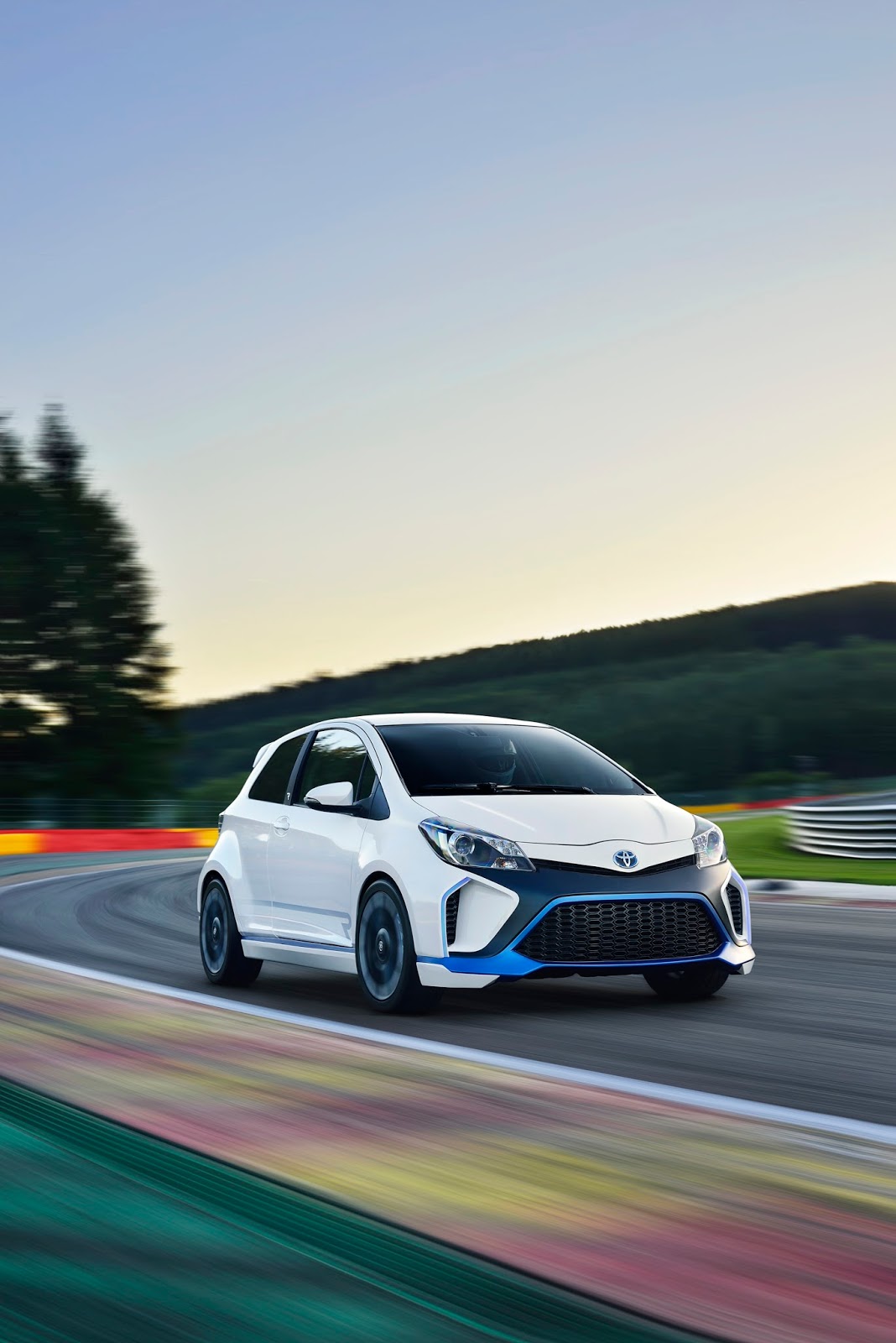
But performance-tuned hybrid propulsion systems won't be exclusive to high-end luxury vehicles. Among the performance hybrid concepts on the Frankfurt show floor are VW's Audi Sport Quattro, Geely Automobile's Volvo Concept Coupe and Toyota Motor Corp's Yaris Hybrid-R.

Toyota, whose Prius remains the world's best-selling gasoline-electric vehicle, describes the Yaris Hybrid-R as a "showcase of ideas for the development of hybrid technology for maximum performance and increased driving pleasure."

While the standard Yaris is a modest hatchback aimed at entry-level buyers, the addition of all-wheel drive and a 420-horsepower powertrain inspired by the Toyota TS030 Hybrid Le Mans racecar injects some serious sizzle into the subcompact.

Volvo's Concept Coupe is the first effort from new design boss Thomas Ingenlath and is the first to use Volvo's new scalable product architecture, which will underpin a whole family of future compact vehicles.

The Concept Coupe's underlying architecture is flexible to accommodate completely autonomous driving - a goal that Volvo hopes to put on the road "before 2020." For now, the Frankfurt show car features a potent 400-horsepower hybrid powertrain.

While it sports a plug-in hybrid driveline, the Audi Sport Quattro concept is all about pure performance. With nearly 700 horsepower on tap, the all-wheel-drive coupe features a twin-turbocharged 4.0-litre V8 gasoline engine with cylinder deactivation and a start-stop system to improve efficiency.

On the production front, the new Mercedes-Benz S 500 Plug-In Hybrid is being prepared for an early 2014 introduction, when it will square off against such competitors as Porsche's recently launched Panamera S E-Hybrid.

The S 500 combines a 329-horsepower turbocharged 3.0-litre V6 gasoline engine with a 107-horsepower electric motor.

Also slated for delivery in early 2014 are the new Range Rover Hybrid and Range Rover Sport Hybrid, which British parent Land Rover, a unit of India's Tata Group, is billing as "the world's first premium diesel SUV hybrids."

Both utility vehicles share a common drivetrain, built around the company's turbocharged 3.0-litre V6 diesel mated with an electric motor, producing a combined output of just under 340 horsepower.

At the opposite end of the hybrid spectrum, in terms of size, shape, styling and sporting character, is BMW's i8, which has been seen previously in concept guise at various motor shows and debuts at Frankfurt in final production trim.

Ian Robertson, BMW's global sales and marketing boss, puts the i8 in "in the super-sports category ... it's all that you'd expect from a performance car."

Built on a lightweight chassis with a carbon-fiber passenger cell, the four-passenger coupe features futuristic styling to match its advanced technology. Under the skin is a hybrid propulsion system that marries a 129-horsepower electric motor at the front with a 228-horsepower turbocharged 1.5-litre three-cylinder gasoline engine in the rear.

BMW plans a global launch of the i8 next May, initially targeting buyers in Europe, North America and China.

Land Rover Evoque_e project announced

Jaguar Land Rover has announced its leadership of an advanced powertrain research and development programme for state-of-the-art, next-generation hybrid and battery-electric powertrain technologies based on the Range Rover Evoque platform.

‘Evoque_e’ is a two-year £16.3m UK government Technology Strategy Board project. Jaguar Land Rover will contribute £4m to the project and will lead a consortium of 12 selected partners – eight from industry and three universities.

The partners include Zytek Automotive, GKN Driveline, Motor Design Limited, AVL, Drive System Design, Williams Advanced Engineering, Delta Motorsport, Tata Steel, Bristol University, Cranfield University and Newcastle University.

Starting in October 2013, the unique collaboration will design, develop and build three research vehicles showcasing state-of-the-art, next-generation powertrain concepts for a mild hybrid electric vehicle (MHEV); a Plug-In Hybrid (PHEV) and a full Battery Electric Vehicle (BEV).

Peter Richings, Jaguar Land Rover Director Hybrids and Electrification,said: “The aim of the project is to develop technology platforms which are configurable and compatible within the architecture of an existing production vehicle. The modular technologies include single and multi-speed axle drives; modular battery packs and integrated power electronics, multi-machine, advanced control development and torque vectoring.

“The research teams will look at how the speed of the electric motor can be increased, to reduce its size, weight and cost while enhancing performance and durability. We will also look at the use of alternative materials to both reduce the use of rare earth materials and for systems optimisation.

“The outcome of the Evoque_e project will be new technologies with the potential for high volume production that are capable of delivering benchmark performance in terms of cost, weight and ustainable use of materials.”

As Britain’s biggest investor in automotive research and development, and the biggest investor in manufacturing R&D, Jaguar Land Rover is spending £2.75 billion in the year to March 2014 on product creation. Jaguar Land Rover showcased a number of the other collaborative research projects it is leading at the LCV 2013 event. These projects include the extreme downsizing of internal combustion engines, efficient management and storage of heat energies and weight reduction of engines through innovative new design concepts.

Commenting on these research projects, Dr Wolfgang Epple, Jaguar Land Rover Director Research and Technology said: “Jaguar Land Rover has ambitious plans for growth. We believe that the success of our global business – and the UK economy – lies in engineering and innovation. Our research programmes bring together some of the best engineering minds in the UK. With Evoque_e, we will build on previous Jaguar Land Rover technology demonstrators and show clearly the breadth of our capability and commitment in advanced powertrain technology.”

Jaguar Land Rover already collaborates with a number of leading universities in the UK on a range of technology and skills projects. More than half of Jaguar Land Rover’s research and advanced engineering team are based at Warwick University’s Warwick Manufacturing Group (WMG), to work collaboratively on key new technologies including energy storage, weight reduction and digital verification.

Antony Harper, Jaguar Land Rover Head of Research, illustrated the importance of this work and its benefits to the company and the UK economy, saying: “We are keenly aware that not all the clever people work for us and our collaborative research programmes harness the best of UK engineering innovation, to develop new and exciting technologies.

“The development of our business and our continuing investment in R&D has also encouraged inward investment into the UK, with our suppliers creating and funding their own research projects in UK universities. Technology Strategy Board funding allows us to multiply the effect of our investment and nurture UK-based technology investment, in supporting our work to address future needs, wants and legislation around the world.”

Land Rover Evoque_e project announced

Jaguar Land Rover has announced its leadership of an advanced powertrain research and development programme for state-of-the-art, next-generation hybrid and battery-electric powertrain technologies based on the Range Rover Evoque platform.

‘Evoque_e’ is a two-year £16.3m UK government Technology Strategy Board project. Jaguar Land Rover will contribute £4m to the project and will lead a consortium of 12 selected partners – eight from industry and three universities.

The partners include Zytek Automotive, GKN Driveline, Motor Design Limited, AVL, Drive System Design, Williams Advanced Engineering, Delta Motorsport, Tata Steel, Bristol University, Cranfield University and Newcastle University.

Starting in October 2013, the unique collaboration will design, develop and build three research vehicles showcasing state-of-the-art, next-generation powertrain concepts for a mild hybrid electric vehicle (MHEV); a Plug-In Hybrid (PHEV) and a full Battery Electric Vehicle (BEV).

Peter Richings, Jaguar Land Rover Director Hybrids and Electrification,said: “The aim of the project is to develop technology platforms which are configurable and compatible within the architecture of an existing production vehicle. The modular technologies include single and multi-speed axle drives; modular battery packs and integrated power electronics, multi-machine, advanced control development and torque vectoring.

“The research teams will look at how the speed of the electric motor can be increased, to reduce its size, weight and cost while enhancing performance and durability. We will also look at the use of alternative materials to both reduce the use of rare earth materials and for systems optimisation.

“The outcome of the Evoque_e project will be new technologies with the potential for high volume production that are capable of delivering benchmark performance in terms of cost, weight and ustainable use of materials.”

As Britain’s biggest investor in automotive research and development, and the biggest investor in manufacturing R&D, Jaguar Land Rover is spending £2.75 billion in the year to March 2014 on product creation. Jaguar Land Rover showcased a number of the other collaborative research projects it is leading at the LCV 2013 event. These projects include the extreme downsizing of internal combustion engines, efficient management and storage of heat energies and weight reduction of engines through innovative new design concepts.

Commenting on these research projects, Dr Wolfgang Epple, Jaguar Land Rover Director Research and Technology said: “Jaguar Land Rover has ambitious plans for growth. We believe that the success of our global business – and the UK economy – lies in engineering and innovation. Our research programmes bring together some of the best engineering minds in the UK. With Evoque_e, we will build on previous Jaguar Land Rover technology demonstrators and show clearly the breadth of our capability and commitment in advanced powertrain technology.”

Jaguar Land Rover already collaborates with a number of leading universities in the UK on a range of technology and skills projects. More than half of Jaguar Land Rover’s research and advanced engineering team are based at Warwick University’s Warwick Manufacturing Group (WMG), to work collaboratively on key new technologies including energy storage, weight reduction and digital verification.

Antony Harper, Jaguar Land Rover Head of Research, illustrated the importance of this work and its benefits to the company and the UK economy, saying: “We are keenly aware that not all the clever people work for us and our collaborative research programmes harness the best of UK engineering innovation, to develop new and exciting technologies.

“The development of our business and our continuing investment in R&D has also encouraged inward investment into the UK, with our suppliers creating and funding their own research projects in UK universities. Technology Strategy Board funding allows us to multiply the effect of our investment and nurture UK-based technology investment, in supporting our work to address future needs, wants and legislation around the world.”

Double Victory for Audi Hybrids at WEC round in Brazil [VIDEO]

Audi has remained unbeaten in the 2013 sports car season to date. The Audi R18 e-tron quattro hybrid sports car has won the fourth of eight rounds in the FIA World Endurance Championship (WEC). In addition, it claimed victory in the 12-hour classic at Sebring in March.

The race weekend in Brazil ended in victory for Marcel Fässler/André Lotterer/Benoît Tréluyer (CH/D/F) ahead of Loïc Duval/Tom Kristensen/Allan McNish (F/DK/GB). On clinching their success in the São Paulo 6 Hours, the winners reduced the gap to their team colleagues in the drivers’ standings by eight to 22 points.

After a flawless race, the current World Champions celebrated their second WEC win of the season following their success at Spa in May. 38,000 spectators watched Fässler/Lotterer/Tréluyer in car number ‘1’ cross the finish line at Interlagos with a three-lap advantage over their sister car.

The situation in the standings at the season’s midpoint has thus become more thrilling again after the Le Mans winners Loïc Duval (F), Tom Kristensen (DK) and Allan McNish (GB) had arrived with a 30-point advantage.

The significant gap in the race, though, does not reflect the true performance delivered by car number ‘2.’ In the early phase, Audi factory driver Allan McNish dominated the action. But then the drivers’ trio experienced an unusual streak of misfortune. In a safety car period, Tom Kristensen, after pitting, returned to the track behind a slower GT race car.

The nine-time Le Mans winner, who drove the fastest race lap as well, lost around half a minute because the car in front was not keeping the pace of the pack ahead. Loïc Duval subsequently took over the cockpit and was in the process of starting a recovery when, on lap 142 at the exit of the pit lane, he lost the right rear wheel of his car, which had gotten jammed while being mounted.

Thus, Duval had to complete one lap on three wheels. The resulting two stop-and-go penalties completed the misfortune of the leaders of the standings who thus lost four laps in total.

In the end though, Head of Audi Motorsport Dr. Wolfgang Ullrich had reason to be pleased with a race weekend that left nothing to be desired. Audi Sport Team Joest, on taking grid positions one and two, setting the fastest race lap and scoring a one-two result, achieved the maximum that was possible and celebrated the first victory in South America.

Only the eagerly awaited battle with Toyota did not take place. The challenger’s only race car had become involved in an accident as early as on lap 25 and, as a result, was forced to retire.

In three weeks from now, Audi Sport is aiming to continue its string of success. On September 22, the WEC will be racing on the circuit at Austin in the US state of Texas for the first time.

Toyota Yaris Hybrid-R designed for Road or Track

Toyota has transformed the volume-selling Yaris hatch into a dynamic track or road car by injecting it with high-performance engineering and advanced hybrid technology inspired by the company's Le Mans racing program.

The Yaris Hybrid-R, which will make its world premiere at next week's Frankfurt Motor Show, is a showcase of ideas for the future development of hybrid technology to achieve maximum performance and increased driving pleasure.The concept car's hybrid powertrain combines a highly tuned 1.6-litre four-cylinder turbo engine and two powerful electric motors to provide total output of 313kW (420hp). The direct-injection turbo, which has been adapted to racing conditions, provides 224kW (300hp) of power and 420Nm of torque to drive the front wheels.

It was specifically developed by Toyota Motorsport GmbH according to FIA (International Automobile Federation) rules for a Global Race Engine to be used in different motorsport disciplines, such as the World Rally Championship and the World Touring Car Championship

At the rear of the Yaris Hybrid-R, each wheel is powered by a 45kW (60hp) electric motor, providing an "intelligent" electric four-wheel drive capability. The motors generate electricity during braking and supplement the petrol engine during acceleration.

As with Toyota's TS030 hybrid Le Mans race car, the energy recovered from braking is stored in a super capacitor. Its high power density and fast charge/discharge speed are perfectly suited to the requirements of sporty driving on a track, which requires brief and immediate bursts of power.

Track and road modes

The Yaris Hybrid-R driver can push a button on the steering wheel to select "road" mode for day-to-day driving or "track" mode for competition."Track" mode makes full use of available performance, with the rear electric motors able to reach a combined maximum power peak of 90kW (120 hp) for up to five seconds.A third 45kW electric motor, located between the engine and the six-gear sequential transmission, can operate as an advanced traction-control system.

At low speeds, or in a curve, when the engine power and torque exceed the grip potential of the front wheels, the motor can convert torque from the petrol engine into electric energy and direct it to the rear wheels.The twin rear electric motors can also enhance handling characteristics during cornering by altering the distribution of torque between the left and right rear wheels, achieving the same effect as an intelligent torque vectoring differential. Depending on the radius of the curve, the system can send more torque to the outside rear wheel, apply more braking force to the inside wheel or even brake and accelerate each wheel independently to promote a better driving line and to limit understeer.

Selecting "road" mode reduces engine output and the amount of energy distributed by the super capacitor. The hybrid system works seamlessly with the 1.6-litre turbo, especially during start-up phase at low rpm when the engine's efficiency is not yet optimum. The super capacitor can release the energy recovered under braking for a maximum duration of 10 seconds, while the total power of the two electric motors is limited to 30kW (40hp). Depending on the state of charge of the battery, the Yaris Hybrid-R can be operated in full electric mode for short distances, especially during parking operations.

The Toyota press conference at the Frankfurt Motor Show will take place in Hall 8, Stand D19, at 12:45pm (20:45pm AEST) on Tuesday 10 September.

700 Hp Audi Sport Quattro Plug-In Hybrid concept bound for Frankfurt

Quattro is Audi and Audi is quattro – the brand and the technology are indelibly linked. In celebration of the 30th birthday of the Sport quattro, Audi will present its legitimate successor at the 2013 IAA in Frankfurt am Main. The Audi Sport quattro concept show car continues the grand quattro tradition, with a stunning coupe design and plug-in hybrid drive with a system output of 515 kW (700 hp).

quattro is more than just a technology – quattro is a philosophy. The term stands for driving safety and sportiness, technical competence and a dynamic approach to life. Since the debut of the "Ur-quattro" in 1980, Audi has sold more than five million cars with permanent all-wheel drive, far more than any other premium manufacturer worldwide. The strengths of the quattro concept and its successes in racing have been impressively displayed for over three decades now.

One legendary Audi classic is the Sport quattro, which made its debut at the 1983 IAA and was designed as a homologation model for the World Rally Championship. With 225 kW (306 hp) and many technical innovations, it was the supercar of its day. The short wheelbase, which honed the handling, gave the Sport quattro an unmistakable look. The competition car wrote racing history. Walter Röhrl drove it to a convincing victory in the 1987 Pike's Peak International Hill Climb in Colorado, U.S.A.

Powerful performance: the plug-in hybrid drive

The plug-in hybrid drive makes the Audi Sport quattro concept a breathtakingly dynamic coupe. System output is 515 kW (700 hp); system torque is 800 Nm (590.05 lb-ft). Power flows through a modified eight-speed tiptronic to the quattro powertrain, which features a sport differential on the rear axle. According to the applicable standard, the show car consumes on average 2.5 liters of fuel per 100 kilometers (94.09 US mpg), a CO2 equivalent of 59 grams per kilometer (94.95 g/mile).

The combustion engine is a four-liter, twin-turbo V8. It produces 412 kW (560 hp) and 700 Nm (516.29 lb-ft) of torque. The cylinder on demand (COD) system, which deactivates four cylinders under part load, and a start-stop system make the sonorous eight-cylinder unit very efficient.

Located between the 4.0 TFSI and the transmission is a disc-shaped electric motor producing 110 kW and 400 Nm (295.02 lb-ft). It draws its traction energy from a liquid-cooled lithium-ion battery in the rear with a capacity of 14.1 kWh. The show car is charged via an Audi wall box, which uses intelligent charge management to ensure the optimal feed of energy to the lithium-ion battery. The Audi Sport quattro concept can cover up to 50 kilometers (31.07 miles) on electric power alone. An intelligent management system controls the interplay between the two drives as needed, and the driver can choose between various operating modes.

The customer can choose between various characteristics for the Audi Sport quattro concept depending on the operating and driving strategy. A choice of three modes is available. EV mode is for purely electric driving; Hybrid mode for maximum efficiency and Sport mode for maximum performance.

In EV mode, only the electric motor is active. With a peak electric output of 110 kW and 400 Nm (295.02 lb-ft) of torque, electric driving both inside and outside the city is possible. An active accelerator indicates the transition to hybrid operation to the driver so that he/she can consciously control the switch between electric and hybrid vehicle.

In Hybrid mode, environmental and route data are used to compute the optimal use of the electric motor and combustion engine for fuel efficiency and implement this via the operating strategy. If navigation is active, the route is optimized for efficiency. This mode also includes the ability to customize the operating strategy. If the driver wants to retain a certain amount of electric range or to drive certain route segments on electric power, they can use the Hold or Charge function to precisely adjust the charge of the battery even without charging from the power grid.

In Sport mode, the operating strategy sets the drive system for maximum power and performance. The electric boost function supports the combustion engine in all driving situations. The energy management system ensures that the battery always has sufficient charge.

When the V8 and the electric motor work together, the Audi Sport quattro concept accelerates from 0 to 100 km/h (62.14 mph) in 3.7 seconds – much like the powerful Audi rally cars once did. Its top speed is 305 km/h (189.52 mph).

The lightweight construction concept also plays a large part in this dynamic performance. The occupant cell combines ultra-high-strength steel panels and cast aluminum structural elements. The doors and fenders are made of aluminum, and the roof, the engine hood and the rear hatch are made of carbon fiber-reinforced polymer. The result is a curb weight including the battery pack of just 1,850 kilograms (4,078.55 lb).

The show car's chassis is easily able to handle the drive system's power. Handling is as dynamic as it is stable. The front suspension features five control arms per wheel; the rear suspension follows the Audi track-controlled trapezoidal link principle. Tautly tuned springs and dampers connect the Audi Sport quattro concept firmly to the road. The dynamic steering varies its ratio as a function of driving speed. The brake calipers grip large, carbon fiber-ceramic brake discs, and the tire format is 285/30 R 21.

Production-ready Porsche 918 Spyder will debut @ Frankfurt [VIDEO]

The Porsche 918 Spyder is celebrating its debut at the International Motor Show (IAA) in Frankfurt, Germany, 10 – 22 September. The super sports car with plug-in hybrid drive is not only a technology pioneer but also marks the beginning of a new era for sports car manufacturing. Never before has a super sports car designed for everyday use offered such an impressive bandwidth of dynamic performance combined with the fuel consumption of a compact car.

In setting this technological benchmark, the Porsche 918 Spyder is taking on a pioneering role similar to that of the 911 when it was first unveiled at the IAA 50 years ago. Appropriately, in honour of this anniversary, Porsche is presenting the limited edition "50 years 911" model. Based on the 911 Carrera S, this latest version of the iconic coupe combines traditional 911 features with state-of-the-art technology. On the subject of icons, Porsche is completing its line-up of sports cars at Frankfurt with the public unveiling of the new 911 Turbo – which, in turn, is 40 years after the turbocharged 911 was first shown.

In addition, the new generation of the Panamera Gran Turismo underlines the unique breadth of the Porsche range today. As the first plug-in hybrid in the luxury car market segment, the Panamera S E-Hybrid is further proof that Porsche is leading the field with its expertise in the development of fuel-efficient powertrain concepts for sports cars.

The outstanding combination of performance and efficiency for which Porsche is renowned remains consistently attractive to customers. Matthias Müller, President and CEO of Dr. Ing. h.c. F. Porsche AG recently said, "From January to July, we were able deliver around 95,300 new vehicles worldwide – that's 17% more than in the first seven months of 2012. We are therefore very confident about the next few months and we now firmly believe we will have sold more vehicles by the end of 2013 than we did in the previous year. Based on how things are going at the moment, we are set to have another record year – and that's in spite of the fact that the present economic climate is far from satisfactory."

2012 was the most successful year to date in the history of Porsche, with 143,096 vehicles sold and sales revenue of Euro 13.9 billion.

The Porsche genetic blueprint for the future: 918 Spyder with high-performance hybrid

The 918 Spyder is the continuation of the traditional Porsche DNA in a ground-breaking sports car concept. Designed from the start to be a high-performance hybrid, the 918 Spyder boasts an unprecedented combination of performance (offering the 887 hp output of a super sports car) and the virtually silent motion of an electric vehicle. The vehicle is able to accelerate from 0 – 62 mph in 2.8 seconds and offers an average standard fuel consumption of between 94 mpg and 85 mpg. The 918 Spyder also allows a combustion engine to be combined with an electric motor-based drive to further optimise the dynamic performance of the vehicle.