Audi reveal eROT energy harvesting ‘regen’ shock absorders

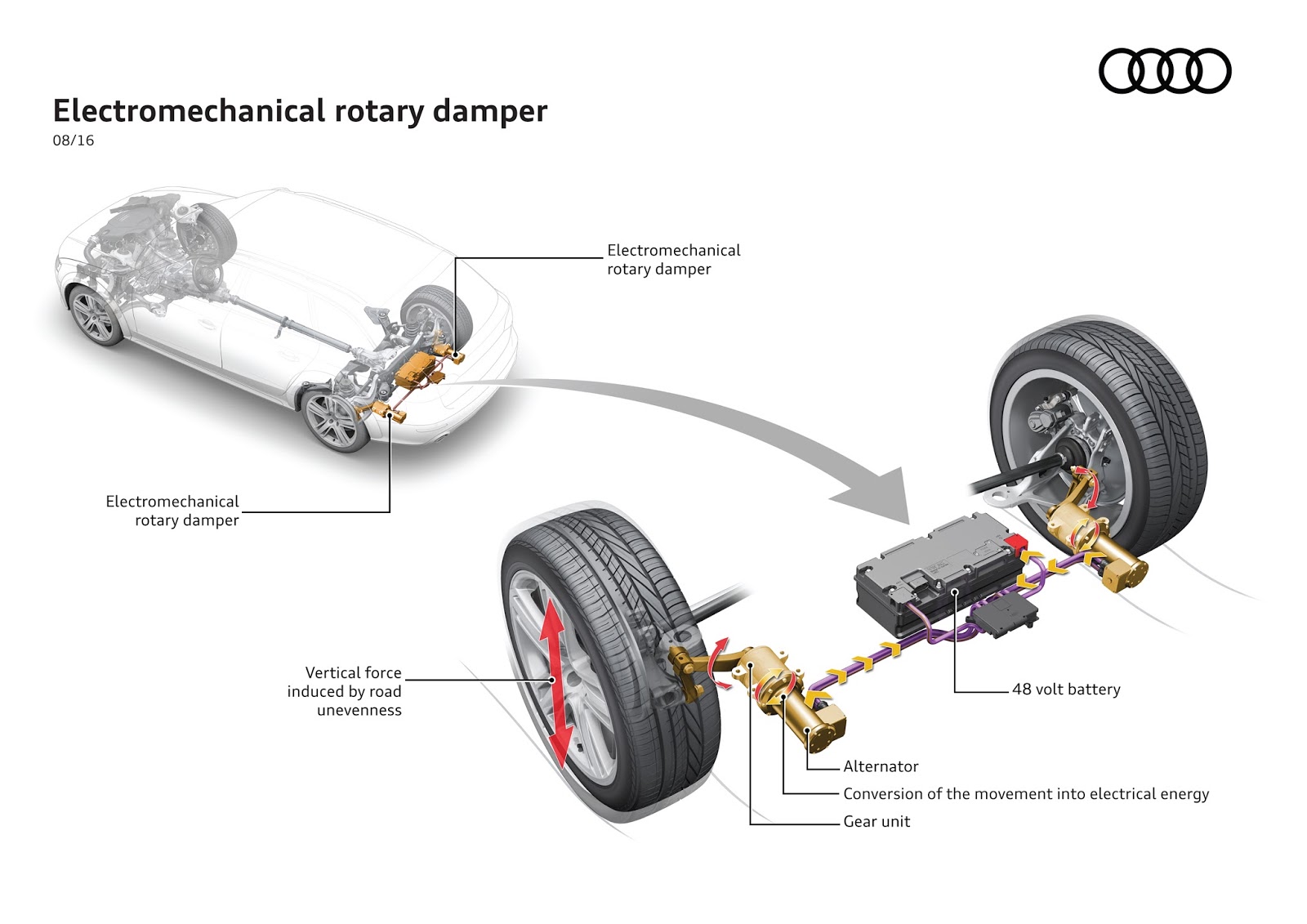
We have reported on a wide range of energy regenerative shock absorbers over the years that most often convert linear motion into electricity. Audi is working on a prototype called “eROT,” in which electric motors replace telescopic shock absorbers in the form of electromechanical rotary dampers.

The principle behind eROT is easily explained: “Every pothole, every bump, every curve induces kinetic energy in the car. Today’s dampers absorb this energy, which is lost in the form of heat,” said Dr.-Ing. Stefan Knirsch, Board Member for Technical Development at AUDI AG. “With the new electromechanical damper system in the 48-volt electrical system, we put this energy to use. It also presents us and our customers with entirely new possibilities for adjusting the suspension.”

The eROT system responds quickly and with minimal inertia. As an actively controlled suspension, it adapts ideally to irregularities in the road surface and the driver’s driving style. A damper characteristic that is virtually freely definable via software increases the functional scope. It eliminates the mutual dependence of the rebound and compression strokes that limits conventional hydraulic dampers. With eROT, Audi configures the compression stroke to be comfortably soft without compromising the taut damping of the rebound stroke. Another advantage of the new damper system is its geometry. The horizontally arranged electric motors in the rear axle area replace the upright telescopic shock absorbers, which allows for additional space in the luggage compartment.

The eROT system enables a second function besides the freely programmable damper characteristic: It can convert the kinetic energy during compression and rebound into electricity. To do this, a lever arm absorbs the motion of the wheel carrier. The lever arm transmits this force via a series of gears to an electric motor, which converts it into electricity. The recuperation output is 100 to 150 watts on average during testing on German roads – from 3 watts on a freshly paved freeway to 613 watts on a rough secondary road. Under customer driving conditions, this corresponds to a CO2 savings of up to three grams per kilometer (4.8 g/mi).

The new eROT technology is based on a high-output 48-volt electrical system. As currently configured, its lithium-ion battery offers an energy capacity of 0.5 kilowatt hours and peak output of 13 kilowatts. A DC converter connects the 48-volt electrical subsystem to the 12-volt primary electrical system, which includes a high-efficiency, enhanced output generator.

Initial test results for the eROT technology are promising, thus its use in future Audi production models is certainly plausible. A prerequisite for this is the 48-volt electrical system, which is a central component of Audi’s electrification strategy. In the next version planned for 2017, the 48-volt system will serve as the primary electrical system in a new Audi model and feed a high-performance mild hybrid drive. It will offer potential fuel savings of up to 0.7 liters per 100 kilometers.

Driven | 2016 Toyota Prius

Toyota has been promising better handling with its cars, and it has delivered with the fourth-generation Prius. While it still does not look like a conventional car, the Prius now handles more like one.

Xtrac Launch Dual Motor EV transmission to suit torque vectoring

Xtrac’s P1227 gearbox family has been developed to address the growing market requirement for single speed, lightweight and power dense electric vehicle (EV) transmissions. It offers a range of installation possibilities for fast and powerful electric supercars with front-wheel drive, rear wheel drive or four-wheel drive configuration.

“There is substantial innovation and intellectual property in the design of this new transmission system,” says James Setter, head of Xtrac’s Automotive and Engineering business unit, which focuses on developing transmission systems for hypercars, hybrids and EVs to complement the company’s world-beating motorsport transmissions. “Significant focus went into the integration of the gearbox with numerous proprietary traction motors, and in particular, reducing its mass by almost 20 per cent compared with our previous P1092 electric vehicle transmission to provide the ultimate electric drive transaxle.”

The new transmission system can be integrated with motors supplied by BorgWarner, GKN and YASA, all of whom worked with Xtrac on the integration of their technology into this transmission. The dual electric motors of the transmission system also provide an inherent torque vectoring capabilities. For lower power applications a single electric motor can be specified, reducing the overall vehicle weight further and requiring an even smaller space envelope. The highly configurable nature of the design also enables an open or a limited slip differential to be specified.

In addition, the P1227 family of gearboxes offers a range of single gear ratios, as well as considerable motor-generator configuration and hence vehicle installation possibilities. This enables the transmission, for example, to be installed within a 90-degree angle from the motors positioned vertically above through to horizontally in front of the output.

“The design draws on Xtrac’s precision design, analysis and manufacturing engineering capabilities,” says Setter, “ensuring that the ground helical gear sets, necessary for road vehicle transmission systems, offer exceptional levels of NVH refinement for the most demanding silent driveline electric vehicle applications, as well as the durability required for this marketplace.”

The transmission has been designed as a family to integrate with either YASA P400, GKN AF130 or AF230 or BorgWarner HVH-250-090-SOM or HVH-250-115-DOM motors, but other motors could be suitable as long as the RPM of the motor is less than 10,000rpm, and the peak torque is less than 500Nm per motor like the 90 kW / 300 Nm Evans Electric axial flux induction motor.

More: Xtrac

REMY / BorgWarner

YASA P400

GKN AF130


Evans Electric previews new Axial Flux EV motor

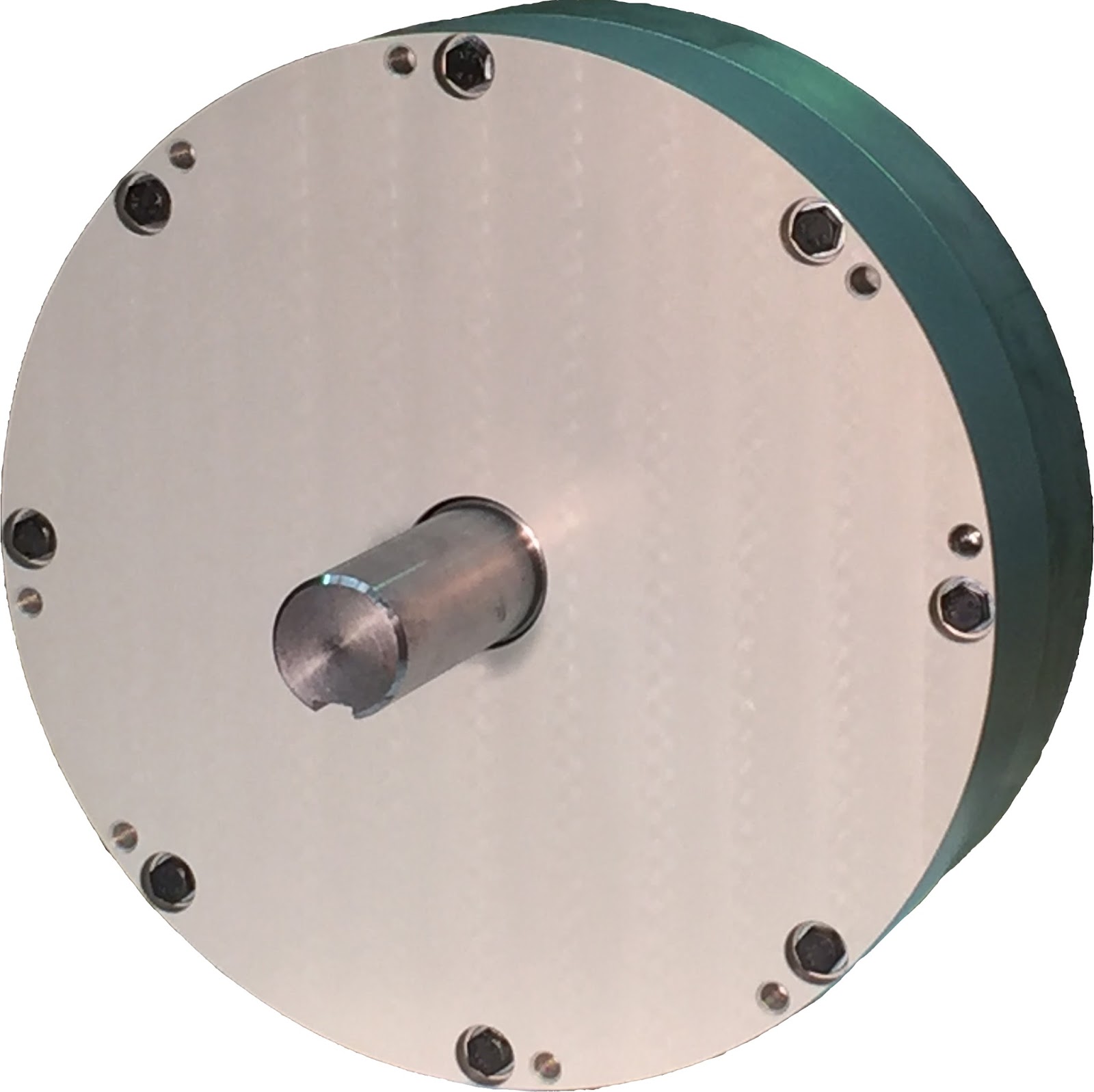
Evans Electric has previewed a next generation EV motor that it says will be licensed for production in 2017. The Axial flux asynchronous induction motor offers 90 kW of power, 300 Nm of peak torque and features very high torque density.

Evans Electric designed the new motor with integration, miniaturization and high energy efficiency in mind. It uses a double stator, single rotor axial air gap architecture with a patent pending solid core, copper disc rotor.

Overall, the size of the motor represents a reduction of 70%, while retaining the same level of performance. The motor has the same peak torque as a standard Tesla Roadster AC induction motor yet is only 1/3rd the volume due to a much shorter axial length. The oil-cooled 3 phase motor is designed to be integrated into the bellhousing of a multi-speed transmission.

The AFIM design is also well suited to wheel hub motor applications such as electric bus and military ground vehicles.

“Not only does the high power density of the axial air gap design give a cost advantage because less active material is required for a given amount of torque, but our copper rotor axial flux induction motor also has the significant cost advantage of eliminating the need for rare-earth permanent magnets.” said founder, Paul Evans.

The 4 person Sydney Australia based startup have been working on the AFIM design for a German OEM and has now opened their series A funding round.

More: Evans Electric

Graphene-based ultracapacitors give trucks a boost of acceleration

Adgero, the French transport tech developer, has unveil the world’s first operational energy-saving, hybrid electric system for road transport at Britain’s biggest commercial vehicle conference this week.

Adgero will display the regenerative braking-powered UltraBoost ST, a kinetic energy recovery system (KERS) installed on a curtainsider semi-trailer – that aims to cut fuel and carbon emissions by up to 25 per cent.

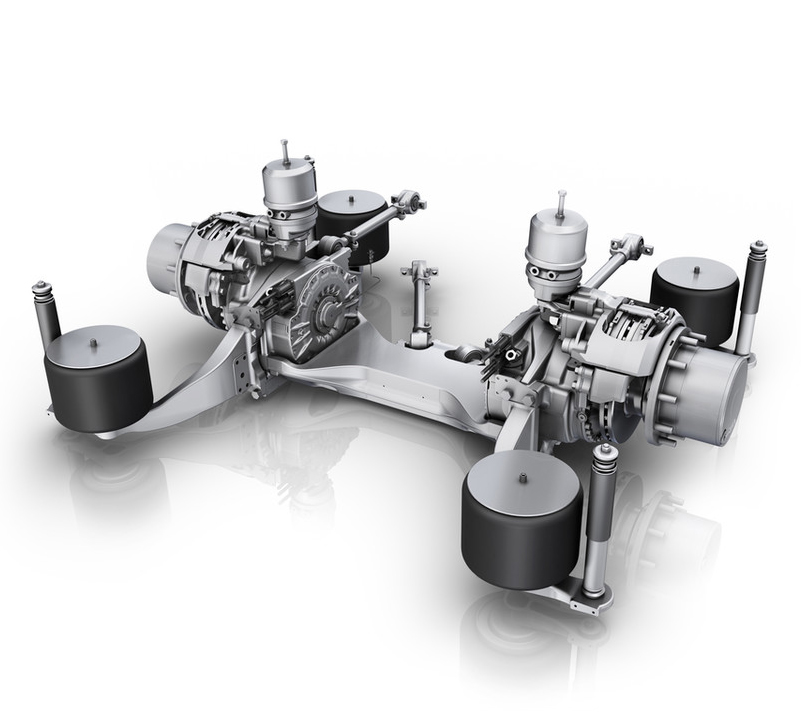
Adgero’s unique hybrid technology consists of an electrically driven axle mounted under the semi-trailer, powered by a bank of ultracapacitors, and controlled by intelligent management software that automatically controls regenerative braking and acceleration boost.

The UltraBoost ST uses a compact and lightweight YASA motor (the same axial flux motor as used in the Koenigsegg Regera) to recover kinetic energy, otherwise lost as heat during braking, and stores it in high-power graphene-based ultracapacitors from European manufacturer Skeleton Technologies – who helped develop the KERS technology for road haulage with Adgero last year.

Leading European manufacturer SDC Trailers installed the system on a 13.6m curtainsider trailer, finished in the livery of major UK-based transport and distribution company, Eddie Stobart. The transport operator will be conducting road testing of Adgero’sUltraBoost ST system in coming weeks.

President of Adgero SAS Mack Murray commented:

“The Adgero UltraBoost ST system has the potential to boost fuel efficiency, reduce overall fuel consumption and reduce associated emissions. And because our hybrid system can be easily and economically retrofitted to existing fleets, voluntary fleet-based implementation could have an immediate and meaningful impact on fleet costs and vehicle emissions within a very short timeframe.

“Road haulage accounts for over a fifth of the EU’s total CO2 emissions, so fuel efficient solutions are crucial. We are beginning to see regenerative braking systems in automotive applications but the market clearly needs a similar solution for articulated lorries.

“Unveiling the world’s first operational hybrid electric system for road transport at Britain’s biggest commercial vehicle show has taken a real collaboration between leading industry players and we’re now looking forward to the next phase of road testing in coming weeks.”

Head of Engineering at SDC, Jimmy Dorrian, said:

“Operator efficiency was the driving force behind the (KERS) trailer innovation. Our customers are always looking for ways to reduce their fuel consumption and overall carbon footprint, especially in demanding applications such as heavy terrain or continuous urban transport.”

Last week Adgero signed a €3.5 million distribution agreement to ensure the UltraBoost ST system for road haulage was powered by modules from Europe’s leading ultracapacitor manufacturer, Skeleton Technologies.

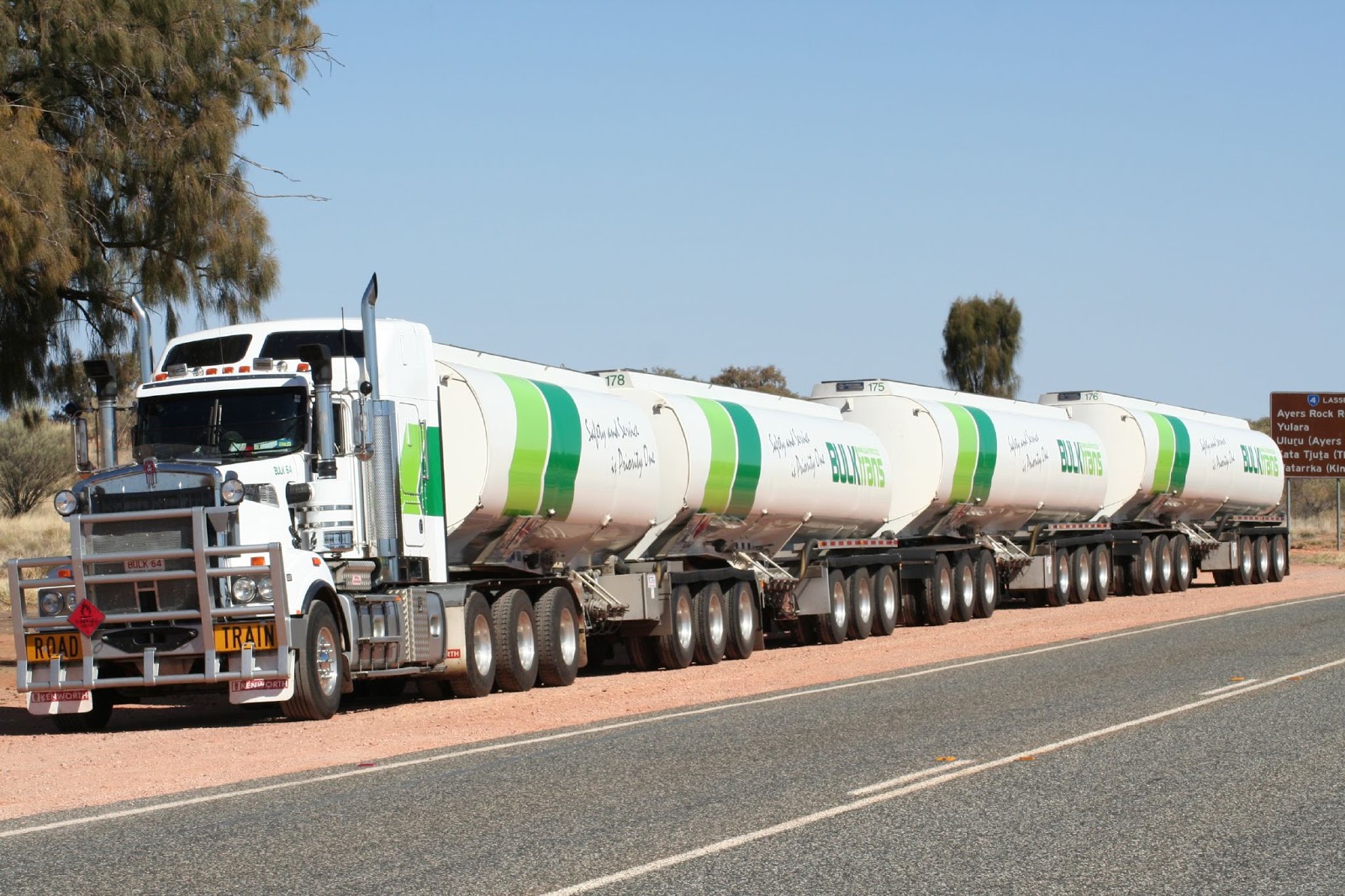
Combining such a distributed electric powertrain with a battery electric prime mover would provide not only range extension capability but also improve drive traction for both single and multi-trailer road trains.

Electromagnetic Anti-Lock Braking for Electric Vehicles

In part 2 of this series (Part 1) we'll take a closer look at electromagnetic braking as a replacement for mechanical friction brakes in hybrid and electric passenger cars.

Electromagnetic braking is very well established in industrial applications. From 400 tonne mine haul trucks to 300 km/h Bullet trains, electromagnetic 'friction' is used to slow these high performance vehicles with industrial strength reliability, so why shouldn't it also be used on comparatively light weight private passenger vehicles ?

Lets take a look at a few of the more familiar applications of electromagnetic braking. Japan's Shinkansen high speed rail network has the best safety record on the planet: beating conventional trains, automobiles and flying. Over the Shinkansen's 50-plus year history, carrying over 10 billion passengers, there have been zero fatality / injury since 1964. Clearly many factors contribute to this but obviously the train braking system plays an important role, especially given the maximum operating speed is 320 km/h (200 mph).
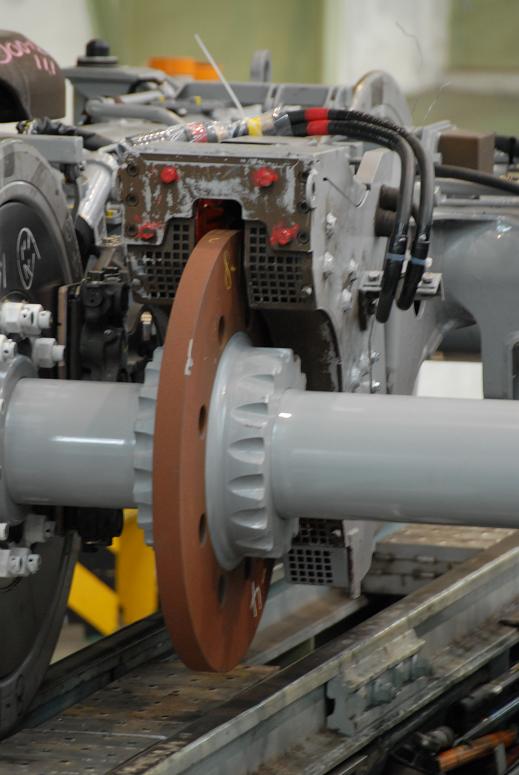
Bullet trains uses electricity to brake up to 640 tonnes down from 300 km/h at a controlled and predictable deceleration rate. Since 1984 all Shinkansen trains have used axial flux eddy current disc brakes (pictured above). These work along the same lines as an eddy current dyno where a steel brake rotor has electromagnets facing it, that when energised, induce eddy currents in the rotor which generates electromagnetic friction that converts the trains kinetic energy into heat.

With the only moving part being the rotor and no wear and tear from mechanical friction, eddy current brakes have proved incredibly reliable and no doubt contribute to the 100% safety record achieved by the Shinkansen rail system. Since 2007 next generation Bullet trains have moved to regenerative braking that uses the main traction motors which helps increase overall system efficiency.

Another very large vehicle that uses electromagnetic brakes is the 400 t class Liebherr T282B Mine haul truck. with a maximum operating weight of almost 600 tonnes, the T282B has no mechanical connection between the monster 90 liter V20 twin turbo diesel engine and the rear wheels.

Instead it takes advantage of high efficiency and maintenance free diesel-electric locomotive technology. Siemens provide two AC induction motors for the rear axle, engine mounted generator and the solid state computer controlled power inverters that are proven over millions of operating hours in trains. The main service brake electric retarders can slow the truck to a stand-still and provide precise speed control on descent using built in cruise control which works in both drive and retard modes.

The electric retarders can apply over 6,000 hp (4,489 Kw) worth of braking effort (the Diesel ICE maximum output is 'only' 3650 hp (2700 Kw). Like the Bullet train there is no battery storage system on-board so the regenerated energy is not stored for later use but is converted to heat via a stainless steel resistor grid in a systems called dynamic braking.

If ultra-reliable electromagnetic braking of 600 tonne vehicles hasn't convinced you then surely this last example will. Strictly speaking this is called magnetic braking as the source is permanent magnets, yet it is just as impressive.

Drop Tower amusement park rides feature up to 400 feet (120 m) towers with a carriage capable of taking up to 40 passenger aloft. Once 30 stories off the ground, the 25 tonne carriage is dropped and free-falls back down the tower reaching speeds of 105 km/h. Built by Swiss firm Intamin, the eddy current magnetic brakes pull the falling riders up at 2.5G from 100 to 0 km/h within 100 feet.

To put that into perspective, a Tesla Model S brakes from 100 to 0 km/h in 113 feet, weighs only 2.5 tonne and moves parallel to the ground, not hurtling head-first towards it.

The common threat between all the above braking applications is that mechanical friction brakes would simply not be capable of reliably doing the job. While these electric braking systems convert kinetic energy into heat, as do hydraulic friction brakes, using electromagnetic friction offers a non-contact method of braking that virtually eliminates maintenance and therefore reliability issues.

In the previous post we've seen evidence that hydro-mechanical friction brakes on hybrids and EVs have become redundant legacy systems primarily still required on vehicles because they provide mandatory safety systems. In order to allow electromagnetic braking to functionally replace systems like ABS & ESC not only do we need each wheel to have an electric motor to drive / brake each wheel independently, but also additional electromagnetic braking strategies other then just regeneration feeding kinetic energy into a battery pack.

Currently in hybrid and electric vehicles only a fraction of the electric motors full power is used for braking. For example, a Chevy Volt has 115 kw of electric motor power available for acceleration but only 60 kw for braking. Even a Tesla Model S with over 500 kw for acceleration is limited to 60 Kw maximum brake regeneration. The primary reason for this is battery cell charge limits. Most lithium ion batteries have asymmetric charge & discharge curves.

In order to allow full electric motor power to be applied in brake mode, alternative energy discharge methods are required. As we have seen in the examples provided above, there are several options from dynamic to eddy current braking and/or the addition of supercapacitors in parallel with the battery pack. With an electric motor for each wheel and full motor power available for braking, modulating the motors independently to perform anti-lock, stability control, emergency brake assist, automatic emergency braking and torque vectoring becomes a software project.

GM Buying 3 yo Self-Driving Tech Startup for $1 Billion

General Motors announced Friday it is buying Cruise Automation, a San Francisco self-driving vehicle startup, the latest move by the auto company as it competes with Silicon Valley to develop self-driving cars that could be used in ride-sharing fleets.

GM and Cruise did not disclose the value of the deal. Technology website Re/Code cited sources as saying GM paid $1 billion. A GM spokesman declined to comment on that figure. If correct GM has just set a new precedent for valuations of automotive tech start-ups.

GM intends to use Cruise’s technology and people to accelerate its effort to develop vehicles that can operate without a human driver, potentially as part of ride-sharing fleets “as soon as possible,” GM President Dan Ammann said in an interview.

“We will be committing considerable resources to recruit and grow the capability of the team,” Ammann said.

Cruise has been working to develop hardware and software that could be installed in a vehicle to enable the car to pilot itself on a highway, without the driver steering or braking.

GM initially planned an investment in the company but moved within five weeks to buy Cruise outright, said venture partner Nabeel Hyatt of Spark Capital, an investor in Cruise.

"They moved faster than most Silicon Valley companies would move," he said.

Cruise, which has 40 employees, was launched in 2013 and has raised $20 million in venture capital, founder Kyle Vogt said in an interview.

Vogt impressed Silicon Valley venture capital fund Signia Venture Partners by demonstrating an Audi A4 that could be controlled by a game console, said Signia principal Sunny Dhillon.

More recently, Cruise was working on a system that could make a car "fully driverless," Vogt said.

A flurry of investments by traditional auto companies reflects a fear among industry executives that the century-old business of building and selling cars that people drive themselves is at risk, even though global vehicle demand is strong.

In January, GM said it would invest $500 million in ride-hailing company Lyft Inc and followed that by forming a new car-sharing operation called Maven. The company has also established a separate unit for self-driving vehicle development.

Other automakers are moving into ride sharing and self-driving vehicles, as are some traditional auto suppliers.

Germany’s Continental and Delphi Automotive among others are seeking technology companies to buy for intellectual property and programming talent.

World’s First All-Electric Propulsion Satellite Begins Operations

The world’s first all-electric propulsion satellite, built by Boeing for Bermuda-based ABS, is now operational after an on-orbit handover on August 31. The ABS-3A, a 702SP (small platform) satellite, expands ABS’ communications services in the Americas, Europe, the Middle East and Africa.

“The operational ABS-3A satellite and ABS-2A, launching in early 2016, will further strengthen and solidify our global expansion and offer flexible capacity to our growing fleet,” said Tom Choi, CEO of ABS. “We believe Boeing’s innovative portfolio can help us to affordably grow now and in the future.”

The ABS-3A spacecraft was the world’s first all-electric propulsion satellite to be built and launched – part of a stacked pair launched in March with a 702SP satellite built for Eutelsat, based in Paris. The spacecraft’s all-electric xenon-ion propulsion system contains a sufficient quantity of the inert, non-hazardous element xenon to extend the satellite’s operations beyond the expected spacecraft design life of 15 years.

“With a successful launch, testing and execution of orbit operations, we were able to deliver the first 702SP to ABS about one month earlier than planned,” said Mark Spiwak, president, Boeing Satellite Systems International. “The 702SP product line was designed to bring the latest technology into the hands of customers seeking adaptable and affordable solutions. In addition, the 702SP’s patented dual-launch capability helps customers share launch costs, which can significantly lower overall expenses for a satellite owner.”

Boeing is under contract to build a second 702SP satellite for ABS, designated ABS-2A, which will be delivered and launched early next year.

Bosch buys solid state battery start-up Seeo

German industrial conglomerate Bosch is acquiring Silicon Valley battery firm Seeo, including all of its intellectual property and research staff. With the move, Bosch is looking to enhance its offer to the electric car industry, which is witnessing a significant growth.

Founded in 2007, Seeo is known for its advancements in creating high-energy rechargeable lithium-ion batteries based on a nano-structured polymer electrolyte. Seeo uses solid state technology that avoids the use of flammable liquid electrolyte.

Using solid electrolyte, Seeo manufactures DryLyte batteries that deliver high energy density alongside impressive reliability and safety. Seeo has an exclusive license to core patents from Lawrence Berkeley National Laboratory and has more than 30 issued, exclusively licensed and pending patent applications.

News website Quartz reported that Bosch confirmed the acquisition. A Bosch spokeswoman told the website that the financial terms of the deal will not be released.

In December, Seeo made news as its CEO Hal Zarem announced plans to manufacture a battery with an energy density that is about double that of existing commercial lithium-ion batteries. The new battery would have a density of 300 watt hours per kg.

Bosch, which is already supplying a lot of components to the automobile industry, has long been looking to enter the advanced battery market. The acquisition may prove successful, as Seeo and its innovations are said to be of great potential.

Meanwhile, Seeo faces intense competition from start-ups such as Sakti3, QuantumScape, XG Sciences, Envia Systems and SolidEnergy Systems that are working on new types of electric car batteries. Panasonic is currently the leading player in the electric car battery market with a 39% market share, followed by LG Chem and Samsung SDI, according to research firm Lux Research.

UK To Test Dynamic Wireless Charging For Electric Cars

Trials of technology needed to power electric and hybrid vehicles wirelessly on England’s major roads are due to take place later this year.

The trials are the first of their kind and will test how the technology would work safely and effectively on the country’s motorways and major A roads, allowing drivers of ultra-low emission vehicles to travel long distances without needing to stop and charge the car’s battery.

The trials follow the completion of the feasibility study commissioned by Highways England into ‘dynamic wireless power transfer’ technologies.

Transport Minister Andrew Jones said:

The potential to recharge low emission vehicles on the move offers exciting possibilities. The government is already committing £500 million over the next five years to keep Britain at the forefront of this technology, which will help boost jobs and growth in the sector. As this study shows, we continue to explore options on how to improve journeys and make low-emission vehicles accessible to families and businesses.

Highways England Chief Highways Engineer Mike Wilson said:

Vehicle technologies are advancing at an ever increasing pace and we’re committed to supporting the growth of ultra-low emissions vehicles on our England’s motorways and major A roads.

The off road trials of wireless power technology will help to create a more sustainable road network for England and open up new opportunities for businesses that transport goods across the country.

The trials are expected to begin later this year following the completion of an ongoing procurement process. The trials will involve fitting vehicles with wireless technology and testing the equipment, installed underneath the road, to replicate motorway conditions. Full details of the trials will be publicised when a successful contractor has been appointed.

The trials are expected to last for approximately 18 months and, subject to the results, could be followed by on road trials.

As well as investigating the potential to install technology to wirelessly power ultra-low efficient vehicles, Highways England is also committed in the longer-term to installing plug-in charging points every 20 miles on the motorway network as part of the government’s Road Investment Strategy.

World’s Fastest Charging Electric Bus Takes 10 seconds to Charge

The world's fastest charging electric busses, that takes just 10 seconds to be fully charged, were put into operation for the first time in Ningbo on Tuesday.

The bus operates a 11-km route with 24 stops in Ningbo, Zhejiang province, local transport authorities said.

In the next three years, a total of 1,200 such buses will be used for public transport in the city, where the electric bus plant is located.

The bus recharges while stationary or while passengers get on or off, and each charge enables the bus to run for least five kilometers, according to Zhou Qinghe, president of Zhuzhou Electric Locomotive, a subsidiary of high-speed train maker CRRC.

In addition, the bus, which rolled off production line in April, consumes 30 to 50 percent less energy than other electric vehicles.

The capacitor can be charged one million times and has a 10-year life cycle.

BorgWarner to buy electric motor maker Remy for $950M

BorgWarner agreed to buy Remy for $951 million in cash, driving further consolidation of the auto-parts industry.

BorgWarner will pay $29.50 a share, a 44 percent premium from Remy’s closing price on Friday, according to a statement today. The price indicates an enterprise value of about $1.2 billion, BorgWarner said. The maker of turbochargers and transmission parts said the deal is set to close in the fourth quarter and should add to earnings in the first year because of purchasing efficiencies and other savings.

Demand for fuel-saving technology and global scale is pushing auto-parts makers to consolidate. In May, TRW Automotive Holdings Corp. was acquired by German auto supplier ZF Friedrichshafen AG for $12.4 billion.

“Our main focus has been organic growth, and that remains a prime path for us,” James Verrier, CEO of BorgWarner, said on a conference call. “But we’ve also been consistent about the need for M&A to add key technology to sustain that growth.”

The acquisition highlights the increasing importance of the electrification of the powertrain, which has not been a strength of BorgWarner’s, Verrier said.

BorgWarner rose 1 percent to $54.14 at 11:39 a.m. in New York, as Remy soared 42 percent to $29.18. This year through Friday, Remy had fallen 1.9 percent and BorgWarner had declined 2.4 percent.

Electric Powertrains

Buying Remy will add alternators, starters and hybrid motors, giving BorgWarner the ability to benefit as more powertrains blend electric power with traditional gasoline-fueled technology.

Some investors had been concerned that the move to hybrid engines would eventually cause BorgWarner to lose sales to automakers, Joseph Spak, an analyst with RBC Capital Markets, wrote in a research note today.

BorgWarner CFO Ron Hundzinski said he expects savings from the acquisition of at least $15 million annually within two years, in part by eliminating duplicate costs associated with a public company, and from lower purchasing expenses. He said he expects the Remy business to have profit margins in the mid-teens, similar to BorgWarner’s.

Former GM unit

Remy International, formerly known as Delco Remy, traces its roots to brothers Frank and Perry Remy, who developed magnetos, generators that used magnets to help start early automobiles. GM acquired Delco Remy in 1918 and spun it off in 1995. The name was changed to Remy International in 2004 and the Pendleton, Ind.-based company spent less than two months in bankruptcy in 2007.

Remy posted net income from continuing operations of $6.1 million last year on revenue of $1.2 billion. In 2013, it posted net income of $12.4 million on revenue of $1.1 billion.

VW ‘close to battery breakthrough’ next-gen e-Golf to get 300km range

Volkswagen is closing in on a new battery technology that will bring “a quantum leap for the electric car”, according to the firm’s boss Martin Winterkorn.

Winterkorn told German tabloid newspaper Bild, "VW is researching a super-battery in Silicon Valley in California, that is cheaper, smaller and more powerful. An electric Volkswagen that can travel 300km (186 miles) on electricity is in sight. It will be a quantum leap for the electric car.”

As we reported back in December, VW acquired a 5% holding in QuantumScape, a San Jose-based early-stage battery startup that has been working on commercializing solid-state battery technology from Stanford University.

Volkswagen was due to decide in the first half of this year whether QuantumScape's battery technology is ready for use in its electric cars.

Torque Vector Steering Improves Electric Vehicle Energy Efficiency

Germany's Karlsruhe Institute for Technology along with industry partner Schaeffler are researching improvements in electric vehicle energy efficiency by using brake steer or torque vector control of wheel motors to assist power steering.

The project "Intelligent Assisted Steering System with Optimum Energy Efficiency for Electric Vehicles (e²-Lenk)" subsidized by the Federal Ministry for Education and Research (BMBF) focuses on a new assisted steering concept. In conventional vehicles, the internal combustion engine not only accelerates the car but also supplies on-board assist systems with energy; such as the assisted steering system, which reduces the strain on the driver at the wheel.

In electric vehicles, this energy comes from the battery and also reduces the range as a result. In this research project by the collaborating partners, Karlsruhe Institute for Technology (KIT) and Schaeffler, the steering system is assisted in an energy-efficient manner by intelligent control of the drive torques transmitted to the individual wheels. The project is being sponsored by BMBF with a sum of around 0.6 million euros over 3 years and was started in January 2015.

"The new assisted steering system would require less system components in an electric vehicle, this would mean savings in terms of weight and energy in an electric vehicle", explain project managers Dr. Marcel Mayer, Schaeffler, and Dr. Michael Frey, KIT. "This would mean that an electric car would be cheaper and have a greater range." Materials and production steps can be saved due to the potential optimization of the design and weight.

The basic idea of the e²-Lenk project is simple: The wheels in an electric car will be driven individually by electric motors in contrast to a car with an internal combustion engine where all the wheels are provided with equal force. If the wheels on the left side transmit more drive torque to the road than those on the right side, this will result in acceleration of the vehicle to the right without the need to turn the front wheels or consume additional energy for steering.

Tracked vehicles or quadrocopters steer using the same principle. "Steering assistance can be provided while driving by means of an intelligent control system and suitable wheel suspension", says Schaeffler engineer Mayer, Manager of the Automatic Driving Working Group, which is carrying out research as part of the collaborative research project SHARE (Schaeffler Hub for Automotive Research in E-Mobility) at KIT. "Only steering when stationary remains a challenge with conventional designs."

"The assisted steering system is part of the drive train with our approach", explains Frey who is researching at KIT's Institute of Vehicle Systems Technology. Steering the front wheels is carried out without using additional energy. "We also want to significantly increase the quality of driving. Customer benefit, comfort, safety and reliability go hand in hand here."

As part of the project, functional demonstrators are being built, with which the concepts can be validated and optimized in experiments. It is also planned to implement the system in last year's Formula Student racing car KIT built by the university group KA-RaceIng with the participation of the students.

e²-Lenk is the first publicly subsidized joint project as part of the collaborative re-search project SHARE at KIT between Schaeffler Technologies AG & Co. KG and KIT. This joint project is being managed at KIT's East Campus in a joint project management office run by SHARE at KIT and the Institute of Vehicle Systems Technology (FAST).

Schaeffler and KIT are partners in the Leading Edge Cluster Electric Mobility South-West (ESW), which connects over 80 stakeholders from science and economics in the region Karlsruhe – Mannheim – Stuttgart – Ulm. The cluster strategy of the ESW cluster aims to achieve intensive regional collaboration in the field of electric mobility by means of new approaches and forms of cooperation. As a result, knowledge is developed, consolidated and ultimately advantages are achieved in international competition.

Axial Flux Induction Motor for Hybrid and Electric Cars [VIDEO]

EV Powertrain start-up Evans Electric is rumoured to have been working on some interesting electric vehicle projects recently.

The team have developed a world-first copper rotor axial flux induction motor for automotive applications. The patent pending design has torque density on par with comparable axial air gap synchronous motors but without the expense of rare-earth permanent magnets.

Disc-shaped Axial flux motors are steadily making inroads into electric vehicle powertrains with Renault, Koenigsegg and Bugatti all looking to incorporate them into future models.

Evans Electric were also rumoured to have been hired by an OEM to help develop the architecture of a series hybrid powertrain based on in-board AFIMs with all-wheel-drive torque vectoring powered by a supercapacitor / li-ion battery energy storage system.

No news on which OEMs head these projects but they are believed to be EU headquartered.

Carbon Fiber to Go Mainstream in Automobile by 2025

Driven by a faster-than-expected pace of technology development, carbon-fiber reinforced plastics (CFRPs) will be poised to gain widespread adoption for automotive lightweighting by 2025, according to Lux Research.

Already advances underway in fiber, resin and composite part production will lead to a $6 billion market for automotive CFRPs in 2020, more than double Lux's earlier projection. Even this figure is dwarfed by the full potential for CFRPs in automotive if they can become affordable enough for use in mainstream vehicles.

“Current trends strongly indicate significant mainstream automotive adoption of CFRPs in the mid-2020s, and companies throughout the value chain must position themselves to take advantage of the coming shifts. However, long-term megatrends towards urbanization, connectivity and automation suggest that there could be a limited time window beyond that for penetrating the automotive space,” said Anthony Vicari, Lux Research Associate and the lead author of the report titled, “Scaling Up Carbon Fiber: Roadmap to Automotive Adoption.”

“CFRP developers will have to continue the pace of innovation to overcome the high cost that has so far limited the material to less price-sensitive markets like aerospace and sporting goods,” he added.

Lux Research analysts reviewed the technology development in CFRPs, and evaluated its economics to consider its impact on the automotive sector. Among their findings:

  • Growing partnerships hasten development. The number of direct partnerships between carmakers or Tier-1 automotive suppliers and carbon fiber players has nearly doubled to 11 since 2012. Toray, with partnerships with Plasan Carbon Composites and Magna, has formed the most new relationships and is a major hub.

  • Patent uptick suggests mid-2020 adoption. Using a predictive tool, Lux Research identified a lag of about 18 years between uptick of patent activity and attainment of mainstream commercial adoption milestones. With another major upturn in CFRP patent activity occurring in 2007, large-scale mainstream automotive use is likely by the mid-2020s.

  • Other manufacturing costs need to be cut. Carbon fiber itself, at $28/kg for standard modulus fiber, represents just 22% of the cost of a final CFRP part. Additional advances are needed to reduce capital, labor, energy, resin and processing costs, which together make up the remaining 78%.

    Source: Lux Research