Self-propelled electric tank tread All-terrain vehicle [VIDEO]

Meet the MTT-136, a self-contained battery powered electric tank track. Developed by Canadian Inventor Yvon Martel, the tank track has different attachments and can be used for towing, pushing and grading on virtually any terrain.

The specs claimed in the video are battery dependant, with recharging time varying from 15 minutes to eight hours and range is a similarly variable 45 to 210 kms. The device as shown in the video weighs 280 lbs (127 kg)

Mahindra unveil Reva Halo concept EV sports car [VIDEO]

Mahindra & Mahindra unveiled its concept electric sports car 'Halo' which it expects to launch commercially in the next three years.

"There is a plan to commercialise Halo, we are working on a bigger powertrain and a final design. It will take about three years to be production ready," Mahindra & Mahindra Executive Director and President Pawan Goenka told reporters at the Indian Auto Expo.

According to the company, the Halo can touch a speed of 0-100 kmph in less than 8 seconds. It has a top speed of 160 kmph with a range of 200 km on full recharge.

"This car has been fully designed and developed in India with all indigenous technology," Mahindra Reva Electric Vehicle CEO Chetan Maini said.

The company also introduced a quick recharge variant of its existing electric car e20, equipped with smart port technology.

The car can be fully recharged in one hour, while a recharge of 15 minutes will give a range of 25 km.

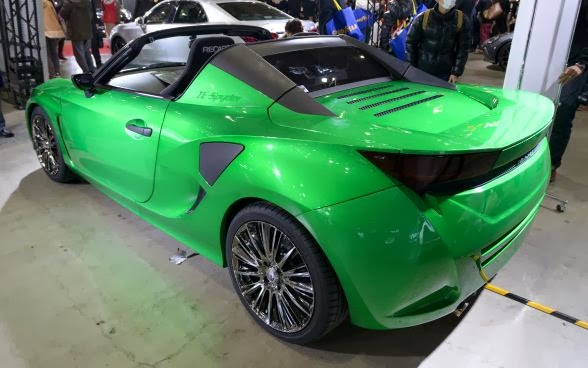
Toyota TE-Spyder 800 Plug-In Hybrid concept [VIDEO]

A Prius hybrid powertrain into a Toyota MR2 chassis sounds like a no-brainer.

This is the TE-S800, and it represents what one Toyota engineer imagines an MR2 successor could be. It weighs approx 1,000 kg and with the 1.5 liter Otto-cycle 1NZ-FE engine outputting more than 115 hp at 6400 rpm plus the plug-in Prius’ 102 hp electric motor coupled to a Toyota E-CVT transmission, the TE-800 does 0-100 km/h in just 5.8 seconds.

The MR2 plug-in hybrid was one of several cars unveiled at the Tokyo Auto Salon by the Toyota Engineering Society which is a volunteer collective that mostly comprises Toyota engineers.

Renault Kwid Plug-In Hybrid Concept unveiled

KWID CONCEPT, a concept car unveiled at the Delhi Auto Expo, highlights both Renault's commitment to new markets, such as India, as well as the company's ability to produce appealing products in the compact car segment. The vehicle's robust, yet fun design, along with its technology-driven features, is targeted at meeting the needs of young customers in these markets.

A robust yet joyful vehicle

The KWID CONCEPT was designed with inputs from Renault Design India and is covered by the 'Explore' petal of Renault's lifecycle-based design strategy. The vehicle's exciting proportions and dimensions as well as very short overhangs give the impression of a bouncing vehicle, while its oversized wheels protrude past the fenders and make the KWID CONCEPT look like a buggy car.

The playfulness of the vehicle's exterior design is offset by a robust appearance due to its protective guards and chunky wings, which exude an impression of strength. The vehicle comes with a two-wheel drive transmission, but projects the facade of an off-road car.

The interior of the KWID CONCEPT is designed to serve as a snug cocoon and is inspired by a bird's nest. The vehicle's seats, suspended over a solid base in white, give an impression of lightness, while their 2-tone elastomer material provides a sense of brightness. The KWID CONCEPT also features rear climate control with controls on the driver seat's back as well as ventilation through concentric perforations. The dashboard is an integrated tablet for commanding the navigation of the Flying Companion.

A high-tech concept car

Beyond the playful and imaginative styling of the KWID CONCEPT, the concept car also comes equipped with a host of technology-driven features, led by its Flying Companion. Aimed at offering a safe as well as fun driving experience, the Flying Companion is the first of its kind in the automotive world. Taking off from the rotating rear portion of the KWID CONCEPT's roof, the Flying Companion can be operated in one of two modes – the automatic mode using a pre-programmed flying sequence and GPS location as well as the manual mode, which enables the companion to be controlled using a tablet inside the vehicle. The Flying Companion can be used for a variety of purposes, including scouting traffic, taking landscape pictures and detecting obstacles on the road ahead.

"Customers in new markets are much younger. Their expectations are different and customers are basically gamers. They tend to take a closer interest in technology and want to enjoy themselves. This concept car meets those needs in a variety of ways, but mainly thanks to the Flying Companion which makes driving both safe and fun. This is the very first time in the long automotive history we can dry on earth with an eye in the sky. It's an amazing feature!" Serge Mouangue, Brand Manager and Innovative Cooperative Laboratory Manager.

The KWID CONCEPT is also Z.E. ready - being pre-disposed to receive batteries for electric use - and comes with a charging plug behind the Renault logo. It's powered by the latest-generation downsized 1.2-litre petrol turbocharged engine mated to dual-clutch transmission EDC to combine driving enjoyment with low fuel consumption. Other technology-rich features include electric operated front bench seat on a center rail, electric opening doors, LED lighting, lack of gearshift (command with touches next to the steering). The vertically-mounted TFT touchscreen display acts as the dashboard in the KWID CONCEPT and also provides access to connected services.

Designed by an international team for international markets

A multinational concept car, the KWID CONCEPT is the first of its kind in Renault to target new markets and Renault Designers around the world cooperated to conceive a vehicle made for local markets and designed to meet the latters' needs. The interior of the vehicle was designed by François Grenier (Technocentre Design, France) based on original drawings by Mishu Batra (Renault Design India) and the exterior by Anton Shamenkov (of Russian origins, Technocentre Design, France) based on original drawings by Jean Semeriva (Studio Design Brazil). The colors and materials of the vehicle were worked upon by Neha Lad (Indian trainee, Technocentre Design) and developed by Chie Yanagisawa (Japanese designer, Technocentre Design). Axel Breun (Technocentre Design) was the overall Project Manager.

"Renault Design is a highly international team with studios in France, Romania, Brazil, Korea and India. This concept car is a reflection of the distinctly international flavour of our design network." Laurens van den Acker, Head of Industrial Design

Reitarating commitment to India

The first Renault concept car to be unveiled outside Europe, the KWID CONCEPT also emphasises India's significant place in Renault's global strategy as well as the company's ability to offer appealing products in the compact car segment.

"This is the first time we have chosen to reveal a concept car outside Europe and this is an eloquent sign of our commitment to India. Young customers in India are often trend setters, looking forward to pushing the envelope when it comes to technology and enjoyable drives. The KWID CONCEPT, with its Flying Companion, meets this forward-looking spirit with both its dynamic styling and hyper connectivity." Gilles Normand, Chairman of Asia-Pacific Region, Renault S.A.S.

The KWID CONCEPT is also tailored specifically to meet the needs of Indian drivers. The vehicle is a compact five-seater to enable family trips, a common occurrence in India. The multimedia dashboard, along with the Flying Companion, answers the young and modern Indian need to stay connected, with a strong attempt for technology. The vehicle's lightweight interior design is also adapted to warm weather conditions.

The KWID CONCEPT 's two-tone body coloring consists of satin grey for the body and textured grey for functional parts as well as golden yellow for contrasting roof and air intake. The vehicle also sports yellow inserts on wheels, lower doors and perforated parts. While this colour scheme features the corporate colors of the Renault Group, the tones also evoke associations with India: the grey represents the soil, while the yellow and gold symbolise flowers and spices.

Additionally, the KWID CONCEPT features an unusual seat arrangement, with three passengers up front and the driver seat in the middle, in a slightly forward position to offer shoulder room, as well as two seats at the back. The central driving position afforded by this arrangement meets international driving demands, enabling the car to driven in both right hand and left hand drive markets.

"Renault has seen unparalleled growth in India in just under 3 years and the market is set to continue playing a significant role in the company's global strategy in the years to come." said Sumit Sawhney, Managing Director, Renault India Pvt. Ltd. "The reveal of the KWID CONCEPT in India – the first such unveil outside Europe, as well as its design keeping in mind the young customers in India illustrate our strong commitment to the country."

Kia Niro four-wheel drive Hybrid electric makes US debut @ Chicago [VIDEO]

Kia’s Niro urban lifestyle concept vehicle, unveiled last September at the Frankfurt Motor Show, made its US debut at the 2014 Chicago Auto Show. The Niro suggests a possible future B-segment contender, and features a hybrid electric powertrain working through an advanced four-wheel drive system.

The concept is powered by a variant of Kia’s turbocharged 1.6-liter Gamma engine, capable of 160 hp (119 kW). The engine and a seven-speed, dual-clutch transmission serve the front wheels while an electric hybrid system powered by regenerative braking delivers up to 45 hp (34 kW) to the rear wheels when road conditions require extra grip.

Although Niro presents a sturdy and muscular outline, it has relatively compact dimensions on its all-new B-segment platform. Its 164.8-inch overall length, 72.8-inch width and 61.3-inch height place it firmly in the city car bracket.

Entry into the vehicle is by way of dihedral “butterfly” doors with flush door handles, that swing up high into the roof. Mounted directly onto the side windows are milled Plexiglas door mirrors with built-in cameras.

2016 Nissan GT-R Hybrid Rendered

Is this (above) a preview of the 2016 Nissan GT-R Hybrid? The Nissan Sport Sedan concept (below) revealed at The North American International Auto Show was originally expected to transform into a new Maxima sedan but reports out of Detroit hint at one other potential evolution of the concept: the next-generation GT-R.

Hungarian graphics blogger X-Tomi has rendered a two door coupe version of the Detroit show car that looks feasible. EV News have reported several times that the next generation GT-R will have a hybrid powertrain with the 600 hp Infiniti Essence Hybrid revealed at the 2009 Geneva Motor Show and confirmation from Nissan engineering, sales and marketing boss Andy Palmer in 2013.

Some unanswered questions remain, will the new GT-R continue to be all-wheel-drive and will the wheel motor powered 380Z sports car Nissan is working on play any role in GT-R development?

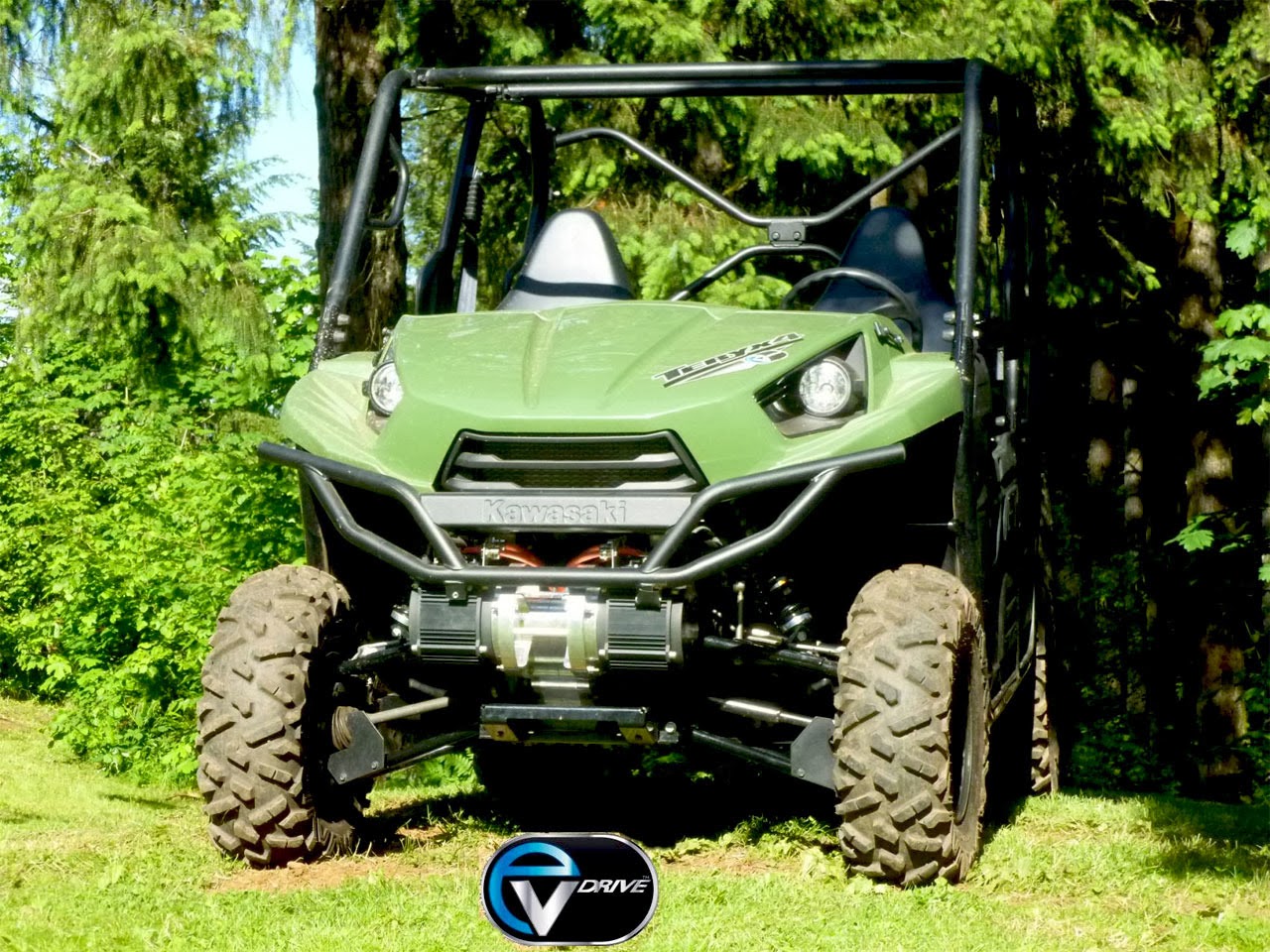
EVDrive Demo a UTV with 4-Wheel Motor Torque Vectoring [VIDEO]

EVDrive completed development and demonstrated a powersports industry first, an "electric 4-wheel 4-electric-motor torque vectoring technology" called Terra-Torque-Drive™, specifically geared to 4-wheel off-road powersports vehicles, such as for the rapidly growing market segment of side by side Utility Terrain Vehicles or UTVs. After taking recent demo rides in the EVDrive-UTV tech demonstrator, powersports industry insiders, such as UTV OEM reps and UTV racers enthusiastically agree, that the Terra-Torque-Drive™, technology would beat almost all of today's top "gas/mechanical powered" 4wd UTVs. OEMs now have the opportunity to license this unique technology for integration into their own future powersports side by side UTV vehicle offerings.

Approximately 323,000 UTVs were retailed in North America in 2012, according to Power Products Marketing (PPM), a market research firm. PPM found consumer models (for example: Polaris RZR XP900) accounted for around 35% of total sales; Prosumer models (example: Deere XUV825i) garnered around 55% share, and commercial models (example: Bobcat Toolcat) were responsible for about 5% of sales. Industry insiders concur that the new EVDrive technology could apply to all 3 market segments. Compared to the top UTVs sold today, a Terra-Torque-Drive™, powered UTV with EVDrive Range Extender (REX) installed would excel in these areas:

1 - Highest efficiency 4wd drivetrain on any UTV today (least mechanical losses)
2 - Adjustable hill descent control (accomplished via an "electric engine braking" called "regen" putting energy back into the vehicles battery system from each of the 4 wheels)
3 - Dynamic torque vectoring modes both for high and low speed operation, e.g. industry unique "Zero Radius Turning" and high speed active torque vectoring allows for better and safer handling off-road
4 - Torque and power from -100 to +100% can be dynamically sent to any wheel, in either direction, in any combination, at any time.
5 - True Series hybrid with optimized internal combustion engine powered REX to allow for longer range matching or exceeding gas powered UTVs sold today. (REX is a high voltage specialized generator- LPG, gas or diesel powered REX engine easily adaptable, no mechanical connections to vehicle)
6 - 120vac power from onboard battery pack, backed up with the REX for general utility use
7 - Lower cost to maintain and operate - superior fuel economy, estimated average 50-100% better – for short trips, no fuel may be needed at all – plug-in to standard electric car chargers.
8 - Superior straight-line and rough loose material, curvy trail acceleration
9 - Greater river depth traversal possible due to completely sealed liquid cooled e-motors/power electronics.
10 - Stealthy low noise operation in electric only mode e.g. wildlife observation & hunting
11 - Torque vectoring software platform allows new traction capabilities to be supported like "apps" without costly mechanical NRE expenses to the OEM – OEM can provide customers software updates for new capabilities.

EVDrive chose the 4-seat Kawasaki Teryx4 as a tech demonstration platform because of its short wheelbase, smaller turning radius, and large break over angle to minimize getting hung up on obstacles. EVDrive modified this UTV with complete removal of the gas engine and AWD mechanical drivetrain and replaced with a 160hp peak total version of the Terra-Torque-Drive™. Unlike the stock Kawasaki Teryx4 UTV mechanical AWD drive, no additional mechanical losses are incurred in the Terra-Torque-Drive™, regardless of AWD mode from lack of transmission, driveshafts and differentials. "Off-road UTVs are ideally suited to our torque vectoring technology where only single fixed speed reduction is required per motor-wheel to attain 55-75mph top-speeds with the type of high RPM brushless motor technology we employ," said COO, co-founder, Steve Tice.

The Terra-Torque-Drive™, is a customized version of the general and modular EVDrive-Train architecture™ (http://bit.ly/EVD-Arch) used on all EVDrive conversion projects, with an in-house developed scale-able torque vector software platform added running on the EVDrive VCU (vehicle control unit), which supports new traction modes with inputs from all driver controls plus vehicle sensors such as accelerometers, etc. Some planned traction modes, that go beyond what is currently running on the demonstrator: auto dynamic terrain type posi-traction control, variable inclination angle offset descent control, zero radius turns on incline, emergency 4-wheel panic braking/stop & boulder climbing.

The Terra-Torque-Drive™, powered e-UTV demonstrator uses 4 of the sealed liquid-cooled EVDrive EVD35 35kW/47HP peak drive sub-systems, de-tuned to ~30kW/40HP each or delivering a total of ~160HP/120kW peak. At each motor shaft, ~66 ft-lbs peak torque is delivered. The 4 gearboxes allow ratio changes with off-the-shelf gearsets. With the currently installed single speed gearsets, at the CV joint of each wheel, a whopping 726 ft-lbs peak torque is delivered. This is the kind of torque necessary to perform Zero Radius Turns with a fully loaded vehicle and perhaps even some extreme rock climbing. "With these gearsets, a top speed of 45mph is achieved with acceleration to this speed of less than 4 seconds if you get good traction – at zero speed all 4 wheels will break loose on dry asphalt!" said EVDrive's CTO & co-founder, Bob Simpson.

In the accompanying video to this press release, some of the e-UTV tech demonstrator more technical features are revealed, such as: control touch screen for the Terra-Torque-Drive™, specifically the interface to the in-house developed VCU, shown in accompanying picture links below, and optional engine sound synthesis unit some OEMs expressed interest in, with 2 sounds demonstrated in the video, a gas turbine and V-twin motorcycle sound.

Addition of the15kW REX not only gives the UTV full performance and range to match and exceed top UTVs on the market but also offers a feature the competition does not, that is 120vac of electrical power anywhere you need it. "With the REX sub-system part of the Terra-Torque-Drive™, a hybrid UTV can be a true swiss-army-knife UTV, able to deliver power in remote locations for construction/utility/ranch applications, run silent for hunting/wildlife observation & with full-time 4wd torque vectoring, can deliver off-road handling and performance for sports/recreation, in summary, addressing all needs in the consumer, prosumer and commercial markets," said CEO, Steve Tice.

"Similar to our 25kW REX technology installed in our Series-PHEV BMW325 tech testbed -> http://bit.ly/PHEV-BMW-3-series but smaller, our custom high voltage 15kW-single cylinder (ICE) powered REX for the UTV is located between the rear seats – so with this sub-system, competing against top 4-seat UTVs in range will not be a problem - certainly the performance meets and beats stock UTVs we have tested" said EVDrive's CTO Bob Simpson. The REX gas engine can be modified to run on LPG as well offering additional emissions and operational cost advantages. EVDrive's REX technology supporting the hybrid e-UTV development has been already designed & proven in EVDrive Series PHEV BMW 325i Technology Testbed here shown sealed below rear spare tire floor - no protrusion above stock floor as shown in pictures at link included above.

EV West is partnering with EVDrive to deploy and demonstrate Terra-Digital-Torque-Steer™ all-wheel torque vectoring technology on full-size off-road vehicles. EV West is known for many milestones; e.g. Builders and drivers of the record breaking all-electric BMW 3-series street sedan at the Pikes Peak International Hill climb and builders of first ever electric off-road race car to run the Baja Mexican 1000 race in the National Off Road Racing Association's series.

Nissan “seriously testing” wheel motor powered 380Z like EV sports car

We reported almost a year ago that Nissan were “really seriously testing” in-wheel electric motors for the new-generation of electric-powered cars. The automaker's global design chief Shiro Nakamura has again confirmed this during an interview with Motor Authority at the recent Detroit Auto Show.

“It's not just at the concept level...We are making serious progress with in-wheel motors; cost is becoming less of an issue, and at a certain point we would like to use in-wheel motors.”

While Nissan's BladeGlider EV concept has in-wheel motors on the rear axle, Nakamura admitted that Bladeglider has some design attributes (like its narrow front track) that might prove insurmountable for a global product—especially with respect to safety—and that any production car would likely have to be wider in front.

He suggests the ESFLOW EV concept, which from behind looks alot like the Bladegliber and at first glance could easily be mistaken for a 380Z, could be a production direction.

The ESFLOW concept presented at the 2011 Geneva Motor Show was said to have a cruising range on one charge of 240 kilometer (150 mile) and was rear-wheel drive powered by two motors that where placed above the axis of the rear wheels, in a mid-ship position.

These motors independently control the left and right wheels, and so the torque is optimized to ensure outstanding vehicle stability and control as well as efficient power regeneration. The motors produce enough torque in an instant for the ESFLOW to reach 100 kph in under 5 seconds.

Fully Charged – Electric Land Rover Defender [VIDEO]

The Electric Defender has all the qualities and performance you'd expect, full all-terrain capability, permanent 4WD and a top speed of 70mph.

However, it has been engineered in-house by Land Rover to test out the latest sustainable technologies. The vehicle's Hill Descent Control is linked to a regenerative braking function, and overall up to 80 per cent of the car's kinetic energy can be recovered. Land Rover's acclaimed Terrain Response system has been adapted for electric drive, offering a 50-mile range with a reserve of a further 12.5 miles.

The result is a zero tailpipe emissions vehicle like no other; eight hours of low-speed off-road use is achievable, and it takes 10 hours for the advanced lithium-ion batteries to be fully charged. 'Fast-charge' technology reducing that to just fours is also possible.

Audi e-tron Allroad 400 HP plug-in hybrid concept officially revealed

The Audi Allroad Shooting Brake has been revealed ahead of its motor show debut in Detroit.

The show car’s engine is a 2.0-litre petrol with 288bhp and 280lb ft of torque, which drives the front axle. This is supplemented by a 54bhp electric motor that’s integrated within the six-speed automatic gearbox.

The second motor is mounted to the rear axle, and produces 114bhp and 199lb ft of torque. It can either power the car on its own – in rear-wheel-drive pure electric mode – or combine with the powertrain over the front axle to turn the Allroad Shooting Brake into a four-wheel-drive hybrid.

In pure electric drive mode, the rear motor can propel the car up to 80mph, while the battery can power the car for 31 miles. A hybrid mode lets the engine and motors work together as efficiently as possible, permitting the front motor to top up the lithium-ion battery when required.

This generator function means that the pure electric range can be replenished, which would allow for multiple stints of all-electric driving on a long enough journey. The car has a range of 510 miles using the most efficient settings. Average fuel economy is a claimed 148.7mpg, while CO2 emissions are just 45g/km.

There are ‘Hold’ and ‘Charge’ settings within Audi’s redesigned MMI infotainment system that allows the driver to choose how the battery’s charge is managed. Hold mode will keep the battery at its current state of charge, while Charge mode will replenish it until it is full.

The final drive mode is Sport, which combines the petrol engine and both motors to give a total power output of 402bhp with 479lb ft of torque. In this set-up, the car has a 0-62mph time of 4.6 seconds, and a limited top speed of 155mph.

700 hp Audi Sport e-tron quattro plug-in hybrid to début @ 2014 CES

Dynamic design, immense power and new electronic features: Audi is presenting a fascinating technology concept car at the Consumer Electronics Show (CES) from January 6 to 10, 2014 in Las Vegas, USA. The Audi Sport quattro laserlight concept is reminiscent of the classic Sport quattro of 1983 while pointing towards the future – with the latest of the brand's technologies in plug-in hybrid drives, user control and display interfaces and lighting technology.

“The new show car demonstrates technical ‘Vorsprung’ on many levels,” says Prof. Dr. Ulrich Hackenberg. “On-board this car we have e-tron technology with 515 kW of power and 2.5 l/100 km (94.09 US mpg) fuel economy; laser headlights that leave all previous systems in the dark with its higher performance as well as new display and operating systems with cutting-edge electronic performance. We are showing the future of Audi here.”

The coupe, a new evolutionary stage of the Sport quattro concept, painted in the color Plasma Red, combines the power of the historic Sport quattro with emotional elegance. Its body is tautly set over its large wheels. The overhangs are short, and the car's proportions show a sporty balance. With a wheelbase of 2,784 mm (109.61 in), it is 4,602 mm (181.18 in) long. At a width of 1,964 mm (77.32 in), the two-door model is very wide, and it is just 1,386 mm (54.57 in) tall, which is exceptionally low.

In the dual headlights, a typical quattro feature, Audi is demonstrating the future of lighting technology by combining matrix LED and laser light technologies. Two low-profile trapezoidal elements are visible within the headlights – the outer one generates the low beam light using matrix LEDs and an aperture mask, while the inner element produces laser light for high-beam functionality.

The powerful laser diodes are significantly smaller than LED diodes; they are only a few microns in diameter. Illuminating the road for a distance of nearly 500 meters (1,640 ft), the laser high-beam light has approximately twice the lighting range and three times the luminosity of LED high beam lights. In this future technology, Audi is once again demonstrating its leadership role in automotive lighting technology with a system that will also be used on the race track in the 2014 R18 e-tron quattro.

The angular, swept-back C pillars of the Audi Sport quattro laserlight concept car and the blisters above the fenders are other design elements reminiscent of the classic Sport quattro. The broad shoulders of the body were reinterpreted and intensively sculpted to convey even greater dynamism. Throughout the car, sharp contours frame muscular surfaces – the interplay between convex and concave curvatures defines the athletic character of the coupe.

The hexagonal single-frame grille also offers an outlook on future design of the sporty production models. The lower section is nearly vertical, while the upper follows the contour of the hood; the screen insert is a typical solution from car racing. The low grille emphasizes the show car's width. Two large, vertical blades divide each of the large air inlets; their form is repeated in the creases of the hood. The splitter, which is made of carbon fiber reinforced polymer (CFRP), is shifted far to the front, as on a race car.

The combination of a swept-back glass cabin and broad shoulders defines the proportions at the rear. Another defining element at the rear of the show car is the CFRP diffuser, which extends upward significantly. Its upper section is honeycombed, while its lower section houses two large, oval tailpipes. The tail lights, which are backed by a black CFRP panel, are rectangular in form – another quattro reference. The luggage space, which is reinforced by a large cross bar stiffener, offers 300 liters (10.59 cu ft) of cargo capacity.

Precise design details round out the dynamic look of the Audi Sport quattro laserlight concept. The sill extensions are made of CFRP, the door handles electrically extend from the door when they detect the approach of a hand. The center locking wheels have a five twin-spoke design.

Lightweight design made visible: the interior

In its generously cut interior, the elegant sporty styling of the show car is continued with dark gray colors and clean lines. The interior design and material selections demonstrate the Audi philosophy of lightweight design. The slender instrument panel is reminiscent of the wing of a sailplane. The supporting structure of the interior is a carbon shell that also serves as a storage compartment in the doors.

A line of trim beneath the windshield wraps around the driver and front passenger and integrates functions such as the inside door handles. The folding race car shell seats with their high lateral supports and integrated head restraints, together with the two rear seats, provide space for four persons. The climate controls are integrated in the air nozzles; a single element is used to control the intensity, temperature and volume of the air stream. In addition to showing climate control settings, the slim display at the centers of the air nozzles also shows media data.

New solutions: displays and controls

The interior of the Audi Sport quattro laserlight concept focuses very much on the driver. Even the multifunction sport steering wheel points the way towards future sporty production solutions. It has two buttons which the driver can use to control the hybrid drive, a red start-stop button, a button for the Audi drive select vehicle handling system and a "View" button to control the Audi virtual cockpit.

All key information is shown on the large Audi TFT display in high-resolution, three-dimensional graphics; a cutting-edge Tegra 30 processor from Audi partner Nvidia processes the graphics. The driver can switch between different modes. For example, in the MMI mode the dominant display elements include the navigation map and media lists, while in the Classic view the speedometer appears in the foreground.

Nearly all functions of the Audi Sport quattro laserlight concept can be controlled from the further developed MMI terminal that is mounted on the center console over the tunnel. Its large rotary pushbutton, which also serves as a touchpad, can be pushed in four directions, and it is surrounded on three sides by four buttons – for the main menu, submenus, options and a back function.

The new user interface has a menu structure whose intuitive layout is similar to that of a smart phone. All frequently used functions can be accessed lightning fast. For most inputs, just a few steps are needed thanks to a new free text search feature; generally just four characters suffice for a navigation address. The driver can quickly scroll through lists or zoom the map image using multitouch gestures on the touchpad. Voice control functionality has also been intensively further developed.

Powerful and highly efficient: the drive system

The plug-in hybrid drive gives the Audi Sport quattro laserlight concept fascinating dynamic performance. Its system output is 515 kW (700 hp), and its system torque is 800 Nm (590.05 lb-ft). Power flows via a modified eight-speed tiptronic to the quattro drivetrain, which features a sport differential at the rear axle. The show car's combined fuel consumption, based on the applicable fuel economy standard, is just 2.5 liters of fuel per 100 km (94.09 US mpg) – which equates to CO2 emissions of 59 g/km (94.95 g/mile).

The combustion engine is a four-liter V8 with biturbo charging; it produces 412 kW (560 hp) of power and 700 Nm (516.29 lb-ft) of torque. The cylinder on demand (COD) system, which deactivates four cylinders under part load and a start-stop system make the sonorous eight-cylinder engine very efficient. Located between the 4.0 TFSI and the transmission is a disc-shaped electric motor that produces 110 kW and 400 Nm (295.02 lb-ft). It draws its drive energy from a lithium-ion battery at the rear, which stores 14.1 kWh of energy – enough for up to 50 km (31.07 miles) of all-electric driving. An Audi wallbox that is used for charging provides for optimal energy transfer.

An intelligent management system controls the interplay of engine and motor on demand. The driver can switch between three different modes. In EV mode, just the electric motor operates; its high torque propels the show car with plenty of power – even outside of the city. The active accelerator pedal indicates the transition to Hybrid mode to the driver – by a change in pedal resistance; this is done so that the driver can intentionally influence the mode selection.

The Hybrid mode aims at optimal fuel-savings in the interplay between the TFSI and the electric motor, and environmental and route data are utilized here. The driver can choose the Hold and Charge modes in the MMI to influence the operating strategy, e.g. if the driver wants to ensure that sufficient electrical energy is available for the final kilometers to the destination. The Audi drive select dynamic vehicle handling system offers even more control options – individual driving profiles are set up for different levels of regenerative braking.

In Sport mode, the operating strategy configures the drive system for maximum power. When the V8 and electric motor are boosting, the Audi Sport quattro laserlight concept accelerates from a standstill to 100 km/h (62.14 mph) in 3.7 seconds and can reach a top speed of 305 km/h (189.52 mph).

Body and chassis

A lightweight design strategy also plays a major role in the car's dynamic performance. A combination of ultra high-strength steel sheet and structural elements of cast aluminum is used in the occupant cell. The doors and fenders are made of aluminum, and the roof, engine hood and rear hatch are made of CFRP. This results in an unladen weight of just 1,850 kilograms (4,078.55 lb), including the large battery pack.

The front suspension is comprised of five links per wheel, while the rear suspension is based on the self-tracking trapezoidal link principle of Audi, which guarantees dynamic performance and stability. Stiff tuning of the springs and shock absorbers make the Audi Sport quattro laserlight concept hold tightly to the road, while Audi drive select makes the driving experience even more multifaceted. The dynamic steering system varies the steering ratio as a function of driving speed. The brake calipers grip large, carbon fiber-ceramic brake discs, and the tire size is 285/30 R 21.

Airbus signs MoU to develop electric taxiing for A320 Family

As part of on-going research and development into future technology options, Airbus has signed a memorandum of understanding (MoU) with EGTS International, a joint venture company between Safran and Honeywell Aerospace, to further develop and evaluate an autonomous electric pushback and taxiing solution for the A320 Family.

The agreement marks the selection of EGTS International’s Electric Green Taxiing System to be evaluated as a new option on the A320 Family – referred to by Airbus as eTaxi. This option would allow the aircraft to push-back from the gate without a tug, taxi-out to the runway, and return to the gate after landing without operating the main engines.

eTaxi will use the aircraft’s Auxiliary Power Unit (APU) to power electric motors fitted to the main landing gear wheels. The architecture will include the ability for pilots to keep full control from the cockpit over their aircraft’s speed and direction during taxi operations.

Olivier Savin, EGTS Programme Vice President, Safran said: “We are extremely pleased to strengthen our relationship with Airbus, a key customer and industry leader in innovation. Through this agreement we are creating the ideal context to collaborate to best utilize our own landing gear systems expertise to develop a green taxiing solution for the A320 Family.”

Brian Wenig, EGTS Programme Vice President, Honeywell Aerospace said: “Following our demonstration of the technology at this year’s Paris Airshow, this MoU marks the next critical milestone in the advancement of the Electric Green Taxiing System as an option for Airbus’ A320 Family, by securing Airbus’ support in the development of the system. Airbus will provide extremely valuable insight to facilitate a seamless integration into the aircraft.”

Daniel Baubil, Airbus EVP, Head of A320 Family Programme said: “Today Airbus delivers the world’s most eco-efficient single-aisle aircraft – the A320 Family. This is the result of our permanent research for innovative enhancements to make our aircraft even more efficient and capable.” He adds: “We therefore look forward to working with our EGTS International expert partners – Honeywell and Safran – with whom we share the common view that the A320 Family is a natural fit for an electric taxiing capability.”

The eTaxi option will offer several operational and environmental benefits for the A320 Family:

  • Per trip, the projected fuel savings and CO2 reductions would be approximately four percent;
  • It would contribute to significantly more efficient taxiing operations and save around two minutes of time on pushback;
  • Taxiing-related carbon and nitrous oxide emissions would be cut by more than half.

    Over the next few months the partners will jointly develop and present a global commercial case and implementation plan to determine the feasibility of an electric taxiing solution for the A320 Family. To this end, Airbus and EGTS International are reinforcing their existing teams to finalize validation studies, define specifications and converge on market requirements for a fully tailored forward-fit and retrofit technological solution.

    To regularly enhance the A320 Family’s capabilities and performance, Airbus invests approximately 300 million euros annually in keeping the aircraft highly competitive and efficient. More than 10,000 A320 Family aircraft have been ordered and over 5,800 delivered to operators worldwide. With a record backlog of over 4,200 aircraft, the A320 Family reaffirms its position as the world’s best-selling single-aisle aircraft family.

  • Kawasaki “J” EV Motorcycle Concept [VIDEO]

    The Kawasaki J has three wheels. However it uses more than one mode, allowing it to transition to a sports bike, making the two front wheels mesh together. In that mode, the vehicle also lowers, closer to the ground.

    The bike was recently unveiled at the Tokyo Motor Show. Housing an all electric motor, when the rider is taking part in leisurely, slow cruises, or stop and go trips through the city, the two wheels remain separated and the handlebars raise offering the driver more comfort.

    It's during the fast speed, highway type of rides, the tires comes together and the bars lower, allowing the rider to have optimal positioning and posture.

    The basic idea behind the bike is for it to stretch out as speeds increase. The radical and mean looking machine has been generating some serious buzz since the premiere, however it is just a concept for now.

    Kawasaki did not release any plans to put it into production.

    Ford Reveals Automated Fusion Hybrid Research Vehicle

    Taking the next step in its Blueprint for Mobility, Ford today – in conjunction with the University of Michigan and State Farm® – revealed a Ford Fusion Hybrid automated research vehicle that will be used to make progress on future automated driving and other advanced technologies.

    The result of an ongoing project that builds on more than a decade of Ford's automated driving research, the Fusion Hybrid automated vehicle will test current and future sensing systems and driver-assist technologies. Ford's goal is to advance development of new technologies with its supplier partners so these features can be applied to the company's next generation of vehicles.

    "The Ford Fusion Hybrid automated vehicle represents a vital step toward our vision for the future of mobility," said Ford Executive Chairman Bill Ford. "We see a future of connected cars that communicate with each other and the world around them to make driving safer, ease traffic congestion and sustain the environment. By doing this, Ford is set to have an even greater impact in our next 100 years than we did in our first 100."

    Today's Ford vehicles already have technology that enables them to park themselves, understand a driver's voice commands, detect dangerous driving situations and assist with emergency braking. With these technologies and others that one day could allow a person to be driven to a destination, the driver always will need to be in control of the wheel if necessary.

    "In the future, automated driving may well help us improve driver safety and manage issues such as traffic congestion and global gridlock, yet there are still many questions that need to be answered and explored to make it a long-term reality," said Raj Nair, group vice president, Ford global product development. "With the automated Ford Fusion Hybrid research project, our goal is to test the limits of full automation and determine the appropriate levels for near- and mid-term deployment."

    The automated Fusion Hybrid will serve as the research platform to develop potential solutions for these longer-term societal, legislative and technological issues raised by a future of fully automated vehicles.

    The Fusion Hybrid research vehicle builds on driver-in-control studies conducted in Ford's VIRTTEX driving simulator. Using VIRTTEX, Ford researchers study how to merge the capabilities of human and automated drivers to create a seamless, integrated experience.

    Ford's Blueprint for Mobility
    Last year at the Mobile World Congress in Barcelona, Bill Ford outlined Ford Motor Company's Blueprint for Mobility – a plan that describes what the automaker believes transportation will look like in 2025 and beyond, and the technologies, business models and partnerships needed to get there.

    Today, Ford is working on improving technology already used in vehicles on the road. This includes functions that alert drivers to traffic jams and accidents, and technologies for parking and for driving in slow-moving traffic.

    In the mid-term, vehicle-to-vehicle communications will begin to enter into the mainstream. This will include some autopilot capabilities, such as vehicle "platooning," where vehicles traveling in the same direction sync up their movements to create denser driving patterns.

    In the longer-term, vehicles will have fully autonomous navigation and parking. They will communicate with each other and the world around them, and become one element of a fully integrated transportation ecosystem. Personal vehicle ownership also will change as new business models develop. The benefits include improved safety, reduced traffic congestion and the ability to achieve major environmental improvements.

    Tomorrow's technology, today
    The Ford Fusion Hybrid was chosen as the test platform for the new research effort because it is among the leaders in offering the most advanced driver-assist technologies in its class.

    These technologies include Blind Spot Information System, active park assist, lane-departure warning, and adaptive cruise control and collision warning with brake support. These vehicle sensing systems, offered on many Ford vehicles today, are the building blocks for the future of fully automated driving.

    In North America, these technologies can be found on Ford Focus, C-MAX hybrids, Fusion, Taurus, Escape, Explorer and Flex. In Europe, these technologies are available on Ford C-MAX, Mondeo, S-MAX and Galaxy.

    "Products such as Ford Fusion Hybrid give us a head start in the development of automated features," said Paul Mascarenas, chief technical officer and vice president, Ford research and innovation. "Our Blueprint for Mobility aligns the desired outcomes of our work in automated functionality with the democratization of driver-assist technology found on today's lineup of Ford products."

    Ford's Fusion Hybrid research vehicle is unique in that it first uses the same technology found in Ford vehicles in dealer showrooms today, then adds four scanning infrared light sensors – named LiDAR (for Light Detection And Ranging) – that scan the road at 2.5 million times per second. LiDAR uses light in the same way a bat or dolphin uses sound waves, and can bounce infrared light off everything within 200 feet to generate a real-time 3D map of the surrounding environment.

    The sensors can track anything dense enough to redirect light – whether stationary objects, or moving objects such as vehicles, pedestrians and bicyclists. The sensors are so sensitive they can sense the difference between a paper bag and a small animal at nearly a football field away.

    Working together
    Developing the necessary infrastructure to support a sustainable transportation ecosystem will require the collaboration of many partners across multiple industries. State Farm and the University of Michigan's robotics and automation research team are critical to creating the visionary research project.

    Ford's work with others on the future of mobility is longstanding. Ford was an active participant in the Defense Advanced Research Projects Agency (DARPA)-controlled autonomous vehicle challenges in 2004, 2005 and 2007, the year Ford extended its efforts to include the University of Michigan.

    While Ford is responsible for developing unique components allowing for the vehicle to function at high levels of automation, the University of Michigan – under the direction of faculty members Ryan Eustice and Edwin Olson – is leading in development of sensor-based technologies. The sensors aid in the logic and virtual decision making necessary to help the vehicle understand its physical surroundings on the road.

    The university's researchers are processing the trillions of bytes of data collected by the vehicle's sensors, from which they can build a 3D model of the environment around the vehicle. The goal is to help the vehicle – and the driver – make appropriate and safe driving decisions.

    "This research builds on the University of Michigan's long history of pioneering automotive research with Ford," said Alec Gallimore, associate dean of research and graduate education at the school's College of Engineering. "The unique collaboration will enable Ford to benefit from the university's deep knowledge of robotics and automation, and it will allow University of Michigan faculty and students to work side-by-side with some of the best auto engineers in the world."

    Meanwhile, State Farm has been working with Ford to assess the impact of driver-assist technologies to determine if the technologies can lower the rate of rear collisions.

    Last year there were nearly 34,000 fatalities due to traffic accidents in the United States. By developing more intelligent vehicles, Ford helps create smarter drivers.

    "By teaming up with Ford and the University of Michigan in this research, we are continuing our decades-long commitment to making vehicles, roadways and drivers safer," said State Farm Chairman and CEO Edward Rust. "The changes new technologies bring to our lives are exciting, and we are always looking at how technology can better meet the ever-changing needs of our customers."

    Setting the stage for mobility in Michigan
    Today's Ford Fusion Hybrid research vehicle announcement follows an aggressive plan released this week by Business Leaders for Michigan to position the state as the global center for mobility and grow up to 100,000 new jobs in its auto sector by becoming a hub for excellence in advanced powertrain, lightweight and smart/connected transportation technologies.

    With Bill Ford as champion of Business Leaders for Michigan's mobility initiative, the plan has been developed with a coalition of top industry experts, the Center for Automotive Research and McKinsey & Company. The plan identifies growth strategies for the auto sector as it transitions to an increasingly advanced technology-based sector.

    Zoox Reveal Autonomous Bi-directional Electric Vehicle Concept

    Meet The Boz; it's not really a car - it's what might come after the car - a vehicle design based entirely around autonomous driving.

    Inside the Boz, the experience would be like sitting in a train. Drivers become passengers, or "commanders." Without needing to focus on traffic and road signs, they would be able to use the commute to do some work or watch a video or have a snooze!

    Just as the internal combustion engine enabled the car to replace the carriage, Zoox believe autonomous technology will replace the car, and in doing so create a new class of mobility known as 'Level 4'.

    Level 4 is a term taken from a policy statement the US National Highway Traffic Safety Administration released on May 30, 2013. This document outlines a spectrum of mobility systems from the fully manual Level 0, through to Level 4 which is fully autonomous.

    From a design perspective, the first element you may notice is what's absent: the front and rear windshield. This is not to say L4s can't have them — certainly those designed for tourism would — but this vehicle makes the statement that you now have an option.

    Firstly, it gains thermal, aerodynamic and acoustic efficiencies. The thermal load lost through the windshield is significant, requiring energy intensive climate control systems, as well as a number of ancillary systems to keep the glass clear. These inefficiencies are removed.

    The entry profile of the vehicle is aerodynamic as a near teardrop, unattainable in a car due to the requirement for driver vision. The low profile roofline and absence of glass further lends itself to superior acoustic insulation. The side windows are thin, but double glazed, which enhances these properties.

    Because the requirement for the passenger to be situationally aware of their exterior environment is removed, external sound and light can be shielded to enhance a sense of serenity and safety. This is a superior environment for interacting with voice-activated systems, watching video or conversing.

    You can be in the middle of a bustling city, but when the door seals, you are in your own world.

    The next point of observation may be that there is no hood. This is because there is no internal combustion engine — behind each wheel sits an electric in-wheel motor. The body language has been changed to reflect this setup, moving each wheel to its outer corner with minimal overhangs to maximize vehicle stability and interior volume.

    Finally, the L4 is symmetrical in its X and Y axes — there is no differentiation between back or front. In fact, each quadrant of the vehicle is mirrored and identical.

    Source: Zoox

    e-volo VC200 18 rotor 2 person electric helicopter – first flight [VIDEO]

    E-volo’s Volocopter is a revolution in aviation Made in Germany. Safer, simpler, and cleaner than normal helicopters, it has a unique way of moving – a groundbreaking innovation. The Volocopter is an environmentally friendly and emission-free private helicopter. Instead of one combustion engine, eighteen electrically driven rotors propel it.

    The maiden flight and first test flights were conducted in the dm-arena in Karlsruhe with the prototype of the 2-person VC200 on Sunday, November 17, 2013. Based on this model, it will be prepared for series production in the coming years. “There are already numerous requests for the Volocopter from around the world,“ said Alexander Zosel, managing director of e-volo.

    With multiple flights lasting several minutes reaching the nearly 22 m high ceiling of the dm-arena, including a number of smooth takeoffs and landings, the Volocopter concept exceeded all expectations. “Rich and incredibly quiet sound, absolutely no noticeable vibrations in the flight, convincing structure with a great, new spring strut landing gear, and an extremely calm rotor plane,“ concluded the e-volo managing director, thanking the KMK. “New innovations that have the possibility to change our world are continually presented at the Messe Karlsruhe. Therefore it was natural to work in partnership with the e-volo team to enable the test flights in the dm-arena,“ announced KMK managing director Britta Wirtz. “The fair is not just a display of strengths in the technology field, but concretely supports pioneers of aviation as well.“

    The developing team of e-volo knew from the onset that the Volocopter was very easy to fly. Due to elaborate simulations at the Stuttgart University, they already knew that it was much more quiet than a helicopter. However, the pleasant low, rich sound and the lower-than-expected noise level caused great cheering among the e-volo team during the first flights.

    People were eager to know whether there would be disturbing or even dangerous vibrations in the mechanic structure of the rotor plane. “Such vibrations are a large problem for normal helicopters,“ stated e-volo managing director Stephan Wolf, adding that “there, the vibrations together with the deafening noise have lead to much discomfort on passenger flights in helicopters.“ Due to the complex structure of the Volocopter in carbon lightweight design, it was not possible to simulate the expected vibrations in the laboratory. “The result of the first flight created a euphoria among the entire project team.“ Wolf and Zosel further stated that “not even the HD video cameras secured to the exterior carbon ring of the rotor plane captured the least vibrations.“

    Nearly all problems of normal helicopters are thereby solved.

    Yamaha Unveil Motive.e City Car @ Tokyo [VIDEO]

    In the current era of urban traffic and environmental problems there is increasing demand for downsizing and fuel efficient cars. MOTIV.e satisfies these demands by utilising ground breaking manufacturing and materials technology while delivering a new level of driver experience which emanates from the Yamaha Motor Company DNA.

    The MOTIV.e is created from Yamaha Motor's multi-wheel history and experience (2 wheel - 3 wheel and 4 wheel technology). Yamaha Motor Company has always been dedicated to craftsmanship with a focus on 'quality mobility'. The MOTIV.e builds on this philosophy and incorporates Formula One heritage, inspiration from motorcycle design and the latest technology to deliver an exciting and high quality driving experience. The MOTIV.e delivers a new level of personal mobility.

    Yamaha Motor Company chose Gordon Murray Design to cooperate in the design and development of the MOTIV.e which utilises Gordon Murray Design's revolutionary iStream® manufacturing technology. Yamaha Motor Company and Gordon Murray Design are a perfect fit as a partnership with both company's Formula One and technology backgrounds.

    The iStream® manufacturing system which incorporates Formula One composite technology delivers new levels of lightweight, safety, vehicle dynamics and manufacturing flexibility alongside low environmental impact.

    The MOTIV.e design reflects Yamaha's rich heritage in high quality lifestyle products while introducing a technical and dynamic shape which is inspired by Yamaha Motor's Motorcycle products. The iStream® design is centred on a steel frame incorporating bonded composite monocoque panels to produce a lightweight, rigid safety cell. All independent suspension and low unsprung weight delivers new levels of ride and handling. The all-new electric powertrain has been designed using 'state of the art' materials and technology.

    The MOTIV.e represents a new starting point for urban mobility vehicles and sets new standards in the ultra compact 4 wheeler segment.

    Mitsubishi GC-PHEV plug-in concept SUV [VIDEO]

    The Mitsubishi Concept GC-PHEV blazes new trails with powerful driving performance thanks to its full-time 4WD Plug-in Hybrid EV System; excellent stability and road handling that S-AWC (Super All Wheel Control) provides; and information power that an innovative human interface and Connected Car technology together bring. Offering the latest environmental performance, this vehicle empowers you to drive freely on the Earth while enjoying safety and peace of mind. Experience the reliability and satisfaction of driving the Mitsubishi Concept GC-PHEV.

    EXTERIOR
    A dynamic front face with SUV personality. A futuristic form that looks sculpted from a single block and wraps the vehicle with the strength to drive on any road.

    INTERIOR
    When you open the easy-access doors with no center pillar, the spacious cabin and futuristic interface catch your eye. Enter a progressive informational space that stimulates your adventurous heart. The door to a new driving experience is now opening.

    CONNECTED "TACTICAL TABLE"
    A large interface with a touch screen, sweeping wide through the center, collects information that passengers bring, information from the internet, and data accumulated by the vehicle itself, allowing the creation of original maps and driving plans that occupants can share as they connect with the world. The Connected Car possibilities expand from here.

    AR WINDSHIELD
    Vital driving information is displayed on the windshield to enhance navigation and warn of car distances and lane departures. A driving assist system that uses communication technology also enhances driving safety by notifying the driver with guidance and a warning when vehicles or pedestrians enter blind spots in intersections. AR:Augmented Reality

    NEW PHEV SYSTEM
    The FR-type Plug-in Hybrid EV system effectively employs engine and motor power. The 3.0-liter V6 supercharged MIVEC engine is assisted by a 70kW high output motor that provides dynamic performance. This system realizes low energy consumption while achieving CO2 emissions under 100 g/km and supremely quiet operation. SPECIFICATION : CONCEPT GC-PHEV

    ■Overall length / Overall width / Overall height (mm): 4930 / 1940 / 1980
    ■Seating capacity: 4
    ■Targeted hybrid fuel consumption: 15 km/L or more
    ■Targeted EV cruising distance: 40 km or more
    ■Engine type: 3.0-liter V6 supercharged MIVEC engine / Max. output: 250 kW
    ■Motor: Max. output: 70 kW
    ■Total battery electric power: 12 kWh
    ■Wheel drive: Full-time 4WD
    ■Transmission: 8-speed automatic

    Nissan BladeGlider Wheel Motor Powered EV Concept [VIDEO]

    More than a concept, Nissan BladeGlider is both a proposal for the future direction of Nissan electric vehicle (EV) development and an exploratory prototype of an upcoming production vehicle from the world's leading EV manufacturer. BladeGlider was developed with form following function. Nissan crafted the vehicle's unique architecture to give the driver and passengers "sustainable exhilaration" - a fresh electric vehicle driving experience based on peerless technology and exotic styling.

    Targeting the visionary individual seeking visceral driving and sustainability, BladeGlider goes beyond sheer power and acceleration to send the heart soaring into new realms of smooth "gliding" pleasure. It is a physical demonstration of the innovation and excitement of the Nissan brand and Nissan's Zero Emissions Mobility leadership. BladeGlider's pioneering spirit distinguishes it from anything yet envisioned for EVs and destines it to rule the roads of the not-so-distant future.

    Re-inventing the Performance Car - A Game Changer Designed from Scratch

    A clean slate was the starting point for this project, led by Francois Bancon, division general manager of Product Strategy and Product Planning at Nissan. "The goal was to revolutionise the architecture of the vehicle to provoke new emotions, provide new value and make visible for consumers how Zero Emissions can help redefine our conception of vehicle basics," said Bancon.

    BladeGlider's shape alone, with its narrow front track, challenges the orthodoxy that has dominated the roads since the earliest days of the internal combustion engine. The revolutionary nature of the car is more than skin deep. New possibilities for the designers and engineers were opened up by the unique characteristics of electric vehicles.

    BladeGlider has its conceptual roots in two aerial images: the soaring, silent, panoramic freedom of a glider and the triangular shape of a high performance "swept wing" aircraft.

    It is therefore fitting that, in terms of engineering, BladeGlider's developmental focus was aerodynamics: achieving low drag (cdA) while generating road-hugging downforce.

    Disruptive and challenging to the status quo, BladeGlider shares sustainable engineering values with both Nissan LEAF - the best-selling EV in history ─and the Nissan ZEOD RC (Zero Emission On Demand Racing Car), which will make its debut at next year's Le Mans 24 Hour race.

    A Provocative Shift in the Engineering Paradigm

    With its narrow, 1.0 metre lightweight front track and wide, stable rear track, BladeGlider looks as if it could have sprung from a "skunk works" project. But the radical architecture all boils down to aerodynamics and balance. Having the front wheels close together reduces drag and enhances manoeuvrability for high-G cornering power, assisted by its 30/70 front/rear weight distribution ratio. Aerodynamic downforce is created by the highly rigid yet lightweight carbon-fibre underbody, hence the lack of drag-inducing wings.

    When BladeGlider matures into a production car, it could be Nissan's first use of in-wheel motors. The in-wheel motors provide rear-wheel propulsion with independent motor management, while also contributing to freedom of upper body design and space-efficient packaging.

    To power the electric motors, BladeGlider employs Nissan's innovative lithium-ion battery technology, proven in Nissan LEAF. Battery modules are mounted low and towards the rear to enhance stability and handling.

    Revolutionary Breakthrough in High-Performance Design

    BladeGlider embodies a fearless vision of the EV future. Its tightly streamlined deltoid body comprises a tough and structurally optimised chassis wrapped in ultra-lightweight, yet strong and stiff, carbon fibre reinforced plastic (CFRP) finished in a pearlescent white colour that evokes the pristine freedom of a glider. The racing-inspired exterior features a sculpted contour that is both functional and breathtakingly beautiful. Starting from the low, flat and narrow nose, the body line rises gracefully to the cockpit canopy and then curves forcefully back over the large rear wheels, evoking a sense of dynamic movement even when the vehicle is standing still.

    "BladeGlider was conceived around delivering a glider-like exhilaration that echoes its lightweight, downsized hyper-efficient aerodynamic form," said Shiro Nakamura, Nissan's senior vice president and chief creative officer. "This design is more than revolutionary; it's transformational, applying our most advanced electric drive-train technology and racetrack-inspired styling in the service of a new dimension of shared driving pleasure."

    Inside the canopy, the cockpit seats three in a triangular configuration with the driver centre-forward. Seating appointments feature special light and comfortable coverings with yellow fluorescent lines. Amid simple yet edgy interior styling cues, an aircraft-type steering wheel and state-of-the-art instrumentation technology complete the glider-like image. To support maximum EV cruising efficiency, the IT system can display relief maps and atmospheric conditions.

    This efficient, aerodynamic, simple, and lightweight vehicle provides a "gliding" feel that combines the feeling of gravity-defying freedom and near-360 degree view of a glider with the pulse-quickening exhilaration of a race car.

    "I think that the excitement of the racing car should be mirrored in the excitement of driving the road car," said Ben Bowlby, director of Nissan Motorsport Innovation, who has supported the BladeGlider's development. "I think there are elements we can bring from the race track to make these future road cars more exciting, more fulfilling and give greater driving pleasure."

    As a rear-drive performance car, BladeGlider exhibits a coherent and linear handling that enables it to consistently hug road curves, providing feedback for intuitive and exhilarating steering control when cornering under threshold conditions.

    Augmenting BladeGlider's aerodynamically-engineered precise feedback and control, the canopy-like visibility of the driving position engenders a synchronised feeling of oneness with the machine and the road. The result is a free soaring experience which the driver can share with two passengers in the V-shaped seating configuration. Passengers sit at the longitudinal centre of gravity to maintain the car's balance at all times. The centre-driving setting of the cabin space is designed to enhance the driver's sensatory experience. 

    As a final touch, the driver's seat automatically slides laterally when you open the door, enabling easy access to passenger seats.

    New EV Values for the Next Generation

    By thinking outside the box, Nissan has created an EV that truly symbolises the unlimited potential of electric propulsion - balancing zero emissions with innovative excitement like never before.

    Mitsubishi Electric to Exhibit EMIRAI 2 EV concept car @ Tokyo Motor Show [VIDEO]

    Mitsubishi Electric will display its EMIRAI 2 concept car at this year’s Tokyo Motor Show. The car is a continuation of the original EMIRAI first exhibited in December 2011 with rear projection customizable dashboard display, biometrics capabilities, and sensor array.

    Advanced automotive technologies and products will be displayed in two EMIRAI 2 electric-vehicle concept cars. One vehicle features an EV powertrain and the other a driving-assistance system to offer safer and more comfortable driving experiences in the coming future.

    The EV powertrain system incorporates high-accuracy traction control and acceleration control. The driving-assistance system features integrated image sensing and powered on-board display technologies.

    The show will be held at the Tokyo Big Sight exhibition complex in Tokyo, Japan from November 23 to December 1.