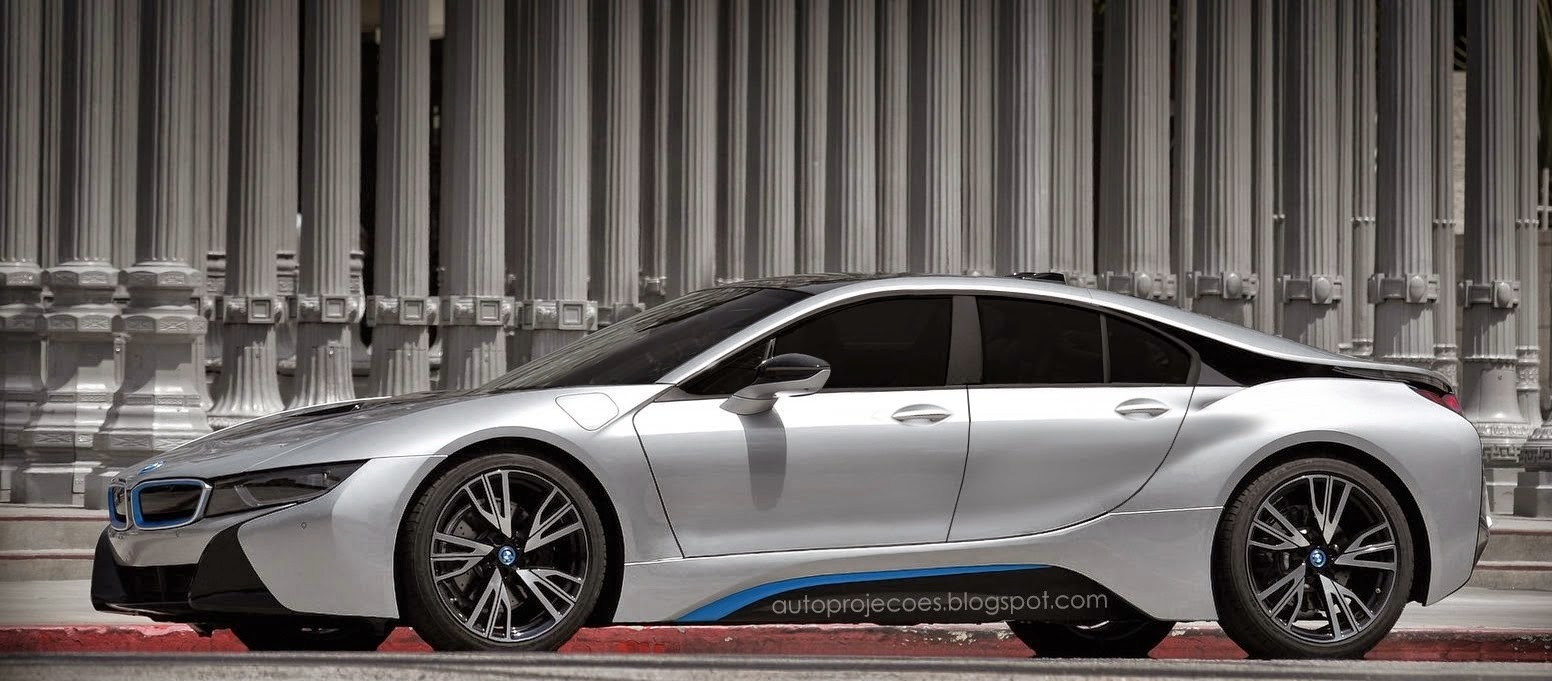
2015 BMW i8 by the numbers [VIDEO]

Jason Cammisa of Road & Track brings us the first real world performance numbers of the new BMW i8. One interesting figure that stands out is the 0 to 60 mph which was recorded at 3.8 seconds. You can also read our BMW i8 test drive here.

BMW i8 uses a plug-in hybrid system consisting of a turbocharged three-cylinder BMW TwinPower Turbo petrol engine and BMW eDrive technology in the form of an electric drive system.

In the rear of the BMW i8, the B38 three-cylinder engine makes 231 hp and delivers its power solely to the rear wheels. At the front, an electric motor is installed, which is powered by a lithium-ion battery in the middle of the vehicle. The system performance drives up to 362 horsepower.

BMW Launch i Solar Carport Concept for i3 and i8 [VIDEO]

With the all-electric BMW i3 already on the market and the BMW i8 plug-in hybrid sports car poised for its own launch, the BMW Group portfolio boasts the world’s first premium automobiles purpose-designed for zero-emission mobility.

The international media launch of the BMW i8 in Los Angeles will include the presentation of a solar carport concept developed by BMW Group DesignworksUSA for the use of renewable energy. It combines high-grade technology for generating electricity from solar power with an innovative design that perfectly complements the BMW i models.

In its choice of materials, design and colour, the DesignworksUSA carport concept takes its cue from the characteristic styling of the BMW i models to form a harmonious counterpart. The holistic sustainability concept is underlined by the materials used in the construction of the carport and by its solar modules. In addition to the carbon elements on the side of the carport, the principal material used is bamboo in the form of struts. Thanks to its rapid growth, bamboo is considered a particularly sustainable raw material. For the generation of electricity, high-grade glass-on-glass solar modules are used. These are translucent and very durable, as well as generating a high energy yield. For the panels used in Europe, the manufacturer offers a 30-year guarantee.

The solar carport not only guarantees the supply of green power but furthermore allows for energy self-sufficiency, so that customers remain independent of electricity prices. In conjunction with the BMW i Wallbox Pro, the car can be specifically charged with solar electricity from the carport. The Wallbox also indicates the amount of solar energy that goes into the car and provides an analysis of recent charging processes which shows the respective proportions of solar and grid power. If the solar panels provide energy beyond the requirements of the vehicle, this surplus solar power can be put to domestic use.

Generating private electricity with the aid of solar collectors and feeding this CO2-free energy via the BMW i Wallbox into the vehicle’s high-voltage battery further optimises of the life cycle assessment of the BMW i models. Regularly hooking up the high-voltage battery to the Wallbox connected to the solar carport enables a high degree of CO2-neutral usage of the BMW i8. With a fully charged high-voltage battery, the plug-in hybrid sports car has a range of around 37 kilometres (22 miles) in all-electric mode.

During development of the solar carport concept by BMW Group DesignworksUSA, the spotlight was firmly on the harmonious interplay between vehicle design and architecture. The glass-on-glass solar modules of the carport are supported by exclusively designed bamboo and carbon elements that authentically reflect the hallmark lines and surface sculpting of the BMW i automobiles. “With the solar carport concept we opted for a holistic approach: not only is the vehicle itself sustainable, but so is its energy supply,” explains Tom Allemann, who is responsible for the carport design at BMW Group DesignworksUSA. “This is therefore an entirely new generation of carports that allows energy to be produced in a simple and transparent way. It renders the overarching theme of lightweight design both visible and palpable.” The BMW Group subsidiary headquartered in California runs an international design studio network in Europe, Asia and America. As an impulse-generator in the fields of design and innovation, the company works for the BMW Group brands as well as for numerous other high-profile international clients spanning a range of industrial sectors.

Panasonic Has 39% Share of Plug-In Vehicle Batteries Thanks to Tesla

Batteries for hybrids and plug-in vehicles are growing fast, more than tripling over the past three years to reach 1.4 GWh per quarter, according to the Automotive Battery Tracker from Lux Research. Panasonic has emerged as the leader thanks to its partnership with Tesla, capturing 39% of the plug-in vehicle battery market, overtaking NEC (27% market share) and LG Chem (9%) in 2013.

"Even at relatively low volumes -- less than 1% of all cars sold -- plug-in vehicles are driving remarkable energy storage revenues for a few developers, like Panasonic and NEC, that struck the right automotive partnerships," said Cosmin Laslau, Lux Research Analyst and the lead author of the new Lux Research Automotive Battery Tracker.

"To understand this opportunity, we combined a comprehensive data set of vehicle sales with detailed battery specifications for each car and supplier relationships, yielding a flexible tool that uncovers unexpected insights into this fast-changing market," he added.

Lux Research analysts used historical and current vehicle sales, detailed battery specifications for each car, and supplier relationships to create the Automotive Battery Tracker. Among their findings:

  • The electric vehicle drivetrain is the most lucrative for battery developers. Hybrids move the most cars -- the Toyota Prius is the best-selling car in Japan and California -- but their small battery packs mean they require less energy storage in total than full electric vehicles like the Nissan Leaf. Hybrids demanded 481 MWh of batteries in Q1 2014, while electric vehicles called for 774 MWh. Nonetheless, in terms of demand by OEM, hybrid leader Toyota (28%) edges EV providers Tesla Motors (24%) and Renault-Nissan (21%).
  • Regulations and consumer preference drive significant regional differences. China has the highest ratio in the world of plug-in vehicles to hybrids, but its average EV battery packs are less than half the size of those sold in the U.S. Adoption of hybrids also varies widely: Japanese consumers bought more than three times as many hybrids as U.S. drivers did, despite Japan being a much smaller automotive market overall.
  • Lithium-ion extends its lead, but NiMH sticks around. Lithium-ion batteries captured 68% of the 1.4 GWh of batteries used in plug-ins and hybrids in Q1 2014, with nickel metal hydride (NiMH) technology trailing at 28% -- but kept aloft by Toyota's loyalty to the lower-cost technology for its top-selling Prius. Next-generation solid-state batteries continue to make only a small dent, with less than 1% of the market.
  • Night Racing in a Silent Nissan Leaf [VIDEO]

    The location: one of Europe's quietest villages. The challenge: take a high speed run through the streets without waking a single person up!

    Only one car has the combination of great performance and unbelievable quietness to make it possible: the 100% electric Nissan LEAF. But could it really succeed, and complete the course without ever passing 100 decibels?

    Porsche to Develop Plug-in hybrid Cayenne Coupé

    Porsche are planning to expand their Cayenne SUV line-up with a uniquely styled coupé model. Design proposals for the new five-door liftback are described as already being at an advanced phase.

    The Cayenne coupé will be positioned as a more sporting alternative to the regular Cayenne with a possible resemblanece to BMW's X6 coupe. It will receive a range of petrol and diesel engines, together with plug-in petrol-electric and diesel-electric hybrid powertrains.

    It is one of up to seven new SUVs set to be developed on a new version of the VW Group’s MLB platform currently being engineered by Audi.

    Source: Autocar

    Flexible Nano Nickel-fluoride Battery Doubles as a Supercapacitor

    A Rice University laboratory has flexible, portable and wearable electronics in its sights with the creation of a thin film for energy storage.

    Rice chemist James Tour and his colleagues have developed a flexible material with nanoporous nickel-fluoride electrodes layered around a solid electrolyte to deliver battery-like supercapacitor performance that combines the best qualities of a high-energy battery and a high-powered supercapacitor without the lithium found in commercial batteries today.

    The new work by the Rice lab of chemist James Tour is detailed in the Journal of the American Chemical Society.

    Their electrochemical capacitor is about a hundredth of an inch thick but can be scaled up for devices either by increasing the size or adding layers, said Rice postdoctoral researcher Yang Yang, co-lead author of the paper with graduate student Gedeng Ruan. They expect that standard manufacturing techniques may allow the battery to be even thinner.

    In tests, the students found their square-inch device held 76 percent of its capacity over 10,000 charge-discharge cycles and 1,000 bending cycles.

    Tour said the team set out to find a material that has the flexible qualities of graphene, carbon nanotubes and conducting polymers while possessing much higher electrical storage capacity typically found in inorganic metal compounds. Inorganic compounds have, until recently, lacked flexibility, he said.

    “This is not easy to do, because materials with such high capacity are usually brittle,” he said. “And we’ve had really good, flexible carbon storage systems in the past, but carbon as a material has never hit the theoretical value that can be found in inorganic systems, and nickel fluoride in particular.”

    “Compared with a lithium-ion device, the structure is quite simple and safe,” Yang said. “It behaves like a battery but the structure is that of a supercapacitor. If we use it as a supercapacitor, we can charge quickly at a high current rate and discharge it in a very short time. But for other applications, we find we can set it up to charge more slowly and to discharge slowly like a battery.”

    To create the battery/supercapacitor, the team deposited a nickel layer on a backing. They etched it to create 5-nanometer pores within the 900-nanometer-thick nickel fluoride layer, giving it high surface area for storage. Once they removed the backing, they sandwiched the electrodes around an electrolyte of potassium hydroxide in polyvinyl alcohol. Testing found no degradation of the pore structure even after 10,000 charge/recharge cycles. The researchers also found no significant degradation to the electrode-electrolyte interface.

    “The numbers are exceedingly high in the power that it can deliver, and it’s a very simple method to make high-powered systems,” Tour said, adding that the technique shows promise for the manufacture of other 3-D nanoporous materials. “We’re already talking with companies interested in commercializing this.”

    Rice graduate student Changsheng Xiang and postdoctoral researcher Gunuk Wang are co-authors of the paper.

    The Peter M. and Ruth L. Nicholas Postdoctoral Fellowship of the Smalley Institute for Nanoscale Science and Technology and the Air Force Office of Scientific Research’s Multidisciplinary University Research Initiative supported the research.

    BMW i8 First Drive – CHRIS HARRIS [VIDEO]

    Chris Harris takes a trip to Los Angeles to drive the new BMW i8.

    Capable of 23 miles all electric before the 3-cylinder turbocharged motor kicks in to recharge the batteries. Harris things the i8 is one of the closest production cars ever seen that looks almost identical to the concept car it's based on.

    Ferrari LaFerrari 950 hp Hybrid Supercar Test Drive [VIDEO]

    The LaFerrari is powered by a 950bhp petrol-electric hybrid drivetrain. It can accelerate from 0-62mph in less than 3sec, from 0-124mph in less than 7sec and from 0-186mph in less than 15sec. Top speed is 220 mph and production is limited to just 499 models.

    The battery compartment is integrated into the chassis (the batteries and engine are mid-mounted) to improve stiffness, while the electric drive itself consists of two motors, one with 161bhp to power the rear wheels and another for the ancillaries. The batteries weigh 60kg and can be charged either under braking or via any excess torque produced by the engine, which is diverted from the rear wheels.

    This is all attached to a 6,262cc V12 with a screaming 9,250rpm rev limit, driving through a seven-speed paddle-shift gearbox. On its own this engine produces 789bhp and 516lb ft of torque. Combined with the electric motor this swells to the 950bhp headline figure, as well as 664lb ft of torque.

    TDK Licenses WiTricity Patent Portfolio for Wireless Charging

    The wireless charging space is on fire this week with first Hella and now TDK announcing that it has entered into a licensing agreement for wireless power transfer technology with U.S. based WiTricity Corporation (Watertown, MA). The aim of the alliance is to develop wireless power transfer systems for electric vehicles (EV) and other mobility applications, and to promote business.

    Wireless power transfer technology can supply electricity without using cables. The technology TDK intends to implement is known as resonant magnetic coupling for wireless power transfer*. Because power can be transferred efficiently even though the power source device and power capture device are separated by many centimeters and through roadway materials such as concrete and asphalt, this technology is expected to find commercial application in EVs and other mobility areas requiring recharging.

    TDK boasts ferrite and other proprietary magnetic materials. Leveraging its strengths in magnetic materials technologies and circuit technologies, in 2009 TDK developed wireless power transfer coil units for smartphones and other compact electronic equipment, which it is now manufacturing and selling.

    Furthermore, since 2010, TDK has been developing wireless power transfer systems based on unique technologies that are envisaged mainly for EVs. In 2013, TDK created one of the world’s smallest and lightest prototype wireless power source and capture systems, and verified its ability to transfer the required power levels at high efficiency for charging electric vehicles.

    Capitalizing on this licensing agreement with WiTricity, TDK plans to quickly commercialize wireless power transfer systems for charging EVs and other electric mobility applications.

    Mercedes-Benz B-Class Electric Drive Priced From $41,450

    The all-new 2014 B-Class Electric Drive features dynamic design, a premium interior and a powerful electric motor for emission-free mobility. This allows for lively, effortless driving pleasure over a real-world range of 85 miles (EPA)*. In addition, the B-Class Electric Drive is digitally networked. Thanks to its connectivity, it can be conveniently checked and configured via the internet. As the Mercedes-Benz among electric vehicles, the B-Class Electric Drive sets clear standards in terms of comfort, quality and safety for up to five occupants. The B-Class Electric Drive, bearing the unmistakable three-pointed star trademark, will first be launched in the US market in the summer of 2014.

    The new B-Class Electric Drive surprises with an especially dynamic driving experience. It provides noticeably powerful acceleration, while gliding along quietly. The new electric Mercedes offers the driver and up to four passengers the familiar high standards of ride comfort in a high-class, spacious and precision-designed interior. The B-Class Electric Drive combines dynamic and driving pleasure with zero local emissions – in short: it delivers electric driving at premium level.

    Powerful drive with brisk acceleration

    The new Mercedes-Benz B-Class Electric Drive is based on the conventionally powered B-Class, for which the current generation has become a bestseller since being launched in many countries in 2011. Since the launch of the first B-Class version in 2005, Mercedes-Benz has seen customers taking delivery of over one million of these vehicles. As an especially versatile vehicle concept, the B-Class with its innovative electric drive now allows additional environmental friendly capabilities to Mercedes standards.

    Mercedes-Benz has collaborated with TESLA Motors to develop the electric B-Class. The two companies share many years of cooperation in the field of electric mobility. The battery for the predecessor model of the smart fortwo electric drive, for instance, came from TESLA. For the B-Class Electric Drive, Mercedes-Benz is once again leveraging the extensive know-how available from the electric car pioneer and is using the TESLA drive system in its own vehicle.

    Quiet and local emission-free driving is ensured by an electric motor generating 177 hp (132 kW). Typical for an electric drive system, the motor develops its maximum torque of 251 lb-ft (340 Newton meters) from the very first touch of the accelerator. This is approximately equivalent to the torque from a modern three-liter gasoline engine. The result is noticeably powerful acceleration from a standing start. The electrically driven B-Class drives from zero to 60 mph in 7.9 seconds. Effortless drivability and exhilarating driving pleasure with a high level of comfort are thus guaranteed in every situation.

    The power supply to the electric drive is delivered via a highperformance lithium-ion battery, which is compactly and safely housed in the “Energy Space” in the underfloor of the vehicle. Such intelligent packaging allows the five-seater to retain the B-Class’s familiar spaciousness in both its interior and its luggage compartment of 17.69-51.42 ft3.

    Zero emissions also on longer journeys

    In the interests of optimizing range, the top speed is electronically limited to 100 mph. Depending on driving cycle; the vehicle has a range of 85 miles (EPA)*. This permits emission-free driving not just in city traffic and on short journeys, but also over longer distances – such as a daily commute. The B-Class Electric Drive can be charged from any standard domestic power socket. For a range of 60 miles, the charging time at 240V in the United States is less than 2 hours*. On the road, the electric drive itself makes its own contribution to a favorable energy balance by converting kinetic energy into electric current during coasting and braking, and feeds this energy into the battery.

    Dynamic Mercedes-Benz design

    Refined sportiness combined with aesthetic appeal – the B-Class Electric Drive features the self-assured and dynamic styling so typical of Mercedes with powerfully defined lines and finely crafted details. The front and rear sections express the width of the vehicle. This is ensured by the wide, prominent grille and the headlamps, which wrap round into the sides, as well as by the wide rear window, two-piece tail lights and large tailgate with deep sill. A dynamic look is created by door-sill panels and striking bumpers with bar-shaped LED daytime running lamps. The charge socket is inconspicuously installed behind the conventional fuel door.

    Sporty interior with classy touches

    The interior underscores the high standards of comfort typical of Mercedes-Benz. High-grade materials and finely textured surfaces, classy touches and precision workmanship make it clear that Mercedes-style electric drive is defined by high standards.

    The three large round center air vents with their uniquely styled cruciform nozzles add a sporty flair that contributes to the overall emotive design idiom of the interior. Positioned above the air vents and seemingly free-floating is the screen for the telematics system – a state-of-the-art eye-catcher in the cockpit.

    In terms of information and communication systems, the electric B-Class offers levels of comfort and functionality that is customary of any Mercedes-Benz. The standard equipment package includes a head unit with 5.8 in (14.7 cm) color display, twin tuner and MP3- Page 4 compatible CD player as well as USB port. The Becker® MAP PILOT is the standard navigation system while the COMAND multimedia system with internet access, navigation and LINGUATRONIC voice control is also optionally available.

    The instrumentation of the B-Class Electric Drive is rounded off by functions that are specific to electric vehicles. One of the striking features is the power display in the right-hand circular instrument. The instrument pointer moves in a clockwise direction from the green zone towards the red zone, when full power is demanded by the driver. It drops back below the zero line when the vehicle is feeding energy into the battery through the recuperation feature.

    Ideally networked: connected services

    Thanks to its state-of-the-art technology, the B-Class Electric Drive is not just sustainable and agile, but also connected. For example, the Vehicle Homepage allows convenient remote interaction and remote configuration of the vehicle. The driver can use their PC or smartphone to conveniently access the vehicle via the internet. It is possible, for instance, to determine the current state of charge of the lithium-ion battery or show the vehicle’s current range on a map. In addition, the planned route can be displayed, showing at a glance where the vehicle can be recharged along the way, should this prove necessary. The range of connected services is rounded off by a feature that allows individually timed pre-heating or cooling of the vehicle. This pre-entry climate control system makes the B-Class Electric Drive unique in its segment.

    Big on safety

    Mercedes-Benz applies its familiar, high safety standards to the BClass Electric Drive. Thanks to the innovative “Energy Space”, the battery is safely accommodated in the underfloor of the vehicle, where it is ensured protection in the event of a crash. In addition, Mercedes-Benz has equipped this innovative electric car with the radar-based collision warning system COLLISION PREVENTION ASSIST with adaptive Brake Assist as standard. This assistance system gives the driver a visual and audible warning of detected obstacles, prepares them for braking action and assists them with the braking process as the situation requires. In this way, it significantly reduces the danger of a rear-end collision. Additional cutting-edge driver assistance systems are also available, including Blind Spot Assist, Lane Keeping Assist and Active Parking Assist.

    Electric drive made by Mercedes-Benz

    Locally emission-free electric vehicles such as the new B-Class Electric Drive are a key part of Mercedes-Benz’s strategy for sustainable mobility. The Stuttgart-based premium manufacturer is asserting its claim to leadership in this sector with electric vehicles that are fully suitable for everyday use. Mercedes-Benz aims to strengthen its position in future, not least with the new BClass Electric Drive, which will be available initially in the USA as of mid of 2014, before subsequently being launched in European markets.

    Technical data*
    Output177 hp (132 kW)
    Torque251 lb-ft (340 Nm)
    Range85 miles (EPA)
    Charging time for a range of     60 miles [US City]USA: under 2 h at 240V
    Acceleration 0-60 mph7.9 seconds (estimated)
    Top speed100 mph (160 km/h),     electronically limited
    *provisional figures

    BMW i8 testing on the Nürburgring [VIDEO]

    In more news on the soon to be launched BMW i8, we've found a short video of the car testing at the Nürburgring. Also, while in Munich recently on business, I personally spotted an i8 test mule in morning peak hour traffic with a young lady at the wheel (I didn't take the pictures as I was driving the rental)

    BMW plans to sell the i8 in about 50 countries, with the U.S. expected to be the largest sales market. In Europe, Germany, France and the UK are expected to be the top markets. Deliveries to retail customers in Europe are scheduled to begin in June 2014, and about one month later in the U.S.

    Pricing for the 2015 BMW i8 destined for the U.S. market starts at US$135,925. BMW are currently taking orders for the i8 in Japan. Pricing starts at ¥19,170,000 (US$191,500)

    HELLA Developing Wireless Charging Systems For Electric Vehicles

    HELLA is working with Paul Vahle GmbH to develop wireless charging systems for electric and hybrid-electric vehicles.

    Commonly used to recharge small consumer products such as smartphones and electric toothbrushes, inductive or wireless charging for cars will make it easier for drivers to charge car batteries and extend a vehicle's driving range.

    Rather than using plug-in charging stations, car owners in the future will simply need to park over an inductive charging unit to trigger the process, according to Dr. Marc Rosenmayr, CEO for HELLA Electronics in North and South America.

    He adds that if inductive charging coils were embedded in streets, electric vehicles also could be recharged when stopped at traffic lights or even while being driven.

    For electric car buyers, a contact-free method of transferring energy to the vehicle certainly will be more convenient and less time consuming. Cables no longer will be necessary. Inclement weather and the risk of vandalism also can be avoided if outside charging stations are involved.

    "Wireless, inductive charging is a far more convenient way to recharge a vehicle's battery system," Rosenmayr points out. "The driver only needs to stop or drive over a charging unit or network to activate the process. As wireless charging has become more available and easy to use, it also might allow automakers to reduce battery size and weight on electric and hybrid electric vehicles.

    Rosenmayr notes that a number of technological and infrastructure challenges still must be overcome before wireless charging for cars and light trucks can be successfully introduced. Energy transfer over high-frequency fields that are at the heart of inductive systems, for example, cause heat to build up in metal objects which could lead to safety issues. The impact that wireless charging might have on other vehicle electronic systems such as navigation, infotainment, driver-assistance and keyless entry systems also will need to be studied.

    The cooperation between Vahle and HELLA combines the expertise and experience of both companies in the field inductive charging. Based in Kamen, Germany, Vahle has 15 years of experience in contact-free energy transfer in industrial environments, while HELLA is a recognized leader in the development of electronics, software, processes and production in the auto industry.

    BMW i8 test drive in China [VIDEO]

    According to Bloomberg's Stephen Engle, the ultra high-end electric and hybrid car space is suddenly getting a bit more crowded in China.

    Tesla had the first deliveries of the Model S to Chinese customers this week, while BMW will roll out its hybrid i8 super sports car for the China market by the end of the year.

    Engle got behind the wheel of BMW's new offering in Beijing.

    Airbus Developing Hybrid Electric Jet Aircraft

    Airbus is learning from automakers as it works on developing a small aircraft powered by hybrid electric engines that could represent its first move into the market for regional jets.

    The development of a regional plane, seating between 70 and 90 people, that can take off and land using electric power could take between 15 and 20 years, Airbus Group Chief Technology Officer Jean Botti told reporters in Munich.

    Airbus, which with Boeing dominates the market for passenger jets, presently makes planes that seat more than 150 people.

    Airbus is already working on an all-electric two-seater plane, powered by two electric motors with a combined output of 60 kilowatts, hoping this technology will serve as a step to bringing electric motors on to larger aircraft.

    The two-seater, which Airbus says is suited for short missions such as pilot training and aerobatics, can run on its lithium-ion polymer batteries for half an hour, with the aim to get it up to an hour.

    The batteries are tricky, Botti said. "They're causing us a lot of headaches."