Robert Llewellyn has had the opportunity to do a couple of long road trips in the Tesla Model S this year.
One to Cornwall and the Eden Project with co-driver Simon Hackett and more recently to Edinburgh and the Fringe Festival.


Charged with Electric Vehicle News and Views
Robert Llewellyn has had the opportunity to do a couple of long road trips in the Tesla Model S this year.
One to Cornwall and the Eden Project with co-driver Simon Hackett and more recently to Edinburgh and the Fringe Festival.

The Antelope Valley Transit Authority’s (AVTA) new electric BYD bus is performing better than advertised! AVTA and BYD operators put the electric bus to the test this weekend during a 24-hour marathon ride that looped from Rosamond to Palmdale a total of 18 times.
The BYD bus managed to travel an astounding 746 miles (1,193 kms) over the 24-hour period, operating in three shifts. Each shift logged between 240 and 256 miles before recharging the battery. “This is tremendous news and it proves the BYD electric bus can be a transit work horse like its diesel counterpart,” stated Board Chair Norm Hickling. “We are looking forward to putting our electric buses into service on local transit routes to further evaluate their true performance under all weather and road conditions.”
This weekend’s 24-hour marathon began on Saturday at 1:04 in the afternoon starting from the BYD factory in Lancaster. AVTA’s electric bus was loaded with 5,250 lbs. of sand bags to simulate the weight of 35 passengers. The bus traveled a total of 240 miles before its first battery charge, which is nearly 100 miles more than BYD advertises and 30 miles more than is needed to service an average transit route in the Antelope Valley. The air conditioning system ran during most of the test except during the early morning hours when it was cold outside.
This is the second test for AVTA’s electric bus. Its first unofficial test was July 29 when it traveled to Los Angeles to pick up the consul general of the Chinese Consulate who was scheduled to tour the BYD manufacturing facility in Lancaster. AVTA offered to pick up the Chinese delegation using its new BYD bus in order to test the zero emission vehicle’s performance on the 14 freeway. After circulating downtown, the electric bus easily climbed the 14 Freeway grade which has an elevation change of nearly 4,000 feet. The 92-mile trip ended in Lancaster, CA with 64% of the bus’ battery life still remaining.
“We are ecstatic to see our electric bus performing so well. Our 12-month demonstration project is now off the ground and we could not be more pleased at the early results,” stated Executive Director Julie Austin. “We are also hopeful our plans to install wireless charging stations at AVTA’s two main transfer centers will extend the battery life of our electric buses even more than BYD technology can guarantee.”


The Tesla Model S electric car earned the highest score ever in Consumer Reports tests, and owners love them.
But after 20 months and over 15,000 miles, CR’s test car has had more than its fair share of problems.


The smart fortwo electric drive is a champion of urban mobility. But is it a champion of the drag strip? Against some of the fastest cars in the city?!
Remember, in urban driving top speed means nothing, it's the first 5 meters that count!


Brammo has announced the appointment of ELMOFO (Electro Motive Force) as their importer and distributor for Australia.
Brammo is excited to partner with ELMOFO, who have a deep understanding of the Australian EV market and the challenges associated with building premium electric vehicles.
Commenting on this latest appointment, Founder and CEO of Brammo Inc., Craig Bramscher, said, “Our vision continues to be to bring our world-class motorcycles to leading global markets. This partnership marks a significant milestone in our expansion. We look forward to being part of the Australian EV market and working with ELMOFO.”
"Over the past two years, ELMOFO has been searching globally for the best two wheel EV company to provide electric motorcycles to the Australian market. Brammo offers award-winning, leading-edge technology that will bring a real world impact to Australian riders," said Brett Sutherland, CEO of ELMOFO.
ELMOFO have been racing a battery powered Radical, the current electric lap record holder, the only electric powered vehicle in a field of petrol powered cars in the NSW SuperSports State Championships.


Wide bandgap (WBG) materials such as silicon carbide (SiC) and gallium nitride (GaN) are best positioned to address emerging power electronics performance needs in electric vehicles (EVs), with SiC displacing silicon as early as 2020, according to Lux Research.
As silicon struggles to meet higher performance standards, WBG materials are benefiting critically from evolving battery economics. On Tesla Model S, for example, a 20% power savings can result in gains of over $6,000 in battery cost, or 8% of the vehicle's cost.
"Efficient power electronics is key to a smaller battery size, which in turn has a positive cascading impact on wiring, thermal management, packaging, and weight of electric vehicles," said Pallavi Madakasira, Lux Research Analyst and the lead author of the report titled, "Silicon vs. WBG: Demystifying Prospects of GaN and SiC in the Electrified Vehicle Market."
"In addition to power electronic modules, opportunities from a growing number of consumer applications -- such as infotainment and screens -- will double the number of power electronic components built into a vehicle," she added.
Lux Research analysts evaluated system-level benefits WBG materials are bringing to the automotive industry, and predicted a timeline for commercial roll-outs of WBG-based power electronics. Among their findings:


.jpg)
According to a recent report, Tesla could launch up to four new models by 2018.
While we already know about the Model X and the Model 3, Autobild is reporting the company is considering a compact city car.
Little is known about the vehicle - which has been dubbed the Model C - but it would be smaller and more affordable than the Model 3 which is expected to cost approximately $35,000.
The magazine goes says a new roadster - dubbed Model R - could arrive in 2017. This seems to contradict statements from Tesla CEO Elon Musk who has previously said an all-new Roadster is at least five years off. However, the wait could be worth it as Tesla's vice president of sales, George Blankenship, has previously suggested it could accelerate from 0-60 mph in less than four seconds and have a range in excess of 200 miles (322 km).
.jpg)


Autocar report that a new Bugatti Veyron is currently undergoing initial conceptual engineering tests in a programme aimed at unveiling the car in 2016 prior to a planned start to customer deliveries the following year. According to sources close to Bugatti, early test mules for the new car exist and have already been pressed into action in an early round of testing.
“Five developmental prototypes with differing powertrain combinations have been constructed up to now,” said one insider. “They are based on the existing car but use various solutions that are being considered for the new model.”
Following recent arrivals such as the McLaren P1, Porsche 918 Spyder and LaFerrari, the new Bugatti will feature a battery powered hybrid electric powertrain. The same quad-turbocharged 8.0-litre W16 powerplant as its predecessor will be retained but with the possible addition of electric turbochargers, perhaps along the lines of those used by Porsche in LMP1 (Porsche and Bugatti are both part of the VW group) and the 2014 Formula One KERS MGU-H (where the H stands for heat).
The big news centres around plans to provide the new Bugatti with hybrid drive by way of a disc-shaped Axial Flux electric motor mounted within the gearbox housing. Together, the petrol engine and electric motor are said to deliver up to 1500 hp. By comparison, the Veyron Super Sport has 1183 hp.
Autocar sources suggest that torque will be capped at 1500 Nm for the sake of gearbox reliability. A Veyron Super Sport already has 1500 Nm from 3000 to 5000 rpm. With an Axial Flux AC Induction motor able to generate almost as much torque (1250 Nm from the EE in-wheel motor) The Bugatti hybrid electric powertrain design looks like a very conservative step with full potential limited by the fragility of it's mechanical driveline.
The new hybrid Veyron should have some fairly startling performance in electric only mode (if it has one - see LaFerrari), but in parallel mode, other than providing torque fill below 3,000 rpm, (partly explaining why Bugatti expect 0-100 km/h times to drop to 2.3 sec) the full potential of the hybrid powerplant will be restricted by a mechanical transmission layout that may not have moved on much from the current Veyron.
As with the McLaren P1, a hybrid that still idles in traffic, or the LaFerrari which has no pure EV mode, the new Bugatti may succeed in combined the superior low rpm torque characteristics of an electric motor to give the instant throttle response and acceleration of an EV, what McLaren call 'torque fill', with the enormous top end torque of a large displacement forced induction ICE, but in common with the aforementioned hybrid hypercars, it will be very much a first generation mild hybrid.
We will have to wait for future evolutions of hybrid supercar powertrain design before we see anything truly revolutionary.


The next generation Chevrolet Volt will debut at the 2015 North American International Auto Show in Detroit, Global Chevrolet Chief Marketing Officer Tim Mahoney said today.
The 2016 Volt will build on the award-winning original's strong foundation of technology innovation. Volt sales were up 13 percent in July and more than 65,000 have been sold since it was introduced – making it the best-selling plug-in passenger car in the U.S. market.
"Volt is the perfect example of the ingenuity that drives everything we do at Chevrolet," Mahoney said at the Center for Automotive Research Management Briefings. "Volt fully delivers on the promises of Find New Roads and will continue to provide consumers with the transportation solutions they need and deserve in the future."
Volt owners are driving more than 63 percent of their overall miles in electric vehicle mode, collectively logging more than 500 million gas-free miles since the Volt's retail debut in 2010. That has saved more than 25 million gallons of gasoline.
While the driving range in EV mode can be affected by temperature, driving technique and terrain, the ease with which Volt drivers are avoiding gasoline use demonstrates the Volt's suitability for almost any lifestyle.
Volt owners who charge regularly typically drive more than 970 miles between fill-ups and visit the gas station less than once a month.
The Volt has received multiple customer satisfaction awards from leading third-parties. According to a recent leading independent satisfaction survey, the Volt is the highest-rated compact car under $55,000. Owners are showing their satisfaction as well. For the past three years, a leading customer publication has reported survey results showing more than 90 percent of Volt owners said they would definitely buy a Volt again.
The Volt continues to draw buyers from non-General Motors' products. In the 2013 calendar year, nearly seven of 10 new Volt buyers traded in a non-GM vehicle, the majority of which were Toyota Priuses.
Among its accolades, the 2014 Volt has been recognized for its safety, most recently receiving the Insurance Institute for Highway Safety 2014 Top Safety Pick+ designation for vehicles equipped with an available Forward Collision Alert system.


The Outlander PHEV is helping Mitsubishi sales success in the UK.
In July Outlander PHEV outsold all other vehicles which qualify for the governments Plug-in Car Grant, accounting for 43% of successful applications. This car has received huge levels of public interest, driven by the vehicle’s outstanding fuel consumption of 148 MPG and low emission credentials – 44g/km.
Toby Marshall, Director of Sales & Marketing for Mitsubishi Motors in the UK, said: “Now that the sales figures are in for July, it is clear to see we have made significant progress so far this year. The addition of the game-changing Outlander PHEV to our vehicle line-up has helped boost Mitsubishi brand awareness, increasing sales of all models in our range.”


A Japanese research group developed a rechargeable battery based on a new principle in cooperation with Nippon Shokubai Co Ltd.
The group is led by Noritaka Mizuno, professor at the School of Engineering, the University of Tokyo. The new battery uses the oxidation-reduction reaction between oxide ions and peroxide ions at the positive electrode. The group proved that peroxides are generated and dispersed due to charge and discharge reactions by using a material made by adding cobalt (Co) to the crystal structure of lithium oxide (Li2O) for the positive electrode, verifying a battery system based on a new principle.
The new technology can realize an energy density seven times higher than that of existing lithium (Li)-ion rechargeable batteries, increase capacity, lower price and enhance safety. It is expected to be used for batteries for electric vehicles (EVs) and next-generation stationary batteries.
The oxidation-reduction reaction between Li2O and Li2O2 (lithium peroxide) and oxidation-reduction reaction of metal Li are used at the positive and negative electrodes, respectively, of the new battery. The battery has a theoretical capacity of 897mAh per 1g of the positive/negative electrode active material, voltage of 2.87V and theoretical energy density of 2,570Wh/kg.
At that time, the energy density is 370Wh per 1kg of the positive/negative electrode active material, which is about seven times higher than that of existing Li-ion rechargeable batteries using LiCoO2 positive electrodes and graphite negative electrodes. The theoretical energy density of the new battery is lower than that of lithium-air batteries (3,460Wh/kg). But it has a sealed structure like conventional Li-ion batteries, realizing a high reliability and safety.
This time, as the positive electrode material, the research group used a material made by using a planetary ball mill to add Co to the crystal structure of LiO2. And the group proved that it is possible to realize a battery system in which the oxidation-reduction reaction between oxides and peroxides reversibly proceeds. And it proved that (1) peroxides are generated in the positive electrode for charge, (2) the peroxides are dispersed for discharge and (3) those reactions are repeated, by quantitatively analyzing the peroxides.
The group also proved that neither O2 nor CO2 is generated in the range where it is possible to reversibly charge/discharge the battery.
The positive electrode used in the demonstration test enables to repeatedly charge/discharge the battery with a capacity of 200mAh/g and to quickly charge/discharge the battery with a large current. The positive electrode has a smaller mass ratio of Co than LiCoO2, which is used for existing Li-ion batteries, and possibly lowers costs.


For the first time ever, electric trucks powered by overhead cables will run in the USA and help to reduce carbon dioxide emissions. The South Coast Air Quality Management District (SCAQMD) has given the go-ahead for Siemens to install an e-highway system for test purposes close to the ports of Los Angeles and Long Beach, the biggest in the USA.
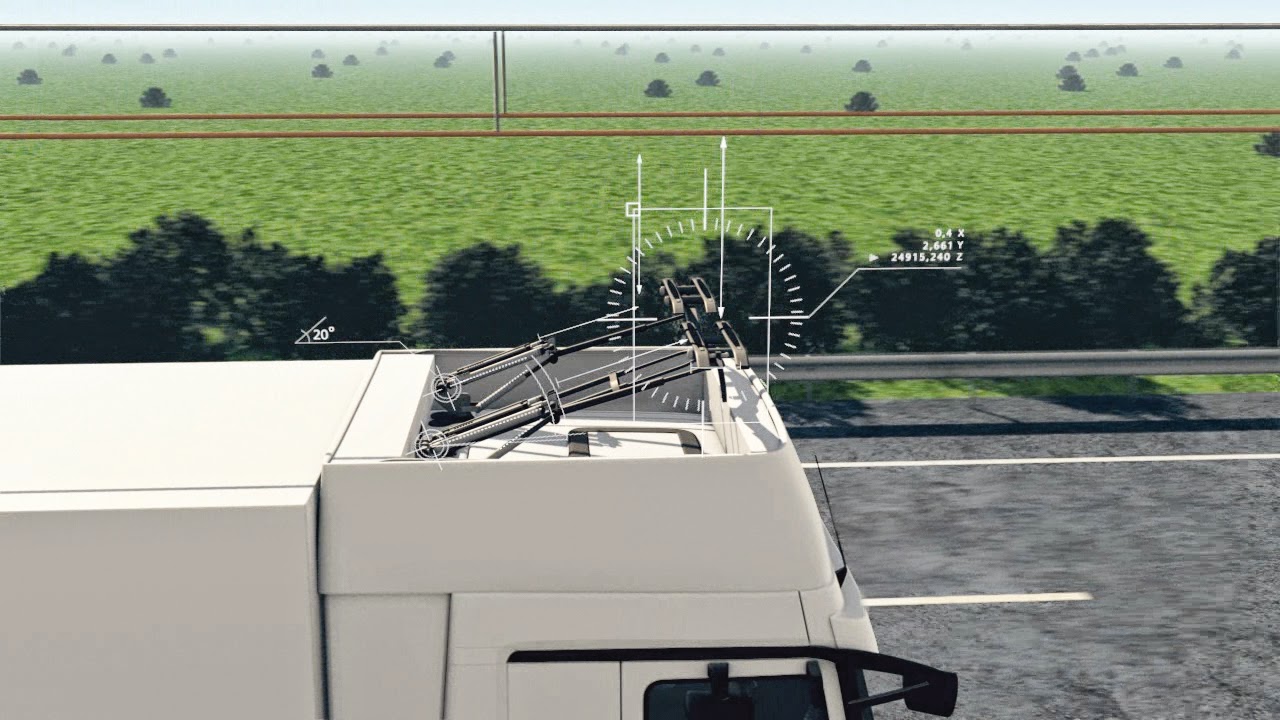
The Siemens e-highway electrifies selected traffic lanes using an overhead cable system. As a result, trucks can be supplied with electricity in the same way as trams. Working together with the Volvo Group and its Mack brand, Siemens is developing a demonstration vehicle for the project. Siemens is also working with local truck integrators in California whose vehicles will be part of the test as well.
The overhead cable infrastructure will now be installed in two directions in Carson (California) near Los Angeles. The project is expected to begin in July 2015 and will last a year. During the test phase, up to four trucks will travel up and down the route every day. The "e-trucks" are equipped with a hybrid drive system and intelligent current collectors. Powered by electricity from overhead cables, they produce no emissions when operating in the local area. On roads without overhead cables, the vehicles use an electric drive system which can be powered by diesel, compressed natural gas, a battery or with other energy sources. The current collector allows the vehicles to overtake and automatically dock and undock at speeds of up to 90 kilometers per hour.
The e-highway concept is particularly effective from an environmental and economic point of view on heavily used and relatively short truck routes, e.g. between ports, industrial estates, freight transport centers and central transshipment terminals. The ports of Los Angeles and Long Beach are looking for a zero-emission solution ("Zero Emission I-710 Project") for a section of the Interstate I-710. Around 35,000 shuttle truck journeys currently take place here every day. The intention is to set up a "zero emission corridor" for shuttle traffic between the two sea ports and the inland rail transshipment centers around 30 kilometers away. This will help to ease the pressure on the environment in a region which is plagued by smog. The aim is to eliminate local emissions completely, reduce the use of fossil fuels, cut operating costs and establish a basis for using the system on a commercial basis in the future



Nissan Motor and Mitsubishi Motors will work together to develop a minicar-based electric vehicle, aiming to release a new model in fiscal 2016 at the lowest price among major automakers.
The carmakers have set up a 50-50 joint venture to pursue development.
Nissan, which released the Leaf electric car in 2010, is the world's largest manufacturer of electric vehicles, with global sales of at least 124,000 units. Mitsubishi has a track record in this area as well, including the minicar-based i-MiEV released in 2009. They plan to co-produce the new car and work together to procure such key components as lithium-ion batteries.
The i-MiEV is the cheapest electric passenger car on the Japanese market, starting at $26,440. When government subsidies of up to $7,760 are included, it can be purchased for as little as $18,680.
By basing the new EV on a minicar, Nissan and Mitsubishi expect to sell it for around $15,000 including subsidies, the lowest price among major automakers and similar to gas-fueled compacts.


Bosch eBike Systems is introducing two new drive systems which will be available next to the existing Classic+ line. The newcomers are called Active Line and Performance Line. Both Lines have a new mid-motor developed by Bosch which is smaller and lighter than the current one. It's also not possible to mount it upside down at 220º as the Classic+ one. Thanks to its design the new drive unit of both Active and Performance lines offer even for the sportive segment enough ground clearance.
While the Classic+ drive system is offered in both up to 25 km/h and up to 45 km/h versions, the new agile Active Line comes only in a 25 km/h version and stands for "carefree enjoyment". The more dynamic and powerful Performance Line offers next to a 25 km/h also a 45 km/h version for derailleur-equipped bicycles. Also new is that the Active Line offers a version for coaster brake bikes.
Also new at the Active and Performance Lines are 'drivetrains'. Bosch means by that a drive concept ensuring optimal coordination by relying on three sensors for force, cadence, and speed. According to Bosch there are now, "1,000 sensor measurements per second and more powerful electronics with a modern 32-bit processor." Also new: gear shift detection for derailleur systems. "During shifting, the torque is reduced at precisely at the right moment and then increased, resulting in a smooth shifting process which reduces stress on the components and cuts down on wear."
Not only the mid drive unit and rear carriers that hold the battery pack are tuned, but also the Intuvia onboard computer that comes with the Bosch e-bike kit. More functions are available as well as more modes: eco, tour, sport, turbo, and off. Both Active and Performance e-bike kits weigh less than four kilograms (Classic+: 4.1 kilos).


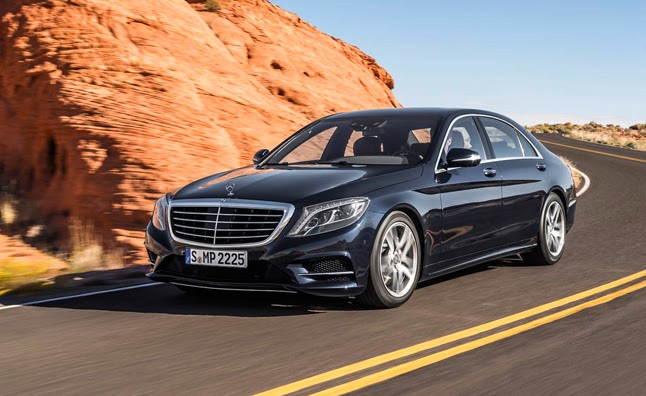
The Mercedes-Benz S 500 PLUG-IN HYBRID can be ordered for prices from 108,944.50 euros[1]. The S 500 PLUG-IN HYBRID blends an ultramodern hybrid drive configuration with the unique innovations and the luxurious equipment and appointments of the S-Class. The luxury saloon with a long wheelbase impresses with unique dynamism and efficiency. Thanks to standard pre-entry climate control it also offers unique climate comfort. In September the first certified three-litre luxury saloon in the world will be arriving at the dealers - a further milestone on the road to emission-free mobility.
"The new S 500 PLUG-IN HYBRID offers our customers the entire range of innovations that make our new S-Class so successful, and thanks to its intelligent operating strategy ensures outstanding driving pleasure and dynamism combined with the highest efficiency. Moreover, it allows completely emission-free driving for up to 33 km," says Ola Källenius, Executive Vice-President for Sales at Mercedes-Benz Cars.
"The S 500 PLUG-IN HYBRID is the first luxury saloon with the performance of a V8 and the fuel consumption of a compact model. The greatest challenge in this is to translate highest efficiency into superior performance. In this respect there is a highly interesting parallel with our successful Formula 1 racing car, which likewise has a turbocharged V6 engine and hybrid drive," says Prof. Dr. Thomas Weber, member of the Daimler AG Executive Board responsible for corporate research and Mercedes-Benz Cars Development.
The Mercedes-Benz S 500 PLUG-IN HYBRID offers a system output of 325 kW and 650 Nm torque, and in just 5.2 seconds sprints from 0 to 100 km/h and can drive up to 33 km purely electrically. The certified consumption is 2.8 litres/100 km, which corresponds to 65 g CO2/km emissions. Key elements of this impressive output are the V6 biturbo and the intelligent hybrid drive. Following the S 400 HYBRID and S 300 BlueTEC HYBRID the S 500 PLUG-IN HYBRID is the third hybrid model in the new S-class. Its new high-voltage lithium-ion battery can be externally recharged via the charging socket in the right side of the rear bumper.
In order to strengthen the customers' trust in the new, innovative PLUG-IN HYBRID drive system, for the S 500 PLUG-IN HYBRID Mercedes-Benz is for the first time issuing a certificate and thus a promise to perform for the high-voltage battery and PLUG-IN HYBRID components (e.g. e-machine and power electronics). This ensures that every technical malfunction within a period of six years after initial delivery or registration, or up to a mileage of 100,000 kilometres, is corrected by Mercedes-Benz.
Model | S 500 PLUG-IN HYBRID |
Internal combustion engine: | |
Number of cylinders/arrangement | 6/V |
Mixture formation | High-pressure injection, 2 turbochargers |
Displacement (cc) | 2996 |
Rated output (kW/hp at rpm) | 245/333 at 5250-6000 |
Rated torque (Nm at rpm) | 480 at 1600-4000 |
Electric motor: | |
Output (kW) | 85 |
Torque (Nm) | 340 |
System output (kW/hp) | 325/442 |
System torque (Nm)1 | 650 |
Consumption combined from (l/100 km)2 | 2.8 |
CO2 emissions combined from (g/km)2 | 65 |
Efficiency class | A+ |
Electric range (km) | 33 |
Charge time 20%-100% (400 V/16 A – 230 V/8 A)3(h) | 2 – 4.1 |
Acceleration 0-100 km/h (s) | 5.2 |
Top speed (km/h)1 | 250 |
Top speed electric (km/h)1 | 140 |
Price (euros)4 | 108,944.50 |


Auto Bild has revealed Audi plans to catch-up with the competition in automotive electrification with two purely electric Audi SUV, the A2Q and Q6 expected around 2017/18.
A2Q with up to 500 km electric range
If the expected advances in battery technology are true, the compact A2Q, expected in 2016, will have 500 km battery range. Seen as a competitor against BMW's i3, Audi will not develop a completely new electric platform but uses the familiar MQB modular architecture of Golf/A3.
Audi Q6 as Tesla competitor
The Q6, internally designated within Audi as the Tesla Fighter, is expected to be a coupe-like offshoot of the Q5 and come with 700 km battery range with a launch date around 2017. A larger battery powered Q7/8 is also expected around 2017.


BMW presented the new i8 hybrid supercar for the official UK launch at an event held in Mayfair, London. With two models on display auto buff Shmee takes a quick look around the car before jumping in for a test drive.


The first plug-in hybrid from Audi, the A3 Sportback e-tron, is now available to order for customers in Europe. Approximately 410 Audi dealers in Europe – including no fewer than 105 in Germany – are selling the A3 e-tron at a basic price of 37,900 euros on the German market. An individual installation check, the “e-tron plus” special package and “green” power from Audi complete the offering for the Audi A3 Sportback e-tron. The compact electric car will be handed over to its first customers this winter.
“For Audi, the A3 Sportback e-tron marks another important step toward sustainable individual mobility,” states Wayne Griffiths, Head of Sales Germany at AUDI AG. “Our dealers have had an entirely positive response to the A3 Sportback e-tron, which shows that the combination of efficient drive technology and a sustainable energy source is really what the market is looking for.”
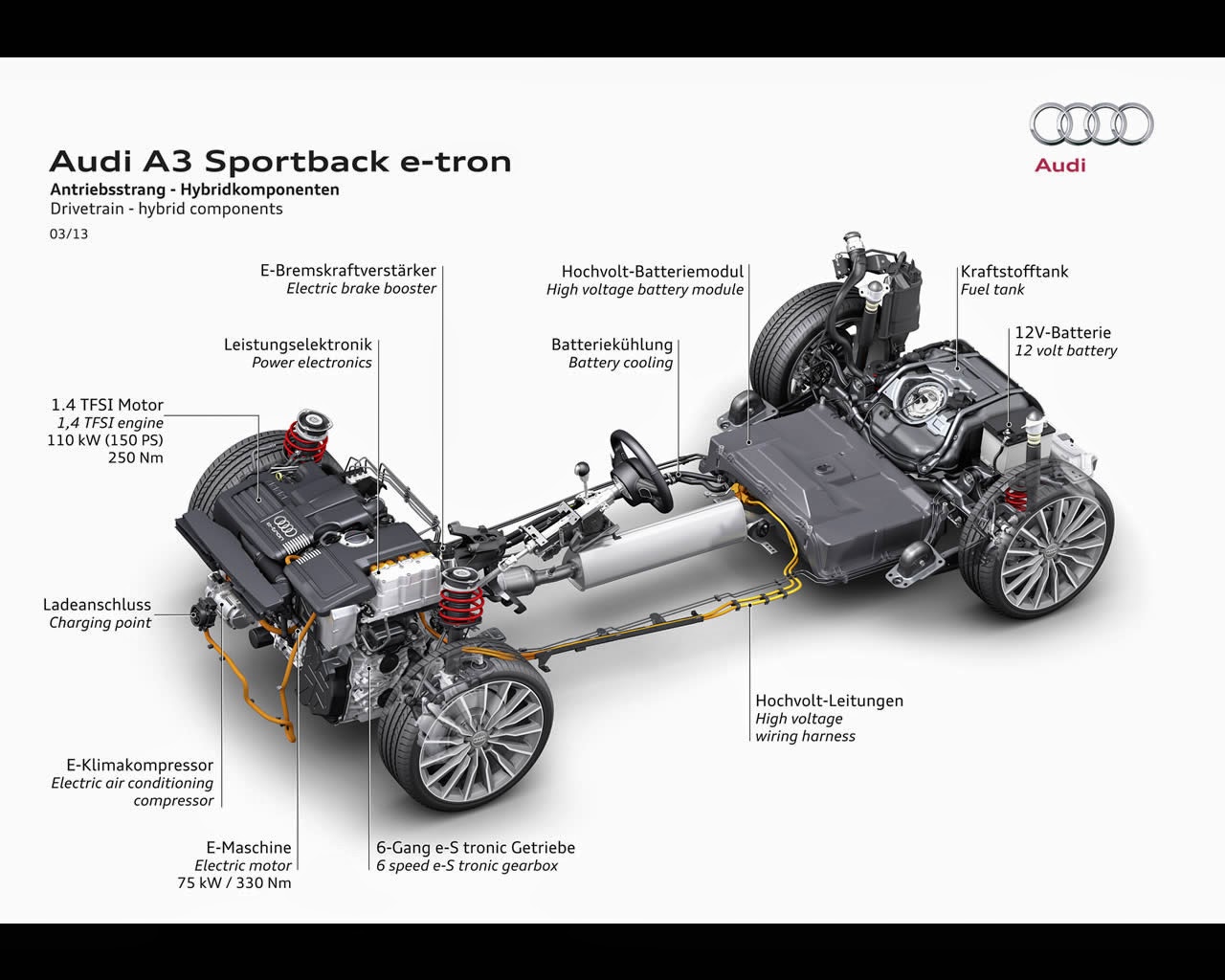
The Audi A3 Sportback e-tron brings together a 1.4 TFSI gasoline engine and an electric motor, giving the compact automobile a system output of 150 kW (204 hp). The A3 Sportback e-tron’s fuel consumption in accordance with the NEDC standard for plug-in hybrid vehicles is just 1.5 liters of fuel per 100 kilometers (156.8 US mpg), with CO2 emissions of 35 grams per kilometer (56.3 g/mi). Under electric power alone it has a range of 50 kilometers (31.1 mi), and over 900 kilometers (559.2 mi) in combined mode. The basic price for the Audi A3 e-tron in Germany is 37,900 euros. Audi is also offering attractive leasing conditions: 319 euros per month with a term of 36 months.
In Germany, the plug-in hybrid will be sold by 105 selected e-tron dealers; across Europe approximately 410 dealerships will sell the model. Their employees are receiving special training in sales and service relating to electric vehicles. Between mid-July and the end of August, Audi is providing training to around 2,000 sales, service and used car employees from all over Europe at its Training Center next to Munich. In addition, some 300 German high-voltage technicians and service advisors from Audi will undertake a technical training course at the Service Training Center in Neckarsulm.
In future, every e-tron dealer will also have at least one charging station that e-tron customers can use, even after their purchase. The Audi A3 Sportback e-tron can be charged quickly via a charging point at the dealership, within the public charging infrastructure or at the customer’s home. For the latter option, Audi offers – in Germany – an individual installation service whereby a technician checks the electrics in the customer’s home, makes any adjustments that may be required and installs the charging dock, which is designed for safe, convenient charging.
To ensure that sustainability is not compromised during the at-home charging process, customers in Germany can switch to environmentally friendly electricity, known as Audi energy. With Audi energy, the A3 Sportback e-tron is totally emission-free when operated electrically. All electricity all comes from hydroelectric power stations in Germany, Austria and Switzerland. To mark the start of the A3 Sportback e-tron, Audi has additionally put together the attractive “e-tron plus” package. In Germany it includes the charging dock, a cable for public charging points, MMI navigation plus, Audi connect and phone box.


There are only a few minutes before your flight check-in closes, or before your train departs, but you now have to spend precious time hunting for a free space at the airport or station car park. Imagine leaving your vehicle at the main entrance and letting the car do the rest on its own. Researchers from Germany, Italy, the UK and Switzerland are working on this, and successful tests took place at Stuttgart airport earlier this year. €5.6 million of EU funding is invested in the system which will be available in the coming years.
In the future, more and more people will drive electric cars and will switch from one mode of transport to another – creating the need for more and varied parking options at transport hubs. To prepare for this mobility shift, the V-CHARGE consortium is working on a fully automated parking and charging system for electric cars at public car parks.
"The idea is that we can actually use technology to give people a better mix of public and private transport", explains Dr Paul Furgale, scientific project manager for V-CHARGE and deputy director of the autonomous systems lab at the Swiss Federal Institute of Technology in Zurich.
A smartphone app to leave and get back the car
Drivers will be able to leave their car in front of the car park and use a smartphone app to trigger the parking process. The vehicle will connect with the car park’s server and drive itself to the designated space. While in the garage, the car can also be programmed to go to a charging station. Upon returning, the driver uses the same app to summon the car – fully charged and ready to go.
Since GPS satellite signals don’t always work inside garages, the scientists have developed a camera-based system based on their expertise in robotics and environment sensing. Safety is at the centre of the project: the car is designed to avoid unexpected obstacles.
Dr Furgale believes the same technology could be used to develop autonomous parking systems for electric cars on city streets. "That will be more of a challenge", he says. "But once you have the maps in place, the rest of the technology will come together."
A system to be integrated into production
In April, the team presented the latest version of the system at Stuttgart airport. This was a success and the researchers are now fine-tuning the technology to tackle more precise manoeuvres and ensure reliability, even in difficult weather conditions.
The project is set to conclude in 2015, and its results available to be progressively commercialised in the coming years. The functions developed should be cost-effective enough to be integrated into production of electric vehicles. Engineers are working with equipment that is already available today such as ultrasonic sensors and stereo cameras that are used in parking assistance and emergency braking systems.


GKN plc and The Go-Ahead Group have agreed a deal that will help reduce emissions in cities with the supply of electric flywheel systems to 500 buses over the next two years.
The innovative GKN system is based on Formula One race technology developed in the UK. It will help increase the efficiency of every bus to which it is fitted by using less fuel and therefore reducing carbon emissions. This same technology helped Audi’s R18 e-tron win at Le Mans last month.
Go-Ahead has placed an order for GKN Hybrid Power to supply 500 of its Gyrodrive systems to the transport operator. The Gyrodrive system uses a high speed flywheel made of carbon fibre to store the energy generated by a bus as it slows down to stop. It then uses the stored energy to power an electric motor which helps accelerate the bus back up to speed, generating fuel savings of more than 20% at a significantly lower cost than battery hybrid alternatives.
The agreement covers the supply of the complete Gyrodrive system, including the innovative GKN Hybrid Power flywheel as well as GKN’s advanced EVO electric motor, a GKN designed and manufactured gearbox, and installation. The system is designed to last for the life of the bus eliminating the need for any battery changes.
Following successful trials on buses in London, Go-Ahead intends to utilise the technology in cities it serves across the UK, initially in London and Oxford.
Philip Swash, CEO GKN Land Systems, said: ‘This is an important milestone for GKN Hybrid Power. We’ve worked in close partnership with Go-Ahead throughout the development of this innovative technology and it’s very exciting to move into the production phase.
The fact that we are using the same groundbreaking technology that helped Audi win at Le Mans for the past three years to improve fuel efficiency in the public transport sector also shows what great innovation there is in the UK’s engineering sector.’ CEO of Go-Ahead, David Brown, added: ’Our collaboration with GKN has been a most constructive one. We have a strong record in continually reducing our carbon emissions and flywheel technology will help us make buses an even more environmentally responsible choice and encourage more people to travel by public transport.
The flywheel technology helps us to reduce our fuel consumption and C02 emissions so improving air quality for all those living, working and visiting the city.’
GKN Hybrid Power is based in Oxfordshire, with final assembly taking place in a new facility at GKN’s site in Telford. The Gyrodrive technology is being further developed for other mass transit markets including trams, construction and agricultural equipment. Earlier this year GKN announced the acquisition of Williams Hybrid Power from Williams Grand Prix Engineering Limited to form GKN Hybrid Power, which is focused on delivering complete hybrid solutions across multiple vehicle, power and industrial markets.


