A team at NASA's Langley Research Center is developing a concept of a battery-powered plane that has 10 motors and can take off like a helicopter and fly efficiently like an aircraft.
The prototype, called Greased Lightning or GL-10, is currently in the design and testing phase. The initial thought was to develop a 20-foot wingspan (6.1 meters) aircraft powered by hybrid diesel/electric engines, but the team started with smaller versions for testing, built by rapid prototyping.
This research has helped lead to NASA Aeronautics Research Mission Directorate efforts to better understand the potential of electric propulsion across all types, sizes and missions for aviation.
The hybridised World Endurance Championship has introduced a new version of cut and thrust racing that is very entertaining to watch but I'm not sure either Jalopnik nor the (with respect) race commentators fully understand how the very different hybrid systems interact on the track.
The video sequence features a race for position between the Audi R18 E-Tron Quattro and the Porsche 919 Hybrid. While these cars are both in the same LMP1 hybrid class, the rules allow for a large amount of technical freedom (especially when compared to many other 'control formula' International championships).
The 2015 Audi R18 features a 558 HP (410 kW) 4.0-liter Turbo Diesel V6 combustion engine driving the rear wheels with a 272 HP (200 kW) electric motor driving the front wheels. The R18 is in the 4 Megajule class with a flywheel energy storage system can store 700 kilojoules.
The Porsche 919 Hybrid features a 500 Hp (370 kW) 2.0-liter Turbo Petrol V4 combustion engine driving the rear wheels with a 400 HP (300 kW) electric motor driving the front wheels. The 919 is in the 8 Megajule class with an A123 Lithium-ion battery energy storage system and also has thermodynamic energy recuperation using the energy from exhaust gases from the turbo charger.
The energy class regulations refer to the amount of regenerated energy that can be used each lap, for example 8 megajoules equals 2.2 kWh that can be deployed around the race track (3.6 megajoules is equivalent to 1 kilowatt hour (kWh).
Like in Formula One, the energy recuperation is pre-programmed and not directly controlled by the drivers, what might be confusing is that unlike in F1 where output from the KERS systems is driver controlled via a steering wheel mounted 'boost' button, in the WEC the KERS output is also pre-programmed. In fact KERS 'boost' buttons are banned in the WEC.
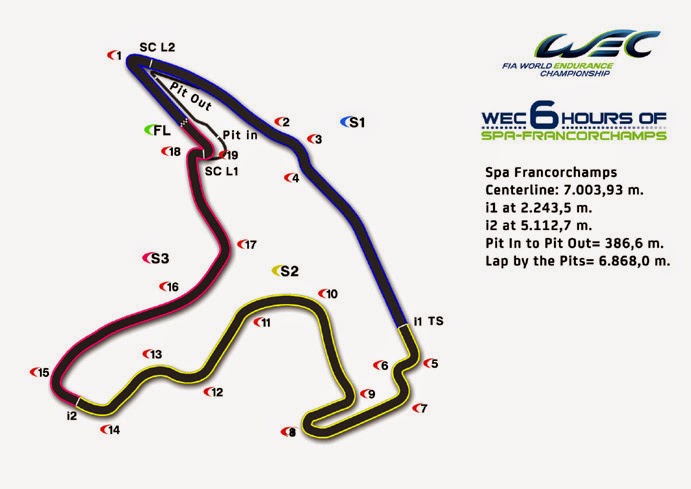
The FIA specify hybrid ‘braking zones’ where teams can program energy recovery. The hybrid output can be used anywhere around the track and is calculated by race engineers pre-race to maximise the use of this energy for fastest laps times with minimal fuel burn. As a result, what we're seeing in the video above where the Porsche 919 is said to be "running out of hybrid power" is in fact the same pre-programmed energy duty cycle used by the 919 on every laps of the race. This becomes very clear watching extended in-car race footage (the FIA WEC on-line package offers full race in-car access to all works LMP1 cars). What we see as the Porsche massively out accelerates the Audi at the top of Eau Rouge is a combination of the 919 having a 60 kW advantage over the Audi and where the Porsche is pre-programmed to apply it's 4Mj of additional hybrid power. Again, the 919 drives this duty cycle every lap.
There are other very interesting differences at play such as braking performance. Where the Audi (flywheel) and Toyota (super capacitor) systems can recover a 'full charge' during high speed braking, while the Porsche (li-ion battery) has a noticeable extended high speed braking profile, e.g the 919 starts braking a longer distance before the corner, and is belived to take several braking zones to recover a 'full charge'. This is due to the asymmetric charge and discharge curves of lithium ion batteries and is partially compensated for by the thermodynamic turbo generator which makes the Porsche 919 Hybrid the only car in the field that recuperates energy not only when it brakes but also when it accelerates.
Motorsport is a technical sport and this is exactly what racing is meant to be about, advancing automotive technology.
Aston Martin has announced a production version of the all electric DBX SUV concept will enter production and be on sale by 2019.
In a statement issued last night, Aston’s boss Andy Palmer announced his company had raised the £200m from its two majority shareholders to begin work on creating a production version of last month’s Geneva motor show concept.
“The additional investment announced today will allow us to realise the DBX and other new luxury vehicles that will form the strongest and most diverse portfolio in our history”. Said the Aston CEO.
The DBX Concept is an all-wheel drive crossover high luxury GT that uses in-board electric wheel motors at all four corners powered by lithium sulphur cells. Steering is a drive-by-wire system and both the driver and passenger have head-up displays surrounded by auto-dimming ‘smart glass’.
Looking virtually identical to the digital model created for Gran Turismo 6, the real world Vision GT concept provides a glimpse at what a "high performance Infiniti could look like in the future.”
While the company didn't have much to say about the car, it has a naturally aspirated 4.5-litre V8 petrol-electric hybrid system powering the rear wheels and features an aggressive front fascia with a prominent grille that is flanked by slender headlights and sporty air intakes. Moving further back, there's sporty side skirts, carbon fiber trim and massive alloy wheels.
According to the game maker’s, the Infiniti Concept Vision Gran Turismo’s electric motor delivers “overwhelming torque” in low-speed situations while at higher speeds, the V8 engine teams “immense power”
In February 2015 Robert Llewellyn drove a Tesla Model S P85 from Oslo, Norway to London, England, a distance of 2,000 km (1,300 miles), using free Tesla superchargers virtually the entire distance.
Researchers at the University of Illinois at Chicago have taken a significant step toward the development of a battery that could outperform the lithium-ion technology used in electric cars.
They have shown they can replace the lithium ions, each of which carries a single positive charge, with magnesium ions, which have a plus-two charge, in battery-like chemical reactions, using an electrode with a structure like those in many of today's devices.
"Because magnesium is an ion that carries two positive charges, every time we introduce a magnesium ion in the structure of the battery material we can move twice as many electrons," says Jordi Cabana, UIC assistant professor of chemistry and principal investigator on the study.
"We hope that this work will open a credible design path for a new class of high-voltage, high-energy batteries," Cabana said.
The research is part of the Joint Center for Energy Storage Research, a Department of Energy Innovation Hub led by Argonne National Laboratory, that aims to achieve revolutionary advances in battery performance. The study is online in advance of print in the journal Advanced Materials.
Every battery consists of a positive and negative electrode and an electrolyte. The electrodes exchange electrons and ions, which are usually of positive charge. Only the ions flow through the electrolyte, which is an electric insulator so as to force the electrons to flow through the external circuit to power the vehicle or device.
To recharge the battery, the exchange is reversed. But the chemical reaction is not perfectly efficient, which limits how many times the battery can be recharged.
"The more times you can do this back and forth, the more times you will be able to recharge your battery and still get the use of it between charges," Cabana said.
"In our case, we want to maximize the number of electrons moved per ion, because ions distort the structure of the electrode material when they go in or leave. The more the structure is distorted, the greater the energy cost of moving the ions back, the harder it becomes to recharge the battery."
"Like a parking garage, there are only so many spaces for the cars," Cabana said. "But you can put a car in each space with more people inside without distorting the structure."
Having established that magnesium can be reversibly inserted into electrode material's structure brings us one step closer to a prototype, said Cabana.
"It's not a battery yet, it's piece of a battery, but with the same reaction you would find in the final device," said Cabana.
Volkswagen Group may shift to a single lithium ion battery cell design for all of its electrified vehicles.
Heinz-Jakob Neusser, VW's board member in charge of development, says the group is targeting a 66 percent cost reduction with a design that would be packaged into modules customized for each vehicle.
"We have a clear understanding in the group of a common cell," Neusser said during a roundtable at the auto show here. "That means each member of the group, each brand, uses the same cell. Otherwise, we cannot get the synergies out of this development."
Volkswagen currently uses multiple types of lithium ion cells. For example, Panasonic supplies cells for the e-Golf, Golf GTE plug-in hybrid and Audi A3 e-tron, while Samsung supplies cells for the upcoming Passat GTE and Audi electrified vehicles.
A single design would enable greater utilization of the group's battery module assembly plant in Braunschweig, Germany. Multiple suppliers could be used to source the single cell design, a spokesman said.
Volkswagen plans to decide in the first half of this year whether new battery technology under development at U.S. startup QuantumScape Corp. is ready for use in its electric cars.
With high numbers of apartment dwellers, New York, along with other cities, represents the promise and challenge of the untapped market for electric vehicles.
Japan’s state-of-the-art Maglev train set a world speed record Tuesday during a test run near Mount Fuji, clocking more than 600 km/h.
The seven-car Maglev — short for magnetic levitation — train, hit a top speed of 603 km/h (377 Mph), and managed nearly 11 seconds over 600 km/h Central Japan Railway (JR Tokai) said.
The new record came less than a week after the train clocked 590 km/h, by breaking its own 2003 record of 581 km/h.
The Maglev hovers 10 cm above the tracks and is propelled by electrically charged magnets.
JR Tokai wants to have a train in service in 2027 plying the route between Tokyo and Nagoya, a distance of 286 km.
The service, which will run at a top speed of 500 km/h, is expected to connect the two cities in only 40 minutes, less than half the time it takes by shinkansen.
By 2045 Maglev trains are expected to link Tokyo and Osaka in just 67 minutes, slashing the journey time in half.
However, construction costs for the dedicated lines are astronomical — estimated at nearly ¥11.9 trillion just for the stretch to Nagoya, with more than 80 percent of the route expected to go through costly tunnels.
Chevrolet has created a vision of what it thinks a full autonomous all-electric vehicle of the future might look like.
Created by GM’s Pan Asia Technical Automotive Center the Chevrolet-FNR is an autonomous electric concept vehicle that boasts a futuristic capsule design. It has crystal laser headlights and taillights, dragonfly dual swing doors.
The Chevrolet-FNR features an extremely aero design focused on low drag powered by AWD magnetic hubless electric wheel motors along with autonomous wireless charging. A laundry list of imaginary specification like range and power output has been provided.
The Chevrolet-FNR is loaded with a range of sensors like roof-mounted radar that can map out the environment to enable driverless operation, Chevy Intelligent Assistant and iris recognition start. The Chevrolet-FNR can also serve as a “personal assistant” to map out the best route to the driver’s preferred destination.
In self-driving mode, the vehicle's front seats can swivel 180 degrees to face the rear seats, creating a more intimate setting. The driver can switch to manual mode through the gesture control feature.
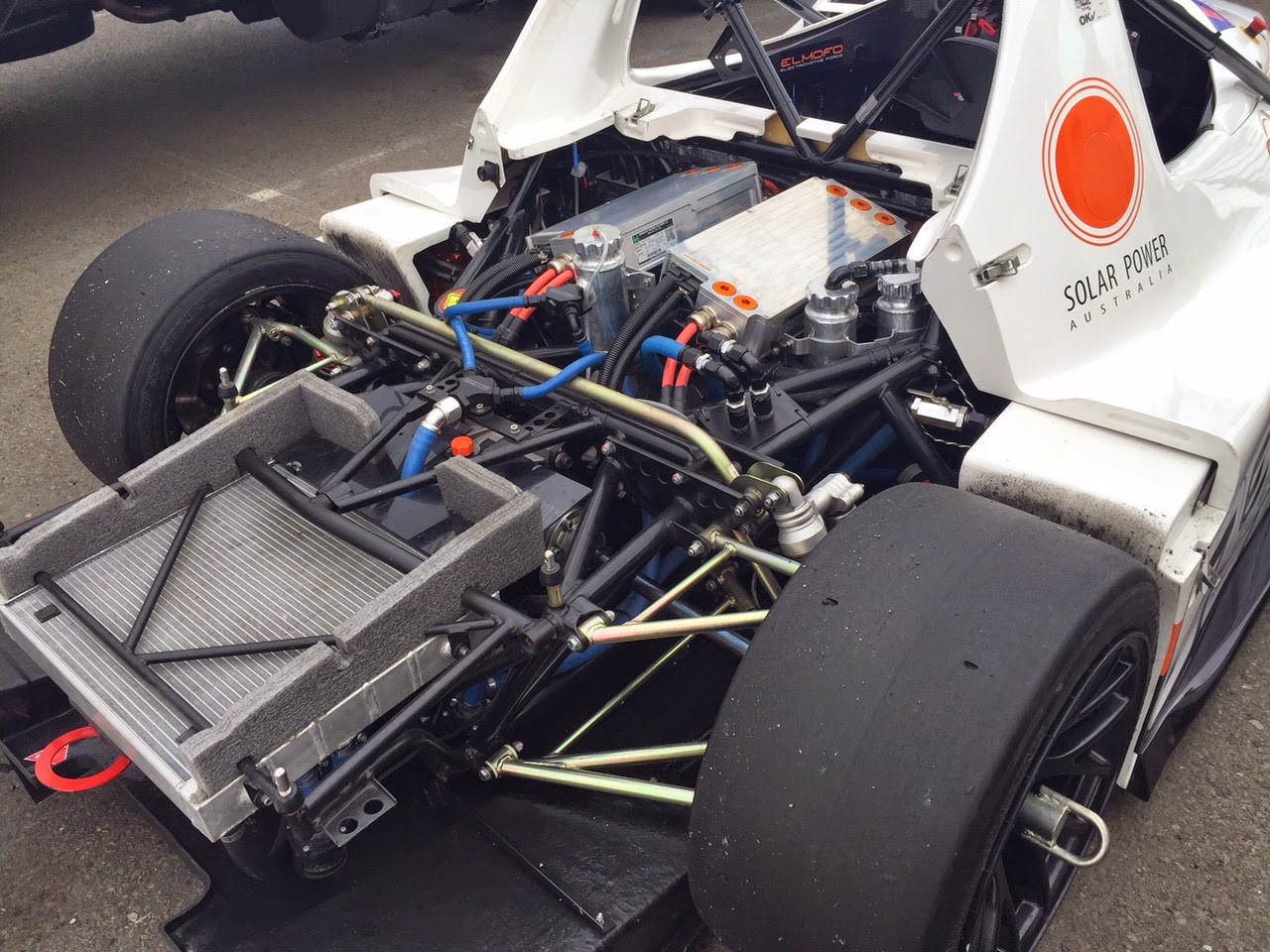
In a demonstration run during the Mighty Car Mods Nationals at Sydney Dragway the ELMOFO Electric Radical made it's maiden run down the quarter mile achieveing at time of 10.922 seconds @ 131.25 Mph (211.24 km/h).
The EV Radical SR8 is designed for circuit racing and has the distinction of being the first electric car to win a race against petrol vehicles in a sanctioned event. The ELFOMO Racer has a peak output of 300 Kw / 600 Nm from twin Remy based BLDC permanent magnet motors with energy fed from a 30 kWh KoKam Li-Po battery pack via two RMS inverters.
This was the cars first run down a quarter mile and the 10s time was achieved with worn rain tires and gearing more suitable to circuit racing (top speed of 270 km/h). With lower gearing and heated slick tires ELMOFO could be knocking on the door of a 9 second pass. Even with the current set-up, ANDRA officials started to warn the team the car is close to requiring a parachute if it runs much faster.
Finnish startup Toroidion has launched their all-electric megacar at the Top Marque show in Monaco. The Toroidion has 1341 hp total and a swappable battery.
With 2x 200 kw at the front and 2x 300 kw direct drive in-board wheel motors at the rear, the Toroidion 1MW Concept, built by designer Pasi Pennanen, was created to be an electric car that can compete in the GT classes at the 24 Hours of Le Mans.
Feast your eyes on the ultimate 308. PEUGEOT has unveiled a stunning new version of the compact family hatchback – with a combined 500 bhp and four-wheel drive.
Badged the PEUGEOT 308 R HYbrid, it has been developed by PEUGEOT Sport, the brand’s famous in-house engineering and racing division, which last year unveiled the critically acclaimed RCZ R. The car’s plug-in petrol hybrid powertrain results in a car capable of hitting 62mph (100km/h) in 4.0 seconds, yet still has astonishingly low CO2 emissions of 70g/km.
At the heart of the PEUGEOT 308 R HYbrid is a plug-in powertrain with four-wheel drive that develops 500hp. The unit combines three sources of power, each capable of moving the vehicle independently of the others. They are a four-cylinder 1.6-litre THP 270 S&S petrol engine, plus two electric motors – each with power of 85kW/115hp – mounted one on each axle. The front one is linked to the six-speed gearbox.
The result is a family hatchback which is capable of supercar performance. The PEUGEOT 308 R HYbrid can hit 62mph (100km/h) from a standing start in only 4.0 seconds, with top speed electronically limited to 155mph. In spite of such astonishing performance, CO2 emissions are just 70g/km.
“If we were able to reach this kind of performance on a C-segment, it is all down to our passion for a challenge and our desire for excellence. PEUGEOT 308 R HYbrid is part of a very select club of cars reaching 0-62mph in four seconds” says Jean-Philippe Delaire, PEUGEOT Sport Head of Development, 308 R HYbrid powertrain.
PEUGEOT Sport has been involved in every stage of development of the 308 R HYbrid, using its technical expertise and successful racing record to define the specifications of each component. For impeccable dynamic handling, the car’s weight has been optimised and placed as low as possible. The lithium-ion 3kWh battery has an excellent ratio between power and size, and is housed under the rear seats in place of the fuel tank. In turn, the 50-litre tank has been placed in the boot above the rear electric motor and two transformers.
The PEUGEOT Sport engineers have equipped the car with four driving modes:
Hot Lap mode is the most powerful, harnessing the full potential from the three power sources to reach a total of 500hp and maximum torque of 730Nm.
Track mode delivers 400hp and 530Nm, mainly from the petrol engine and the rear electric motor. The front electric motor serves as an additional booster when accelerating.
Road mode is specially designed for road use with power of 300hp and torque of 400Nm. The petrol engine delivers its full potential, while the rear electric motor helps during accelerations. The front electric motor is not used in this mode.
ZEV makes priority use of the rear electric motor. The front electric motor comes into play, depending on the pressure applied on the accelerator pedal.
The all-wheel drive system of the 308 R HYbrid makes for formidable handling, especially when coming out of the corners. The braking system is on a par with the car's performance, with 380mm ventilated discs at the front, gripped by four pistons, and 290mm discs to the rear. However, they are not used every time the brakes are applied, because PEUGEOT Sport has designed the powertrain to decelerate using the electric motors throughout the full speed range, starting at 155mph. Not only does this preserve the discs and pads, but uses regenerative braking to recharge the battery.
It is one of three recharging strategies. The second uses the front electric motor as a generator, driven by the petrol engine, while the third solution is a rapid recharging terminal restoring the battery to its maximum power in just 45 minutes.
The Modular Robotic Vehicle, or MRV, was developed at NASA’s Johnson Space Center in order to advance technologies that have applications for future vehicles both in space and on Earth. With seating for two people, MRV is a fully electric vehicle well-suited for busy urban environments.
One of NASA’s key purposes for the project was to have access to a technology development platform. “This work allowed us to develop some technologies we felt were needed for our future rovers,” said Justin Ridley, Johnson Space Flight Center. “These include redundant by-wire systems, liquid cooling, motor technology, advanced vehicle control algorithms. We were able to learn a lot about these and other technologies by building this vehicle.”
Just as NASA helped pioneer fly-by-wire technology in aircraft in the 1970s, MRV is an attempt to bring that technology to the ground in modern automobiles. With no mechanical linkages to the propulsion, steering, or brake actuators, the driver of an MRV relies completely on control inputs being converted to electrical signals and then transmitted by wires to the vehicle’s motors. A turn of the steering wheel, for instance, is recorded by sensors and sent to computers at the rear of the vehicle. These computers interpret that signal and instruct motors at one or all four of the wheels to move at the appropriate rate, causing the vehicle to turn as commanded. Due to a force feedback system in the steering wheel, the driver feels the same resistance and sensations as a typical automobile.
Not having a mechanical linkage between the driver and the steering wheel introduces new risks not seen on conventional automobiles. A failed computer, or cut wire, could cause a loss of steering and the driver to lose control. Because of this, a fully redundant, fail-operational architecture was developed for the MRV. Should the steer-ing motor fail, the computer system responds immediately by sending signals to a second, redundant motor. Should that computer fail, a second computer is ready to take over vehicle control. This redundancy is paramount to safe operations of a by-wire system.
MRV’s redundant drive-by-wire architecture allows for advanced safety and dynamic control schemes. These can be implemented with a driver operating either within the vehicle or by remote interface. In the future this system can be expanded to allow for autonomous driving
MRV is driven by four independent wheel modules called e-corners. Each e-corner consists of a redundant steering actuator, a passive trailing arm suspension, an in-wheel pro-pulsion motor, and a motor-driven friction braking system.
Each e-corner can be controlled independently and rotated ±180 degrees about its axis. This allows for a suite of driving modes allowing MRV to maneuver unlike any traditional vehicle on the road. In addition to conventional front two wheel steering, the back wheels can also articulate allowing for turning radiuses as tight as zero. The driving mode can be switched so that all four wheels point and move in the same direction achieving an omni-directional, crab-like motion. This makes a maneuver such as parallel parking as easy as driving next to an available spot, stopping, and then operating sideways to slip directly in between two cars.
“This two-seater vehicle was designed to meet the growing challenges and demands of urban transportation,” said Mason Markee, also with Johnson. “The MRV would be ideal for daily transportation in an urban environment with a designed top speed of 70 km/hr and range of 100 km of city driving on a single charge of the battery. The size and maneuverability of MRV gives it an advantage in navigating and parking in tight quarters.”
The driver controls MRV with a conventional looking steering wheel and accelerator/brake pedal assembly. Both of these interfaces were specially designed to mimic the feel of the mechanical/hydraulic systems that people are used to feeling when driving their own cars. Each device includes its own redundancy to protect for electrical failures within the systems. A multi-axis joystick is available to allow additional control in some of the more advanced drive modes. A configurable display allows for changing of drive modes and gives the user critical vehicle information and health and status indicators.
Each propulsion motor is located inside the wheel and capable of producing 190 ft-lbs of torque. An active thermal control loop maintains temperatures of these high powered motors. A separate thermal loop cools the avionics, includ-ing custom lithium-ion battery packs.
“While the vehicle as a whole is designed around oper-ating in an urban environment, the core technologies are advancements used in many of our robotic systems and rovers,” explained Mason. “Actuators, motor controllers, sensors, batteries, BMS, component cooling, sealing, and software are all examples of technologies that are being devel oped and tested in MRV that will be used in next generation rover systems.”
The technologies developed in MRV have direct appli-cation in future manned vehicles undertaking missions on the surface of Earth’s moon, on Mars, or even an asteroid. Additionally, MRV provides a platform to learn lessons that could drive the next generation of automobiles.
Rocket Lab, a privately-held company financed by weapons maker Lockheed Martin Corp and other high-tech investors, on Tuesday said its low-cost Electron launch system for small satellites will be the first rocket powered by batteries.
Chief Executive Peter Beck said the company founded in 2008 to help commercialize the space business, expected to carry out the first flight of its all-composite Electron launch vehicle and the new Rutherford engine before the end of the year.
Beck said the engine was also the first to use 3D printing for all primary components, including its engine chamber, injector, pumps and main propellant valves, all mostly made of titanium and other alloys.
The lightweight engine can be "printed" in three days, compared to about a month if it were built using traditional manufacturing.
Rocket Lab, which is based in Los Angeles and has a launch site in New Zealand, says the two-stage Electron rocket will make it cheaper and quicker to launch small 100-kilogram payloads into low-earth orbit.
The company expects to start launching satellites for customers in 2016, and eventually aims to launch a satellite a week. It says its launch cost will be less than $5 million, half the price that Virgin Galactic is charging for rides on its air-launched satellite booster, LauncherOne.
Beck said the batteries on the new launcher would produce just shy of one megawatt of power, enough to power a whole city block. The engine's electric propulsion cycle uses electric motors and lithium polymer batteries to drive its turbopumps at extremely high speeds.
Rocket Lab aims to help companies that want to launch hundreds and thousands of small satellites into low-earth orbit to provide space-based access to the Internet, respond to natural disasters and improve crop yields.
Beck said the company had been working on the Rutherford engine for the past year and a half, racing to meet growing demand from companies ranging from Google Inc to small Silicon Valley startups.
"There's a lot of payload ready to go," Beck said. "The missing piece is a responsive and cost-effective launch capability."
The company's investors include Khosla Ventures, K1W1 and Bessemer Venture Partners.
According to the Wall Street Journal, Google’s X research lab is working on a project to improve battery technology. This group is led by Dr Ramesh Bhardwaj, a former Apple employee who worked on batteries there, too.
WSJ is reporting that Bhardwaj and his 4-member team reportedly originally tested batteries that were developed by others for use in Google devices, but have since switched gears and may even develop the new battery tech themselves. Apparently their focus area is improving Li-Ion technology and solid state batteries for consumer devices.
Dr. Bhardwaj has told industry executives that Google has at least 20 battery-dependent projects including the company’s latest self-driving car. “Google wants to control more of their own destiny in various places along the hardware supply chain,” said Lior Susan, head of hardware strategy at venture-capital firm Formation 8. “Their moves into drones, cars and other hardware all require better batteries.”
Google joins many technology companies trying to improve batteries, including Apple, Tesla Motors Inc. and International Business Machines Corp. These efforts have so far produced only incremental gains, a contrast for tech companies accustomed to regular, dramatic leaps in the efficiency of semiconductors.
Emerging battery technologies promise bigger gains. Solid-state, thin-film batteries use a solid, rather than liquid, making them smaller and safer. Such batteries can be produced in thin, flexible layers, useful for small mobile devices. But it isn’t clear whether they can be mass produced cheaply, said Venkat Srinivasan, a researcher at Lawrence Berkeley National Lab.




.jpg)


.jpg)