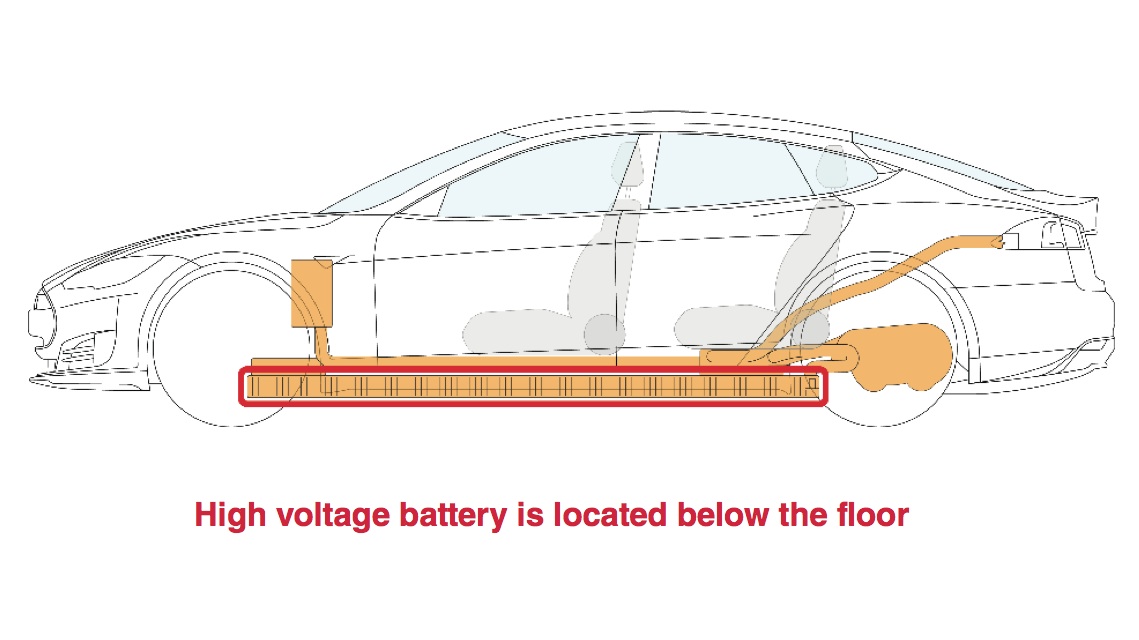
Following the trend confirmed by VW Group for flat battery packs (re: Tesla) with the Porsche Mission-E, Audi e-tron SUV & Volkswagen EV Microbus announcements, Samsung SDI said Wednesday that it is seeking to gain new momentum in its battery business by promoting its Low Pack batteries at this year's auto show in the German city of Frankfurt.
In a statement, SDI said the battery pack will have a huge influence on the surface design of electric vehicles (EVs) as global carmakers are looking at battery performance of the different battery suppliers.
In addition to batteries, materials to be used in EVs were also exhibited during the major European auto fair. Samsung SDI Battery Systems (SDIBS), a new name after SDI's acquisition of Magna in May, also attended the annual event.
"The Low Pack battery has drastically reduced the height of battery packs, helping carmakers get more flexibility when they design stylish EVs and want to change the structure of EVs," said its spokesman Seo Hae-su.
Even small changes in battery pack design impact the optimum size of the motors, brakes and suspension. Until battery performance is locked down, any design the car makers come up with rests, in a sense, on quicksand.
Seo declined to comment about which carmakers were talking with the Samsung Group's battery affiliate.
The statement said SDI installed an independent booth for the show to promote the company's latest battery packs and materials.
At the 66th show, top European carmakers including Audi are expected to steal the limelight with much-awaited electric sedans and electric SUV concept cars.
"With SDI's full battery cell lineup, the company is exhibiting standardized modules to be used in plug-in hybrid electric vehicles. SDI is the only major battery maker worldwide that will be participating in the show," Seo said, adding that he will talk with existing and new car producers to win more orders.
SDI has secured more than 30 orders to supply battery packs to global car makers since the Samsung affiliate jumped into the market in 2009. SDI said 50 percent of the orders came from the European market.
In addition to batteries, SDI is displaying engineering plastic products for automobile exterior and interior design, and metallic materials to reduce the weight of cars.
Seo said SDI is on track to improve its battery technology to better compete with its chief rivals LG Chem and Panasonic of Japan.
Audi, a key customer for SDI, will show its Audi e-tron Quattro concept at the fair to provide a hint of the future of the brand's sporty electric SUVs. Along with the new lithium-ion batteries supplied by LG Chem and Samsung SDI, EVs should have a range of 500 kilometers on a single charge.
As the show highlights the popularity of SUVs rather than sedans, thanks to the European market's shift to favor new luxury SUVs, SDI is eyeing new growth opportunities for batteries in SUVs, said analysts.
During the fair, Bentley's most luxurious SUV will be exhibited; and Jaguar is entering the market with the F-Pace, the first SUV by the sports car brand.
The planned luxury performance sedan has 600 horsepower and can reach 60 miles an hour in under 3.5 seconds, Porsche says. Top speed is 155 miles an hour.
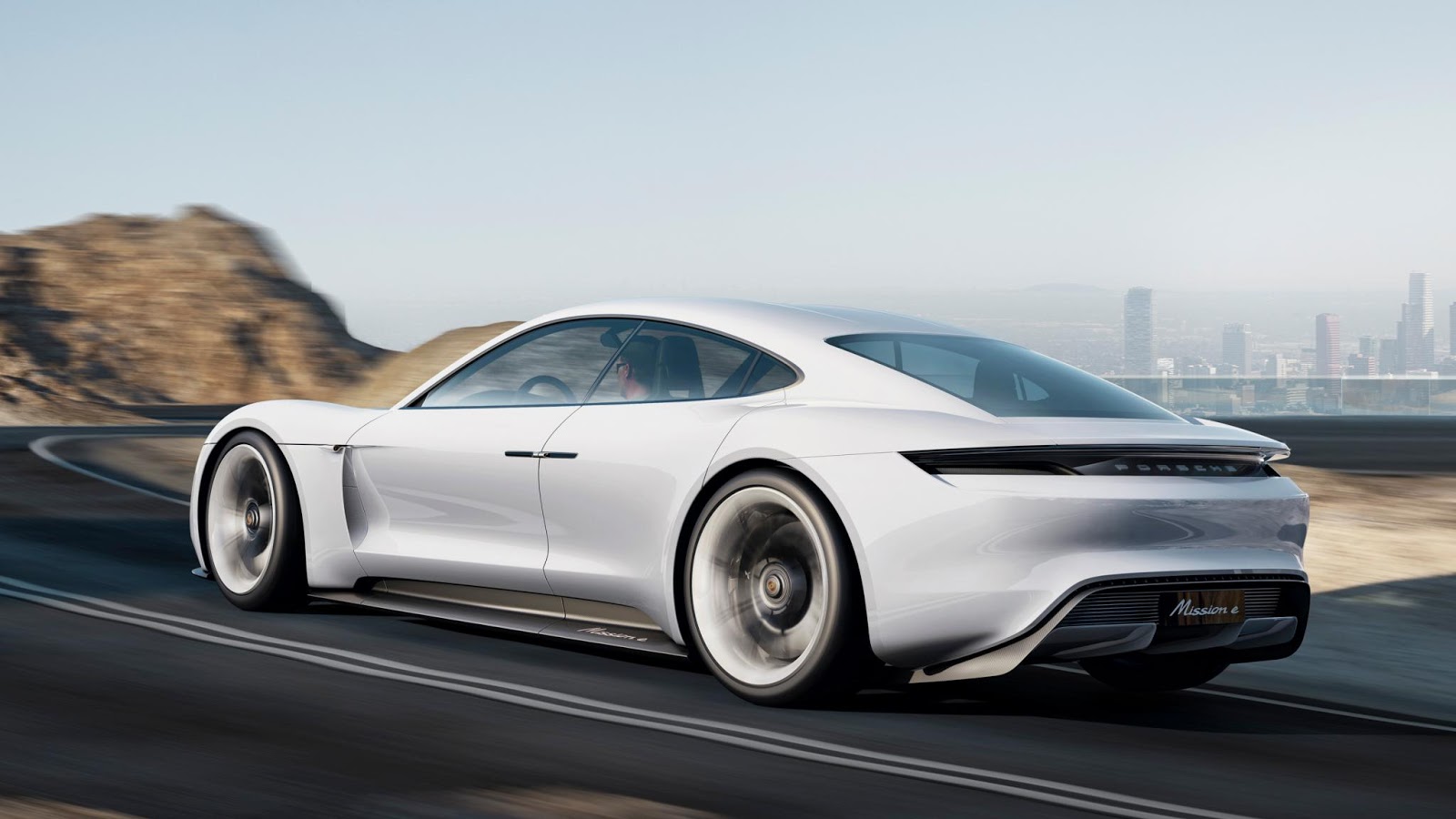
In presenting the Mission E at the IAA in Frankfurt, Porsche is introducing the first all-electrically powered four-seat sports car in the brand's history. The concept car combines the unmistakable emotional design of a Porsche with excellent performance and the forward-thinking practicality of the first 800-volt drive system. Key specification data of this fascinating sports car: four doors and four single seats, over 600 hp (440 kW) system power and over 500 km driving range. All-wheel drive and all-wheel steering, zero to 100 km/h acceleration in under 3.5 seconds and a charging time of around 15 minutes to reach an 80 per cent charge of electrical energy. Instruments are intuitively operated by eye-tracking and gesture control, some even via holograms – highly oriented toward the driver by automatically adjusting the displays to the driver's position.
Drive system: over 600 hp with technologies from endurance racing
The drive system of the Mission E is entirely new, yet it is typical Porsche, i.e. proven in motor racing. Two permanent magnet synchronous motors (PMSM) – similar to those used in this year's Le Mans victor, the 919 hybrid – accelerate the sports car and recover braking energy. The best proof of a Porsche is 24 hours of top racing performance and a 1-2 finish. Together the two motors produce over 600 hp, and they propel the Mission E to a speed of 100 km/h in less than 3.5 seconds and to 200 km/h in under twelve seconds. In addition to their high efficiency, power density and uniform power development, they offer another advantage: unlike today's electric drive systems, they can develop their full power even after multiple accelerations at short intervals. The need-based all-wheel drive system with Porsche Torque Vectoring – which automatically distributes torque to the individual wheels – transfers the drive system's power to the road, and all-wheel steering gives precise, sporty steering in the desired direction. This makes the Mission E fit for the circuit race track; its lap time on the Nürburgring Nordschleife is under the eight-minute mark.
Everyday practicality: convenient and quick charging, over 500 km driving range
It is not just passionate sportiness that makes up a Porsche but also a high level of everyday practicality. Accordingly, the Mission E can travel over 500 km on one battery charge, and it can be charged with enough energy for around 400 km more driving range in about fifteen minutes. The reason: Porsche is a front-runner in introducing innovative 800-volt technology for the first time. Doubling the voltage – compared to today's electric vehicles that operate at 400 volts – offers multiple advantages: shorter charging times and lower weight, because lighter, smaller gage copper cables are sufficient for energy transport. A moveable body segment on the front left wing in front of the driver's door gives access to the charging port for the innovative "Porsche Turbo Charging" system. Via the 800-volt port, the battery can be charged to approximately 80 per cent of its capacity in around 15 minutes – a record time for electric vehicles. As an alternative, the technology platform can be connected to a conventional 400-volt charging station, or it can be replenished at home in the garage via convenient inductive charging by simply parking over a coil embedded in the floor of the garage from which the energy is transferred without cables to a coil on the car's underbody.
Low centre of gravity for superior driving dynamics
Another feature that is typical of a Porsche sports car is a lightweight concept with optimal weight distribution and a low centre of gravity. The battery mounted in the car's underbody, which is based on the latest lithium-ion technology, runs the whole length between the front and rear axles. This distributes its weight to the two drive axles uniformly, resulting in exceptionally good balance. In addition, it makes the sports car's centre of gravity extremely low. Both of these factors significantly boost performance and a sports car feeling. The body as a whole is made up of a functional mix of aluminium, steel and carbon fibre reinforced polymer. The wheels are made of carbon: the Mission E has wide tyres mounted on 21-inch wheels in front and 22-inch wheels at the rear.
Design: fascinating sports car with Porsche DNA
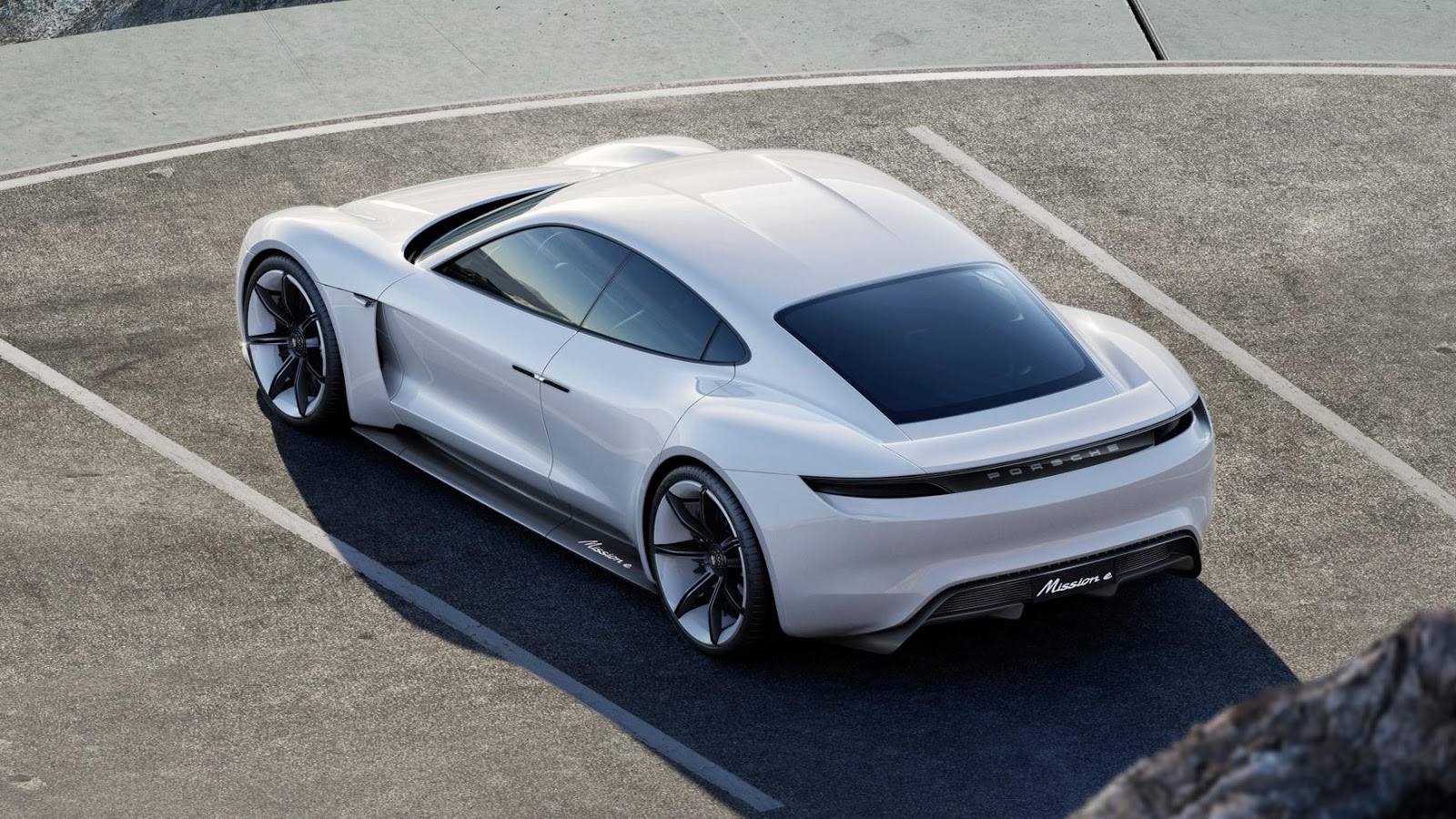
Every square inch, every angle, every radius of the Mission E reflects one thing above all else: emotional sportiness in the best tradition of Porsche design. The starting point is the sculpture of a sport saloon with a low height of 130 cm with sports car attributes from Zuffenhausen that embodies visible innovations such as its integrated aerodynamics. Distinctive air inlets and outlets – on the front, sides and at the rear – typify the body's full flow-through design that enhances efficiency and performance. Integrated air guides improve airflow around the wheels, for instance, and air outlets on the sides reduce overpressure in the wheel wells, thereby reducing lift.
The much reduced sculpting of the front end shows a classic Porsche sweepback, and it relates the concept car to the 918 Spyder and Porsche race cars. A new type of matrix LED headlights in the brand's typical four-point light design captures the viewer's gaze. Integrated as an element hovering in the airflow of the air inlet, they lend a futuristic character to the front end. The four LED units are grouped around a flat sensor for assistance systems whose border serves as an indicator light. Distinctive front wings and an extremely low-cut bonnet reference 911 design. As in the 911 GT3 RS, a wide characteristic recess extends from the overlapping front luggage compartment lid up and over the roof. The line of the side windows is also similar to that of the 911, however, with one important difference: two counter-opening doors enable convenient entry – without a B-pillar. Another difference: instead of the classic door mirror, inconspicuous cameras are mounted on the sides that contribute to the car's exceptional aerodynamics.
The rear design underscores the typical sports car architecture. The lean cabin with its accelerated rear windscreen, which draws inward at the rear, creates space for the sculpted shape of the rear wings that only a Porsche can have. A three-dimensional "PORSCHE" badge illuminated from inside hovers beneath an arch of light that extends across the entire width in a black glass element.
Interior: light and open with four single seats
The interior of the Mission E transfers all of the traditional Porsche design principles into the future: openness, purist design, clean architecture, driver orientation and everyday practicality. The all-electric drive concept made it possible to fully reinterpret the interior. The lack of a transmission tunnel, for instance, opens up space and gives a lighter and more airy atmosphere to the entire interior. Race bucket seats served as inspiration for the four single seats. Their lightweight design is weight-saving, and it gives occupants secure lateral support during dynamic driving. Between the front seats, the centre console – elegantly curved like a bridge with open space beneath it – extends up to the dashboard.
Display and control concept: intuitive, fast and free of distractions
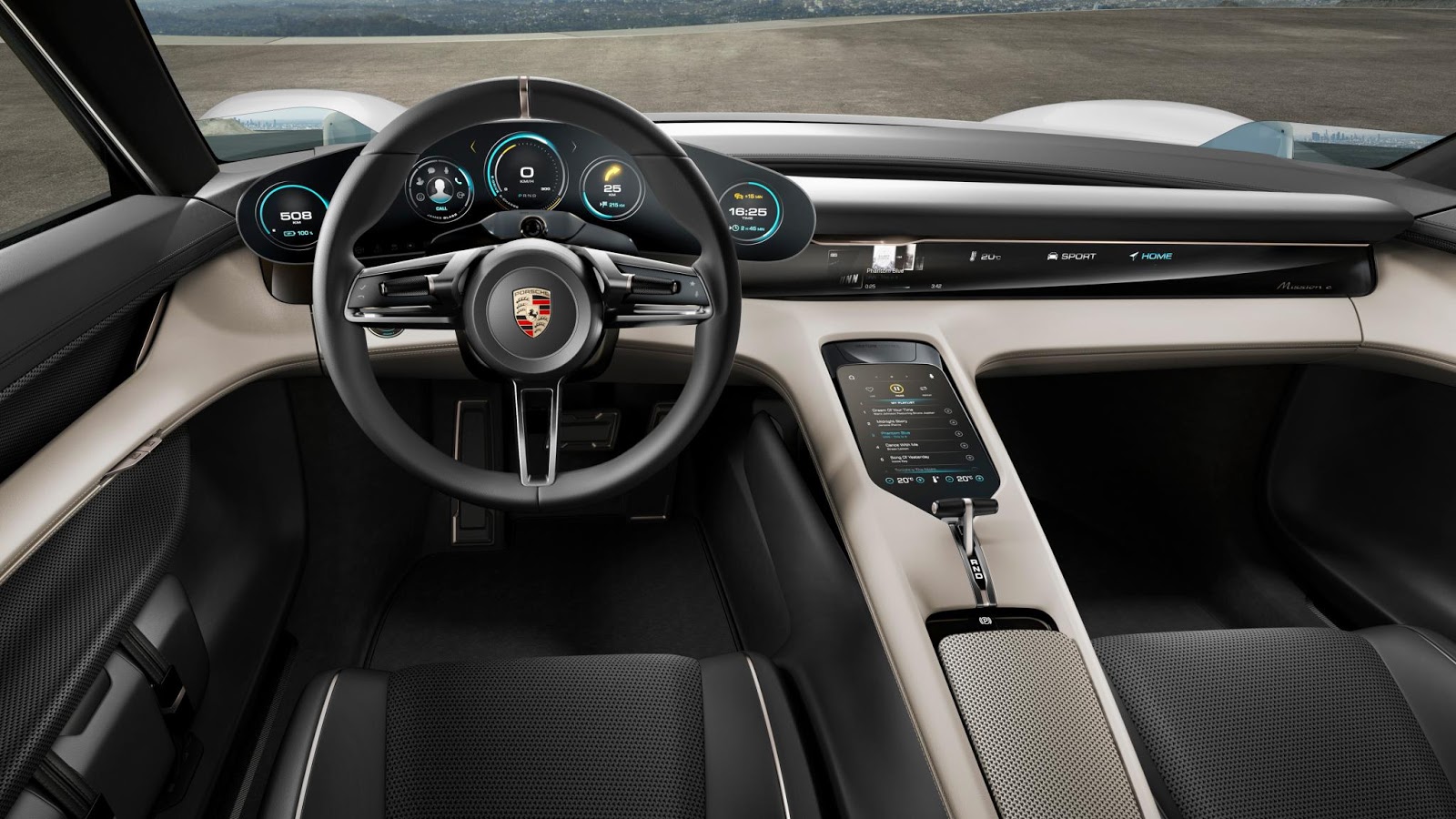
A new world based on an innovative display and control concept opens up before the driver. It is intuitive, fast and free of distractions – created for the sports car of tomorrow. The filigree driver's display is curved, low-profile and free-standing. The instrument cluster shows five round instruments – they can be recognized as Porsche, but they are displayed virtually in OLED technology, i.e. by organic light-emitting diodes. The round instruments are organized according to the driver-relevant themes of Connected Car, Performance, Drive, Energy and Sport Chrono. The controls are just as innovative. An eye-tracking system detects, via camera, which instrument the driver is viewing. The driver can then activate the menu of the instrument in focus by pushing a button on the steering wheel and navigate in it – which also involves an interplay of eye-tracking and manual activation. But that is not all: the display follows the seat position and body attitude of the driver in what is known as a parallax effect. If the driver sits lower, higher or leans to one side, the 3D display of the round instruments reacts and moves with the driver. This eliminates situations in which the steering wheel blocks the driver's view of certain key information, for instance. All relevant information such as vehicle speed is always within the driver's line of sight.
The Mission E can even portray driving fun: a camera mounted in the rear-view mirror recognizes the driver's good mood and shows it as an emoticon in the round instrument. The fun factor can be saved together with individual information such as the route or speed, and it can be shared with friends via a social media link.
Holographic display with touch-free gesture control
The entire dashboard is chock full of new ideas. Its division into two three-dimensionally structuring layers reinforces the impression of lightness and clarity. The upper layer integrates the driver's display, and between the levels there is a holographic display that extends far into the passenger's side. It shows individually selectable apps, which are stacked in virtual space and arranged by priority with a three-dimensional effect. The driver – or passenger – can use these apps to touch-free control primary functions such as media, navigation, climate control, contacts and vehicle. The desired symbol is activated by gestures that are detected by sensors. A grasping gesture means select, while pulling means control. Moreover, driver or passenger can use a touch display on the centre console to control secondary functions such as detailed information menus.
The concept vehicle can also be configured externally from a tablet via Porsche Car Connect. Using "Over the Air and Remote Services" the driver can essentially change the functional content of the vehicle overnight. A simple update via the integrated high-speed data module is all it takes to implement the travel guide or additional functions for the chassis, engine or infotainment system. The driver can use a smartphone or tablet to start updates conveniently from the Porsche Connect Store. Furthermore, Porsche Connect enables direct contact to a Porsche Centre for remote diagnostics or to schedule appointments. Another function of integrated Remote Services is the digital key, which can be sent via the Porsche Connect Portal. It not only lets the owner open the doors, but also other persons authorized by the owner such as friends or family. After successful authentication, the key can be used within a specific time frame and defined location.
The virtual exterior mirrors are literally eye-catching. The lower corners of the windscreen show the images of the outside cameras that are mounted in the front wings. The benefits: the driver gets a better view of images and the surroundings, and safety information can also be actively displayed there
In presenting the Mission E at the IAA in Frankfurt, Porsche is introducing the first all-electrically powered four-seat sports car in the brand's history. The concept car combines the unmistakable emotional design of a Porsche with excellent performance and the forward-thinking practicality of the first 800-volt drive system. Key specification data of this fascinating sports car: four doors and four single seats, over 600 hp (440 kW) system power and over 500 km driving range. All-wheel drive and all-wheel steering, zero to 100 km/h acceleration in under 3.5 seconds and a charging time of around 15 minutes to reach an 80 per cent charge of electrical energy. Instruments are intuitively operated by eye-tracking and gesture control, some even via holograms – highly oriented toward the driver by automatically adjusting the displays to the driver's position.
Drive system: over 600 hp with technologies from endurance racing
The drive system of the Mission E is entirely new, yet it is typical Porsche, i.e. proven in motor racing. Two permanent magnet synchronous motors (PMSM) – similar to those used in this year's Le Mans victor, the 919 hybrid – accelerate the sports car and recover braking energy. The best proof of a Porsche is 24 hours of top racing performance and a 1-2 finish. Together the two motors produce over 600 hp, and they propel the Mission E to a speed of 100 km/h in less than 3.5 seconds and to 200 km/h in under twelve seconds. In addition to their high efficiency, power density and uniform power development, they offer another advantage: unlike today's electric drive systems, they can develop their full power even after multiple accelerations at short intervals. The need-based all-wheel drive system with Porsche Torque Vectoring – which automatically distributes torque to the individual wheels – transfers the drive system's power to the road, and all-wheel steering gives precise, sporty steering in the desired direction. This makes the Mission E fit for the circuit race track; its lap time on the Nürburgring Nordschleife is under the eight-minute mark.
Everyday practicality: convenient and quick charging, over 500 km driving range
It is not just passionate sportiness that makes up a Porsche but also a high level of everyday practicality. Accordingly, the Mission E can travel over 500 km on one battery charge, and it can be charged with enough energy for around 400 km more driving range in about fifteen minutes. The reason: Porsche is a front-runner in introducing innovative 800-volt technology for the first time. Doubling the voltage – compared to today's electric vehicles that operate at 400 volts – offers multiple advantages: shorter charging times and lower weight, because lighter, smaller gage copper cables are sufficient for energy transport. A moveable body segment on the front left wing in front of the driver's door gives access to the charging port for the innovative "Porsche Turbo Charging" system. Via the 800-volt port, the battery can be charged to approximately 80 per cent of its capacity in around 15 minutes – a record time for electric vehicles. As an alternative, the technology platform can be connected to a conventional 400-volt charging station, or it can be replenished at home in the garage via convenient inductive charging by simply parking over a coil embedded in the floor of the garage from which the energy is transferred without cables to a coil on the car's underbody.
Low centre of gravity for superior driving dynamics
Another feature that is typical of a Porsche sports car is a lightweight concept with optimal weight distribution and a low centre of gravity. The battery mounted in the car's underbody, which is based on the latest lithium-ion technology, runs the whole length between the front and rear axles. This distributes its weight to the two drive axles uniformly, resulting in exceptionally good balance. In addition, it makes the sports car's centre of gravity extremely low. Both of these factors significantly boost performance and a sports car feeling. The body as a whole is made up of a functional mix of aluminium, steel and carbon fibre reinforced polymer. The wheels are made of carbon: the Mission E has wide tyres mounted on 21-inch wheels in front and 22-inch wheels at the rear.
Design: fascinating sports car with Porsche DNA
Every square inch, every angle, every radius of the Mission E reflects one thing above all else: emotional sportiness in the best tradition of Porsche design. The starting point is the sculpture of a sport saloon with a low height of 130 cm with sports car attributes from Zuffenhausen that embodies visible innovations such as its integrated aerodynamics. Distinctive air inlets and outlets – on the front, sides and at the rear – typify the body's full flow-through design that enhances efficiency and performance. Integrated air guides improve airflow around the wheels, for instance, and air outlets on the sides reduce overpressure in the wheel wells, thereby reducing lift.
The much reduced sculpting of the front end shows a classic Porsche sweepback, and it relates the concept car to the 918 Spyder and Porsche race cars. A new type of matrix LED headlights in the brand's typical four-point light design captures the viewer's gaze. Integrated as an element hovering in the airflow of the air inlet, they lend a futuristic character to the front end. The four LED units are grouped around a flat sensor for assistance systems whose border serves as an indicator light. Distinctive front wings and an extremely low-cut bonnet reference 911 design. As in the 911 GT3 RS, a wide characteristic recess extends from the overlapping front luggage compartment lid up and over the roof. The line of the side windows is also similar to that of the 911, however, with one important difference: two counter-opening doors enable convenient entry – without a B-pillar. Another difference: instead of the classic door mirror, inconspicuous cameras are mounted on the sides that contribute to the car's exceptional aerodynamics.
The rear design underscores the typical sports car architecture. The lean cabin with its accelerated rear windscreen, which draws inward at the rear, creates space for the sculpted shape of the rear wings that only a Porsche can have. A three-dimensional "PORSCHE" badge illuminated from inside hovers beneath an arch of light that extends across the entire width in a black glass element.
Interior: light and open with four single seats
The interior of the Mission E transfers all of the traditional Porsche design principles into the future: openness, purist design, clean architecture, driver orientation and everyday practicality. The all-electric drive concept made it possible to fully reinterpret the interior. The lack of a transmission tunnel, for instance, opens up space and gives a lighter and more airy atmosphere to the entire interior. Race bucket seats served as inspiration for the four single seats. Their lightweight design is weight-saving, and it gives occupants secure lateral support during dynamic driving. Between the front seats, the centre console – elegantly curved like a bridge with open space beneath it – extends up to the dashboard.
Display and control concept: intuitive, fast and free of distractions
A new world based on an innovative display and control concept opens up before the driver. It is intuitive, fast and free of distractions – created for the sports car of tomorrow. The filigree driver's display is curved, low-profile and free-standing. The instrument cluster shows five round instruments – they can be recognized as Porsche, but they are displayed virtually in OLED technology, i.e. by organic light-emitting diodes. The round instruments are organized according to the driver-relevant themes of Connected Car, Performance, Drive, Energy and Sport Chrono. The controls are just as innovative. An eye-tracking system detects, via camera, which instrument the driver is viewing. The driver can then activate the menu of the instrument in focus by pushing a button on the steering wheel and navigate in it – which also involves an interplay of eye-tracking and manual activation. But that is not all: the display follows the seat position and body attitude of the driver in what is known as a parallax effect. If the driver sits lower, higher or leans to one side, the 3D display of the round instruments reacts and moves with the driver. This eliminates situations in which the steering wheel blocks the driver's view of certain key information, for instance. All relevant information such as vehicle speed is always within the driver's line of sight.
The Mission E can even portray driving fun: a camera mounted in the rear-view mirror recognizes the driver's good mood and shows it as an emoticon in the round instrument. The fun factor can be saved together with individual information such as the route or speed, and it can be shared with friends via a social media link.
Holographic display with touch-free gesture control
The entire dashboard is chock full of new ideas. Its division into two three-dimensionally structuring layers reinforces the impression of lightness and clarity. The upper layer integrates the driver's display, and between the levels there is a holographic display that extends far into the passenger's side. It shows individually selectable apps, which are stacked in virtual space and arranged by priority with a three-dimensional effect. The driver – or passenger – can use these apps to touch-free control primary functions such as media, navigation, climate control, contacts and vehicle. The desired symbol is activated by gestures that are detected by sensors. A grasping gesture means select, while pulling means control. Moreover, driver or passenger can use a touch display on the centre console to control secondary functions such as detailed information menus.
The concept vehicle can also be configured externally from a tablet via Porsche Car Connect. Using "Over the Air and Remote Services" the driver can essentially change the functional content of the vehicle overnight. A simple update via the integrated high-speed data module is all it takes to implement the travel guide or additional functions for the chassis, engine or infotainment system. The driver can use a smartphone or tablet to start updates conveniently from the Porsche Connect Store. Furthermore, Porsche Connect enables direct contact to a Porsche Centre for remote diagnostics or to schedule appointments. Another function of integrated Remote Services is the digital key, which can be sent via the Porsche Connect Portal. It not only lets the owner open the doors, but also other persons authorized by the owner such as friends or family. After successful authentication, the key can be used within a specific time frame and defined location.
The virtual exterior mirrors are literally eye-catching. The lower corners of the windscreen show the images of the outside cameras that are mounted in the front wings. The benefits: the driver gets a better view of images and the surroundings, and safety information can also be actively displayed there
Audi has taken the wraps off its vision of the perfect electric SUV, the Audi e-tron quattro concept, delivering more than 500 km (310 miles) of range along with autonomous driving. Shown off for the first time at the Frankfurt Motor Show today, the concept previews Audi's production luxury electric SUV currently pencilled in for early 2018, with a slippery but meaty design and a trio of motors.
It's clearly an Audi from the outside, but the 16ft length and 6.3ft width are offset by the 5.1ft height, leaving the e-tron quattro concept looking low and chunky. Electrically-actuated aero elements on the hood, the flanks, and on the rear help control the flow of air, adding up to a mere 0.25 coefficient of drag. That, Audi points out, is a record for the SUV segment, where figures in excess of 0.30 cd are more typical.
The lighting uses Matrix lasers, combined with LED and OLED elements, the latter being shown for the first time at the Frankfurt show, but headed to production according to Audi. Inside, there's seating for four and up to 21.7 cu ft of their luggage. Surrounding them is an updated version of the Virtual Cockpit already in production cars, with various unusually-shaped OLED displays scattered across the dashboard.
Around the digital instruments, for instance, are glass touch displays for controlling the piloted driving, multimedia, and navigation, while more touch panels are wrapped around the spokes of the steering wheel. Two more OLEDs are on the center tunnel, while the doors have curved screens that replace external mirrors. In the rear, passengers get their own OLED screens to control the AC and choose what they want to watch on the LTE-streaming media system.
Of course, the real magic is in the powertrain. Audi has equipped the e-tron quattro concept with three motors in all, one at the front axel and two at the rear; altogether, they're good for 400 HP and 800 Nm of torque in boost mode. 0-100 km/h comes in 4.6 seconds, and the top speed is limited to 130.5 mph. The SUV automatically adjusts which rear wheel gets the torque according to grip and stability, while there are various degrees of driver-selectable power recuperation during braking.
Audi has slung the 95 kWh battery under the passenger compartment, keeping the center of gravity low, and paired it with a Combined Charging System (CCS) that's happy with either DC or AC current. Supply the concept with 150 kW of DC power, for instance, and a full charge can be completed in around 50 minutes, the company claims. However, if plugging in a cable is too much for you, Audi Wireless Charging is also included, using contactless induction charging and a low-speed autonomous driving system that navigates the SUV on top of the inductive plate. Finally there's a solar panel on the roof.
All-wheel steering, air suspension, and a combination of radar, video, ultrasonic sensors, and a laser scanner - which feed into what Audi calls the "central driver assistance controller" (zFAS) in the trunk, and which will eventually be used for piloted driving - round out the key tech. Of course, the e-tron quattro concept won't make it to dealerships in quite this form - expect the interior to be significantly more mainstream, for instance - but as EV drivetrains go this one is shaping up to be very interesting, and could cause some consternation over at Tesla's Model X lab.
Audi has taken the wraps off its vision of the perfect electric SUV, the Audi e-tron quattro concept, delivering more than 500 km (310 miles) of range along with autonomous driving. Shown off for the first time at the Frankfurt Motor Show today, the concept previews Audi's production luxury electric SUV currently pencilled in for early 2018, with a slippery but meaty design and a trio of motors.
It's clearly an Audi from the outside, but the 16ft length and 6.3ft width are offset by the 5.1ft height, leaving the e-tron quattro concept looking low and chunky. Electrically-actuated aero elements on the hood, the flanks, and on the rear help control the flow of air, adding up to a mere 0.25 coefficient of drag. That, Audi points out, is a record for the SUV segment, where figures in excess of 0.30 cd are more typical.
The lighting uses Matrix lasers, combined with LED and OLED elements, the latter being shown for the first time at the Frankfurt show, but headed to production according to Audi. Inside, there's seating for four and up to 21.7 cu ft of their luggage. Surrounding them is an updated version of the Virtual Cockpit already in production cars, with various unusually-shaped OLED displays scattered across the dashboard.
Around the digital instruments, for instance, are glass touch displays for controlling the piloted driving, multimedia, and navigation, while more touch panels are wrapped around the spokes of the steering wheel. Two more OLEDs are on the center tunnel, while the doors have curved screens that replace external mirrors. In the rear, passengers get their own OLED screens to control the AC and choose what they want to watch on the LTE-streaming media system.
Of course, the real magic is in the powertrain. Audi has equipped the e-tron quattro concept with three motors in all, one at the front axel and two at the rear; altogether, they're good for 400 HP and 800 Nm of torque in boost mode. 0-100 km/h comes in 4.6 seconds, and the top speed is limited to 130.5 mph. The SUV automatically adjusts which rear wheel gets the torque according to grip and stability, while there are various degrees of driver-selectable power recuperation during braking.
Audi has slung the 95 kWh battery under the passenger compartment, keeping the center of gravity low, and paired it with a Combined Charging System (CCS) that's happy with either DC or AC current. Supply the concept with 150 kW of DC power, for instance, and a full charge can be completed in around 50 minutes, the company claims. However, if plugging in a cable is too much for you, Audi Wireless Charging is also included, using contactless induction charging and a low-speed autonomous driving system that navigates the SUV on top of the inductive plate. Finally there's a solar panel on the roof.
All-wheel steering, air suspension, and a combination of radar, video, ultrasonic sensors, and a laser scanner - which feed into what Audi calls the "central driver assistance controller" (zFAS) in the trunk, and which will eventually be used for piloted driving - round out the key tech. Of course, the e-tron quattro concept won't make it to dealerships in quite this form - expect the interior to be significantly more mainstream, for instance - but as EV drivetrains go this one is shaping up to be very interesting, and could cause some consternation over at Tesla's Model X lab.
The world’s first all-electric propulsion satellite, built by Boeing for Bermuda-based ABS, is now operational after an on-orbit handover on August 31. The ABS-3A, a 702SP (small platform) satellite, expands ABS’ communications services in the Americas, Europe, the Middle East and Africa.
“The operational ABS-3A satellite and ABS-2A, launching in early 2016, will further strengthen and solidify our global expansion and offer flexible capacity to our growing fleet,” said Tom Choi, CEO of ABS. “We believe Boeing’s innovative portfolio can help us to affordably grow now and in the future.”
The ABS-3A spacecraft was the world’s first all-electric propulsion satellite to be built and launched – part of a stacked pair launched in March with a 702SP satellite built for Eutelsat, based in Paris. The spacecraft’s all-electric xenon-ion propulsion system contains a sufficient quantity of the inert, non-hazardous element xenon to extend the satellite’s operations beyond the expected spacecraft design life of 15 years.
“With a successful launch, testing and execution of orbit operations, we were able to deliver the first 702SP to ABS about one month earlier than planned,” said Mark Spiwak, president, Boeing Satellite Systems International. “The 702SP product line was designed to bring the latest technology into the hands of customers seeking adaptable and affordable solutions. In addition, the 702SP’s patented dual-launch capability helps customers share launch costs, which can significantly lower overall expenses for a satellite owner.”
Boeing is under contract to build a second 702SP satellite for ABS, designated ABS-2A, which will be delivered and launched early next year.
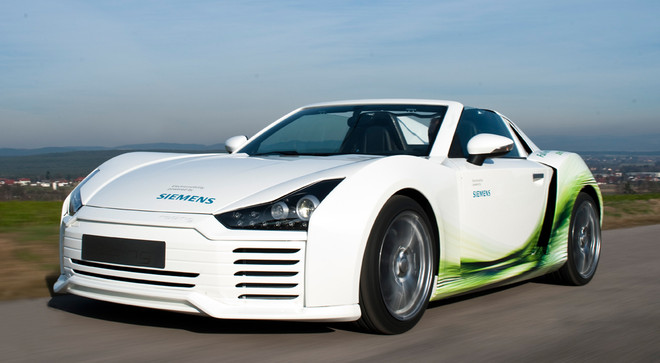
Siemens will show the wheel motor powered Roding Roadster Electric at the 2015 IAA (Internationale Automobil-Ausstellung) in Frankfurt Germany this month.
The Roding Roadster Electric is a hub drive powered research vehicle. Based on the Roding Carbon Cell, this innovative battery-powered drive train could be realized together with Siemens Corporate Technology. The prototypes used for this purpose were constructed without a mechanical brake at the rear axle, instead, braking is done by the electric motor.
The brake system is controlled by so-called Brake Blending, i.e., as circumstances require, the brake torque is automatically transferred from the electrically powered brake to the friction brake at the front axle. It is aimed to recuperate the entire potential energy in 70% of all braking processes.
Nissan is once again transforming the performance, practicality and perception of EVs with the introduction of the LEAF 30 kWh - an updated Nissan LEAF that gives drivers 250 km (155 miles) of motoring range, beating all of its competitors in the segment.
This remarkable achievement – one that opens up a new world of opportunity for drivers – is made possible thanks to the introduction of a new 30kWh battery. The new battery is the highlight of an update package that will see the 2016MY LEAF 30 kWh reinforce its position as the most capable and practical electric vehicle in the world, and with the best value. The longer range significantly broadens the LEAF’s appeal – making it a true alternative to an internal combustion engine vehicle for thousands of motorists and reinforcing its position as the world’s best electric car.
Commented Paul Willcox, Chairman, Nissan Europe: “The LEAF, the best-selling EV in the world, just got even better. And up-to 155 miles opens the world of EV to thousands of drivers across Europe who before just weren’t completely confident that an EV would work for them. This extra range will make LEAF ownership an easy first choice, for many, many more drivers.”
New battery, new technology, same simple usability
The LEAF’s new 30kWh battery delivers a longer range with no compromise on internal packaging. Available on Acenta and Tekna trim grades, it has exactly the same exterior dimensions as existing 24kWh unit and only a modest 21 kg increase in weight. The result? A car that goes significantly further while offering the same practicality and usability as previous versions.
Key to the new battery’s higher performance is an update to its internal design and chemistry. The introduction of Carbon, Nitrogen and Magnesium to the electrodes improves performance, while the change to the cell layout also contributes to the gain. Indeed, Nissan is so confident about the performance and reliability of the new 30kWh battery that the capacity will be covered by an eight year, 100,000 mile warranty.
Recharging the LEAF’s new 30kWh battery is as easy and stress-free as it is with the current 24kWh unit. Just as with the current LEAF, customers will be able to recharge from their homes, from public chargers, or from the network of rapid chargers (3 phase, 400V) expanding across European – the best EV network available. In the UK there are approximately 500 LEAF-compatible rapid chargers, covering more than 95% of the UK’s motorway network.
New IT technology gives owners even greater control
One of the LEAF’s most celebrated and useful features is its ability to interact with and be controlled remotely by its owner via NissanConnect EV. From being able to check charge status to pre-heating the cabin on cold winter days, owners across the world have used this advanced smartphone-enabled telematics facility to make life even easier. NissanConnect EV not only brings greater comfort but also improves driving range, thanks to the ability to pre-heat or pre-cool the cabin without using battery energy.
The LEAF 30 kWh introduces a significant update to this unique technology with a new NissanConnect EV system that replaces the previous Carwings setup. It retains all the acclaimed elements of the original system, but adds new features, a much-simplified activation process and a new design.
One of the many advances of the new NissanConnect EV system is the new charging map that is capable of showing which charging points are available and which are being used. Designed to offer seamless integration with the new-generation NissanConnect EV infotainment system, it also features a completely revised navigation system, maintenance alerts and a car-finder facility.
LEAF 30 kWh – the world’s favourite EV made even better
All Acenta and Tekna 2016MY LEAF models are equipped with the latest evolution of the brand’s acclaimed NissanConnect EV infotainment system. Featuring a new interface and digital radio receiver, it also offers a capacitive 7-inch touchscreen that allows owners to zoom in and out of maps and flick between menus just by moving their fingers on the screen.
The LEAF 30 kWh also introduces a number of subtle exterior design changes – including a new roof-mounted aerial along with the availability of a new colour – Bronze.
Full pricing
Sales of the model year 2016 Nissan LEAF 30kW will begin in the UK in December 2015. Priced from £24,490 for the Acenta trim, the LEAF 30kW is available for just £1,600 more than the equivalent LEAF with a 24kW battery.
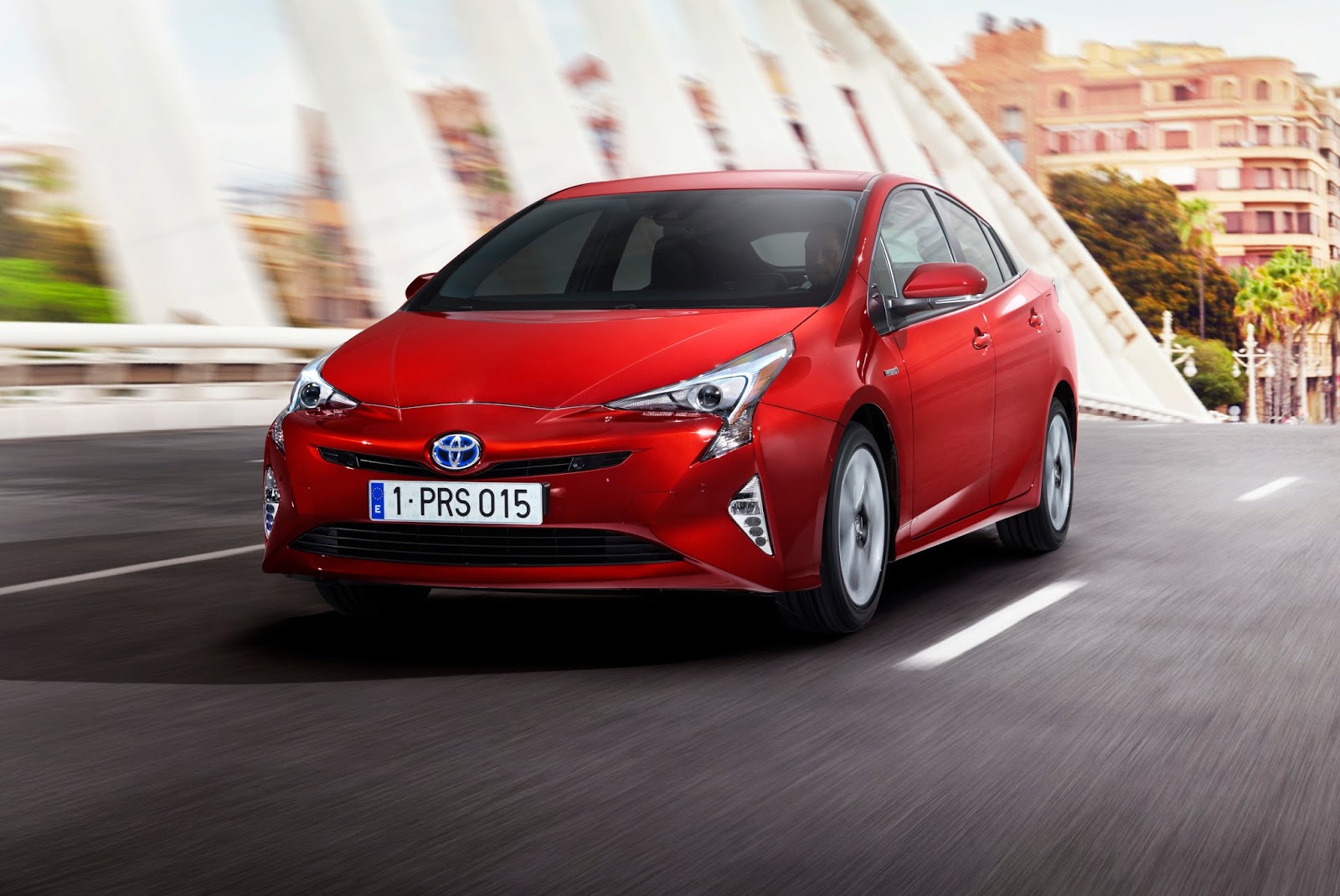
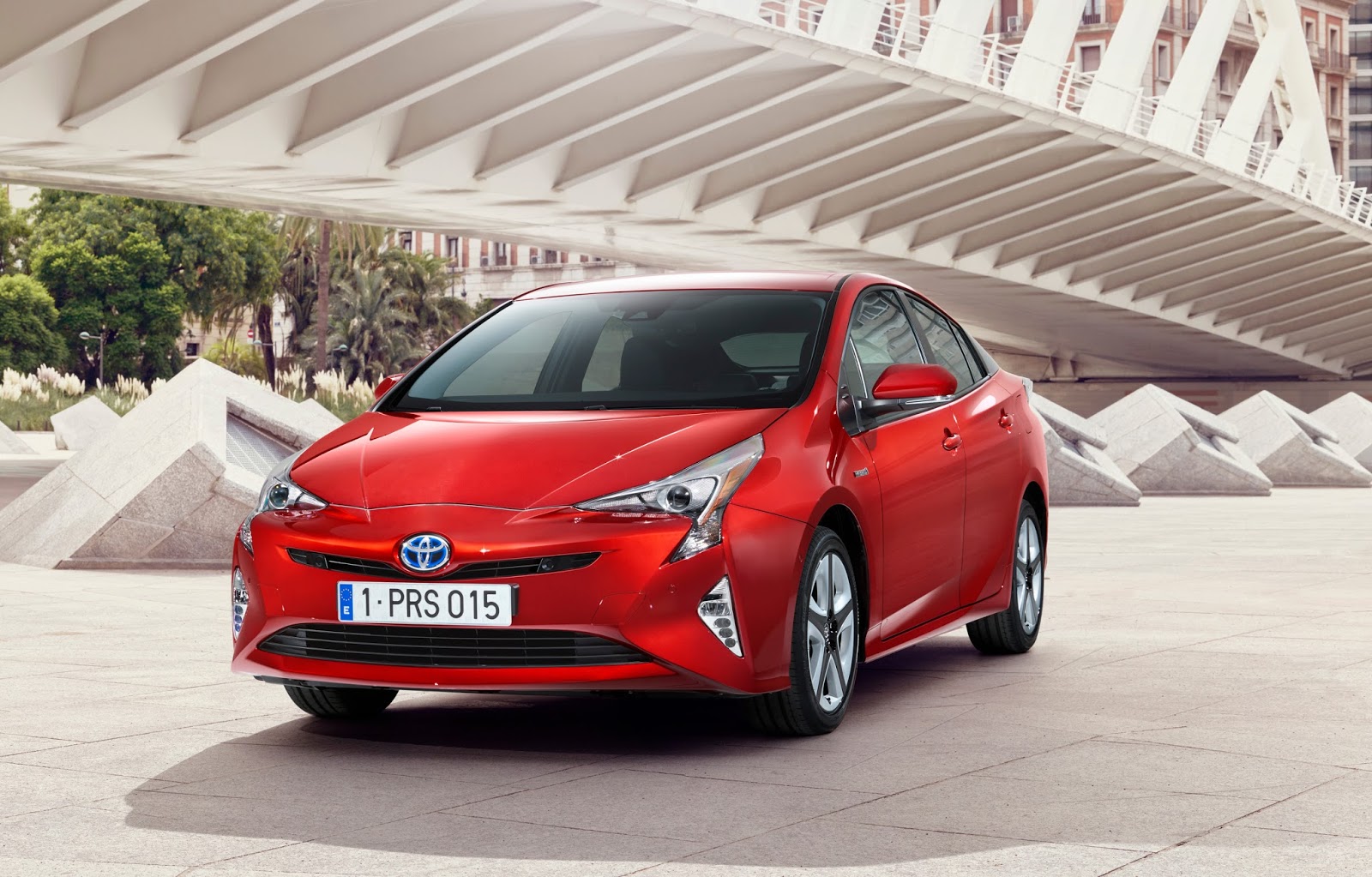
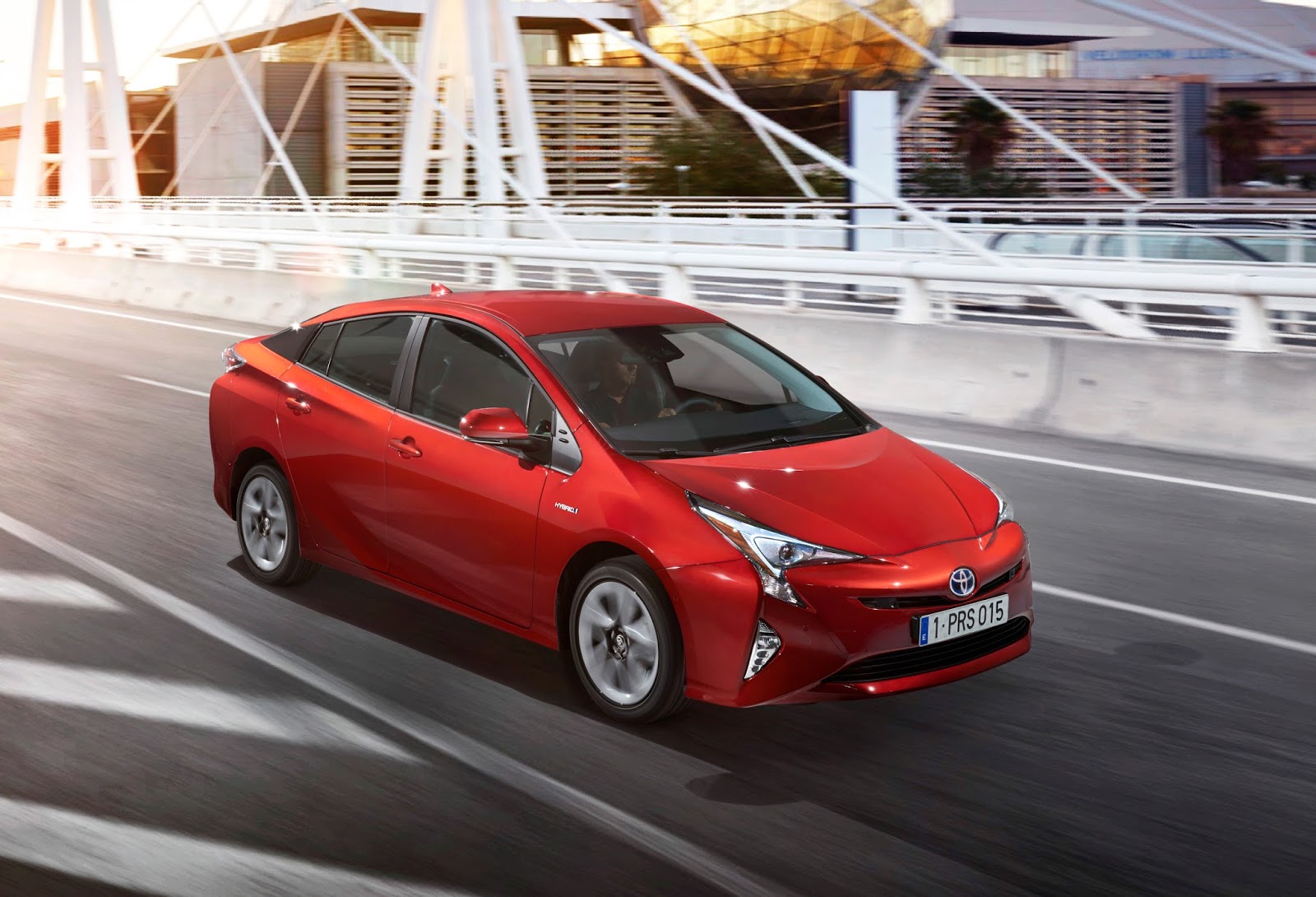
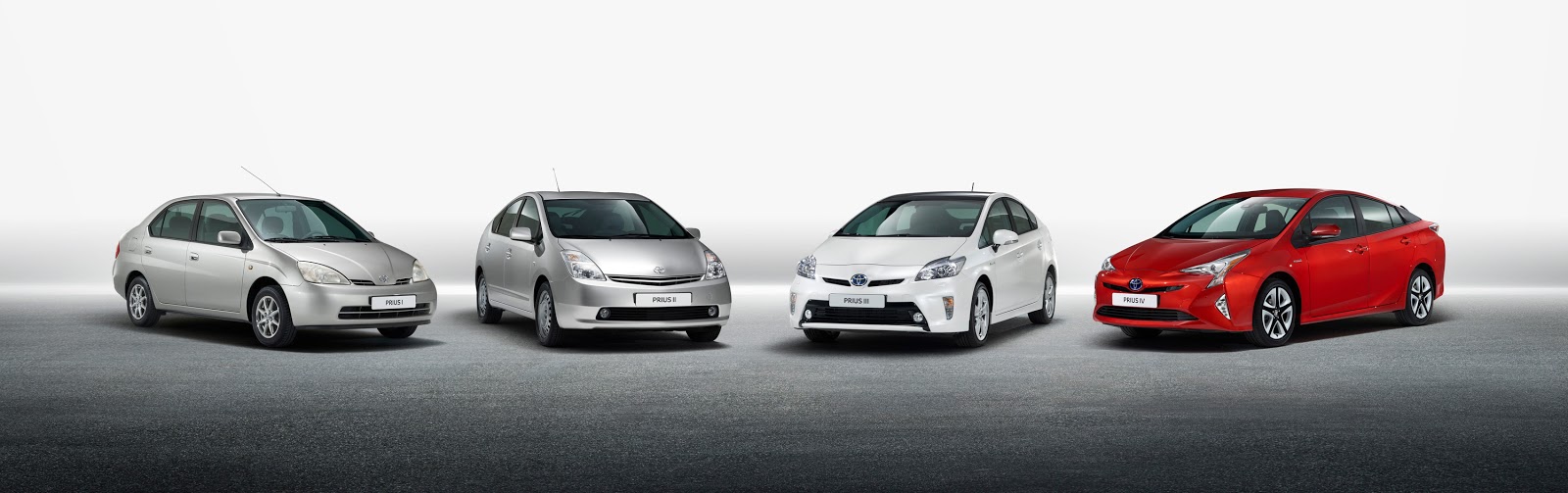
Toyota has advanced the pioneering status of its iconic Prius hybrid car by revealing a fourth-generation model that debuts a futuristic design, fun-to-drive dynamics and an impressive gain to fuel economy.
A new, stiffer platform - the first developed under Toyota's New Generation Architecture (TNGA) program - is at the heart of revolutionary improvements that support a more responsive driving experience and enhanced occupant protection.
In keeping with the Prius name which means "front runner", the new-generation car continues to build on its eco-car DNA with technical breakthroughs including the world's most thermally efficient petrol engine at 40 per cent.
This remarkable achievement, which provides a significant improvement in fuel efficiency, is due to the adoption of new or substantially revised components that were effectively blueprinted to the finest limits and tolerances.
Engineers also succeeded with a comprehensive program of size and weight reductions for major hybrid components while maintaining overall performance, confirming Prius as the global pacesetter in hybrid technology.
The cutting-edge development program for the new Prius also focused on a more responsive drive experience achieved through a lower centre of gravity, newly developed double-wishbone rear suspension and a more rigid body.
The all-new rear double wishbone suspension produces a better connection to the road, providing greater control and feedback in all driving conditions. A more rigid body helps improve responsiveness while cornering without sacrificing ride quality or occupant comfort.
Unveiled at a special event in Las Vegas ahead of its international motor-show debut in Frankfurt next week and an Australian launch early in 2016, the new Prius exterior has completely evolved.
It features a dramatic low-slung silhouette that is approximately 60mm longer, 15mm wider and 20mm lower, delivering a much more planted on-road presence with a lower centre of gravity and more space for occupants and their luggage.
Designers embraced Toyota's concept of "Iconic Human-tech" to blend flowing curves with aggressive cut edges, producing ground-breaking advances and aerodynamic innovations that display a sculptural quality.
The bonnet is lower and the most distinctive Prius cue - the roof peak - has been moved forward, creating an athletic shape inspired by a runner in the starting blocks.
The sporty theme for the new Prius is accentuated by the Toyota emblem in the front grille sitting at exactly the same height as on Toyota's 86 sports car. It is flanked by new headlamps that minimise frontal area while providing a striking light display that helps define the vehicle's distinctive character.
Bold character lines run along the side from the front fenders - one just above the sill that sweeps up towards the rear fender, while the upper crease morphs into the rear spoiler, which has been lowered.
Striking rear combination lamps express the distinctive lines of the Prius from the rear spoiler to the trailing edges of the sides.
Exterior colours include an "Emotional Red", which utilises a newly developed treatment process to achieve a deep and vibrant lustre.
The new Prius interior also embraces Toyota's concept of "Iconic Human-tech" with a strong presence that adopts advanced technology complemented by features that are functional, fun and have high visual impact.
Owners will be rewarded with the comfort and utility offered by a wrap-around cockpit, form-hugging seat design, easy-to-use controls and increased visibility.
A sense of quality and space is created through the wide instrument panel with its layered construction that clearly defines the "display zone", separating it from the "control zone" which is now closer to the driver.
The next-generation Prius will make available a package of electronic safety assistance aids including a pre-collision system, lane departure alert, automatic high beam and active cruise control.
Prius global chief engineer Kouji Toyoshima said nearly every aspect of Prius has been improved to create a car that will appeal to the senses in its own right, above its well-recognised green credentials.
"There is much more to the new Prius than a green image. From the bold design to the quality interior, the Prius has never had such a powerful presence," Mr Toyoshima said.
Prius - with more than 3.5 million sold globally - has popularised hybrid technology to the point it has now become mainstream. The fourth-generation Prius is ground- breaking in its own right.
"We have developed an even-better Prius by expanding its environmentally sensitive DNA while ramping up its desirability with an emotional design and an engaging drive. It offers a new perspective of what a hybrid can be."
Toyota New Generation Architecture is an innovative development program designed to enhance product appeal through improved core vehicle performance and new technologies.
It promotes the strategic sharing of powertrain components and vehicle platforms with the goal of improving resource efficiency by better than 20 per cent.
A Japanese research group prototyped a translucent lithium-ion (Li-ion) rechargeable battery that can charge itself by using sunlight.
With the battery, the group aims to realize a "smart window," which is an almost transparent window that functions both as a large-area rechargeable battery and as a photovoltaic cell (when the window receives sunlight, it is pigmented, lowering light transmittance).
The group is led by Mitsunobu Sato, president of Kogakuin University and professor at the Department of Applied Physics, School of Advanced Engineering of the university. The battery was exhibited at Innovation Japan 2015, a trade show that took place from Aug 27 and 28, 2015, in Tokyo.
Translucent Li-ion battery announced in 2013
The group developed a translucent Li-ion rechargeable battery and announced it in a thesis in 2013.
The main component of the electrolyte used for the positive electrode of the battery is Li3Fe2(PO4)3 (LFP). And those of the electrolyte used for the negative electrode are Li4Ti5O12 (LTO) and LiPF6 (lithium hexafluorophosphate). Those material are commonly used for Li-ion rechargeable batteries. However, oxides are basically transparent, and the thicknesses of the positive and negative electrodes are only 80nm and 90nm, respectively, realizing a high light transmittance.
The light transmittance for green light (wavelength: about 550nm) is about 60% after discharging. It lowers to about 30% after charging because the density of lithium changes at the electrodes and the electronic state (valence) of the material changes.
The output voltage of the battery is about 3.6V. And the research group confirmed 20 charge-discharge cycles.
Latest battery
This time, the group exhibited a device that has not been announced in a thesis. It was made by making some changes to the materials of the translucent Li-ion battery announced in 2013 so that electrons excited by light coming to the negative electrode can be used to charge the battery.
At the trade show, the group showed the results of an experiment in which optical charge and discharge are repeated five times by applying near-ultraviolet light with an output of 10mW/cm2, which is about 1/10 that of sunlight.
Mercedes is reportedly working on a model range of electric vehicles able to cover up to 500 km on a single charge according to Daimler Chief Development Officer Thomas Weber.
In an interview with German publication auto motor und sport, Weber said, “We are working on an intelligent concept for a highly attractive electric vehicle with a range of 400-500 kilometers,” adding that the car would come “soon.” More importantly, the electric drivetrain will fit into the automaker’s flexible architecture, meaning it can be used in numerous models.
Mercedes might have a slight lead on the competition, however, considering that it has been developing numerous applications of all-electric vehicles for a while now, including on the A- and B-Class as well as the electric SLS AMG that set a record on the Nurburgring.
Proterra announced today that their 40-foot Catalyst XR bus drove 258 miles (412 km) on a single charge under test conditions at Michelin's esteemed Laurens Proving Grounds (LPG). The Catalyst's range demonstration marks a significant step toward Proterra's goal of providing a high-performance bus that can serve any typical transit route in the United States.
The Catalyst XR configuration included eight battery packs, with a total energy capacity of 257 kWh. Based on these test results, Proterra predicts its ten pack XR configuration (321 kWh) will achieve 300 miles (480 km) on a single charge. According to available General Transit Feed Specification (GTFS) data, typical urban and rural bus routes in the United States run less than 200 miles a day, bringing most routes within reach of Proterra's current technology.
"The purpose-driven Catalyst design affords the best efficiency rating ever for a 40-foot transit bus, at 22 MPG equivalent," said John Sleconich, Chief Engineer at Proterra. "Proterra buses are the only mass transit vehicle built from the ground up as an electric vehicle. With a unique aerodynamic body made from carbon fiber and advanced composite materials, we are able to reduce mass for maximum efficiency."
Beyond meeting a given route's minimum range requirements, Proterra electric vehicles are poised to make a significant impact on the transit market because of the Catalyst's low operational cost per mile compared to diesel, CNG, and diesel-hybrid buses. Over the 12-year life of a bus, Proterra customers will dramatically reduce maintenance costs, saving around $135K. The environmental benefits are also making an impressive impact. Collectively, Proterra customers have logged more than 1.3 million miles of revenue service to date, preventing more than 4.7 million pounds of emissions.
"The U.S. is quickly waking up to the economic, environmental, and performance benefits of zero-emission electric buses," said Proterra CEO, Ryan Popple. "While diesel buses pollute our communities and are increasingly more costly to own and operate, Proterra is pushing the bounds of EV technology and steadily driving down costs. Achieving this range is validation for our technology and gives us the confidence that Proterra is capable of what we initially set out to accomplish - replacing every fossil fuel bus in the United States with a fully electric one. "
Some future buyers of Tesla Motors Inc.’s Model X are configuring their vehicles this week, as details about the electric-car maker’s much-awaited SUV emerge.
Among the highlights: A Model X “Signature” edition will cost $132,000 and as much as $144,000 with upgrades such as the “ludicrous speed” mode. The car will be able to go 385 km (240 miles) between charges, 7 miles more than a Model S P85D, the sedan’s top of the line, which starts at $108,000 but can also go north of $140,000 with upgrades.
With AWD via a 190 kw (259 hp) front motor and 370 kw (503 hp) rear motor giving an 'insane' total output of 560 kw (762 hp), the Model X Signature can accelerate to 100 km/h (60 mph) in 3.8 seconds, a tad slower than the Model S P85D’s 3.1 seconds. The Model X top speed of 155 mph is the same as the Model S P85D and others.
Tesla fans have posted several screenshots of their invitation-only Model X configuration Web pages on the Tesla Motors Club blog, a forum for Tesla enthusiasts that is independent of the company.
These future Model X owners were the first to put down a deposit on the Model X, which is expected to roll out of the Fremont, Calif., factory on 29th September. People reserving their Model X now would get the car in early 2016.
Here’s what else is known about the Model X:
The car’s rear-door falcon wings, which differ from the gull wings of yesteryear as they are better at negotiating tight spaces, will have sensors so they won’t bump into ceilings.
Accessories like a hitch for bikes or skis are standard. Also standard are parking sensors and blind-spot warning.
The Signature series will offer autopilot with self parking and automatic lane steering, and flat-folding third-row seats. The series’ second-row seats — which Tesla Chief Executive Elon Musk called “a sculptural work of art” — will be “independently operable,” although it is not clear what that meant.
See also: Tesla lower deliveries forecast irks Wall Street
The $10,000 “ludicrous” speed upgrade is also available for the Model X, as Musk had said. Other upgrades include a $1,000 subzero package, which comes with a heated steering wheel and a wiper-blade defroster, among other equipment, although Tesla warns that choosing that package could delay the car’s delivery by a month.
Those upgrades plus a $750 tow package push the price of the Model X Signature to $144,000.
The innovative BMW eDrive technology in the new BMW 225xe and new BMW 330e once again underlines BMW’s leading role in the premium segment when it comes to powertrain electrification.
BMW eDrive technology includes a number of cutting-edge plug-in hybrid components and makes a significant contribution to reducing fuel consumption and emissions. BMW eDrive is one of the most cutting-edge elements of the groundbreaking BMW EfficientDynamics suite of technology.
Locally emission-free driving BMW eDrive is the new drive system technology used in all the electrically powered vehicles from BMW i and the plug-in hybrid models from BMW. As well as outstanding efficiency and seamless everyday practicality, BMW eDrive also delivers the highest standards in driving dynamics and quality, in keeping with BMW tradition. Alongside BMW TwinPower Turbo technology for combustion engines, intelligent lightweight design and optimised aerodynamics, BMW eDrive technology is therefore one of the most important elements in the EfficientDynamics strategy designed to increase power and further reduce fuel consumption and CO2 emissions. In addition, BMW eDrive offers the option of driving on electric power alone and therefore with zero local emissions – yet at the same time reveals the ability to cover long distances when the two drive systems team up.
Moreover, BMW eDrive technology ensures extremely dynamic acceleration off the line thanks to the instantaneous responses of the electric motor, which generates its remarkable torque from the word go. Plus, the eBoost function, which pools the torque of both drive systems under acceleration, serves up BMW’s signature driving pleasure, whatever the conditions.
Designed for different vehicle concepts The most important components of BMW eDrive technology are the synchronous electric motor (including the power electronics developed by BMW), the lithium-ion high-voltage battery and intelligent energy management. The latter ensures the electric motor and combustion engine in plug-in hybrid models work together as effectively as possible according to the situation at hand.
Developed initially for the all-electric BMW i3 and BMW i8 plug-in hybrid sports car – which duly led the way in electric mobility in the premium sector – the modular structure of BMW eDrive technology sets it up perfectly for use in various vehicle concepts and segments. BMW uses its plentiful technical experience and customer feedback in the development of the latest BMW eDrive models. The fine-tuning of vehicle-specific elements, such as the battery cells, cooling management, power electronics and operating strategy, has involved the transfer of knowledge from the BMW i3 and BMW i8 to the development of new BMW eDrive models. Here, all components are adapted precisely to the vehicle at hand and optimised in terms of performance, efficiency, safety and durability. Moreover, BMW eDrive technology enables the electrified xDrive concept first featured in the BMW i8 to be executed with great efficiency.
BMW eDrive: familiar BMW character, flexible usage options BMW eDrive technology essentially spans the electric motor, the lithium-ion high-voltage battery and the power electronics. Based on a shared eBoost strategy, all BMW plug-in hybrid models offer supreme power delivery by bringing together their two drive systems, and elevate the responsiveness of BMW TwinPower Turbo technology to another new level. BMW eDrive makes all-electric driving in urban areas and over cross-country routes a marketable proposition. An important element of the operating strategy is the need-oriented use of externally sourced and recuperated electric energy to maximise the vehicle’s efficiency. The components of the BMW eDrive architecture are tailored to each particular vehicle concept and can be combined with four- and three-cylinder petrol engines as well as with classical rear-wheel drive, BMW xDrive or electrified all-wheel drive.
The eDrive components developed as part of the BMW i projects will soon be integrated into other model ranges from the core brands. This scalable architecture also provides the platform required to offer plug-in hybrid vehicles at attractive prices on a par with those of conventionally powered variants of similar output. This means customers who opt for this advanced drive concept encounter not only the environmental benefits of electric mobility, but also economic plus-points.
Plug-in hybrid: energy management at its most intelligent In plug-in hybrid vehicles, intelligent energy management ensures the combustion engine and electric motor work together to maximum effect in all driving situations. Their operating strategy is based on the vehicle starting up on electric power only. BMW’s plug-in hybrid vehicles prioritise electric mode at low and moderate speeds, which allows them to exploit the benefits of the locally emission-free electric drive system. Under greater acceleration and at higher speeds, however, the combustion engine also joins the action. The boost function pools the torque of both drive systems to maximise the car’s dynamic performance and lend it remarkable poise and assurance. BMW eDrive ensures that the combustion engine runs efficiently (electric assist) at higher speeds as well. This allows a reduction in fuel consumption on brisk cross-country or motorway runs, for example. And when the route guidance function of the car’s navigation system is activated, the proactive function initiates an anticipatory operating strategy which optimises efficiency and maximises the electric driving experience.
Like the BMW i8, the BMW X5 xDrive40e, BMW 330e and BMW 740e can all – at the touch of a button in MAX eDRIVE mode – run on purely electric power up to 120 km/h (75 mph), the BMW 225xe up to 125 km/h (78 mph). Here, the combustion engine only comes into play when the accelerator’s kickdown threshold is passed. In SAVE BATTERY mode the battery’s charge can be maintained to enable electric driving later on in the journey. If the charge level drops below 50 per cent, the battery is replenished. If the selector lever is moved into the S gate, the combustion engine starts up regardless of the mode engaged, ensuring sustained availability of the combined maximum output of the two drive systems. In addition, the battery’s charge is raised to 80 per cent.
With the addition of the BMW eDrive functions, the ECO PRO, COMFORT and SPORT driving experience modes are now even more clearly defined than on conventional vehicles.
Fast and convenient battery charging The high-voltage batteries of the new BMW plug-in hybrid models can be charged extremely easily, conveniently and quickly – both at home and while on the move – using BMW 360° ELECTRIC solutions. The battery can be powered up again from a domestic socket using the standard charging cable supplied or from a BMW i Wallbox (charging power: 3.7 kW). When it comes to topping up the battery during a journey, the BMW i mobility service, ChargeNow, gives customers access to the world’s largest public charging network of over 30,000 charging points run by partners in 22 countries.
Higher performance, lower fuel consumption The new BMW plug-in hybrid models with eDrive technology – such as the new BMW X5 xDrive40e, the BMW 225xe and BMW 330e currently making their debuts, and the BMW 740e due for launch in the near future – are once again setting the benchmark in the various corners of the premium segment when it comes to reducing fuel consumption, and will also meet the stipulations of international legislation in the future regarding CO2 emissions. Moreover, their all-electric and therefore locally emission-free driving mode will also allow them to drive into city centre zones where entry is regulated. And yet the BMW plug-in hybrid models also deliver the hallmark BMW attributes of dynamic excellence, sporting ability and driving pleasure while offering the best performance in their respective segments.
Toyota has confirmed that it will switch to turbocharged power for the 2016 World Endurance Championship season.
Toyota's technical director Pascal Vasselon confirmed the decision, stating: "I don't think we will retain the normally aspirated V8 configuration. It will be a turbo engine. It's a little too early to release any specific information."
The engine is highly likely to be a small-capacity turbo engine and will target the 8MJ category, something which has reaped dividends for Porsche so far in 2015.
The new technical package will also introduce battery storage, which will work with the same twin-axle retrieval system the team currently uses.
The 2016 car will be known as the Toyota TS 050 and is scheduled to test just after Christmas.
2015 development halted
Toyota is set to undergo a painful remainder of the 2015 season as it essentially calls time on significant development of the TS 040.
"Clearly, it wouldn't be very efficient for us to invest in developing this year's car," said Vasselon. "We could tweak a few things on it, but we do not think that these would make a significant difference. So, yes, we are fully focused on next year's car.
"The gap will vary, obviously, depending on the characteristics of the circuits. However, we expect a difficult end to the season, a bit like Audi experienced last year".
Third Toyota at Le Mans still possible
Toyota could run a third car at Le Mans in 2016, but it would only happen if it would not impinge on the initial development of the TS 050 program.
The decision would also depend on budget resources, which are set to be increased for 2016 onwards.
"We couldn't enter a third car previously, but now the question will arise," said Vasselon. "Now, I cannot give you that answer because we do not yet know the full budget we'll have.
"We know it will be increased, but we know that it will never be at the same level as Audi and Porsche, that's a sure thing. However, it will be increased.
"We will need to re-assess whether running a third car is acceptable without threatening our development programme."
Consumer Reports put the performance version of Tesla's all-electric Model S through its testing and found that it's fast and super-efficient, proving that car companies don't have to sacrifice to achieve superior fuel economy.