DARPA is developing smarter, faster armored ground vehicles

Today’s ground-based armored fighting vehicles are better protected than ever, but face a constantly evolving threat: weapons increasingly effective at piercing armor. While adding more armor has provided incremental increases in protection, it has also hobbled vehicle speed and mobility and ballooned development and deployment costs. To help reverse this trend, DARPA’s Ground X-Vehicle Technology (GXV-T) program recently awarded contracts to eight organizations.

DARPA's Ground X-Vehicle Technology (GXV-T) program seeks to develop groundbreaking technologies that would make future armored fighting vehicles significantly more mobile, effective, safe and affordable.

Radically Enhanced Mobility—Ability to traverse diverse off-road terrain, including slopes and various elevations. Capabilities of interest include revolutionary wheel/track and suspension technologies that would enable greater terrain access and faster travel both on- and off-road compared to existing ground vehicles.

Like previous autonomous off-road military vehicle prototypes, for example Carnegie Mellon University's "Crusher", (pictured below) all-wheel-drive in-wheel motor electric powertrains are a key enabling technology for these next generation vehicles.

“We’re exploring a variety of potentially groundbreaking technologies, all of which are designed to improve vehicle mobility, vehicle survivability and crew safety and performance without piling on armor,” said Maj. Christopher Orlowski, DARPA program manager. “DARPA’s performers for GXV-T are helping defy the ‘more armor equals better protection’ axiom that has constrained armored ground vehicle design for the past 100 years, and are paving the way toward innovative, disruptive vehicles for the 21st Century and beyond.”

Graphene-based ultracapacitors give trucks a boost of acceleration

Adgero, the French transport tech developer, has unveil the world’s first operational energy-saving, hybrid electric system for road transport at Britain’s biggest commercial vehicle conference this week.

Adgero will display the regenerative braking-powered UltraBoost ST, a kinetic energy recovery system (KERS) installed on a curtainsider semi-trailer – that aims to cut fuel and carbon emissions by up to 25 per cent.

Adgero’s unique hybrid technology consists of an electrically driven axle mounted under the semi-trailer, powered by a bank of ultracapacitors, and controlled by intelligent management software that automatically controls regenerative braking and acceleration boost.

The UltraBoost ST uses a compact and lightweight YASA motor (the same axial flux motor as used in the Koenigsegg Regera) to recover kinetic energy, otherwise lost as heat during braking, and stores it in high-power graphene-based ultracapacitors from European manufacturer Skeleton Technologies – who helped develop the KERS technology for road haulage with Adgero last year.

Leading European manufacturer SDC Trailers installed the system on a 13.6m curtainsider trailer, finished in the livery of major UK-based transport and distribution company, Eddie Stobart. The transport operator will be conducting road testing of Adgero’sUltraBoost ST system in coming weeks.

President of Adgero SAS Mack Murray commented:

“The Adgero UltraBoost ST system has the potential to boost fuel efficiency, reduce overall fuel consumption and reduce associated emissions. And because our hybrid system can be easily and economically retrofitted to existing fleets, voluntary fleet-based implementation could have an immediate and meaningful impact on fleet costs and vehicle emissions within a very short timeframe.

“Road haulage accounts for over a fifth of the EU’s total CO2 emissions, so fuel efficient solutions are crucial. We are beginning to see regenerative braking systems in automotive applications but the market clearly needs a similar solution for articulated lorries.

“Unveiling the world’s first operational hybrid electric system for road transport at Britain’s biggest commercial vehicle show has taken a real collaboration between leading industry players and we’re now looking forward to the next phase of road testing in coming weeks.”

Head of Engineering at SDC, Jimmy Dorrian, said:

“Operator efficiency was the driving force behind the (KERS) trailer innovation. Our customers are always looking for ways to reduce their fuel consumption and overall carbon footprint, especially in demanding applications such as heavy terrain or continuous urban transport.”

Last week Adgero signed a €3.5 million distribution agreement to ensure the UltraBoost ST system for road haulage was powered by modules from Europe’s leading ultracapacitor manufacturer, Skeleton Technologies.

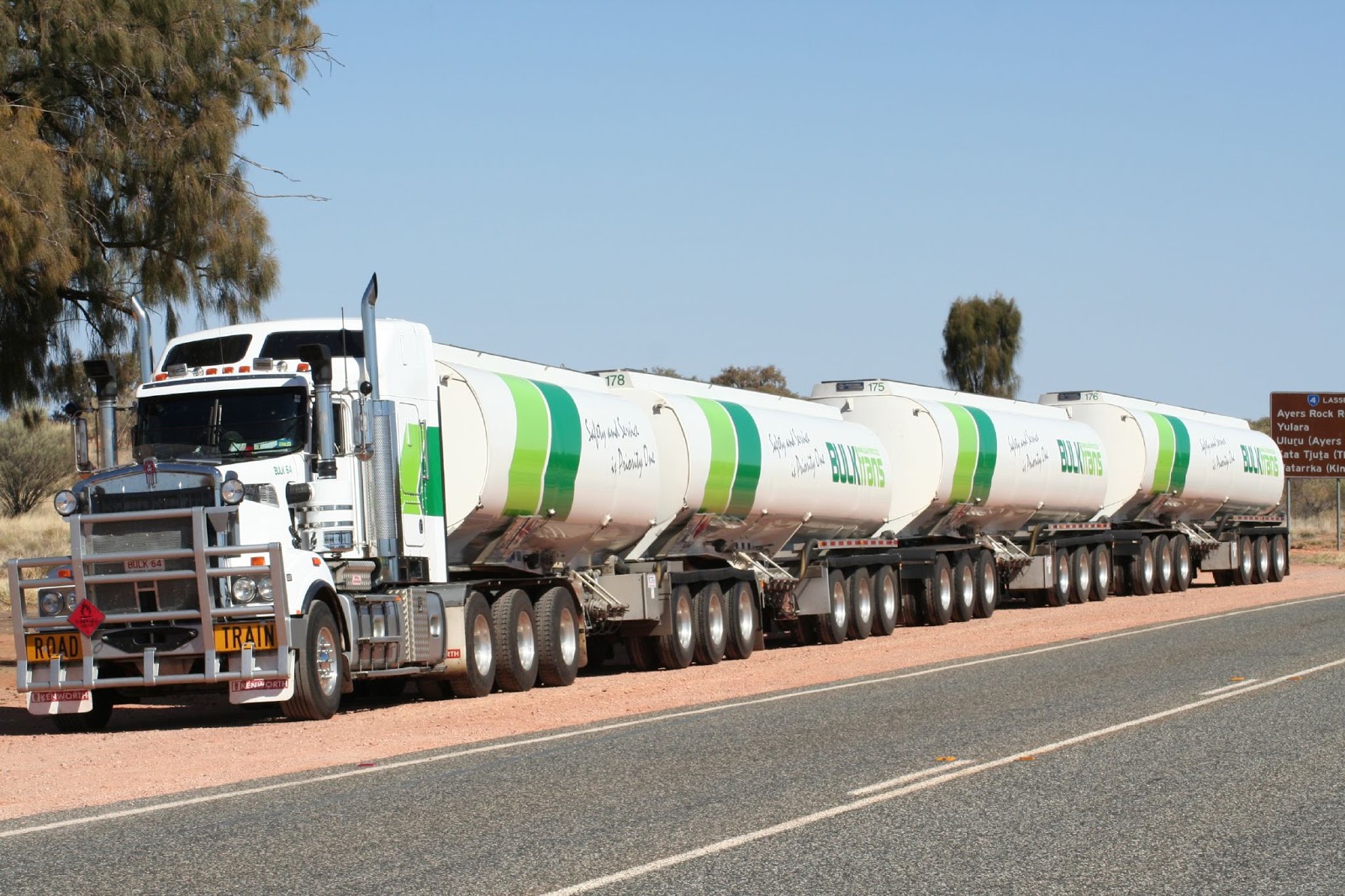
Combining such a distributed electric powertrain with a battery electric prime mover would provide not only range extension capability but also improve drive traction for both single and multi-trailer road trains.

Volvo targets one million electrified cars by 2025

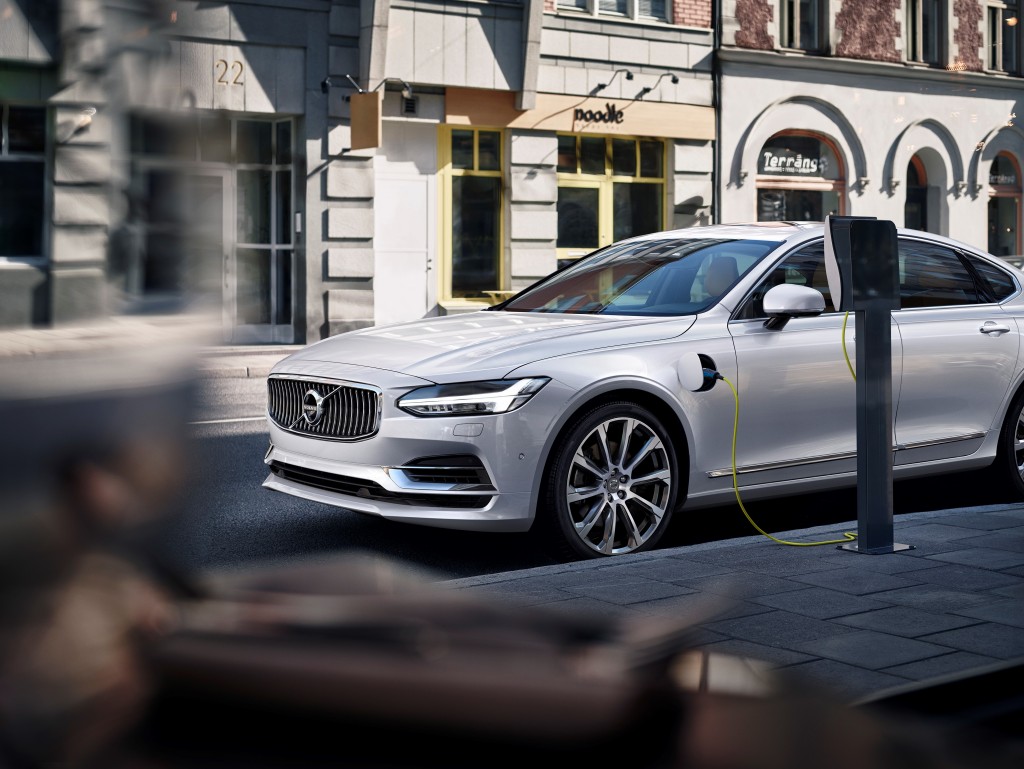
Volvo has set itself a target of producing one million electrified cars by 2025, in a bid to serve the growing demand for battery-powered vehicles.

The Swedish car maker is aiming to produce two hybrid versions of every model in its range, with the first all-electric car expected to appear in 2019.

“It is a deliberately ambitions target,” said Volvo boss Håkan Samuelsson. “It’s going to be a challenge, but Volvo wants to be at the forefront of this shift to electrification”.

Volvo says it has been preparing for the move to electric vehicles for five years by developing two platforms, both of which can incorporate hybrid and electric technology, with one for large cars and one for small cars.

The Scalable Product Architecture (SPA) platform will be used for its 90 and 60 series models, with the soon to be launched 40 series using the Compact Modular Architecture (CMA). All of its models will be available with as electrified versions.

Last year, Volvo announced that it would launch an all-electric rival to Tesla, with a range of 325 miles, by 2019. Volvo says the years between 2020 and 2025 are a “period of critical acceptance” for the electric vehicle, as it aims to make electric cars part of the mainstream market.

LeEco Unveils LeSEE Autonomous Electric Vehicle Concept [VIDEO]

China's Le Holdings Co Ltd, also known as LeEco and formerly as LeTV, on Wednesday unveiled an all-electric battery concept car whose production version the company hopes will compete head-on with Tesla Model S.

The concept car, called LeSEE, which hints at a production version of the car LeEco is widely expected to launch in the future, is one of an array of similarly positioned premium electric vehicles (EVs) due to hit the market in the next few years from more than half a dozen Chinese-funded EV start-ups.

LeEco said the concept car, which will be displayed at next week's Beijing auto show, is not only fully electrically propelled but has been engineered to be a "smart", "connected" and "automated self-driving" car.

Jia Yueting, co-founder and head of LeEco, said he hopes that when the car hits the market it will help China's auto industry reach the forefront of the global auto sector.

"When everyone is questioning us over our ability to develop a car like this and is laughing at us, we are still able to be here and show you this car ... I am so emotional," Jia said at a LeEco launch event for several products in Beijing on Wednesday.

Jia said LeEco is also developing a car-sharing business in connection with its green car efforts.

He said one day LeEco cars would be offered free of charge to consumers because the company aims to make money on content and other services it sells through those connected cars. Jia did not say when that day might come.

"Our cars' pricing model will be similar to pricing models for cellphones and tv sets we sell today," he said. "One day our cars will be free ... We are getting there some day."

LeEco's electric vehicle unit and other EV startups in China proliferated after the government, looking to fuel a more determined switch to electricity as the ultimate alternative to petrol, liberalized and opened its automotive industry to allow deep-pocketed tech firms to invest as long as they dabble in electric cars.

Aside from LeEco, the likes of Baidu, Alibaba, Xiaomi Inc, Tencent and other tech firms have funded more than half a dozen EV start-ups, which include NextEV and CH-Auto.

Those new players have been emboldened by the government's all-out support for all types of electric cars, which includes generous incentives to buyers.

They also expect industry policymakers to mandate providers of public transportation such as bus companies, taxi operators and even courier services to purchase electric vehicles and invest in charging infrastructure to usher in an electric future.

LG Chem plans to build electric car battery factory in Poland – source

South Korea's LG Chem plans to build an electric vehicle battery factory in Poland to meet rising demand from European automakers, a person familiar with the matter said on Thursday.

"The plant will be completed in about one-and-a-half years," said the source, who did not want to be named as he was not authorized to talk to the media. He did not provide any details on the size of the investment.

The facilities, to be located in the southwestern Polish city of Wroclaw, will ultimately have a production capacity of 229,000 EV batteries a year, making it LG Chem's second-biggest EV battery factory after China, the source said.

The company also builds EV batteries in South Korea and the United States.

LG Chem - the battery supplier for General Motors' upcoming electric car Bolt - counts a total of 25 automakers globally, including Renault, Volkswagen, Audi and Volvo in Europe, as its customers.

A spokesman for LG Chem said it was considering adding car battery production facilities, but nothing had been decided.

Automakers around the world are expected to roll out a slew of electric vehicles to meet tougher emissions and fuel economy regulations, although there are concerns that current low oil prices will dent demand for fuel-efficient cars.

LG Chem's rival Samsung SDI, which has BMW as one of its customers, is also considering building an EV battery factory in Europe, a Samsung SDI spokesman said.

Electromagnetic Anti-Lock Braking for Electric Vehicles

In part 2 of this series (Part 1) we'll take a closer look at electromagnetic braking as a replacement for mechanical friction brakes in hybrid and electric passenger cars.

Electromagnetic braking is very well established in industrial applications. From 400 tonne mine haul trucks to 300 km/h Bullet trains, electromagnetic 'friction' is used to slow these high performance vehicles with industrial strength reliability, so why shouldn't it also be used on comparatively light weight private passenger vehicles ?

Lets take a look at a few of the more familiar applications of electromagnetic braking. Japan's Shinkansen high speed rail network has the best safety record on the planet: beating conventional trains, automobiles and flying. Over the Shinkansen's 50-plus year history, carrying over 10 billion passengers, there have been zero fatality / injury since 1964. Clearly many factors contribute to this but obviously the train braking system plays an important role, especially given the maximum operating speed is 320 km/h (200 mph).
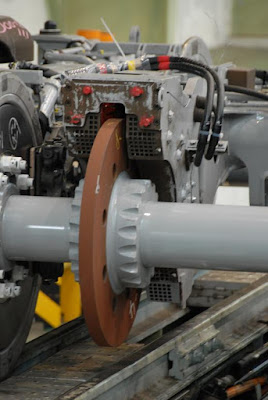
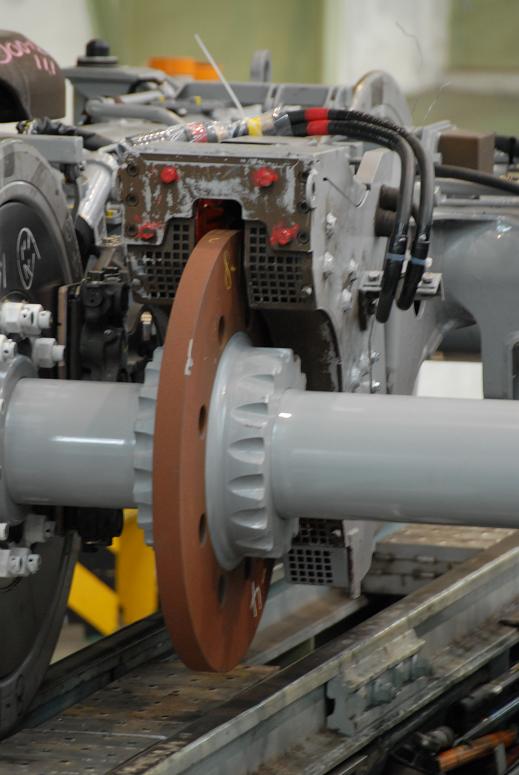
Bullet trains uses electricity to brake up to 640 tonnes down from 300 km/h at a controlled and predictable deceleration rate. Since 1984 all Shinkansen trains have used axial flux eddy current disc brakes (pictured above). These work along the same lines as an eddy current dyno where a steel brake rotor has electromagnets facing it, that when energised, induce eddy currents in the rotor which generates electromagnetic friction that converts the trains kinetic energy into heat.

With the only moving part being the rotor and no wear and tear from mechanical friction, eddy current brakes have proved incredibly reliable and no doubt contribute to the 100% safety record achieved by the Shinkansen rail system. Since 2007 next generation Bullet trains have moved to regenerative braking that uses the main traction motors which helps increase overall system efficiency.

Another very large vehicle that uses electromagnetic brakes is the 400 t class Liebherr T282B Mine haul truck. with a maximum operating weight of almost 600 tonnes, the T282B has no mechanical connection between the monster 90 liter V20 twin turbo diesel engine and the rear wheels.

Instead it takes advantage of high efficiency and maintenance free diesel-electric locomotive technology. Siemens provide two AC induction motors for the rear axle, engine mounted generator and the solid state computer controlled power inverters that are proven over millions of operating hours in trains. The main service brake electric retarders can slow the truck to a stand-still and provide precise speed control on descent using built in cruise control which works in both drive and retard modes.

The electric retarders can apply over 6,000 hp (4,489 Kw) worth of braking effort (the Diesel ICE maximum output is 'only' 3650 hp (2700 Kw). Like the Bullet train there is no battery storage system on-board so the regenerated energy is not stored for later use but is converted to heat via a stainless steel resistor grid in a systems called dynamic braking.

If ultra-reliable electromagnetic braking of 600 tonne vehicles hasn't convinced you then surely this last example will. Strictly speaking this is called magnetic braking as the source is permanent magnets, yet it is just as impressive.

Drop Tower amusement park rides feature up to 400 feet (120 m) towers with a carriage capable of taking up to 40 passenger aloft. Once 30 stories off the ground, the 25 tonne carriage is dropped and free-falls back down the tower reaching speeds of 105 km/h. Built by Swiss firm Intamin, the eddy current magnetic brakes pull the falling riders up at 2.5G from 100 to 0 km/h within 100 feet.

To put that into perspective, a Tesla Model S brakes from 100 to 0 km/h in 113 feet, weighs only 2.5 tonne and moves parallel to the ground, not hurtling head-first towards it.

The common threat between all the above braking applications is that mechanical friction brakes would simply not be capable of reliably doing the job. While these electric braking systems convert kinetic energy into heat, as do hydraulic friction brakes, using electromagnetic friction offers a non-contact method of braking that virtually eliminates maintenance and therefore reliability issues.

In the previous post we've seen evidence that hydro-mechanical friction brakes on hybrids and EVs have become redundant legacy systems primarily still required on vehicles because they provide mandatory safety systems. In order to allow electromagnetic braking to functionally replace systems like ABS & ESC not only do we need each wheel to have an electric motor to drive / brake each wheel independently, but also additional electromagnetic braking strategies other then just regeneration feeding kinetic energy into a battery pack.

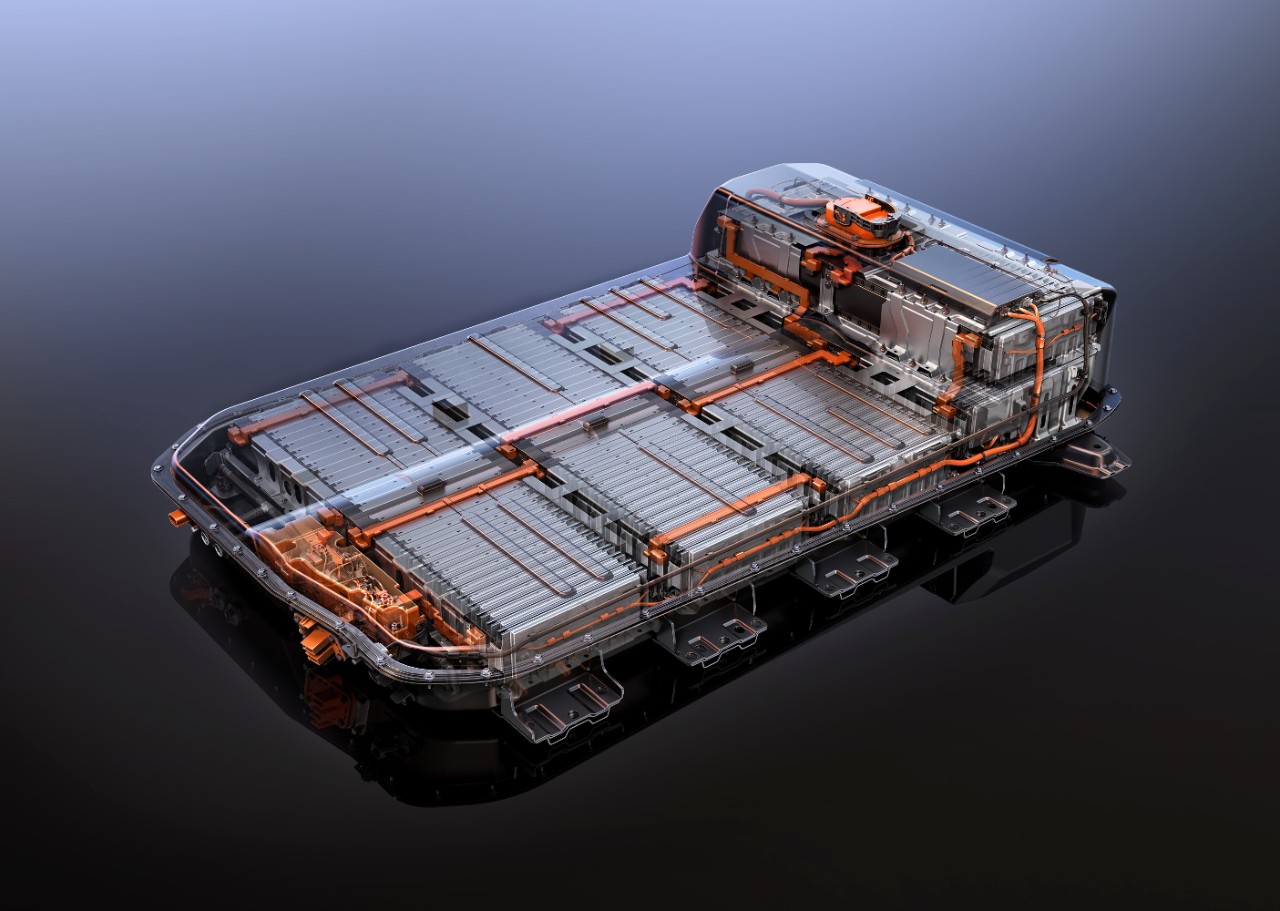
Currently in hybrid and electric vehicles only a fraction of the electric motors full power is used for braking. For example, a Chevy Volt has 115 kw of electric motor power available for acceleration but only 60 kw for braking. Even a Tesla Model S with over 500 kw for acceleration is limited to 60 Kw maximum brake regeneration. The primary reason for this is battery cell charge limits. Most lithium ion batteries have asymmetric charge & discharge curves.

In order to allow full electric motor power to be applied in brake mode, alternative energy discharge methods are required. As we have seen in the examples provided above, there are several options from dynamic to eddy current braking and/or the addition of supercapacitors in parallel with the battery pack. With an electric motor for each wheel and full motor power available for braking, modulating the motors independently to perform anti-lock, stability control, emergency brake assist, automatic emergency braking and torque vectoring becomes a software project.