Panasonic Ene-1 GP Suzuka KV-40 Challenge [VIDEO]

The "2013 Ene-1 GP SUZUKA" next-generation electric energy car event was held last month at Suzuka Circuit.

It was sponsored by Land Mobility Inc, owner of Suzuka Circuit, and Panasonic was an official partner of the event.

Panasonic promoted its "KV-40 Challenge" where cars were powered on 40x AA rechargeable nickel-metal hydride (NiMH) batteries. In this challenge, teams were invited to independently produce single-seater electric vehicles, powered by EVOLTA batteries, and complete 3 laps around the 5.8 km Suzuka circuit which features a maximum elevation change of 50 meters.

75 teams from all over Japan participated, ranging from junior high school teams to serious hobbyists, with average speeds on the track reaching up to 60 km/h and it was noted that driving skill definitely played a large part in participant success.

The winner of the time trial was "Ahiru-Ecopa Racing Togo" team.

GM Working on $30,000 EV with 200-Mile Range

As automakers race to make cheaper electric cars with greater battery range, General Motors is working on one that can go 200 miles per charge at a cost of about $30,000, a top company executive said.

Vice President of Global Product Development Doug Parks wouldn't say when or if such a car will be built, however.

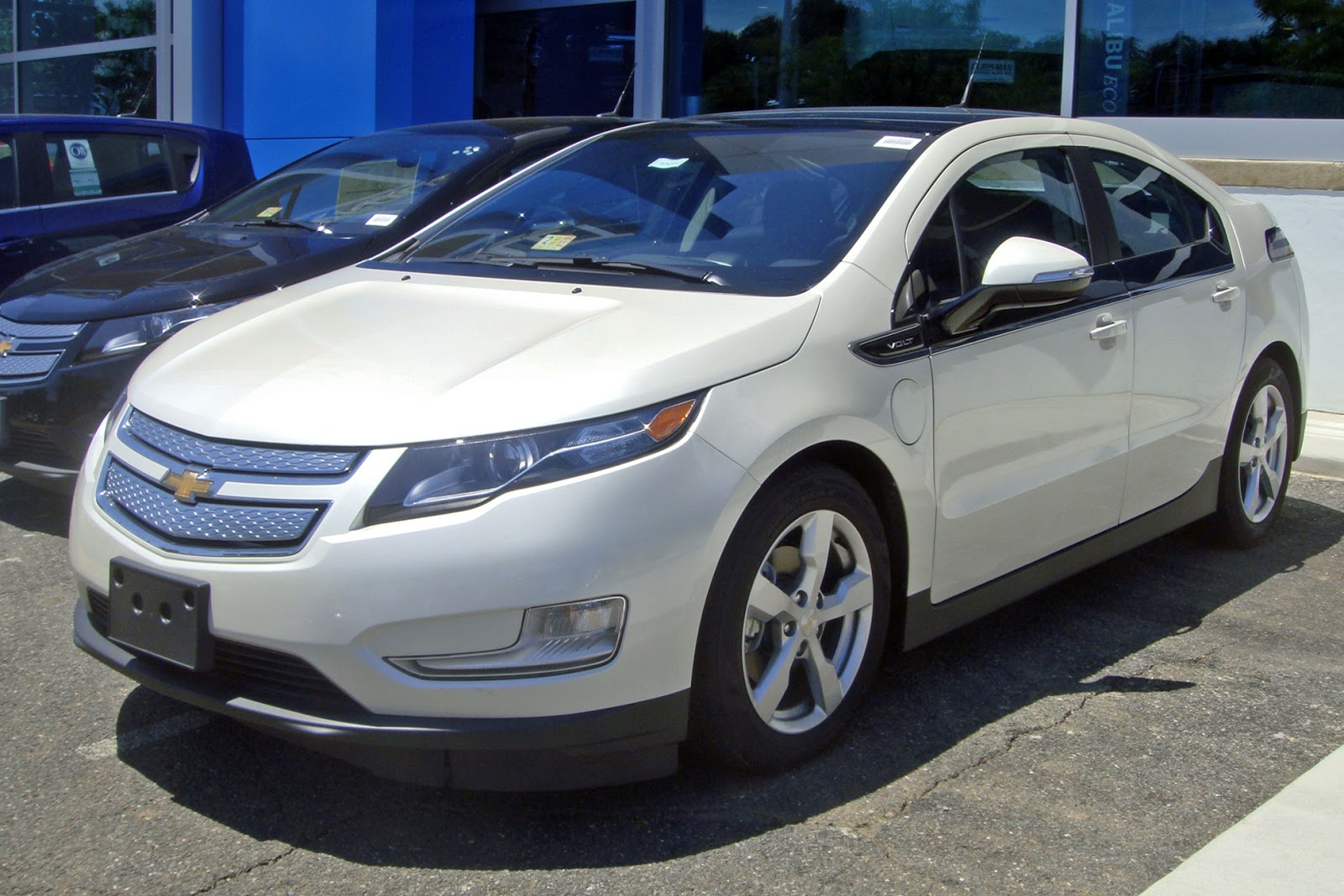
Currently GM sells the $35,000 Chevrolet Volt plug-in hybrid, which can go 38 miles on electricity before a gas-powered generator kicks in. It also offers the all-electric Chevy Spark subcompact that can go 82 miles on a charge. It starts at $26,685. Electric cars are eligible for a $7,500 federal tax credit.

The 200-mile car would cost about the same as the current Volt, and it would match the range and be far cheaper than Tesla Motors' $71,000, all-electric Model S. The Model S can go up to 265 miles on a single charge.

A moderately priced electric car with a 200-mile range would make electric cars more appealing to Americans, solving the two chief complaints about such cars: Anxiety over running out of power and high price, said Tom Libby, lead North American analyst for the Polk automotive research firm.

"That would be a huge step forward, no question," he said.

Currently, cars powered solely by batteries make up only 0.3 percent of U.S. sales, Libby said, but he's confident that would increase if an automaker came out with a moderately priced 200-mile car.

Tesla gets accolades for the Model S, including the highest test score ever recorded by Consumer Reports magazine. And the Palo Alto, Calif., company also is working on a mass-market electric car. CEO Elon Musk has said it will have around a 200-mile range and cost about $35,000. It could go on sales as early as the end of 2016, he has said.

GM has taken a different approach from Tesla, Parks said, pricing electric vehicles from around $25,000 to about $40,000. They don't go as far after each charge, which has kept battery costs down and made the cars more affordable, he said.

"Their pricing is up there for a real unique customer," Parks said of Tesla. "The real trick will be who can do a 200-mile car for more of the price range I'm talking about. We're all in races to do that."

The 200-mile car won't be the next-generation Volt. Speaking at a Monday event to show off GM's expanded battery laboratory at its technical center in Warren, a suburb north of Detroit, Parks said that GM engineers are now working on a new Volt, which will go a little father on electricity than the current model and cost a little less. He wouldn't say when it will arrive in showrooms or how much it will cost.

GM on Monday showed off a 50,000-square-foot addition to the battery lab. The added space, which nearly doubled the lab's size, will let the company test batteries and computer controls much faster than before. Parks said the goal is to develop electric cars twice as fast as the company could in the past. It took GM about four years to develop the Volt and bring it to market.

Solar Cars improve the breed

A famous quote from Soichiro Honda, the legendary founder of Honda Motor Company, says “Racing improves the breed”. There's no doubt many Formula One teams have used the phrase to imply a legitimate link between innovations made in racing that eventually benefit us all as the technology from top-level motorsport filters down into road cars, although it would be hard to convince anyone of a practical use for an off-throttle blown diffuser in a hatch back.

Likewise solar racing cars have made significant contributions that have lead to today's current crop of mass produced Plug-In electric cars. It all started with the winning vehicle of the very first World Solar Challenge in 1987. GM's Sunrayer was designed by Hughes Aerospace, (the company originally founded by Howard Hughes) at the time a division of General Motors, in collaboration with a smaller aerospace company called AeroVironment.

More than a dozen Caltech graduates participated in Sunrayer programs at AeroVironment, the most deeply involved was Alan Cocconi who was responsible for the power electronics systems. This included everything from motor controller through battery management to telemetry.

The Cocconi designed MOSFET based three phase AC motor drive inverter ran a 92% efficient 10 hp (peak) motor that drove the left rear wheel of Sunraycer via a cogged belt.

Sunraycer won Pole with a top speed of 109 km/h and lead the 24 car field from start to finish covering the 3,005 km route at an average speed of 66.9 km/h (41.6 mph), 50% faster than 2nd place.

Following the World Solar Challenge success, in early 1988 GM insiders proposed the idea of making a very efficient EV with the knowledge gained from Sunraycer but to make it an affordable car with decent range and performance equal to a petrol powered car. Work soon begins at AeroVironment on the 'Impact' based around a 15 kWh Lead Acid battery pack, Al Cocconi again responsible for power electronics design.

The Impact EV concept car was launched at the LA Auto Show in Jan 1990 and the car so well received that by April GM announced the car would go into production. The Alan Cocconi designed motor controller for the Impact, a direct descendant of that used in Sunraycer, were refined by Hughes Electronics and went into the GM EV1 when production started in 1996.

Based on his work to date, in 1992 Alan Cocconi founded AC Propusion to produce electric vehicle drive systems featuring high performance, high efficiency induction motors and integrated high power battery charging. The original test bed was a not too glamorous Honda Civic but once the powertrain design was debugged, a Piontek Sportech kit car chassis, originally designed for a Suzuki GSX-R motor, was converted into an EV sports car called t-zero.

Launched in 1997, the 1040 kg t-zero, powered by 28x lead acid batteries, started to make headlines with it's 0 to 100 km/h in 4 seconds levels of performance. By 2003 the car had been upgraded with 6,800x 16850 Li-ion cells with a single charge range of 480 km, a 320 kg reduction in kerb weight and 0-60 times reduced to a supercar beating 3.2 seconds.

If some of these specs sound similar to the Tesla Roadster, that's because the Roadster was developed by Tesla Motors to mass-produce AC propulsions t-zero, the first EV to demonstrate the performance and range potential of lithium ion batteries and the car that can legitimately be credited with inspiring today's mass produced plug-In electrics from GM, Nissan, Mitsubishi etc. In fact Tesla Motors was founded to commercialise Alan Cocconi's work and the Tesla Model S uses technology licensed from AC Propulsion.

Today's solar racers are still blazing a trail years ahead of the automotive industry, witness BMWs i3 Electric car, the first all carbon fibre production car. In the area of powertrains, every WSC winner since 1999 has used direct drive in-wheel motors (road car in-wheel motors are currently being developed) and surely in won't be much longer before the 12.5% of Australian homes that have roof-top PV systems installed realise they already have the infrastructure in place to solar power a plug-in electric vehicle for their daily commute?

This year’s Bridgestone World Solar Challenge is held from 6th – 13th October. If you can’t make it to Darwin or Adelaide, you can follow the race on Twitter via @tsport100 or @WorldSolarChlg.

Disclosure: Post is sponsored by Bridgestone World Solar Challenge. Words and thoughts are entirely my own.

Spark-Renault SRT_01E Formula E race car unveiled in Frankfurt

FIA President Jean Todt and Alejandro Agag, CEO of Formula E Holdings, earlier this week (September, 10) revealed the much-anticipated new Spark-Renault SRT_01E fully-electric single-seater during the opening day of the prestigious 65th International Frankfurt Motor Show.

Watched by invited guests and members of the press, the SRT_01E has been designed and built by Spark Racing Technology, headed by the renowned Frédéric Vasseur, together with a consortium of the leading manufacturers in motorsport, and will compete in the inaugural FIA Formula E Championship - the world’s first global electric race series beginning in September 2014.

Using the very latest technology, the SRT_01E aims to push the boundaries of what is currently achievable in electric motorsport, whilst ensuring a balance between cost-effectiveness and sustainability, in addition to coping with the demands of racing entirely on city-centre circuits.

The car’s monocoque chassis has been constructed by leading Italian firm Dallara and has been aerodynamically designed to aid overtaking. Made from carbon fibre and aluminium, the chassis will fully comply with the 2014 FIA crash tests.

Providing the electric motor, gearbox and electronics is McLaren Electronics Systems, the world leader in high- performance technology for motorsport. Williams Advanced Engineering, part of the Williams group of companies that includes the world famous Williams F1 Team, is responsible for the design and supply of the batteries and their battery management systems; producing 200kw (the equivalent of 270bhp).

Overseeing all the systems integration, performance optimisation and powertrain electrical safety is Formula E’s Technical Partner Renault, a leader in electric vehicles and an expert in motorsport thanks to its Renault Sport Technologies and Renault Sport F1 programmes. Meanwhile, custom made 18-inch treaded tyres have been created by Official Tyre Partner Michelin, with just one durable tyre to cater for both wet and dry conditions and helping to reduce overall costs and promote sustainability.

“I congratulate all partners involved in the production of the fully-electric SRT_01E car – it is a fantastic achievement,” said FIA President Jean Todt. “The innovative technology deployed follows the best environmental practices, highlighting the potential of the Formula E Championship to spark a revolution in the development of new electromobility systems, not just for motorsport but also for everyday use. This new championship builds on the FIA’s traditional role as a leading promoter of innovation, technology and performance in the automotive sector.”

The car, which has been 10 months in the making, will be used by all 10 teams and 20 drivers competing in the new zero emission series although only for the first season as Formula E is an ‘open championship’ designed to encourage manufacturers to build their own car to help accelerate R&D around the electric vehicle. A total of 42 cars will be produced by Spark with each driver using two cars during the one hour races.

Alejandro Agag, CEO of Championship promoter Formula E Holdings, said: “With Formula E being an open championship, the series gives manufacturers the opportunity to showcase their electrical energy innovations and we’re delighted to have Spark Racing Technology as the first, and for them to produce our new fully-electric Formula E car. Spark has enlisted the very best companies in motorsport to aid with its development, with Dallara, Renault, McLaren, Williams and Michelin all leaders in their respective fields and it’s an honour to welcome them here today. The Frankfurt Motor Show is also the perfect environment to reveal our new car. Many leading manufacturers at the Show today are unveiling their new electric road cars but not just one offs, full car ranges, demonstrating how times have changed and why the time is right to launch the new FIA Formula E Championship.”

Frédéric Vasseur, President of Spark Racing Technology, added: “I am extremely proud and happy to work with the partners Spark has gathered together to form this unique consortium, a first in the history of motorsport. I regard each and every one of these partners with the highest esteem, I have worked with them throughout my career and they have accompanied me in a lot of the successes I have been fortunate to achieve in my other activities in traditional motorsport. All consortium members are driven by a motivation to make this innovative project a success.”

Patrice Ratti, CEO of Renault Sport Technologies, said: “As a global leader for the production of electric vehicles and with a unique expertise in motorsports ever since the company was founded, the choice of Renault as technical partner to develop the fully-electric SRT_01E car for the FIA Formula E championship was obvious. Renault engineers and motorsport experts are directly contributing to the overall powertrain architecture and are in charge of electric systems' specifications and integration, benefiting from the experience acquired while developing the new 2014 Renault-Energy-F1 Power Unit. Renault is also working with Spark to enhance the performance and safety level of the SRT_01E car powertrain. The objective is to design an outstanding race car that will be clean, reliable, safe as well as fast and responsive.”

Peter van Manen, Managing Director of McLaren Electronic Systems, said: “These cars are going to be brilliant racing through the centres of cities. Electric motors deliver instant torque and acceleration and that is what McLaren is all about. Performance and efficiency. Our electric motor, developed originally for the McLaren P1™, has the highest power-to-weight ratio in the world. McLaren is proud to provide the performance behind Formula E.”

Sir Frank Williams, Founder and Team Principal of Williams, commented; "Motorsport is moving towards a greener future and the FIA Formula E Championship will be a prime opportunity to showcase the latest green technology that has its origins in motor racing. Williams has a track record in developing hybrid technologies and we are proud to be supplying the battery and battery management system for the car that is being launched today. These components will be a pivotal part of what makes the car so green and the team at Williams Advanced Engineering is working hard to develop a battery system that is reliable and makes for excellent racing."

Andrea Pontremoli, CEO of Dallara Automobili, said: “With our single-seater cars running successfully in the most important categories and championships all over the world, we could not lose the opportunity to be part of the new Formula E exciting challenge and we are very thankful to our long term partner Frédéric Vasseur for the credit he gave us. We will use all our experience and know how to design and build the best possible chassis in terms of performance, reliability, ease of use and safety. The safety aspect is particularly important for us and we are working hard with Spark and the FIA to set new safety standards for such an innovative championship.”

Pascal Couasnon, Director of Michelin Motorsport, added: “Michelin is the official tyre supplier to the FIA Formula E Championship for the next three years [2013 to 2015]. This new discipline is of special interest to Michelin because it is a means to work on the design of efficient tyres to optimise the range of the formula’s single-seater cars. These solutions need to be extremely versatile in order to adapt to different weather conditions without losing any of their pedigree as genuine racing tyres. For Michelin, it is an additional opportunity to carry over the innovations developed for motorsport from the race track to the street.”

The SRT_01E will undergo a stringent FIA crash test followed by an extensive testing programme.

VW announce plans to electrify 14 models by 2014 possibly up to 40

Amazing how some companies change their tune. Only as recently as 2009 Dr Winterkorn himself said that EVs won't have a majority share in the market for another 15-20 years. Yet within 5 years they're planning a total of 14 models from several Group brands with electric or hybrid drive technology. If there is sufficient demand, Dr Winterkorn says up to 40 new models could be fitted with alternative drivetrains.

The Volkswagen Group has set its sights on global market leadership in electric mobility. "We are starting at exactly the right time. We are electrifying all vehicle classes, and therefore have everything we need to make the Volkswagen Group the top automaker in all respects, including electric mobility, by 2018", Prof. Dr. Martin Winterkorn, CEO of Volkswagen Aktiengesellschaft, said on the eve of the 65th International Motor Show in Frankfurt am Main.

Winterkorn is convinced that Volkswagen is strongly positioned: "We have the most comprehensive approach to tomorrow's mobility. From highly-efficient, eco-friendly diesel, gasoline and natural gas-fuelled engines to classical hybrids, purely battery-driven vehicles and plug-in hybrids - no other automaker can match the broad range we have to offer." The company wants to win new customers with electric vehicles that are technically mature, practical in everyday use, safe and affordable, and is showcasing models such as the all-electric e-up! and e-Golf as well as the Audi A3 e-tron plug-in hybrid and the Porsche Panamera S E-Hybrid, also a plug-in model, at the auto industry’s leading motor show.

According to Winterkorn: "The electric car cannot be a compromise on wheels, it must convince customers in every respect." He said that environmental compatibility and sustainability were increasingly becoming the main purchasing criterion: "From the zero-emission city car, through the plug-in hybrid all-rounder to the three-liter sports saloon: It is our customers who decide for themselves just how much e-mobility they want." He went on to say that electric-drive vehicles were a key building block for achieving the ambitious climate protection targets, and that the plug-in hybrid had the greatest market potential.

Initially, a total of 14 models from several Group brands will be available with electric or hybrid drive technology by 2014. If there is sufficient demand, up to 40 new models could be fitted with alternative drivetrains. Winterkorn underscored that Volkswagen had placed electric mobility "at the center of the Group": "We have developed the know-how for electric motors and battery systems at our own components plants, we have recruited 400 top experts for electric traction and qualified almost 70,000 development, production and service employees in this new technology – the biggest electrification training program in our industry."

The Volkswagen Group invests over seven billion euros in research and development each year. A significant share is spent on developing technologies and components for electric mobility – more than in any other field.

The key to rolling out electric mobility swiftly and efficiently across all brands and vehicle classes is the modular toolkit systems which from the start have been designed for assembling electric drives. Production in Bratislava, Puebla, Wolfsburg, Leipzig or Ingolstadt can now respond flexibly and at low risk to demand as it arises and can reduce both weight and costs through the use of proven components.

According to Winterkorn, anyone who genuinely takes ecological responsibility seriously goes one step further: "We must have a holistic mindset and a comprehensive approach to mobility – from generating energy through development, production, retail and vehicle operation right down to recycling. Our clear goal, therefore, is to lead with holistic, modern mobility concepts."

In Europe, Volkswagen Group brands currently offer 420 model variants with maximum CO2 emissions of 130 grams per kilometer, 302 models emitting a maximum of 120 g/km, 50 models emitting up to 100 g/km and 23 models emitting 95 g/km or less. The Volkswagen XL1 plug-in hybrid has the lowest emissions. The world's most efficient series production vehicle has CO2 emissions of 21 g/km, consumes 0.9 liters of fuel and has a range of 500 kilometers, making it the company's technological spearhead.

ELMOFO Electric Radical SR8 Track Testing [VIDEO]

Solar Power Australia's ELMOFO (Electro Motive Force) Electric Radical SR8 has logged more testing laps around Eastern Creek Raceway, now known as Sydney Motorsport Park.

The team are chasing more track time to tune the dual RMS PM150 Inverters to suit the 600 hp EVDrive Dual-Inline Stacked Motor.

The Radical currently holds the EV lap record at the 3.9 km circuit of 1:37.5.

World Premiers of VW e-Golf and e-up! @ IAA 2013 [VIDEO]

In a dual world premiere, Volkswagen will be presenting two new and extremely efficient electric cars at the International Motor Show (IAA) in Frankfurt (10th to 22nd September): the e-up! and e-Golf. This means that Europe's most successful carmaker is transitioning two high-volume production models to the age of electric mobility. Both zero-emissions cars offer unlimited everyday practicality, each has four doors, and they are attractively equipped. Standard features: automatic climate control with parking heater and ventilation, radio-navigation system, windscreen heating, LED daytime running lights and, in the e-Golf, the Volkswagen brand's first use of LED headlights. The two newcomers are also leaders in energy efficiency: the e-up! consumes just 11.7 kWh of electricity per 100 km – this makes it the new world champion in efficiency. The e-Golf, positioned two classes higher, attains an excellent value of 12.7 kWh. Given an electricity price of €0.258 per kWh (Germany, as of 31st July 2013), driving 100 km with the e-up! costs just €3.02, and with the e-Golf it is around €3.30.

Made in Germany. Innovative drive technologies are core competencies at Volkswagen. Therefore, the e-motors, gearboxes and lithium-ion batteries of the e-up! and e-Golf are developed in-house, and they are manufactured in large Volkswagen component plants in Germany.

Typical Volkswagen. All Volkswagen are intuitive to operate, extremely practical in everyday use and sophisticated, and these traits have been fully transferred to the brand's new e-vehicles. The zero-emission cars from Volkswagen are manufactured with the same high-volume production systems as their counterparts with combustion engines.

e-Golf data. The e-Golf, which is being presented in a world premiere in Frankfurt, is driven by a 85 kW / 115 PS electric motor. The motor produces its maximum drive torque of 270 Nm as soon as it starts off. The results: the front-wheel drive e-Golf reaches 100 km/h in 10.4 seconds. On a motorway, the speed of the five-seat front-wheel drive car is electronically limited to 140 km/h.

e-up! data. Also making its debut in a world premiere at the IAA is the four-seat e-up!. Its electric motor produces 60 kW / 82 PS. This motor transmits 210 Nm of torque to the driven front axle from a standstill. It completes the sprint to 100 km/h in 12.4 seconds. Top speed: 130 km/h.

Driving ranges tailored for commuters. The e-up! can drive 160 km on one battery charge (18.7 kWh), while the e-Golf with its larger battery (24.2 kWh) has a range of 190 km. In both models, two very efficient driving modes ("Eco", "Eco+") and four just as easy to activate regenerative braking modes ("D1", "D2", "D3" and "B") help to extend maximum ranges. And they are driving ranges that make sense. In Germany, for example, studies by the Federal Ministry for Transport, Building and Urban Development found that around 80 per cent of all car drivers in Germany drive fewer than 50 km daily.

Quick charging. The fastest CCS charging stations (direct current) shorten the time needed to charge the battery of an e-up! or an e-Golf to 80 per cent capacity to just around half an hour.

Powertrain and fuel strategy. Over the past decade, Volkswagen has already systematically sketched out a schedule for the future in its powertrain and fuel strategy, which included starting points for electric vehicles like the e-up! and e-Golf. This strategy sets up a timeline with realistic time windows for the introduction of alternative drive systems such as the hybrid, electric and hydrogen-based systems. In this scenario, the all-electric drive system – which will be demonstrated by the new e-up! and e-Golf – represents an indispensable and sensible supplemental drive system. That is because electric cars utilise renewable energy sources and enable zero-emissions mobility in metropolitan areas. Nonetheless, well into the future Volkswagen will continue to promote an intelligent mix of the most efficient drive systems.

Driving at the pace of the big city. The fact is that the target group for electric cars is growing, because a paradigm shift has begun. Sustainable mobility is having an increasing impact on people's actions. Yet the products for implementing this environmental awareness must be practical and fun as well - such as the e-up! and e-Golf which accelerate to big city pace in just a few seconds. The new zero-emission Volkswagen cars therefore have the potential for irreversibly charging up the electric car segment with innovative technology, a high level of everyday practicality and a dynamic driving feeling.

Nissan e-NV200 Electric Van in Final Development Phase

Nissan is in the final development phase of its second mass production zero emission vehicle, the e-NV200 compact van. Electric vehicles are ideal for urban delivery applications, and this vehicle is envisaged for use as a delivery van that offers a breakthrough type of mobility for entrepreneurs, featuring efficiency and green consciousness.

The company has been working with several large commercial fleets in global markets since 2011 to understand how the e-NV200 test car performs under real operating conditions. So far the e-NV200 has received positive comments for its quiet, comfortable driving with no emissions and low noise, CO2 reduction, and generous carrying capacity.

Feedback will help Nissan adapt future battery-powered light commercial vehicles to better fulfill exacting customer requirements.

The 100% electric compact van, e-NV200, is scheduled for launch in 2014. As Nissan’s second global electric vehicle, it follows Nissan LEAF, the world’s first affordable 100% EV for the mass market.

In addition to further reinforcing Nissan’s zero-emissions leadership, the launch of the e-NV200 represents significant innovation in the commercial vehicle market. The model offers all the spaciousness, versatility and practicality of its base vehicle, the multipurpose commercial van NV200. It delivers advanced performance that can only be achieved through the powertrain of the Nissan LEAF.

The e-NV200 provides exceptionally smooth acceleration and quietness, driving characteristics that are unique to EVs, while emitting no CO2 emissions at the point of use. e-NV200 displays great potential for businesses, with its advanced telematics system and power-supply function in the cargo compartment. Also, the model's enviable running cost – a priority for most companies – will be highly attractive when competing in the commercial vehicle marketplace.

"The e-NV200 will offer all the spaciousness, versatility and practicality of a traditional diesel or gas-powered compact van, but with zero CO2 or other pollutant emissions at the point of use. What's more, it will provide an outstanding driving experience that is unique to EVs. e-NV200 represents a bold and innovative addition to our commercial vehicle range, which is already one of the broadest of any manufacturer," said Hideto Murakami, corporate vice president, Nissan Motor Co., Ltd.

When e-NV200 production begins it will become Nissan's second zero-emission vehicle, but the company is already investigating further innovative ways of harnessing its world-leading EV technology in the commercial vehicle market with the e-NT400, which is a light truck based on the European NT400Cabstar, known as NT400 Atlas in Japan.

The e-NT400, still in its development phase but with plans for production under study, uses Nissan LEAF running gear to create a zero-emission 100% electric vehicle.

Like e-NV200, e-NT400 would be able to enter city areas denied to conventional vehicles powered by diesel or petrol engines, while its near-silent running means it could operate around the clock as it creates no noise or emission nuisance.

Low running costs would make e-NT400 a breakthrough business proposition, while the high output, high capacity lithium-ion battery powering the 80kW electric motor gives smooth, vibration-free acceleration for a completely unprecedented driving experience.

With a cruising range of 87 miles (140 kilometers) in NEDC mode, and the availability of fully integrated Quick Charging potential - allowing the battery to be charged to 80 per cent capacity in just 60 minutes - the e-NT400 has the potential to make a serious contribution to lowering CO2 emission in cities. At the same time, it will increase productivity and lower running costs for operators.

Hideto Murakami, Nissan corporate vice president responsible for the Global LCV Business Unit, said: "As well as e-NV200, Nissan is developing a number of vehicles that adapt a diverse range of EV technologies. We want to explore the potential of EV technology in the light commercial market to diversify the value that Nissan's commercial vehicles provide to businesses."

Tesla Model S takes on the Aston Martin Rapide S [VIDEO]

The Tesla Model S is a landmark car, but is it better than the mighty Aston Martin Rapid S? Autocar take to the test track to find out.

Steve Sutcliffe over at Autocar thinks the Tesla Model S is the future...today. It offers most of the usability of the world's best luxury saloons, but with no tailpipe emissions and a fraction of the running costs.

And it handles too. Really handles. But can it really be better than the £150,000 Aston Martin Rapide S?

Nissan to Showcase ZEOD RC Electric Race Car at Fuji WEC event

Japanese fans will have the first opportunity to see the Nissan ZEOD RC in action when the car makes its public on-track debut at this year's Fuji Speedway round of the FIA World Endurance Championship.

Running in pure electric mode, the Nissan ZEOD RC will undertake demonstration runs on October 18, 19 and 20 - all three days of the Japanese round of the WEC. The Fuji demonstration was announced today at the Nissan 360 global media event in California.

The ZEOD RC (Zero Emission On Demand Racing Car) will make its race debut at next year's Le Mans 24 Hour. The global leader in electric vehicles for the road, Nissan will trial variants of new electric drive train technologies as part of its intended future return to LM P1 competition to challenge for overall victory at the world's most prestigious endurance race.

Nissan's two-time Japanese SUPER GT champion Michael Krumm will drive the car at Fuji. Krumm was part of the driver line-up for the Nissan DeltaWing program in 2012 and also finished third in the LM P2 class this year at the Le Mans 24 Hours.

Krumm competes for Kondo Racing in the SUPER GT championship in Japan alongside Hironobu Yasuda. In addition to his SUPER GT and Le Mans schedule, Krumm also recently tested a Nissan Altima V8 Supercar in Australia for the factory Nissan team.

"It is certainly going to be a very unique experience to go that fast with electric power - especially since Fuji's main straight is nearly a mile long.

"Fuji Speedway is such an historic venue - it's actually pretty fitting that the ZEOD RC will have its first public runs here because this car certainly has the opportunity to change motorsport history.

"We're only doing a demonstration run but I'm really looking forward to seeing what kind of top speed we'll see on the straight."

"To be able to do that at such a great venue like Fuji Speedway, only 90 minutes away from the home of NISMO [Nissan's motorsport arm and a partner in the development of the ZEOD] in Yokohama, was too good to pass up."

The internal-combustion motor that will form part of the ZEOD's powertrain is not due to run in the car until January.

Toll switches on Australia’s first all-electric truck

Australia’s leading provider of transport and logistics, Toll Group, has unveiled Australia’s first 100 per cent electric truck.

The 10-tonne Smith Electric vehicle will be used for parcel pick-ups and deliveries around Brisbane, and was on display at Toll’s Larapinta depot in Brisbane’s south today.

Market-leading express road freight business Toll IPEC will use the all-electric vehicle during an initial three-month trial that will look at how the vehicle performs in Australian conditions, and its cost to operate. Speaking at today’s unveiling, Toll Group Environment and Energy General Manager Nick Prescott said Toll is constantly looking for ways to apply new technologies and practices to reduce the consumption of non-renewable resources.

“We are extremely excited to be the first to get a look at this type of vehicle,” Mr Prescott said. “It is a shining example of the sorts of things we’re doing as part of our broader Smarter Green environmental program, which looks at the use of smarter fuels such as biodiesels, compressed natural gas and electric vehicles, but only when it makes operational and economic sense to do so. The Smith Electric adds to the many CNG, LNG and hybrid vehicles we operate in Australia and globally.

“Improving emissions, safety and energy consumption and costs also benefits our customers. That’s why we offer lower-carbonchoices through our technology, fuels and energy efficiency initiatives.” Toll will use data from on-board diagnostics that can be viewed online to monitor the vehicles’ performance in real-time.

Patico Automotive is the exclusive distributor of the Smith Electric range in the Oceania region. Managing Director Tony Fairweather said Patico was proud to be representing such an innovative brand as Smith Electric in this region, and was looking forward to trialling the vehicle in Australia.

“Smith Electric has been able to develop a product that makes absolute commercial sense, and we’re honoured Australia’s leading transport and logistics company, Toll, were so keen to be the first to use it,” Mr Fairweather said.

Dutch Drivers Achieve 625 km Single Charge Range with a Tesla Model S [VIDEO]

A standard Tesla Model S equipped with the 85 kWh battery pack has an official EPA rated range of 265 Miles (424 km) and 310 Miles (500 km) NEDC rating.

On Wednesday August 21st four students from the Technical University Eindhoven Sponsored by Athlon Car Lease achieved 388 miles (624 km) in real world driving conditions.

They're calling it a world record "real long distance driving" for the Tesla Models S because they drove with 2 people on normal roads with normal speeds.

Tesla Motors Launch Supercharger Network in Norway [VIDEO]

First European Superchargers from Tesla Motors on Vimeo.

Tesla Motors today unveiled its European Supercharger network, energizing stations across Norway that enable Model S owners to conveniently travel for free between cities along well-traveled highways throughout the country.

With locations in Lyngdal, Aurland, Dombås, Gol, Cinderella and Lillehammer, Norway’s most vital and commonly used roads and highways are covered by Tesla Superchargers. Model S customers can drive routes such as the E6 from Trondheim to Oslo, the E18 from Oslo to Kristiansand, the E39 from Kristiansand to Stavanger, and Highway7 from Oslo to Gol for free and with minimal stops. Approximately 90 percent of the Norwegian population lives within 320 km of a Supercharger station, and about 60 percent of the country’s total land mass is within the same distance of a station.

Tesla Superchargers represent the most advanced charging technology in the world, capable of charging Model S 20x faster than most common charging stations. Superchargers provide half a charge in about 20 minutes, delivering up to 120 kW DC (Direct Current) power directly to the Model S battery using special cables that bypass the onboard charging equipment. And because Superchargers are located where customers want to stop, near amenities like roadside diners, cafes and shopping centers, road trippers can stop for a quick meal while their Model S charges for free.

The extensive coverage provided by Tesla’s Supercharger network allowed three Model S to depart for Oslo this morning from locations in the north, west and south of Norway and travel the following major routes with ease: Trondheim-Dombås-Lillehammer-Oslo; Bergen-Aurland-Gol-Oslo; and Stavanger-Lyngdal- Cinderella-Oslo. During their 500 km journeys, each car charged at two of the new Tesla Supercharger locations, where they were met by enthusiastic customers and local officials.

Nissan’s 2013 LEAF Sales Surge 335%

Nissan reported a massive 335% increase in sales of its hatchback electric car LEAF in U.S since the launch of the 2013 model in Mar 2013. LEAF has been Nissan's bestselling car in Seattle, Portland and San Francisco. Alongside, the company also witnessed burgeoning demand for electric vehicles outside the traditional West Coast market, i.e., in "New Wave" markets across the country.

Nissan expects incremental demand for electric vehicles in diverse markets and LEAF is expected to dominate the market share. With more than 75,000 LEAF electric cars on the road, Nissan emerged as the global leader in zero emission vehicles.

Nissan has witnessed 8.5% year-on-year growth in sales so far this year. The increase was driven by record-breaking U.S. monthly sales in 4 out of 7 months. The biggest contribution came from year-over-year increase in the sales of Nissan LEAF and a surge in the sales of the redesigned Pathfinder SUV.

Apart from the U.S., Nissan is also doing well in other parts of America. The company witnessed 7.5% sales growth in Mexico in the first seven months of 2013. Moreover, it plans to open new manufacturing facilities in Aguascalientes, Mexico and Resende, Brazil.

Toyota adds discounts for Tesla-powered all-electric RAV4

Toyota Motor Corp. is discounting its all-electric RAV4 through low-cost lease and loan offers to boost demand for the slow-selling compact crossover that’s powered by a Tesla Motors Inc. battery pack and motor.

Toyota, the world’s biggest maker of hybrid autos, this month is promoting the option of a $299-a-month, three-year lease for the $49,800 light truck, or a 60-month, no-interest loan, said Carly Schaffner, a company spokeswoman. The offers run through Sept. 3 and are available only in the Los Angeles and San Francisco regions, the vehicle’s main markets.

Honda Motor Co., Nissan Motor Co. and General Motors Co. similarly have turned to discounted leases to buoy their rechargeable models. Toyota last year said it would sell 2,600 RAV4 EVs by the end of 2014. Through July, just 709 have been sold since sales began last September.

“The use of our incentives is tactical, reinforcing our value and focus on keeping our products competitive in the market,” Schaffner said. “We’re still evaluating the market demand for EVs.”

The battery-powered RAV4 arose in 2010 as a result of Toyota President Akio Toyoda’s desire to work with Palo Alto, Calif.-based Tesla. Along with the vehicle project, Toyota made a $50 million investment in Tesla. Tesla shares have surged about fivefold this year, boosting the value of Toyota’s 2.4 percent stake in the company to about $476 million.

Toyota, with the biggest market share in California, is under pressure to sell the most rechargeable vehicles in the state to meet strict emissions rules. Along with the electric RAV4 that goes about 100 miles per charge, Toyota sells a plug-in version of its Prius hybrid to meet state rules and will add a hydrogen-powered electric sedan in 2015.

200,000 Fast-Charging Stations for Electric Vehicles by 2020

Total fast-charging stations for EVs are set to reach 199,000 locations globally in 2020, up from just 1,800 in 2012. The number of these stations, meanwhile, is anticipated to rise more than threefold in 2013 to 5,900 and then nearly triple to 15,200 in 2014. Overall growth will continue at a rapid pace through 2020.

Hard charging

"The length of time it takes to recharge an EV continues to be one of the major stumbling blocks inhibiting the widespread adoption of electric vehicles," said Alastair Hayfield, associate research director at IHS Automotive. "Compared to the time it takes to refuel an internal combustion engine (ICE) vehicle, the recharge time for EVs is incredibly slow-at about four hours to charge a 24 kilowatt-hour (kWh)-capacity battery using a 6.6 kW on-board charger. If EV auto manufacturers could overcome this obstacle, it could lead to a high rate of adoption from environmentally minded consumers as well as those seeking to cut gasoline expenses. That's where fast charging comes in."

Hooked up to a fast-charging system, which offers a high-voltage DC charge instead of a slower AC charge, a vehicle can be fully charged in as little as 20 minutes. This could be a major step toward EVs becoming generally equivalent to ICE vehicles when it comes to refueling.

"IHS believes fast charging is a necessary step to promote higher adoption of EVs, but there will need to also be better consumer education regarding behavioral changes that may need to happen when owning an electric vehicle-such as charging overnight or at work," Hayfield said.

Japanese standard charges ahead

One fast-charging standard designed for electric vehicles is dubbed CHAdeMO, a primarily Japanese-backed technology. The major proponents of the technology are Japanese automotive OEMs-including Toyota, Nissan, Mitsubishi; and Japanese industrial giants-including Fuji Heavy Industries Ltd., Tokyo Electric Power Co. and more.

CHAdeMO, roughly translated as "charge for moving," began deployment in 2009 in order to accelerate the adoption of electric vehicles in Japan, where EVs have found positive reception. Today there are as many as 2,445 CHAdeMO fast chargers in operation and more than 57,000 CHAdeMO-compatible EVs around the world. This accounts for as much as 80 percent of all electric vehicles on the road, especially given the high concentration of EVs coming from Japan in the form of the Nissan Leaf, Mitsubishi i-MiEv, Hondo Fit EV and more.

One size charges all

A competing solution to CHAdeMO, aptly named the combined charging system (CCS), offers electric vehicle owners the option of having a single charging inlet that can be used for all available charging methods. That includes 1-phase charging at an AC power source, high-speed AC charging with a 3-phase current connector at home or at public charging stations, DC charging at conventional household installation and DC fast charging at power-charging stations globally.

CCS, which was submitted for international standardization in January of 2011, has garnered the support of Audi, BMW, Daimler, Chrysler, Ford, GM, Porsche and Volkswagen. Already BMW, GM and Volkswagen have announced they will introduce fast-charging EVs based on the CCS standard sometime this year.

Tesla vies to electrify the market

Tesla Motors, the California company most notable for the all-electric Tesla Model S, is driving a third method for fast charging. Tesla is developing its own proprietary network of fast chargers in the U.S. Dubbed "Superchargers," the chargers operate at a higher power rating than current CHAdeMO or CCS chargers, and also have a proprietary plug interface, which means that only Tesla vehicles can use them.

"In addition to the proprietary technology, the charging stations are free to use for Tesla owners, and there are plans to power all stations using photovoltaics," Hayfield said. "These Superchargers represent a powerful proposition for Tesla-drivers can charge faster, have U.S.-wide coverage by 2015 and will charge for free for life. This triple threat will aim to lock drivers into the Tesla experience, and also will give Tesla a perceived advantage over other original equipment manufacturers competing in the same market.

Future charge

Looking ahead to the future of EVs, it's clear that DC charging is becoming the favored means for supporting rapid, range-extension electric vehicles. But it is less clear as to whether CHAdeMO or CCS will win the battle for the consumer.

Japan will continue to utilize CHAdeMO, while Germany is set on using CCS; other nations likely will also utilize CCS as well, since it supports slow-charging. But no matter which solution is used, DC-based fast charging is critical to promoting consumer approval and interest in EVs.

VW to launch all-electric up! in Frankfurt

Volkswagen has confirmed that it will lift the veil off of an all-electric version of the pint-sized up! at the Frankfurt Motor Show next month.

Likely dubbed e-up!, the small EV will be offered as both a three-door and a five-door hatchback. Apart from discreet badges on the front fenders and on the trunk lid, it will look exactly the same as its gasoline-powered counterpart, enabling it to appeal to buyers that want a low-key EV.

Tipping the scale at almost 400 pounds, the up!'s electric drivetrain will consist of an electric motor mounted in the engine bay and a lithium-ion battery pack stored under the rear bench seat. The motor will send the equivalent of 82 horsepower to the front wheels, propelling the e-up! from zero to 62 mph in a little under 13 second and on to a top speed of 80 mph.

The lithium-ion battery pack will be rechargeable in about six hours when plugged in to a regular household outlet, or in 40 minutes when using a quick charger. It will give the city a car a maximum driving range of 80 miles.

Volkswagen has hinted that the e-up! will carry a base price of roughly €19,000 (about $25,000). Buyers will lease the battery pack from Volkswagen for €60 (around $80) a month.

After greeting the show-going public in Frankfurt, the e-up! will hit showrooms across Europe before the end of the year.

Panasonic Announce Tokai University Solar Car Team Sponsorship

Panasonic Corporation today announced that it has agreed to provide technical support to Tokai University's solar car team, which will compete in the 2013 World Solar Challenge (WSC 2013), one of the world's biggest races for solar cars, to be held from October 6 to 13 in Australia. Under the sponsorship agreement, Panasonic will provide the Japanese university team with its HIT(R) solar cells which boast the industry's top-class electricity output as well as its high-capacity lithium-ion batteries.

The WSC, which started in 1987 and became a biennial event in 1999, is a time-based competition over a distance of 3,021km from Darwin in the north down to Adelaide in the south. Teams from around the world, including universities and corporations, participate in the race in cars powered solely by sunlight.

The Tokai University team has an impressive track record in solar car racing. The team won the previous WSC races held in 2009 and 2011, and is now looking to make a hat trick in the WSC this year. Last year, the team also won the race in South Africa that was recognized by the Federation Internationale de l'Automobile (FIA) as the world's longest alternative fuel vehicle car race. Panasonic's energy products contributed to the team's victories at these international competitions.

Panasonic's HIT solar cells have a unique hybrid configuration with a crystalline silicon substrate surrounded by ultrathin amorphous silicon layers. Compared to ordinary crystalline silicon-based solar cells, Panasonic's HIT solar cells suffer less degradation of power output at high temperatures, delivering the industry's highest-level energy output per unit of area. This makes Panasonic's HIT solar cells ideal for solar cars competing in races such as the WSC, given that the WSC regulations limit the total area of solar cells installed on the body to up to six square meters and that the cells will be exposed to the scorching Australian sun. The HIT solar modules for the Tokai University team are purpose-built for the solar car race, using the same solar cells - the main component that converts the sunlight into electricity - that are mass-produced for the residential market.

The rechargeable batteries Panasonic is providing are the cylindrical 18650 type (18 mm in diameter x 65 mm in height) high-capacity lithium-ion battery cells which use the company's proprietary nickel-based positive electrode. The high-capacity and lightweight battery cells store excess power generated by the HIT solar cells so that the car is able to continue running even on overcast days.

Bridgestone Sponsors World Solar Challenge 2013

Bridgestone will be the title sponsor of the World Solar Challenge 2013, which will be held in Australia October 6-13.

Dubbed “The Bridgestone World Solar Challenge 2013,” the event will see a record 45 teams from 26 countries compete in a 3,000 km cross-country race using only solar energy to power the vehicles.

The event will feature three separate classes, Adventure Class, which will showcase cars built for previous events; Cruiser Class, which will be judged by design practicality, and Challenger Class, which will compete for the title of the world’s most efficient solar car.