Finnish Electric RaceAbout Blitz the Nürburgring [VIDEO]

During a recent Nürburgring expedition the Electric RaceAbout team set a new, greatly improved, lap time.

While testing the latest powertrain improvements and the new Nordschleife Aero-kit Micke Be rgman stopped the timing at 8:23.56. To put this in context the Audi R8 e-tron did it in 8:09.099 while the Mercedes SLS E-Cell set a time of 7:56.234

Due to the limited possibilities for only three complete laps this time there is still room for significant improvement.

According to Micke the new Nokian Hakka Black tyres, the torque vectoring control and Aero-kit combined with the lighter and more powerful battery take the E-RA to a completely new level of performance.

The almost unlimited new potential unleashed by the torque vectoring both improve the car's agility and stability. This was not previously possible with traditional powertrain technologies and together with the team we'll continue to explore the possibilities and improve the technology.

Kia Soul EV confirmed for 2014 launch

Kia has announced plans to offer a Soul EV in the United States.

Set to go on sale next year, the Soul EV is described as a "natural extension of the Soul's urban-friendly place in the brand's lineup of award-winning vehicles." The company declined to release additional information but said we can expect to learn more at an upcoming auto show.

While Kia is remaining mum on details, our spies have already caught the model undergoing testing. Despite being heavily camouflaged, the photos revealed the model will have a revised grille with an integrated charging port.

Little else is known about the model but previous reports have indicated it could accelerate from 0-100 km/h in less than 12 seconds, have a top speed of 140 km/h (87 mph) and travel up to 200 km (124 miles) on a single charge.

GM creates a Tesla task force

We've already heard reports that General Motors is working on a new electric vehicle with a Tesla Model S-like range of 200 miles (322 km) but new details are starting to emerge about the company's Tesla task force.

In an interview with Reuters, General Motors Vice Chairman Steve Girsky revealed the company has created a new task force to study Telsa and the Model S. The diverse group - which includes product planning, engineering, manufacturing and sales personal - will attempt to learn everything they can about Tesla so they can improve their own future products. As Girsky explained, Tesla is "revolutionizing the business model ... not just how you put an EV together [but] how you go to market with something like this."

While it's unclear what lessons General Motors will learn, the company is reportedly working on a handful of new hybrids and EVs. Besides the 200 mile (322 km) Chevrolet EV, which is expected to cost between $30,000 and $35,000, the company is reportedly developing fuel-efficient flagships which could be badged as Cadillacs and cost more than $100,000.

Source: Reuters

Top Gun Scrutineering for the Bridgestone World Solar Challenge [VIDEO]

The Clipsal and Schneider Electric Challenger Class single seat aerodynamic masterpieces were presented to Scrutineering on day 2 of the Bridgestone World Solar Challenge at the Royal Darwin Showgrounds.

This year’s Bridgestone World Solar Challenge is held from 6th – 13th October. If you can’t make it to Darwin or Adelaide, you can follow the race on Twitter via @tsport100 or @WorldSolarChlg.

Disclosure: This post is sponsored by Bridgestone World Solar Challenge. Words and thoughts are entirely my own.

World’s Most Efficient EVs Travel 3,000 km without Plugging-In

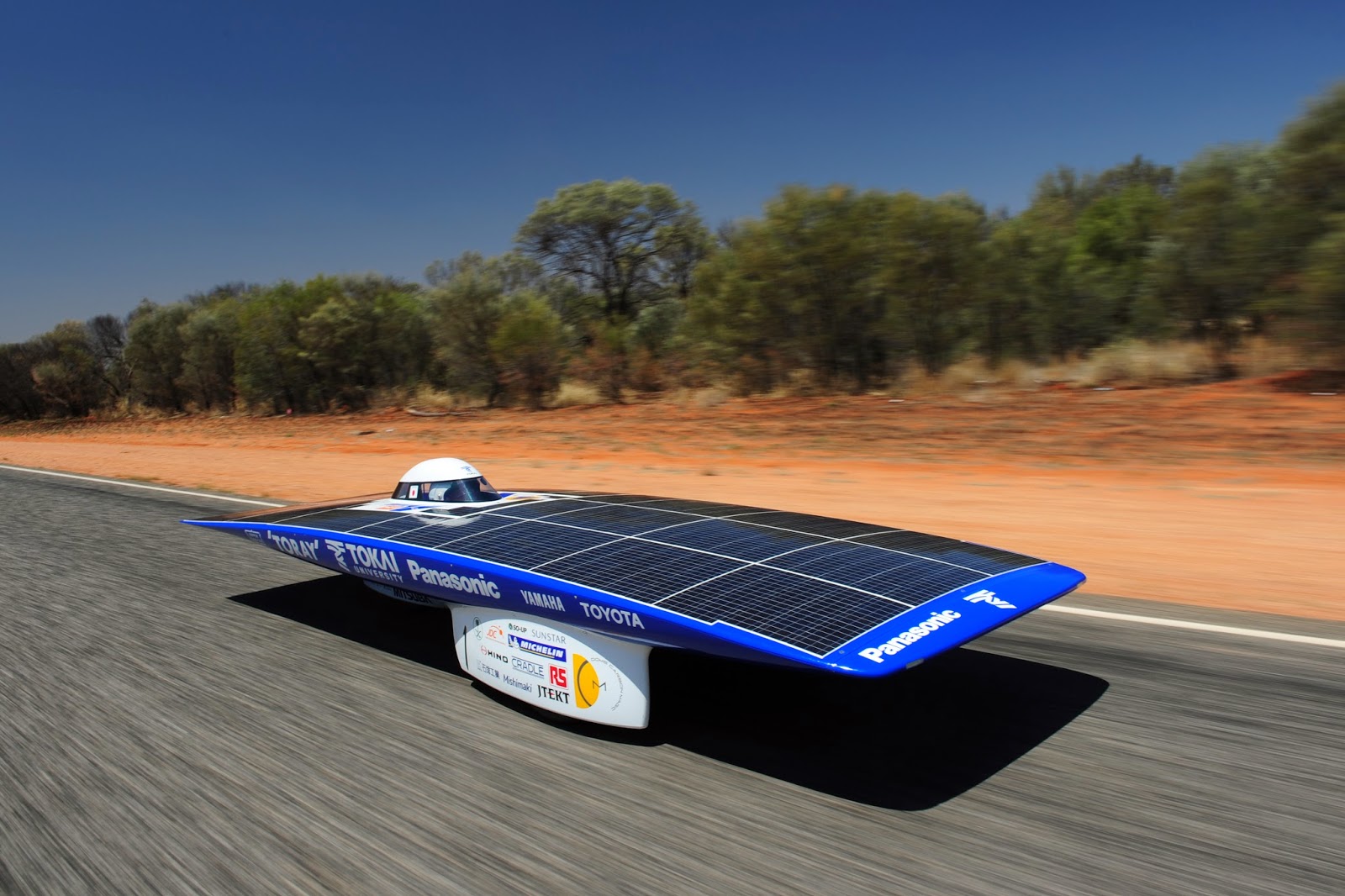
This time next week the world's most energy efficient electric cars will be hitting speeds of up to 130 km/h (81 mph) as they race 3,000 km (1,865 Miles) coast to coast across the Australian Outback contesting the Bridgestone World Solar Challenge.

The outright contenders for line honours will come from the big budget single seater aerodynamic vehicles of the Schneider Electric Challenger Class. The only external energy source allowed during the race is solar irradiation received by a maximum of either 3 square meters of high-efficiency (22.5%+), triple-junction gallium arsenide (GaAs) solar cells or 6 square meters of silicon based solar cells with less than 22.5% efficiency. The solar array is paired with a maximum on-board energy storage capacity of 5 kw/h to assist with energy use strategy, hills, clouds or extra acceleration for overtaking.

To have a good chance to win each car has to 1) Collect as much solar energy as possible and 2) Use as little energy as possible. This means special attention needs to be applied to the efficiency of transferring electrical energy to the wheels and minimising friction from aerodynamic drag and rolling resistance which is affected by vehicle weight amongst other things.

To achieve the electrical efficiency goal, every Bridgestone World Solar Challenge winner since at least 1999 has used a direct drive in-wheel motor to propel the vehicle. Direct drive eliminates mechanical transmission losses that can be as much as 20%.

Solar cars use very low rolling resistance tires that are specially designed for this race with a rolling resistance ten times less than an average road car. With the rolling resistance of a cars tyres accounting for roughly 20% of all energy used, tyres can account for up to one in every five tanks of fuel in a regular road car. Vehicle weight is also kept extremely low with extensive use of carbon fiber, again to minimise rolling resistance.

Tokai Challenger in 2011 won with an average speed of 91.54 km/h (56 mph). With such high average speeds combined with the physics of air resistance being proportional to the square of speed, aerodynamic drag is the main source of losses on a solar race car. Much design effort is invested in CFD computer simulation, scale and full size wind tunnel testing. The best solar race cars achieve a drag coefficient as low as 0.07 (Nuna 3 – which holds the record for highest average winning speed @ 102.8 km/h) where a road car ranges from 0.24 (Tesla Model S) to 0.35 (Toyota Land Cruiser).

It is the chase of maximum aerodynamic efficiency that has lead to the race winning dominance of “coffee table” type vehicle designs which brings up the question of how practical can a solar-powered vehicles be? The 2013 Bridgestone World Solar Challenge sees the introduction of the Michelin Cruiser Class which is not focused on speed but practicality, with the ultimate goal of entrants being able to meet the requirements for road registration. Cruiser Class cars must seat a minimum of two people and will be allowed over-night battery charging at select locations.

While the Michelin cruiser class aligns solar race car design more closely with road car requirements, if the limitations of having the solar panels on the vehicle itself are removed, powering a regular road going EV with solar power is an affordable reality today!

Tesla Motors recently launched a network of solar powered superchargers capable of charging their Model S to 320 km of range in 30 minutes. Even a modest 1.5 kw residential roof-top PV solar system generates enough energy to power a commuter EV like a Nissan Leaf for more than average annual mileage. In fact, displacing the cost of petrol instead of grid power will reduce the break even time on a roof-top PV installation to just a few months.

This year’s Bridgestone World Solar Challenge is held from 6th – 13th October. If you can’t make it to Darwin or Adelaide, you can follow the race on Twitter via @tsport100 or @WorldSolarChlg.

Disclosure: This post is sponsored by Bridgestone World Solar Challenge. Words and thoughts are entirely my own.

San Diego Gets First Public SAE Fast-Charging Station for EVs

The SAE International DC “Combo” Fast Charge station installation at the Fashion Valley Mall in San Diego is a milestone for plug-in electric vehicles – the first public installation in the U.S. of an industry-coordinated standard for fast charging of plug-in electric vehicles.

The Chevrolet Spark EV, available in California and Oregon, will be the first EV in the U.S. to offer the SAE International fast-charge connector as a vehicle option starting in late December.

“The launch of these new charge stations will help improve the convenience and adoption of electric vehicles because they dramatically reduce the charge time,” said Pamela Fletcher, executive chief engineer of electrified vehicles at General Motors. “The SAE Combo DC fast charge stations are the result of EV industry collaboration to help customers benefit from available public infrastructure.”

The new combined AC and DC charging, or combo, connector is accessible via a single charge port on the vehicle and allows electricity to flow at a faster rate, making EVs more convenient for longer trips and for EV owners who may lack convenient access to overnight home charging.

“San Diego Gas & Electric applauds the collaborative efforts it took to make San Diego home to the world’s first retail SAE DC fast charge station,” said Lee Krevat, director of smart grid and clean transportation for the utility. “Our local drivers that have vehicles equipped with this charging system connector will be the true beneficiaries of this technology.”

Many major automakers including GM, Ford, Chrysler, BMW, Daimler, Volkswagen, Audi and Porsche have announced they will adopt the SAE combo fast charge connector standard. Earlier, many of the world’s major automakers had adopted the SAE’s 120V/240V AC connector standard to assure plug-in vehicles could access all charging infrastructure regardless of vehicle make or model.

A Day in the Life of an EV Fast Charger [VIDEO]

Nissan is selling more LEAFs than ever before and is the lead sponsor of National Plug-In Day in 2013.

With the day being about plugging in to charge up, Nissan pointed some video cameras at the company's EV quick charger, stationed in front of Nissan Americas headquarters in Nashville, Tenn. to see who is stopping in to charge and go.

California Goal to Have 1.5M EVs on the Road by 2025 [VIDEO]

California has a goal of having 1.5 million electric vehicles on its roads by 2025.

Gov. Jerry Brown on Monday toured an electric car fleet that included Tesla, BMW and Honda as part of a meeting with other car manufacturers and private companies. The meeting was held at San Francisco's Exploratorium and discussed the future of the electric car.

Brown said he will sign two pieces of legislation continuing incentives for purchasing electric cars.

BMW Plan PHEV Version of it’s Entire Model Range

Not only have BMW invested a total of €600 million ($811 million) in it's i3 and i8 electric vehicle production network, a spokesman this week spelled out BMW’s commitment to electrification in no uncertain terms.

“We are planning to have a plug-in hybrid in each and every model series,” BMW’s head of production for large vehicles, Peter Wolf, told motoring.com.au this week. “So far we have the 3, 5 and 7 Series as full hybrids, and at the other end of the bookshelf the i3 and the i8. We are planning to work on that with the X5 eDrive, but at this stage, the plug-in is a completely new concept, and the battery is very specific [to the X5].”

BMW showed off the X5 eDrive concept at the recent Frankfurt motor show, and officially launched it this week. The large SAV (not an SUV, mind you) has an intelligent all-wheel-drive system, a four-cylinder gas engine, a 70 kW electric motor and a 19-mile electric range.

Wolf said that the X5 eDrive is close to production-ready, but wouldn’t give an actual date: “We can’t tell [you] anything about what is the start of production, but we are working on such a concept [and] we are very far [along]. But it’s not a part of next year.”

Source: motoring.com.au

Tesla EVs offered by Hertz at Calif. airports

A handful of Tesla Motors Inc. electric cars are now available for rental at two California airports by Hertz Global Holdings Inc., which is adding more upscale autos to its fleet.

Hertz said it is introducing Tesla Model S and Roadster rechargeable cars at Los Angeles and San Francisco airports. Hertz has five Teslas combined at the two airports, with rental prices starting at about $500 a day, Paula Rivera, a Hertz spokeswoman, said in an e-mail.

The Tesla models expand on a lineup of higher-priced vehicles that Hertz has added to its fleet under its Dream Cars program, which includes Ferrari and Lamborghini models.

In July, Hertz won final regulatory approval for its $2.3 billion acquisition of Dollar Thrifty Automotive Group Inc. The merged companies compete with closely held Enterprise Holdings Inc. and Avis Budget Group Inc.

Enterprise has carried three Tesla Model S cars in its Exotic Car Collection fleet since June and plans to add two more by the end of the year, spokesman Greg Phillips said in an e-mail. The cars rent for about $300 to $500 per day, he said.

Hertz separately reduced its full-year forecast for full-year revenue and profit, citing weaker than anticipated car rentals at U.S. airports.

There’s ‘No Charge To Charge’ For New Nissan Leaf Buyers In Texas

Driving the all-electric Nissan LEAF means never having to buy gas. Now, thanks to the new "No Charge to Charge" program, offered by Nissan and NRG eVgo, new buyers and lessees of the all-electric Nissan LEAF in the Dallas-Fort Worth and greater Houston areas will have unlimited access to the eVgo network for public charging stations for their first year of ownership at no cost.

Beginning in October, customers who lease or purchase a new Nissan LEAF in the Dallas-Fort Worth and Houston markets will receive one year of complimentary access to eVgo's comprehensive Freedom Station (R) charging network, including 23 locations in the Dallas-Fort Worth metroplex and 17 in the greater Houston area. Also, included as part of the eVgo network, is charging at Park N' Fly locations at DFW and IAH airports.

"Nissan LEAF owners who already subscribe to NRG eVgo's Freedom Station network rave about the convenience and increased range confidence it provides," said Erik Gottfried, Nissan's director of EV Sales and Marketing. "Adding one of the country's most innovative charging plans to the world's best-selling electric car is a clear win for Nissan LEAF buyers."

Dallas-Fort Worth is one of the fastest growing markets in the country for Nissan LEAF sales, with deliveries up 500 percent so far in 2013 as compared to 2012. The presence of strong public infrastructure with eVgo, as well as major technology companies and strong word-of-mouth referrals from existing owners has fuelled the rapid rise in LEAF sales.

"NRG eVgo has created a comprehensive suite of electric vehicle charging products to support the growing number of EVs and to address EV drivers' need to charge both at home as well as on the road," said Jack Cannata, director of marketing for NRG eVgo. "With access to our well-placed charging stations across the Dallas-Fort Worth and Houston metro areas, Nissan LEAF drivers can really maximize their use of the vehicle."

eVgo Freedom Station sites, conveniently located along major roadways, offer electric car drivers DC fast charging and Level 2 charging. DC fast chargers can deliver up to an 80% charge in less than 30 minutes. Level 2 chargers deliver range at a rate of 12 -- 25 miles per hour. Most sites are available 24/7 and are positioned near retail stores as well as restaurants to provide the option to shop or eat while charging.

Nissan will offer "No Charge to Charge" with acquisitions of the Nissan LEAF made between October 1, 2013 and March 31, 2014 at all certified Nissan LEAF dealers in the Dallas-Fort Worth and greater Houston area markets.

Autonomous Nissan Leaf Gets First License Plate for Public Road Testing

Nissan President and CEO Carlos Ghosn today took delivery of Japan's first license plate for a car equipped with highly advanced driver assist systems. It clears the way for a Nissan LEAF equipped with the technology to be tested on the public roads in Japan for the first time. The research program will accelerate the development of technologies fundamental to Autonomous Drive. The systems are designed to allow the driver to manually take over control at any time.

The license plate includes the number 2020, which reflects Nissan's goal to be ready with multiple, commercially-viable Autonomous Drive vehicles by the year 2020.

"This is an ordinary license plate for an extraordinary vehicle," said Nissan president and CEO Carlos Ghosn. "A month ago we revealed to the world our 2020 Autonomous Drive target. Road testing of the underlying technologies is critical to maintaining our leadership position and we are grateful to the Government of Japan for its support."

The Nissan LEAF to be tested is capable of a number of functions, including:

  • Lane keeping
  • Automatic Exit
  • Automatic lane change
  • Automatic overtaking slower or stopped vehicles
  • Automatic deceleration behind congestion on freeways
  • Automatic stopping at red lights

    Nissan is developing Autonomous Drive as it works to achieve virtually zero fatalities in accidents involving its vehicles. The goal stands alongside zero emissions as a key pillar of Nissan's research and development. Autonomous Drive is an extension of the Nissan Safety Shield, which monitors a 360-degree view around vehicles for risks, gives warnings to the driver, and automatically intervenes if necessary. Work is already underway to build a dedicated Autonomous Drive proving ground in Nissan's facility in Oppama, Japan.

    Nissan Executive Vice President for Research and Development, Mitsuhiko Yamashita, said: "The realization of the Autonomous Drive system is one of our greatest goals, because Zero Fatalities stands alongside Zero Emissions as major objective of Nissan's R&D. Through public road testing, we will further develop the safety, efficiency and reliability of our technology."

  • BMW i3 to have 200 Mile Lithium-Air Battery by 2017 [VIDEO]

    At the recent launch of the BMW i3 lithium-ion battery-electric car, BMW board member Ian Robertson said that in the next three to four years there will be more progress in battery development than in the previous 100 years. He said electric cars will have batteries with twice the current power within four to five years, which will double the range.

    We reported back in January that Toyota Motor Corp and BMW AG agreed to jointly research a lithium-air battery. Lithium-air battery has its anode filled with lithium, and cathode with air.

    Lithium metal-air batteries can store more than 5,000 watt-hours per kilogram. (A123 M1 cells are around 120 wh/kg) That's more than forty-times as much as today's high-performance lithium-ion batteries, and more than another class of energy-storage devices: fuel cells.

    The reduction in battery mass is achieved by eliminating the need for a second reactant inside the cell. Lithium metal batteries react with oxygen in the air that is pulled in through a 'breathing' casing, making them lightweight and compact.

    The technology is being studied by researchers including IBM , which is working to develop a lithium-air battery that will let electric vehicles run 500 miles on one charge.

    Given the recent new that General Motors is working on an EV that can go 200 miles (320 km) per charge at a cost of about $30,000 to compete with Tesla's as yet un-named 200 mile $30,000 EV due in approx three to four years, the 2016/17 model year promises to be a very exciting year for affordable, long range electric vehicles.

    Tesla Model S is Norway’s top-selling car in September

    The newly landed Tesla Model S, after a market presence of less than two months, has already topped Norway’s best-sellers' list during the opening two week’s of this month, comfortably outselling all other cars, regardless of fuel type, accounting for 6.2 per cent of all the new cars sold in Norway.

    Hot on the heels of recording 184 registrations in its debut month in Norway, registrations of the Model S in Norway hit a chart-topping 322 units to bulldoze Volkswagen’s conventionally powered Golf (256 units) out of first place by a substantial sales margin, according to AID compiled data.

    The number eight slot went to Nissan’s LEAF, Norway’s most popular electric car so far this year. Both fully-fledged electric cars have captured a combined market share of 9.1 per cent.

    1) Tesla Model S – 322
    2) Volkswagen Golf – 256
    3) Toyota Auris
    4) Mazda CX-5
    5) Volvo V40
    6) Skoda Octavia
    7) Toyota RAV4
    8) Nissan LEAF

    Dutch Students Break EV Acceleration Record 0-100 km/h in 2.13 sec [VIDEO]

    Dutch students today reset the Guiness world record for acceleration 0-100 km/h, in the category for electric cars. The Delft University of Technology Racing Team used their 2012 All-Wheel-Drive 148 kg Formula Student DUT12 to accelerate from zero to 100 km/h in just 2.13 seconds at Valkenburg Airport.

    The Formula SAE car has a four wheel drive powertrain with a 26 kw / 27 Nm motor driving each wheel giving a total peak power output of 104 kw. The front motors are out-board and drive through a 1:7 Planetary gear system. The rear motors are in-board and drive the wheels via a 1:13 two-stage spur gear system with carbon fiber half-shafts.

    The Delft Team first prepared the ground by pouring a solution of sugar in water over the track, and heating it with a gas-burner. All rubble was removed and a plastic sheet was put over the track to keep it dry. Additionally, tire warmers were used on the car, the driver was the team's lightest member, Marly Kuijpers, and the the run was repeated ten times with traction control and tire slippage tweaked within the four motor controllers via the CAN bus ECU for each run.

    The team says that rule changes make 2013 and 2014 Formula Student cars less likely contenders for future acceleration records. For one thing they will have high downforce wings, which add drag, and larger batteries, adding weight. The heavier machines are unlikely to reach a new record, so Delft may well hang on to the top spot longer than another student team, which held its record just over a year.

    Buckeye Bullet 3 Delayed in Bid to become first 400 MPH EV [VIDEO]

    The Buckeye Bullet is a collaboration between Ohio State University and Venturi, and although due to the flooding of Bonneville salt flats (Utah, USA), the FIA and the organizers of the world speed records program decided to cancel the competition for this year, the team were targeting a 400 MPH (640 km/h) world land speed record for electric cars.

    The car, called VBB-3, is actually the third “Buckeye Bullet” land speed record car. Driver Roger Schroer took the VBB-2.5 to 307.58 mph in 2010, giving him the current FIA world record.

    VBB-3 is powered by four electric motors, which generate 400 horsepower each (750 hp Peak) with energy storage provided by 2,000x prismatic A123 batteries that weigh 1600 kg. The 3.2 ton Carbon fiber skinned vehicle can output a total of more than 2 Megawatts (3,000 hp) which, when combined with a drag co-efficient of only 0.13, the team hope is sufficient to re-write the EV Land Speed Record.

    To break the record, the electric car must travel at least one mile and average two runs within an hour. The student team hopes that the new car will break 400 mph, something no electric car has achieved, but this will now have to wait till 2014.

    BMW Begins Production of i3 Electric Car [VIDEO]

    Assembly lines in Leipzig, Germany, today began turning out BMW AG’s new i3 electric car, which is scheduled to arrive in U.S. dealerships in the second quarter of 2014.

    The i3 opens a new frontier for BMW, which has long been known for turning out big, powerful, gasoline-powered vehicles that while fairly efficient, did not rely on their “green” qualities as selling points.

    The i3 also marks a departure in design and structure for BMW because the i3s body is made of carbon-fiber reinforced plastic, or CFRP. The strong, light material allows the car to accommodate the weight of its batteries and electric-drive system without becoming excessively heavy. The company said the car will deliver the kind of sporty, fun-to-drive performance customers expect from BMW cars.

    Chevrolet Spark EV Driving 101 [VIDEO]

    Car reviewers describe the all-new 2014 Chevrolet Spark EV as “fun,” “spunky” and a “hoot to drive.” With 130hp and 400 lb-ft of instant torque, the all-electric mini-car can go from 0 to 60 in less than 7.6 seconds.

    “Spark EV is the new benchmark for electric cars aimed at urban driving and a kick in the pants to pilot around town,” said Lindsay Brooke, senior editor, SAE International magazines. “Spark EV owners who are new to all-electric driving will soon find out how difficult it is to hide their silly grin when they realize how far that car will take them for pennies on the dollar.”

    For many Spark EV owners, getting plugged-in to an all-electric, no-gas-required lifestyle will be a new experience.

    Here are a few tips to ease the transition:

  • Recharge daily – And do it quicker with the soon-to-be-available SAE combo charger for DC fast charging. It can recharge the 21-kWh lithium-ion battery pack to 80-percent capacity in 20 minutes.

  • Extend range – Maximize the mini-car’s EPA-estimated 82 miles (130 km) of driving range by recharging in public charging stations, or use Spark EV’s standard 120V cord in any outlet.

  • Don’t be a juice hog – Public charging stations are in high demand. After charging, move on so that other EV owners can recharge. Or if parking conditions allow, place a note on your dashboard saying it’s okay to unplug your car if the Green Light indicating a full charge is flashing.

  • Know the distance – The available BringGo smartphone app can help Spark EV owners know how far they can go without recharging by providing full-function, in-dash navigation via Chevrolet MyLink as well as live traffic updates, for less than $60.

  • Go with the flow – Many EV owners like to maximize range by driving at or below the speed limit. No problem, just steer clear of the fast lane so other Spark EV drivers can enjoy their instant torque.

  • Be loud – The Pedestrian Friendly Alert Function projects a light chirp and calls attention to Spark EV’s presence. Pulling the turn signal lever back while in Drive will give a friendly honk. The alert can be set to activate automatically in Drive and Reverse at speeds below 18 mph (28 km/h).

  • Enjoy the savings – Spark EV can save its owners approximately $9,000 in fuel over five years compared to the average new vehicle – that’s $150 per month that can be spent on something else.

  • Be an EV advocate – Expect to get lots of questions about Spark EV. Take these opportunities to spread the advantages of going gas free.

    Expanding the Spark lineup, the 2014 Chevrolet Spark EV is designed to make the trip as electrifying as the destination. It is priced under $19,995 with tax incentives and is now available to residents in California and Oregon, with sales expanding to Canada, South Korea and Europe later.