2023 BMW i8 to double power to 750hp + torque vectoring

As the EV technology arms race gathers pace, the second generation BMW i8 is rumored to boost power output from it's current 350 hp to a more Tesla like 750 hp.

Automobile reports that the next-generation i8 will ditch the current i8’s three-cylinder, range-extending internal combustion engine in favor of going all-electric with three high-revving (25,000rpm) electric motors producing a total of 750 hp and more potent batteries capable of delivering a 500 kilometre range. Also part of the package are four-wheel drive, four-wheel steering, torque vectoring, and an active suspension system that scans the road ahead.

While the front axle mounted electric motor in the current i8 revs to 11,400 rpm and is mated to a 2 speed GKN transmission, using high revving electric motors could potentially allow a single speed reduction gearbox yet still achieve terminal velocity on Autobahnen.

The rumored three electric motor powertrain would have BMW only catching up to the recently launched Acura NSX. The Honda has a three electric motor torque vectoring systems with dual motors up front and combined ICE/eMotor at the rear.

Back in 2012 Mercedes demonstrated the full potential of all-wheel-drive torque vectoring with their Mercedes SLS E-Cell. By the time the next gen i8 launches around 2022-2023, a full decade after the SLS E-Cell, we can only hope BMW's next generation EV sports car at least meets if not exceeds that benchmark.

Audi reveal eROT energy harvesting ‘regen’ shock absorders

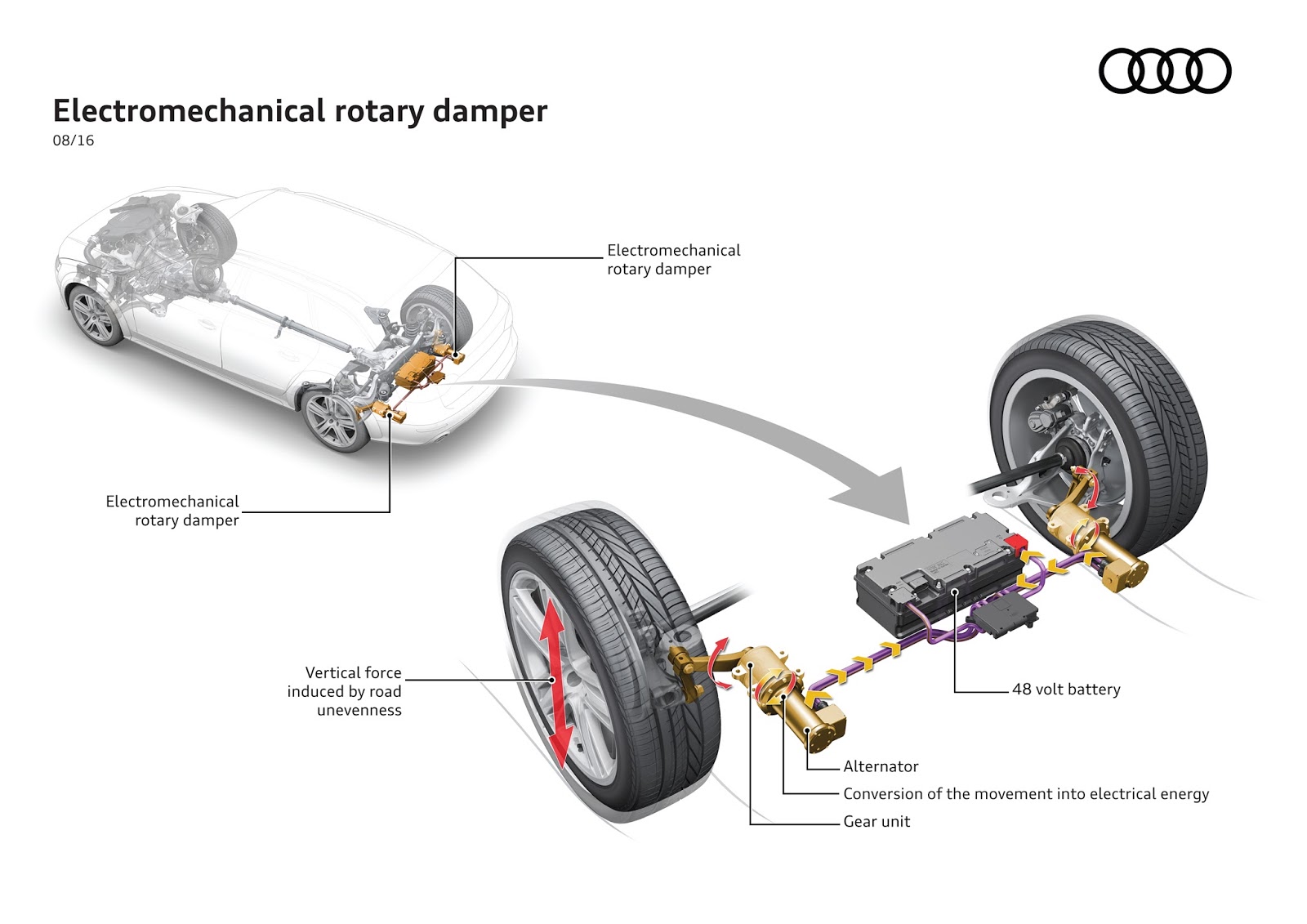
We have reported on a wide range of energy regenerative shock absorbers over the years that most often convert linear motion into electricity. Audi is working on a prototype called “eROT,” in which electric motors replace telescopic shock absorbers in the form of electromechanical rotary dampers.

The principle behind eROT is easily explained: “Every pothole, every bump, every curve induces kinetic energy in the car. Today’s dampers absorb this energy, which is lost in the form of heat,” said Dr.-Ing. Stefan Knirsch, Board Member for Technical Development at AUDI AG. “With the new electromechanical damper system in the 48-volt electrical system, we put this energy to use. It also presents us and our customers with entirely new possibilities for adjusting the suspension.”

The eROT system responds quickly and with minimal inertia. As an actively controlled suspension, it adapts ideally to irregularities in the road surface and the driver’s driving style. A damper characteristic that is virtually freely definable via software increases the functional scope. It eliminates the mutual dependence of the rebound and compression strokes that limits conventional hydraulic dampers. With eROT, Audi configures the compression stroke to be comfortably soft without compromising the taut damping of the rebound stroke. Another advantage of the new damper system is its geometry. The horizontally arranged electric motors in the rear axle area replace the upright telescopic shock absorbers, which allows for additional space in the luggage compartment.

The eROT system enables a second function besides the freely programmable damper characteristic: It can convert the kinetic energy during compression and rebound into electricity. To do this, a lever arm absorbs the motion of the wheel carrier. The lever arm transmits this force via a series of gears to an electric motor, which converts it into electricity. The recuperation output is 100 to 150 watts on average during testing on German roads – from 3 watts on a freshly paved freeway to 613 watts on a rough secondary road. Under customer driving conditions, this corresponds to a CO2 savings of up to three grams per kilometer (4.8 g/mi).

The new eROT technology is based on a high-output 48-volt electrical system. As currently configured, its lithium-ion battery offers an energy capacity of 0.5 kilowatt hours and peak output of 13 kilowatts. A DC converter connects the 48-volt electrical subsystem to the 12-volt primary electrical system, which includes a high-efficiency, enhanced output generator.

Initial test results for the eROT technology are promising, thus its use in future Audi production models is certainly plausible. A prerequisite for this is the 48-volt electrical system, which is a central component of Audi’s electrification strategy. In the next version planned for 2017, the 48-volt system will serve as the primary electrical system in a new Audi model and feed a high-performance mild hybrid drive. It will offer potential fuel savings of up to 0.7 liters per 100 kilometers.

Driven | 2016 Toyota Prius

Toyota has been promising better handling with its cars, and it has delivered with the fourth-generation Prius. While it still does not look like a conventional car, the Prius now handles more like one.

Driven | 2016 Toyota Prius

Toyota has been promising better handling with its cars, and it has delivered with the fourth-generation Prius. While it still does not look like a conventional car, the Prius now handles more like one.

Mercedes-Benz unveil all-electric 26T heavy-duty Urban eTruck

Daimler Trucks presented the Mercedes-Benz Urban eTruck in Stuttgart today, as the first fully electric truck with an admissible total weight of up to 26 tonnes. This means that in the future, heavy trucks will take part in urban distribution operations with zero local emissions and hardly a whisper.

The market launch of this technology is conceivable for Daimler Trucks at the beginning of the next decade. In the light distribution sector, Daimler Trucks has already been impressively demonstrating the day-to-day suitability of the fully electric truck in customer trials with the Fuso Canter E-Cell since 2014. The development of electric trucks and series production maturity are fixed parts of the strategy of Daimler Trucks to build on our technological leadership. For this purpose a considerable part of the future investments by the truck division in the fields of research and development flow in the further development of the full electric drive.

"Electric drive systems previously only saw extremely limited use in trucks. Nowadays costs, performance and charging times develop further so rapidly that now there is a trend reversal in the distribution sector: the time is ripe for the electric truck. In light distribution trucks, our Fuso Canter E-Cell has already been undergoing intensive customer trials since 2014. And with the Mercedes-Benz Urban eTruck, we are now electrifying the heavy distribution segment up to 26 tonnes. We intend to establish electric driving as systematically as autonomous and connected driving," says Dr. Wolfgang Bernhard, responsible for Daimler Trucks & Buses at the Board of Management.

Growing urbanisation requires fully electric trucks

Better air quality, lower noise and restricted-access zones are now important keywords in large metropolises worldwide, because more and more people worldwide are moving to cities. 2008 was the first year in which more people lived in cities than in the countryside. The trend is continuing: The UN predicts a global population of nine billion people by 2050, with approximately 70 percent of them living in cities. In future, it will be necessary to transport goods in urban environments for increasing numbers of people – and with the lowest possible emissions and noise. By now large cities such as London or Paris are considering a ban on internal combustion engines in city centres in the future. That means: there will be fully electric trucks ensuring the supply of humas with food or other goods of daily needs.

Fast enhancement of battery capacity while significantly lower costs

Until quite recently, the use of fully electric drives systems in trucks seemed to be unimaginable – especially because of the high costs of the batteries coupled with a low range. The technology has now become much more mature. In particular battery cells rapidly developing further. Daimler Trucks expects the costs of batteries to lower by the factor 2.5 between 1997 and 2025 – from 500 Euro/kWh down to 200 Euro/kWh. At the same time, performance will improve by the same factor over the same period – from 80 Wh/kg up to 200 Wh/kg.

Stefan Buchner, Head of Mercedes-Benz Trucks: "With the Mercedes-Benz Urban eTruck, we are underlining our intention to systematically developing the electric drive in trucks to series production maturity. This means that we will begin to integrate customers, so as to gain valuable joint experience with respect to the operating ranges and the charging infrastructure in daily transport operations. Because we think the entry of this technology into the series production is already conceivable at the beginning of the next decade."

Innovative battery technology for Urban e Truck

Technically the Mercedes-Benz Urban eTruck is based on a heavy-duty, three-axle short-radius Mercedes-Benz distribution truck. In addition, however, the developers at Daimler Trucks have totally revised the drive concept: The entire conventional drivetrain being replaced by a new electrically driven rear axle with electric motors directly adjacent to the wheel hubs – derived from the electric rear axle which was developed for the Mercedes-Benz Citaro hybrid bus. The power is supplied by a battery pack consisting of three lithium-ion battery modules. This results in a range of up to 200 km – enough for a typical daily delivery tour. Thanks to the integrated concept with motors adjacent to the wheel hubs, the batteries are housed in a crash-proof location inside the frame.

As the EU Commission is in favour of increasing the permissible gross vehicle weight of trucks with alternative drives by up to one tonne, this will more or less level out the weight surplus of the electric drive. This will raise the permissible gross vehicle weight of the Urban e Truck from 25 to 26 tonnes, which will bring the original extra weight down to 700 kg compared with a directly comparable IC-engined truck.

Fuso Canter E-Cell: all-electric drive in customer operation since 2014

Where light-duty trucks are concerned, all-electric drive is already a reality. This is demonstrated by the Fuso Canter E-Cell. Fuso already presented the first generation of the fully electrically powered Canter in 2010. In 2014 this was followed by the second generation, which proved its worth in the first fleet trials in Portugal. With ranges of over 100 kilometres, the vehicles exceeded the average daily distance covered by many trucks in light-duty short-radius distribution. Under widely varying operating conditions, the trucks covered more than 50,000 km within one year. In the process the vehicless were locally emission-free and, taking power generation into account, reduced CO2 emissions by 37 percent compared to diesel engines. The operating costs were 64 percent lower on average.

Marc Llistosella, Head of Daimler Trucks Asia and President & CEO of Mitsubishi Fuso Trucks and Bus Cooperation (MFTBC): "The current generation Canter E-Cell offers our customers transport services which are not only environment-friendly, but also economical. Our test in Lisbon revealed respectable savings of around 1000 euros per 10,000 kilometres in comparison to diesel trucks."

"We at Fuso have now acquired extensive experience in the development of local emission-free commercial vehicles und we will consequently pursue this development also in future. At the Commercial Vehicles show IAA in September, will will take a step further towards series production with our next generation under the new name: Fuso eCanter," continues Llistosella.

Current fleet trials with the Fuso Canter E-Cell in Germany

Since April 2016 the city of Stuttgart and the parcel service provider Hermes are testing five Fuso Cater E-Cell in Germany. Especially the using in the topographically very demanding environment in urban Stuttgart provides important insights for Daimler Trucks from the customer operation with regard to the further development of the fully electric drive. First results from this customer trial are expected at the beginning of 2017.

Dirk Rahn, Managing Director Operations at Hermes Germany underlined during the today's event: "We are very proud of our successful cooperation with Daimler in the development of relevant future technologies for many years. Also regarding the current project, we accepted with pleasure the invention of Daimler to actively support the testing of the Fuso Canter E-Cell out of our logistical everyday life. Thereby, the results of our test run are extremely positive! With regard to the growing requirements in city logistics we are now looking forward to test further vehicle classes and to bring them to market maturity soon. Our common goal: making e-mobility more economical."

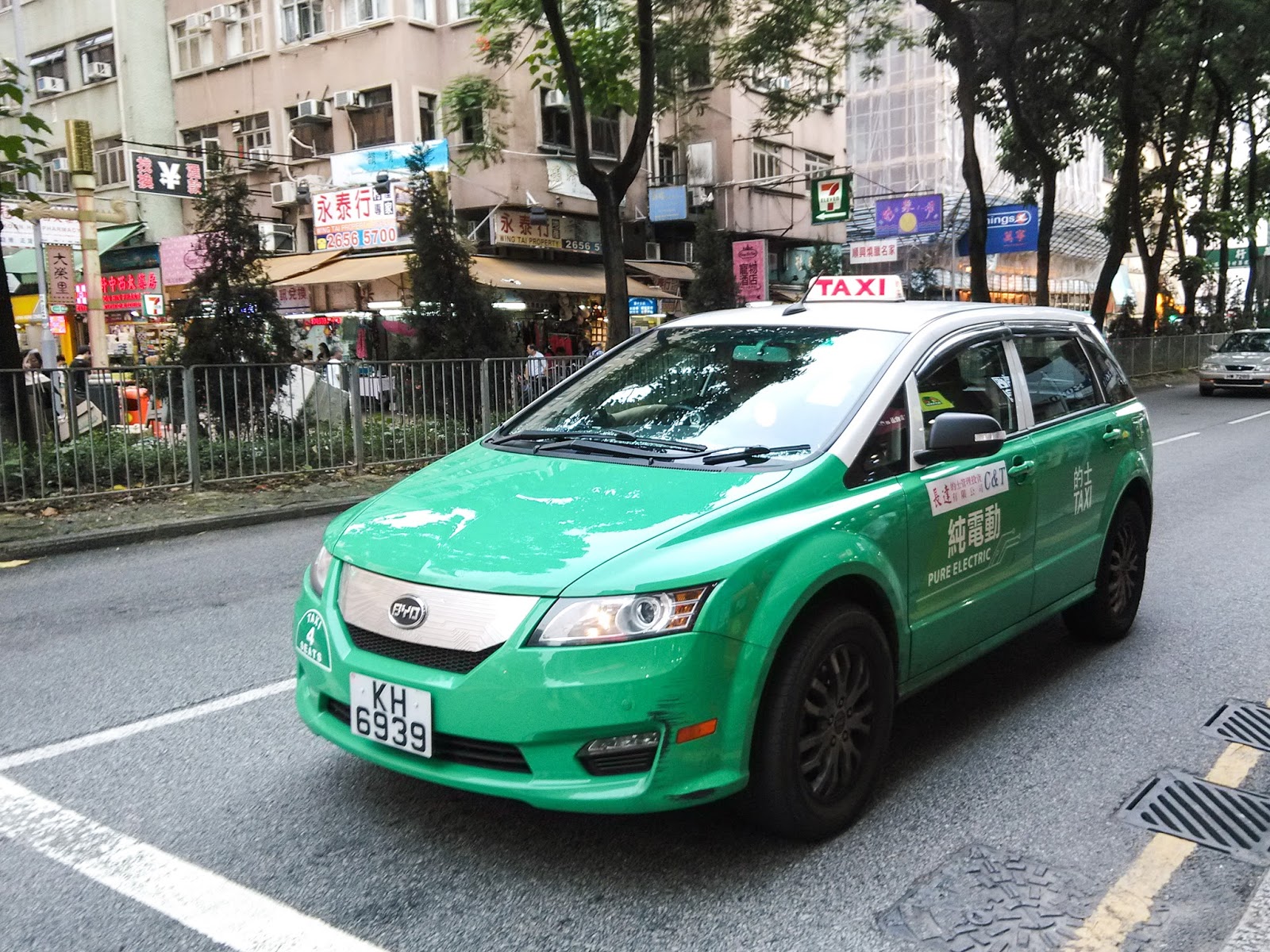
Samsung buys $450 million stake in Chinese electric car firm BYD

Samsung Electronics will pay $450 million for a stake in Chinese automaker and rechargeable batteries firm BYD Co Ltd, the Chinese company said in a stock exchange filing on Thursday.

Automakers and technology companies have formed a series of partnerships in recent years as the race to develop electric, self-driving, internet-connected vehicles has created demand for more electronics components and software.

The Samsung investment has been made through Chinese subsidiary Shanghai Samsung Semiconductor and gives the Korean firm a 1.92 percent stake in BYD, making it the ninth largest investor in the company.

Samsung Electronics said last week it was in talks to acquire a stake in BYD to boost its automotive chip business, after the Korea Economic Daily first reported that Samsung had agreed to buy a stake.

BYD, which also counts Warren Buffet's Berkshire Hathaway as a backer, began as a battery maker for personal electronics before launching its automotive business that focuses on electric and hybrid vehicles.

Rimac Concept_One 0-100 km/h acceleration [VIDEO]

This is what 0-100 km/h in 2.6 seconds looks like.

The Concept One’s powertrain consists of four electric motors and four gearboxes with a total of 800 kW (1088 hp) and 1,600 Nm (1,180 ft-lb) distributed via torque vectoring.

The 620 volt, 82 kWh, LiNiMnCoO2 battery’s 1 MegaWatt of discharge capability linked to those four wheels moves the two-ton hypercar to 62.5 mph in just 2.6 seconds, to 124 mph in 6.2 seconds and to 186 mph in 14.2 seconds.

Top speed is rated at 221 mph.

Xtrac Launch Dual Motor EV transmission to suit torque vectoring

Xtrac’s P1227 gearbox family has been developed to address the growing market requirement for single speed, lightweight and power dense electric vehicle (EV) transmissions. It offers a range of installation possibilities for fast and powerful electric supercars with front-wheel drive, rear wheel drive or four-wheel drive configuration.

“There is substantial innovation and intellectual property in the design of this new transmission system,” says James Setter, head of Xtrac’s Automotive and Engineering business unit, which focuses on developing transmission systems for hypercars, hybrids and EVs to complement the company’s world-beating motorsport transmissions. “Significant focus went into the integration of the gearbox with numerous proprietary traction motors, and in particular, reducing its mass by almost 20 per cent compared with our previous P1092 electric vehicle transmission to provide the ultimate electric drive transaxle.”

The new transmission system can be integrated with motors supplied by BorgWarner, GKN and YASA, all of whom worked with Xtrac on the integration of their technology into this transmission. The dual electric motors of the transmission system also provide an inherent torque vectoring capabilities. For lower power applications a single electric motor can be specified, reducing the overall vehicle weight further and requiring an even smaller space envelope. The highly configurable nature of the design also enables an open or a limited slip differential to be specified.

In addition, the P1227 family of gearboxes offers a range of single gear ratios, as well as considerable motor-generator configuration and hence vehicle installation possibilities. This enables the transmission, for example, to be installed within a 90-degree angle from the motors positioned vertically above through to horizontally in front of the output.

“The design draws on Xtrac’s precision design, analysis and manufacturing engineering capabilities,” says Setter, “ensuring that the ground helical gear sets, necessary for road vehicle transmission systems, offer exceptional levels of NVH refinement for the most demanding silent driveline electric vehicle applications, as well as the durability required for this marketplace.”

The transmission has been designed as a family to integrate with either YASA P400, GKN AF130 or AF230 or BorgWarner HVH-250-090-SOM or HVH-250-115-DOM motors, but other motors could be suitable as long as the RPM of the motor is less than 10,000rpm, and the peak torque is less than 500Nm per motor like the 90 kW / 300 Nm Evans Electric axial flux induction motor.

More: Xtrac

REMY / BorgWarner

YASA P400

GKN AF130


Atieva testing AWD powertrain in 900-hp Electric Van [VIDEO]

One of the four Chinese backed EV start-ups in Silicon Valley, Atieva was started by former executives from Tesla and Oracle in late 2007.

As Reuters reports, Atieva is headed by Bernard Tse, an ex-Tesla Vice President and board member, as well as Peter Rawlinson, the former chief engineer of the Tesla Model S. They don't have a factory yet, but they do have a van nicknamed Edna.

With its first car still at least two years away from production, Atieva is using a Mercedes-Benz Vito commercial van to test the drivetrain: a pair of high-output electric motors, a 87 kWh lithium-ion battery pack, inverters, gearboxes and dual motor controller.

Rawlinson, who while at Tesla led engineering of the Model S sedan, said Atieva's "secret sauce" is the software tying all that hardware together to deliver a combined 900 horsepower to the 2,200 kg all-wheel-drive van. With a dual motor powertrain the company is clearly not testing full-spec torque vectoring (which requires 4x motors).
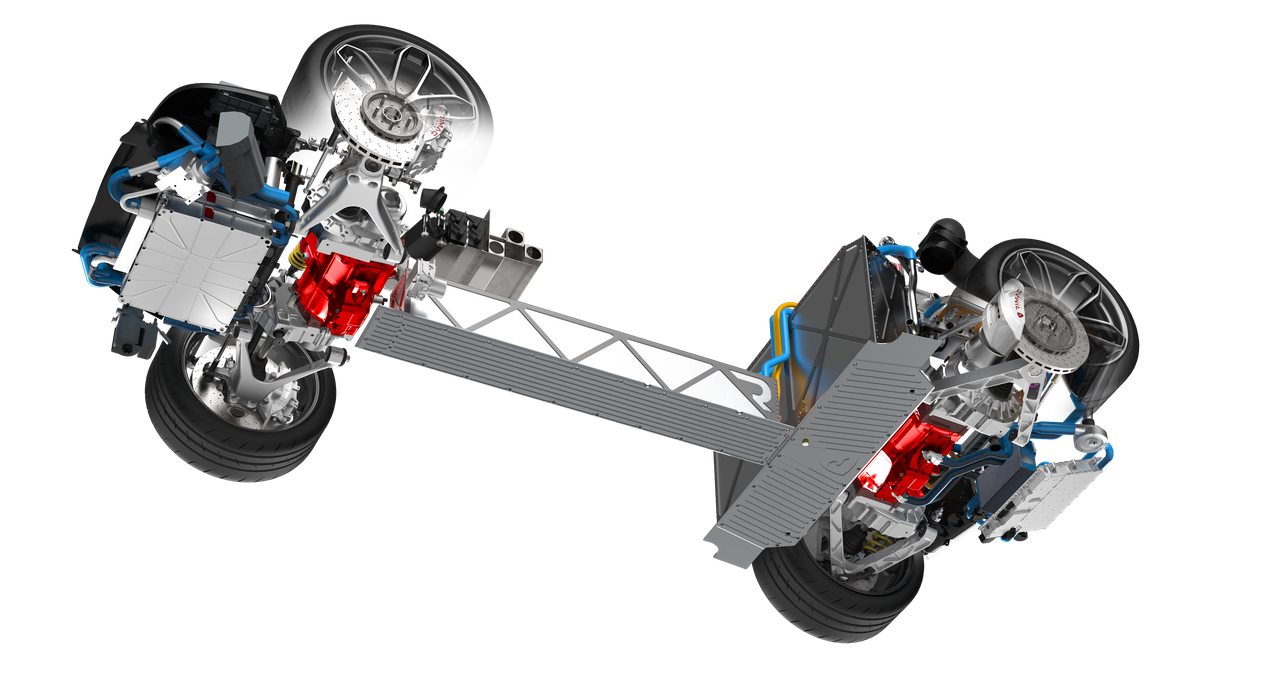
The drivetrain propels the van from zero to 60 mph in just 3.1 seconds, a fraction slower than the fastest Tesla Model S. Atieva’s 0-60 acceleration target for its 2018 sedan is 2.7 seconds.

The Atieva sedan, being developed under the code name Project Cosmos, looks like a futuristic descendent of the Audi A7. Its headlamps are ultra-thin, with thousands of insect-inspired micro lenses. Its dashboard has a three-piece reconfigurable digital display that can be controlled by voice or touch.

Atieva has raised several hundred million dollars from investors including Mitsui & Co Ltd, the Japanese trading giant, and Venrock, a Silicon Valley venture capital firm connected with the Rockefeller family that once funded Intel and Apple. Two of Atieva’s biggest shareholders are Chinese: State-owned Beijing Auto and a subsidiary of publicly traded LeEco, an internet company that has also declared it intends to offer an electric car. LeEco is controlled by Chinese tech entrepreneur Jia Yueting.