Mitsubishi Concept XR-PHEV Evolution Vision Gran Turismo [VIDEO]

Mitsubishi Motors, a company with a spectacular history in races like the Dakar Rally and World Rally Championships (WRC), has developed a special concept model for Vision Gran Turismo: This is the "Mitsubishi Concept XR-PHEV Evolution Vision Gran Turismo".

In the development of this special concept model, Mitsubishi Motors introduced their design team, Advanced Vehicle Research and Development Group, and Aerodynamic Engineering Development Group into this project in the same process they would normally follow to plan and develop real motorsports vehicles.

The styling of the car follows the basic concepts of the "MITSUBISHI Concept XR-PHEV" shown at the 2013 Tokyo Motor Show, while pouring in know-how gained from years of motorsports experience into its every detail. The result was the evolution of the concept into a stoic racing machine.

The "Athlete Form" design concept was advanced further, emphasizing the driving features aggressively. The iconic front grill is a study of next generation Mitsubishi automobiles, and the shape that forms a wedge starting from the triple diamond mark is designed in the image of an athlete at crouching position on a starting line, evoking an intense image of tension and potential.

Utilizing advanced development technology from the Plug-in Hybrid EV System, the spontaneous power of the motor and powerful torque of the engine is transmitted through an 8 speed dual clutch transmission (DCT) to drive the 4 wheels. It's overwhelming drive performance is controlled precisely with the S-AWC vehicle dynamics control system that distributes the drive force optimally to the 4 wheels, producing a handling characteristic that moves the car exactly as the driver desires.

In addition, the carbon fiber reinforced plastic (CFRP) body reduces weight and greatly contributes to its agility, and the downforce produced by the aerodynamic form of the front and rear diffusers produces excellent cornering performance. The large diameter 20 inch aluminum wheels gives an impression of a tough suspension system, and the powerful appearance of the front and rear fenders is in the image of toned muscles of a powerful athlete.

Google launches an all-electric self driving ‘pod’ car [VIDEO]

We have seen battery powered 'pod' type driver-less cars before with the ULTRra PRT at Heathrow airport and the recently announced 100 vehicle trial on public streets around Milton Keynes. These vehicles can only navigate on purpose built guideways as opposed to merging with general traffic. Google has demonstrated a driver-less pod type electric vehicle based on their self-driving technology.

The two-seater prototype vehicle is Google’s reimagination of what the modern automobile should look and feel like if you took the human out of the transportation equation and designed something solely to chauffeur passengers from point A to B.

“The project is about changing the world for people who are not well-served by transportation today,” Google co-founder Sergey Brin said at the inaugural Code Conference in Rancho Palos Verdes, California. “There’s not great public transportation in many public places in the United States.”

The car — which was conceived and designed by Google, unlike the ones it previously modified — lacks many of the trappings of a normal car, and that includes the three essentials: A steering wheel, an accelerator and a brake pedal.

Google wants to get these cars on the streets ASAP. The company plans to start testing them in Mountain View, Calif., later this summer. They hopes to build at least 100 prototypes over the next two years, and get them into the hands of volunteer drivers — or nondrivers, as it were — as soon as the system is evaluated to be safe.

ELMOFO Electric Radical First Race at Eastern Creek [VIDEO]

The Electric Radical SR8 built by Newcastle based ELMOFO had it's first race yesterday at Sydney Motorsport Park (Eastern Creek).

With Garth Walden at the wheel for the first official CAMS sanctioned race meeting for an Electric Vehicle. The instant torque can make this car a bit of a handful on tight track sections, particularly with cooler tyres.

The ELMOFO Radical, the current electric lap record holder, was the only electric powered vehicle in a field of petrol powered cars in Race 1 of Round 1 of the NSW SuperSports State Championships.

The car performed as expected during practice, qualified 3rd (of 7) in it's class and was positioned 5th (of 9) on the grid for the start. The 2 front runners are super-light and faster Stohr racers which are in a different class to the Radicals.

The 500 hp and 600 Nm of instant torque enabled Garth to wheel spin his way to the front of the Radical field which he led for the whole race until the last 150m where a technical issue caused a sudden power drop and let 2 cars pass just before the finish line.

Airbus Electric Airplane Flies—For an Hour Per Charge [VIDEO]

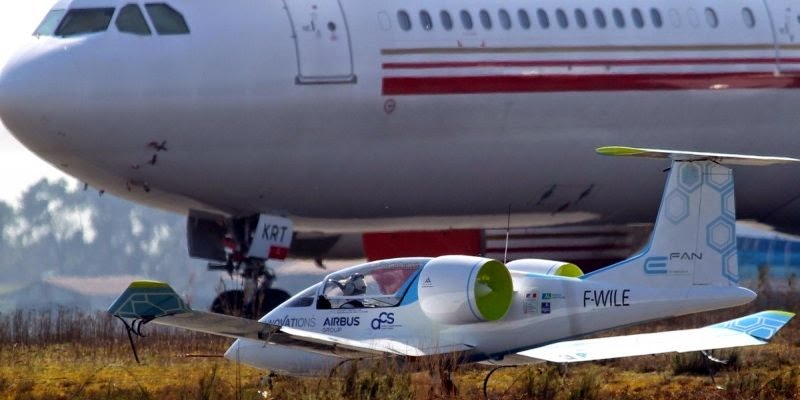
The Airbus E-Fan, an all-electric trainer aircraft made of composite material, made its first flight last month–proving once again that it is possible to fly without jet fuel.

That’s with one caveat however: The plane can fly for about an hour on a single charge. But still, this seems like a big deal mainly because the largest aerospace and defense company in Europe and the world’s leading commercial aircraft manufacturer is backing it.

The successful first public flight of the electric E-Fan experimental aircraft was the highlight of Airbus Group’s E-Aircraft Day in Bordeaux, France on April 25. The electric E-Fan training aircraft is an experimental demonstrator based on an all-composite construction. Airbus Group and its partners intend to perform research and development to construct a series version of the E-Fan and propose an industrial plan for a production facility close to Bordeaux Airport. In addition, the group’s research efforts support the environmental protection goals of the European Commission, as outlined in its Flightpath 2050 program.

Built with an all-composite construction, the E-Fan is 22 feet long and has a wingspan of 31 feet. It looks like a toy version of a jet aircraft with a pair of nacelles that aren’t really jets, but two ducted, variable pitch fans spun by two electric motors with a combined power of 60 kW. The ducting increases the thrust while reducing noise, and by centrally mounting them, the fans provide better control. The E-Fan flies at only 114 miles per hour.

Powering the fans are a series of 250-volt, lithium-ion polymer batteries made by Kokam of South Korea. These batteries are mounted in the inboard section of the wings and carry enough charge for up to one hour of flight. They can be recharged in one hour. Worried about the “recharge” light coming on while up in the air? There’s a backup battery for emergency landings.

Another key technology on the E-Fan is its e-FADEC energy management system, which automatically handles the electrical systems. According to Airbus, this simplifies system controls and, since E-Fan is a trainer, eases the workload of instructors and students.

The E-Fan has zero carbon dioxide emissions in flight and should bring a significant reduction in noise around airfields, according to Airbus, “thus improving relations between local residents and flight schools with long-term prospects for the discreet and economical initial training of future professional pilots.”

“It will not only lead to a further reduction in aircraft emissions and noise to support our environmental goals but will also lead to more economic and efficient aircraft technology in the long run. Our focus is to develop innovations that will help define what tomorrow’s aerospace industry will look like,” said Airbus Group Chief Technical Officer Jean Botti.

So today the E-Fan is a learning platform, tomorrow a larger hybrid version that can fly 80 passengers on short regional trips. That’s apparently the plan. From small beginnings, a revolution in the air.

NISMO ZEOD RC’s Electrical System Explained [VIDEO]

Jason from Engineering Explained has a look at the ZEOD RC's Electrical Systems and Zero Emissions on Demand motors that are capable of making the car go at 300km per hour!

While the video does show a close-up of the enclosure for the 400 volt 12 kWh battery, the only other details provided are that the twin BLDC motors are rated at 120 kw each.

BMW SGL to triple carbon-fiber production capacities

Due to the high demand for carbon fiber in automotive production, BMW and SGL Automotive Carbon Fibers is going to triple the capacity of the carbon fiber plant in Moses Lake, WA (USA).

The expansion will be funded by an investment of 200 million US dollars, in addition to the previously invested 100 million US dollars. The site expansion, scheduled to be completed by early 2015, will make the plant in Moses Lake the world’s largest carbon fiber plant. With the anticipated creation of 120 new jobs, the headcount at the joint venture in Moses Lake is going to rise from currently 80 to about 200 people. Due to the automated production processes, the expansion of the site in Moses Lake will make it possible for the BMW Group to apply carbon fiber material also in other model series in the future, at competitive costs and in large quantities.

At present, the Moses Lake plant operates two production lines, exclusively for BMW i, with an annual output of approx. 3,000 tons of carbon fiber. Already this summer, SGL Automotive Carbon Fibers will commission a third and fourth production line in Moses Lake, which are currently being built, thus doubling the plant’s capacity to 6,000 tons per year. Today’s groundbreaking ceremony for a fifth and sixth production line has been the first step toward tripling capacities to 9,000 tons annually in the medium term. The energy needed for the carbon fiber production is fully generated from hydropower.

“With its highly automated carbon fiber production and stringent quality standards, Moses Lake is setting new standards in the industry. At present, the site is the world’s fastest growing carbon fiber producer. Together with the BMW Group, we are doing pioneering work to establish CFRP as a material in large-series automotive production. In a mix of materials, CFRP offers new opportunities in lightweight construction for an eco-friendly mobility,” explained Dr. Jürgen Köhler, CEO of SGL Group.

Dr. Klaus Draeger, Board Member Purchasing and Supplier Network at BMW AG: “CFRP is a key material for the automotive industry of the 21st century. In our endeavor to identify increasingly lightweight materials in order to reduce a vehicle’s weight and thus its fuel consumption and carbon emissions, this material plays a crucial role. As part of an intelligent mix of materials, we will apply carbon also beyond our BMW i and BMW M models in the future. Thanks to the pooling of the SGL Group’s expertise and our knowledge in large-series production of CFRP components, we will be able to produce the ultra-lightweight high-tech material also for other model series, at competitive costs and in large quantities.”

The carbon fiber plant in Moses Lake is a key element in the strategy pursued by the two companies, which anticipates the industrialized large-series production of carbon fiber reinforced plastics (CFRP) for the application in future vehicle concepts. Up to now, carbon fiber produced in Moses Lake is exclusively used for the BMW i models. Since the start of the year, the Leipzig plant has built over 5,000 BMW i3 vehicles. At present, the production output stands at 100 units a day. Furthermore, the BMW Group has been applying the ultra-lightweight high-tech material also in its BMW M models for the past ten years.

Andreas Wüllner, CEO of SGL Automotive Carbon Fibers: “In the course of only four years, SGL Automotive Carbon Fibers has managed to become the world’s largest carbon fiber production site. The automotive industry will increasingly turn to CFRP because it is a material of the future.”

Availability of renewable energy crucial in the decision for the location in Moses Lake
As part of their joint venture agreement, the BMW Group and the SGL Group invested an initial 100 million dollars at their Moses Lake site by 2013, creating 80 new jobs. Jay Inslee, Governor of Washington State: “Congratulations to the BMW Group and the SGL Group on the groundbreaking of their fifth and sixth production line at the Moses Lake Plant. Washington State is proud to partner with BMW. The game-changing technology of carbon fiber is driving a surge in U.S. manufacturing, and with this production plant Washington State is at the forefront of that surge.”

The production of carbon fiber requires a great amount of energy. Accordingly, decisive factors for the set up of the carbon fiber plant in Moses Lake included the availability of renewable hydropower as well as competitive energy costs in Washington State. The availability of skilled workers also had an influence on the decision in favor of the location, which was taken in April 2010. The groundbreaking ceremony for the plant was in July 2010, the opening of the production site in September 2011. Dr. Jörg Pohlman, CEO of SGL Automotive Carbon Fibers: “We received great support from the regional authorities in Grant County and Moses Lake, a decisive element in making this rapid development of the past few years possible. With the site expansion, we are reaching an important milestone in safeguarding the site’s future.”

Production of carbon fiber composites
The production of carbon fiber composites for automotive manufacturing requires several process steps: The necessary precursor, which is based on polyacrylnitrile fiber, is made by a joint venture between SGL Group and the Japanese company Mitsubishi Rayon in Otake, Japan. In a next step, polyacrylnitrile fiber is turned into the actual carbon fiber in Moses Lake. This material is then processed at the second joint venture site in Wackersdorf, Germany, and turned into textile carbon fiber layers, the starting point for the production of CFRP body parts at the BMW plants in Landshut and Leipzig. In the BMW i models, CFRP already holds a significant share in the mix of materials, a first at this scope and in series production. The joint venture gives the BMW Group access to this innovative key material in the long term. The SGL Group provides their expertise in high-performance materials and their experience with carbon fiber-based materials.

Test driving the new Mercedes B-Class electric Drive [VIDEO]

For the first time, Mercedes brings a fully electric car to the U.S

The B-Class ED is the product of a technology-sharing alliance between Tesla and Daimler that goes back to Mercedes’ 2009 investment.

Rather than rely on in-house R&D, Mercedes essentially contracted with Tesla—the Silicon Valley car maker and acknowledged leader in electric automobiles—to provide the EV architecture (motor, transmission, battery, power electronics) for its electron-fired B-Class.

Tesla will make the B-Class battery pack, power management system etc at the factory in Fremont, Calif., and ship them to Germany for final vehicle assembly.

The B-Class Electric Drive, which is built on the same production line as the gasoline-powered version, is going to go on sale in Europe around the end of the year and will also come in a right-hand drive version for other markets in 2015.

One of these days, one of these compliance cars is going to break out, sales-wise. The B-Class ED, which will sell in all 50 states, could be the one. While it might have emerged out of a compliance effort, the B-ED just shines, a premium family electric that braids Tesla’s and Mercedes’ DNA so convincingly the car might as well be called the Model B.

Monster Tajima preparations for Pikes Peak 2014 [VIDEO]

Nobuhiro Tajima and his APEV Monster Sport team are preparing for their third year at the Pikes Peak International Hillclimb with Battery power.

Nine-time Unlimited division champion Nobuhiro “Monster” Tajima will be gunning for outright course record again after he was the first to break the 10 minute barrier with an electric vehicle at Pikes Peak in 2013, even surpassing the 9:51.278 he turned in during the 2011 race in a 900 hp Suzuki SX4, when he was the first driver ever to crack the Peak’s elusive ten-minute barrier.

The outright hill record goal posts have been moved significantly this year by nine time World Rally Champion Sébastien Loeb setting a time of 8:13.878 in a 900 hp 900 kg Peugeot 208 T16 Pikes Peak Special.

When asked after the 2013 event about beating the new gasoline record, Tajima responded: “We are able to do that very soon, it depends on the battery. With a high quality and high density battery, I can beat that record for sure.”

MotorTorque BMW i3 review [VIDEO]

MotorTorque has tested the BMW i3, the premium brand's first foray into electric vehicles.

This model, the pricier range extender version, promises a range of 180 miles - eighty miles more than the pure electric version.

Adding to its green credentials is how this car has been built. It's an entirely new frame platform made from carbon fibre reinforced plastic, which helps keep weight down and also makes it strong, meaning you don't need the B-pillar.

There's lots of neat touches here like satnav which shows you charging points in a hundred mile radius, and there's the option to switch to petrol mode and conserve the electric range.

You'll only find two seats in the back and the boot is okay at 300 litres but doesn't offer the same practicality as a conventional family hatchback.

2015 BMW i8 by the numbers [VIDEO]

Jason Cammisa of Road & Track brings us the first real world performance numbers of the new BMW i8. One interesting figure that stands out is the 0 to 60 mph which was recorded at 3.8 seconds. You can also read our BMW i8 test drive here.

BMW i8 uses a plug-in hybrid system consisting of a turbocharged three-cylinder BMW TwinPower Turbo petrol engine and BMW eDrive technology in the form of an electric drive system.

In the rear of the BMW i8, the B38 three-cylinder engine makes 231 hp and delivers its power solely to the rear wheels. At the front, an electric motor is installed, which is powered by a lithium-ion battery in the middle of the vehicle. The system performance drives up to 362 horsepower.

BMW Launch i Solar Carport Concept for i3 and i8 [VIDEO]

With the all-electric BMW i3 already on the market and the BMW i8 plug-in hybrid sports car poised for its own launch, the BMW Group portfolio boasts the world’s first premium automobiles purpose-designed for zero-emission mobility.

The international media launch of the BMW i8 in Los Angeles will include the presentation of a solar carport concept developed by BMW Group DesignworksUSA for the use of renewable energy. It combines high-grade technology for generating electricity from solar power with an innovative design that perfectly complements the BMW i models.

In its choice of materials, design and colour, the DesignworksUSA carport concept takes its cue from the characteristic styling of the BMW i models to form a harmonious counterpart. The holistic sustainability concept is underlined by the materials used in the construction of the carport and by its solar modules. In addition to the carbon elements on the side of the carport, the principal material used is bamboo in the form of struts. Thanks to its rapid growth, bamboo is considered a particularly sustainable raw material. For the generation of electricity, high-grade glass-on-glass solar modules are used. These are translucent and very durable, as well as generating a high energy yield. For the panels used in Europe, the manufacturer offers a 30-year guarantee.

The solar carport not only guarantees the supply of green power but furthermore allows for energy self-sufficiency, so that customers remain independent of electricity prices. In conjunction with the BMW i Wallbox Pro, the car can be specifically charged with solar electricity from the carport. The Wallbox also indicates the amount of solar energy that goes into the car and provides an analysis of recent charging processes which shows the respective proportions of solar and grid power. If the solar panels provide energy beyond the requirements of the vehicle, this surplus solar power can be put to domestic use.

Generating private electricity with the aid of solar collectors and feeding this CO2-free energy via the BMW i Wallbox into the vehicle’s high-voltage battery further optimises of the life cycle assessment of the BMW i models. Regularly hooking up the high-voltage battery to the Wallbox connected to the solar carport enables a high degree of CO2-neutral usage of the BMW i8. With a fully charged high-voltage battery, the plug-in hybrid sports car has a range of around 37 kilometres (22 miles) in all-electric mode.

During development of the solar carport concept by BMW Group DesignworksUSA, the spotlight was firmly on the harmonious interplay between vehicle design and architecture. The glass-on-glass solar modules of the carport are supported by exclusively designed bamboo and carbon elements that authentically reflect the hallmark lines and surface sculpting of the BMW i automobiles. “With the solar carport concept we opted for a holistic approach: not only is the vehicle itself sustainable, but so is its energy supply,” explains Tom Allemann, who is responsible for the carport design at BMW Group DesignworksUSA. “This is therefore an entirely new generation of carports that allows energy to be produced in a simple and transparent way. It renders the overarching theme of lightweight design both visible and palpable.” The BMW Group subsidiary headquartered in California runs an international design studio network in Europe, Asia and America. As an impulse-generator in the fields of design and innovation, the company works for the BMW Group brands as well as for numerous other high-profile international clients spanning a range of industrial sectors.

Night Racing in a Silent Nissan Leaf [VIDEO]

The location: one of Europe's quietest villages. The challenge: take a high speed run through the streets without waking a single person up!

Only one car has the combination of great performance and unbelievable quietness to make it possible: the 100% electric Nissan LEAF. But could it really succeed, and complete the course without ever passing 100 decibels?

BMW i8 First Drive – CHRIS HARRIS [VIDEO]

Chris Harris takes a trip to Los Angeles to drive the new BMW i8.

Capable of 23 miles all electric before the 3-cylinder turbocharged motor kicks in to recharge the batteries. Harris things the i8 is one of the closest production cars ever seen that looks almost identical to the concept car it's based on.

Ferrari LaFerrari 950 hp Hybrid Supercar Test Drive [VIDEO]

The LaFerrari is powered by a 950bhp petrol-electric hybrid drivetrain. It can accelerate from 0-62mph in less than 3sec, from 0-124mph in less than 7sec and from 0-186mph in less than 15sec. Top speed is 220 mph and production is limited to just 499 models.

The battery compartment is integrated into the chassis (the batteries and engine are mid-mounted) to improve stiffness, while the electric drive itself consists of two motors, one with 161bhp to power the rear wheels and another for the ancillaries. The batteries weigh 60kg and can be charged either under braking or via any excess torque produced by the engine, which is diverted from the rear wheels.

This is all attached to a 6,262cc V12 with a screaming 9,250rpm rev limit, driving through a seven-speed paddle-shift gearbox. On its own this engine produces 789bhp and 516lb ft of torque. Combined with the electric motor this swells to the 950bhp headline figure, as well as 664lb ft of torque.

BMW i8 testing on the Nürburgring [VIDEO]

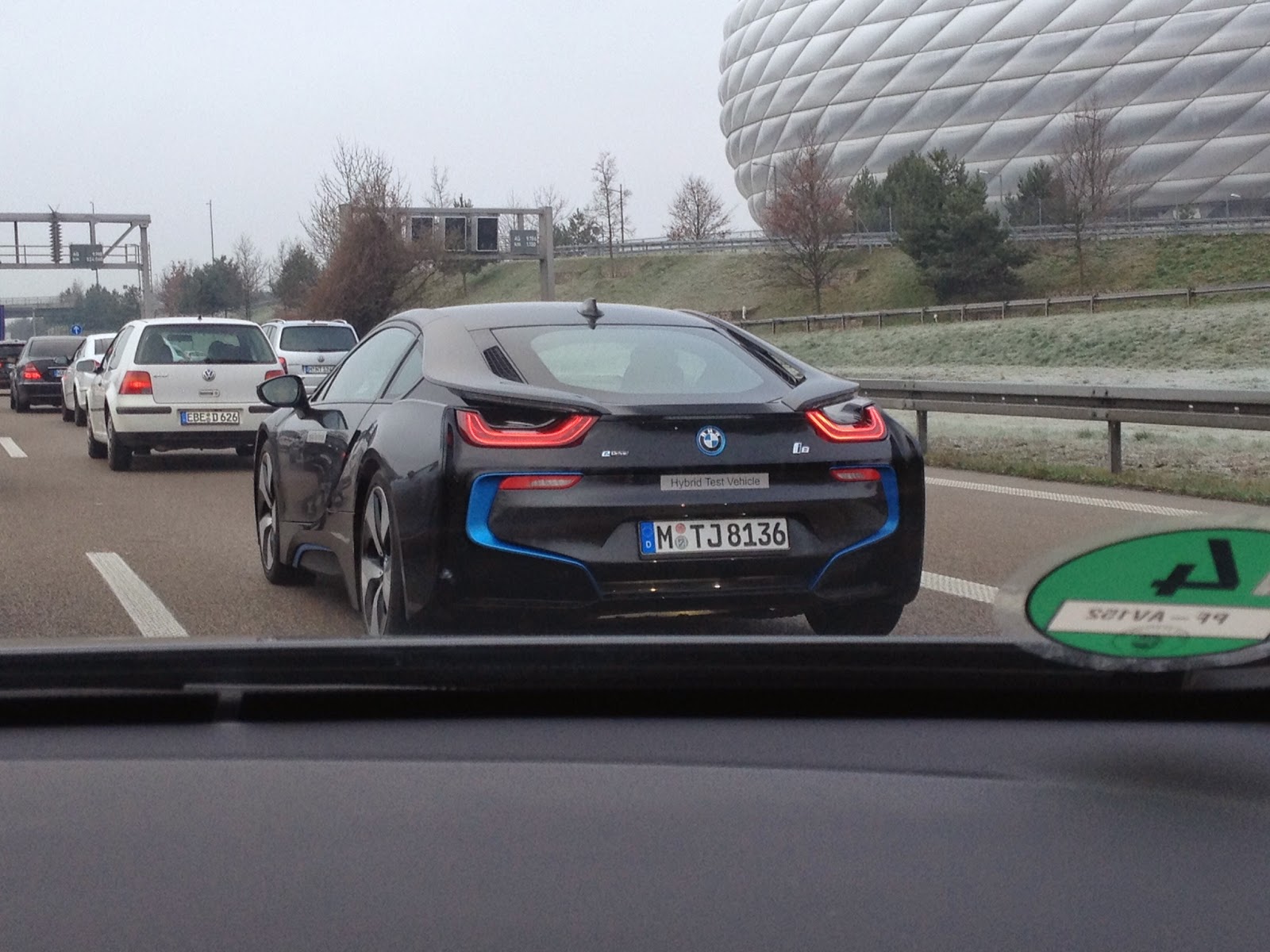
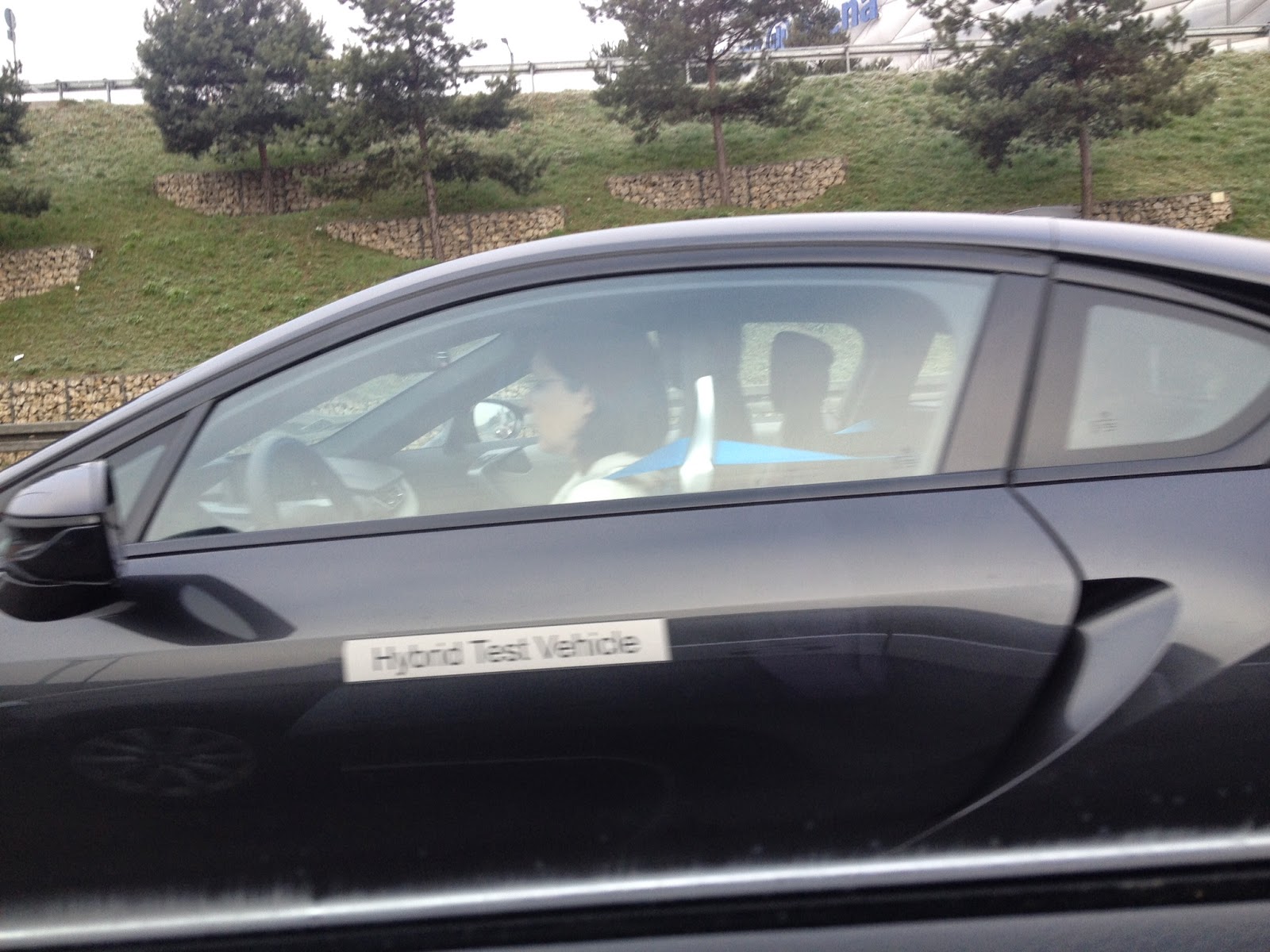
In more news on the soon to be launched BMW i8, we've found a short video of the car testing at the Nürburgring. Also, while in Munich recently on business, I personally spotted an i8 test mule in morning peak hour traffic with a young lady at the wheel (I didn't take the pictures as I was driving the rental)

BMW plans to sell the i8 in about 50 countries, with the U.S. expected to be the largest sales market. In Europe, Germany, France and the UK are expected to be the top markets. Deliveries to retail customers in Europe are scheduled to begin in June 2014, and about one month later in the U.S.

Pricing for the 2015 BMW i8 destined for the U.S. market starts at US$135,925. BMW are currently taking orders for the i8 in Japan. Pricing starts at ¥19,170,000 (US$191,500)