EVDrive Demo a UTV with 4-Wheel Motor Torque Vectoring [VIDEO]

EVDrive completed development and demonstrated a powersports industry first, an "electric 4-wheel 4-electric-motor torque vectoring technology" called Terra-Torque-Drive™, specifically geared to 4-wheel off-road powersports vehicles, such as for the rapidly growing market segment of side by side Utility Terrain Vehicles or UTVs. After taking recent demo rides in the EVDrive-UTV tech demonstrator, powersports industry insiders, such as UTV OEM reps and UTV racers enthusiastically agree, that the Terra-Torque-Drive™, technology would beat almost all of today's top "gas/mechanical powered" 4wd UTVs. OEMs now have the opportunity to license this unique technology for integration into their own future powersports side by side UTV vehicle offerings.

Approximately 323,000 UTVs were retailed in North America in 2012, according to Power Products Marketing (PPM), a market research firm. PPM found consumer models (for example: Polaris RZR XP900) accounted for around 35% of total sales; Prosumer models (example: Deere XUV825i) garnered around 55% share, and commercial models (example: Bobcat Toolcat) were responsible for about 5% of sales. Industry insiders concur that the new EVDrive technology could apply to all 3 market segments. Compared to the top UTVs sold today, a Terra-Torque-Drive™, powered UTV with EVDrive Range Extender (REX) installed would excel in these areas:

1 - Highest efficiency 4wd drivetrain on any UTV today (least mechanical losses)
2 - Adjustable hill descent control (accomplished via an "electric engine braking" called "regen" putting energy back into the vehicles battery system from each of the 4 wheels)
3 - Dynamic torque vectoring modes both for high and low speed operation, e.g. industry unique "Zero Radius Turning" and high speed active torque vectoring allows for better and safer handling off-road
4 - Torque and power from -100 to +100% can be dynamically sent to any wheel, in either direction, in any combination, at any time.
5 - True Series hybrid with optimized internal combustion engine powered REX to allow for longer range matching or exceeding gas powered UTVs sold today. (REX is a high voltage specialized generator- LPG, gas or diesel powered REX engine easily adaptable, no mechanical connections to vehicle)
6 - 120vac power from onboard battery pack, backed up with the REX for general utility use
7 - Lower cost to maintain and operate - superior fuel economy, estimated average 50-100% better – for short trips, no fuel may be needed at all – plug-in to standard electric car chargers.
8 - Superior straight-line and rough loose material, curvy trail acceleration
9 - Greater river depth traversal possible due to completely sealed liquid cooled e-motors/power electronics.
10 - Stealthy low noise operation in electric only mode e.g. wildlife observation & hunting
11 - Torque vectoring software platform allows new traction capabilities to be supported like "apps" without costly mechanical NRE expenses to the OEM – OEM can provide customers software updates for new capabilities.
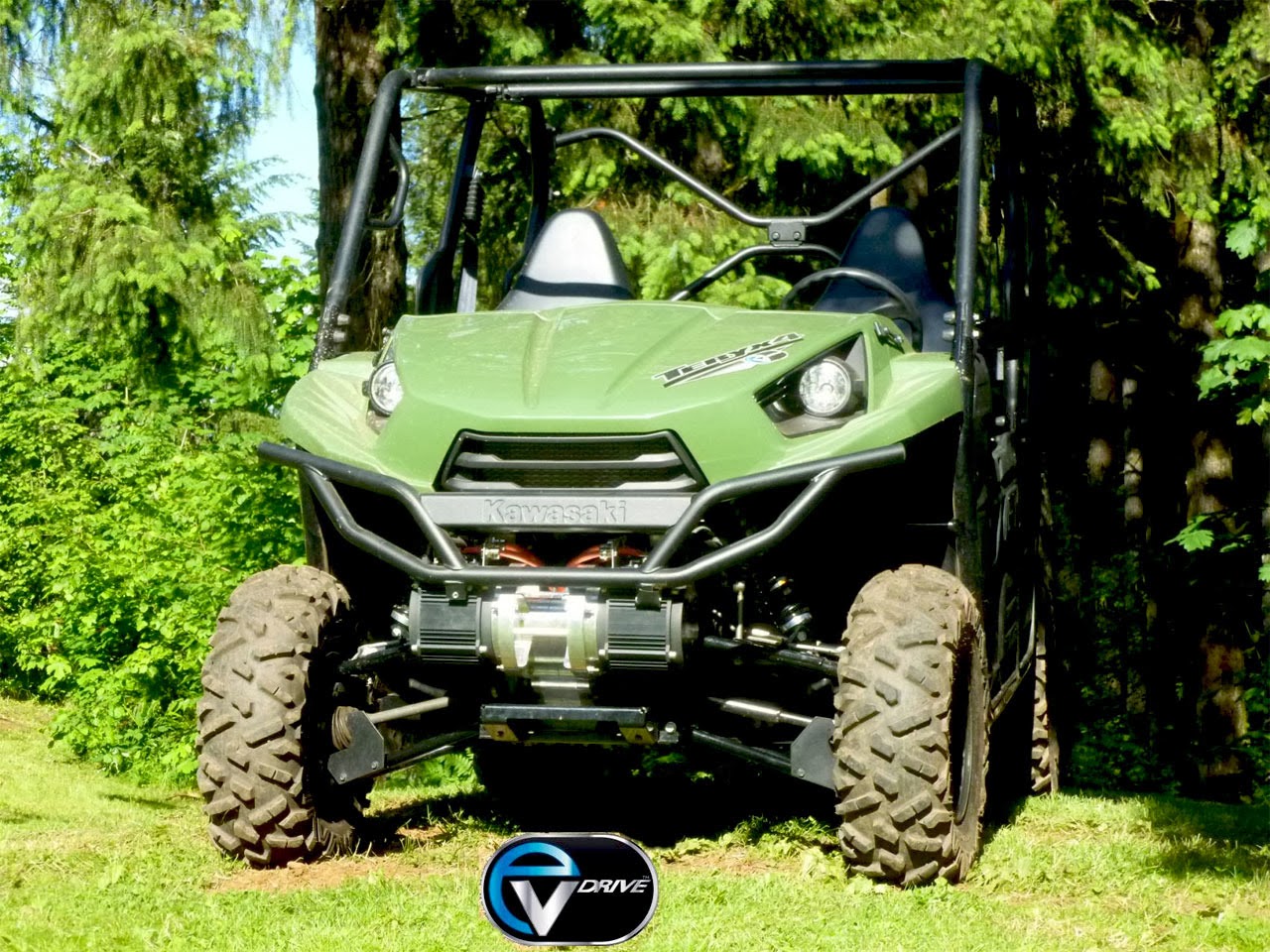
EVDrive chose the 4-seat Kawasaki Teryx4 as a tech demonstration platform because of its short wheelbase, smaller turning radius, and large break over angle to minimize getting hung up on obstacles. EVDrive modified this UTV with complete removal of the gas engine and AWD mechanical drivetrain and replaced with a 160hp peak total version of the Terra-Torque-Drive™. Unlike the stock Kawasaki Teryx4 UTV mechanical AWD drive, no additional mechanical losses are incurred in the Terra-Torque-Drive™, regardless of AWD mode from lack of transmission, driveshafts and differentials. "Off-road UTVs are ideally suited to our torque vectoring technology where only single fixed speed reduction is required per motor-wheel to attain 55-75mph top-speeds with the type of high RPM brushless motor technology we employ," said COO, co-founder, Steve Tice.

The Terra-Torque-Drive™, is a customized version of the general and modular EVDrive-Train architecture™ (http://bit.ly/EVD-Arch) used on all EVDrive conversion projects, with an in-house developed scale-able torque vector software platform added running on the EVDrive VCU (vehicle control unit), which supports new traction modes with inputs from all driver controls plus vehicle sensors such as accelerometers, etc. Some planned traction modes, that go beyond what is currently running on the demonstrator: auto dynamic terrain type posi-traction control, variable inclination angle offset descent control, zero radius turns on incline, emergency 4-wheel panic braking/stop & boulder climbing.

The Terra-Torque-Drive™, powered e-UTV demonstrator uses 4 of the sealed liquid-cooled EVDrive EVD35 35kW/47HP peak drive sub-systems, de-tuned to ~30kW/40HP each or delivering a total of ~160HP/120kW peak. At each motor shaft, ~66 ft-lbs peak torque is delivered. The 4 gearboxes allow ratio changes with off-the-shelf gearsets. With the currently installed single speed gearsets, at the CV joint of each wheel, a whopping 726 ft-lbs peak torque is delivered. This is the kind of torque necessary to perform Zero Radius Turns with a fully loaded vehicle and perhaps even some extreme rock climbing. "With these gearsets, a top speed of 45mph is achieved with acceleration to this speed of less than 4 seconds if you get good traction – at zero speed all 4 wheels will break loose on dry asphalt!" said EVDrive's CTO & co-founder, Bob Simpson.

In the accompanying video to this press release, some of the e-UTV tech demonstrator more technical features are revealed, such as: control touch screen for the Terra-Torque-Drive™, specifically the interface to the in-house developed VCU, shown in accompanying picture links below, and optional engine sound synthesis unit some OEMs expressed interest in, with 2 sounds demonstrated in the video, a gas turbine and V-twin motorcycle sound.

Addition of the15kW REX not only gives the UTV full performance and range to match and exceed top UTVs on the market but also offers a feature the competition does not, that is 120vac of electrical power anywhere you need it. "With the REX sub-system part of the Terra-Torque-Drive™, a hybrid UTV can be a true swiss-army-knife UTV, able to deliver power in remote locations for construction/utility/ranch applications, run silent for hunting/wildlife observation & with full-time 4wd torque vectoring, can deliver off-road handling and performance for sports/recreation, in summary, addressing all needs in the consumer, prosumer and commercial markets," said CEO, Steve Tice.

"Similar to our 25kW REX technology installed in our Series-PHEV BMW325 tech testbed -> http://bit.ly/PHEV-BMW-3-series but smaller, our custom high voltage 15kW-single cylinder (ICE) powered REX for the UTV is located between the rear seats – so with this sub-system, competing against top 4-seat UTVs in range will not be a problem - certainly the performance meets and beats stock UTVs we have tested" said EVDrive's CTO Bob Simpson. The REX gas engine can be modified to run on LPG as well offering additional emissions and operational cost advantages. EVDrive's REX technology supporting the hybrid e-UTV development has been already designed & proven in EVDrive Series PHEV BMW 325i Technology Testbed here shown sealed below rear spare tire floor - no protrusion above stock floor as shown in pictures at link included above.

EV West is partnering with EVDrive to deploy and demonstrate Terra-Digital-Torque-Steer™ all-wheel torque vectoring technology on full-size off-road vehicles. EV West is known for many milestones; e.g. Builders and drivers of the record breaking all-electric BMW 3-series street sedan at the Pikes Peak International Hill climb and builders of first ever electric off-road race car to run the Baja Mexican 1000 race in the National Off Road Racing Association's series.

TRANSLOGIC Test drive the Audi A3 Sportback E-Tron PHEV [VIDEO]

Aol's Translogic get an early drive of Audi's first plug-in vehicle for the U.S. market, the A3 Sportback E-Tron PHEV.

Part of Audi's all-new A3 lineup, the Sportback E-Tron boasts an estimated electric driving range of about 30 miles at speeds up to 80 miles per hour. Does Audi's first ever production E-Tron deliver the same performance and technology that the luxury German automaker has become known for?

2015 Porsche 918 Spyder: The Future of the Hypercars? [VIDEO]

Carlos Lago of Ignition tests the Porsche 918 Spyder in Spain.

Boasting an electric motor on the front axle and a parallel hybrid setup for the rear, this hypercar produces a combined 874 hp and 944 lb-ft of torque and aims to set a new precedent for performance and efficiency. To this end, it has dizzying amount of motorsports-derived technology -- its carbon fiber passenger tub, engine, and chassis are derived from the concepts that created the RS Spyder ALMS racecar -- but its European test cycle fuel economy results are comparable to the Toyota Yaris Hybrid's.

AutoGuide Review – 2014 BMW i3 [VIDEO]

Autoguide.com review the BMW i3.

Fast facts:

  • 1. The i3 offers 125 kw and 250 Nm of torque for a 0-60 time of 7.2 seconds.
  • 2. BMW claims from 80 to 100 miles of electric range, or 150 to 180 miles with the optional range extender.
  • 3. It weighs under 1,195 kg thanks to a carbon-fiber passenger cell.
  • 4. BMW charges $42,275 including destination and before incentives.
  • Chevy Spark EV Tops EPA List with 119 MPGe

    In its 2014 Fuel Economy Guide, the United States Environmental Protection Agency puts one car at the top of the list when it comes to fuel efficiency: the 2014 Chevrolet Spark EV.

    With an EPA-estimated 82 miles of driving range and a fuel economy equivalent of 119 MPGe, the average driver can save $9,000 in fuel costs over five years compared to the average new vehicle.

    Last year’s top ten list of the most fuel-efficient vehicles was comprised entirely of electric vehicles, so it’s not surprising that this year’s ranking is also packed with EVs.

    The Spark EV, sold in California and Oregon, is also the first vehicle in the U.S. to offer the SAE International fast-charge connector as a vehicle option. The new combined AC and DC charging, or combo, connector is accessible via a single charge port on the vehicle and allows electricity to flow at a faster rate.

    How much faster? DC fast charging charges 80 percent of the Spark EV’s battery in just 20 minutes for over 65 miles of range. By comparison, AC 120V charging, which can be done using a conventional household outlet, takes around 17 hours to fully charge. AC 240V charging reduces recharging time to less than seven hours for a full charge, but it requires a dedicated 240V charging station.

    Many major automakers have announced they will adopt the SAE combo fast charge connector standard. Adopting an industry standard for EV charging is an important step in growing the public charging infrastructure.

    GM is committed to leading the charge in the U.S. to develop energy alternatives like EVs and biofuels that help reduce dependency on petroleum, improve fuel economy and reduce emissions.

    It’s why we were part of the unveiling of the very first public SAE combo DC fast charging station last year at the Fashion Valley Mall in San Diego.

    And it’s why our engineers work tirelessly to bring greener vehicles like the Spark EV, Chevrolet Volt, Chevrolet Cruze Diesel, Cadillac ELR and the bi-fuel Chevrolet Impala to market.

    If this year’s list of the most fuel-efficient vehicles on the market tells us anything, it’s that EVs are continuing to grow in popularity. And as more and more hit the market, choices for potential buyers will only increase, which means good things for the wallet and the environment.

    Fully Charged – Electric Land Rover Defender [VIDEO]

    The Electric Defender has all the qualities and performance you'd expect, full all-terrain capability, permanent 4WD and a top speed of 70mph.

    However, it has been engineered in-house by Land Rover to test out the latest sustainable technologies. The vehicle's Hill Descent Control is linked to a regenerative braking function, and overall up to 80 per cent of the car's kinetic energy can be recovered. Land Rover's acclaimed Terrain Response system has been adapted for electric drive, offering a 50-mile range with a reserve of a further 12.5 miles.

    The result is a zero tailpipe emissions vehicle like no other; eight hours of low-speed off-road use is achievable, and it takes 10 hours for the advanced lithium-ion batteries to be fully charged. 'Fast-charge' technology reducing that to just fours is also possible.

    CHRIS HARRIS – 2014 Chevrolet Volt Review [VIDEO]

    YouTube's DRIVE channel test specialist Chris Harris reviews the 2014 Chevrolet Volt.

    The Volt electric car has a backup engine to extend its typical 80 km electric range. It is quick, quiet, and responsive, with a taut ride. Once the lithium-ion battery is depleted, the 1.4-liter engine acts as a generator to extend the range by 500 km with Volt drivers averaging 1500 km between fill-ups. Recharging take 4 hours using a 240-volt supply and 10 hours with 120 volts. Lease deals start from $269 / month.

    Overall the Volt is a brilliantly executed example of automotive innovation that makes any ICE only car seem primitive by comparison. It combines the benefits of a full EV powertrain with a part-time duty-cycle ICE to provide 600 km of combined range. Where the Toyota Prius is an ICE powered car with electric assistance, the Holden Volt is a plug-in electric car with ICE assistance.

    The Volt fills the gap between the 500 km all electric range Tesla Model S, which due to it's 85 kWh battery can costs up to $100k, and the more affordable but shorter range battery only cars like the Mitsubishi iMiEV and the Nissan Leaf.

    New season of Fully Charged – Volkswagen XL1 [VIDEO]

    Robert Llewellyn test drives 'the most fuel efficient production car in the world' according to VW.

    Volkswagen made big claims about the efficiency of their purpose-built XL1 diesel-hybrid. They claimed the car was good for 314 mpg, which equates to 0.9 l/100km in the Metric system.

    However, at a test drive event organized by VW last July, a handful of journalists were given the chance to drive the mid-engined XL1 and results ranged from 160 to 200 mpg.

    SIM-Drive Develop 4 motor AWD electric Toyota 86 [VIDEO]

    The EV SIM-86e, a Toyota 86 developed by SIM-DRIVE, was exhibited at the Odaiba Motor Fes. The car is an 86 based EV, with all 4 wheels powered by independent motors.

    Technical specifications haven't been released (in English at least) but we can make some educated guesses. The AWD EVs developed by SIM-Drive to date, SIM-Lei, SIM-Wil & SIM-Cel have all used direct drive in-wheel motors. We can see from the picture below, the standard friction brakes are visible in the wheels so the SIM-86e must be running in-board motors.

    In developing the SIM-86e, Tajima Motor Corporation used E-RUNNER technology, which the company has been developing for racing vehicles to participate in the Pikes Peak International Hillclimb. TMC Chairman of the Board and SIM-Drive President and Director Nobuhiro Tajima explained:

    “Since our development of a 4WD automobile with a twin engine, we have been playing with such car-control technology as multiple power sources and 4 independent motors. In the SIM-86e we have thoroughly employed the control know-how cultivated through developments to E-RUNNER technology.”

    While the Pikes Peak winning E-RUNNER was all-wheel-drive, it used only two motors driving the wheels through a differential on each axle. The motors were supplied by GKN and belived to be 2x AFM-240 Axial Flux motors, each capable of 335 kw (455 hp) and 1200 Nm Peak. As the GKN Evo motors are not suitable for in-wheel mounting we might speculate that the SIM-86e may be running 4x in-board AFM-140 Axial Flux motors driving the wheels via standard half-shafts, with or without gear reduction.

    “This year there were some wet roads, and for that reason our times didn't improve. However, with next year’s dry conditions, I think it may be possible to achieve a new course record. Also, our efforts for next year’s car are making it compatible with a fast charger, meaning we will get technological feed back for product version EVs as well. Both for practical reasons and in times of crises, EV’s clearly need to have the ability to charge quickly. I’m confident that fast charging technology for harsh motor sports conditions will be useful for developing the product versions to come.”

    NHTSA reaffirms 5-star safety rating of the Tesla Model S

    The National Highway Traffic Safety Administration (NHTSA) has reaffirmed the 5-star safety rating of the Tesla Model S overall and in all subcategories for Model Year 2014, confirming the highest safety rating in America.

    While Tesla is awaiting feedback from NHTSA regarding their investigation of recent fire incidents, the German Federal Motor Transport Authority, Kraftfahrt-Bundesamt (KBA), recently concluded its review of the incidents, finding no manufacturer-related defects or need for further action.

    It is worth noting that a Tesla vehicle is over five times less likely to experience a fire than the average gasoline car and that there have been zero serious injuries or deaths for any reason ever, fire or otherwise, in a Model S.

    Over the course of more than 100 million miles driven in almost every possible terrain, weather and crash conditions, the Tesla Model S has consistently protected its driver and passengers, achieving the best safety track record of any car on the road.

    The Porsche 918 Spyder Tested [VIDEO]

    Tested by /DRIVE's Chris Harris at the Valencia circuit in the winter of 2013. The Porsche 918 Spyder has come a long way since when we first saw it at the Geneva Motor Show in March 2010. Competing against the Ferrari LaFerrari and McLaren P1, it is the cheapest of the trio of new hypercars at a base price of $845,000.

    The engine weights 140 kg according to Porsche and it delivers 608 horsepower (453 kW) at 8,500 rpm and 528 N·m (389 lbf·ft) of maximum torque. This is supplemented by two electric motors delivering an additional 279 hp (208 kW) - One 154 hp electric motor drives the rear wheels in parallel with the engine and also serves as the main generator.

    Kawasaki “J” EV Motorcycle Concept [VIDEO]

    The Kawasaki J has three wheels. However it uses more than one mode, allowing it to transition to a sports bike, making the two front wheels mesh together. In that mode, the vehicle also lowers, closer to the ground.

    The bike was recently unveiled at the Tokyo Motor Show. Housing an all electric motor, when the rider is taking part in leisurely, slow cruises, or stop and go trips through the city, the two wheels remain separated and the handlebars raise offering the driver more comfort.

    It's during the fast speed, highway type of rides, the tires comes together and the bars lower, allowing the rider to have optimal positioning and posture.

    The basic idea behind the bike is for it to stretch out as speeds increase. The radical and mean looking machine has been generating some serious buzz since the premiere, however it is just a concept for now.

    Kawasaki did not release any plans to put it into production.