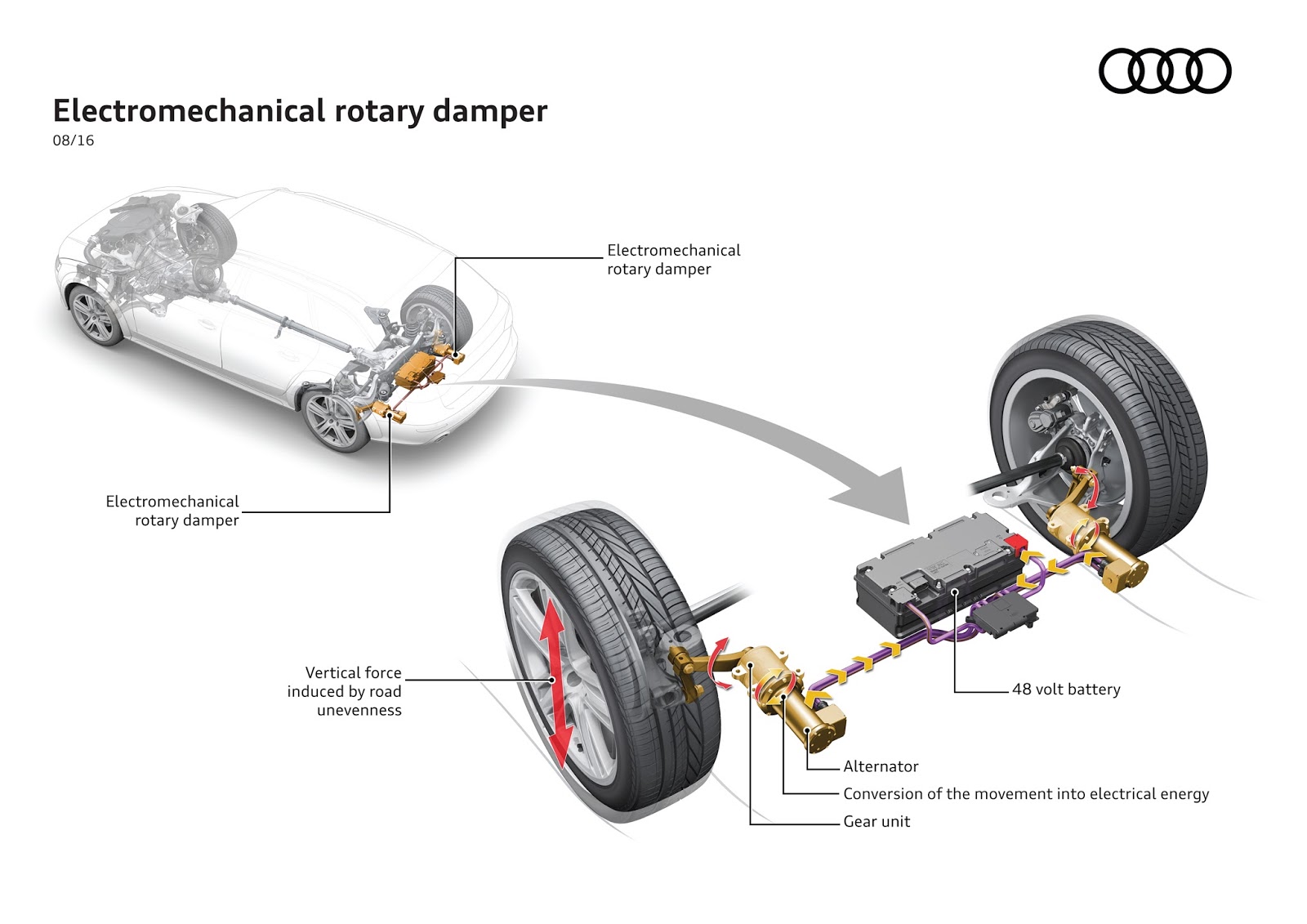
We have reported on a wide range of energy regenerative shock absorbers over the years that most often convert linear motion into electricity. Audi is working on a prototype called “eROT,” in which electric motors replace telescopic shock absorbers in the form of electromechanical rotary dampers.
The principle behind eROT is easily explained: “Every pothole, every bump, every curve induces kinetic energy in the car. Today’s dampers absorb this energy, which is lost in the form of heat,” said Dr.-Ing. Stefan Knirsch, Board Member for Technical Development at AUDI AG. “With the new electromechanical damper system in the 48-volt electrical system, we put this energy to use. It also presents us and our customers with entirely new possibilities for adjusting the suspension.”
The eROT system responds quickly and with minimal inertia. As an actively controlled suspension, it adapts ideally to irregularities in the road surface and the driver’s driving style. A damper characteristic that is virtually freely definable via software increases the functional scope. It eliminates the mutual dependence of the rebound and compression strokes that limits conventional hydraulic dampers. With eROT, Audi configures the compression stroke to be comfortably soft without compromising the taut damping of the rebound stroke. Another advantage of the new damper system is its geometry. The horizontally arranged electric motors in the rear axle area replace the upright telescopic shock absorbers, which allows for additional space in the luggage compartment.
The eROT system enables a second function besides the freely programmable damper characteristic: It can convert the kinetic energy during compression and rebound into electricity. To do this, a lever arm absorbs the motion of the wheel carrier. The lever arm transmits this force via a series of gears to an electric motor, which converts it into electricity. The recuperation output is 100 to 150 watts on average during testing on German roads – from 3 watts on a freshly paved freeway to 613 watts on a rough secondary road. Under customer driving conditions, this corresponds to a CO2 savings of up to three grams per kilometer (4.8 g/mi).
The new eROT technology is based on a high-output 48-volt electrical system. As currently configured, its lithium-ion battery offers an energy capacity of 0.5 kilowatt hours and peak output of 13 kilowatts. A DC converter connects the 48-volt electrical subsystem to the 12-volt primary electrical system, which includes a high-efficiency, enhanced output generator.
Initial test results for the eROT technology are promising, thus its use in future Audi production models is certainly plausible. A prerequisite for this is the 48-volt electrical system, which is a central component of Audi’s electrification strategy. In the next version planned for 2017, the 48-volt system will serve as the primary electrical system in a new Audi model and feed a high-performance mild hybrid drive. It will offer potential fuel savings of up to 0.7 liters per 100 kilometers.


 Over the past few years, the cost of electricity generation from renewable-energy sources has decreased dramatically. So much so, that renewable energy may have just hit an important milestone, according to one study. In the U.S., wind and solar power are now cheaper sources of electricity than natural gas—even without subsidies. DON'T MISS...
 ![The White House, Washington, D.C. [Creative Commons license by dcjohn]](http://images.hgmsites.net/tmb/white-house_100170583_t.gif) President-elect Donald Trump's energy policies are expected to be a sharp departure from those of his predecessor. During his campaign, Trump pledged to expedite and deregulate exploration and processing of fossil fuels, enact an "all-of-the-above" energy policy, and "bring back coal," among other promises. That has led to concerns among...
President-elect Donald Trump's energy policies are expected to be a sharp departure from those of his predecessor. During his campaign, Trump pledged to expedite and deregulate exploration and processing of fossil fuels, enact an "all-of-the-above" energy policy, and "bring back coal," among other promises. That has led to concerns among...  Tesla is perhaps best known for its electric cars, but the company has another prominent business as well. Its Tesla Energy division markets stationary lithium-ion battery packs for energy storage. Energy-storage systems can increase the utility of home solar arrays, meaning Tesla Energy will likely become more important now that Tesla is set to...


 The combination of Tesla and SolarCity is already promoting its potential synergies, albeit in a location far away from the mainland United States. The island of Ta'u in American Samoa is located more than 4,000 miles from the U.S. West Coast, and typically relies on imported diesel fuel to generate electricity. With no local sources of fossil...
  The debate over U.S. energy policy took a dramatic turn last month when Tesla Motors CEO Elon Musk squared off against the CEO top privately-owned U.S. coal producer Murray Energy. In an interview for the CNBC show "Squawk Box," Robert Murray called Tesla and its electric cars a "fraud." He criticized the automaker for failing to turn a profit...
  U.S. renewable-energy generating capacity is not only growing, but it is beginning to erode coal's share of the electricity-generating mix, according to new data from the U.S. Department of Energy (DOE). The agency predicts renewable energy—particularly solar power—to continue growing. At the same time, a combination of renewable...
  The overall carbon emissions associated with electric cars decrease as the electricity used to recharge them gets cleaner. And the latest statistics from the International Energy Agency (IEA) will be good news indeed for electric-car drivers. Last year saw record growth in renewable energy, according to the IEA, which surpassed coal to become the...
  Late last week, Tesla Motors CEO Elon Musk held a press conference whose underlying message was support for the proposed combination of Tesla with solar installer SolarCity. Musk's cousin Lyndon Rive runs SolarCity and Musk sits on its board, but the proposed acquisition has been criticized by analysts as a distraction for the electric car...
  It goes without saying that mass adoption of electric cars would lead to a massive decrease in oil consumption over time. So far, though, the oil industry hasn't seemed to give plug-in electric cars much attention. ExxonMobil and OPEC have both predicted that, even by 2040, electric cars will make up less than 10 percent of global new-car sales...
  Scotland isn't known for having the most pleasant weather. But its persistent winds make the country a great place for renewable energy. Over the past few years, officials have overseen the construction of numerous wind turbines, in hopes of turning Scotland's weather into a useful resource. CHECK OUT: What Country Powered Itself Entirely On...
  While automakers work to meet stricter carbon-emissions standards, another sector of the U.S. economy has already made notable progress in reducing ts emissions. Carbon-dioxide (CO2) emissions from electricity generation during the first six months of 2016 were the lowest since 1991, according to the U.S. Energy Information Administration (EIA)...
  The energy sources used to generate grid electricity can be a major source of greenhouse-gas emissions, and thus they affect the environmental impact of electric cars. The cleaner the electricity used to charge an electric car, the cleaner that car becomes in operation. And among potential energy sources, hydroelectric power from dams would seem...
  Over the past few years, China has made a major push to reduce carbon emissions by encouraging use of green technologies. Thanks to generous government incentives and fleet purchases, it is now the world's largest market for plug-in electric cars. Construction of new solar and wind farms has also proceeded at a rapid pace. DON'T MISS: Chevy Volt...