Autonomous Nissan Leaf Gets First License Plate for Public Road Testing

Nissan President and CEO Carlos Ghosn today took delivery of Japan's first license plate for a car equipped with highly advanced driver assist systems. It clears the way for a Nissan LEAF equipped with the technology to be tested on the public roads in Japan for the first time. The research program will accelerate the development of technologies fundamental to Autonomous Drive. The systems are designed to allow the driver to manually take over control at any time.

The license plate includes the number 2020, which reflects Nissan's goal to be ready with multiple, commercially-viable Autonomous Drive vehicles by the year 2020.

"This is an ordinary license plate for an extraordinary vehicle," said Nissan president and CEO Carlos Ghosn. "A month ago we revealed to the world our 2020 Autonomous Drive target. Road testing of the underlying technologies is critical to maintaining our leadership position and we are grateful to the Government of Japan for its support."

The Nissan LEAF to be tested is capable of a number of functions, including:

  • Lane keeping
  • Automatic Exit
  • Automatic lane change
  • Automatic overtaking slower or stopped vehicles
  • Automatic deceleration behind congestion on freeways
  • Automatic stopping at red lights

    Nissan is developing Autonomous Drive as it works to achieve virtually zero fatalities in accidents involving its vehicles. The goal stands alongside zero emissions as a key pillar of Nissan's research and development. Autonomous Drive is an extension of the Nissan Safety Shield, which monitors a 360-degree view around vehicles for risks, gives warnings to the driver, and automatically intervenes if necessary. Work is already underway to build a dedicated Autonomous Drive proving ground in Nissan's facility in Oppama, Japan.

    Nissan Executive Vice President for Research and Development, Mitsuhiko Yamashita, said: "The realization of the Autonomous Drive system is one of our greatest goals, because Zero Fatalities stands alongside Zero Emissions as major objective of Nissan's R&D. Through public road testing, we will further develop the safety, efficiency and reliability of our technology."

  • Nissan e-NV200 Electric Van in Final Development Phase

    Nissan is in the final development phase of its second mass production zero emission vehicle, the e-NV200 compact van. Electric vehicles are ideal for urban delivery applications, and this vehicle is envisaged for use as a delivery van that offers a breakthrough type of mobility for entrepreneurs, featuring efficiency and green consciousness.

    The company has been working with several large commercial fleets in global markets since 2011 to understand how the e-NV200 test car performs under real operating conditions. So far the e-NV200 has received positive comments for its quiet, comfortable driving with no emissions and low noise, CO2 reduction, and generous carrying capacity.

    Feedback will help Nissan adapt future battery-powered light commercial vehicles to better fulfill exacting customer requirements.

    The 100% electric compact van, e-NV200, is scheduled for launch in 2014. As Nissan’s second global electric vehicle, it follows Nissan LEAF, the world’s first affordable 100% EV for the mass market.

    In addition to further reinforcing Nissan’s zero-emissions leadership, the launch of the e-NV200 represents significant innovation in the commercial vehicle market. The model offers all the spaciousness, versatility and practicality of its base vehicle, the multipurpose commercial van NV200. It delivers advanced performance that can only be achieved through the powertrain of the Nissan LEAF.

    The e-NV200 provides exceptionally smooth acceleration and quietness, driving characteristics that are unique to EVs, while emitting no CO2 emissions at the point of use. e-NV200 displays great potential for businesses, with its advanced telematics system and power-supply function in the cargo compartment. Also, the model's enviable running cost – a priority for most companies – will be highly attractive when competing in the commercial vehicle marketplace.

    "The e-NV200 will offer all the spaciousness, versatility and practicality of a traditional diesel or gas-powered compact van, but with zero CO2 or other pollutant emissions at the point of use. What's more, it will provide an outstanding driving experience that is unique to EVs. e-NV200 represents a bold and innovative addition to our commercial vehicle range, which is already one of the broadest of any manufacturer," said Hideto Murakami, corporate vice president, Nissan Motor Co., Ltd.

    When e-NV200 production begins it will become Nissan's second zero-emission vehicle, but the company is already investigating further innovative ways of harnessing its world-leading EV technology in the commercial vehicle market with the e-NT400, which is a light truck based on the European NT400Cabstar, known as NT400 Atlas in Japan.

    The e-NT400, still in its development phase but with plans for production under study, uses Nissan LEAF running gear to create a zero-emission 100% electric vehicle.

    Like e-NV200, e-NT400 would be able to enter city areas denied to conventional vehicles powered by diesel or petrol engines, while its near-silent running means it could operate around the clock as it creates no noise or emission nuisance.

    Low running costs would make e-NT400 a breakthrough business proposition, while the high output, high capacity lithium-ion battery powering the 80kW electric motor gives smooth, vibration-free acceleration for a completely unprecedented driving experience.

    With a cruising range of 87 miles (140 kilometers) in NEDC mode, and the availability of fully integrated Quick Charging potential - allowing the battery to be charged to 80 per cent capacity in just 60 minutes - the e-NT400 has the potential to make a serious contribution to lowering CO2 emission in cities. At the same time, it will increase productivity and lower running costs for operators.

    Hideto Murakami, Nissan corporate vice president responsible for the Global LCV Business Unit, said: "As well as e-NV200, Nissan is developing a number of vehicles that adapt a diverse range of EV technologies. We want to explore the potential of EV technology in the light commercial market to diversify the value that Nissan's commercial vehicles provide to businesses."

    Nissan to Showcase ZEOD RC Electric Race Car at Fuji WEC event

    Japanese fans will have the first opportunity to see the Nissan ZEOD RC in action when the car makes its public on-track debut at this year's Fuji Speedway round of the FIA World Endurance Championship.

    Running in pure electric mode, the Nissan ZEOD RC will undertake demonstration runs on October 18, 19 and 20 - all three days of the Japanese round of the WEC. The Fuji demonstration was announced today at the Nissan 360 global media event in California.

    The ZEOD RC (Zero Emission On Demand Racing Car) will make its race debut at next year's Le Mans 24 Hour. The global leader in electric vehicles for the road, Nissan will trial variants of new electric drive train technologies as part of its intended future return to LM P1 competition to challenge for overall victory at the world's most prestigious endurance race.

    Nissan's two-time Japanese SUPER GT champion Michael Krumm will drive the car at Fuji. Krumm was part of the driver line-up for the Nissan DeltaWing program in 2012 and also finished third in the LM P2 class this year at the Le Mans 24 Hours.

    Krumm competes for Kondo Racing in the SUPER GT championship in Japan alongside Hironobu Yasuda. In addition to his SUPER GT and Le Mans schedule, Krumm also recently tested a Nissan Altima V8 Supercar in Australia for the factory Nissan team.

    "It is certainly going to be a very unique experience to go that fast with electric power - especially since Fuji's main straight is nearly a mile long.

    "Fuji Speedway is such an historic venue - it's actually pretty fitting that the ZEOD RC will have its first public runs here because this car certainly has the opportunity to change motorsport history.

    "We're only doing a demonstration run but I'm really looking forward to seeing what kind of top speed we'll see on the straight."

    "To be able to do that at such a great venue like Fuji Speedway, only 90 minutes away from the home of NISMO [Nissan's motorsport arm and a partner in the development of the ZEOD] in Yokohama, was too good to pass up."

    The internal-combustion motor that will form part of the ZEOD's powertrain is not due to run in the car until January.

    Nissan’s 2013 LEAF Sales Surge 335%

    Nissan reported a massive 335% increase in sales of its hatchback electric car LEAF in U.S since the launch of the 2013 model in Mar 2013. LEAF has been Nissan's bestselling car in Seattle, Portland and San Francisco. Alongside, the company also witnessed burgeoning demand for electric vehicles outside the traditional West Coast market, i.e., in "New Wave" markets across the country.

    Nissan expects incremental demand for electric vehicles in diverse markets and LEAF is expected to dominate the market share. With more than 75,000 LEAF electric cars on the road, Nissan emerged as the global leader in zero emission vehicles.

    Nissan has witnessed 8.5% year-on-year growth in sales so far this year. The increase was driven by record-breaking U.S. monthly sales in 4 out of 7 months. The biggest contribution came from year-over-year increase in the sales of Nissan LEAF and a surge in the sales of the redesigned Pathfinder SUV.

    Apart from the U.S., Nissan is also doing well in other parts of America. The company witnessed 7.5% sales growth in Mexico in the first seven months of 2013. Moreover, it plans to open new manufacturing facilities in Aguascalientes, Mexico and Resende, Brazil.

    Nissan to expand EV lineup to 5 models all with Wireless Charging

    Nissan Motor Co. says it will expand its global EV product line to five models.

    The company has not announced what additional models it is planning and has not specified a timetable. But it indicates Nissan is taking a long-term view of the slow-growing EV market.

    "We haven't announced what models they will be, but we have plans for five," Carla Bailo, senior vice president for R&D at Nissan Americas, told reporters. "The others will come in due time."

    Bailo said future Nissan-brand EVs will use inductive charging -- an emerging advanced technology for recharging the batteries of electric cars wirelessly. Inductive chargers enable an EV owner to park on top of a charging mat to recharge a battery without hooking up a connector.

    "Once that technology is ready, we will use it across our brands," she said after her presentation.

    Previously, Nissan had said inductive charging was critical to differentiate the luxury EV planned for the Infiniti brand.

    Production of the cargo van begins later this year in Europe, initially for the European market. But this spring, Infiniti President Johan de Nysschen said the Infiniti EV will be delayed. Infiniti said it wanted to wait for improvements in inductive charging technology.

    That means that only the Leaf has made it to market so far, after more than three years of promoting the idea of EVs. The company spent $1.8 billion to move U.S. production of that model to Smyrna, Tennessee, and to construct a lithium ion battery module plant there. That factory, which began production in January, gives Nissan the capacity to build up to 150,000 Leafs a year and 200,000 batteries.

    Sales of the car in the United States have more than tripled since last year, when it was still being imported. Through July, Nissan dealers sold 11,703 Leafs, up from 3,543 in the first seven months of 2012.

    Spy Shots: Venucia E30 EV Spotted in China

    New spy shots showing the production version of the Venucia e30 EV have surfaced. Venucia is a sub-brand of the Dongfeng-Nissan joint venture, the e30 EV is based on the Nissan Leaf. The Venucia e30 debuted as the Venucia E-Concept on the 2012 Beijing Auto Show, and re-appeared as the ‘Venucia e30′ on the Shanghai Auto Show in April.

    Small-batch production will begin later this year with deliveries starting in 2014, but only for local demonstration projects. Deliveries to the general car market will only start in 2015. Power will come from the same electric motor as in the Nissan Leaf, output is 110hp and 280nm. Top speed will be 144km/h and range 228km.

    Nissan and Ecotricity to further expand UK motorway charging network

    Electric vehicle drivers using the UK’s motorway system can now access 13 more rapid chargers at Welcome Break service stations.

    Installed at Welcome Break sites across the country, the 13 rapid chargers represent the latest phase of work completed by Nissan and Ecotricity to expand the rapid charging network on the UK’s motorways.

    Taking into account the existing infrastructure installed under the partnership earlier this year, there are now 16 rapid chargers available at Welcome Break service stations on the motorway, with plans to install at the majority of Welcome Break sites by April 2014.

    The new additions mean the total number of rapid chargers in the UK is now 97.

    The chargers form the UK’s first publicly accessible rapid charging network on the motorway and are capable of ‘refuelling’ an all-electric Nissan LEAF from 0 to 80 per cent battery capacity in just 30 minutes. Safe in the knowledge that there are Welcome Break service stations up and down the country equipped with rapid charging technology, EV users can now explore opportunities to take longer journeys using the UK’s motorway system.

    Jim Wright, managing director of Nissan GB, said:“Nissan is working hard to ensure that 100% electric driving becomes accessible for all UK motorists and the installation of a rapid charging network on the motorway opens up EV ownership to thousands more motorists.

    “The UK’s charging landscape is improving daily, and we are very proud to be the main power source driving the development of infrastructure that will ultimately provide further flexibility and peace of mind to our LEAF drivers.”

    Ecotricity founder, Dale Vince added: “The main barrier in people’s mind to the take up of electric cars is their travel range and charging times.

    “Really these issues are one and the same. Concern over the distance that an electric car will travel on a single charge, called range anxiety, can be overcome if you have the right charging infrastructure in the right locations – to quickly recharge.”

    Nissan is leading the way in developing electric vehicle charging infrastructure, and the new rapid charging network at Welcome Break service stations is part of a long-term plan to install more than 150 rapid chargers across the UK by April 2014. Since 2011, 97 rapid chargers have been installed across the UK with Nissan as the driving force.

    In July, Nissan launched the next generation LEAF, packed with over 100 improvements including increased driving range and quicker charging times. Keen to give motorists maximum choice, Nissan offers the model in three distinctive trim levels as well as a variety of flexible finance packages such as a battery leasingoption.

    Toyota Nissan Honda & Mitsubishi co-operate to promote plug-in cars

    Four of Japan's leading carmakers, including Toyota, today announced a plan to expand sales of next-generation green vehicles by co-operating on the development of electric charging stations.

    Toyota, along with Nissan, Honda and Mitsubishi, said there is a critical need to develop an infrastructure in Japan for vehicles that can be charged from a power point, such as plug-in hybrids and electric cars.

    The carmakers said they will work with the Japanese Government to more than double the number of charging outlets to at least 4,000 quick chargers and 8,000 regular chargers.

    They said an expanded charging network would maximise the electric-only driving performance and combined fuel economy of plug-in hybrids.

    It would also enable motorists to extend the driving range of electric vehicles, which do not produce any tailpipe emissions.

    Normal chargers would be installed in commercial facilities such as large shopping malls or highway service areas where motorists typically stopped for long periods.

    Quick chargers would be installed for shorter-duration stops such as highway parking areas, convenience stores and fuel stations.

    The carmakers will temporarily bear part of the installation and maintenance costs that are not covered by government subsidies of 100.5 billion yen ($1.1 billion) announced for 2013-14.

    Their co-operation is based on an understanding that the charging infrastructure has public value and enhancing it should be done quickly during the limited period the subsidies are available.

    The collaboration extends to car owners being able to use the same credit card for payment at all charging stations.

    The Japanese government would like to see sales of these next-generation cars accounting for 15-20 per cent of new-car sales in 2020.

    The four carmakers are committed to developing a more user-friendly charging infrastructure and to contributing to a society making maximum use of electric-powered vehicles.

    Electric cars enjoyed one of the best months of sales to-date

    Sales of electric cars are really starting to gain traction. Just in the month of June of this year, almost 9,000 plug-in electric vehicles have been sold in the U.S. This adds to more than 110,000 plug-in electric vehicles that have been sold in that country in the last two and a half years, the Electrification Coalition reports.

    Tesla has been one of the biggest winners of the growing tide of electric cars, and managed to capture 8.4 percent of the luxury market in the first six months of 2013. Sales of Tesla cars have beaten virtually all of their competitors, including the Mercedes-Benz S-class, the Audi A8, and the BMW 7 series. Those are impressive statistics indeed, and not something we could have predicted even just a couple years ago.

    The Nissan Leaf has also had a great deal of success, capturing 3.3 percent of the subcompact market. The Electrification Coalition has also pointed out that electric cars have not only the awards from various automotive publications, but have also enjoyed some of the highest customer-satisfaction ratings of any passenger cars. In addition, the Leaf and the Chevrolet Volt continue to receive high marks from major consumer-ratings publications.

    Renault-Nissan Sells its 100,000th Plug-In Electric Car

    The Renault-Nissan Alliance has sold its 100,000th zero-emission car.

    Electric cars from Renault and Nissan have driven approximately 841 million zero-emission kilometers — enough to circle the earth more than 20,000 times. Together, they represent 53 million liters of oil saved and 124 million kg of CO2 that have not been emitted.

    “The age of the mainstream zero-emission vehicle is here,” said Renault-Nissan Alliance Chairman and CEO Carlos Ghosn. “We expect demand to keep growing as the charging infrastructure develops – and we remain 100% committed to zero-emission technology for the long term.”

    Renault-Nissan has sold more zero-emission cars than all other major automakers combined.

    The very first EV from the Alliance is a Nissan LEAF owned by engineer Olivier Chalouhi in California’s Silicon Valley. He bought the LEAF when it debuted in December 2010.

    The 100,000th customer was American graduate student Allison Howard, who became an owner of Nissan LEAF earlier this month and drives the car to Kennesaw State University in Atlanta, Georgia.

    “It just drives perfectly. It’s so cool. I love it!” said Howard.

    “The fact that it’s all electric and I don’t have to spend money on gas as a college student, that’s great,” she added.

    Nissan LEAF best-selling EV ever

    More than 71,000 people worldwide have bought Nissan LEAF, the world’s best-selling electric vehicle. LEAF makes up more than half of all global sales of pure electric cars.

    Nissan LEAF won the 2011 World Car of the Year, European Car of the Year 2011 and Car of the Year Japan 2011-2012 awards.

    More than 80% of LEAF buyers globally exchange cars from other automakers, making the LEAF one of the industry’s most innovative “conquest vehicles.” The majority of customers say the LEAF, which consumes no petroleum whatsoever, has replaced their conventional car for daily use.

    The top markets for Nissan LEAF are the United States with about 30,000 units, Japan with 28,000 units and Europe with 12,000 units.

    In the United States, the LEAF is among the top 10 vehicles sold in San Francisco, Seattle and Honolulu.

    In Norway, the LEAF is one of the top 10 vehicles sold. The car is Nissan’s best-selling model in Norway, where more than 4,600 people have bought LEAFs since 2011. EVs in Norway are exempt from value added tax (VAT) and road tolls, and they have access to bus lanes and free parking.

    Renault – Europe’s leader with full range of electric vehicles

    Renault has sold about 30,000 electric vehicles since its first model, Kangoo Z.E., went on sale in late 2011. Kangoo Z.E. was voted International Van of the Year 2012.

    Renault leads the electric vehicle market in Europe with a 61% share, including Twizy. Renault’s top markets in Europe are France, Germany and Italy.

    In addition to the Kangoo Z.E., Renault also offers Fluence Z.E. sedan; the two-seat commuter vehicle Twizy; and the subcompact ZOE, launched earlier this year.

    Twizy is Renault’s best-selling model with about 11,000 units sold since it went on sale in early 2012.

    Renault ZOE has a range of 210 km (NEDC). The car retails from 13,700 euros in France after the government’s 7,000-euro incentive, excluding the battery. Renault began selling the ZOE in March throughout Europe and has sold about 5,000 units.

    Renault-Nissan CEO sees 100,000 electric vehicles sold end-June

    French carmaker Renault and its Japanese partner Nissan will have sold a total of 100,000 electric vehicles so far by the end of June, Carlos Ghosn, chief executive of both companies, said on Saturday.

    But Ghosn, speaking at a conference in the southern French city of Aix-en-Provence, also said he did not expect any strong recovery in the troubled European auto sector in the medium term.

    "I am preparing Renault to several years of market stability, at best," he said.

    Squeezed household budgets and rising unemployment have discouraged consumers in France and other European countries from purchases of big-ticket items, and the car market is nearing a two-decade low after five years of contraction.

    Ghosn, who has ploughed a bigger share of his companies' cash into electric car technology than any other mass-market carmaker, said the alliance's investment in hybrid and electric vehicles "is not a bet, it is a certainty."

    Renault launched electric car Zoe earlier this year in France, where it has sold more than 3,000 units so far, and began marketing it in other European markets on June 6.

    "The Zoe is selling well. Obviously we are always impatient to see higher volumes but we have already sold more than 6,000 units in Europe," Ghosn told reporters on the sidelines of the conference.

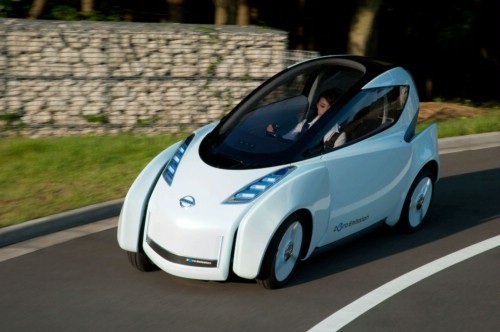
    Nissan developing an improved version of the Renault Twizy

    Nissan is working on an innovative urban electric vehicle that it says improves on the Twizy produced by alliance partner Renault.

    Etienne Henry, Nissan's head of product strategy and planning said the new car will combine the compactness and agility of a motorcycle with the weather protection and protective shell of a conventional car.

    "The Twizy is also trying to combine these, but we think there are optimizations possible with this kind of vehicle," said Henry, who declined to say when the car might be added to Nissan's lineup.

    Renault sees the Twizy as an alternative to scooters in Europe's crowded cities. The Twizy, which debuted last year, is powered by a choice of two electric motors, a 4kW/5-hp version with its top speed capped at 45kph that can be driven in most countries in Europe without a driver's license and a version with a top speed of 80kph. It has maximum driving range of 100 km.

    In 2008, Nissan showed the narrow, two-seat Land Glider concept that leaned into corners like a motorcycle but still came with the security of four wheels and an enclosed cabin. In a statement at the time, Nissan said it "should not be regarded as a mere design study."

    "That was a very interesting concept with very challenging and meaningful technology," said Henry, who declined to say whether any of the Land Glider's features would make it into its future EV.

    Henry, who previously was product manager for the first-generation Qashqai compact crossover, said the new EV would successfully mix the motorcycle and car genres in the same way the Qashqai blended the strengths of a compact hatchback with the styling of an SUV.

    One aim of the new EV is to help address congestion in fast-growing cities. "It's clear we need to offer an efficiency in terms of compactness, of space usage. Probably this will have an answer to this question," he said.

    At this year's Geneva auto show, Toyota showed an electric urban mobility concept with the same capability to lean into corners as the Nissan Land Glider. The three-wheel i-Road is scheduled for limited production and will join the lineup of EVs in Toyota's car-sharing program in the French city of Grenoble next year.

    Plug-In EVs report strong June sales month in US

    Electric vehicles had their strongest month in June this year as major automakers cut prices and added hefty incentives to boost sales.

    General Motors reported sales jumped by 53 percent to 2,698 in June, up over the 1,760 in June 2012 after it offered incentives worth as much as $5,000 off 2012 models and $4,000 off 2013 models. For the first half of 2013, sales are up 11.8 percent.

    Nissan said sales of its all-electric Leaf were up 315 percent over June 2012 to 2,225, for its second-best ever month. Nissan has now sold 9,849 in the first half of 2013, more than the 9,819 it sold in all of 2012. In January, Nissan said it was cutting the price of the entry-level Leaf 18 percent to $28,800 for the 2013 model as it launched U.S. production.

    Honda had its best-ever month in June with 208 Fit EVs sold, after selling 83 in the first five months of the year. Honda announced in May that it has cut the monthly lease payment on its Fit EV from $389 to $259 and also is cutting the payment for those who already had leased the vehicle. Honda sold just 93 last year.

    Honda started sales in July 2012 of the Fit EV and said it plans to sell just 1,100 over two years, citing capacity constraints. The company has 200 dealers selling the Fit EV and said it plans steadier availability. Honda spokeswoman Jessica Fini said after the lease price was cut, “basically everything on the ground sold,” but she emphasized that the company still has inventory to sell.

    GM plans to keep the same incentives in place for at least another month. GM is offering $5,000 off the 2012, and $4,000 off the 2013, and a $269 lease for 36 months with $2,399 due at signing. More than 40 percent of Volts are sold in California, followed by Michigan in second.

    Malcho said GM has increased its incentives to stay competitive in the electric vehicle market. The company also wants to clear out some inventory before it begins building 2014 Volts later this summer.

    In January, Ford Motor Co. dropped the price of the lease for a Focus EV from about $350 a month to $285, plus $930 due at signing. Ford reduced the base price of the EV Focus by $2,000 to $37,995. But Ford EV sales have remained very modest. Ford sold 157 Focus EVs in May to 723 for the first five months of the year. By contrast Ford has sold 8,177 hybrids in the first five months of the year.

    Nissan announce Battery Replacement Program for Leaf.

    Nissan have announced plans to offer a battery replacement program for U.S. LEAF customers who wish to replace their original equipment, lithium-ion battery pack. The program, which will begin...

    [[ This is a content summary only. Visit my website for full links, other content, and more! ]]

    Nissan Enhances Battery Warranty for Existing LEAF Owners

    Nissan has announced today that it will be taking the positive step of retrospectively expanding the warranty of the over 10,000 European owners who purchased the original Nissan LEAF since its...

    [[ This is a content summary only. Visit my website for full links, other content, and more! ]]

    Nissan LEAF Charges through 10,000 European Sales Milestone

    Today, Sylvie Lailler became the 10,000th Nissan LEAF customer in Europe, further cementing the ground-breaking zero emission car's status as the best-selling electric vehicle of all time. Mrs....

    [[ This is a content summary only. Visit my website for full links, other content, and more! ]]