Toyota Racing release details about AWD hybrid powertrain

TOYOTA Racing can reveal the first details of its participation in the 2014 FIA World Endurance Championship (WEC), in which it will push the limits of hybrid powertrain technology in motorsport.

TOYOTA Racing entered two cars for the WEC season, including the Le Mans 24 Hours, and the Automobile Club de l’Ouest is scheduled to confirm the full grid on 13 February.

For the third consecutive year, Alex Wurz, Nicolas Lapierre, Kazuki Nakajima, Anthony Davidson, Sébastien Buemi and Stéphane Sarrazin will drive for TOYOTA Racing. They are joined by test and reserve driver Mike Conway.

The TS040 HYBRID prototype has been designed according to new regulations intended to keep the WEC and Le Mans at the forefront of road-relevant technology development.

Its first public appearance will come at the WEC official test session on 28-29 March when it will take to the track alongside prototypes from Audi and Porsche for the first time.

After the TS030 HYBRID established TOYOTA Racing as a pioneer in the field of hybrid powertrains for motorsport, its successor, the TS040 HYBRID, takes the technology to the next level.

The addition of an Aisin AW motor/generator on the front axle, in combination with the DENSO unit at the rear, means the TOYOTA HYBRID System – Racing now provides power to all four wheels.

Under deceleration, the motor/generators apply braking force in combination with traditional mechanical brakes to generate energy, which is transferred via a DENSO inverter to the Nisshinbo super-capacitor. During acceleration, the motor/generator reverses its function, acting as a motor to deliver a significant power boost.

That four-wheel-drive hybrid power is allied to a petrol-powered V8 engine, both having been developed by Motor Sports Unit Development Division at the Higashifuji technical centre, where next generation TOYOTA road car technology is also under development.

Such a link between motorsport technology and future road cars is fundamental to TOYOTA Racing, with the TS040 HYBRID, like its predecessor, acting as a real-life test bench for TOYOTA’s latest hybrid concepts. TOYOTA has already sold 6million hybrid road cars since the launch of the Prius in 1997.

The TS040 HYBRID chassis is designed, developed, manufactured, built and operated by TOYOTA Motorsport GmbH (TMG) in Cologne. It represents a major evolution on the TS030 HYBRID thanks to advanced aerodynamics and lightweight design.

New regulations with revised dimensions have made the 2014-generation LMP1 cars narrower by 10cm while measures such as wheel tethers and a rear crash box have further increased safety.

Intensive simulation and calculation work at TMG has refined the TS040 HYBRID, utilising hardware-in-the-loop technology to test individual components based on real track data and powerful calculation computers to optimise designs.

Such cutting-edge techniques are significantly more efficient than track testing, allowing TMG engineers to continue optimising all aspects of the TS040 HYBRID chassis and lay-out for longer than rivals relying on traditional methods.

Development of the TS040 HYBRID has been completed alongside a range of external motorsport and automotive projects running concurrently at TMG, for third-party clients and Toyota Motor Corporation.

The car completed a successful roll-out at Paul Ricard earlier this month (21-23 January), with Alex Wurz and Anthony Davidson driving. Further testing is planned prior to the season-opening Six Hours of Silverstone (20 April).

More details about the TS040 HYBRID, including technical specifications, will be released immediately prior to the 28-29 official WEC test.

2016 Nissan GT-R Hybrid Rendered

Is this (above) a preview of the 2016 Nissan GT-R Hybrid? The Nissan Sport Sedan concept (below) revealed at The North American International Auto Show was originally expected to transform into a new Maxima sedan but reports out of Detroit hint at one other potential evolution of the concept: the next-generation GT-R.

Hungarian graphics blogger X-Tomi has rendered a two door coupe version of the Detroit show car that looks feasible. EV News have reported several times that the next generation GT-R will have a hybrid powertrain with the 600 hp Infiniti Essence Hybrid revealed at the 2009 Geneva Motor Show and confirmation from Nissan engineering, sales and marketing boss Andy Palmer in 2013.

Some unanswered questions remain, will the new GT-R continue to be all-wheel-drive and will the wheel motor powered 380Z sports car Nissan is working on play any role in GT-R development?

TRANSLOGIC Test drive the Audi A3 Sportback E-Tron PHEV [VIDEO]

Aol's Translogic get an early drive of Audi's first plug-in vehicle for the U.S. market, the A3 Sportback E-Tron PHEV.

Part of Audi's all-new A3 lineup, the Sportback E-Tron boasts an estimated electric driving range of about 30 miles at speeds up to 80 miles per hour. Does Audi's first ever production E-Tron deliver the same performance and technology that the luxury German automaker has become known for?

2015 Porsche 918 Spyder: The Future of the Hypercars? [VIDEO]

Carlos Lago of Ignition tests the Porsche 918 Spyder in Spain.

Boasting an electric motor on the front axle and a parallel hybrid setup for the rear, this hypercar produces a combined 874 hp and 944 lb-ft of torque and aims to set a new precedent for performance and efficiency. To this end, it has dizzying amount of motorsports-derived technology -- its carbon fiber passenger tub, engine, and chassis are derived from the concepts that created the RS Spyder ALMS racecar -- but its European test cycle fuel economy results are comparable to the Toyota Yaris Hybrid's.

Porsche 919 Hybrid to run turbo V4 engine

Porsche's all-new LeMans contender will feature a turbocharged V4 2.0-liter direct-injection gasoline engine.

The 919 Hybrid marks Porsche's comeback in the world of LMP1 racing and according to Autocar it has a turbocharged 16-valve 2.0-litre direct-injection V4 configuration already confirmed. It is believed Porsche opted for this configuration for packaging reasons to enable the best possible position for installing the hybrid drive system.

This petrol engine works with two energy recuperation systems called KERS and ERS which will store the energy in a battery pack until the driver presses a button to deploy it to the front wheels through an electric motor. It should be noted the V4 engine will power the rear wheels while the battery is of the lithium-ion type and has been provided by A123 Systems from United States.

Behind the wheel of the Porsche 919 Hybrid will be Mark Webber, Neel Jani, Timo Bernhard, Romain Dumas, Marc Lieb and Brendon Hartley. The vehicle will receive its racing debut on April 20 when the 2014 WEC starts at Silverstone Six Hours.

In 2014 all three works hybrid teams - Audi, Toyota and Porsche - will run All-Wheel-Drive powertrains at the 24 Hours of Le Mans (14-15 June).

Source: autocar.co.uk

Bugatti Veyron Hybrid in the works? “Maybe”

Despite rumours of faster, more-powerful and even 4 door version of the Bugatti Veyron, company boss Dr Wolfgang Schreiber has exclusively revealed to Top Gear none of the above will become reality.

With McLaren's P1, Porsche 918 and LaFerrari hypercars all sporting battery powered assistance, what's the brief for the next Veyron? Will the Veyron, like it's rivals utilise hybrid power in pursuit of ultimate speed?

"Maybe," smiles Dr Schreiber. "But it's too early to open the door and show you what we have planned".

We'll take that as a "Yes".

Worldwide Sales of Toyota Hybrids Top 6 Million Units

Toyota today announces that cumulative global sales of its hybrid vehicles topped the 6 million unit mark as of December 31, 2013, reaching 6.072 million units. The latest million-unit milestone was achieved in the fastest time yet for Toyota, taking just nine months.

Helping mitigate the environmental effects of vehicles is a priority at Toyota. Based on its belief that environment-friendly vehicles can only truly have a positive impact if they are widely used, Toyota has endeavored to encourage the mass-market adoption of hybrid vehicles.

As of this month, Toyota sells 24 hybrid passenger car models and one plug-in hybrid model in approximately 80 countries and regions around the world. Furthermore, within the next two years, Toyota will launch a total of 15 new hybrid vehicles worldwide, including the new "Harrier Hybrid" in Japan on January 15 and the new "Highlander Hybrid" in the United States in the near future. Toyota will continue augmenting its product lineup even further and increasing the number of countries and regions where it sells hybrid vehicles.

Toyota calculates that as of December 31, 2013, Toyota hybrid vehicles have resulted in approximately 41 million fewer tons of CO2 emissions—believed to be a cause of global warming—than would have been emitted by gasoline-powered vehicles of similar size and driving performance. Toyota also estimates that its hybrid vehicles have saved approximately 15 million kilolitres of gasoline compared to the amount used by gasoline-powered vehicles of similar size.

In August 1997 in Japan, Toyota launched the "Coaster Hybrid EV" and launched the "Prius"—the world's first mass-produced hybrid passenger vehicle—in December. Since then, Toyota hybrid vehicles have received tremendous support from consumers around the world.

Toyota has positioned hybrid technologies that enable the use of different fuel combinations, including the component technologies necessary for development of various environment-friendly cars, as core environmental technologies for the twenty-first century. Toyota therefore plans to continue working to raise performance, reduce costs, and expand its product lineup—including that of non-hybrid environment-friendly vehicles—to create vehicles that are popular with consumers.

CHRIS HARRIS – 2014 Chevrolet Volt Review [VIDEO]

YouTube's DRIVE channel test specialist Chris Harris reviews the 2014 Chevrolet Volt.

The Volt electric car has a backup engine to extend its typical 80 km electric range. It is quick, quiet, and responsive, with a taut ride. Once the lithium-ion battery is depleted, the 1.4-liter engine acts as a generator to extend the range by 500 km with Volt drivers averaging 1500 km between fill-ups. Recharging take 4 hours using a 240-volt supply and 10 hours with 120 volts. Lease deals start from $269 / month.

Overall the Volt is a brilliantly executed example of automotive innovation that makes any ICE only car seem primitive by comparison. It combines the benefits of a full EV powertrain with a part-time duty-cycle ICE to provide 600 km of combined range. Where the Toyota Prius is an ICE powered car with electric assistance, the Holden Volt is a plug-in electric car with ICE assistance.

The Volt fills the gap between the 500 km all electric range Tesla Model S, which due to it's 85 kWh battery can costs up to $100k, and the more affordable but shorter range battery only cars like the Mitsubishi iMiEV and the Nissan Leaf.

Toyota Prius: Top-selling car in California Again!

The Toyota Prius isn’t just the best-selling hybrid in the US, it is the best-selling car in California according to the California New Car Dealers Association for the second year running.

YTD November 2013, the state received 54,063 new Toyota Prius registrations, not including fleet sales, commercial customers, the government and rental car companies. The Prius edged out the Honda Civic, which reported 50,580 new car registrations up to Q3 last year.

Toyota vehicles actually secured three of the top 5 spots in 2013:

  • Toyota Prius – 54,063
  • Honda Civic -50.580
  • Honda Accord – 48,071
  • Toyota Camry – 43,855
  • Toyota Corolla – 40,941
  • Audi e-tron Allroad 400 HP plug-in hybrid concept officially revealed

    The Audi Allroad Shooting Brake has been revealed ahead of its motor show debut in Detroit.

    The show car’s engine is a 2.0-litre petrol with 288bhp and 280lb ft of torque, which drives the front axle. This is supplemented by a 54bhp electric motor that’s integrated within the six-speed automatic gearbox.

    The second motor is mounted to the rear axle, and produces 114bhp and 199lb ft of torque. It can either power the car on its own – in rear-wheel-drive pure electric mode – or combine with the powertrain over the front axle to turn the Allroad Shooting Brake into a four-wheel-drive hybrid.

    In pure electric drive mode, the rear motor can propel the car up to 80mph, while the battery can power the car for 31 miles. A hybrid mode lets the engine and motors work together as efficiently as possible, permitting the front motor to top up the lithium-ion battery when required.

    This generator function means that the pure electric range can be replenished, which would allow for multiple stints of all-electric driving on a long enough journey. The car has a range of 510 miles using the most efficient settings. Average fuel economy is a claimed 148.7mpg, while CO2 emissions are just 45g/km.

    There are ‘Hold’ and ‘Charge’ settings within Audi’s redesigned MMI infotainment system that allows the driver to choose how the battery’s charge is managed. Hold mode will keep the battery at its current state of charge, while Charge mode will replenish it until it is full.

    The final drive mode is Sport, which combines the petrol engine and both motors to give a total power output of 402bhp with 479lb ft of torque. In this set-up, the car has a 0-62mph time of 4.6 seconds, and a limited top speed of 155mph.

    New season of Fully Charged – Volkswagen XL1 [VIDEO]

    Robert Llewellyn test drives 'the most fuel efficient production car in the world' according to VW.

    Volkswagen made big claims about the efficiency of their purpose-built XL1 diesel-hybrid. They claimed the car was good for 314 mpg, which equates to 0.9 l/100km in the Metric system.

    However, at a test drive event organized by VW last July, a handful of journalists were given the chance to drive the mid-engined XL1 and results ranged from 160 to 200 mpg.

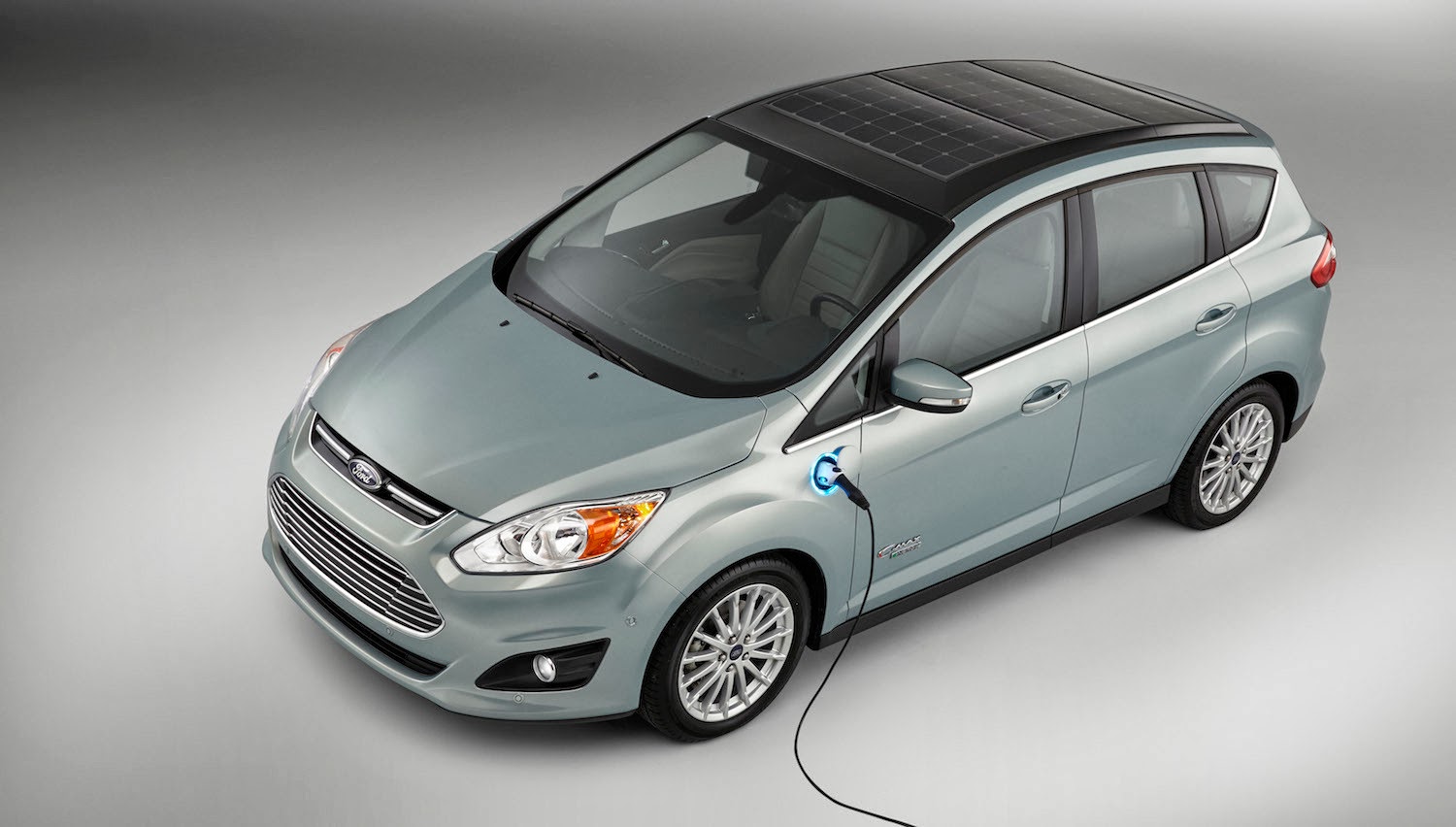
    Ford C-MAX Solar Energi Hybrid Concept Goes Off the Grid

    Ford Motor Company announced today the C-MAX Solar Energi Concept, a first-of-its-kind sun-powered vehicle with the potential to deliver the best of what a plug-in hybrid offers – without depending on the electric grid for fuel.

    Instead of powering its battery from an electrical outlet, Ford C-MAX Solar Energi Concept harnesses the power of the sun by using a special concentrator that acts like a magnifying glass, directing intense rays to solar panels on the vehicle roof.

    The result is a concept vehicle that takes a day's worth of sunlight to deliver the same performance as the conventional C-MAX Energi plug-in hybrid, which draws its power from the electric grid. Ford C-MAX Energi gets a combined best miles per gallon equivalent in its class, with EPA-estimated 108 MPGe city and 92 MPGe highway, for a combined 100 MPGe. By using renewable power, Ford C-MAX Solar Energi Concept is estimated to reduce the annual greenhouse gas emissions a typical owner would produce by four metric tons.

    "Ford C-MAX Solar Energi Concept shines a new light on electric transportation and renewable energy," said Mike Tinskey, Ford global director of vehicle electrification and infrastructure. "As an innovation leader, we want to further the public dialog about the art of the possible in moving the world toward a cleaner future."

    C-MAX Solar Energi Concept, which will be shown at the 2014 International CES in Las Vegas, is a collaborative project of Ford, San Jose, Calif.-based SunPower Corp. and Atlanta-based Georgia Institute of Technology.

    Strong electrified vehicle sales

    The C-MAX Solar Energi Concept debuts as Ford caps a record year of electrified vehicle sales.

    Ford expects to sell 85,000 hybrids, plug-in hybrids and all-electric vehicles for 2013 – the first full year its six new electrified vehicles were available in dealer showrooms.

    C-MAX Energi is Ford's plug-in sales leader, with sales of more than 6,300 through November. Ford sold more plug-in vehicles in October and November than both Toyota and Tesla, and it outsold Toyota through the first 11 months of 2013. Plug-in hybrids continue to grow in sales as more customers discover the benefits of using electricity to extend their driving range.

    C-MAX Hybrid over the last year has been a key driver in helping Ford sell more hybrids than any other automaker in the United States, second only to Toyota. C-MAX Hybrid continues to bring new customers to the Ford brand, with a conquest rate of 64 percent and drawing nearly half of its sales from import brands. Conquest rates are even higher in key hybrid growth markets like San Francisco, Los Angeles and Washington, D.C.

    Breakthrough clean technology

    SunPower, which has been Ford's solar technology partner since 2011, is providing high-efficiency solar cells for the roof of Ford C-MAX Solar Energi Concept. Because of the extended time it takes to absorb enough energy to fully charge the vehicle, Ford turned to Georgia Institute of Technology for a way to amplify the sunlight in order to make a solar-powered hybrid feasible for daily use.

    Researchers developed an off-vehicle solar concentrator that uses a special Fresnel lens to direct sunlight to the solar cells while boosting the impact of the sunlight by a factor of eight. Fresnel is a compact lens originally developed for use in lighthouses. Similar in concept to a magnifying glass, the patent-pending system tracks the sun as it moves from east to west, drawing enough power from the sun through the concentrator each day to equal a four-hour battery charge (8 kilowatts).

    With a full charge, Ford C-MAX Solar Energi Concept is estimated to have the same total range as a conventional C-MAX Energi of up to 620 miles, including up to 21 electric-only miles. Additionally, the vehicle still has a charge port, and can be charged by connecting to a charging station via cord and plug so that drivers retain the option to power up via the grid, if desired.

    After C-MAX Solar Energi Concept is shown at CES, Ford and Georgia Tech will begin testing the vehicle in numerous real-world scenarios. The outcome of those tests will help to determine if the concept is feasible as a production car.

    Off-the-grid car

    By tapping renewable solar energy with a rooftop solar panel system, C-MAX Solar Energi Concept is not dependent on the traditional electric grid for its battery power. Internal Ford data suggest the sun could power up to 75 percent of all trips made by an average driver in a solar hybrid vehicle. This could be especially important in places where the electric grid is underdeveloped, unreliable or expensive to use.

    The vehicle also reinforces MyEnergi Lifestyle, a concept revealed by Ford and several partners at 2013 CES. MyEnergi Lifestyle uses math, science and computer modeling to help homeowners understand how they can take advantage of energy-efficient home appliances, solar power systems and plug-in hybrid vehicles to significantly reduce monthly expenses while also reducing their overall carbon footprint.

    The positive environmental impact from Ford C-MAX Solar Energi could be significant. It would reduce yearly CO2 and other greenhouse gas emissions from the average U.S. car owner by as much as four metric tons – the equivalent of what a U.S. house produces in four months.

    If all light-duty vehicles in the United States were to adopt Ford C-MAX Solar Energi Concept technology, annual greenhouse gas emissions could be reduced by approximately 1 billion metric tons.

    700 hp Audi Sport e-tron quattro plug-in hybrid to début @ 2014 CES

    Dynamic design, immense power and new electronic features: Audi is presenting a fascinating technology concept car at the Consumer Electronics Show (CES) from January 6 to 10, 2014 in Las Vegas, USA. The Audi Sport quattro laserlight concept is reminiscent of the classic Sport quattro of 1983 while pointing towards the future – with the latest of the brand's technologies in plug-in hybrid drives, user control and display interfaces and lighting technology.

    “The new show car demonstrates technical ‘Vorsprung’ on many levels,” says Prof. Dr. Ulrich Hackenberg. “On-board this car we have e-tron technology with 515 kW of power and 2.5 l/100 km (94.09 US mpg) fuel economy; laser headlights that leave all previous systems in the dark with its higher performance as well as new display and operating systems with cutting-edge electronic performance. We are showing the future of Audi here.”

    The coupe, a new evolutionary stage of the Sport quattro concept, painted in the color Plasma Red, combines the power of the historic Sport quattro with emotional elegance. Its body is tautly set over its large wheels. The overhangs are short, and the car's proportions show a sporty balance. With a wheelbase of 2,784 mm (109.61 in), it is 4,602 mm (181.18 in) long. At a width of 1,964 mm (77.32 in), the two-door model is very wide, and it is just 1,386 mm (54.57 in) tall, which is exceptionally low.

    In the dual headlights, a typical quattro feature, Audi is demonstrating the future of lighting technology by combining matrix LED and laser light technologies. Two low-profile trapezoidal elements are visible within the headlights – the outer one generates the low beam light using matrix LEDs and an aperture mask, while the inner element produces laser light for high-beam functionality.

    The powerful laser diodes are significantly smaller than LED diodes; they are only a few microns in diameter. Illuminating the road for a distance of nearly 500 meters (1,640 ft), the laser high-beam light has approximately twice the lighting range and three times the luminosity of LED high beam lights. In this future technology, Audi is once again demonstrating its leadership role in automotive lighting technology with a system that will also be used on the race track in the 2014 R18 e-tron quattro.

    The angular, swept-back C pillars of the Audi Sport quattro laserlight concept car and the blisters above the fenders are other design elements reminiscent of the classic Sport quattro. The broad shoulders of the body were reinterpreted and intensively sculpted to convey even greater dynamism. Throughout the car, sharp contours frame muscular surfaces – the interplay between convex and concave curvatures defines the athletic character of the coupe.

    The hexagonal single-frame grille also offers an outlook on future design of the sporty production models. The lower section is nearly vertical, while the upper follows the contour of the hood; the screen insert is a typical solution from car racing. The low grille emphasizes the show car's width. Two large, vertical blades divide each of the large air inlets; their form is repeated in the creases of the hood. The splitter, which is made of carbon fiber reinforced polymer (CFRP), is shifted far to the front, as on a race car.

    The combination of a swept-back glass cabin and broad shoulders defines the proportions at the rear. Another defining element at the rear of the show car is the CFRP diffuser, which extends upward significantly. Its upper section is honeycombed, while its lower section houses two large, oval tailpipes. The tail lights, which are backed by a black CFRP panel, are rectangular in form – another quattro reference. The luggage space, which is reinforced by a large cross bar stiffener, offers 300 liters (10.59 cu ft) of cargo capacity.

    Precise design details round out the dynamic look of the Audi Sport quattro laserlight concept. The sill extensions are made of CFRP, the door handles electrically extend from the door when they detect the approach of a hand. The center locking wheels have a five twin-spoke design.

    Lightweight design made visible: the interior

    In its generously cut interior, the elegant sporty styling of the show car is continued with dark gray colors and clean lines. The interior design and material selections demonstrate the Audi philosophy of lightweight design. The slender instrument panel is reminiscent of the wing of a sailplane. The supporting structure of the interior is a carbon shell that also serves as a storage compartment in the doors.

    A line of trim beneath the windshield wraps around the driver and front passenger and integrates functions such as the inside door handles. The folding race car shell seats with their high lateral supports and integrated head restraints, together with the two rear seats, provide space for four persons. The climate controls are integrated in the air nozzles; a single element is used to control the intensity, temperature and volume of the air stream. In addition to showing climate control settings, the slim display at the centers of the air nozzles also shows media data.

    New solutions: displays and controls

    The interior of the Audi Sport quattro laserlight concept focuses very much on the driver. Even the multifunction sport steering wheel points the way towards future sporty production solutions. It has two buttons which the driver can use to control the hybrid drive, a red start-stop button, a button for the Audi drive select vehicle handling system and a "View" button to control the Audi virtual cockpit.

    All key information is shown on the large Audi TFT display in high-resolution, three-dimensional graphics; a cutting-edge Tegra 30 processor from Audi partner Nvidia processes the graphics. The driver can switch between different modes. For example, in the MMI mode the dominant display elements include the navigation map and media lists, while in the Classic view the speedometer appears in the foreground.

    Nearly all functions of the Audi Sport quattro laserlight concept can be controlled from the further developed MMI terminal that is mounted on the center console over the tunnel. Its large rotary pushbutton, which also serves as a touchpad, can be pushed in four directions, and it is surrounded on three sides by four buttons – for the main menu, submenus, options and a back function.

    The new user interface has a menu structure whose intuitive layout is similar to that of a smart phone. All frequently used functions can be accessed lightning fast. For most inputs, just a few steps are needed thanks to a new free text search feature; generally just four characters suffice for a navigation address. The driver can quickly scroll through lists or zoom the map image using multitouch gestures on the touchpad. Voice control functionality has also been intensively further developed.

    Powerful and highly efficient: the drive system

    The plug-in hybrid drive gives the Audi Sport quattro laserlight concept fascinating dynamic performance. Its system output is 515 kW (700 hp), and its system torque is 800 Nm (590.05 lb-ft). Power flows via a modified eight-speed tiptronic to the quattro drivetrain, which features a sport differential at the rear axle. The show car's combined fuel consumption, based on the applicable fuel economy standard, is just 2.5 liters of fuel per 100 km (94.09 US mpg) – which equates to CO2 emissions of 59 g/km (94.95 g/mile).

    The combustion engine is a four-liter V8 with biturbo charging; it produces 412 kW (560 hp) of power and 700 Nm (516.29 lb-ft) of torque. The cylinder on demand (COD) system, which deactivates four cylinders under part load and a start-stop system make the sonorous eight-cylinder engine very efficient. Located between the 4.0 TFSI and the transmission is a disc-shaped electric motor that produces 110 kW and 400 Nm (295.02 lb-ft). It draws its drive energy from a lithium-ion battery at the rear, which stores 14.1 kWh of energy – enough for up to 50 km (31.07 miles) of all-electric driving. An Audi wallbox that is used for charging provides for optimal energy transfer.

    An intelligent management system controls the interplay of engine and motor on demand. The driver can switch between three different modes. In EV mode, just the electric motor operates; its high torque propels the show car with plenty of power – even outside of the city. The active accelerator pedal indicates the transition to Hybrid mode to the driver – by a change in pedal resistance; this is done so that the driver can intentionally influence the mode selection.

    The Hybrid mode aims at optimal fuel-savings in the interplay between the TFSI and the electric motor, and environmental and route data are utilized here. The driver can choose the Hold and Charge modes in the MMI to influence the operating strategy, e.g. if the driver wants to ensure that sufficient electrical energy is available for the final kilometers to the destination. The Audi drive select dynamic vehicle handling system offers even more control options – individual driving profiles are set up for different levels of regenerative braking.

    In Sport mode, the operating strategy configures the drive system for maximum power. When the V8 and electric motor are boosting, the Audi Sport quattro laserlight concept accelerates from a standstill to 100 km/h (62.14 mph) in 3.7 seconds and can reach a top speed of 305 km/h (189.52 mph).

    Body and chassis

    A lightweight design strategy also plays a major role in the car's dynamic performance. A combination of ultra high-strength steel sheet and structural elements of cast aluminum is used in the occupant cell. The doors and fenders are made of aluminum, and the roof, engine hood and rear hatch are made of CFRP. This results in an unladen weight of just 1,850 kilograms (4,078.55 lb), including the large battery pack.

    The front suspension is comprised of five links per wheel, while the rear suspension is based on the self-tracking trapezoidal link principle of Audi, which guarantees dynamic performance and stability. Stiff tuning of the springs and shock absorbers make the Audi Sport quattro laserlight concept hold tightly to the road, while Audi drive select makes the driving experience even more multifaceted. The dynamic steering system varies the steering ratio as a function of driving speed. The brake calipers grip large, carbon fiber-ceramic brake discs, and the tire size is 285/30 R 21.

    U.S. EIA sees only 1.5% Hybrid sales growth to 2040

    The U.S. Energy Information Agency seems to have totally sold out to the oil lobby.

    The agency predicts, in a report released Tuesday 17th December, that 78 percent of all cars and trucks will still run on gasoline in 2040, down from 82 percent last year. It predicts a big upswing in micro-hybrids and other advanced fuel technologies to 42 percent of all vehicles by 2040.

    EIA predicts full hybrids will account for only 5 percent of vehicles in 2040 — up from 3.32 percent today. That's an increase of just 1.7% in hybrid sales over the next 26 years?

    It predicts just 1 percent of total sales will be plug-in hybrids and 1 percent full electric vehicles in 2040.

    The agency also predicts that when adjusted for inflation, the price of gasoline will rise to $3.90 by 2040, compared to a prior forecast of $4.40.

    Even using figures from 2011, at a local level, hybrid sales already far surpass this decades out prediction. In the San Francisco Bay Area 8.4% of all new cars sold were hybrid, Seattle and L.A. 5.7%, San Diego 5.6% and Portland 5.4%.

    Lets not even mention Norway where full electric vehicles account for 12% market share amongst passenger car sales or The Netherlands where a plug-in hybrid was the top selling car last month, selling almost twice as many as the best selling petrol car.

    Source: Detroit News

    The Porsche 918 Spyder Tested [VIDEO]

    Tested by /DRIVE's Chris Harris at the Valencia circuit in the winter of 2013. The Porsche 918 Spyder has come a long way since when we first saw it at the Geneva Motor Show in March 2010. Competing against the Ferrari LaFerrari and McLaren P1, it is the cheapest of the trio of new hypercars at a base price of $845,000.

    The engine weights 140 kg according to Porsche and it delivers 608 horsepower (453 kW) at 8,500 rpm and 528 N·m (389 lbf·ft) of maximum torque. This is supplemented by two electric motors delivering an additional 279 hp (208 kW) - One 154 hp electric motor drives the rear wheels in parallel with the engine and also serves as the main generator.

    Netherlands: Mitsubishi Outlander PHEV #1 top seller on debut

    Retail sales of Mitsubishi's Outlander plug-in hybrid (PHEV) only commenced on 21 October in the Netherlands and it has immediately become the best selling car by a significant margin.

    2,736 plug-in Outlanders were sold in November (from a total of 2,766 Outlanders) accounting for a market share of 6.8%. The second highest selling car in the Netherlands for November was the Renault Mégane with 1,505.

    In EU guise the permanent electric 'Twin Motor 4WD' has a claimed maximum driving range of 824 km, electric only range of 52km, fuel consumption of 1.9l/100km, CO2 emissions of 44 g/km and a maximum speed of 170 km/h. Braked towing capacity is 1,500kg.

    The battery pack takes five hours to recharge using a standard European 230V/10A domestic supply but just 30 minutes (to 80%) using a quick charger to CHAdeMO standard.

    MMC insists the Outlander PHEV is neither "a mere adaptation of an existing internal combustion engine vehicle nor a dedicated plug-in hybrid EV system high tech showcase" but a further variant of the Outlander – alongside standard petrol and diesel versions "and developed as such from the start of the programme: a unique/no-compromise proposal in the industry and "the first self-power generating twin motor (permanent) 4WD PHEV".

    Mitsubishi said dealers had booked 10,000 signed orders across the continent since December 2012 and was "Much expected by dealers and customers in a region forecast to be its largest global market". The automaker expects EVs, hybrids and PHEVs to account for 20% of its production by 2020.

    Ford Reveals Automated Fusion Hybrid Research Vehicle

    Taking the next step in its Blueprint for Mobility, Ford today – in conjunction with the University of Michigan and State Farm® – revealed a Ford Fusion Hybrid automated research vehicle that will be used to make progress on future automated driving and other advanced technologies.

    The result of an ongoing project that builds on more than a decade of Ford's automated driving research, the Fusion Hybrid automated vehicle will test current and future sensing systems and driver-assist technologies. Ford's goal is to advance development of new technologies with its supplier partners so these features can be applied to the company's next generation of vehicles.

    "The Ford Fusion Hybrid automated vehicle represents a vital step toward our vision for the future of mobility," said Ford Executive Chairman Bill Ford. "We see a future of connected cars that communicate with each other and the world around them to make driving safer, ease traffic congestion and sustain the environment. By doing this, Ford is set to have an even greater impact in our next 100 years than we did in our first 100."

    Today's Ford vehicles already have technology that enables them to park themselves, understand a driver's voice commands, detect dangerous driving situations and assist with emergency braking. With these technologies and others that one day could allow a person to be driven to a destination, the driver always will need to be in control of the wheel if necessary.

    "In the future, automated driving may well help us improve driver safety and manage issues such as traffic congestion and global gridlock, yet there are still many questions that need to be answered and explored to make it a long-term reality," said Raj Nair, group vice president, Ford global product development. "With the automated Ford Fusion Hybrid research project, our goal is to test the limits of full automation and determine the appropriate levels for near- and mid-term deployment."

    The automated Fusion Hybrid will serve as the research platform to develop potential solutions for these longer-term societal, legislative and technological issues raised by a future of fully automated vehicles.

    The Fusion Hybrid research vehicle builds on driver-in-control studies conducted in Ford's VIRTTEX driving simulator. Using VIRTTEX, Ford researchers study how to merge the capabilities of human and automated drivers to create a seamless, integrated experience.

    Ford's Blueprint for Mobility
    Last year at the Mobile World Congress in Barcelona, Bill Ford outlined Ford Motor Company's Blueprint for Mobility – a plan that describes what the automaker believes transportation will look like in 2025 and beyond, and the technologies, business models and partnerships needed to get there.

    Today, Ford is working on improving technology already used in vehicles on the road. This includes functions that alert drivers to traffic jams and accidents, and technologies for parking and for driving in slow-moving traffic.

    In the mid-term, vehicle-to-vehicle communications will begin to enter into the mainstream. This will include some autopilot capabilities, such as vehicle "platooning," where vehicles traveling in the same direction sync up their movements to create denser driving patterns.

    In the longer-term, vehicles will have fully autonomous navigation and parking. They will communicate with each other and the world around them, and become one element of a fully integrated transportation ecosystem. Personal vehicle ownership also will change as new business models develop. The benefits include improved safety, reduced traffic congestion and the ability to achieve major environmental improvements.

    Tomorrow's technology, today
    The Ford Fusion Hybrid was chosen as the test platform for the new research effort because it is among the leaders in offering the most advanced driver-assist technologies in its class.

    These technologies include Blind Spot Information System, active park assist, lane-departure warning, and adaptive cruise control and collision warning with brake support. These vehicle sensing systems, offered on many Ford vehicles today, are the building blocks for the future of fully automated driving.

    In North America, these technologies can be found on Ford Focus, C-MAX hybrids, Fusion, Taurus, Escape, Explorer and Flex. In Europe, these technologies are available on Ford C-MAX, Mondeo, S-MAX and Galaxy.

    "Products such as Ford Fusion Hybrid give us a head start in the development of automated features," said Paul Mascarenas, chief technical officer and vice president, Ford research and innovation. "Our Blueprint for Mobility aligns the desired outcomes of our work in automated functionality with the democratization of driver-assist technology found on today's lineup of Ford products."

    Ford's Fusion Hybrid research vehicle is unique in that it first uses the same technology found in Ford vehicles in dealer showrooms today, then adds four scanning infrared light sensors – named LiDAR (for Light Detection And Ranging) – that scan the road at 2.5 million times per second. LiDAR uses light in the same way a bat or dolphin uses sound waves, and can bounce infrared light off everything within 200 feet to generate a real-time 3D map of the surrounding environment.

    The sensors can track anything dense enough to redirect light – whether stationary objects, or moving objects such as vehicles, pedestrians and bicyclists. The sensors are so sensitive they can sense the difference between a paper bag and a small animal at nearly a football field away.

    Working together
    Developing the necessary infrastructure to support a sustainable transportation ecosystem will require the collaboration of many partners across multiple industries. State Farm and the University of Michigan's robotics and automation research team are critical to creating the visionary research project.

    Ford's work with others on the future of mobility is longstanding. Ford was an active participant in the Defense Advanced Research Projects Agency (DARPA)-controlled autonomous vehicle challenges in 2004, 2005 and 2007, the year Ford extended its efforts to include the University of Michigan.

    While Ford is responsible for developing unique components allowing for the vehicle to function at high levels of automation, the University of Michigan – under the direction of faculty members Ryan Eustice and Edwin Olson – is leading in development of sensor-based technologies. The sensors aid in the logic and virtual decision making necessary to help the vehicle understand its physical surroundings on the road.

    The university's researchers are processing the trillions of bytes of data collected by the vehicle's sensors, from which they can build a 3D model of the environment around the vehicle. The goal is to help the vehicle – and the driver – make appropriate and safe driving decisions.

    "This research builds on the University of Michigan's long history of pioneering automotive research with Ford," said Alec Gallimore, associate dean of research and graduate education at the school's College of Engineering. "The unique collaboration will enable Ford to benefit from the university's deep knowledge of robotics and automation, and it will allow University of Michigan faculty and students to work side-by-side with some of the best auto engineers in the world."

    Meanwhile, State Farm has been working with Ford to assess the impact of driver-assist technologies to determine if the technologies can lower the rate of rear collisions.

    Last year there were nearly 34,000 fatalities due to traffic accidents in the United States. By developing more intelligent vehicles, Ford helps create smarter drivers.

    "By teaming up with Ford and the University of Michigan in this research, we are continuing our decades-long commitment to making vehicles, roadways and drivers safer," said State Farm Chairman and CEO Edward Rust. "The changes new technologies bring to our lives are exciting, and we are always looking at how technology can better meet the ever-changing needs of our customers."

    Setting the stage for mobility in Michigan
    Today's Ford Fusion Hybrid research vehicle announcement follows an aggressive plan released this week by Business Leaders for Michigan to position the state as the global center for mobility and grow up to 100,000 new jobs in its auto sector by becoming a hub for excellence in advanced powertrain, lightweight and smart/connected transportation technologies.

    With Bill Ford as champion of Business Leaders for Michigan's mobility initiative, the plan has been developed with a coalition of top industry experts, the Center for Automotive Research and McKinsey & Company. The plan identifies growth strategies for the auto sector as it transitions to an increasingly advanced technology-based sector.