If all goes according to plan, more than 450,000 owners of Volkswagen and Audi sedans, wagons, and hatchbacks with 2.0-liter TDI diesel vehicles from the 2009 through 2015 model years will start to receive buyback offers from VW late this year. Many owners have already indicated that they plan to take the buyout, some as soon as possible. But it...
Those tasked with selling electric cars and other products friendly to the environment must confront multiple obstacles as they try to win over often-skeptical consumers. That's something that comes with the territory when marketing new technologies or practices. But could public reticence to adopt green products be influenced by more than just...
There will be a lot riding on the tall, square shoulders of the 2017 Chevrolet Bolt EV when it reaches the first Chevy dealers late this year. It will be the first mass-priced electric car with a range of 200 miles or more, and it will go on sale a year before the much-vaunted Tesla Model 3. Now Chevrolet has released the EPA estimated range...
Electric car prices need to fall (but how much?), Tesla upgrades both its battery architecture and its Autopilot software, and how about that ice driving? All this and more on Green Car Reports. Sure, you know Nissan and Tesla, but which European maker just delivered its 100,00th electric car last Friday? Today, the sticker prices of electric cars...
Last month, when Tesla Motors announced new, even larger battery packs for its Model S sedan and Model X crossover utility vehicle, reaction was less than ecstatic. While even faster, even longer-range electric cars are nice and all, commentators said, shouldn't Tesla be sticking to its knitting? Specifically, shouldn't it be focusing every last...
The 2017 BMW i3 is the most significant update to the groundbreaking electric car since it went on sale in the U.S. back in May 2014. Changes are headlined by a larger, 33-kilowatt-hour lithium-ion battery pack that increases range from 81 miles to 114 miles in the all-electric model. However, until now, BMW had yet to release range estimates for...
Fall is approaching, which means it's time for the auto-show season to get underway once again. Press days for the 2016 Paris Motor Show begin at the end of this month, and we already know several notable green production and concept cars will make their debuts in the French capital. The show's organizers say no fewer than 24 electric cars will...
One of the challenges of making and selling electric cars is that their batteries are still expensive. And despite some makers' absorbing losses on the earliest cars, that means they sell for prices higher than those of similarly sized vehicles with combustion engines. Sure, owners will save money on running costs—but most shoppers will...
French automaker Renault hasn't sold nearly as many electric cars as its alliance partner Nissan. But Renault has steadily increased its electric-car sales volumes, particularly in Europe, with its main focus on the subcompact Zoe hatchback. That allowed the company to pass a notable milestone recently. DON'T MISS: Nissan and Renault together now...
The word "contagious" is often used to describe diseases, but not all contagions are necessarily bad. Studies have found that solar panels can be "contagious," for example. In other words, a homeowner is more likely to install solar panels on their house if their neighbor has done so. CHECK OUT: Electric Cars Vs. Solar Panels: Which One's The...
Chevy hopes to achieve huge success with the Bolt. The EV has a $37,500 starting price before the $7,500 federal tax credit. The Bolt has a 200-mile rated range from an onboard 60 kWh battery pack. Those numbers put the Bolt squarely in the sights of people looking for a moderately priced electric car with a reasonable driving range. Much of the Tesla Model 3’s pre-order success has been attributed to those same factors.
The list of Bolt components supplied by LG defines the car’s performance and most of its user experience. LG is producing the electric drive motor, power inverter module, battery pack, battery heater, onboard charger, high-power distribution module, accessory power module, and power line communication module. The South Korean company is also making the electric climate control system compressor, the instrument cluster, and the infotainment system.
That full inventory of parts will be transported to Michigan where they will be used to make Bolts in GM’s Orion Charter Township assembly plant. With the LG parts on hand, full production starts in October. Finished Bolts will be rolling off car carriers onto dealership lots shortly after production starts.
Carmakers are turning to airplane-quality glue for seams and thinner steel to trim weight, while looking ahead to using magnesium and coasting to save fuel.
Toyota has been promising better handling with its cars, and it has delivered with the fourth-generation Prius. While it still does not look like a conventional car, the Prius now handles more like one.
The billionaire entrepreneur Elon Musk is running a private rocket company, doubling down on alternative fuels and pressing on with Tesla after a series of accidents.
General Motors announced Friday it is buying Cruise Automation, a San Francisco self-driving vehicle startup, the latest move by the auto company as it competes with Silicon Valley to develop self-driving cars that could be used in ride-sharing fleets.
GM and Cruise did not disclose the value of the deal. Technology website Re/Code cited sources as saying GM paid $1 billion. A GM spokesman declined to comment on that figure. If correct GM has just set a new precedent for valuations of automotive tech start-ups.
GM intends to use Cruise’s technology and people to accelerate its effort to develop vehicles that can operate without a human driver, potentially as part of ride-sharing fleets “as soon as possible,” GM President Dan Ammann said in an interview.
“We will be committing considerable resources to recruit and grow the capability of the team,” Ammann said.
Cruise has been working to develop hardware and software that could be installed in a vehicle to enable the car to pilot itself on a highway, without the driver steering or braking.
GM initially planned an investment in the company but moved within five weeks to buy Cruise outright, said venture partner Nabeel Hyatt of Spark Capital, an investor in Cruise.
"They moved faster than most Silicon Valley companies would move," he said.
Cruise, which has 40 employees, was launched in 2013 and has raised $20 million in venture capital, founder Kyle Vogt said in an interview.
Vogt impressed Silicon Valley venture capital fund Signia Venture Partners by demonstrating an Audi A4 that could be controlled by a game console, said Signia principal Sunny Dhillon.
More recently, Cruise was working on a system that could make a car "fully driverless," Vogt said.
A flurry of investments by traditional auto companies reflects a fear among industry executives that the century-old business of building and selling cars that people drive themselves is at risk, even though global vehicle demand is strong.
In January, GM said it would invest $500 million in ride-hailing company Lyft Inc and followed that by forming a new car-sharing operation called Maven. The company has also established a separate unit for self-driving vehicle development.
Other automakers are moving into ride sharing and self-driving vehicles, as are some traditional auto suppliers.
Germany’s Continental and Delphi Automotive among others are seeking technology companies to buy for intellectual property and programming talent.
The 2017 Chevrolet Bolt EV does more than set a new benchmark for affordable, long-range EV driving. It also raises the bar when it comes to driving performance.
Engineers developed the Bolt EV’s propulsion system to offer more than an estimated 200 miles (based on GM estimates) and a peppy driving experience that’s more akin to a compact sports sedan than a small utilitarian crossover.
“Being the leader in range and affordability means nothing if the car isn’t going to excite you each time you get behind the wheel,” said Josh Tavel, Chevrolet Bolt EV chief engineer. “That’s why the team was tasked with delivering a propulsion system that would also make the Bolt EV an electric vehicle that owners would love to drive.”
Single Motor Drive Unit Like most EVs on the road, the Bolt EV’s drive system uses a single high capacity electric motor to propel the car. But it’s the smooth, powerful and quiet motor design, gear configuration and shift-by-wire system that separates it from the pack.
The engineering team designed the Bolt EV’s electric motor with an offset gear and shaft configuration tailored to meet efficiency and performance targets – most notably more than an estimated 200 miles of range. The motor is capable of producing up to 266 lb.-ft. (360 Nm) of torque and 200 hp (150 kW) of motoring power. Combined with a 7.05:1 final drive ratio, it helps propel the Bolt EV from 0-60 mph in less than seven seconds.
Power delivery is controlled by Chevrolet’s first Electronic Precision Shift system. This shift and park-by-wire system sends electronic signals to the Bolt EV’s drive unit to manage precise feel and delivery of power and torque, based on drive mode selection and accelerator inputs. A by-wire shifter requires less packaging space than a traditional mechanical shifter, resulting in more interior space and improved interior layout.
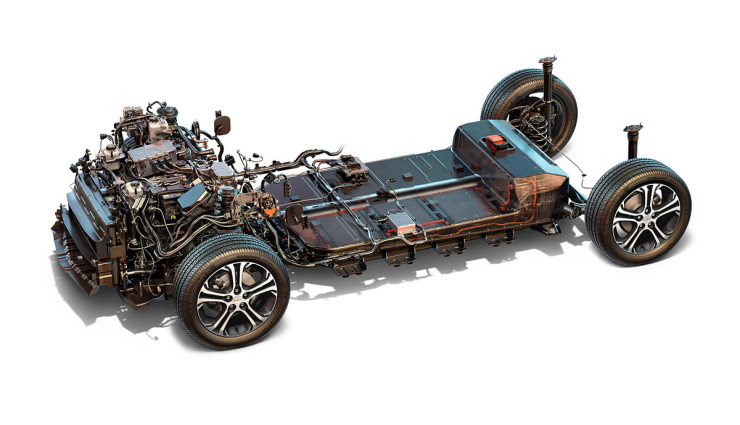
60 kWh Battery System Having more than 1.3 billion miles of EV experience from the Chevrolet Volt helped Bolt EV battery engineers and strategic partner LG Electronics to develop an all-new cell and battery pack to offer more than an estimated 200 miles of range.
Battery system preliminary specifications include:
60 kWh lithium-ion battery pack.
288 lithium ion cells
Five sections
10 modules
96 cell groups – three cells per group
960 lbs. (435 kg) total weight
“You usually have a battery cell that delivers either the desired levels of energy or power, but not traditionally both. With this cell design and chemistry we were able to deliver a battery system with 160 kilowatts of peak power and 60 kilowatts hours of energy,” said Gregory Smith, Bolt EV battery pack engineering group manager.
The battery uses active thermal conditioning, similar to the Chevrolet Volt, to keep the battery operating at its optimum temperature, which results in solid battery life performance. The Bolt EV battery will be covered by an 8-year/ 100,000 mile (whichever comes first) limited warranty.
Inside the battery pack – which spans the entire floor, from the front foot well to back of the rear seat – is a new cell design and chemistry. The nickel-rich lithium-ion chemistry provides improved thermal operating performance over other chemistries, which requires a smaller active cooling system for more efficient packaging. The chemistry allows the Bolt EV to maintain peak performance in varying climates and driver demands.
The cells are arranged in a “landscape” format and each measures in at only 3.9 ins. (100 mms) high and 13.1 ins. (338 mms) wide providing improved packaging underfloor. The lower profile cell design enabled the vehicle structure team to maximize interior space.
The battery system is mated to a standard equipment 7.2 kW onboard charger for regular overnight charging from a 240-V wall box. A typical commute of 50 miles can be recharged in less than two hours. Bolt EV also features an optional DC Fast Charging system using the industry standard SAE Combo connector. Using DC Fast Charging, the Bolt EV battery can be charged up to 90 miles of range in 30 minutes. Outside temperatures may affect charging times.
Regen System Provides One-Pedal Driving Regenerative braking has become more than just a tool to boost range, it’s also transformed into a feature that can provide an improved EV driving experience. The Bolt EV features a new regenerative braking system that has the ability to provide one pedal driving.
“Interviews with EV enthusiasts indicated their desire for one pedal driving capability on the Bolt EV. One pedal operation boosts the thrill and uniqueness of EV driving,” Tavel said.
Through a combination of increased regenerative deceleration and software controls, one pedal driving enables the vehicle to slow down and come to a complete stop without using the brake pedal in certain driving conditions.
When operating the Bolt EV in “Low” mode, or by holding the Regen on Demand paddle located on the back of the steering wheel, the driver can bring the vehicle to a complete stop under most circumstances by simply lifting their foot off the accelerator, although the system does not relieve the need to use the brake pedal altogether.
Operating the Bolt EV in “Drive” mode and not pulling the paddle while decelerating delivers a driving experience where usage of the brake pedal is required to stop.
Hard on the heels of the reveal of the production Volt EV at CES 2016 in Las Vegas, Chevrolet used the North American International Auto Show in Detroit to release additional details on the battery and drivetrain of the new BEV. Engineers developed the Bolt EV’s propulsion system to offer more than an estimated 200 miles and a sporty driving experience.
The Bolt EV’s drive system uses a single high capacity electric motor to propel the car. The engineering team designed the Bolt EV’s electric motor with an offset gear and shaft configuration tailored to meet efficiency and performance targets—most notably more than an estimated 200 miles of range. The motor is capable of producing up to 266 lb-ft (360 N·m) of torque and 200 hp (150 kW) of motoring power. Combined with a 7.05:1 final drive ratio, it helps propel the Bolt EV from 0-60 mph in less than seven seconds.
Power delivery is controlled by Chevrolet’s first Electronic Precision Shift system. This shift and park-by-wire system sends electronic signals to the Bolt EV’s drive unit to manage precise feel and delivery of power and torque, based on drive mode selection and accelerator inputs. A by-wire shifter requires less packaging space than a traditional mechanical shifter, resulting in more interior space and improved interior layout.
Having more than 1.3 billion miles of EV experience from the Chevrolet Volt helped Bolt EV battery engineers and strategic partner LG Electronics to develop an all-new cell and battery pack to offer more than an estimated 200 miles of range. Battery system preliminary specifications include:
60 kWh lithium-ion battery pack
160 kW peak power
288 lithium ion cells
Five sections
10 modules
96 cell groups – three cells per group
960 lbs. (435 kg) total weight
285 liters
The battery uses active thermal conditioning, similar to the Chevrolet Volt, to keep the battery operating at its optimum temperature, which results in solid battery life performance. The Bolt EV battery will be covered by an 8-year/ 100,000 mile (whichever comes first) limited warranty.
Inside the battery pack—which spans the entire floor, from the front foot well to back of the rear seat—is a new cell design and chemistry. The nickel-rich lithium-ion chemistry provides improved thermal operating performance over other chemistries, which requires a smaller active cooling system for more efficient packaging. The chemistry allows the Bolt EV to maintain peak performance in varying climates and driver demands.
The cells are arranged in a “landscape” format and each measures in at only 3.9 ins. (100 mms) high and 13.1 ins. (338 mms) wide providing improved packaging underfloor. The lower profile cell design enabled the vehicle structure team to maximize interior space.
The battery system is mated to a standard equipment 7.2 kW onboard charger for regular overnight charging from a 240-V wall box. A typical commute of 50 miles can be recharged in less than two hours. Bolt EV also features an optional DC Fast Charging system using the industry standard SAE Combo connector. Using DC Fast Charging, the Bolt EV battery can be charged up to 90 miles of range in 30 minutes. Outside temperatures may affect charging times.
Regen System Provides One-Pedal Driving. Regenerative braking has become more than just a tool to boost range, it’s also transformed into a feature that can provide an improved EV driving experience. The Bolt EV features a new regenerative braking system that has the ability to provide one-pedal driving.
Through a combination of increased regenerative deceleration and software controls, one pedal driving enables the vehicle to slow down and come to a complete stop without using the brake pedal in certain driving conditions.
When operating the Bolt EV in “Low” mode, or by holding the Regen on Demand paddle located on the back of the steering wheel, the driver can bring the vehicle to a complete stop under most circumstances by simply lifting their foot off the accelerator, although the system does not relieve the need to use the brake pedal altogether.
Operating the Bolt EV in “Drive” mode and not pulling the paddle while decelerating delivers a driving experience where usage of the brake pedal is required to stop.
Small Wagon (EPA does not have a cross-over category)
Key competitors:
Nissan Leaf, BMW i3, Ford Focus Electric, Kia Soul EV, VW eGolf Mercedes-Benz B-Class Electric
Manufacturing location:
Orion Township, Mich.
Battery manufacturing location:
Incheon, South Korea
Motor and drive unit manufacturing location:
Incheon, South Korea
Battery System
Type:
rechargeable energy storage system comprising multiple linked modules
Volume/case:
285L
Mass (lb / kg):
960 lb./435 kg
Battery chemistry:
lithium-ion
Thermal system:
liquid active thermal control
Cells:
288
Electric driving range:
More than 200 miles (GM estimate pending final tests)
Energy:
60 kWh
Warranty:
eight years / 100,000 miles
Electric Drive
Type:
Single motor and gearset
Motor:
permanent magnetic drive motor
Power:
200 hp/150 kW
Torque: (lb-ft / Nm):
266 lb.ft./360 Nm
Final drive ratio (:1):
7.05:1
Charging Times
120 V:
Available with standard cordset
240 V:
50 miles of range in less than 2 hrs.
SAE Combo DC Fast Charge:
90 miles in 30 minutes
Performance
Top speed (mph):
91 mph / 145 kph *
0-30 mph:
2.9s (75% SoC) *
0-60 mph:
Under 7 seconds
Chassis/Suspension
Front:
Independent MacPherson strut-type front suspension with side load compensating and finely tuned springs, direct-acting solid stabilizer bar system and ride & handling oriented LCA bushings.
Rear:
Compound crank (torsion beam) type rear suspension with the closed section V-shaped profile axle; specifically tuned coil springs, performance balanced shock absorber, angled A-bushing supporting understeer tendency on cornering maneuver and kinematically optimized torsion beam providing stable and best ride & handling performance.
Chassis control:
Four-channel ABS; Traction control system; StabiliTrak; Drag control
Steering type:
column-mounted electric power steering
Steering wheel turns, lock-to-lock:
2.91 revolution *
Turning radius, curb-to-curb ( ft. / m):
10.8m *
Steering ratio:
16.8 :1
Brakes
Type:
power four-wheel disc with ABS; electro-hydraulic; partially regenerative; dynamic rear brake proportioning
Brake rotor diameter front (mm / in):
276mm
Brake rotor diameter rear (mm / in):
264mm
Total swept area (cu cm):
Front : 1398.9
Rear : 1131.4
Wheels/Tires
Wheel size and type:
17in x 6.5J offset 44, cast aluminum
Tires:
Michelin Energy Saver A/S 215/50R17 all-season
Dimensions
Exterior
Wheelbase (in / mm):
102.4 / 2600
Overall length (in / mm):
164.0 / 4166
Overall width (in / mm):
69.5 / 1765(W103)
Track width front (in / mm):
1500.92 mm
Track width rear (in / mm):
1501.05 mm
Height (in / mm):
62.8 / 1594(H100)
Front overhang (in / mm):
32.9 / 836
Rear overhang (in / mm):
28.7 / 730
Interior
Seating capacity (front / rear):
2 / 3
Headroom (in. / mm):
39.7 / 1009 1st row 37.9 / 962 2nd row
Shoulder room (in / mm):
54.6 / 1387 1st row 52.8 / 1340 2nd row
Hip room (in / mm):
51.6 / 1310 1st row 50.8 / 290 2nd row
Legroom (in / mm):
41.6 / 1056 1st row 36.5 / 927 2nd row
Cargo volume (cu ft / L):
16.9 cu-ft / 478 L (V10, Wagon CVI – Max behind rear seat)
Passenger volume (cu ft / L):
PV1 52.2 cu-ft / 1478 L 1st row PV2 42.2 cu-ft / 1195 L 2nd row
Capacities
Curb weight (lb / kg);
3580 lb / 1625kg based on target (w/o 2passengers)
Heating cooling (qt / L):
Heating loop 1.8L
Battery pack cooling (qt / L):
6.9L (RESS cooling loop total coolant volume)
Power electronics cooling (qt / L):
3.9L (PE & DU cooling loop total coolant volume)
Drive unit fluid (qt / L):
2.9L
Note: Information shown is current at time of publication.
General Motors told Wall Street on Thursday that when it introduces the 2017 Chevrolet Bolt small electric car next year, it expects the cost of its battery cells to be an "industry-leading" $145 per kWh.
The electric vehicle market has been pressured by low fuel prices in 2015. A lowering of the costs of EV battery cells to $100 per kilowatt-hour by 2022 will allow EVs to compete with vehicles fueled by petroleum.
LG Chem CFO Cho Suk-jeh last year revealed the company will supply an automaker with a battery that will allow one of their models to travel more than 200 miles (320 km) on a single charge but declined to say which automaker. Although all indications point to LG Chem supplying the Bolt battery, GM do have other options.
In competition with firms like Bosch and Volkswagen, General Motors, via their GM Ventures subsidiary, have made several strategic investments in solid-state battery start-ups such as Sakti3 and Envia Systems
GM considered Envia a very strong prospect for providing the Bolt battery up until it flamed out, but aside from a $15M investment from Sir James Dyson earlier this year, less is known about Sakti3.
The automaker has produced 55 prototypes of the all-electric vehicle at plants in Seoul, South Korea, and Orion Township. They have been driven hard throughout GM's Milford Proving Grounds and early results are positive, engineers say.
The Bolt is expected to go on sale in early 2017 and will have a range between charges of more than 320 km (200 miles). General Motors plan to begin building its new Chevrolet Bolt electric car in October 2016.
BorgWarner agreed to buy Remy for $951 million in cash, driving further consolidation of the auto-parts industry.
BorgWarner will pay $29.50 a share, a 44 percent premium from Remy’s closing price on Friday, according to a statement today. The price indicates an enterprise value of about $1.2 billion, BorgWarner said. The maker of turbochargers and transmission parts said the deal is set to close in the fourth quarter and should add to earnings in the first year because of purchasing efficiencies and other savings.
Demand for fuel-saving technology and global scale is pushing auto-parts makers to consolidate. In May, TRW Automotive Holdings Corp. was acquired by German auto supplier ZF Friedrichshafen AG for $12.4 billion.
“Our main focus has been organic growth, and that remains a prime path for us,” James Verrier, CEO of BorgWarner, said on a conference call. “But we’ve also been consistent about the need for M&A to add key technology to sustain that growth.”
The acquisition highlights the increasing importance of the electrification of the powertrain, which has not been a strength of BorgWarner’s, Verrier said.
BorgWarner rose 1 percent to $54.14 at 11:39 a.m. in New York, as Remy soared 42 percent to $29.18. This year through Friday, Remy had fallen 1.9 percent and BorgWarner had declined 2.4 percent.
Electric Powertrains
Buying Remy will add alternators, starters and hybrid motors, giving BorgWarner the ability to benefit as more powertrains blend electric power with traditional gasoline-fueled technology.
Some investors had been concerned that the move to hybrid engines would eventually cause BorgWarner to lose sales to automakers, Joseph Spak, an analyst with RBC Capital Markets, wrote in a research note today.
BorgWarner CFO Ron Hundzinski said he expects savings from the acquisition of at least $15 million annually within two years, in part by eliminating duplicate costs associated with a public company, and from lower purchasing expenses. He said he expects the Remy business to have profit margins in the mid-teens, similar to BorgWarner’s.
Former GM unit
Remy International, formerly known as Delco Remy, traces its roots to brothers Frank and Perry Remy, who developed magnetos, generators that used magnets to help start early automobiles. GM acquired Delco Remy in 1918 and spun it off in 1995. The name was changed to Remy International in 2004 and the Pendleton, Ind.-based company spent less than two months in bankruptcy in 2007.
Remy posted net income from continuing operations of $6.1 million last year on revenue of $1.2 billion. In 2013, it posted net income of $12.4 million on revenue of $1.1 billion.

 If all goes according to plan, more than 450,000 owners of Volkswagen and Audi sedans, wagons, and hatchbacks with 2.0-liter TDI diesel vehicles from the 2009 through 2015 model years will start to receive buyback offers from VW late this year. Many owners have already indicated that they plan to take the buyout, some as soon as possible. But it...
  Those tasked with selling electric cars and other products friendly to the environment must confront multiple obstacles as they try to win over often-skeptical consumers. That's something that comes with the territory when marketing new technologies or practices. But could public reticence to adopt green products be influenced by more than just...
  There will be a lot riding on the tall, square shoulders of the 2017 Chevrolet Bolt EV when it reaches the first Chevy dealers late this year. It will be the first mass-priced electric car with a range of 200 miles or more, and it will go on sale a year before the much-vaunted Tesla Model 3. Now Chevrolet has released the EPA estimated range...
  Electric car prices need to fall (but how much?), Tesla upgrades both its battery architecture and its Autopilot software, and how about that ice driving? All this and more on Green Car Reports. Sure, you know Nissan and Tesla, but which European maker just delivered its 100,00th electric car last Friday? Today, the sticker prices of electric cars...
  Last month, when Tesla Motors announced new, even larger battery packs for its Model S sedan and Model X crossover utility vehicle, reaction was less than ecstatic. While even faster, even longer-range electric cars are nice and all, commentators said, shouldn't Tesla be sticking to its knitting? Specifically, shouldn't it be focusing every last...
  The 2017 BMW i3 is the most significant update to the groundbreaking electric car since it went on sale in the U.S. back in May 2014. Changes are headlined by a larger, 33-kilowatt-hour lithium-ion battery pack that increases range from 81 miles to 114 miles in the all-electric model. However, until now, BMW had yet to release range estimates for...
  Fall is approaching, which means it's time for the auto-show season to get underway once again. Press days for the 2016 Paris Motor Show begin at the end of this month, and we already know several notable green production and concept cars will make their debuts in the French capital. The show's organizers say no fewer than 24 electric cars will...
  One of the challenges of making and selling electric cars is that their batteries are still expensive. And despite some makers' absorbing losses on the earliest cars, that means they sell for prices higher than those of similarly sized vehicles with combustion engines. Sure, owners will save money on running costs—but most shoppers will...
  French automaker Renault hasn't sold nearly as many electric cars as its alliance partner Nissan. But Renault has steadily increased its electric-car sales volumes, particularly in Europe, with its main focus on the subcompact Zoe hatchback. That allowed the company to pass a notable milestone recently. DON'T MISS: Nissan and Renault together now...
  The word "contagious" is often used to describe diseases, but not all contagions are necessarily bad. Studies have found that solar panels can be "contagious," for example. In other words, a homeowner is more likely to install solar panels on their house if their neighbor has done so. CHECK OUT: Electric Cars Vs. Solar Panels: Which One's The...