
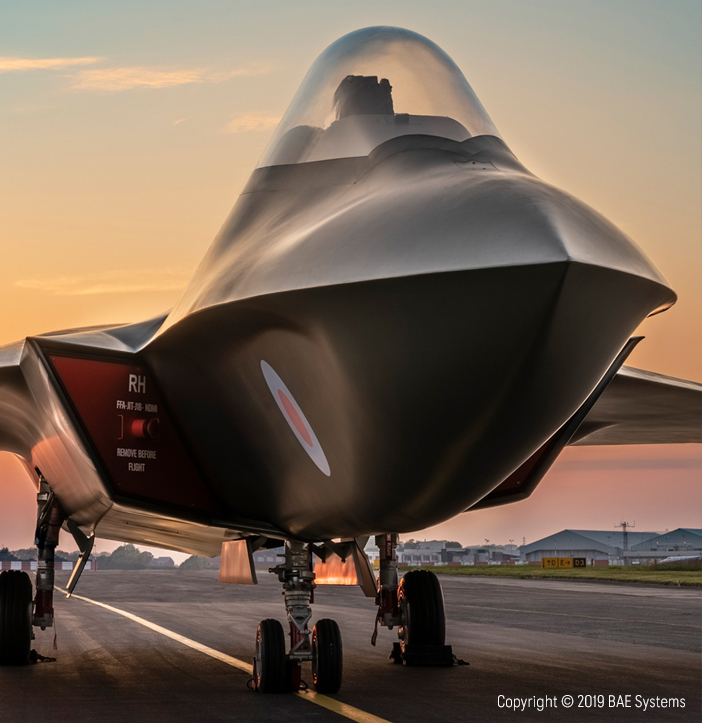
Over the last five years Rolls-Royce has been pioneering world-first technology that will contribute to the UK’s next-generation Tempest programme.
In an aim to be more electric, more intelligent and to harness more power, Rolls-Royce recognised that any future fighter aircraft will have unprecedented levels of electrical power demand and thermal load; all needing to be managed within the context of a stealthy aircraft.
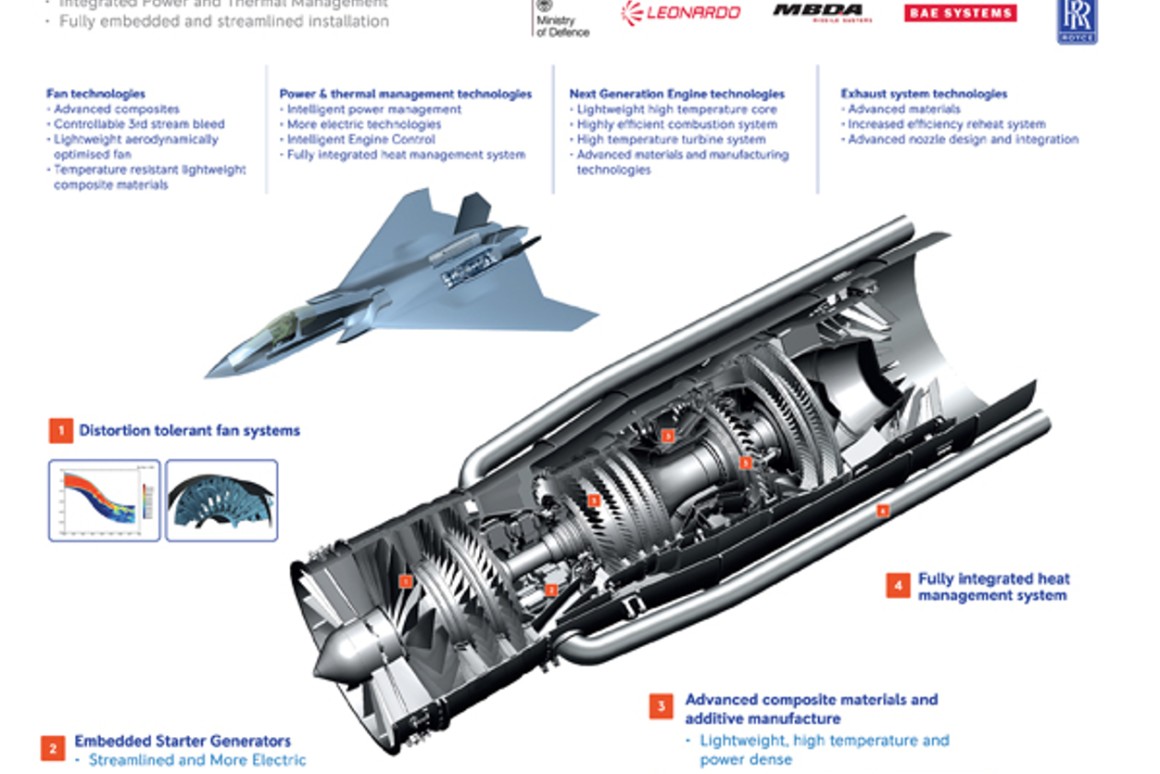
Before the launch of the Tempest programme, Rolls-Royce had already started to address the demands of the future. Back in 2014, the company took on the challenge of designing an electrical starter generator that was fully embedded in the core of a gas turbine engine, now known as the Embedded Electrical Starter Generator or E2SG demonstrator programme.
Conrad Banks, Chief Engineer for Future Programmes at Rolls-Royce said: “The electrical embedded starter-generator will save space and provide the large amount of electrical power required by future fighters. Existing aircraft engines generate power through a gearbox underneath the engine, which drives a generator. In addition to adding moving parts and complexity, the space required outside the engine for the gearbox and generator makes the airframe larger, which is undesirable in a stealthy platform.”
Phase two of this programme has now been adopted as part of Rolls-Royce’s contribution to the Tempest programme.
As part of this journey, the company has been continuously developing its capabilities in the aerospace market, from gas turbine technologies through to integrated power and propulsion systems. The goal being to provide not only the thrust that propels an aircraft through the sky, but also the electrical power required for all the systems on board as well as managing all the resulting thermal loads.
Rolls-Royce is adapting to the reality that all future vehicles, whether on land, in the air or at sea will have significantly increased levels of electrification to power sensors, communications systems weapons, actuation systems and accessories, as well as the usual array of avionics.
The launch of phase one of the E2SG programme saw significant investment in the development of an integrated electrical facility – a unique test house where gas turbine engines can be physically connected to a DC electrical network.
The launch of the second phase of the project in 2017 saw the inclusion of a second electrical generator connected to the other spool of the engine. It also included an energy storage system in the electrical network and the ability to intelligently manage the supply of power between all these systems.
The two-spool mounted electrical machines allows, by combination of operation as either a motor or a generator, the production of a series of functional effects on the engine, including the transfer of power electrically between the two spools.
As part of the E2SG programme, Rolls-Royce is investigating the feasibility of using dual spool generation to influence the operability, responsiveness and efficiency of the engine. Another key technology under development is the Power Manager intelligent control system, which uses algorithms to make real time intelligent decisions about how to supply the current aircraft electrical demand while optimising other factors including engine efficiency to reduce fuel burn or engine temperature to extend component life.
Throughout the Tempest programme, Rolls-Royce will be continuing to mature the electrical technologies demonstrated by the E2SG programme, with a third phase of testing likely to include a novel thermal management system being integrated with the overall system, as well as more electric engine accessories.
The company also intends to showcase a full-scale demonstrator of an advanced power and propulsion system. There will be new technologies in all parts of the gas turbine, including twin spool embedded generation to higher power levels, an advanced thermal management system, an energy storage system tailored to the expected duty cycle of the future fighter and an intelligent power management system which will be able to optimise the performance of both the gas turbine and the power and thermal management system.


 Tesla’s potentially facing an unintended-acceleration investigation. Kia plans for many more electric vehicles. And the Honda Clarity Plug-In Hybrid returns, but only to California. This and more, here at Green Car Reports. The federal government says that it will review a petition claiming unintended-acceleration issues on Tesla vehicles...
 An estimated 500,000 Tesla vehicles pose the risk of exhibiting sudden unintended acceleration, according to Reuters, and a petition filed to NHTSA on behalf of Tesla owners. If the petition is approved, NHTSA will investigate the widespread claims across Tesla's model lineup. The sudden acceleration claim alleges defects in the 2012-2019 Tesla...
 Hyundai’s Kia Motors unit is in many respects a separate automaker from Hyundai, with its own design and manufacturing facilities. Now, Kia is getting specific about its goals for going electric. With an announcement Wednesday, coinciding with an investor day, Kia released a slew of details about the company’s future intent for...
 The often-overlooked Honda Clarity Plug-In Hybrid is the closest thing on the market to the discontinued (and much-loved) Chevrolet Volt. Although a bit quirky-looking, the Clarity is more spacious and comfortable than the Volt ever was, and it remains the plug-in hybrid with the longest electric range, if you don’t count the Karma Revero GT...
 VW diesel settlement funds are putting more electric school buses into service. Porsche’s Taycan Turbo S gets a sub-200-mile range rating. And Nissan’s top design executive talks electric-vehicle platform-sharing among the automaker’s alliance brands. This and more, here at Green Car Reports. The same upcoming electric-vehicle...
 Nissan hasn’t launched a completely new dedicated electric vehicle in nearly 10 years. That’s all set to change soon with the introduction of not just one or two new EVs, but an entire new family of them—and potentially, by the middle of the decade, more than a dozen models globally across Nissan, its Infiniti luxury brand, and...
 Of all the kinds of vehicles that can be made electric, school buses sure make a lot of sense. Electric school buses have fewer maintenance needs and no noise pollution. And they curb diesel emissions—including fine particulate matter, nitrogen oxides, and carbon monoxide—that can contribute to asthma and other health issues. Michigan...
 Last month, results posted for the Porsche Taycan Turbo confirmed an EPA range of just 201 miles. Earlier this week, the EPA posted numbers for the higher-performance Taycan Turbo S, and it achieved an even lower number: 192 miles. That’s a 4.5-percent drop versus the Turbo. To compare, the Tesla Model S Long Range, at an EPA-rated 373 miles...
 Coal plants closed and electric cars got greener. Honda looks to trucks for its fuel-cell technology. And the Lucid Air has a debut date. This and more, here at Green Car Reports. With a passenger-car hydrogen infrastructure moving slowly but development on hydrogen fuel-cell stacks advancing rapidly, Honda and Isuzu have announced that...
 Lucid has announced that a formal introduction for its Air electric luxury sedan will be held in April—perhaps coinciding with the New York Auto Show. It’s also opened reservations for the Air, which is due for deliveries by very early next year. For $1,000, you get a spot for early production—starting by the end of the year...
  One campaign pledge the Trump Administration hasn’t been able to keep, as of yet, is the revival of the U.S. coal industry. U.S. coal power plants shut down at their second-fastest rate ever in 2019, according to new data from Thomson Reuters and the federal government, as reported by Reuters Monday. During 2019, 15.1 gigawatts of coal-fired...
 Honda and Isuzu Motors have signed an agreement to work together in developing commercial trucks powered by hydrogen fuel cells, the companies announced Wednesday. This would be the first time that Honda has provided its fuel cells to another company or given them access to fuel-cell vehicle development. It might also be the first time Honda...
 There are at last some great deals on the Chevy Bolt EV—in time to take advantage of at least some of the EV tax credit. Future Teslas might talk to you in crosswalks. And Nissan is aiming to keep its cabins from being overwhelmed by screen space. This and more, here at Green Car Reports. Pedestrian alert speakers are already required by the...
 From the Sony Vision-S and its many screens to the Chrysler Airflow Vision concept and its additional touchscreen in front of the passenger, a theme inside vehicles shown at CES 2020 last week seemed to be the more screens the merrier. Or, if you consider the Byton M-Byte and its awesome pillar-to-pillar 48-incher, the more screen real estate, the...
 When the Chevrolet Bolt EV’s federal EV tax credit eligibility amount dropped from $3,750 to $1,875 back on October 1, many expected GM to start making up for it with some deals. After all, the Bolt EV’s direct rivals, including the Hyundai Kona Electric, Kia Niro EV, and Nissan Leaf Plus, are eligible for the full $7,500 credit. Turns...
 Pedestrian warning sounds for electric cars are sometimes a fun extension of the vehicle; but they’re more often dissonant with the rest of the experience—a bit like a bongo drum at the opera, or a geeky science fiction reference thrown out in the middle of golf-course outing. In short, electric cars are silent, and so having them make...
  Nissan’s upcoming electric crossover is taking form—and we sample some of the performance technology that might help it stand out in the market. Cost remains a big barrier against EV adoption. And lithium-sulfur batteries could be closer to a breakthrough. This and more, here at Green Car Reports. For a look at the long-awaited...
 A global study of consumers points to a continued disconnect between environmental awareness and electric vehicle sales—especially among Americans. Based on polling of 20,000 worldwide respondents, the study module released Monday finds three familiar foes: cost, range, and charging infrastructure. And, it points out, price ranks far above...
  Researchers in Australia say that advancements made in cathode durability could make lithium-sulfur batteries a reality for electric vehicles soon. The news was reported Friday by IEEE Spectrum following a paper published Monday by researchers at Monash University in Science Advances. In both, researches say lithium-sulfur's lower weight and...