Hybrid and electric vehicle technology has seen rapid development in recent years. The motor and generator are at the heart of the vehicle drive and energy system and often utilise expensive rare-earth permanent magnet material.
Existing hybrid and electric vehicles, such as Toyota Prius, Chevrolet Bolt, Nissan Leaf, and BMW i3 all use high-energy-density permanent magnet (PM) machines for electric propulsion. The magnetic material is usually sintered neodymium–iron–boron (NdFeB).
Squirrel cage induction motors (IM) have been successfully used in electric vehicles (GM and Tesla) and commercial vehicles (buses and trains). They are much cheaper and more robust although they can struggle to get the same torque density.
Currently, the interior permanent magnet synchronous motor (IPMSM) is the most common machine in use, but manufacturers are keen to develop drive motors with much lower magnet content. High torque density and efficiency are required, as well as a wide constant power range.
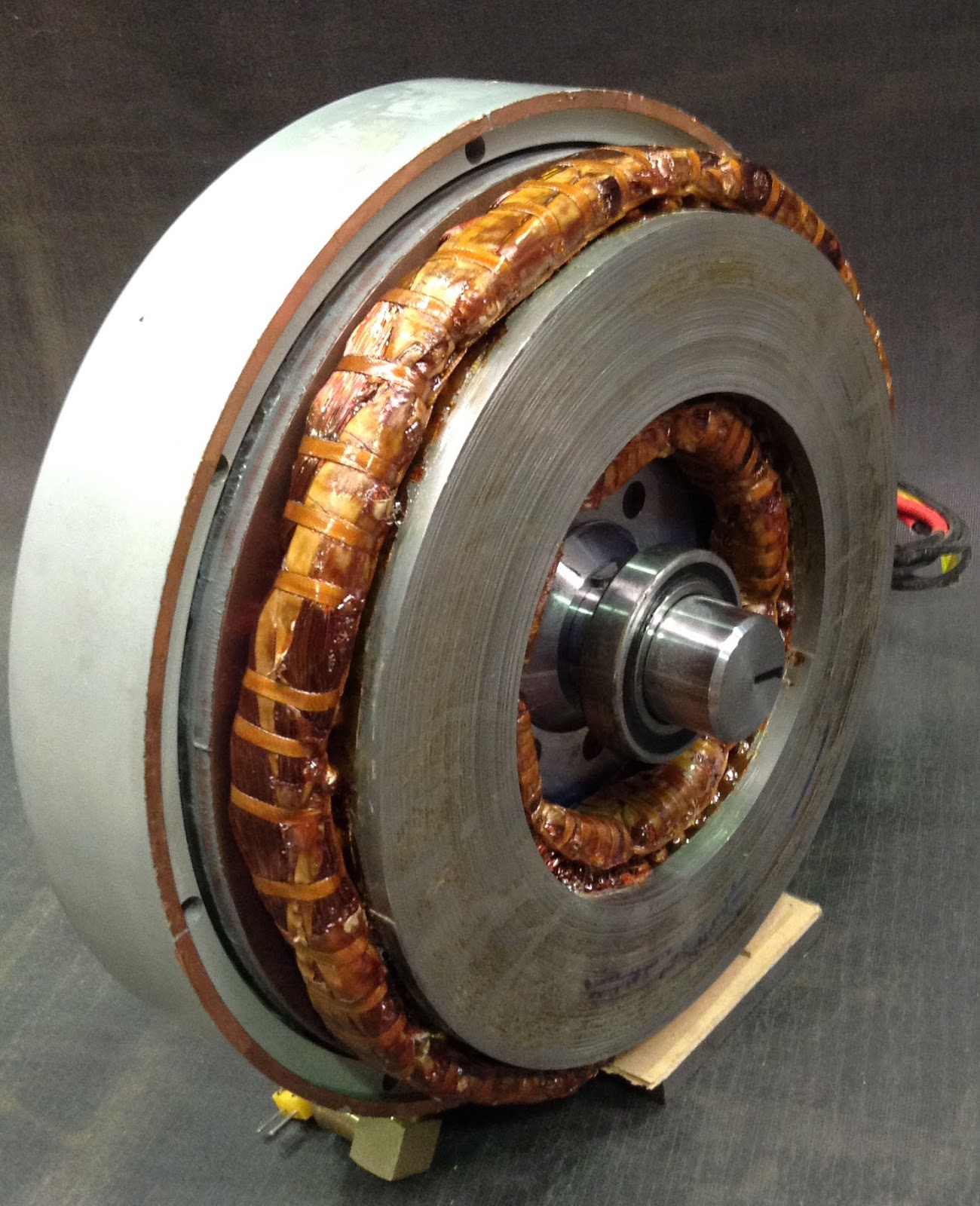
In an effort to improve the torque density of automotive induction motors Evans Electric have developed a double stator, copper rotor, axial flux induction motor. (AFIM) Like a typical squirrel cage induction motor, the AFIM eliminates the need for rare-earth permanent magnets entirely, yet matches the IPMSM for torque density and energy efficiency.
Axial Flux Torque Density (Nm/L)
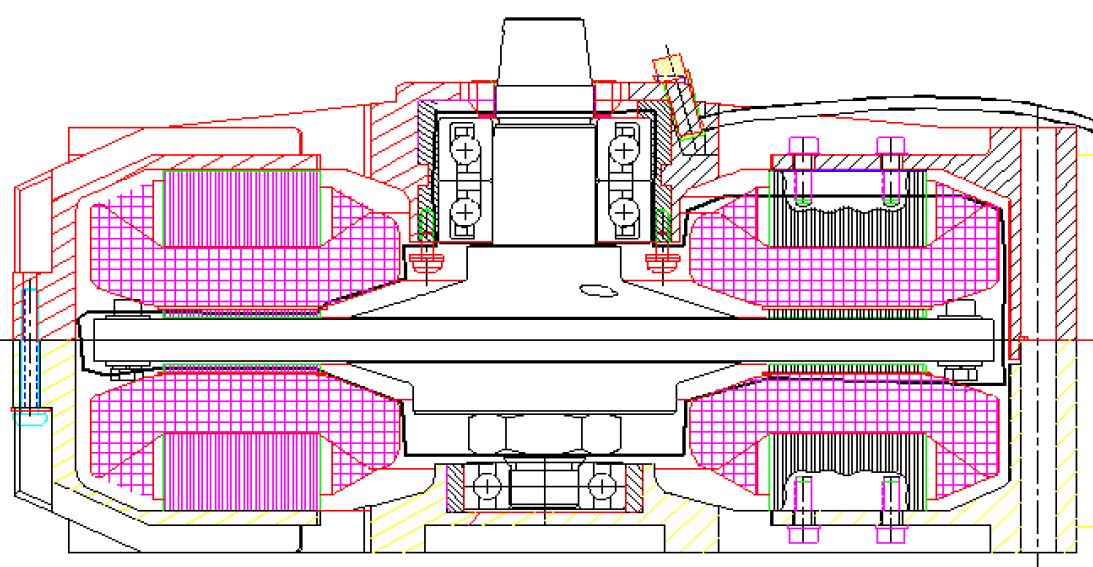
The earliest electrical machines were axial flux motors with the first prototype built by Michael Faraday in 1831. Axial flux machines [Figure 1] (aka. Pancake motors) offer high torque and power density values. A double stator architecture offers the highest torque density coupled with balanced axial forces. Further, the short axial length and solid-core copper rotor construction (patented by Evans Electric) further enhance torque density values when compared to radial flux motors.
Figure 1
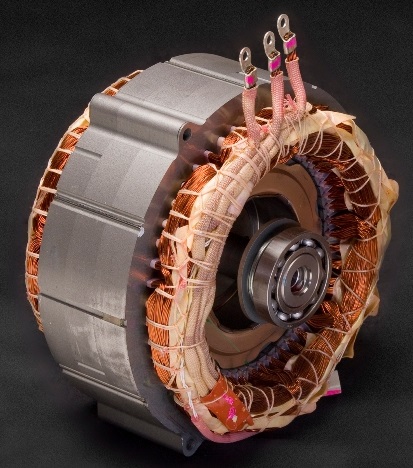
Conventional radial flux motor geometry [Figure 2] requires azimuthal travel of magnetic flux through the rotor. Azimuthal flux path volumes result in substantial parasitic eddy current losses unless laminates are used. A double stator, single rotor axial flux geometry [Figure 1] has a shorter flux return path that inherently avoids parasitic eddy current losses and results in a much smaller total rotor volume.
For example, the Telsa Roadster AC induction motor outputs similar torque values but is dimensionally 3x the volume of the Evans Electric AFIM which was designed to achieve output torque density of 100 Nm/L.
AFIM torque density can be further increased by reducing the impedance of the machine and increasing the bar number. Typical pole numbers are 6 to 8 while the use of high rotor bar number increases torque and decreases torque vibration.
The use of copper in the disc rotor lowers rotor resistance which improves efficiency but can restrict starting torque.
To obtain high efficiency the machine should be running at low slip so that higher pole number is usually required along with low rotor resistance. However, this can restrict the starting torque. This means that the input impedance as a whole needs to be low which does lead to high input current. However, to get high power factor the input reactance should be low compared to the input resistance. This leads to the need for compromise.
Figure 2
In industrial motors deep bars or double cages can be used but these options are not available in an axial flux design. However, the solid steel rotor aids the starting torque since this appears as an effective high resistance rotor. The maximum torque can be increased by reducing the impedance of the machine and increasing the bar number.
Efficiency – Comparing IM and PM Machines
Efficiency is important for hybrid electric vehicle drive motors. With energetically ‘free’ excitation, low fundamental reactance and the ability to have a high pole count, permanent magnet machines can be extremely light in weight and highly efficient. This is particularly true for industrial applications that involve a restricted speed range, meaning a fixed terminal voltage.
In such applications the design strategy is to build in a high internal flux (which permanent magnets do admirably), so that torque is produced with minimal input current. Then efficiency is high, and the motor can be made light in weight and physically small.
Traction motors for applications such as automotive, are different in that they must operate over a wide speed range. Automotive traction motors require a certain torque (‘base torque’) at low speeds, up to what is called the ‘base speed’, and then a roughly constant power over a speed range from the base speed to a maximum speed that might be several times the base speed. In traction motor applications using wound field DC machines, this torque-speed characteristic is accomplished using what is called ‘field weakening’, or simply reducing field current at high speed.
Prius THS II
The requirement for performance over a relatively wide speed range can force some compromises in permanent magnet motor design. It is not possible to turn down the permanent magnet flux to control terminal voltage at high speed. It is possible, however, to counter the permanent magnet flux with armature current, and this can be done in permanent magnet fields if the permanent magnet flux is not too strong.
So permanent magnet machines built for wide speed range operation generally have relatively weak permanent magnet excitation. Then it is necessary to build a high degree of saliency into the machine so that torque can be produced by interaction of terminal current with that saliency. Thus the permanent magnet machines built for automotive traction operation do not have all of the attractive features one would expect of permanent magnet machines.
At low speed and high torque they do not really operate as permanent magnet machines: they are more akin to synchronous reluctance machines, using the interaction between saliency and (large) terminal currents to produce torque. At high speeds they employ much of their armature current capability to counter the permanent magnet flux, and this negatively affects efficiency at high speed. Such machines can be made to be quite efficient at relatively low torque level and intermediate speed.
The Evans Electric AFIM achieves maximum efficiency of 96%.
Evans Electric AFIM
Effective Efficiency of Traction Motors
To understand the impact of motor losses, including PM drag loss on actual machine operation, we now attempt to evaluate the effective efficiency of a machine with a realistic operating scenario.
Recognise that losses in machines come from two sources. First, acceleration force requires current in the windings, so resistive losses occur. Second, rotational speed produces loss from friction, windage and, most important, core loss.
In permanent magnet machines there is always flux present so that there will always be rotational losses. Induction motors can be de-excited so that core loss can be ‘turned off’ when the motor is not producing torque.
In actual operation as a traction motor the induction machine is more efficient and has a substantial advantage because it can be de-excited when it is not producing torque, eliminating electrical loss in that condition. Since those losses are present only when, and to the extent, the induction motor is producing torque, hybrid vehicles are expected to be more efficient when induction machines are used for the drive motor.
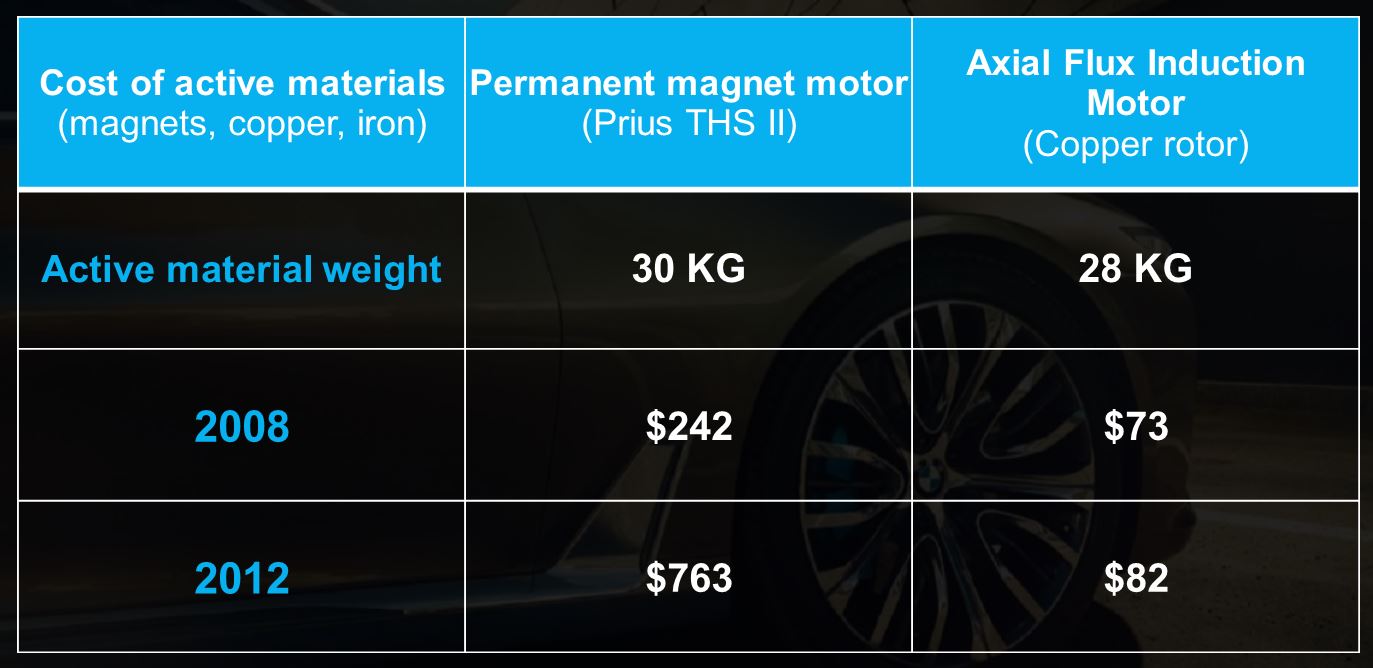
Cost Analysis
Rare-earth material costs can be up to several orders of magnitude more expensive than common steel and copper typically found in IM. The reduced volume of an AFIM further lowers material costs compared to a conventional radial flux IM. A reduction in motor material costs not only improves Hybrid and electric vehicle profitability but also facilitates the long term trend towards multi-motor EV powertrain architectures ie. twin and quad motor AWD.
Source: Evans Electric


 Today, the 2017 Hyundai Ioniq Electric is officially the most energy-efficient car sold in the U.S., a new video shows how a Tesla self-driving car "sees" the world around it, and we have details on the 2018 Toyota C-HR subcompact crossover. All this and more on Green Car Reports. The 2017 Honda Clarity Fuel Cell will lease for $369 a month when...
  Like a human driver, a self-driving car needs to "see" its environment in order to navigate through it. But instead of eyes, autonomous vehicles use an array of sensors—including cameras and radar—to detect objects and obstacles. So what does a self-driving car's view of the road look like? DON'T MISS: Tesla's own numbers show...
  The 2017 Toyota Prius Prime plug-in hybrid's tenure as the most energy-efficient car on sale in the U.S. turned out to be short. The Toyota recently took the title of most energy-efficiency vehicle available in the U.S. away from the BMW i3, which had held it since 2014. But now there's a new kid on the block. DON'T MISS: Hyundai Ioniq electric...
  Tesla Motors is facing a huge increase its production output in order to meet the ambitious goals set by CEO Elon Musk. He says he expects the company produce 500,000 electric cars per year by 2018. Much of that volume will come from the Model 3, the 215-mile, $35,000 sedan Tesla unveiled earlier this year, and plans to put into production by the...
  The 2016 Los Angeles Auto Show was awash in crossover utility vehicles, including a new model from Toyota that stretches the definition of that category. The 2018 Toyota C-HR features the high driving position of a crossover, but in a vehicle with decidedly car-like styling, and without an all-wheel drive option. Adding to the confusion, the...
  The 2017 Hyundai Ioniq will be the first model sold with options for hybrid, plug-in hybrid, and battery-electric powertrains. In addition to this unique combination of powertrain options, Hyundai plans to offer a novel alternative to the traditional purchase or lease models on the battery-electric Ioniq. Announced last week at the 2016 Los...


 The clock is ticking, but we may still see a third hydrogen fuel-cell car go on sale in certain regions of California—alongside the Hyundai Tucson Fuel Cell and Toyota Mirai—before the end of the year. The 2017 Honda Clarity Fuel Cell will be available through certain California dealerships before the year is out, its maker says. Honda...
  Today, Faraday Future halts work on its Nevada electric-car factory, the 2017 Jeep Compass debuts at the 2016 Los Angeles Auto Show, and 250,000 plug-in cars are expected to be sold in California this month. All this and more on Green Car Reports. Faraday Future recently halted work on its Nevada factory, and says it will resume in early 2017...
  Electric vehicles are hardly a new concept any more, but they've largely been the province of Nissan and Tesla. Add another nameplate to that battery-powered mix. The future of Jaguar arrives next year, in the shape of this gas-free SUV. Meet the Jaguar I-Pace concept. CHECK OUT: Jaguar I-Pace electric SUV concept breaks cover at LA Auto Show...
  Ah, Tesla Motors, source of hope, dreams, visions, contempt, dismissal, hilarity, frustration, and so much more. The Silicon Valley startup automaker, now in its ninth year of making electric cars, has built close to 150,000 expensive battery-powered luxury vehicles and defied critics numerous times. So what do our readers think the future holds...
 ![Cumulative battery-electric and plug-in hybrid sales in California to hit 250,000 in Nov 2016 [PEVC]](http://images.hgmsites.net/tmb/cumulative-battery-electric-and-plug-in-hybrid-sales-in-california-to-hit-250000-in-nov-2016-pevc_100581772_t.gif) It's long been obvious that California is the epicenter of emission reduction and electric-car adoption in the United States. And its outsize influence on U.S. environmental policy has global ramifications as well. Of the 1.25 million plug-in vehicles estimated to be on global roads by the end of this year, fully one-fifth are in the Golden State...
It's long been obvious that California is the epicenter of emission reduction and electric-car adoption in the United States. And its outsize influence on U.S. environmental policy has global ramifications as well. Of the 1.25 million plug-in vehicles estimated to be on global roads by the end of this year, fully one-fifth are in the Golden State...  The Renault Zoe again maintained the title of best-selling electric car in Europe for another month. The Renault hatchback was leading European electric-car sales in August, and we now know that it kept the lead through September, the most recent month with available data. As has been the case all year, the Zoe's main competition was the Nissan...
 ![Tesla Model S at Supercharger site in Ventura, CA, with just one slot open [photo: David Noland]](http://images.hgmsites.net/tmb/tesla-model-s-electric-car-road-trip-upstate-new-york-to-southern-california-photo-david-noland_100500011_t.gif) It's no secret that many Tesla Model S owners are very enthusiastic about their cars. A chance encounter with one can easily turn into a discussion of the virtues of Tesla's electric sedan—and of electric cars in general. That passion is reflected in a recent survey of owners conducted by market-research firm Strategic Vision. DON'T MISS...
It's no secret that many Tesla Model S owners are very enthusiastic about their cars. A chance encounter with one can easily turn into a discussion of the virtues of Tesla's electric sedan—and of electric cars in general. That passion is reflected in a recent survey of owners conducted by market-research firm Strategic Vision. DON'T MISS...  Jeeps are no longer exclusively classic SUVs (and actually haven't been for a while now). Despite some grumbling from fans, the Fiat Chrysler Automobiles (FCA) division has embraced crossovers with car-like features as it aims to fill every conceivable utility-vehicle niche. Debuting at the 2016 Los Angeles Auto Show, the 2017 Jeep Compass...
  Faraday Future's ambitious plans to launch a production electric car in less than two years appear to have hit a snag. Before the Chinese-backed startup can begin production, it needs to complete a new factory in North Las Vegas, Nevada, which has a stated cost of $1 billion. Last month, lead contractor AECOM warned Faraday that it was late on a...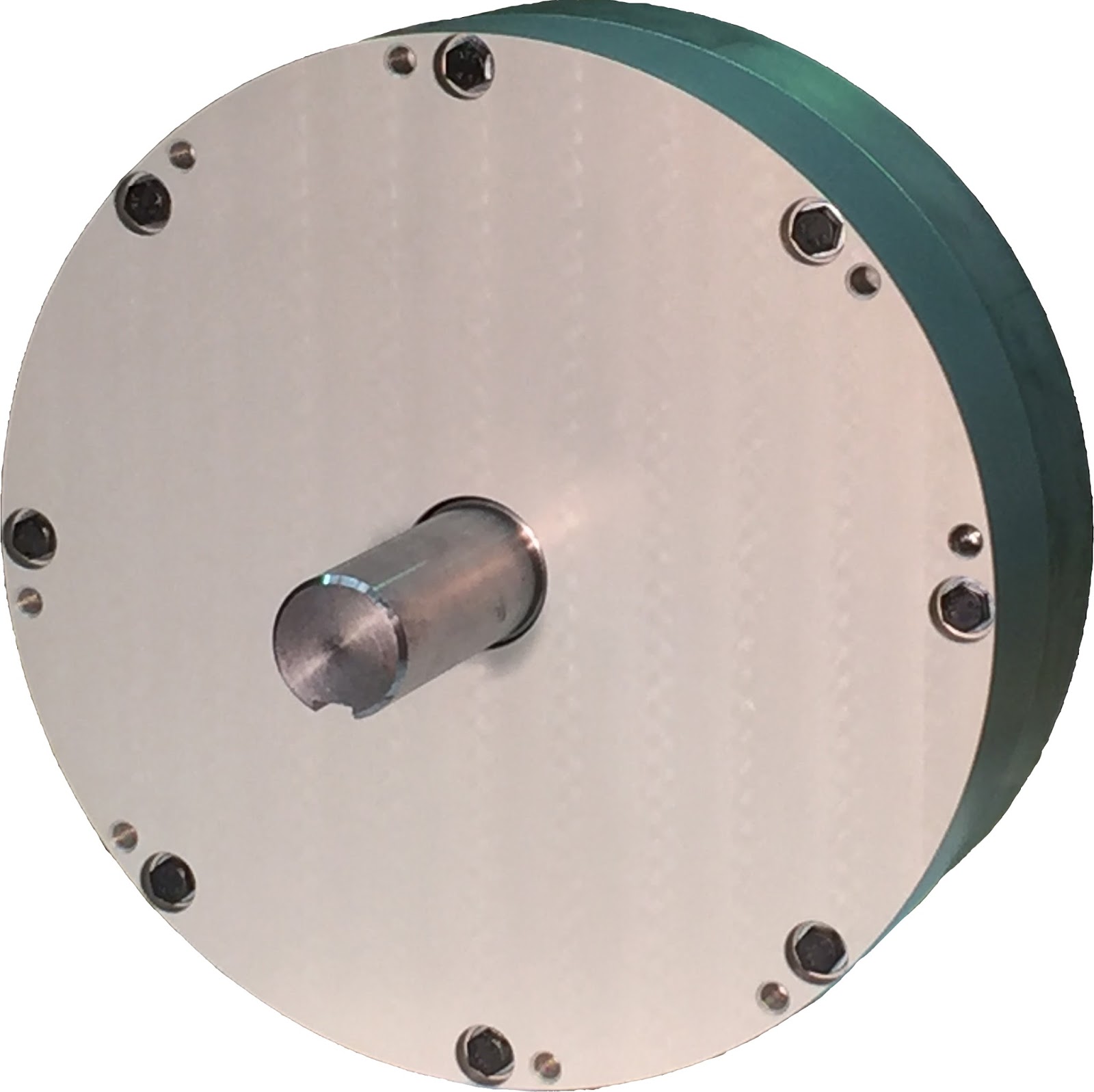




 Today, the updated 2017 Volkswagen e-Golf electric car debuts at the 2016 Los Angeles Auto Show, Elon Musk promises a software update for the Tesla Model S P100D that will make it quicker, and Fiat Chrysler Automobiles (FCA) and engine supplier Cummins face a lawsuit over Dodge Ram diesel pickup-truck emissions. All this and more on Green Car...
  Almost exactly three years after the European launch of the i3 electric car in November 2013, BMW has reached a notable milestone in its electrification efforts. The German automaker says it has delivered 100,000 plug-in cars over the past three years. That figure encompasses both battery-electric cars and plug-in hybrids. DON'T MISS: New 2017...