Ford Recalls 33,000 C-Max Cars
Citing concern about potential head injuries from inadequately padded headliners, N.H.T.S.A. directed Ford to recall a number of C-Max hybrids and E.V.s.

Charged with Electric Vehicle News and Views

The new all-electric BMW i3 is a landmark in BMW's mission to provide a completely sustainable, electric vehicle that still stays true to the Ultimate Driving Machine moniker. The BMW i3 is the first product of the new BMW i sub-brand, and is a truly purpose built electric car. It's a new era for electro mobility at BMW.
The vehicle concept behind the BMW i3 was designed from the outset to incorporate an all-electric drive system. This has numerous advantages over "conversion" vehicles, in which the original combustion engine is swapped for an electric motor. The engineers can design whatever works best, in terms of construction, dimensions and configuration of the electric drive system's components. The car's development is dictated by the characteristics designed into the car by the development team and not by the constraints imposed by a pre-existing vehicle design. For example, the space in a conversion vehicle set aside for the fuel tank or exhaust system cannot be used. In the BMW i3 there is no need for this kind of compromise.
This leads to the LifeDrive architecture concept, which was purpose-built specifically for the BMW i3. It is comprised of two modules; the Life Module, and the Drive Module. Think of the Life Module as the passenger cabin, or greenhouse. It is the first-ever mass produced Carbon Fiber Reinforced Plastic (CFRP) passenger cell in the automotive business, and is a big factor in the cars efficiency. Carbon Fiber Reinforced Plastic is equally as strong as steel, while being 50% lighter, and 30% lighter than aluminum. The result is an electric car that weighs about 2,700 lbs (preliminary US figures).
Due to the lightweight, high tensile strength of CFRP, the passenger cell has added protection, and the battery has less work to do, which allows for the use of a smaller, lighter battery that saves even more weight, reduces charging time and increases range. The light weight design of the Life Module also lowers the BMW i3's center of gravity, making it a more engaging and dynamic car to drive.
The Drive Module, which is constructed out of 100% aluminum, consists of the 22-kWh, 450 lb. lithium-ion battery, electric drive train, MacPherson strut and 5-link rear suspension system and structural and crash components. The battery mounted in the rear, close to the drive wheels, gives impressive performance characteristics while also providing better traction.
Another benefit of the LifeDrive architecture concept is that there is no space-consuming transmission tunnel running through the center of the car, like in most internal combustion powered cars, because of the separate Drive Module. This gives the BMW i3 the interior space of the BMW 3 Series, while only having the footprint of the much smaller BMW 1 Series.
Even the vehicle's key is sustainably manufactured. The source material of the new bio-polymer key is based on castor oil pressed from castor seeds. The owner's manual is also made from renewable resources.
The interior is made using high quality renewable sources and recycled materials. The BMW i3 has the Next Premium interior, which blends sustainable resources with a premium feel for the same interior quality as the BMW 5 Series Sedan. 25% of the plastics in the interior and 25% of the thermoplastic parts on the exterior are made from either recycled materials or renewable sources.
According to studies carried out as part of BMW's Project i, involving more than 1,000 participants and conducted over some 12.5 million miles, it was revealed that the average daily distance covered was around 30 miles. The BMW i3 will be able to travel 80 to 100 miles on a single charge. This can be increased by up to approximately 12% in ECO PRO mode and by the same amount again in ECO PRO+ mode. It is able to recharge in only 3 hours with the use of a 220V Level 2, 32-amp J1772 charger. The SAE DC Combo Fast Charging, which charges the BMW i3 up to 80% in 20 minutes, and 100% in 30, can be had as an option.
In order to reduce range anxiety, a rear-mounted 650cc, 34 hp, two-cylinder, gasoline-powered Range Extender generator is available, which roughly doubles the vehicle's range. When the battery gets to a certain level, the Range Extender starts and maintains the battery's current state of charge. The Range Extender never directly drives the vehicle's wheels. The Range Extender adds roughly 330 lbs. to the vehicle curb weight and has a fuel capacity of 2.4 gallons.
Since 1999 according to the DOE, average gasoline prices in America have increased from approximately $1.136 to $3.618, or about a 218%. In the same time, the pricing of electricity has increased from 6.6 cents to 9.9 cents, a change of only 50%, making electricity a far more attractive commodity from a pricing standpoint.
BMW i3 Quick-Reference Highlights.
- Pricing (before federal or local incentives) starts at $41,350; $45,200 for Range Extender model. Destination & Handling Fee not included.
- On Sale: Q2 of 2014 in the USA.
- BMW's 360 Electric electro mobility services.
- BMW i Remote app, which connects with the car.
- BMW Navigation is standard.
- BMW Intelligent Emergency Call ('eCall"), Anti theft alarm and Rear Parking Distance Control are standard.
Driving.
- 170-hp, 184 lb-ft hybrid-synchronous electric motor with max. revs of 11,400 rpm.
- 80-100 mile real-world EV range.
- 22-kWh lithium-ion battery, which weighs 450 lbs.
- 650cc gasoline powered Range Extender optional; holds charge, doesn't power wheels.
- 0-30mph in 3.5 seconds, 0-60mph in approximately 7.0 seconds (preliminary).
- Top speed of 93 mph, electronically limited to preserve efficiency.
- BMW's signature, near-perfect 50-50 weight distribution.
- Ultra-tight turning radius (32.3 ft), which is ideal for city driving.
- Macpherson strut front and 5-link rear suspension set up.
- Single Pedal Driving Concept with Brake Energy Regeneration, which feeds power back into battery.
- 3 drive modes: Comfort, ECO PRO and ECO PRO+.
- 3 hour 220 V @32 amps charging time.
- Optional SAE DC Combo Fast Charging allows for 80% charge in 20mins; 100% in 30 mins.
Chassis and Body.
- Purpose built construction. World's first mass-produced CFRP-constructed electric vehicle.
- Built on innovative LifeDrive architecture composed of two parts: Life Module and Drive Module.
- Life Module is essentially the cabin, constructed from Carbon Fiber Reinforced Plastic (CFRP).
- Drive Module is where all of the powertrain components are housed.
- Drive Module is made from 100% aluminum.
- Magnesium cross-member for instrument panel saves 20% weight vs. steel.
- BMW 1 Series external footprint with BMW 3 Series interior space.
- Adaptive Full LED headlights and LED taillights (standard in US market).
- Weighs in at roughly 2,700 lbs.(1224 kg)
- No space-consuming transmission tunnel dividing car's interior.
- Pillar-less design with rear coach doors allow for easy entry and exit to rear seats.
- Driver-oriented super-ergonomic controls.
- Three vehicle Worlds (trim levels): Mega (standard in US), Giga, and Tera.
- Standard 19-inch light alloy wheels with unique 155/70 all-season tires. 20-inch light alloy wheels optional.
- No transmission tunnel and low console allows for Slide-through Experience, which benefits urban driving by the ability to exit from the passenger side.
Sustainability.
- Made with sustainable, renewable materials.
+ Instrument panel surround and door trim use fibers from Kenaf plant.
+ Carbon fiber reinforced plastic (CFRP) roof panel is made partially with recycled CFRP from manufacturing process of other components
+ 25% of plastic used in interior comprised of recycled materials.
- Dashboard wood trim crafted from responsibly-forested eucalyptus.
- CFRP components are sustainably produced in Moses Lake, WA, USA, where the factory uses hydroelectric power.
- The Leipzig, Germany assembly plant uses wind-generated electricity.
- Olive-leaf extract is used to tan interior leather surfaces.


Four of Japan's leading carmakers, including Toyota, today announced a plan to expand sales of next-generation green vehicles by co-operating on the development of electric charging stations.
Toyota, along with Nissan, Honda and Mitsubishi, said there is a critical need to develop an infrastructure in Japan for vehicles that can be charged from a power point, such as plug-in hybrids and electric cars.
The carmakers said they will work with the Japanese Government to more than double the number of charging outlets to at least 4,000 quick chargers and 8,000 regular chargers.
They said an expanded charging network would maximise the electric-only driving performance and combined fuel economy of plug-in hybrids.
It would also enable motorists to extend the driving range of electric vehicles, which do not produce any tailpipe emissions.
Normal chargers would be installed in commercial facilities such as large shopping malls or highway service areas where motorists typically stopped for long periods.
Quick chargers would be installed for shorter-duration stops such as highway parking areas, convenience stores and fuel stations.
The carmakers will temporarily bear part of the installation and maintenance costs that are not covered by government subsidies of 100.5 billion yen ($1.1 billion) announced for 2013-14.
Their co-operation is based on an understanding that the charging infrastructure has public value and enhancing it should be done quickly during the limited period the subsidies are available.
The collaboration extends to car owners being able to use the same credit card for payment at all charging stations.
The Japanese government would like to see sales of these next-generation cars accounting for 15-20 per cent of new-car sales in 2020.
The four carmakers are committed to developing a more user-friendly charging infrastructure and to contributing to a society making maximum use of electric-powered vehicles.


Engadget got to test drive the The Spark EV, GM's first pure electric car since the company scrapped the EV1 program in 2002.
Performance is quite impressive for an EV this size: it sprints to 60mph in just 7.6 seconds with a top speed of 90mph. The 21kWh nano-phosphate Li-ion battery pack is liquid cooled / heated and is located in the floor. It offers a range of up to 82 miles and takes less than seven hours to fully charge using a level 2 (240V) charging station. Better yet, with a DC fast-charging option coming to the Spark EV later this year, you'll be able to charge the battery to 80% capacity in just 20 minutes.
Chevy's managed to keep the weight down to 2967lbs, which is pretty svelte for a pure electric car. This, combined a low center of gravity and a close to 50/50 weight distribution makes the Spark EV nimble and fun to drive.
Source: Engadget


Sales of electric cars are really starting to gain traction. Just in the month of June of this year, almost 9,000 plug-in electric vehicles have been sold in the U.S. This adds to more than 110,000 plug-in electric vehicles that have been sold in that country in the last two and a half years, the Electrification Coalition reports.
Tesla has been one of the biggest winners of the growing tide of electric cars, and managed to capture 8.4 percent of the luxury market in the first six months of 2013. Sales of Tesla cars have beaten virtually all of their competitors, including the Mercedes-Benz S-class, the Audi A8, and the BMW 7 series. Those are impressive statistics indeed, and not something we could have predicted even just a couple years ago.
The Nissan Leaf has also had a great deal of success, capturing 3.3 percent of the subcompact market. The Electrification Coalition has also pointed out that electric cars have not only the awards from various automotive publications, but have also enjoyed some of the highest customer-satisfaction ratings of any passenger cars. In addition, the Leaf and the Chevrolet Volt continue to receive high marks from major consumer-ratings publications.


A short 'pre-teaser' video of the BMW i3 has popped up ahead of Monday's launch. BMW are playing social media to the max on this one.
Source: Facebook BMW i3 Group


Toyota Racing can confirm its plans for the remainder of the FIA World Endurance Championship season.
The team will split its efforts between the ongoing 2013 WEC season and the development of its 2014 car in order to make best use of the available resources.
As a consequence, the #8 of Anthony Davidson, Sébastien Buemi and Stéphane Sarrazin, which is the lead TS030 HYBRID in the championship, will compete in Sao Paulo (1 September) and Austin (22 September).
Alex Wurz and Nicolas Lapierre will focus on 2014 development with testing and simulation sessions while Kazuki Nakajima will continue the defence of his Super Formula title whilst also racing in Super GT.
A decision regarding the team’s line-up at the remaining WEC rounds will be announced in due course.


Melbourne is set to become a key testing ground for electric vehicles within Australia with the launch of an electric vehicle hub that includes Victoria’s first fast-charging stations and an electric car for public hire.
The project brings together the Victorian Government, Moreland City Council, ChargePoint, GoGet, Toyota, the local community and businesses to share information, promote discussion and foster development of the electric vehicle industry.
Inaugurating the new hub, Minister for Public Transport and Roads Terry Mulder said Friday, “The Coalition Government recognizes the long-term benefits that EVs will provide for our transport system and the environment."
The EV hub located at Moreland City Council offices includes two standard EV chargers, one dedicated to the car share EV; one EV fast charger; and a Toyota Prius plug-in hybrid electric car, supplied through GoGet car-sharing scheme, for staff use and public hire.
In addition, Moreland City Council has installed a standard charging station in Fawkner to supplement its public EV charging infrastructure.
The Victorian government has invested nearly A$50,000 in the creation of Moreland City Council’s new electric vehicle hub as part of its A$5 million Electric Vehicle Trial project.
To encourage the adoption of electric and hybrid vehicles, all of Moreland City Council’s EV charge stations, including the fast-charger that takes just 30 minutes instead of overnight, will be available for the public free of charge for at least 12 months.
“Moreland City Council is providing the necessary infrastructure to encourage Victorians to use electric vehicles and make it accessible and convenient, which will encourage more people to choose this sustainable transport option," Mulder said.
In 2012 Mitsubishi, Nissan, Holden introduced their electric vehicles into Victoria; in the near future Renault, Ford, Toyota, BMW and Porsche all have plans to sell their electric vehicles into the state.
“This facility is another milestone in Victoria’s evolving EV charging network and an important step towards the State’s sustainable transport future,” Mulder said.
“This project is a great example of how the Electric Vehicle Trial is providing the foundations of an emerging marketplace for electric vehicles in Victoria and Australia,” the minister said.
Moreland residents will be provided with discounts and incentives to join GoGet and experience the EV. Moreland City Council will take out a business membership to GoGet so council staff can use the car when it’s available for hire.
Moreland Mayor Cr Oscar Yildiz said the hub will be actively promoted for public use, to encourage council staff, local residents and businesses to test the benefits of using an electric car. “The pilot project is a perfect opportunity to test the viability and popularity of these facilities in the Coburg area, with a view to this service becoming an ongoing offering,” Yildiz said.
The Electric Vehicle Trial will run until mid-2014, to gather a better understanding of the timelines, processes and barriers electric vehicle technology faces across Victoria.


Acura today released an image of a prototype NSX supercar, announcing that the running prototype will take to the racetrack just prior to the Honda Indy 200 IndyCar Series race at Mid-Ohio Sports Car Course in Lexington, Ohio. The NSX prototype with custom graphics will lap the road course in advance of the race on August 4, 2013. The race will be broadcast live by NBC Sports Network starting at 3 p.m. EDT.
Global development of the NSX, slated for launch in 2015, is being led by engineers at Honda R&D Americas, Inc. in Raymond, Ohio. Additionally, it was announced in May that the next-generation Acura supercar will be produced at the newly established Performance Manufacturing Center in nearby Marysville, Ohio.
The prototype model maintains the styling and proportions of the NSX Concept that debuted at the 2012 North American International Auto Show in Detroit, while packaging the production vehicle's mid-mounted V-6 engine mated to Acura's innovative new three-motor Sport Hybrid SH-AWD (Super Handling All Wheel Drive) system.


BMW i Ventures has announced a strategic investment into Chargemaster Plc, the UK’s leading provider of electric vehicle charging infrastructure. In addition to this investment, Chargemaster and BMW i have entered into a wide ranging cooperation agreement whereby Chargemaster will provide a range of E-mobility services. Both parties will carry out joint electric vehicle (EV) marketing activities and will work together to promote the advancement of EVs and E-mobility services.
Thorsten Mattig, Managing Director BMW i Ventures: “We see Chargemaster playing an important role in preparing the way for E-mobility. This investment and wide ranging cooperation agreement will accelerate our activities as well as boost the synergies with some of our already existing services and investments, such as ParkatmyHouse, where Chargemaster equipment has already been installed.”
The five year cooperation agreement between Chargemaster and BMW i aims to ensure that suitable charging infrastructure is in place for the anticipated proliferation of EVs, with both parties working to establish ChargeNow, the public charging network for BMW i owners across the UK. Chargemaster will also provide charging equipment and sites for the BMW i car sharing service DriveNow.
Both parties are working together on making EV charging as accessible to consumers as possible. This includes working with another BMW i partner, ParkatmyHouse.com (PAMH), to roll out further charging points within the PAMH estate of over 30,000 private parking locations. This cooperation extends Chargemaster’s existing work with PAMH where Chargemaster has already been equipping London PAMH driveways with charging points.
BMW i and Chargemaster will be looking to bring new innovative charging technologies to the market. Under the Agreement, the two parties will be carrying out joint EV marketing activities to promote the practical advancement of electric cars and E-mobility services.
Commenting on the BMW i Ventures investment and cooperation agreement David Martell, Chief Executive Offer of Chargemaster said: “We are delighted to welcome BMW i as investor in Chargemaster. In addition, our selection as a partner to cooperate in the provision of charging programmes to assist the rollout of E-mobility services is an endorsement of Chargemaster’s premier position in the market. We look forward to working with BMW i in this exciting and fast-growing space as we expand our operations in Europe.”


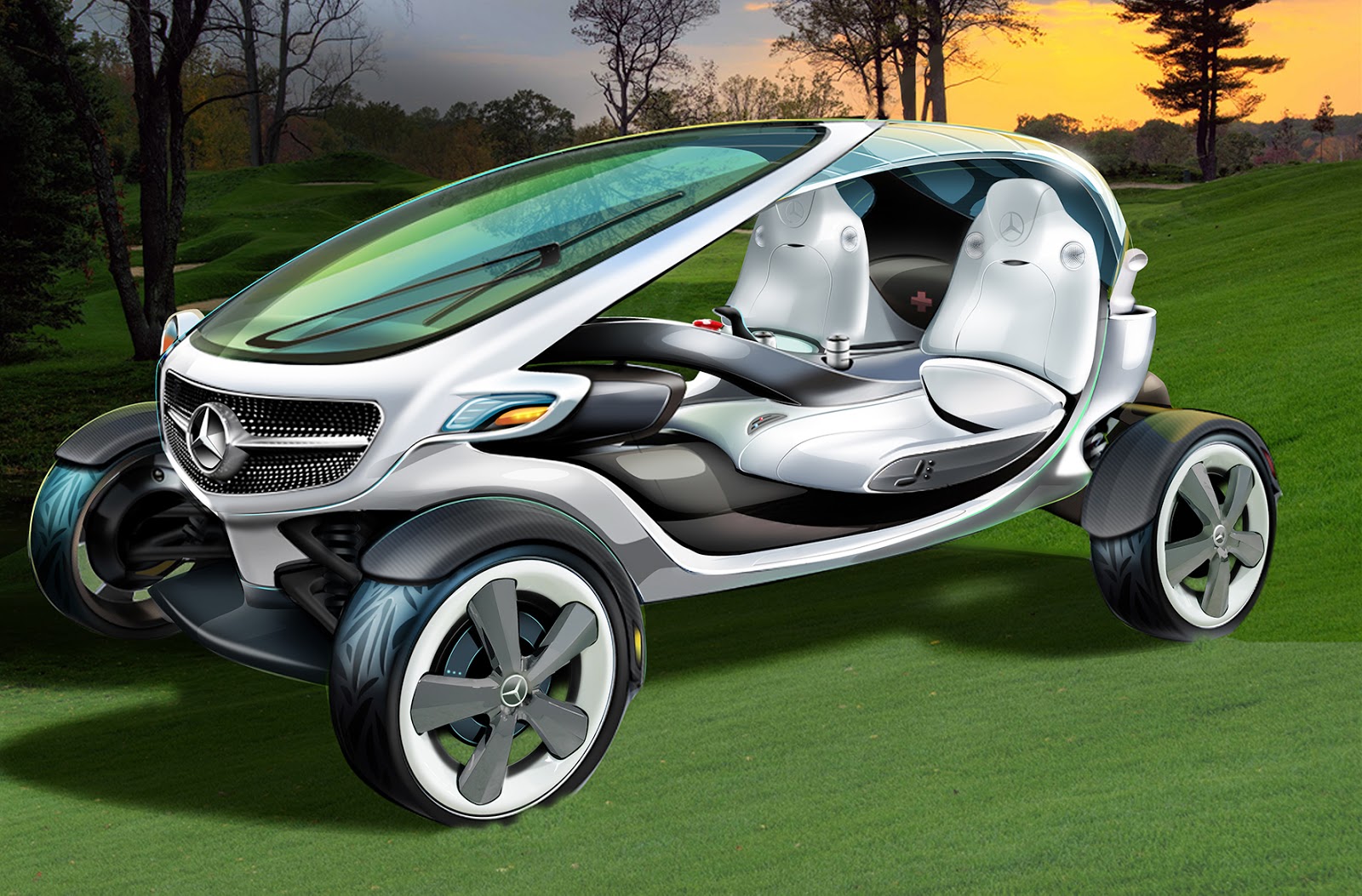
During this year's Open Championship, Mercedes-Benz presented the "Mercedes-Benz Vision Golf Cart". Hundreds of golf as well as automobile fans took part in an international competition by submitting their ideas for a golf cart of the future. This invaluable input provided the basis for a visionary golf cart design study created by the Mercedes-Benz design department. As well as reflecting the innovative and forward-thinking ideas and wishes of golf players, the study includes the characteristics and technologies of a Mercedes-Benz.
"The Mercedes-Benz Vision Golf Cart has a refined, simplified yet functional shape that fits well into our 'Sensual-Purity' design philosophy. The flow shapes create a 'sculpture on wheels' impression", says Gorden Wagener, Vice President Design Daimler AG. "I was very inspired by the idea of designing a golf cart, giving it a new shape and new sorts of meaning. Why not treating a golf cart like a car, and making it a 'Golf Car'".
Earlier this year, Mercedes-Benz called upon golf and automobile fans from around the world to submit their ideas for a Mercedes-Benz golf cart of the future. So began the search to find the best, most unusual, most innovative and most promising concepts. A jury chaired by Gorden Wagener then selected the best entries from among all the submissions. The winners received an exclusive invitation as VIP guests to the Open Championship.
Building on the basis provided by these ideas and concepts, and due consideration to the Mercedes-Benz design strategy, the Mercedes-Benz Advanced Design Center in Carlsbad, California, developed the Mercedes-Benz Vision Golf Cart. The cart combines the aspects of Mercedes-Benz vehicles with the functionality of a golf cart. The diamond grille, for instance, was incorporated to give the cart a modern face that is unmistakably a Mercedes-Benz.
The idea of the competition was enthusiastically taken up by golfers from all over the world like Japan, South Africa and Germany, as well as North- and South America. The most frequently mentioned ideas and requirements were then incorporated into the design study that has now been presented.
The Mercedes-Benz Vision Golf Cart and its innovative features The Mercedes-Benz Vision Golf Cart is electric driven, powered by a battery that is kept continuously charged by a solar module integrated into the roof. Manual charging, as for a conventional golf cart, is also possible. The vehicle is controlled in innovative and intuitive fashion via a joystick mounted on the centre console, so making it possible for either passenger to drive the golf cart.
"It has the latest in modern technology. Using touch screen monitors, virtually all aspects of the cart can be controlled without extra buttons. Simplicity is the key. Intuition and pure form can maybe best describe the cart", says Margarete Wies, Head of the Mercedes-Benz Advanced Design Center in Carlsbad, California.
The centre console also incorporates a multimedia panel that includes a rotatable docking station for an iPad or iPhone and a USB interface. Various functions that are available in the golf cart can be controlled from here, for example vehicle functions such as loudspeakers or the air-conditioning system, the head-up display, the music system or communication with the clubhouse and other golf carts.
If so required the head-up display integrated into the windscreen can also be used, when the golf cart is stationary, to show the course layout, the current status of the game or weather information. The digital speedometer is placed beneath the windscreen. One wish that came up time and time again, irrespective of country or language, was the possibility of being able to use a telephone. The cart thus also features Bluetooth, so allowing telephone calls to be made via the loudspeaker system while on the move.
An important issue is connectivity. Due to the iPad/iPhone connection to the cart it is possible to communicate directly with the golf club, for example to order drinks or food for the halfway catering. Current weather data and rain radars are available at any time. Working people have the possibility to write e-mails. In addition, users can share the digital score card or even photos from the golf game directly on social media channels.
The so-called "fore button" can be used to quickly warn other players of a misplaced shot. Pressing this button sends a warning to all other golf carts within the danger zone so that they, too, can issue a warning signal.
The interior takes its cues from the design of a Mercedes-Benz car. The elegant and ergonomically shaped seats, for example, are heated as well as ventilated and can be adjusted electronically using the Mercedes-typical controls on the side of the seat. The AIRSCARF neck-level heating system, first introduced in 2011 in the new SLK Roadster, is also envisaged as a feature of the Mercedes-Benz Vision Golf Cart. AIRSCARF, as its name suggests, wraps the neck and shoulder area in warm air, so making it possible to drive the vehicle open, even in cooler weather. There is also an integrated air-conditioning system, so ensuring a pleasant ambience even on a very hot or cold day.
The optional lightweight doors are another special feature. A click-in function allows these to be very simply fitted if the weather is not so good, so providing protection against wind and rain. A retractable lightning rod is included for added safety in case storm clouds start to gather. In bright conditions the windscreen can be darkened at the touch of a button, while it also features windscreen wipers with rain sensors, thus ensuring that they activate as soon as it starts to rain. In addition, the space behind the seats is ideal for stowing umbrellas.
One very commonly expressed request from the international entrants to the competition was, quite simply, to have plenty of stowage space. The Mercedes-Benz Vision Golf Cart therefore includes a whole range of stowage facilities. As well as the trunk compartment underneath the stowage area for the two golf bags, there are two dashboard compartments. The centre console is also specially designed to accommodate golf balls and scorecards and have a sun glasses storage. There is a small fridge fitted beneath the centre console, while cup holders between the seats will keep drinks hot or cold. An illuminated vanity mirror was another request, from female participants in particular, and is located at eye-height for the drivers.
In addition to its use on the golf course, the golf cart is also able to run on normal roads. The designers have, for example, also included all the vital features such as indicators, headlamps and tail lights. Thanks to the LED headlamps, play can also continue when the light starts to fail, as they include a floodlight function.
Although the Mercedes-Benz Vision Golf Cart is only a design study so far, there are no doubt many players who would like to see the cart become reality, bringing its fresh ideas and thus more fun, more innovation and more comfort to moving around on the golf course.


The Renault-Nissan Alliance has sold its 100,000th zero-emission car.
Electric cars from Renault and Nissan have driven approximately 841 million zero-emission kilometers — enough to circle the earth more than 20,000 times. Together, they represent 53 million liters of oil saved and 124 million kg of CO2 that have not been emitted.
“The age of the mainstream zero-emission vehicle is here,” said Renault-Nissan Alliance Chairman and CEO Carlos Ghosn. “We expect demand to keep growing as the charging infrastructure develops – and we remain 100% committed to zero-emission technology for the long term.”
Renault-Nissan has sold more zero-emission cars than all other major automakers combined.
The very first EV from the Alliance is a Nissan LEAF owned by engineer Olivier Chalouhi in California’s Silicon Valley. He bought the LEAF when it debuted in December 2010.
The 100,000th customer was American graduate student Allison Howard, who became an owner of Nissan LEAF earlier this month and drives the car to Kennesaw State University in Atlanta, Georgia.
“It just drives perfectly. It’s so cool. I love it!” said Howard.
“The fact that it’s all electric and I don’t have to spend money on gas as a college student, that’s great,” she added.
Nissan LEAF best-selling EV ever
More than 71,000 people worldwide have bought Nissan LEAF, the world’s best-selling electric vehicle. LEAF makes up more than half of all global sales of pure electric cars.
Nissan LEAF won the 2011 World Car of the Year, European Car of the Year 2011 and Car of the Year Japan 2011-2012 awards.
More than 80% of LEAF buyers globally exchange cars from other automakers, making the LEAF one of the industry’s most innovative “conquest vehicles.” The majority of customers say the LEAF, which consumes no petroleum whatsoever, has replaced their conventional car for daily use.
The top markets for Nissan LEAF are the United States with about 30,000 units, Japan with 28,000 units and Europe with 12,000 units.
In the United States, the LEAF is among the top 10 vehicles sold in San Francisco, Seattle and Honolulu.
In Norway, the LEAF is one of the top 10 vehicles sold. The car is Nissan’s best-selling model in Norway, where more than 4,600 people have bought LEAFs since 2011. EVs in Norway are exempt from value added tax (VAT) and road tolls, and they have access to bus lanes and free parking.
Renault – Europe’s leader with full range of electric vehicles
Renault has sold about 30,000 electric vehicles since its first model, Kangoo Z.E., went on sale in late 2011. Kangoo Z.E. was voted International Van of the Year 2012.
Renault leads the electric vehicle market in Europe with a 61% share, including Twizy. Renault’s top markets in Europe are France, Germany and Italy.
In addition to the Kangoo Z.E., Renault also offers Fluence Z.E. sedan; the two-seat commuter vehicle Twizy; and the subcompact ZOE, launched earlier this year.
Twizy is Renault’s best-selling model with about 11,000 units sold since it went on sale in early 2012.
Renault ZOE has a range of 210 km (NEDC). The car retails from 13,700 euros in France after the government’s 7,000-euro incentive, excluding the battery. Renault began selling the ZOE in March throughout Europe and has sold about 5,000 units.


Translogic head back to the Circuit of the Americas race track in Austin, Texas to check out Formula Sun.
The Formula Sun Grand Prix solar car race attracts college teams from across the globe to compete and promote clean energy.
Some of these teams will, no doubt, be shaking down their vehicles in preparation for the World Solar Challenge race across Australia in October.


BMW today announced pricing for the ground-breaking BMW i3 electric vehicle. The Manufacturer's Suggested Retail Price (without Destination & Handling) in the US will be $41,350, before any federal or state incentives. The Destination & Handling fee in the US is currently $925.
"The BMW i3 heralds the dawn of a new era for individual mobility and for the BMW Group. True to a genuine BMW, the BMW i3 has strong emotional appeal, outstanding product substance and a guarantee of sheer driving pleasure," said Ian Robertson, Member of the Board of Management, Sales and Marketing BMW. "With this leading-edge vehicle and attractive price, we will provide customers with a compelling offer for electromobility."
The BMW i3's 170 horsepower and 184 lb-ft of torque hybrid-synchronous electric motor, developed and produced by BMW, is electrified by a 22-kWh lithium-ion battery, good for 80-100 miles of emission-free driving. Designed from the ground up to be an electric car, the BMW i3 uses the Industry's first mass produced carbon fiber reinforced plastic (CFRP) passenger cell mounted on an aluminum chassis.
The BMW i3 will offer interior space comparable to the legendary BMW 3 Series on a shorter overall body. Its 32.3-foot turning circle and a relatively long wheelbase make it agile and engaging to drive, yet ideally suited to driving in dense urban areas.
Quick and convenient charging is possible either with the home charging station supplied by BMW i or at any public charging station that uses a Level 2 SAE J1772 charging system. DC fast charging, using the SAE DC Combo-Fast Charger, will be available as an option. From a public fast-charging station, it will provide an 80 percent charge from a fully depleted battery in just 20 minutes.
BMW i's commitment to sustainable urban mobility encompasses the i3 production facilities, where hydro-electric, wind and solar power are used to power the CFRP production facilities in Moses Lake, Washington and the Leipzig, Germany assembly line. Sustainable materials are also used for the BMW i3 interior upholstery and trim.
The BMW i3 will make its world debut at three simultaneous events in New York, London and Beijing on Monday, July 29. It will arrive in US showrooms in the second quarter of 2014.


The next-gen Mitsubishi Evo will allegedly feature a hybrid setup good enough for about 500 bhp (373 kW).
The standard Lancer will be globally launched sometime next year, while a plug-in hybrid model is already in the works. In addition, Autocar says Mitsubishi executives are also analyzing the prospects of a high-performance gasoline-electric variant with technology derived from the MiEV Evolution II Pikes Peak.
Although it's in an early development stage, the new Evo is expected to offer better all-wheel drive performance than its predecessor, as well lower CO2 emissions and the possibility of running on electric power. If green-lighted for production, the car's styling could be influenced from the 2008 Concept-RA.
Before a new Evo is out, Mitsubishi is planning a Lancer PHEV with a 2.0-liter gasoline engine working together with two 80 bhp (60 kW) electric motors. The setup should enable the car to return at least 150 mpg UK (125 mpg US or 1.8 liters / 100 km) with CO2 emissions of 50 g/km and a 40-mile (64 km) electric range.
Source: autocar.co.uk


Marking GM's return to building full-electric cars, the Chevrolet Spark EV improves upon its slow and noisy gasoline-powered version. Performance is quick but recharge times are slow.


