Nissan’s 2013 LEAF Sales Surge 335%

Nissan reported a massive 335% increase in sales of its hatchback electric car LEAF in U.S since the launch of the 2013 model in Mar 2013. LEAF has been Nissan's bestselling car in Seattle, Portland and San Francisco. Alongside, the company also witnessed burgeoning demand for electric vehicles outside the traditional West Coast market, i.e., in "New Wave" markets across the country.

Nissan expects incremental demand for electric vehicles in diverse markets and LEAF is expected to dominate the market share. With more than 75,000 LEAF electric cars on the road, Nissan emerged as the global leader in zero emission vehicles.

Nissan has witnessed 8.5% year-on-year growth in sales so far this year. The increase was driven by record-breaking U.S. monthly sales in 4 out of 7 months. The biggest contribution came from year-over-year increase in the sales of Nissan LEAF and a surge in the sales of the redesigned Pathfinder SUV.

Apart from the U.S., Nissan is also doing well in other parts of America. The company witnessed 7.5% sales growth in Mexico in the first seven months of 2013. Moreover, it plans to open new manufacturing facilities in Aguascalientes, Mexico and Resende, Brazil.

Toyota adds discounts for Tesla-powered all-electric RAV4

Toyota Motor Corp. is discounting its all-electric RAV4 through low-cost lease and loan offers to boost demand for the slow-selling compact crossover that’s powered by a Tesla Motors Inc. battery pack and motor.

Toyota, the world’s biggest maker of hybrid autos, this month is promoting the option of a $299-a-month, three-year lease for the $49,800 light truck, or a 60-month, no-interest loan, said Carly Schaffner, a company spokeswoman. The offers run through Sept. 3 and are available only in the Los Angeles and San Francisco regions, the vehicle’s main markets.

Honda Motor Co., Nissan Motor Co. and General Motors Co. similarly have turned to discounted leases to buoy their rechargeable models. Toyota last year said it would sell 2,600 RAV4 EVs by the end of 2014. Through July, just 709 have been sold since sales began last September.

“The use of our incentives is tactical, reinforcing our value and focus on keeping our products competitive in the market,” Schaffner said. “We’re still evaluating the market demand for EVs.”

The battery-powered RAV4 arose in 2010 as a result of Toyota President Akio Toyoda’s desire to work with Palo Alto, Calif.-based Tesla. Along with the vehicle project, Toyota made a $50 million investment in Tesla. Tesla shares have surged about fivefold this year, boosting the value of Toyota’s 2.4 percent stake in the company to about $476 million.

Toyota, with the biggest market share in California, is under pressure to sell the most rechargeable vehicles in the state to meet strict emissions rules. Along with the electric RAV4 that goes about 100 miles per charge, Toyota sells a plug-in version of its Prius hybrid to meet state rules and will add a hydrogen-powered electric sedan in 2015.

200,000 Fast-Charging Stations for Electric Vehicles by 2020

Total fast-charging stations for EVs are set to reach 199,000 locations globally in 2020, up from just 1,800 in 2012. The number of these stations, meanwhile, is anticipated to rise more than threefold in 2013 to 5,900 and then nearly triple to 15,200 in 2014. Overall growth will continue at a rapid pace through 2020.

Hard charging

"The length of time it takes to recharge an EV continues to be one of the major stumbling blocks inhibiting the widespread adoption of electric vehicles," said Alastair Hayfield, associate research director at IHS Automotive. "Compared to the time it takes to refuel an internal combustion engine (ICE) vehicle, the recharge time for EVs is incredibly slow-at about four hours to charge a 24 kilowatt-hour (kWh)-capacity battery using a 6.6 kW on-board charger. If EV auto manufacturers could overcome this obstacle, it could lead to a high rate of adoption from environmentally minded consumers as well as those seeking to cut gasoline expenses. That's where fast charging comes in."

Hooked up to a fast-charging system, which offers a high-voltage DC charge instead of a slower AC charge, a vehicle can be fully charged in as little as 20 minutes. This could be a major step toward EVs becoming generally equivalent to ICE vehicles when it comes to refueling.

"IHS believes fast charging is a necessary step to promote higher adoption of EVs, but there will need to also be better consumer education regarding behavioral changes that may need to happen when owning an electric vehicle-such as charging overnight or at work," Hayfield said.

Japanese standard charges ahead

One fast-charging standard designed for electric vehicles is dubbed CHAdeMO, a primarily Japanese-backed technology. The major proponents of the technology are Japanese automotive OEMs-including Toyota, Nissan, Mitsubishi; and Japanese industrial giants-including Fuji Heavy Industries Ltd., Tokyo Electric Power Co. and more.

CHAdeMO, roughly translated as "charge for moving," began deployment in 2009 in order to accelerate the adoption of electric vehicles in Japan, where EVs have found positive reception. Today there are as many as 2,445 CHAdeMO fast chargers in operation and more than 57,000 CHAdeMO-compatible EVs around the world. This accounts for as much as 80 percent of all electric vehicles on the road, especially given the high concentration of EVs coming from Japan in the form of the Nissan Leaf, Mitsubishi i-MiEv, Hondo Fit EV and more.

One size charges all

A competing solution to CHAdeMO, aptly named the combined charging system (CCS), offers electric vehicle owners the option of having a single charging inlet that can be used for all available charging methods. That includes 1-phase charging at an AC power source, high-speed AC charging with a 3-phase current connector at home or at public charging stations, DC charging at conventional household installation and DC fast charging at power-charging stations globally.

CCS, which was submitted for international standardization in January of 2011, has garnered the support of Audi, BMW, Daimler, Chrysler, Ford, GM, Porsche and Volkswagen. Already BMW, GM and Volkswagen have announced they will introduce fast-charging EVs based on the CCS standard sometime this year.

Tesla vies to electrify the market

Tesla Motors, the California company most notable for the all-electric Tesla Model S, is driving a third method for fast charging. Tesla is developing its own proprietary network of fast chargers in the U.S. Dubbed "Superchargers," the chargers operate at a higher power rating than current CHAdeMO or CCS chargers, and also have a proprietary plug interface, which means that only Tesla vehicles can use them.

"In addition to the proprietary technology, the charging stations are free to use for Tesla owners, and there are plans to power all stations using photovoltaics," Hayfield said. "These Superchargers represent a powerful proposition for Tesla-drivers can charge faster, have U.S.-wide coverage by 2015 and will charge for free for life. This triple threat will aim to lock drivers into the Tesla experience, and also will give Tesla a perceived advantage over other original equipment manufacturers competing in the same market.

Future charge

Looking ahead to the future of EVs, it's clear that DC charging is becoming the favored means for supporting rapid, range-extension electric vehicles. But it is less clear as to whether CHAdeMO or CCS will win the battle for the consumer.

Japan will continue to utilize CHAdeMO, while Germany is set on using CCS; other nations likely will also utilize CCS as well, since it supports slow-charging. But no matter which solution is used, DC-based fast charging is critical to promoting consumer approval and interest in EVs.

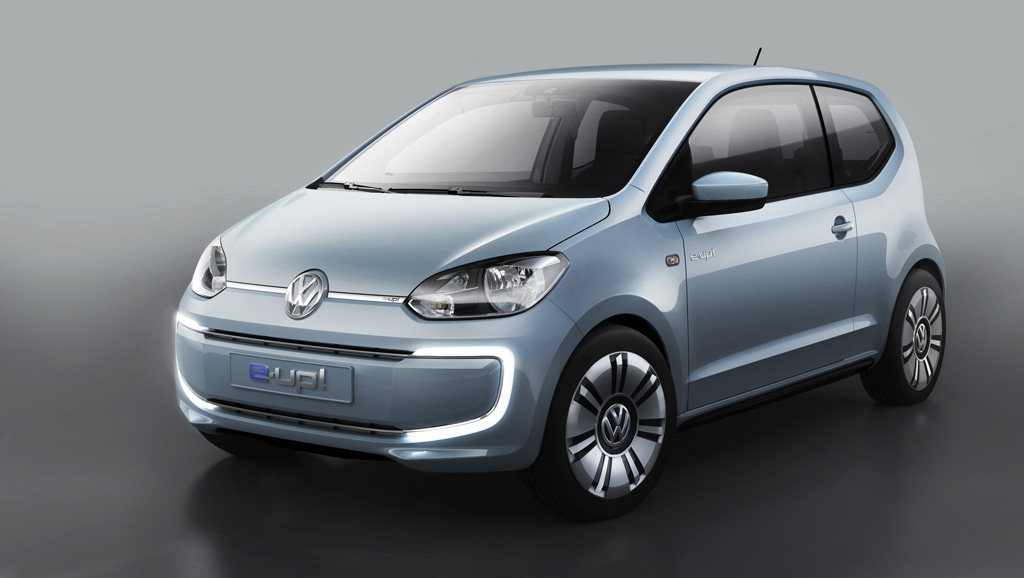
VW to launch all-electric up! in Frankfurt

Volkswagen has confirmed that it will lift the veil off of an all-electric version of the pint-sized up! at the Frankfurt Motor Show next month.

Likely dubbed e-up!, the small EV will be offered as both a three-door and a five-door hatchback. Apart from discreet badges on the front fenders and on the trunk lid, it will look exactly the same as its gasoline-powered counterpart, enabling it to appeal to buyers that want a low-key EV.

Tipping the scale at almost 400 pounds, the up!'s electric drivetrain will consist of an electric motor mounted in the engine bay and a lithium-ion battery pack stored under the rear bench seat. The motor will send the equivalent of 82 horsepower to the front wheels, propelling the e-up! from zero to 62 mph in a little under 13 second and on to a top speed of 80 mph.

The lithium-ion battery pack will be rechargeable in about six hours when plugged in to a regular household outlet, or in 40 minutes when using a quick charger. It will give the city a car a maximum driving range of 80 miles.

Volkswagen has hinted that the e-up! will carry a base price of roughly €19,000 (about $25,000). Buyers will lease the battery pack from Volkswagen for €60 (around $80) a month.

After greeting the show-going public in Frankfurt, the e-up! will hit showrooms across Europe before the end of the year.

Toyota to add Wireless Charging to Plug-In Prius

During the recent Toyota Hybrid World Tour Satoshi Ogiso, Managing Officer of Toyota Motor Corporation said Toyota will begin verification of wireless/inductive charging system system in Japan, the US and Europe in 2014.

We have been listening very carefully to Prius PHV owners over the past two years… and are considering their requests for additional all-electric range.

We have also heard from these owners, that they would like a more convenient charging operation. In response, we are developing a new wireless/inductive charging system that produces resonance between an on-floor coil and an onboard coil to recharge the battery without the fuss of a cable.

We will begin verification of the system in Japan, the US and Europe in 2014.

Nissan recently said they are working on an open source wireless induction charging system and that five future Nissan-brand EVs will use inductive charging.

Source: Toyota

ZF and Levant Partner to Develop Regenerative Suspension

Regenerative brakes are increasingly becoming a popular option on new cars as a way to save energy, and soon that technology could be joined by another engineering breakthrough: a regenerative suspension.

We have reported on Regenerative shock absorber developments including Linear tubular electric motors Here, Here and Here and hydraulic actuator based systems Here and Here.

This technology is being developed by ZF and Levant Power, in hopes of producing a suspension system that combines “the vast gains of active suspension with modest power consumption, minimal complexity and affordable cost,” the companies announced in a release. Essentially, the alliance hopes to build the world’s first fully active and regenerative suspension for automobiles, and make it affordable enough for volume production.

Forming the basis of the technology is an innovative, functional unit that is fitted to the outside of a ZF damper. In the compact unit is its own control unit, an electric motor and an electrohydraulic gear pump. That gear pump is in charge of regulating the oil flow to the damper, allowing it to adapt optimally and automatically to the driving conditions. In addition, the system is even capable of actively raising each individual wheel on the vehicle.

The innovative valve system automatically uses the swaying motion of the damper piston in order to recover energy. The system then guides the oil in the damper, driving the electric pump motor, essentially allowing it to function like a generator. The generated kinetic energy is then turned into electricity which is fed into the vehicle’s power supply.

“We look forward to working closely together with Levant Power. The objective is to develop the world’s first fully active and regenerative suspension, make it ready for volume production and introduce it to the market. Thus, we are promoting efficient innovations that are tailored to meet global requirements,” said Rolf Heinz Rüger, in charge of the Suspension Technology business unit of ZF’s Car Chassis Technology division.

Panasonic Announce Tokai University Solar Car Team Sponsorship

Panasonic Corporation today announced that it has agreed to provide technical support to Tokai University's solar car team, which will compete in the 2013 World Solar Challenge (WSC 2013), one of the world's biggest races for solar cars, to be held from October 6 to 13 in Australia. Under the sponsorship agreement, Panasonic will provide the Japanese university team with its HIT(R) solar cells which boast the industry's top-class electricity output as well as its high-capacity lithium-ion batteries.

The WSC, which started in 1987 and became a biennial event in 1999, is a time-based competition over a distance of 3,021km from Darwin in the north down to Adelaide in the south. Teams from around the world, including universities and corporations, participate in the race in cars powered solely by sunlight.

The Tokai University team has an impressive track record in solar car racing. The team won the previous WSC races held in 2009 and 2011, and is now looking to make a hat trick in the WSC this year. Last year, the team also won the race in South Africa that was recognized by the Federation Internationale de l'Automobile (FIA) as the world's longest alternative fuel vehicle car race. Panasonic's energy products contributed to the team's victories at these international competitions.

Panasonic's HIT solar cells have a unique hybrid configuration with a crystalline silicon substrate surrounded by ultrathin amorphous silicon layers. Compared to ordinary crystalline silicon-based solar cells, Panasonic's HIT solar cells suffer less degradation of power output at high temperatures, delivering the industry's highest-level energy output per unit of area. This makes Panasonic's HIT solar cells ideal for solar cars competing in races such as the WSC, given that the WSC regulations limit the total area of solar cells installed on the body to up to six square meters and that the cells will be exposed to the scorching Australian sun. The HIT solar modules for the Tokai University team are purpose-built for the solar car race, using the same solar cells - the main component that converts the sunlight into electricity - that are mass-produced for the residential market.

The rechargeable batteries Panasonic is providing are the cylindrical 18650 type (18 mm in diameter x 65 mm in height) high-capacity lithium-ion battery cells which use the company's proprietary nickel-based positive electrode. The high-capacity and lightweight battery cells store excess power generated by the HIT solar cells so that the car is able to continue running even on overcast days.

Bridgestone Sponsors World Solar Challenge 2013

Bridgestone will be the title sponsor of the World Solar Challenge 2013, which will be held in Australia October 6-13.

Dubbed “The Bridgestone World Solar Challenge 2013,” the event will see a record 45 teams from 26 countries compete in a 3,000 km cross-country race using only solar energy to power the vehicles.

The event will feature three separate classes, Adventure Class, which will showcase cars built for previous events; Cruiser Class, which will be judged by design practicality, and Challenger Class, which will compete for the title of the world’s most efficient solar car.

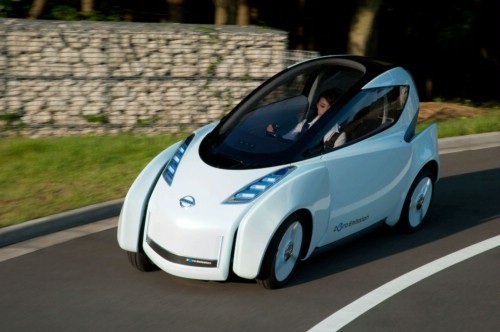
Nissan to expand EV lineup to 5 models all with Wireless Charging

Nissan Motor Co. says it will expand its global EV product line to five models.

The company has not announced what additional models it is planning and has not specified a timetable. But it indicates Nissan is taking a long-term view of the slow-growing EV market.

"We haven't announced what models they will be, but we have plans for five," Carla Bailo, senior vice president for R&D at Nissan Americas, told reporters. "The others will come in due time."

Bailo said future Nissan-brand EVs will use inductive charging -- an emerging advanced technology for recharging the batteries of electric cars wirelessly. Inductive chargers enable an EV owner to park on top of a charging mat to recharge a battery without hooking up a connector.

"Once that technology is ready, we will use it across our brands," she said after her presentation.

Previously, Nissan had said inductive charging was critical to differentiate the luxury EV planned for the Infiniti brand.

Production of the cargo van begins later this year in Europe, initially for the European market. But this spring, Infiniti President Johan de Nysschen said the Infiniti EV will be delayed. Infiniti said it wanted to wait for improvements in inductive charging technology.

That means that only the Leaf has made it to market so far, after more than three years of promoting the idea of EVs. The company spent $1.8 billion to move U.S. production of that model to Smyrna, Tennessee, and to construct a lithium ion battery module plant there. That factory, which began production in January, gives Nissan the capacity to build up to 150,000 Leafs a year and 200,000 batteries.

Sales of the car in the United States have more than tripled since last year, when it was still being imported. Through July, Nissan dealers sold 11,703 Leafs, up from 3,543 in the first seven months of 2012.

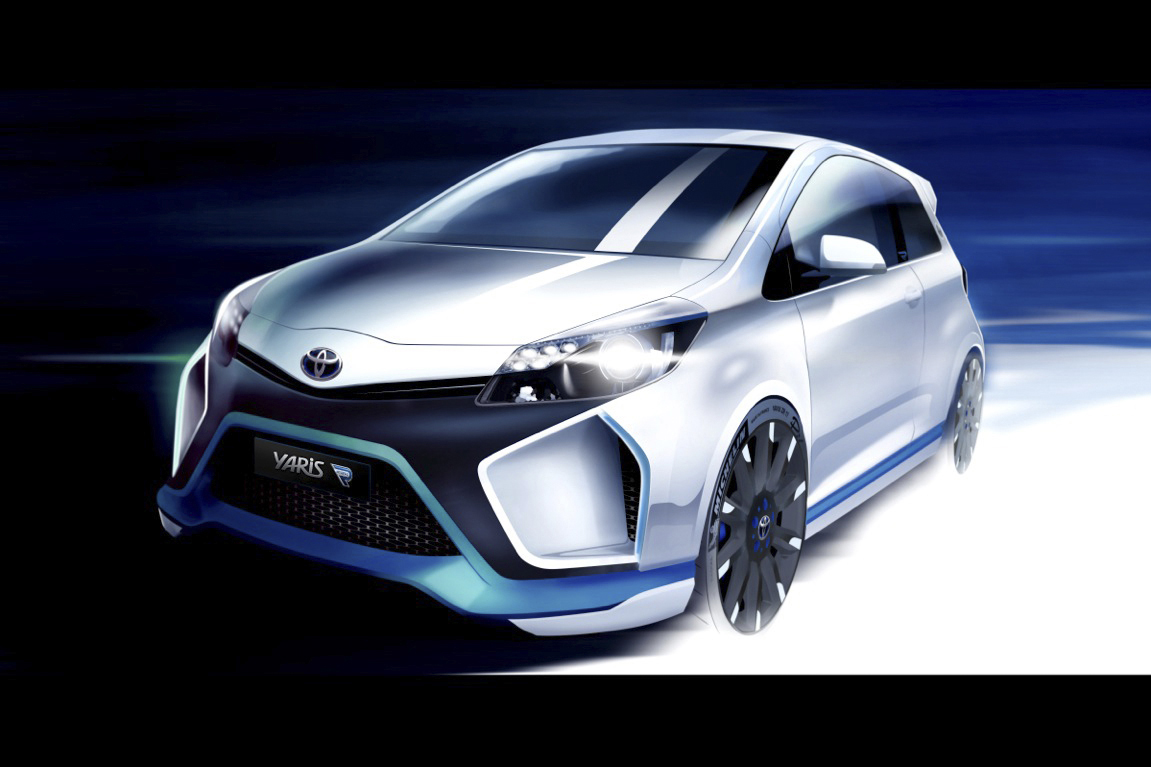
Toyota Reveal 420hp AWD Yaris Hybrid-R Powertrain Details

Based on the Yaris 3-door, the Yaris Hybrid R concept hybrid powertrain configuration combines the powerful 1.6l petrol Global Race Engine with two powerful electric motors to provide an ‘intelligent’ electric four-wheel drive capability.

The front wheels are driven by a 300hp 4-cylinder 1.6 turbo engine with direct injection specifically developed by Toyota Motorsport GmbH (TMG) according to the rules of the International Automobile Federation (FIA) for a Global Race Engine to be utilised in various motorsport disciplines.

At the rear, each wheel is individually powered by a 60hp electric motor – the same as those used in the standard Yaris Hybrid.

Taken together, the hybrid powertrain system develops a total system output of up to 420 hp. The two electric motors work as electric generators during the braking phase, and supplement the petrol engine during the accelerating phases.

Super-capacitor

Just like in the TS030 HYBRID, the energy recovered during the braking phase is stored in a super capacitor. Compared to the standard NiMh hybrid battery, the super capacitor has a higher power density and a fast power charge / discharge speed. It is perfectly suited to the requirements of sporty driving on track, which requires brief and immediate bursts of power.

Nevertheless, level of power depends on the duration of energy delivery desired. In road mode, the super-capacitor releases the energy recovered under braking for a maximum duration of 10 seconds per charge and the total power of the two electric motors is reduced to 40 hp. In track mode, the rear electric motors reach a combined maximum power of 120hp for up to 5 seconds per charge, reflecting the higher frequency of braking and acceleration events during circuit driving.

Advanced traction control

A 3rd 60hp electric motor, located between the engine and the 6 gear sequential transmission, operates as a generator in two different cases: during deceleration to feed the super capacitor and during acceleration to directly power the rear electric motors.

The latter will only happen when the engine power and torque exceed the grip potential of the front wheels. The generator behaves like an advanced traction control system, redirecting the torque as electric energy to the rear wheels, to boost the acceleration and improve the handling rather than to simply limit the engine power.

Torque vectoring

Rear electric motors - one per wheel – can greatly influence the Yaris Hybrid-R handling characteristics during cornering by altering the distribution of torque between the left and right rear wheels.

Each motor can be used independently as a generator or a motor to achieve the same effect as an intelligent torque vectoring differential.

Depending on the radius of the curve, the system can send more torque to the outside rear wheel allowing higher cornering speeds into the corner (middle-speed curves), apply more braking force to the inside wheel (fast curves), or even brake and accelerate each wheel independently (slow curves) to adjust the yaw effect for a better line, to limit steering angle, and understeer.

Wondering if Tesla Can Get There From Here

Tesla Motors gets raves for its Model S, and Wall Street loves the company’s soaring stock. But it remains to be seen whether Tesla can meet its ambitious growth targets, which will mean actually selling the cars.