New 1/4 Mile EV Record at 9.12 Seconds @ 145 mph [VIDEO]

NEDRA President John Metric took his Miata, Assault and Battery to an all-time 1/4 mile record for an Electric door slammer at Royal Purple Raceway with a best time of 9.12 at 145 mph!

The EV record has been held by Black Current III since 2010 with a 9.51 sec @135 mph pass of Santa Pod.

The tube frame and tubbed 2002 Mazda Miata runs a 340 volt LiPo pack with 2x 2000 amp Zilla 2K-EHV controllers feeding dual brushed DC NetGain 9-inch motors, a Lenco 2 speed and double GV overdrive. For the record run the controllers were set to 170 volt & 1100 amps per motor.

  • 60ft 1.312
  • 330' 3.729
  • 660' 5.793 118.29mph
  • 1320' 9.161 144.23mph
  • BMW say i5 ‘already in the works’

    BMW could build a large battery powered sedan to compete head on with Tesla's Model S.

    Following the critical success being enjoyed by the Tesla Model S many within BMW's i project are already convinced that there is potential for a model larger than the i3.

    The company is still deciding whether the new car – likely to be called i5 – would be a crossover or a conventional sedan.

    'We are having these discussions right now,' said the senior BMW source, 'and no decision has been taken. In fact, there's still not an absolute decision that the car, if it is called i5, should even happen. Many, including myself, believe that there is potential. Then if we decide the car should happen, we need to decide if it is a regular sedan or something where the passengers are sitting slightly higher up.

    'Then after that we need to decide whether a car of this size can be a fully electric edition, like the i3, or whether it needs to be a range-extender – or perhaps even a plug-in hybrid. That could ultimately be the best solution for that model; we don't know yet.'

    BMW have already underestimated demand for their first fully electric i3 and have announced they are planning to have a plug-in hybrid in each and every model series. BMW have also already road tested an all electric X1 crossover, initially bound for Chinese production in a joint venture with Chinese partner Brilliance Auto, so perhaps an all electric 5 series or X5 is a logical next step.

    Source: WHATCAR?

    Nissan Dualis Crossover EV ‘likely’ for UK Production

    Nissan bosses have refused to rule out the introduction of an electric version of the next-generation Nissan Dualis (Qashqai in EU)

    According to Autocar Guillaume Cartier, Nissan's head of European sales and marketing says the Japanese automaker won't consider an electric-drive version of the model "for now," implying that there may be one in the future for Europe. He added that economies of scale are driving battery-electric powertrain production costs down, so Nissan is likely to expand the battery-electric option well beyond models such as the Leaf.

    The Qashqai has been built at Nissan's UK plant in Sunderland since December 2006. Nissan started production of the LEAF at Sunderland in March of this year.

    Cartier also said that Nissan's EV lineup will continue to grow, but EV technology will not be retro-fitted into existing models. New models will be designed with electric propulsion in mind from the outset.

    Source: Autocar

    Nissan ZEOD RC makes its first public run at Fuji Speedway [VIDEO]

    Japanese fans will have the first opportunity to see the revolutionary Nissan ZEOD RC in action when the car makes its public on-track debut at this year's Fuji Speedway round of the FIA World Endurance Championship.

    Running in pure electric mode, the Nissan ZEOD RC will undertake demonstration runs on October 18, 19 and 20 – all three days of the Japanese round of the WEC. The Fuji demonstration was announced today at the Nissan 360 global media event in California.

    The ZEOD RC (Zero Emission On Demand Racing Car) will make its race debut at next year's Le Mans 24 Hour. The global leader in electric vehicles for the road, Nissan will trial variants of new electric drive train technologies as part of its intended future return to LM P1 competition to challenge for overall victory at the world's most prestigious endurance race.

    The Nissan ZEOD RC will kick off its testing and development program soon in the UK with inaugural Nissan PlayStation GT Academy winner Lucas Ordóñez behind the wheel.

    Ordóñez and Krumm were teammates at Le Mans this year where they scored third place in the LM P2 class with 2011 GT Academy winner, Jann Mardenborough.

    Nissan is also enjoying a highly successful season in the FIA World Endurance Championship in the LM P2 class with pole position and victory at the first four rounds of the season at Silverstone, Spa-Francorchamps and Le Mans and Interlagos.

    "One of our goals with the Nissan ZEOD RC is to draw back the curtain for fans so they can see what goes on behind the scenes in the development of such a unique race car," said Nissan's Global Motorsport Director, Darren Cox.

    "As part of that philosophy, we thought it would be quite fitting that rather than just test behind closed doors, we give the fans the chance to see the car in action.

    "To be able to do that at such a great venue like Fuji Speedway only 90 minutes away from the home of Nismo in Yokohama was too good to pass up.

    "We'll be on track with many of the cars from the WEC at Le Mans next year so our demonstration runs will also give us some initial comparison data as well."

    After the Fuji events, the Nissan ZEOD RC will continue its development program in Europe with Lucas Ordóñez returning to the driver seat. The car is scheduled to make its race debut at next year's Le Mans 24 Hour where it will occupy Garage 56 – an additional entry reserved by the Automobile Club de l'Ouest for cars using new and innovative technology not previously seen in the French endurance classic.

    "Nissan has become a global leader in the development of zero emission automotive technology and the Nissan ZEOD RC will allow us to further develop those capabilities using the toughest endurance race in the world as a mobile test bed to test the potential of our planned LM P1 power train," said Andy Palmer, Executive Vice President and Executive Committee member at Nissan Motor Company Limited.

    "The ZEOD RC program is designed to develop multiple technologies to evaluate how they could be used for a future LM P1 class return of Nissan at the Le Mans 24 Hour."

    Nissan is already a global leader in the development of electric vehicles for the road. Launched in 2010, the Nissan LEAF has become the world's best-selling all-electric car. The LEAF won the 2010 Green Car Vision Award, the 2011 European Car of the Year, the 2011 World Car of the Year, and the 2011–2012 Car of the Year Japan.

    Nissan launched the Nissan LEAF RC in 2011 – a race car prototype powered by the same 107-hp electric motor that is used in the road car.

    The Nissan ZEOD RC is the next step in the electrification of motorsport. The new car will turn speeds faster than GTE class cars running purely on electric power with zero emissions.

    Bloomberg says BMW, Audi to Blitz Tesla With High-End Competition [VIDEO]

    Bloomberg reporter Matt Miller tries to make a case that BMW and Audi are going to squeeze out Tesla at the top-end of the market, but the analysis is fairly poor.

    Miller's argument starts by comparing BMW's two seater plug-in hybrid i8 sports car to Tesla's seven seater 100% battery electric Model S 4 door sedan? These cars aren't even in the same market segment!

    We're not even sure how Audi enters the competitive analysis as Audi admitted defeat and canned the R8 e-tron saying they couldn't figure out how to make a high performance battery only car economically viable and they have not announced any plans for a high performance battery only sedan to go up against the Model S.

    This is the kind of trash reporting that listed companies must endure, commentators constantly trying to talk the stock price up or down. At least it's good to see a 'real' analyst like Dougherty & Co.'s Andrea James who actually knows what's she's talking about get some air time.

    Pikes Peak EV Record Holder Demos 900 HP AWD [VIDEO]

    The recent Electric Vehicle Racing in Motor Sports Japan Festival saw some interesting EV race car demonstrations, some of which have made their way onto Youtube.

    While the environmental benefits of converting tire rubber into smoke are debatable, what is of particular interest is the demonstration of the horsepower available in Monster Tajima's EV class winning Pikes Peak Special.

    GKN EVO axial flux motors power all the leading Japanese Pikes Peak EV entries and we believe Tajima's Monster Sport E-RUNNER runs 2x AFM-240 Axial Flux motors, each capable of 335 kw (455 hp) and 1200 Nm Peak.

    While we don't know what differential gearing the car runs front and back so are unable to calculate torque at the wheels, anyway you look at it, that's just over 900 horsepower shredding tires in this car park demo, which equals the 900 hp 900 kg Peugeot 208 T16 Pikes Peak Special used by nine time World Rally Champion Sébastien Loeb to win overall.

    When asked about beating the new gasoline record, the 63 year old Tajima responded: “We are able to do that very soon, it depends on the battery. With a high quality and high density battery, I can beat that record for sure.”

    Will Diesel dominance in EU be replaced by EVs?

    Europe's car fleets have been persistently transformed from being petrol-driven to diesel-driven over the last 20 years. The EU average for diesel new car sales is 55%, with Spain and France as high as 70%.

    According to leading automotive engineers the dominance of diesel engines in Europe’s new car market could be over before the end of the decade. A combination of increasingly stringent emissions regulations and the high cost of new-generation anti-pollution technology will make diesel engines much more expensive along with the high possibility of significant rises in the price of diesel fuel making them more expensive to run.

    Joe Bakaj, head of product development for Ford of Europe said “It is much cheaper to get petrol engines through EU6.2; with diesel engines we need technology such as selective catalyst reduction systems, and costs increase again with heavier vehicles.”

    Will EVs fill the void? With the average cost of fuel across the EU approx € 1.50 / liter (US $8 /US Gallon), those prices have driven european motorists to sacrifice the performance of a petrol engine for sluggishness and jack-hammer sound track of a diesel engine in search of 10-20% fuel efficiency improvements.

    Based on those motives, if a 10-20% fuel saving can generate 50-70% market share of new car sales, then the 95% energy cost saving of running a plug-in electric car has the potential to take over significantly more than 70% market share.

    Nissan Race 48 kWh LEAF at ECOseries motorsport event

    Nissan employees working at the company's Barcelona Technical Centre are proving there's more to motorsport than striving for the fastest lap times by taking part in a new concept in motorsport: ECOseries, which rewards efficiency and fuel economy rather than outright speed.

    The employees - who are all taking part in the series in their spare time - are using three Nissan Leaf in the zero-emission category.

    ECOseries, which is based in Spain and combines track and road-rally events over the season, attracts entries from a wide variety of road cars. Aside from the Nissan team, there are cars from rival manufacturers including Peugeot, Toyota, Volkswagen, Porsche and Mercedes-Benz.

    In the EV category, the Nissan LEAFs and a Mercedes A-Class E-Cell have been fighting for outright honours. Although two of the team's three LEAFs are essentially standard, a third was introduced as a mobile test lab, running in the series' EV prototype category. For the final race, its battery pack was doubled in size to take battery performance to 48 kWh and allowing it to perform on more equal terms with the 36 kWh Mercedes.

    In the end, although the LEAF was quicker than the A-Class and ran at the same pace as the Nissan Juke with no potential range issues to affect the car's progress, the Mercedes took outright honours by lapping closer to its regularity target.

    A 48 kWh Leaf could have up to 250 miles (400 km) estimated range, although the extra weigh would reduce that slightly.

    Kia Soul EV on sale in UK by end of 2014

    The electric Kia Soul is due to go on sale in the UK in October 2014, with prices set to rival those of other electric vehicles.

    Yaser Shabsogh, Kia’s UK Commercial Director, has confirmed that the electric Soul will be offered in the UK, but not until the end of 2014, some months after the arrival of the new Soul in early 2014.

    He said the projected prices were based on the assumption that the car would be sold with a battery, rather than via a leasing scheme. Kia is yet to decide whether to lease or sell the battery.

    The car, which Shabsogh says will have a "low-to-mid £20,000" price tag, will also be eligible for the government's £5000 electric car grant, assuming the scheme is still operational as the car goes on sale.

    Kia UK will use it to demonstrate Kia has cutting-edge EV technology available.

    Shabsogh told Headline Auto:

    It is not going to be priced to try to stimulate demand.

    We won’t be selling hundreds of them – maybe a couple of hundred, mostly in the key metropolitan areas.

    The bigger question for the manufacturer is the support network that an electric car would require, with Shabsogh saying: 'We would definitely have some specialist dealers that can charge and service it.'

    Renault Leads Electric Vehicle Market in Europe with 34,000 sales

    Renault leads the electric vehicle market in Europe where it has sold over 34,000 electric vehicles since its first model, Kangoo Van Z.E., went on sale in late 2011. In this developing European electric vehicle market, Renault has a market share of 47% so far this year.

    Renault ZOE, spearheads its Z.E. range of 100 per cent electric vehicles and is the world’s first affordable, purpose-built, all-electric supermini – perfect for households whether they’re commuting, doing supermarket and school runs, or even doing moderate distances.

    ZOE’s official NEDC range is 130 miles (208 km), the longest of any affordable EV on sale today, with a real-world range of around 90 miles in temperate conditions or 60 in the harshest conditions. It is priced from just £13,995 on-the-road after grant, plus battery hire from £70 per month.

    In addition to the Kangoo Van Z.E., Renault also offers Fluence Z.E. saloon; the two-seat commuter vehicle Twizy; and the ZOE supermini, launched earlier this year.

    Twizy is Renault’s best-selling model with over 11,400 units sold since it went on sale in early 2012, closely followed by 11,000 Kangoo Z.E.

    Tesla Model S Sold Out Till Next Year [VIDEO]

    Tesla’s backlog of orders for the Model S continue well into March of next year despite a 25% increase in production rates over the second quarter. It is always great to be wanted, but how long will Tesla Model S demand outpace production?

    Elon Musk told ABC News that the Tesla Model S “I am not worried about demand for the Model S as we are currently sold out through March of next year, so we don’t have a demand generation problem”.

    Contributing to the strong demand for the Model S is that earlier this year Tesla introduced a new lease program and started deliveries of the Model S in Europe. In Norway Tesla is already breaking sales records and as of September is currently the best selling car there. Tesla EVs accounted for about one in 20 of all new cars sold easily outselling hybrids.

    Also of note in addition to Norway, Switzerland and Netherlands are also very EV friendly. Those countries in particular are not only very green but also offer additional EV incentives: free EV parking, HOV or bus lane access to EVs and reduced VAT and/or no road tax for EVs. In addition to Europe Tesla plans to open it’s first Tesla Store in China by the end of the year.

    Renault Samsung begins production of electric vehicles

    Renault Samsung Motors, the local unit of French automaker Renault SA, has begun producing its electric sedans on Monday, its chief executive said.

    The annual production capacity for its SM3 electric vehicle (EV) will reach up to 4,000 units starting next year at its assembly plant in Busan, said Francois Provost, the CEO of Samsung Renault Motors, at a ceremony in the southeastern port city.

    "We are on track with our strategy and plan to become the firm leading" the EV market in Korea, Provost said, noting that his company has supplied 307 units of its sub-midsized EV to the country's southern resort island of Jeju and separately secured contracts for 500 units.

    The SM3 EV can travel 135 kilometers on a single charge, according to the carmaker.

    Though the price for an SM3 EV is set at 45 million won (US$42,000), with government subsidies for electric car buyers, the price tag comes down to 22 million won, the company said.

    As part of efforts to reduce greenhouse gas emissions, the environment ministry and provincial authorities in Jeju have begun providing subsidies worth 15 million won and 8 million won, respectively, to zero-emission car buyers.

    The ceremony came two months after GM Korea Co., the local unit of U.S. General Motors Co., unveiled the electric version of the compact Chevrolet Spark.

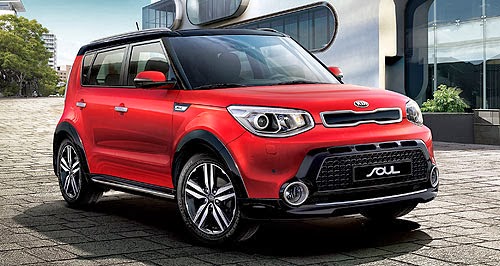
    Kia Motors Corp., South Korea's second-largest carmaker, has also rolled out its electric car called the Ray and said it plans to introduce the electric version of its Soul box car in the first half of next year.

    As of June, a total of 1,146 electric cars were used in the country, mostly by government agencies and public corporations, according to the environment ministry.

    South Korea has installed 1,165 charging stations for electric vehicles across the country including 110 quick charge stations, the ministry said.

    BMW to Boost Electric-Car Capacity due to Strong Demand for i3 [VIDEO]

    BMW will have to increase investment in electric-car production if demand for the new i3 model continues in line with initial orders.

    Customers have reserved more than 8,000 of the battery-powered i3, which will cost $US41,350 ($43,500) in the US, even before the car hits showrooms in Europe next month, Chief Financial Officer Friedrich Eichiner said today in Amsterdam.

    BMW expects to sell more than 10,000 of the four-person car next year and “will adjust capacity according to demand,” he said at a press conference. “If demand holds, which is what it's looking like, we will soon have to invest more.”

    The maker of BMW, Mini and Rolls-Royce vehicles is upgrading its lineup with the i3, the new 4-Series coupe and a revamp of the X5 sport-utility vehicle to maintain its sales lead over Volkswagen AG's Audi and Daimler's Mercedes-Benz. Both competitors have vowed to surpass Munich-based BMW in deliveries by the end of the decade.

    The i3 will go on sale in Germany for 34,950 euros ($50,100) on Nov. 16, followed by the US, China and Japan in the first half of next year. The model made its public debut July 29 at simultaneous events in New York, London and Beijing. The push to sell the electric car and recoup investments in the technology underpinning the vehicle include an international print, TV and Internet advertising campaign.

    The spending on development of new models and expanding production capacity caused the operating profit margin at BMW's auto division to narrow to 9.6 per cent in the second quarter from 11.6 per cent a year earlier.

    “We'll have to work very hard to keep profitability within our target corridor” of 8 per cent to 10 per cent in the coming years because of large investments required to meet stricter emissions regulations and the weak car market in Europe, Eichiner said today.

    Sales gains in China and the US have helped BMW cushion the effects of the sovereign-debt crisis on Europe's car market, which is sliding to a 20-year low. BMW, which doesn't anticipate a recovery in demand in its home region before the second half of 2014, expects deliveries to rise this year for its third straight annual sales record.

    “Demand in China and North America continues to be strong,” Eichiner said. “It makes sense for us to think about expanding production capacity in North America,” with the US and Mexico both options, he said.

    The rollout of the i3 will go ahead as planned next month and won't be impacted by issues that typically affect the ramp up of a new model, he said. The executive was responding to a report by Wirtschaftswoche over the weekend that problems bonding carbon-fiber components for the car led to a 10-day production halt.

    Shell: “By 2070, the passenger road market could be nearly oil-free” [VIDEO]

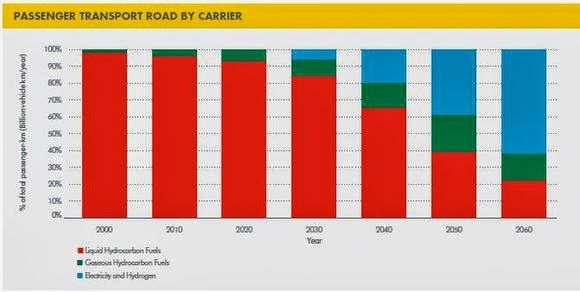
    According to the 2013 Shell Lens Scenarios, which tries to predict what the world’s energy dependence could look like in 2100, by 2070 we could be living oil free.

    There are lots of factors that went into this prediction, such as increased urbanization, more efficient urban planning, and regulations on CO2 emissions. But the people at Shell believed these factors were so powerful that it made the following claim: the rise in the use of electricity and hydrogen as transportation fuels will result in oil having a meagre 22% of the global transportation market by 2060. It further claims:

    By 2070, the passenger road market could be nearly oil-free

    Shell lumps electric and hydrogen into the same group, which they project will have a 60% market share by 2060. Shell has a vested interest in pushing the hydrogen barrow as they and Total are currently the only two major oil companies that have stated they are actively developing hydrogen based fueling technology for vehicles.

    The rest of the oil industry does not seem to share Shell's opinion. BP predicted in Feb 2012 that electric vehicles and plug-in hybrids, will make up only 4 percent of the global fleet by 2030 while Exxon said electric vehicles, plug-in hybrids and vehicles that run on natural gas would make up only 5 percent of the fleet by 2040.

    Let's hope big oil are only trying to fool themselves with these predictions, because if market trends in the third largest oil exporting nation in the world, Norway, where fully-fledged electric cars have already captured a combined market share of 9.1 per cent, is an accurate leading indicator, even Shell's time scale might be conservative.

    Team Eindhoven Win Bridgestone World Solar Challenge Michelin Cruise Class [VIDEO]

    The Dutch have dominated this year’s 2013 Bridgestone World Solar Challenge. Having already won the elite Schneider Electric Challenger Class title when team Nuon crossed the line first on Thursday, Team Eindhoven made it two from two winning the Michelin Cruiser Class category announced at the Awards Ceremony in Adelaide on Sunday night.

    With a score of 97.5% to Eindhoven it was perhaps closer than the Dutch had predicted, with Germany’s Hochschule Bochum team a close second on 93.9%, in turn just beating Australia’s UNSW Sunswift team, who scored 92.3% taking third place.

    The Michelin Cruiser class was judged on the key criteria of solar kilometres travelled, passenger kilometres, speed, energy efficiency, and a subjective element of design and practicality.

    Of the eight Cruisers built especially for the Australian event, four completed the 3020 kilometres on full solar power, the University of Minnesota from the USA joining the ranks with the Dutch, German and Australian teams, taking out fourth place with 79.2%.

    Each of the top teams had differing strategic approaches to the contest. Eindhoven being a four seater car easily accounted for the most passenger kilometres; Bochum were the most energy efficient, and UNSW Sunswift were the fastest to the finish line.

    Final judging occurred on Saturday afternoon with the expert panel assessing characteristics such as: ease of access, comfort, controls, features, style, ease of charging, overall desirability, road registration, parking and cargo space. Judges put the cars through their paces on the finish line. Teams were tested for their parking skills, their ability to load the trunk with numerous suitcases and the ultimate cargo test – could the Aussie esky also be stowed the right way up in the trunk?

    The judging panel spent hours deliberating final scores with the topl three cruisers all shining in their own right. Team Bochum’s Powercore Suncruiser scored high on accessibility and desirability and Sunswift’s ‘eVe’ was the most stylish. In the end it came down to just five points between the three top teams with the world’s first four seater solar family car , ‘Stella’ taking the honours.

    The remaining four cruisers completed the Challenge with a combination of solar kilometres and trailer kilometres: Goko High School from Japan (2288 km); Apollo Taiwan (1558); Australia’s TAFE SA (1469) and University of Calgary (719).

    The Bridgestone World Solar Challenge started October 6th in Darwin and finished 3,000 km later on Sunday 13th October in Adelaide.

    Disclosure: EV News has been engaged by the South Australian Motor Sport Board to help promote the World Solar Challenge 2013.

    2014 Toyota Prius Plug-In to Start Under $30,000

    Toyota is cutting the price of its Prius plug-in hybrid electric vehicle by more than $2,000, making it the latest automaker to cut prices of electric vehicles.

    Toyota reduced the price on the 2014 Prius Plug-in hybrid by $2,010 to $29,990, a 6 percent price cut.

    The automaker is also cutting the price on its 2014 Prius Plug-in Advanced model by $4,620 to $34,905, an 11 percent price reduction. That model has more features including navigation and infotainment, heated front seats and a heads-up display.

    Moe Durand, a Toyota spokesman, said the new pricing was a reflection of its competitors’ moves.

    “It’s dictated by market conditions. When somebody starts that trend of allowing a little softer prices, market demand can determine price,” Durand said.

    Toyota has sold 8,000 plug-ins in the first nine months, behind its target of 12,000 for the year. Durand said the automaker has been offering some “considerable” incentives on the 2013 model to help boost sales, but acknowledged it was behind were it had hoped to be at this point. Incentives vary by region.

    Toyota’s price cuts come nearly two months after General Motors Co. said in August it was cutting the price of its plug-in hybrid Chevrolet Volt by $5,000. The Detroit-based automaker cut the base price 12.5 percent, from $39,995 to $34,995. The price cut came shortly after the automaker announced a $5,000 incentive on the 2012 Volt and $4,000 on the 2013 model.

    The first Volt, a 2010 model, cost $41,000. Sales jumped in August to their highest level ever to 3,351 vehicles.

    In July, Ford Motor Co. said it would reduce the price of its low-selling Focus EV by $4,000 for the 2014 model year to $35,200.

    Ford also offered lease discounts of more than $10,000 and $2,000 off the base price for cash purchases.

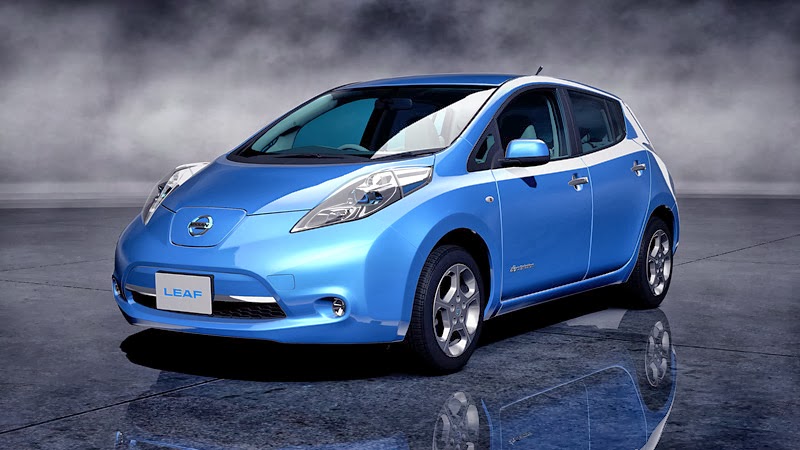
    Sales of Nissan’s all-electric Leaf have jumped since the Japanese automaker dropped the base price by 18 percent, to $28,800 for the 2013 model year. Nissan also added extra cargo room, and for higher-end trims, an on-board charger that reduces electric charging times by half.

    Honda Motor Co. said in May it was cutting the monthly lease price of its Fit EV from $389 to $259 a month, and reducing by $130 a month the cost of existing Fit EV leases. The revised lease has unlimited mileage.

    Most of the vehicles are eligible for a $7,500 federal tax credit. The Prius with a smaller battery pack is eligible for a $2,500 federal tax credit.

    Top Teams Nuon and Tokai Race to World Solar Challenge Finish [VIDEO]

    A familiar scenario is being played out between two champion teams in the 2013 Bridgestone World Solar Challenge. After nearly 2,800 kilometres just 20 minutes separates the two leading cars. It is almost a repeat performance of 2011 except on this occasion the order is reversed, with the Netherlands Nuon Solar team leading Team Tokai from Japan.

    The flying Dutch team have maintained an average speed of around 93 kilometres an hour accelerating at some points today up to 113 km but the Japanese matched their pace, refusing to let the gap between the two teams widen. Unless the Japanese team has something more in reserve, Nuon in their solar car ‘Nuna 7’ look poised to take back the title they lost to Team Tokai in 2009 and again in 2011.

    Both teams are camped south of Port Pirrie and are due to make their final run to the official finish line in Hindmarsh Square Adelaide, arriving mid-morning tomorrow.

    Netherlands Team Twente with their ‘Red Engine’ is in third place some 240 kilometres behind the leaders with Stanford University from the USA hot on their heels in 4th just nine kilometres behind, 49 kilometres south of Woomera. Belgium’s Punch Powertrain is in 5th with Solar Energy Racers about 25 kilometres behind in 6th. Still flying the flag for Australia, team Arrow holds 7th position. Other teams still under solar power include Onda Solare from Italy, Blue Sky Solar from Canada and Australia’s UWS Solar team in SolAce.

    Strong wind gusts today played havoc with some of the teams including the American solar champions Michigan, who were bumped to the side of the road coming into the Coober Pedy Control Stop. They are now frantically working on their solar car Generation hoping to resume tomorrow morning.

    All Michelin Cruisers are now in Coober Pedy for their last mandatory overnight stop before they resume tomorrow morning for the final stage. It will be a battle between Team Eindhoven from the Netherlands in their four seater Stella; the German Hochschule Bochum’s Powercore SunCruiser and Australia’s UNSW Sunswift Team, in their solar sports car ‘eVe’ who flew into Coober Pedy today hours ahead of the field. Final judging of the Cruiser class will be held in Adelaide on Saturday, taking into account design, practicality and person kilometres travelled which could put Eindhoven in a strong position as they have the capacity to carry four passengers.

    In the GoPro Adventure Class Australia’s Aurora arrived into Coober Pedy, their final overhead stop, ahead of the other contender still running on solar power, team Antakari from Chile.

    The leaders are expected to reach ‘finish of timing’ in Angle Vale tomorrow morning before proceeding to the Official Finish Line at Hindmarsh Square. Even if a team is first to Angle Vale they must still reach the official finish line to claim victory.

    The Bridgestone World Solar Challenge started October 6th in Darwin and finishes 3,000 km later tomorrow in Adelaide.

    Disclosure: EV News has been engaged by the South Australian Motor Sport Board to help promote the World Solar Challenge 2013.

    Nissan Sold 4,700 LEAF Units Globally in September

    Nissan achieved a new global record of 4,700 LEAF units sold in September.

    Of the 4,700 LEAFs sold globally, 1,953 were delivered in the United States.

    Nissan credits part of the US market success with the proliferation of 1,900 DC quick chargers installed by a variety of companies. Of these, 800 are installed at Nissan dealerships, and plans to install 700 more by the end of this fiscal year.

    By the end of September, cumulative global sales of the Nissan LEAF since launch totaled 83,000 units.

    Tesla Model S proves to be ‘safest car ever made’

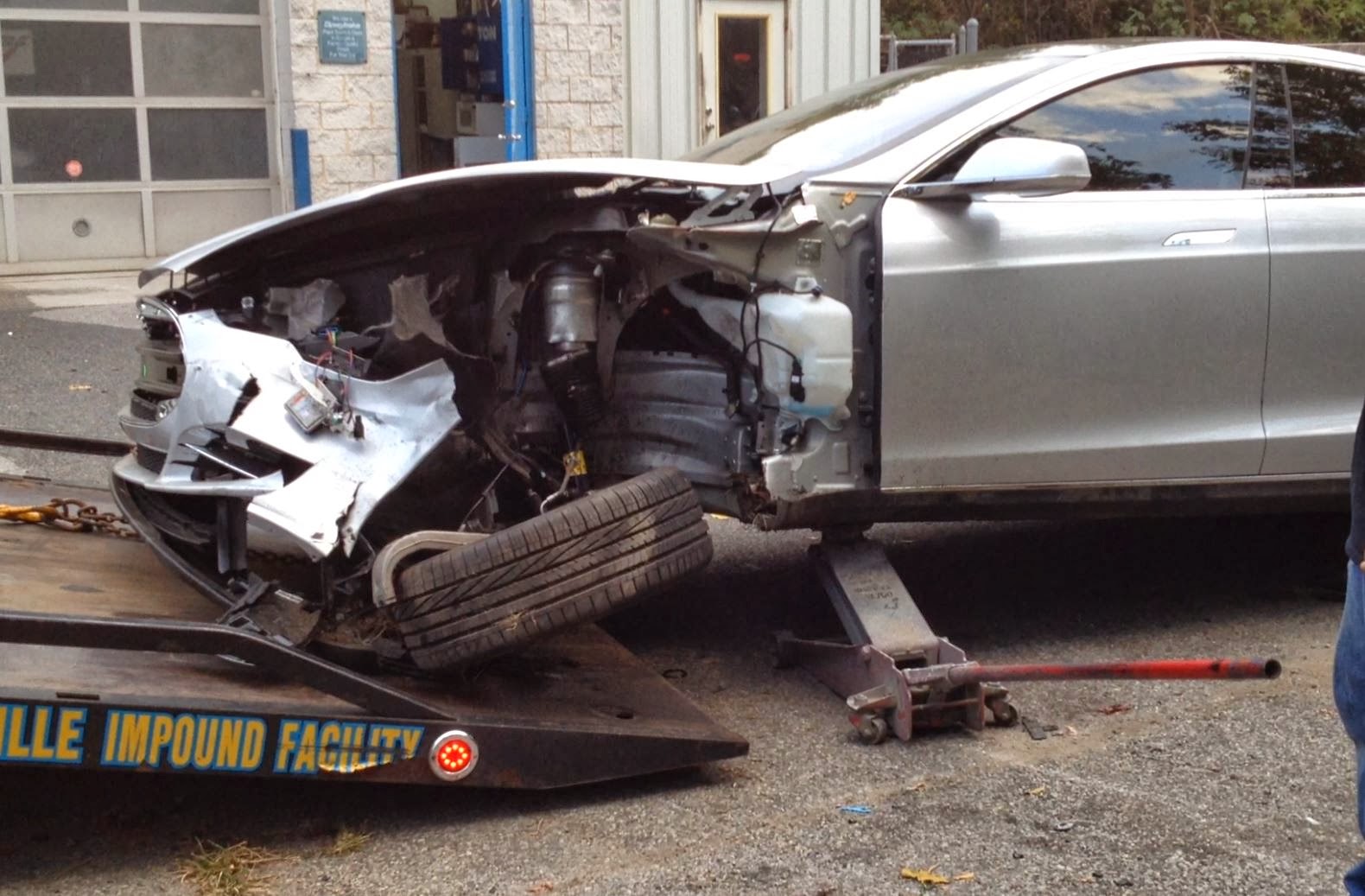
    Tesla Forum member 'jdovi' from Long Island, New York recently posted photos of an accident he was involved in while driving a Tesla Model S.

    The Model S was hit side on at an intersection by a driver who was talking on her cell phone and ran a red light. While the other driver left the scene of the accident in an ambulance, the Tesla Model S owner not only walked away without a scratch, the car which was extensively damaged on the drivers side front wheel by the impact, didn't so much as smoke or release any fluids onto the roadway.

    This 'real world' evidence only backs up the NHTSA Five Start crash test results for Frontal, Side and Side Pole impacts awarded to the Model S in August.

    'jdovi' feelings about the Tesla Model S:

    This is the safest car on the road hands down, and for me, I can honestly say it saved my life. Thank you Elon.

    Source: Tesla Forum