Tesla plans ‘giga factory’ for EV battery pack manufacture

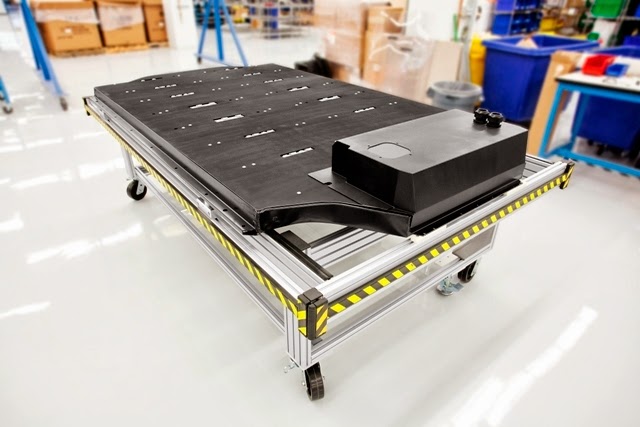
Tesla Motors is considering plans to create a "giga factory" to manufacture electric vehicle battery packs for the automaker's consumption, Tesla CEO Elon Musk said.

Musk said Tesla's long-term ambitions to build 500,000 electric vehicles annually could chew up the vast majority of current lithium ion battery supplies globally for all industries, including computers and cell phones.

Musk said the Tesla plant would be "something comparable to all lithium ion production in the world, in one factory."

Musk declined to give a timeframe for the plant, but with the smaller Gen III cars slated to arrive in 2017 with a $35,000 price point, Tesla production should ramp up rapidly.

"If we were to produce 500,000 cars, we need cell capacity commensurate with that. That might be more, or at least on par with, all lithium ion production in the world today. We're in the process of figuring that out. There might need to be some giga-factory built," Musk said in a conference call with analysts.

Musk foresees such a plant that would take "raw materials to finished packs, with partners, in North America.

"Raw materials are not an issue. I would not worry about lithium supply. The main constituents, by weight, are nickel, cobalt, aluminum, then lithium," Musk said, adding that the plant would be, "a green factory, a lot of solar power. No toxic elements are going to come out of this plant."

Tesla recently inked a deal with Panasonic to update and expand their 2011 arrangement to now supply nearly 2 billion cells over the course of four years.

The Tesla Model S due in Australia mid 2014

Speaking in Dublin, Tesla Motors founder Elon Musk said that a right-hand-drive version of the Model S, appropriate for the roads of England and Ireland, as well as for Australia, should be ready for production by the end of March 2014.

It is understood that Tesla has scheduled an initial production run of 500 Model S cars bound for right-hand-drive markets, including the UK, Hong Kong, Japan and Australia. Tesla has told buyers it expects Australian deliveries of right-hand-drive Model S sedans to begin sometime between March and June.

Tesla already has an Australian presence, with a store and service centre in Sydney, although neither is open to the public. The workshop functions to serve existing Tesla Roadster owners in Australia,

Tesla has been inviting Australian applications for Model S purchases for some time; securing a vehicle from the general production run requires a refundable AU$6,000 deposit, while ordering a top-spec Signature model won't leave you with any change from AU$40,000.

BMW says they won’t add SUV to ‘i’ range

BMW has announced an SUV will not be added to the recently introduced "i" range of frugal models.

The Bavarian marque has already started work on future "i" models but none of these include an SUV.

BMW introduced it's first EV earlier this year with the launch of the i3 available as a full electric car or with a range-extending engine. At IAA in Frankfurt this past September the lineup was expanded with the unveiling of a sportier i8 plug-in hybrid which reaches 62 mph (100 km/h) in 4.4 sec.

BMW has already trademarked all nameplates from i1 to i9 and even if each designation will be covered, none of the added cars will include an SUV. These are the words of i3's project manager Roland Kowalski who added the BMW i philosophy is "about an urban concept for megacities." The third "i" model could be an i5 sedan or a crossover providing more room compared to the i3 and go up against the Tesla Model S.

BMW are are also planning to have a plug-in hybrid version of their entire model range.

Nissan LEAF best selling car in Norway for October

The Nissan Leaf has for the first time claimed the number one spot in Norway's passenger car sales chart. In October, the zero emission family car out sold all of its internal combustion engine, hybrid and electric rivals, taking almost 6% of the total passenger vehicle market.

Nissan's second generation LEAF, which was launched earlier in the year, continues to lead the way in zero emission mobility. The Nissan LEAF consistently performs outstandingly in the Norwegian market, the undisputed electric car capital of the world, taking fourth in the sales charts for 2013 to date with over 3% of the market.

Jean-Pierre Diernaz, Nissan Europe Director of Electric Vehicles, is delighted with the latest Norwegian success, commenting: "We have had incredibly strong sales this year in Norway and with the introduction of the new Nissan LEAF in the middle of 2013, we have seen that level not just maintained, but exceeded. To get the number one spot is an extraordinary sales performance, even for the world's best selling electric car, but to be number four in the charts for 2013 so far is something we are incredibly proud of. We continue to be successful in the main Norwegian cities, but the majority of our growth is coming from rural areas, which shows is the breadth of the Nissan LEAF's appeal."

Norway has been the centre of the electric vehicle market in Europe for some time, with a package of incentives including zero VAT and zero road tax for electric vehicles as part of efforts to improve air quality for all citizens.

Jacek Gorski, Nissan Nordic Europe Managing Director believes the success is because the car fits Norwegian customers' needs, commenting: "It is no surprise that we are beating even our April record of second position with the new Nissan LEAF, we knew that that latest version was an even better fit to the Norwegian lifestyle. The increased boot capacity, five seats and standard quick charging make it a great family car. In addition, our engineers have designed a Nordic pack including battery heater, just for the Nordic region, to maintain customer satisfaction even in our very cold winters."

October 2013 Sales in Norway
Position
Model
Sales
Percentage
1
Nissan LEAF
716
5.6
2
Toyota Auris
679
5.3
3
Volkswagen Golf
646
5.0
4
Skoda Octavia
540
4.2
5
Toyota Yaris
446
3.5
6
Volvo V40
319
2.5
7
Toyota RAV-4
300
2.3
8
Mazda CX-5
299
2.3
9
Volvo V70
291
2.3
10
Suzuki SX4
277
2.1


2013 January to October Car Sales in Norway
Position
Model
Sales
Percentage
1
Volkswagen Golf
6239
5.3
2
Toyota Auris
3982
3.4
3
Mazda CX-5
3950
3.3
4
Nissan LEAF
3755
3.2
5
Toyota Yaris
3656
3.1

Daimler wants to expand cooperation with Tesla

Daimler would like to expand its cooperation with Tesla Motors, a top Daimler executive said on Thursday.

"I told my guys, go back to Tesla and look for other opportunities" to work together, Bodo Uebber, Daimler's chief financial officer, said at a press briefing. "We want to look for more cooperation."

Tesla is supplying electric motors and batteries to Daimler for its Smart Fortwo EV and the new Mercedes-Benz B-Class EV that goes on sale next year in the United States and Europe.

"We could use more" from Tesla, Uebber said, without providing specifics. Daimler holds a 4.3 percent stake in Tesla, which also provides EV components to Toyota Motor Corp.

Uebber said Daimler, which just launched its new CLA compact sedan and is preparing to add a second model, the GLA compact crossover, in early 2014, is already reviewing plans for its next generation of small vehicles, due around 2018.

Daimler is discussing "different strategies" for building the next-generation compacts in Mexico with partner Renault-Nissan , "but no decision has been made," Uebber said.

He said the CLA, the GLA and at least one more derivative in 2015 from the company's MFA modular platform were crucial to Daimler's growth, especially in the United States and China.

"We are a late comer" to the small premium segment, he said, but "we need compact cars to get a broader, younger customer base."

Subaru to reveal Viziv Evolution Plug-In Hybrid Concept @ Tokyo Motor Show

The Subaru Viziv Evolution concept, which was exhibited at the 2013 Geneva show, will be revealed at the 2013 Tokyo Motor Show in a closer to production form.

The Viziv Evolution we saw in Geneva utilized a diesel-hybrid set up, whereas this iteration is a plug-in hybrid that employs the same 1.6-liter DIT boxer engine in the Levorg concept.

The overall design carries over, though, with the engine connected to a continuously variable transmission, one electric motor up front and two additional electric motors connected to the rear wheels.

Technology is a big component of the innovative all-wheel drive Viziv Evolution concept, which will also come with a new autopilot system that previsions the future of fully-autonomous vehicles.

Major Specifications

  • Engine Type: 1.6-liter Horizontally-Opposed direct injection turbo "DIT" engine
  • Transmission Type: Lineartronic (CVT)
  • Electric Motor Type: Interior permanent magnet synchronous motor;
    1 front motor,
    2 rear motors
  • Drivetrain: Independent-rear-motor-driven Symmetrical AWD (All-Wheel drive) + Plug-in hybrid system
  • Battery Type: Lithium-ion batteries
  • Tesla Superchargers Enables Free Travel Between San Diego and Vancouver

    Tesla Motors today announced the opening of the West Coast Supercharger Corridor, energizing a network of stations that enable Model S owners to travel for free between San Diego, California and Vancouver, British Columbia.

    With stations along U.S. Highway 101 and Interstate 5, the West Coast's key routes, cities and destinations are connected by Tesla Superchargers. Model S customers can drive between San Diego, Los Angeles, Santa Barbara, San Francisco, Sacramento, Portland, Seattle, and Vancouver for free with minimal stops. More than 99 percent of Californians and 87 percent of Oregon and Washington owners are now within 200 miles of a Supercharger.

    Tesla Superchargers are substantially more powerful than any other charging technology in the world, capable of charging Model S 20x faster than most public charging stations. Superchargers deliver up to 120 kW DC (Direct Current) power directly to the Model S battery, providing half a charge in as little as 20 minutes. Superchargers are strategically placed along major highways connecting city centers. Stations are located where customers want to stop, near amenities like roadside diners, cafes and shopping centers, so owners can stop for a quick meal while their Model S charges for free.

    This morning in San Diego, two Model S will embark on a 1,750 mile #DriveFree road trip to Vancouver powered only by Tesla Superchargers. The journey will take them through Santa Barbara, San Francisco, Sacramento, Mt. Shasta, Portland, Seattle, and Vancouver, with stops at popular destinations such as the Santa Monica Pier, Monterey Bay and the world famous Pike Place Fish Market. Throughout the trip, Tesla will be hosting owner and media events and providing real time updates from the road on Twitter, Facebook and Instagram.

    Panasonic Agree to Supply Tesla with 2 Billion Battery Cells

    Panasonic Corporation and Tesla Motors today announced that the two companies have reached an agreement in which Panasonic will expand its supply of automotive-grade lithium-ion battery cells to Tesla. With this agreement, the two companies update and expand their 2011 arrangement to now supply nearly 2 billion cells over the course of four years. The lithium-ion battery cells purchased from Panasonic will be used to power the award winning Model S as well as Model X, a performance utility vehicle that is scheduled to go into production by the end of 2014.

    This agreement builds upon a multi-year collaboration between Panasonic and Tesla to develop next-generation automotive-grade battery cells and accelerate the market expansion of electric vehicles. Panasonic’s cells combined with Tesla’s proven EV battery expertise have already enabled more than 130 million customer miles driven in Tesla Roadsters and Model S.

    “This expanded agreement with Panasonic is important to Tesla as we continue to increase the pace of production,” said Tesla Co-Founder and CEO Elon Musk. “We look forward to strengthening our relationship with Panasonic, and I’m confident that this partnership will continue to be an integral part of Tesla’s success for years to come.”

    Together, Panasonic and Tesla have developed a next-generation battery cell technology that provides the highest energy density and best performance cells in the market. Panasonic’s cylindrical cell is a customized technology designed specifically for optimizing electric vehicle quality and life. These cells are integrated by Tesla into the battery pack in a way that enables an industry-leading range of approximately 265 miles for the Model S.

    “We are extremely proud to be a strategic partner of Tesla,” said Yoshihiko Yamada, president of the Automotive & Industrial Systems Company, an internal company of Panasonic. “Panasonic will increase its production capacity of lithium-ion battery cells to supply Tesla’s growing needs as it expands its production of EVs.”

    100 Years Down the Line

    Automakers like Ford are finding that building multiple models on an updated, ever-evolving line is integral to success in the global marketplace.

    BMW Joins VW in Backing Germany’s 1 Million Electric-Car Goa

    BMW backed the German government’s goal to have 1 million electric cars by 2020 on the country’s roads, a week after Volkswagen said the target is achievable under broader terms for alternative drives.

    Developing the European Union’s electric-vehicle market will need the backing of authorities, though official support in the bloc is lagging behind initiatives in the U.S. and China, BMW Chief Executive Officer Norbert Reithofer said today in a speech at an industry conference in Munich.

    “I hope the ongoing discussions between national governments, the European Parliament and the European Commission lead to a package that’s viable,” Reithofer said at the conference sponsored by Handelsblatt newspaper. “At the moment, the commission’s proposals don’t offer incentives to speed up introduction of alternative drives.”

    Carmakers are promoting electric-powered models to comply with tightening regulations that apply to their fleets’ emissions across the globe. Munich-based BMW, the world’s biggest maker of luxury vehicles, is putting the 34,950-euro ($48,200) all-electric i3 city car into showrooms in Germany next month.

    VW CEO Martin Winterkorn said last week that the Wolfsburg, Germany-based manufacturer, Europe’s largest volume carmaker, will “contribute” to the German goal for electric vehicles to play a larger role in the market by 2020. Authorities’ plans are feasible as long as they include plug-in hybrids, which can switch between rechargeable battery power and conventional combustion engines, as the models offer the biggest market potential, he said.

    Volkswagen outlined plans in September to offer as many as 40 electric or hybrid models in the event that demand for low-emission cars takes off. The manufacturer will produce 14 vehicles with alternative drive through next year after introducing electric versions of the Golf hatchback and Up! city car at the Frankfurt auto show last month. VW also showed new plug-in hybrid versions of the Porsche brand’s Panamera four-door coupe and Audi’s A3 compact.

    Purely or partly battery-powered vehicles accounted for 4,157 new car registrations in Germany in 2012, about twice as many as the year before, according to the VDA auto-industry association. Germany’s new car market amounts to about 3 million vehicles a year.

    Volkswagen’s e-Up! went on sale in Germany this month for 26,900 euros. The model is “deliberately positioned” against BMW’s i3, Rudolf Krebs, head of electric-powertrain technology at VW, said on Sept. 4.

    BMW presented the i3 at the Frankfurt show, as well as a plug-in hybrid version of the X5 sport-utility vehicle. Reithofer reiterated today that the i8 plug-in hybrid sports car will be added to BMW’s lineup in 2014.

    Battery-powered driverless cars to be launched on UK streets by 2015

    Driverless cars will be trialled in Milton Keynes city centre from 2015, as part of a five year pilot scheme.

    100 pod devices will run on specifically marked out lanes between Milton Keynes Central train station, the centre:mk shopping centre and the offices in-between.

    They will be powered by an electric motor, and will travel along pavements at speeds of up to 12mph. Initially, they will be on separate lanes but the government may remove these lanes as the experiment progresses.

    The pods will be big enough to fit two passengers and luggage. They will also be fitted with sensors to avoid colliding with pedestrians and parked cars.

    A trial of the devices will begin in 2015, with a full rollout expected two years later. This will allow customers to hire pods from £2 a ride using smartphone apps to either hail or advance book one of the machines.

    The experiment is expected to cost £65million over the five year period, and has the backing of Business Secretary Vince Cable and Higher Education minister David Willets.

    Milton Keynes was chosen for the experiment because of its wide pavements. The trials will be the first driverless cars in operation on Britain’s streets.

    Tesla eyes 10,000 annual sales of Model S in Germany

    Tesla Motors is aiming to sell around 10,000 cars a year in Germany by 2015 as it builds out its networks of charging stations, its chief executive told a German paper.

    "I have confidence in the German consumer," Tesla Chief executive Elon Musk was quoted as saying in an interview with Welt am Sonntag.

    "Our fast charging stations should cover around half of Germany by the end of March 2014 and the entire country by the end of 2014," he said, adding he expected there to be 25 Tesla dealerships in Germany by the end of next year.

    Tesla's high performance, all-electric Model S went on sale in Europe in August, and even overtook Volkswagen's Golf as the bestselling car in Norway in September.

    Even vehicle sales of 10,000 would be only a small fraction of the German car market. Main industry association VDA expects sales to reach between 2.9-3.0 million cars this year from 3.08 million in 2012, and keep hovering at around 3 million vehicles in coming years.

    Germany was the biggest market outside the U.S. for Tesla Roadster sales. The Model S costs from 71,400 euros ($98,500) in Germany, according to the group's website.

    Graphene-Coated Silicon Supercapacitor could make batteries obsolete

    Solar cells that produce electricity 24/7, not just when the sun is shining. Mobile phones with built-in power cells that recharge in seconds and work for weeks between charges.

    These are just two of the possibilities raised by a novel supercapacitor design invented by material scientists at Vanderbilt University.

    It is the first supercapacitor that is made out of silicon so it can be built into a silicon chip along with the microelectronic circuitry that it powers. In fact, it should be possible to construct these power cells out of the excess silicon that exists in the current generation of solar cells, sensors, mobile phones and a variety of other electromechanical devices, providing a considerable cost savings.

    “If you ask experts about making a supercapacitor out of silicon, they will tell you it is a crazy idea,” said Cary Pint, the assistant professor of mechanical engineering who headed the development. “But we’ve found an easy way to do it.”

    Instead of storing energy in chemical reactions the way batteries do, “supercaps” store electricity by assembling ions on the surface of a porous material. As a result, they tend to charge and discharge in minutes, instead of hours, and operate for a few million cycles, instead of a few thousand cycles like batteries.

    These properties have allowed commercial supercapacitors, which are made out of activated carbon, to capture a few niche markets, such as storing energy captured by regenerative braking systems on buses and electric vehicles and to provide the bursts of power required to adjust of the blades of giant wind turbines to changing wind conditions. Supercapacitors still lag behind the electrical energy storage capability of lithium-ion batteries, so they are too bulky to power most consumer devices. However, they have been catching up rapidly.

    Research to improve the energy density of supercapacitors has focused on carbon-based nanomaterials like graphene and nanotubes. Because these devices store electrical charge on the surface of their electrodes, the way to increase their energy density is to increase the electrodes’ surface area, which means making surfaces filled with nanoscale ridges and pores.

    “The big challenge for this approach is assembling the materials,” said Pint. “Constructing high-performance, functional devices out of nanoscale building blocks with any level of control has proven to be quite challenging, and when it is achieved it is difficult to repeat.”

    So Pint and his research team – graduate students Landon Oakes, Andrew Westover and post-doctoral fellow Shahana Chatterjee – decided to take a radically different approach: using porous silicon, a material with a controllable and well-defined nanostructure made by electrochemically etching the surface of a silicon wafer.

    This allowed them to create surfaces with optimal nanostructures for supercapacitor electrodes, but it left them with a major problem. Silicon is generally considered unsuitable for use in supercapacitors because it reacts readily with some of chemicals in the electrolytes that provide the ions that store the electrical charge.

    With experience in growing carbon nanostructures, Pint’s group decided to try to coat the porous silicon surface with carbon. “We had no idea what would happen,” said Pint. “Typically, researchers grow graphene from silicon-carbide materials at temperatures in excess of 1400 degrees Celsius. But at lower temperatures – 600 to 700 degrees Celsius – we certainly didn’t expect graphene-like material growth.”

    When the researchers pulled the porous silicon out of the furnace, they found that it had turned from orange to purple or black. When they inspected it under a powerful scanning electron microscope they found that it looked nearly identical to the original material but it was coated by a layer of graphene a few nanometers thick.

    When the researchers tested the coated material they found that it had chemically stabilized the silicon surface. When they used it to make supercapacitors, they found that the graphene coating improved energy densities by over two orders of magnitude compared to those made from uncoated porous silicon and significantly better than commercial supercapacitors.

    The graphene layer acts as an atomically thin protective coating. Pint and his group argue that this approach isn’t limited to graphene. “The ability to engineer surfaces with atomically thin layers of materials combined with the control achieved in designing porous materials opens opportunities for a number of different applications beyond energy storage,” he said.

    “Despite the excellent device performance we achieved, our goal wasn’t to create devices with record performance,” said Pint. “It was to develop a road map for integrated energy storage. Silicon is an ideal material to focus on because it is the basis of so much of our modern technology and applications. In addition, most of the silicon in existing devices remains unused since it is very expensive and wasteful to produce thin silicon wafers.”

    Pint’s group is currently using this approach to develop energy storage that can be formed in the excess materials or on the unused back sides of solar cells and sensors. The supercapacitors would store excess the electricity that the cells generate at midday and release it when the demand peaks in the afternoon.

    “All the things that define us in a modern environment require electricity,” said Pint. “The more that we can integrate power storage into existing materials and devices, the more compact and efficient they will become.”

    Source: Nature