Autoguide.com review the BMW i3.
Fast facts:


Charged with Electric Vehicle News and Views
Autoguide.com review the BMW i3.
Fast facts:
.jpg)
In its 2014 Fuel Economy Guide, the United States Environmental Protection Agency puts one car at the top of the list when it comes to fuel efficiency: the 2014 Chevrolet Spark EV.
With an EPA-estimated 82 miles of driving range and a fuel economy equivalent of 119 MPGe, the average driver can save $9,000 in fuel costs over five years compared to the average new vehicle.
Last year’s top ten list of the most fuel-efficient vehicles was comprised entirely of electric vehicles, so it’s not surprising that this year’s ranking is also packed with EVs.
The Spark EV, sold in California and Oregon, is also the first vehicle in the U.S. to offer the SAE International fast-charge connector as a vehicle option. The new combined AC and DC charging, or combo, connector is accessible via a single charge port on the vehicle and allows electricity to flow at a faster rate.
How much faster? DC fast charging charges 80 percent of the Spark EV’s battery in just 20 minutes for over 65 miles of range. By comparison, AC 120V charging, which can be done using a conventional household outlet, takes around 17 hours to fully charge. AC 240V charging reduces recharging time to less than seven hours for a full charge, but it requires a dedicated 240V charging station.
Many major automakers have announced they will adopt the SAE combo fast charge connector standard. Adopting an industry standard for EV charging is an important step in growing the public charging infrastructure.
GM is committed to leading the charge in the U.S. to develop energy alternatives like EVs and biofuels that help reduce dependency on petroleum, improve fuel economy and reduce emissions.
It’s why we were part of the unveiling of the very first public SAE combo DC fast charging station last year at the Fashion Valley Mall in San Diego.
And it’s why our engineers work tirelessly to bring greener vehicles like the Spark EV, Chevrolet Volt, Chevrolet Cruze Diesel, Cadillac ELR and the bi-fuel Chevrolet Impala to market.
If this year’s list of the most fuel-efficient vehicles on the market tells us anything, it’s that EVs are continuing to grow in popularity. And as more and more hit the market, choices for potential buyers will only increase, which means good things for the wallet and the environment.
.jpg)


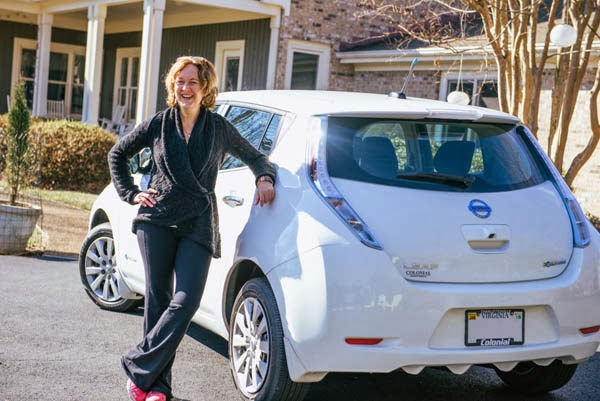
Amy Eichenberger of Charlottesville, Va., became the 99,999th global Nissan LEAF customer when she purchased her 100 percent electric vehicle at Colonial Nissan.
Amy, a 47-year-old mother of two, wasn't even in the market for a new car. Then she spotted a University of Virginia colleague's Nissan LEAF and decided she wanted to know more about the "modern-looking, futuristic and progressive" car.
"As an architect, the style first got my attention, and I loved the concept of zero emissions," Amy said. Amy is a project manager overseeing major capital investments for the University of Virginia in Charlottesville.
Nissan LEAF was the first car Amy test drove, and she loved the zip it had. A Mercedes driver for 10 years, Amy describes herself as "picky." Quality, safety, a "glide ride" and reliability were at the top of Amy's auto shopping list criteria.
She said she had a few initial reservations—primarily around range—so she tested out some gasoline and diesel competitors as well. "I'd been told once I drove a Mercedes I'd never drive anything else again. I don't need fancy, but I do appreciate the solid feel and craftsmanship of a luxury vehicle, and I get that in the LEAF," Amy said.
"The general fuel economy out there is unimpressive and many of them felt tin-canny. I didn't even want to look at anything in the 20 MPG range. I considered the VW Jetta TDI, Toyota Prius, Honda CRV and a couple of Subaru wagons, and I always came back to the Nissan LEAF. Everything else seemed stuck in the past," Amy explained.
Amy ultimately chose a LEAF S in Glacier White. Her commute is about 10 miles to the university each day and most of her errand-running is around the city—well under the LEAF's estimated range of 84 miles on a full charge.
"I have friends I like to visit in Richmond, which I can do in the LEAF with some planning, and in DC, which I'll do in my son's or boyfriend's car. LEAF will meet my needs 98 percent of the time, and I didn't want to let a little range anxiety prevent me from missing out on what I consider a much more progressive and forward-thinking vehicle than any of the alternatives."
Chris Crowley, the dedicated EV salesperson for Colonial Nissan, sold Amy her LEAF. He explained that LEAF buyers are not typical walk-ins. "LEAF buyers generally come in well educated about the vehicle, looking for even more information and wanting to see how it feels and drives. We spend a lot of time talking about driving habits to make sure it meets their needs and reviewing how very much it's like any other vehicle in its capabilities with the added benefit of no fuel bill. Folks like to be green, but you can talk to their pocket books as well," Chris said.
Chris has been with Colonial Nissan for two years and has been the lead EV person for most of that time. He's sold nine LEAFs total with three of those coming in the past three weeks. "LEAF sales have picked up because once we were selling to engineers who were fans of the car and knew exactly how it worked. Now we're selling to a much broader audience, and I think we've benefitted from a few folks who resolved to be greener in the new year."
Nissan LEAF launched in the United States in December 2010. The United States accounts for nearly half of the sales worldwide. The pace of LEAF sales has continued to accelerate. In 2013, Nissan sold 22,610 of the electric vehicles in the United States, more than twice as many as in 2012 and more than 2012 and 2011 Leaf sales combined.
Nissan LEAF traditionally has performed well on the West Coast with notable markets such as San Francisco, Los Angeles and Seattle, but now interest has expanded across the country. New hot markets have emerged such as Atlanta, which has been the No. 1 LEAF market for the past five months.
"With LEAF, we see a high level of organic growth and viral sales where LEAF owners become our best evangelists and salespeople. With electric vehicles, many folks presume a 100 percent electric vehicle won't meet their needs until they chat with a neighbor, co-worker or family friend who loves their LEAF and explain its practicality, and then it goes on their consideration list," said Erik Gottfried, Nissan's director of EV Sales and Marketing. "In fact, we're seeing similar results with the geographic dispersion of sales. With sales high in Atlanta, we now see other Georgia markets such as Macon and Columbus picking up significant momentum, similar to Eugene, Ore., following on the success of Portland."
Nissan LEAF is best-selling EV in history with 48 percent market share of the electric vehicle market globally. As of November 2013, Nissan LEAF drivers have completed an estimated 1 billion zero-emission kilometers, resulting in approximately 165 million kilograms of CO2 saved.
Nissan LEAF offers powerful acceleration, quiet operation, energy efficiency and low cost of maintenance. Nissan has extended the standard warranty for the battery-power holding capacity with its own additional warranty for customer satisfaction and assurance.
After leading the era of electrification in passenger vehicles with the LEAF, in 2014 Nissan will become the first to bring a mass-market all-electric light commercial vehicle to market. The e-NV200 will go on sale in Europe and Japan bringing the benefits of quiet, cost-efficient, zero-emissions mobility to businesses.
In June 2014, Nissan will participate in the 24 Hours of Le Mans with the NISSAN ZEOD RC and aims to set a record for the fastest all-electric, zero-emissions lap of the circuit. Nissan is committed to using the EV platform to break new ground in both the commercial-vehicle and motorsports arenas.


The 2014 Chevrolet Spark EV is the first vehicle in the US to offer DC Fast Charging using DC Fast Charging SAE Combo standard.
With this technology, you'll be able to charge your Spark EV to 80% in just 20 minutes.


We reported almost a year ago that Nissan were “really seriously testing” in-wheel electric motors for the new-generation of electric-powered cars. The automaker's global design chief Shiro Nakamura has again confirmed this during an interview with Motor Authority at the recent Detroit Auto Show.
“It's not just at the concept level...We are making serious progress with in-wheel motors; cost is becoming less of an issue, and at a certain point we would like to use in-wheel motors.”
While Nissan's BladeGlider EV concept has in-wheel motors on the rear axle, Nakamura admitted that Bladeglider has some design attributes (like its narrow front track) that might prove insurmountable for a global product—especially with respect to safety—and that any production car would likely have to be wider in front.
He suggests the ESFLOW EV concept, which from behind looks alot like the Bladegliber and at first glance could easily be mistaken for a 380Z, could be a production direction.
The ESFLOW concept presented at the 2011 Geneva Motor Show was said to have a cruising range on one charge of 240 kilometer (150 mile) and was rear-wheel drive powered by two motors that where placed above the axis of the rear wheels, in a mid-ship position.
These motors independently control the left and right wheels, and so the torque is optimized to ensure outstanding vehicle stability and control as well as efficient power regeneration. The motors produce enough torque in an instant for the ESFLOW to reach 100 kph in under 5 seconds.


Despite rumours of faster, more-powerful and even 4 door version of the Bugatti Veyron, company boss Dr Wolfgang Schreiber has exclusively revealed to Top Gear none of the above will become reality.
With McLaren's P1, Porsche 918 and LaFerrari hypercars all sporting battery powered assistance, what's the brief for the next Veyron? Will the Veyron, like it's rivals utilise hybrid power in pursuit of ultimate speed?
"Maybe," smiles Dr Schreiber. "But it's too early to open the door and show you what we have planned".
We'll take that as a "Yes".


The BMW i3 is the first car from the new "i" sub-brand for eco focused Beemers. Can an all-electric BMW car drive like a BMW? We find out.


Tesla Motors have confirmed the company will return to Australia by June to launch the RHD Model S and its own network of Apple-style stores.
Having wound back its Australian operations following the end of its Roadster the US brand will begin deliveries of the Model S in the second quarter of 2014.
Speaking at the 2014 Detroit motor show, a spokesperson for the automaker said orders had already been taken.
They also confirmed plans are underway to establish a network of Tesla-owned stores in Australia, rather than traditional car dealerships. The Tesla store concept has been developed by the same man behind the Apple Store, George Blankenship.
The stores are usually based in shopping districts rather than traditional automotive areas and are owned by Tesla rather than being franchised to dealers.
The company’s next car, the Model X SUV, won’t arrive in Australia until 2015 at the earliest. Tesla declined to comment on price but it is expected the Model S may be priced around AUD$200,000.


The Electric Defender has all the qualities and performance you'd expect, full all-terrain capability, permanent 4WD and a top speed of 70mph.
However, it has been engineered in-house by Land Rover to test out the latest sustainable technologies. The vehicle's Hill Descent Control is linked to a regenerative braking function, and overall up to 80 per cent of the car's kinetic energy can be recovered. Land Rover's acclaimed Terrain Response system has been adapted for electric drive, offering a 50-mile range with a reserve of a further 12.5 miles.
The result is a zero tailpipe emissions vehicle like no other; eight hours of low-speed off-road use is achievable, and it takes 10 hours for the advanced lithium-ion batteries to be fully charged. 'Fast-charge' technology reducing that to just fours is also possible.


Toyota today announces that cumulative global sales of its hybrid vehicles topped the 6 million unit mark as of December 31, 2013, reaching 6.072 million units. The latest million-unit milestone was achieved in the fastest time yet for Toyota, taking just nine months.
Helping mitigate the environmental effects of vehicles is a priority at Toyota. Based on its belief that environment-friendly vehicles can only truly have a positive impact if they are widely used, Toyota has endeavored to encourage the mass-market adoption of hybrid vehicles.
As of this month, Toyota sells 24 hybrid passenger car models and one plug-in hybrid model in approximately 80 countries and regions around the world. Furthermore, within the next two years, Toyota will launch a total of 15 new hybrid vehicles worldwide, including the new "Harrier Hybrid" in Japan on January 15 and the new "Highlander Hybrid" in the United States in the near future. Toyota will continue augmenting its product lineup even further and increasing the number of countries and regions where it sells hybrid vehicles.
Toyota calculates that as of December 31, 2013, Toyota hybrid vehicles have resulted in approximately 41 million fewer tons of CO2 emissions—believed to be a cause of global warming—than would have been emitted by gasoline-powered vehicles of similar size and driving performance. Toyota also estimates that its hybrid vehicles have saved approximately 15 million kilolitres of gasoline compared to the amount used by gasoline-powered vehicles of similar size.
In August 1997 in Japan, Toyota launched the "Coaster Hybrid EV" and launched the "Prius"—the world's first mass-produced hybrid passenger vehicle—in December. Since then, Toyota hybrid vehicles have received tremendous support from consumers around the world.
Toyota has positioned hybrid technologies that enable the use of different fuel combinations, including the component technologies necessary for development of various environment-friendly cars, as core environmental technologies for the twenty-first century. Toyota therefore plans to continue working to raise performance, reduce costs, and expand its product lineup—including that of non-hybrid environment-friendly vehicles—to create vehicles that are popular with consumers.


Nissan has lifted U.S. production of its all-electric Leaf by about 50 percent to 3,000 units a month to meet growing demand for the car.
The Leaf logged record sales of 2,500 units in December and was now the best-selling car in some dealerships in Atlanta, where the government is helping promote the technology, outpacing the Altima sedan.
The pickup in sales was driven in large part by Nissan's decision to cut its price by more than $6,000 to $29,650 at the beginning of last year after a shift in production of the model to the United States allowed it to lower manufacturing costs.
While volumes are still at relatively low levels for a production car, sales more than doubled last year to above 22,000 in the U.S. market, momentum is building.
One factor is the increase in charging stations in Atlanta and cities such as Seattle and San Francisco on the West Coast. There are currently 554 quick-charging stations, and more than 15,000 slower "level 2" public charging stations across the U.S., Nissan estimates.
The Leaf's customer base is also evolving. While at first most Leaf buyers were green enthusiasts, increasingly customers focused on the potential cost benefits of owning an electric car are showing up at its dealerships. As a result, it has recently increased prices on some versions of the Leaf. Nissan produces the Leaf at its Smyrna, Tennessee plant.


Tesla Motors said Tuesday it sold 6,900 Model S electric cars in the last three months of 2013 — 20 percent above the previous forecast.
On news that the company delivered 6,900 Model S cars in the fourth quarter, Tesla’s shares spiked 15.74 % in regular trading, and another 3.56 % in after-hours trading.
Palo Alto, Calif.-based Tesla had forecast just under 6,000 Model S sales in the fourth quarter. Tesla delivered about 22,400 Model S vehicles for all of 2013.
Diarmuid O'Connell, vice president of development for Tesla, said demand remains strong for the vehicle, but the company continues to wage battles with franchised auto dealers in different states. Tesla sells its vehicles directly to consumers, not using franchised dealers, which has drawn attacks from many of the dealer groups around the country.
Mr. O'Connell said Tesla is now fighting new political battles in Ohio and New Jersey, and expects a battle in Georgia. Last year, Tesla waged fights in Texas, Virginia, North Carolina and New York.
"We have had some success when we have been able to shed some light on the issue," he said. "But dealers in some states have not changed their point of view" on Tesla's sales system.
Tesla said it is still on target to deliver the first Model X sport-utility vehicle by the end of the year, but the company didn't give any other updates on the vehicle. Currently, the Model S is its only model.


YouTube's DRIVE channel test specialist Chris Harris reviews the 2014 Chevrolet Volt.
The Volt electric car has a backup engine to extend its typical 80 km electric range. It is quick, quiet, and responsive, with a taut ride. Once the lithium-ion battery is depleted, the 1.4-liter engine acts as a generator to extend the range by 500 km with Volt drivers averaging 1500 km between fill-ups. Recharging take 4 hours using a 240-volt supply and 10 hours with 120 volts. Lease deals start from $269 / month.
Overall the Volt is a brilliantly executed example of automotive innovation that makes any ICE only car seem primitive by comparison. It combines the benefits of a full EV powertrain with a part-time duty-cycle ICE to provide 600 km of combined range. Where the Toyota Prius is an ICE powered car with electric assistance, the Holden Volt is a plug-in electric car with ICE assistance.
The Volt fills the gap between the 500 km all electric range Tesla Model S, which due to it's 85 kWh battery can costs up to $100k, and the more affordable but shorter range battery only cars like the Mitsubishi iMiEV and the Nissan Leaf.


The Toyota Prius isn’t just the best-selling hybrid in the US, it is the best-selling car in California according to the California New Car Dealers Association for the second year running.
YTD November 2013, the state received 54,063 new Toyota Prius registrations, not including fleet sales, commercial customers, the government and rental car companies. The Prius edged out the Honda Civic, which reported 50,580 new car registrations up to Q3 last year.
Toyota vehicles actually secured three of the top 5 spots in 2013:


The Audi Allroad Shooting Brake has been revealed ahead of its motor show debut in Detroit.
The show car’s engine is a 2.0-litre petrol with 288bhp and 280lb ft of torque, which drives the front axle. This is supplemented by a 54bhp electric motor that’s integrated within the six-speed automatic gearbox.
The second motor is mounted to the rear axle, and produces 114bhp and 199lb ft of torque. It can either power the car on its own – in rear-wheel-drive pure electric mode – or combine with the powertrain over the front axle to turn the Allroad Shooting Brake into a four-wheel-drive hybrid.
In pure electric drive mode, the rear motor can propel the car up to 80mph, while the battery can power the car for 31 miles. A hybrid mode lets the engine and motors work together as efficiently as possible, permitting the front motor to top up the lithium-ion battery when required.
This generator function means that the pure electric range can be replenished, which would allow for multiple stints of all-electric driving on a long enough journey. The car has a range of 510 miles using the most efficient settings. Average fuel economy is a claimed 148.7mpg, while CO2 emissions are just 45g/km.
There are ‘Hold’ and ‘Charge’ settings within Audi’s redesigned MMI infotainment system that allows the driver to choose how the battery’s charge is managed. Hold mode will keep the battery at its current state of charge, while Charge mode will replenish it until it is full.
The final drive mode is Sport, which combines the petrol engine and both motors to give a total power output of 402bhp with 479lb ft of torque. In this set-up, the car has a 0-62mph time of 4.6 seconds, and a limited top speed of 155mph.


 Honda was the first to market with a hybrid, the Insight, but the Toyota Prius went on to dominate the niche. Now Honda is trying again, and this time getting things right.
Nissan CEO Carlos Ghosn said he expects to double Leaf sales in the United States in 2014.
Sales of the battery-powered Leaf jumped 130 percent last year to a record 22,610, aided by 2,529 deliveries in December, the most ever in a single month for the carmaker. That figure should keep rising, Ghosn said in a CNBC interview.
"We are now on a trend of 3,000 cars a month in the U.S., which is about 36,000 cars" a year, Ghosn said. "The next step is moving up to 4,000 a month, which is going to be approximately 50,000," he said, without setting a target date.
Nissan and other automakers delivered a record number of hybrid and rechargeable cars and light trucks last year as the industry remains under U.S. pressure to boost fuel efficiency. Sales of vehicles powered partially or entirely by electricity totaled at least 578,000 units last year, up more than 100,000 units from 2012 and accounting for about 7.5 percent of all new cars sold in the U.S. last year.


Harvard researchers have developed a battery that harnesses energy by using the electrochemistry of organic molecules rather than metals. The battery, which they say can be applied on a power-grid scale, uses naturally abundant and small organic compounds called quinones rather than electrocatalysts from costly precious metals such as platinum.
Quinones would be inexpensive to obtain and can be found in green plants or synthesized from crude oil. The battery designed by Harvard scientists and engineers used a quinone molecule that's almost identical to one that's found in rhubarb.
Unlike solid-electrode batteries, flow batteries are recharged by two chemical components dissolved in fluids that are kept in separate tanks. Flow batteries are well suited to storing large amounts of energy, but a major drawback to metal-based flow cells has been cost.
According to MIT Technology review, a conventional metal-reliant flow battery costs an estimated $700 per kilowatt-hour of storage capacity, whereas the Harvard team's metal-free technology would bring those costs down to $27 per kilowatt-hour.
"The whole world of electricity storage has been using metal ions in various charge states, but there is a limited number that you can put into solution and use to store energy, and none of them can economically store massive amounts of renewable energy," said Roy G. Gordon, one of the researchers who helped screen more than 10,000 quinone molecules to find the best candidate for the novel battery.
"With organic molecules, we introduce a vast new set of possibilities. Some of them will be terrible and some will be really good. With these quinones we have the first ones that look really good."
Source: Harvard


