

While monitoring the 24/7 Internet news cycle it seems not an hour goes by without another 'news' story about driverless cars, usually showing someone behind the controls grinning from ear-to-ear with their hands off the steering wheel like they're riding a roller coaster. The fact that these systems are merely an advanced form of cruise control never seems to penetrate the reality distortion field generated by the hype machine pushing these stories.
History
Speed regulating cruise control (originally named “Auto-pilot”) was first put into a production car almost 60 years ago. Lane Keeping Assist features were first introduced almost 25 years ago. A Honda version of LKAS that provided 80% of steering torque to keep the car in the lane on highways has been on the market since 2003.
Similarly autonomous cruise control with auto brake features was also first introduced 25 years ago and there are now 15+ auto brands offering these systems. Even cars that park themselves have been on-sale for over a decade. (2003 Toyota Prius) Yet as we're about to hit 2017 these functions still has enough novelty value that some media types have branded them 'robot cars'??
Self driving car (SDC) hype really leapt off the Richter scale when Google acquired a startup called 510 systems in 2008. A small team of UC Berkeley students with DARPA Challenge experience built a robotized Toyota Prius called “PriBot” for a TV show pizza delivery stunt.
It's clear that choosing a Toyota Prius to become the first road legal SDC was a strictly functional decision. The mass market adaption of hybrid and electric vehicle brake regeneration has played a large role in enabling self driving cars. The two features that allow relatively easy implementation of robotic control in production cars are 1) electric power steering 2) brake-by-wire regenerative braking. In conjunction with by-wire throttle, these systems allow direct control of steering, acceleration & moderate braking via low-voltage electronic signals that can be generated in software. This is why all SDC's are either hybrid or electric cars.
What is less clear is how well self driving cars handle emergency situations. Despite hybrids and EVs primarily using regen braking to the extent that brake pads now last the life of the vehicle, anti-lock brakes and stability control functions are still part of the legacy friction brake system that requires human muscle input to activate. The work-around has been to restrict Google prototype testing speeds to 25 mph (40 km/h) and requiring a safety drivers onboard at all times.
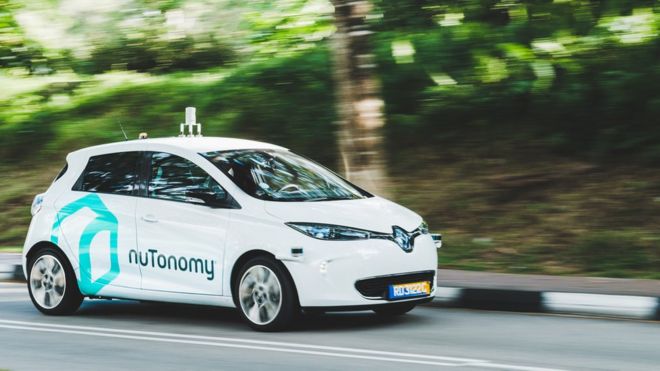
Despite the fact nine US states have passed legislation to allow public road testing of 'driverless' cars, by some estimates, Google cars are unable to use about 99% of US roads. Aside from their inability to drive in anything but perfect weather conditions, the cars do not carry the computing horsepower to process all the required data in real-time so the car’s exact route must be extensively mapped. Data from multiple passes by a special sensor vehicle must be pored over, meter by meter, by both computers and humans before any SDC can test a new route. It’s vastly more effort than what’s needed for Google Maps.
While there are half a dozen public 'trials' of self-driving cars/shuttles active around the world , they are either on private roads/campuses or if on public roads, they run in very geographically limited areas. None of them are strictly speaking 'driverless' as they all have human 'safety' drivers.
Safety
The original goal for Google's SDC program, as stated by the “godfather” of self-driving Sebastian Thrun, was to promote safety. Most definitely a laudable goal, but is a map localising cruise control really the best solution to reduce 1 million road deaths and 50 million serious injuries every year?
Real world evidence is starting to suggest, maybe not! A long read by Tim Harford published by The Guardian makes the case that too much automation increases driver in-attention to the point that responding to emergency situations becomes more dangerous, a situation known as the automation paradox.
While governments around the world are cracking down on driver distractions like texting while driving, with the UK now suggesting that offenders could face a life sentence, self-driving/auto-pilot systems actively promote in-attention by lulling drivers into a false sense of security.

The fact is that while SDC systems are designed to replace the driver, they do nothing to improve functional vehicle safety. SDC's still has the same mandatory mechanical friction brake based anti-lock and stability control systems as any other car on the road. A self-driving system has the same three basic controls to operate a vehicle as a human driver, yet with the introduction of electric vehicles the potential is there to develop augmented digital by-wire control systems that can bring commercial aviation levels of safety to the automotive world.
Fly-by-wire was developed 50 years ago for aerospace during the Apollo program. Augmented fly-by-wire electronic control systems aid and protect aircraft in flight via 'control laws' that provide flight envelope protection, a human machine interface (HMI) that prevents a pilot from making control commands that would force the aircraft to exceed its structural and aerodynamic operating limits. These augmented HMI systems are standard equipment on commercial aircraft and today’s impressive safety and reliability statistics are a testimony to the advanced technology represented in fly-by-wire digital flight control systems. Yet despite the ever increasing level of electronics in ICE powered vehicles, they are still primarily direct control mechanical systems with some limited power assistance.
Electric Vehicles
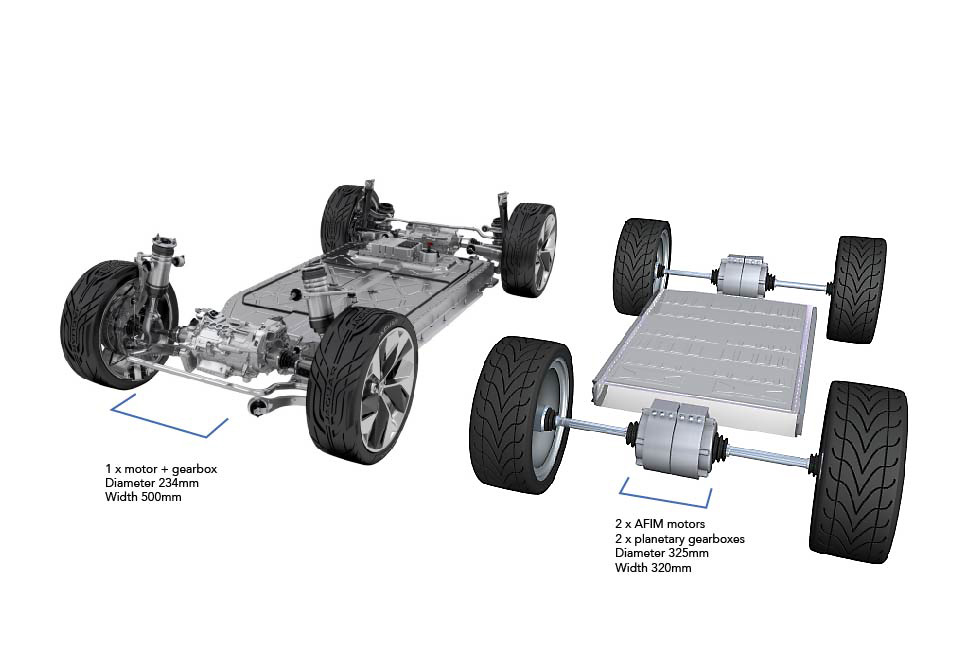
The introduction of electric powertrains opens the opportunity for augmented drive-by-wire control via primarily solid-state electric powertrains. Replacing mechanical friction brakes with electromagnetic braking by incorporating an electric motor for each individual wheel, either in-board or in-wheel, establishes a direct digital connection that allows precise control of vehicle dynamics and takes human muscle strength out of the loop. This allows a rules based augmentation system to compensate for a drivers lack of knowledge and/or skill while providing a 'guardian angel' to protect drivers from exceeding a vehicles dynamic limits, or in some cases can assist them in reaching those limits.
In 1992, Daimler-Benz performed a study that utilised its driving simulator in Berlin, which revealed some striking data about simulated panic stops and crashes. In the study, more than 90% of the drivers failed to apply enough pressure to the brakes when faced with emergency situations. This is co-incidentally the same figure the SDC industry often quotes, “some 90% of motor vehicle crashes are caused by human error.”
Based on the Daimler study it seems clear that despite the fact drivers react to emergencies, their lack of training/familiarity with either the braking effort required and/or the capability of the vehicles braking system is the cause of the majority of road accidents. In 1996 Mercedes-Benz introduced yet another extension to hydraulic brakes called Emergency Brake Assist which compensates for 1) human leg muscle strength still being required to operate a modern automobile 2) the "buzzing" feedback and sinking brake pedal during ABS operation.
So does a hybrid brake-by-wire system qualify as an advance that removes human leg muscles from the loop? For moderate brake applications yes, but because brake regeneration is limited by battery charge rates to 50-60 kw max, under emergency braking the car defaults back to the legacy hydraulic friction brake system with it's plethora of add-on systems like ABS, ESC, EBA, EBD etc that, while power assisted, still requires leg muscle strength.

I have previously discussed how hydraulic friction brakes on hybrid and electric vehicles are effectively redundant, yet because of regen limits a Google self-driving Toyota Prius would only be able to perform moderate braking under computer control, requiring human leg-muscle input for emergency braking, which seems to defeat the advertised purpose of the program?
A drive-by-wire quad motor electric powertrain could provide a machine to machine (M2M) / human to machine interface (HMI) that would require no more leg effort to execute an emergency stop from any speed than operating a throttle pedal, while also incorporating all mandatory safety features in software to be executed via brake-mode torque vectoring all while keeping the vehicle within it's safe dynamic envelope. A drive-by-wire powertrain would provide a platform for map localising algorithms and various 3D sensor hardware to work together in a similar fashion to aircraft auto-pilot and rules based augmented fly-by-wire in commercial aviation. Drive-by-wire would provide a certifiable advanced computer control system to monitor and step-in to assist drivers to improve road safety while we're all waiting the next 10-20-30 years for consumer ready self-driving cars.


 If you find yourself on the roads of central Oregon, keep an eye out for this eye-catching Nissan Leaf. It's owned by Pine Mountain Sports, a ski and mountain-bike shop located in Bend, Oregon, which uses it as a shop vehicle. Christened, the "Pinemobile," it was purchased back in August, and is living up to the expectations of its owner so far...
  Which climate-science denier has been tapped to run an agency he repeatedly sued for attempting to enforce its own rules? What does the Chevy Bolt EV owners manual have to tell us about the 238-mile electric car that goes on sale this month? This is our look back at the Week In Reverse—right here at Green Car Reports—for the week...
  The Fiat 500e electric minicar is aging, and with the introduction of the 238-mile Chevrolet Bolt EV this month, the three-door hatchback's 84 miles of range becomes woefully uncompetitive. So Fiat Chrysler Automobiles needs a new all-electric vehicle to comply with California zero-emission vehicle rules, despite its CEO's frequent complaints that...
  Today, we have more details on Lucid Motors' upcoming electric car, pricing information on the 2017 Chevrolet Cruze diesel, and a legal scuffle between the European Union and member nations over emissions standards. All this and more on Green Car Reports. Lucid Motors' electric "executive sedan" will be unveiled later this month. The base model...
  The Volkswagen diesel scandal has led to numerous lawsuits against the German automaker in multiple countries. But now regulatory agencies in European countries have become caught up in the legal fallout from VW's emissions cheating. The European Union began legal action Thursday against Germany, the U.K., and five other nations. DON'T MISS: Every...
  Several automakers have backed away from diesels in the wake of the Volkswagen emissions scandal. But General Motors is moving ahead with the launch of its Chevrolet Cruze Diesel compact. The 2017 Cruze diesel sedan will go on sale early next year, with a hatchback model following later in the calendar year as a 2018 model. DON'T MISS: Chevy...
  The 238-mile 2017 Chevrolet Bolt EV electric car should begin deliveries in the coming weeks. But sales of the Bolt EV's European cousin—the Opel Ampera-e—won't begin until well into the next year. Because it offers a range of over 200 miles at a mainstream price ($37,495, before federal, state, and local incentives) Chevy has high...
  African nations have a very specific problem when it comes to dealing with emissions from diesel vehicles. Because of lax emissions standards, traders import fuel to these countries that is too dirty for sale elsewhere. But now a handful of African nations are taking a stand against this. DON'T MISS: Why Africa gets filthiest diesel fuel: little...
  From small startups to major established automakers, many companies have Tesla Motors in their sights. But Lucid Motors—the California-based startup formerly known as Atieva—may have the biggest guns in its arsenal of any of Tesla's would-be rivals. The company plans to unveil its previously-teased electric "executive sedan" December...
  Today, Donald Trump nominates a climate-science denier to head the Environmental Protection Agency (EPA), Congress questions $2 billion in zero-emission vehicle infrastructure funding from the Volkswagen diesel scandal, and a new study claims it is better to recycle electric-car battery packs than reuse them. All this and more on Green Car...
  The Volkswagen diesel settlement for 2.0-liter TDI models, approved at the end of October, includes a provision for $2 billion in funds to install charging or fueling infrastructure for zero-emission vehicles. There has been considerable debate over what those funds should be used for, and how they should be administered. The vast majority of the...
  Since it was launched in December 2010, the Nissan Leaf electric car has been offered with a telematics system that relies on a cellular connection. NissanConnectEV, previously known as Carwings, lets owners monitor functions like climate control and charging remotely, and find nearby charging stations. When the system launched, it was based on a...
  If there were any doubt that president-elect Donald Trump supports fossil fuels and does not believe in the scientific consensus of climate change, his pick to head the U.S. Environmental Protection Agency should put it to rest. Yesterday, he named Oklahoma attorney general Scott Pruitt, a 48-year-old Republican, as his nominee for EPA...
  Engineers are nothing if not creative. Significant research is going into improved ways of storing electricity, including alternatives to the currently dominant lithium-ion battery-cell chemistry in electric cars. That includes using supercapacitors to substitute for storage batteries in some circumstances. DON'T MISS: Batteries from junkyard...
  Last week, we wrote about the results of a Twitter poll we put up to get a feel for what our readers like best about the site. The flipside of "most valuable" is "least valuable," so we put up the same list of choices again, this time asking survey respondents to rank their least favorite types of articles. Surprisingly, however, the results...
  Even after they have degraded too much for continued automotive use, the lithium-ion battery packs in electric cars still have significant useful storage capacity. That's led several automakers to experiment with alternative uses for these "second-life" batteries in stationary energy storage. Battery packs can store energy generated by renewable...
  Today, Tesla opens a gallery in Michigan, one of the states that bars it from actually selling cars to customers, automaker lobbyists fail to overturn EPA emissions rules, and BMW sets the goal of selling 100,000 plug-in cars next year. All this and more on Green Car Reports. Tesla still can't sell cars directly to Michigan, but it now has a...
  Sometimes interesting predictions come buried inside a completely different topic. Take, for example, an investment note on the auto-parts supplier Continental contained in a roundup of industry research, market analysis, and news items issued yesterday by investment bank UBS. It contains the prediction that diesel engines' share of the global...