BMW Launch 225xe and 330e Plug-In Hybrids [VIDEO]

The innovative BMW eDrive technology in the new BMW 225xe and new BMW 330e once again underlines BMW’s leading role in the premium segment when it comes to powertrain electrification.

BMW eDrive technology includes a number of cutting-edge plug-in hybrid components and makes a significant contribution to reducing fuel consumption and emissions. BMW eDrive is one of the most cutting-edge elements of the groundbreaking BMW EfficientDynamics suite of technology.

Locally emission-free driving
BMW eDrive is the new drive system technology used in all the electrically powered vehicles from BMW i and the plug-in hybrid models from BMW. As well as outstanding efficiency and seamless everyday practicality, BMW eDrive also delivers the highest standards in driving dynamics and quality, in keeping with BMW tradition. Alongside BMW TwinPower Turbo technology for combustion engines, intelligent lightweight design and optimised aerodynamics, BMW eDrive technology is therefore one of the most important elements in the EfficientDynamics strategy designed to increase power and further reduce fuel consumption and CO2 emissions. In addition, BMW eDrive offers the option of driving on electric power alone and therefore with zero local emissions – yet at the same time reveals the ability to cover long distances when the two drive systems team up.

Moreover, BMW eDrive technology ensures extremely dynamic acceleration off the line thanks to the instantaneous responses of the electric motor, which generates its remarkable torque from the word go. Plus, the eBoost function, which pools the torque of both drive systems under acceleration, serves up BMW’s signature driving pleasure, whatever the conditions.

Designed for different vehicle concepts
The most important components of BMW eDrive technology are the synchronous electric motor (including the power electronics developed by BMW), the lithium-ion high-voltage battery and intelligent energy management. The latter ensures the electric motor and combustion engine in plug-in hybrid models work together as effectively as possible according to the situation at hand.

Developed initially for the all-electric BMW i3 and BMW i8 plug-in hybrid sports car – which duly led the way in electric mobility in the premium sector – the modular structure of BMW eDrive technology sets it up perfectly for use in various vehicle concepts and segments. BMW uses its plentiful technical experience and customer feedback in the development of the latest BMW eDrive models. The fine-tuning of vehicle-specific elements, such as the battery cells, cooling management, power electronics and operating strategy, has involved the transfer of knowledge from the BMW i3 and BMW i8 to the development of new BMW eDrive models. Here, all components are adapted precisely to the vehicle at hand and optimised in terms of performance, efficiency, safety and durability. Moreover, BMW eDrive technology enables the electrified xDrive concept first featured in the BMW i8 to be executed with great efficiency.

BMW eDrive: familiar BMW character, flexible usage options
BMW eDrive technology essentially spans the electric motor, the lithium-ion high-voltage battery and the power electronics. Based on a shared eBoost strategy, all BMW plug-in hybrid models offer supreme power delivery by bringing together their two drive systems, and elevate the responsiveness of BMW TwinPower Turbo technology to another new level. BMW eDrive makes all-electric driving in urban areas and over cross-country routes a marketable proposition. An important element of the operating strategy is the need-oriented use of externally sourced and recuperated electric energy to maximise the vehicle’s efficiency. The components of the BMW eDrive architecture are tailored to each particular vehicle concept and can be combined with four- and three-cylinder petrol engines as well as with classical rear-wheel drive, BMW xDrive or electrified all-wheel drive.

The eDrive components developed as part of the BMW i projects will soon be integrated into other model ranges from the core brands. This scalable architecture also provides the platform required to offer plug-in hybrid vehicles at attractive prices on a par with those of conventionally powered variants of similar output. This means customers who opt for this advanced drive concept encounter not only the environmental benefits of electric mobility, but also economic plus-points.

Plug-in hybrid: energy management at its most intelligent
In plug-in hybrid vehicles, intelligent energy management ensures the combustion engine and electric motor work together to maximum effect in all driving situations. Their operating strategy is based on the vehicle starting up on electric power only. BMW’s plug-in hybrid vehicles prioritise electric mode at low and moderate speeds, which allows them to exploit the benefits of the locally emission-free electric drive system. Under greater acceleration and at higher speeds, however, the combustion engine also joins the action. The boost function pools the torque of both drive systems to maximise the car’s dynamic performance and lend it remarkable poise and assurance. BMW eDrive ensures that the combustion engine runs efficiently (electric assist) at higher speeds as well. This allows a reduction in fuel consumption on brisk cross-country or motorway runs, for example. And when the route guidance function of the car’s navigation system is activated, the proactive function initiates an anticipatory operating strategy which optimises efficiency and maximises the electric driving experience.

Like the BMW i8, the BMW X5 xDrive40e, BMW 330e and BMW 740e can all – at the touch of a button in MAX eDRIVE mode – run on purely electric power up to 120 km/h (75 mph), the BMW 225xe up to 125 km/h (78 mph). Here, the combustion engine only comes into play when the accelerator’s kickdown threshold is passed. In SAVE BATTERY mode the battery’s charge can be maintained to enable electric driving later on in the journey. If the charge level drops below 50 per cent, the battery is replenished. If the selector lever is moved into the S gate, the combustion engine starts up regardless of the mode engaged, ensuring sustained availability of the combined maximum output of the two drive systems. In addition, the battery’s charge is raised to 80 per cent.

With the addition of the BMW eDrive functions, the ECO PRO, COMFORT and SPORT driving experience modes are now even more clearly defined than on conventional vehicles.

Fast and convenient battery charging The high-voltage batteries of the new BMW plug-in hybrid models can be charged extremely easily, conveniently and quickly – both at home and while on the move – using BMW 360° ELECTRIC solutions. The battery can be powered up again from a domestic socket using the standard charging cable supplied or from a BMW i Wallbox (charging power: 3.7 kW). When it comes to topping up the battery during a journey, the BMW i mobility service, ChargeNow, gives customers access to the world’s largest public charging network of over 30,000 charging points run by partners in 22 countries.

Higher performance, lower fuel consumption
The new BMW plug-in hybrid models with eDrive technology – such as the new BMW X5 xDrive40e, the BMW 225xe and BMW 330e currently making their debuts, and the BMW 740e due for launch in the near future – are once again setting the benchmark in the various corners of the premium segment when it comes to reducing fuel consumption, and will also meet the stipulations of international legislation in the future regarding CO2 emissions. Moreover, their all-electric and therefore locally emission-free driving mode will also allow them to drive into city centre zones where entry is regulated. And yet the BMW plug-in hybrid models also deliver the hallmark BMW attributes of dynamic excellence, sporting ability and driving pleasure while offering the best performance in their respective segments.

Toyota confirms turbo engine for 2016 LeMans

Toyota has confirmed that it will switch to turbocharged power for the 2016 World Endurance Championship season.

Toyota's technical director Pascal Vasselon confirmed the decision, stating: "I don't think we will retain the normally aspirated V8 configuration. It will be a turbo engine. It's a little too early to release any specific information."

The engine is highly likely to be a small-capacity turbo engine and will target the 8MJ category, something which has reaped dividends for Porsche so far in 2015.

The new technical package will also introduce battery storage, which will work with the same twin-axle retrieval system the team currently uses.

The 2016 car will be known as the Toyota TS 050 and is scheduled to test just after Christmas.

2015 development halted

Toyota is set to undergo a painful remainder of the 2015 season as it essentially calls time on significant development of the TS 040.

"Clearly, it wouldn't be very efficient for us to invest in developing this year's car," said Vasselon. "We could tweak a few things on it, but we do not think that these would make a significant difference. So, yes, we are fully focused on next year's car.

"The gap will vary, obviously, depending on the characteristics of the circuits. However, we expect a difficult end to the season, a bit like Audi experienced last year".

Third Toyota at Le Mans still possible

Toyota could run a third car at Le Mans in 2016, but it would only happen if it would not impinge on the initial development of the TS 050 program.

The decision would also depend on budget resources, which are set to be increased for 2016 onwards.

"We couldn't enter a third car previously, but now the question will arise," said Vasselon. "Now, I cannot give you that answer because we do not yet know the full budget we'll have.

"We know it will be increased, but we know that it will never be at the same level as Audi and Porsche, that's a sure thing. However, it will be increased.

"We will need to re-assess whether running a third car is acceptable without threatening our development programme."

Bosch buys solid state battery start-up Seeo

German industrial conglomerate Bosch is acquiring Silicon Valley battery firm Seeo, including all of its intellectual property and research staff. With the move, Bosch is looking to enhance its offer to the electric car industry, which is witnessing a significant growth.

Founded in 2007, Seeo is known for its advancements in creating high-energy rechargeable lithium-ion batteries based on a nano-structured polymer electrolyte. Seeo uses solid state technology that avoids the use of flammable liquid electrolyte.

Using solid electrolyte, Seeo manufactures DryLyte batteries that deliver high energy density alongside impressive reliability and safety. Seeo has an exclusive license to core patents from Lawrence Berkeley National Laboratory and has more than 30 issued, exclusively licensed and pending patent applications.

News website Quartz reported that Bosch confirmed the acquisition. A Bosch spokeswoman told the website that the financial terms of the deal will not be released.

In December, Seeo made news as its CEO Hal Zarem announced plans to manufacture a battery with an energy density that is about double that of existing commercial lithium-ion batteries. The new battery would have a density of 300 watt hours per kg.

Bosch, which is already supplying a lot of components to the automobile industry, has long been looking to enter the advanced battery market. The acquisition may prove successful, as Seeo and its innovations are said to be of great potential.

Meanwhile, Seeo faces intense competition from start-ups such as Sakti3, QuantumScape, XG Sciences, Envia Systems and SolidEnergy Systems that are working on new types of electric car batteries. Panasonic is currently the leading player in the electric car battery market with a 39% market share, followed by LG Chem and Samsung SDI, according to research firm Lux Research.

Volkswagen e-Golf vs. BMW i3 REx [VIDEO]

Polish blogger Marek Wieruszewski reviews the Volkswagen e-Golf and the BMW i3 REx.

The Volkswagen e-Golf has a claimed range of up to 200 kilometres while the BMW i3 can squeeze up to around 160 kilometers, but it can be equipped with a petrol range-extender, which doubles its range.

Consumer Reports Tesla P85D Test Results [VIDEO]

Consumer Reports put the electric Model S P85D through the same tests other cars undergo at its track as part of its overall assessment of Tesla's performance sedan.

Watch the above video to see how it fared in three key tests, along with its fuel efficiency figure.

Audi e-tron quattro concept will be unveiled at IAA 2015 next month

The conceptual basis for a completely new all-electric Audi SUV with a potential range of more than 310 miles will be one of the stars of the IAA in Frankfurt next month. The Audi e-tron quattro concept profits from the expertise gained in the development of the forthcoming R8 e-tron, and the roadgoing model which it will help to spawn will be notable as the brand’s first large-series electric car when it enters production in 2018.

The Audi e-tron quattro concept is designed from the ground up as an electric car and proves to be pioneering in its segment at the very first glance. It follows the Audi “Aerosthetics” concept, combining technical measures for reducing aerodynamic drag with creative design solutions. Movable aerodynamic elements at the front, on the sides and at the rear improve the air flow around the car. The aerodynamically optimised underbody is completely closed. With a cd value of 0.25, the car sets a new record in the SUV segment. This contributes considerably to the long range of more than 500 kilometres (310 miles).

The study is based on the second-generation modular longitudinal platform, which provides considerable scope for the drive system and package. Its length is between that of the Audi Q5 and the Q7. Its typical SUV body and flat, coupé-like cabin give the Audi e-tron quattro concept a very dynamic appearance. The spacious interior offers room for four people.

The large lithium-ion battery is positioned between the axles and below the passenger compartment. This installation position provides for a low centre of gravity and a balanced axle load distribution, giving the car better driving dynamics and driving safety than other vehicles in the segment.

Audi uses its experience with the electrically driven Audi R8 e-tron sports car for the drive system. Three electric motors – one on the front axle and two on the rear – effectively create an ‘electrified quattro’, making the e-tron quattro concept both highly efficient and responsive.

Going solid-state could make batteries safer and longer-lasting

New research paves the way for rechargeable batteries with almost indefinite lifetimes, researchers say.

If you pry open one of today’s ubiquitous high-tech devices — whether a cellphone, a laptop, or an electric car — you’ll find that batteries take up most of the space inside. Indeed, the recent evolution of batteries has made it possible to pack ample power in small places.

But people still always want their devices to last even longer, or go further on a charge, so researchers work night and day to boost the power a given size battery can hold. Rare, but widely publicized, incidents of overheating or combustion in lithium-ion batteries have also highlighted the importance of safety in battery technology.

Now researchers at MIT and Samsung, and in California and Maryland, have developed a new approach to one of the three basic components of batteries, the electrolyte. The new findings are based on the idea that a solid electrolyte, rather than the liquid used in today’s most common rechargeables, could greatly improve both device lifetime and safety — while providing a significant boost in the amount of power stored in a given space.

The results are reported in the journal Nature Materials in a paper by MIT postdoc Yan Wang, visiting professor of materials science and engineering Gerbrand Ceder, and five others. They describe a new approach to the development of solid-state electrolytes that could simultaneously address the greatest challenges associated with improving lithium-ion batteries, the technology now used in everything from cellphones to electric cars.

The electrolyte in such batteries — typically a liquid organic solvent whose function is to transport charged particles from one of a battery’s two electrodes to the other during charging and discharging — has been responsible for the overheating and fires that, for example, resulted in a temporary grounding of all of Boeing’s 787 Dreamliner jets, Ceder explains. Others have attempted to find a solid replacement for the liquid electrolyte, but this group is the first to show that this can be done in a formulation that fully meets the needs of battery applications.

Solid-state electrolytes could be “a real game-changer,” Ceder says, creating “almost a perfect battery, solving most of the remaining issues” in battery lifetime, safety, and cost.

Costs have already been coming down steadily, he says. But as for safety, replacing the electrolyte would be the key, Ceder adds: “All of the fires you’ve seen, with Boeing, Tesla, and others, they are all electrolyte fires. The lithium itself is not flammable in the state it’s in in these batteries. [With a solid electrolyte] there’s no safety problem — you could throw it against the wall, drive a nail through it — there’s nothing there to burn.”

The proposed solid electrolyte also holds other advantages, he says: “With a solid-state electrolyte, there’s virtually no degradation reactions left” — meaning such batteries could last through “hundreds of thousands of cycles.”

The key to making this feasible, Ceder says, was finding solid materials that could conduct ions fast enough to be useful in a battery. “There was a view that solids cannot conduct fast enough,” he says. “That paradigm has been overthrown.”

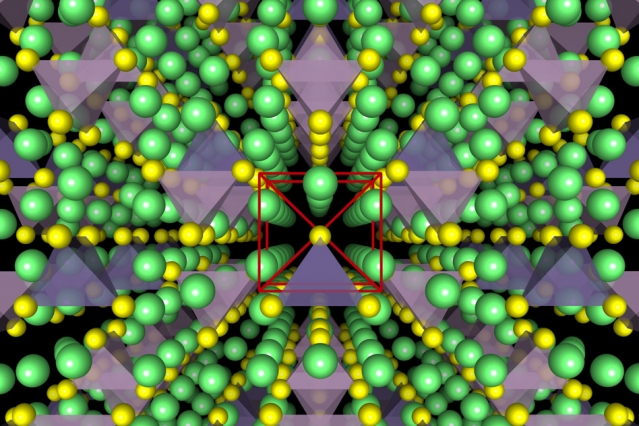
The research team was able to analyze the factors that make for efficient ion conduction in solids, and home in on compounds that showed the right characteristics. The initial findings focused on a class of materials known as superionic lithium-ion conductors, which are compounds of lithium, germanium, phosphorus, and sulfur, but the principles derived from this research could lead to even more effective materials, the team says.

The research that led to a workable solid-state electrolyte was part of an ongoing partnership with the Korean electronics company Samsung, through the Samsung Advanced Institute of Technology in Cambridge, Massachusetts, Ceder says. That alliance also has led to important advances in the use of quantum-dot materials to create highly efficient solar cells and sodium batteries, he adds.

This solid-state electrolyte has other, unexpected side benefits: While conventional lithium-ion batteries do not perform well in extreme cold, and need to be preheated at temperatures below roughly minus 20 degrees Fahrenheit, the solid-electrolyte versions can still function at those frigid temperatures, Ceder says.

The solid-state electrolyte also allows for greater power density — the amount of power that can be stored in a given amount of space. Such batteries provide a 20 to 30 percent improvement in power density — with a corresponding increase in how long a battery of a given size could power a phone, a computer, or a car.

The team also included MIT graduate student William Richards and postdoc Jae Chul Kim; Shyue Ping Ong at the University of California at San Diego; Yifei Mo at the University of Maryland; and Lincoln Miara at Samsung. The work is part of an alliance between MIT and the Samsung Advanced Institute of Technology focusing on the development of materials for clean energy.

LG & Samsung to develop 500km+ battery for Audi Q6 e-tron

German carmaker Audi said it will develop batteries for electrically powered Q6 e-tron sport utility vehicles (SUVs) that can run more than 500 kilometers per charge, in partnerships with South Korea's LG Chem Ltd and Samsung SDI Co Ltd.

The South Korean companies will supply the batteries from plants in Europe, Audi said in a statement on Thursday.

Audi, Samsung SDI and LG Chem declined to give financial terms of the respective partnerships.

LG Chem recently entered into a patent license agreement with 3M to expand the use of nickel, cobalt, manganese (NCM) in lithium ion batteries. In May LG Chem also announced its intention to be a supplier of larger batteries between 80 and 120 kWh to car manufacturers targeting a range of 300-500 km.

LG Chem's automotive customers include General Motors, Renault SA, and Daimler AG, while Samsung SDI supplies electric vehicle batteries to BMW and Volkswagen

UK To Test Dynamic Wireless Charging For Electric Cars

Trials of technology needed to power electric and hybrid vehicles wirelessly on England’s major roads are due to take place later this year.

The trials are the first of their kind and will test how the technology would work safely and effectively on the country’s motorways and major A roads, allowing drivers of ultra-low emission vehicles to travel long distances without needing to stop and charge the car’s battery.

The trials follow the completion of the feasibility study commissioned by Highways England into ‘dynamic wireless power transfer’ technologies.

Transport Minister Andrew Jones said:

The potential to recharge low emission vehicles on the move offers exciting possibilities. The government is already committing £500 million over the next five years to keep Britain at the forefront of this technology, which will help boost jobs and growth in the sector. As this study shows, we continue to explore options on how to improve journeys and make low-emission vehicles accessible to families and businesses.

Highways England Chief Highways Engineer Mike Wilson said:

Vehicle technologies are advancing at an ever increasing pace and we’re committed to supporting the growth of ultra-low emissions vehicles on our England’s motorways and major A roads.

The off road trials of wireless power technology will help to create a more sustainable road network for England and open up new opportunities for businesses that transport goods across the country.

The trials are expected to begin later this year following the completion of an ongoing procurement process. The trials will involve fitting vehicles with wireless technology and testing the equipment, installed underneath the road, to replicate motorway conditions. Full details of the trials will be publicised when a successful contractor has been appointed.

The trials are expected to last for approximately 18 months and, subject to the results, could be followed by on road trials.

As well as investigating the potential to install technology to wirelessly power ultra-low efficient vehicles, Highways England is also committed in the longer-term to installing plug-in charging points every 20 miles on the motorway network as part of the government’s Road Investment Strategy.

ZF Powers First Australian All-Electric Bus

ZF is at the core of a next generation of public transport, with the global drive line technology specialists providing local company Bustech with electric drive axles for Australia's first all-electric city bus.

Long-time partners in diesel powered bus projects, ZF has previously supplied Bustech with products such as transmissions, axles, steering and suspension systems, with the new project paving the way for zero-emissions operation along busy urban roads.

The bus features an AVE130 electric drive axle, which dimensionally fits into the same envelope as a conventional drop centre axle, making the system simple to integrate into existing designs.

In Bustech’s configuration, the AVE130 utilises pure battery power, although the system can be used in serial as a hybrid with a conventional combustion engine, or via alternate power sources such as fuel cells or overhead lines.

With no requirement for a traditional transmission, the electric axle provides smooth acceleration in all driving conditions.

“It’s exciting times for ZF Services in Australia, particularly with Bustech, and the bus industry in general,” said Gary Bain, ZF Services Australia OE Business Manager. “Working closely with Bustech and their design and development partners such as the CSIRO and Swinbourne University, we have the finished vehicle today, the all-electric bus ready for the market place.

“Bustech is a rather unique company; not only do they produce chassis and bodies for buses, but they undertake some of the best market research in the bus industry. “With over 800 vehicle in service under the Transit Australia banner, they have incredible insight into the requirements of public transport passengers.”

Designed for axle loads of up to 13 tonnes, each wheel is fitted with a high-revving (11,000rpm) asynchronous electric motor, which provides maximum drive power of 240kW, while continuous power of 120kW is available per axle. Like many electric engines, the motors have strong torque characteristics, with output peaking at 21,000Nm per axle.

This makes the system ideal for stop-start city traffic, which also takes advantage of the systems power regenerative braking, which tops up batteries while in operation. Because there is no requirement to provide space for a diesel engine, Bustech has been able to employ an interesting new cabin design.

The AVE130 axle uses widely available existing components such as standard wheels and tyres, brake callipers, ventilated brakes discs, as well as wheel bearings and seals, making the units extremely service-friendly. In operation, the axle paves the way for improved torque distribution which in turn reduces tyre wear.

The system also includes sensors for temperature, ABS, and speed.

Operational targets between recharges for Australia are 300km, and 200km in Malaysia, with trials set to commence in September.

Outside of the electric axle, the new design also utilises a conventional RL85A low-floor front axle, and many modern innovations, such as touch screens, LED lighting, as well as all-electric doors and air conditioning.

An example of the forward thinking of the design, the bus utilises rear vision cameras, which provide a wider field of vision, while also streamlining the bus exterior, saving drivers from having to make mirror adjustments.

Previous collaborations between Bustech and ZF Services Australia have included projects such as the Bustech CDI, the world's first low-floor twin steer double decker bus.

The project was developed in part due to Australia’s front axle load regulations, which limit design flexibility, especially for a city bus with a passenger capacity of around 90.

While the steering setup is common in trucks, ZF Services worked closely with Bustech to develop the system to allow for easy access throughout the cabin for passengers, while the 12.5 metre package has considerable operational cost savings over conventional articulated buses.

Nissan to Address KERS Issues Before Returning to WEC

Nissan today announced that it will delay its return to the LM P1 class of the FIA World Endurance Championship and instead focus on technical issues that challenged its race team during the Le Mans 24 Hours.

Issues with the energy recovery system (ERS) meant that Nissan had to run at the Le Mans 24 Hours on engine power alone. The bespoke Nissan V6 3-litre twin turbo petrol engine and the unique aerodynamics of the GT-R LM NISMO proved to be the main strengths of the car at Le Mans but without a fully working ERS, many of the car's other systems were compromised.

"We know people will be disappointed but be assured that nobody is more disappointed than us," said Shoichi Miyatani, President of NISMO. "We are racers and we want to compete but we also want to be competitive. That is why we have chosen to continue our test programme and prepare the GT-R LM NISMO for the strong competition we face in the World Endurance Championship. When you innovate you don't give up at the first hurdle. We are committed to overcoming this challenge."

This news only affects Nissan's LM P1 programme. The manufacturer's global motorsport programmes continue unabated as Nissan strives to add to its tally of victories in the Blancpain Endurance Series, Super GT and the many other championships it competes in. Nissan's pioneering GT Academy programme is now entering the ‘Race Camp' phase where the first of the 2015 graduates will be chosen before going on to compete as NISMO Athletes all over the world.

"We've said it before but innovation hurts," said Darren Cox, Global Head of Brand, Marketing & Sales, NISMO. "We've built an LM P1 car that is very different to other racing cars as we continue to drive motorsport innovation. The beauty of this programme is that people have got behind us and they are willing us to succeed. This has shown us once again that people want something different in motorsport and that gives us increased motivation to make our LM P1 car competitive."

Nissan will continue the test programme for the GT-R LM NISMO, predominantly but not exclusively in the United States. Media updates will be issued as the car's development continues. A decision on the date for Nissan's return to the World Endurance Championship will be made in due course, depending on the progress of the test programme.

3M and LG Chem Complete NCM Patent License Agreement

3M and LG Chem have entered into a patent license agreement to further expand the use of nickel, cobalt, manganese (NCM) in lithium ion batteries. Under the agreement, 3M grants LG Chem a license to U.S. Patents 6,660,432, 6,964,828, 7,078,128, 8,685,565 and 8,241,791 and all global equivalents including in Korea, Taiwan, Japan, China and Europe.

NCM cathode compositions offer an outstanding balance of power, energy, thermal stability and low cost. NCM cathode materials can be tailored through changes in composition and morphology to meet a wide range of customer requirements from high-energy handheld consumer electronics to high-power electric vehicles.

“We are pleased to have reached this agreement with 3M,” said Kyunghwa Min, vice president of LG Chem IP Center. “This license will give our battery customers confidence in LG’s technology and our long-term commitment to the battery industry. The license also opens the door to new opportunities for LG Chem as a supplier of cathode materials to the battery industry.”

“LG Chem is a leader in the electric vehicle battery field, and NCM cathode compositions have shown significant benefit in large format applications, like electric vehicles,” said Christian Milker, business manager, 3M Electronics Materials Solutions Division. “This license will accelerate the adoption of NCM technology to meet the growing demand for electric vehicles worldwide.”

World’s Fastest Charging Electric Bus Takes 10 seconds to Charge

The world's fastest charging electric busses, that takes just 10 seconds to be fully charged, were put into operation for the first time in Ningbo on Tuesday.

The bus operates a 11-km route with 24 stops in Ningbo, Zhejiang province, local transport authorities said.

In the next three years, a total of 1,200 such buses will be used for public transport in the city, where the electric bus plant is located.

The bus recharges while stationary or while passengers get on or off, and each charge enables the bus to run for least five kilometers, according to Zhou Qinghe, president of Zhuzhou Electric Locomotive, a subsidiary of high-speed train maker CRRC.

In addition, the bus, which rolled off production line in April, consumes 30 to 50 percent less energy than other electric vehicles.

The capacitor can be charged one million times and has a 10-year life cycle.

BMW wants electric racing future

German brand BMW believes electric cars are its future - even on the racetrack.

Speculation has been mounting for months that the company would join the World Endurance Championship with an LMP1 car to rival entries from Porsche, Audi, Toyota and Nissan.

However, BMW's motorsport boss, Jens Marquardt, has ruled out building a car to the current hybrid rulebook, saying the brand wants to race a fully-electric car to promote its new range of electric road cars, the i3 and i8.

"The regulations in LMP1 will be new for 2017 and it will be a hybrid class where the key players are competing at a high level," Marquardt told Autosport.

"We see hybrid as a stepping-stone towards EV [electric vehicle] and EV as the future for BMW, which we showcase in the i sub-brand.

"This current set-up does not fulfil our needed criteria."

And the BMW bigwig also ruled out joining Citroen's DS brand and Renault in supporting teams in the all-electric Formula E Championship.

He said the series reliance on mid-race car swaps was bad for the public perception of electric cars and the so-called "range anxiety".

"If you look at public discussions of electric mobility, the issue of reach is very important," Marquardt said.

However, Formula E organisers are pushing to eliminate the car swaps ahead of originally planned as part of increased technical freedoms for the teams and manufacturers.

Apple, BMW in courtship with an eye on car collaboration

BMW and Apple may rekindle a courtship put on hold after an exploratory visit by executives of the world's top maker of electronic gadgets to the headquarters of the word's biggest seller of premium cars.

Apple Chief Executive Tim Cook went to BMW's headquarters last year and senior Apple executives toured the carmaker's Leipzig factory to learn how it manufactures the i3 electric car.

The dialogue ended without conclusion because Apple appears to want to explore developing a passenger car on its own.

Also, BMW is being cautious about sharing its manufacturing know-how because it wants to avoid becoming a mere supplier to a software or internet giant.

During the visit, Apple executives asked BMW board members detailed questions about tooling and production and BMW executives signaled readiness to license parts, a source said. News of the Leipzig visit first emerged in Germany's Manager-Magazin last week.

"Apple executives were impressed with the fact that we abandoned traditional approaches to car making and started afresh. It chimed with the way they do things too," a senior BMW source said.

The carmaker says there are currently no talks with Apple about jointly developing a passenger car and Apple declined to comment. However, a source said exploratory talks between senior managers may be revived at a later stage.

It is too early to say whether this will be a replay of Silicon Valley's Prometheus moment: The day in 1979 when Apple co-founder Steve Jobs visited Xerox's Palo Alto Research Center where the first mouse-driven graphical user interface and bit-mapped graphics were created, and walked out with crucial ideas to launch the Macintosh computer five years later.

BMW has realized next-generation vehicles cannot be built without more input from telecoms and software experts, and Apple has been studying how to make a self-driving electric car as it seeks new market opportunities beyond phones.

STAFF CHANGES

Since the visit, there has been a reshuffle at the top of BMW, with Harald Krueger, appointed BMW Chief Executive in May, in favor of establishing his own team and his plans for BMW by year end, before engaging in new projects, a person familiar with his thinking told Reuters.

A further complication was the departure of BMW's board member for development Herbert Diess, who played a leading role in initial discussions with Apple. He defected to Volkswagen in December.

Diess, who declined to comment for this piece, oversaw the development of BMW's "i" vehicles which are built using light weight carbon fiber, using a radical approach to design and manufacturing.

Car technology has become a prime area of interest for Silicon Valley companies ranging from Google, which has built a prototype self-driving car, to electric car-maker Tesla Motors.

Diess has said the German auto industry needs to undergo radical change because consumers are demanding more intelligent cars and anti-pollution rules mean the next generation vehicles will increasingly be low emission electric and hybrid variants.

In 2030, only two generations of new cars away in auto manufacturing time scales, only a third of vehicles will be powered by a conventional combustion engine alone, experts predict.

"It means that in two cycles we will shut down two thirds of our engine manufacturing," Diess told a panel discussion in July last year, adding that the value chain for new electric cars is already shifting, with vehicle batteries made mainly in Asia.

"The second part is that the car will become intelligent, part of the Internet," Diess continued. "And the strong players in this area are in the United States, in the software development area. We will surely need to find alliances in this field."

Germany has two years to prove that it can hold its own against new entrants when it comes to shaping the future of luxury vehicles, Diess said.

THEM AND US

Automakers including BMW have already developed next generation self-driving cars, vehicles which need permanent software updates in the form of high-definition maps allowing a car to recalculate a route if it learns about an accident ahead. The technology is moving ahead faster than the legal and regulatory rules which would allow large-scale commercial availability.

Earlier this year, BMW's new R&D chief Klaus Froehlich said his company and Apple had much in common, including a focus on premium branding, an emphasis on evolving products and a sense of aesthetically pleasing design.

Asked, in general terms, whether a deeper collaboration beyond integration of products like the iPhone would make sense, Froehlich initially said BMW would not consider any deal that forces it to open up its core know-how to outsiders.
"We do not collaborate to open our eco systems but we find ways, because we respect each other," Froehlich said.

BMW will keep in mind the needs of the customer, and what the company's core strengths are, when it considers the merits of entering any strategic collaboration, Froehlich added.

Peter Schwarzenbauer, BMW's management board member in charge of the Mini brand as well as digital services declined to comment on possible talks with Apple in an interview earlier this year.

But he said: "Two worlds are colliding here. Our world, focused on hardware and our experience in making complex products, and the world of information technology which is intruding more and more into our life."

The winners will be those companies that understand how to build intelligent hardware, he said, adding it made sense for carmakers and tech firms to cooperate more closely.

"We need to get away from the idea that it will be either us or them ... We cannot offer clients the perfect experience without help from one of these technology companies," Schwarzenbauer said. That dialogue is well underway, he stressed.

With $202.8 billion in cash, Apple has the resources to enter the automotive market on its own, said Eric Noble, president of the Car Lab, a consulting firm in Orange, Calif.

The tech giant would have an edge on the dashboard, its CarPlay infotainment system connecting iPhones to cars, but would be at square one with the rest of the car, Noble said.

If Apple decided to sell a car it could make sense to find a partner to help with industrial scale production, retail and repair, since demand for such a vehicle could be high.

There are no estimates for potential Apple car sales but the brand and its products command a loyal following. So if only 1 percent of Apple's annual iPhone customers decided to order a car, it would need to make 1.69 million vehicles.

That's more than the 434,311 vehicles Jaguar and Land Rover produced last year. Even BMW Group, which made just over 2 million cars last year, would struggle to free up capacity.

SK Innovation doubles automobile battery annual production capacity

SK Innovation, the energy holding unit of SK Group, is accelerating its drive to expand its electric automobile battery business by kicking its lithium-ion battery production into full gear.

The Korean firm’s newly-expanded battery plant in Seosan, South Chungcheong Province, has more than doubled its annual production capacity from 300 to 700 megawatt-hours -- sufficient to power around 30,000 electric vehicles, the company said.

Since the factory first opened its doors in September 2012, it has been enlarging its production lines every year to meet rising client demands, with the latest expansion completed in May.

The Seosan plant added a new production line this year to produce more batteries to be placed inside electric-powered vehicles by major automakers -- the Kia Soul EV and China-based BAIC Group’s EV200 and ES210, according to SK.

From the initial electrode manufacturing process to the cell assembly, cell activation and final packaging stages, the plant is churning out new battery packs nonstop, every day to fulfill its target quotas on time.

The nation’s leading energy firm is pinning high hopes on its expanded production capabilities to significantly drive up annual profits, as it looks to record a threefold increase in sales this year.

The plant is also at the center of company CEO Chung Chul-khil’s ongoing efforts to reform its business structure by strengthening select businesses and finding new sources of income in cooperation with overseas companies.

“Though we understand that the battery development business is a difficult one, we will not give up,” Chung told local reporters in May, reaffirming the company’s commitment to its fledgling rechargeable battery business.

The energy firm is particularly looking to direct its efforts on developing energy cells suited for plug-in hybrid electric vehicles and BEVs, or vehicles powered solely by batteries, according to vice president of SK Innovation’s battery business Kim Yoo-suk.

“We will focus on developing next-generation lithium-ion battery cells with higher energy capacity and concentration, perceived as holding great growth potentials,” Kim said Wednesday.

“Demand for such batteries is expected to rise in line with an increase in global EV usage across the world over the next few years. Though currently supply exceeds demands in the status quo, this situation will turn around by 2018.”

Despite its limited resources and small size compared to rivals -- including the world’s top electric car battery producer Panasonic, as well as Samsung and LG -- SK Innovation is continuing to seal more supply deals with clients at home and abroad.

In January 2014, SK Energy joined hands with BAIC’s Beijing Automobile Works and liquid crystal display manufacturer Beijing Electronic Holding to establish Beijing BESK Technology, which has paved the way for the Korean energy firm to expand its presence in China’s burgeoning electric-powered vehicle market.

The Korean energy firm is also expected to further step up production after reportedly having sealed a deal with a major European automaker to develop car batteries to be placed in its EVs from 2016. The supply volume would be nearly “three times larger” than the combined output for its current clients, according to CEO Chung in May.

“On the back of our standout technology, SK will maximize its operational efficiency and strengthen cooperation with existing partners to better target the domestic and global electric car battery market,” said SK Innovation’s head of Battery and Information Electronic Materials Kim Hong-dae.

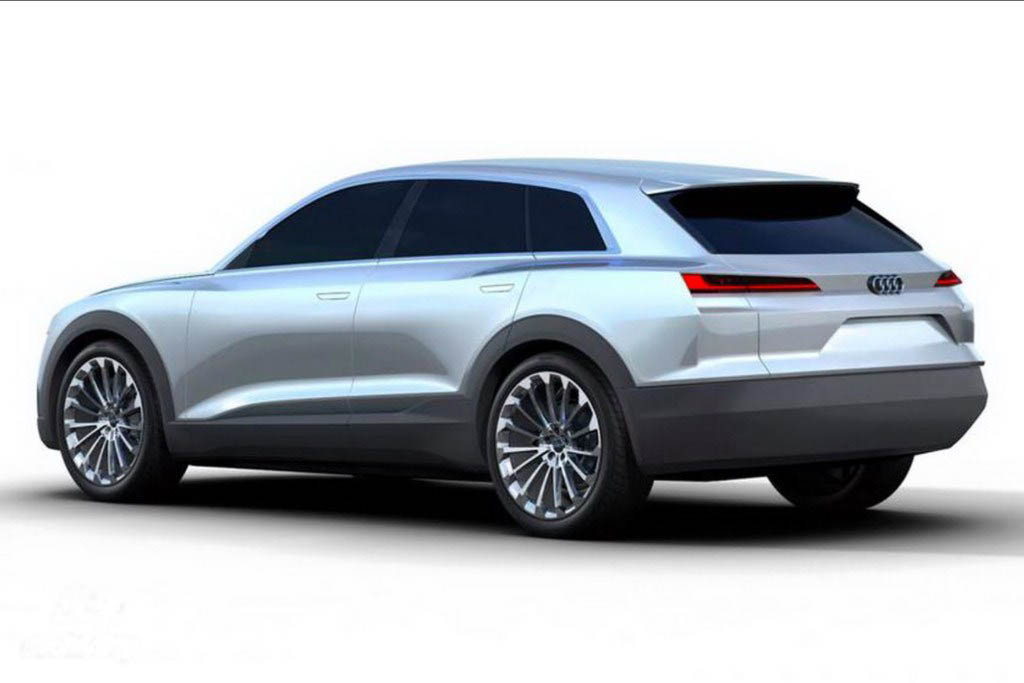
Leaked: Audi’s Q6 e-tron Plug-In Hybrid

Images of Audi’s all-new Q6 have been leaked online months before its reveal at this September’s Frankfurt motor show.

The renderings, said to be official, first appeared late last night on German website Auto Motor und Sport and are thought to be final drawings of the concept, codenamed C-BEV, that will preview the zero-emission Q6 e-tron.

On sale some time in 2018, it’s already been confirmed by senior Audi board member Dr Ulrich Hackenberg, the Q6 will ride on the Q7’s MLB evo platform and that the objective for engineers was that it must cover 500km between charges.

Back then, Hackenberg said the Q6 must be “a technical light tower” and incorporate state-of-the-art technology.

According to reports from sources close to Audi the C-BEV will lift its motor and the 92kWh batteries from the latest R8 e-tron supercar, but instead of two rear-mounted motors, the Q6 will benefit from an additional third motor encased within its gearbox.

With the third motor the production Q6 e-tron will generate even more power, and the concept is expected to have a combined total of 375kW/700Nm. Factor in widespread use of lightweight composites like carbon-fibre and the new Tesla rival is expected to hit 100km/h in less than four seconds and top out at a limited 250km/h.

As well as a state-of-the-art powertrain the next-generation Q6 e-tron is expected to have a fully autonomous driving feature to allow occupants to enjoy the big Audi’s next-generation infotainment system.

Following the launch of the all-electric version, other more conventional variants powered by internal combustion engines will join the Q6 range. All engines will be borrowed from the Q7 range.

Audi is expected to reveal more of what will star on the 2018 Q6 e-tron production car at the Frankfurt show in September.

Fully Charged | Airbus E-Fan [VIDEO]

In this weeks episode of Fully Charged Robert Llewellyn gets a VIP invitation to witness the Aibus E-Fan battery powered electric aeroplane cross the English Channel.

First flown in April 2014, the plug-in plane is powered by two electric motors with a combined power of 60 kilowatts each driving a variable pitch fan providing a static thrust of 1.5 kN which is another engineering first on an electrically powered aircraft.

The motors are in turn powered by a 250V lithium polymer battery pack made by South Korean company Kokam. The batteries are housed within the inboard part of the wings parallel to the cockpit providing an endurance of between 45 minutes and 1 hour.

The batteries can be recharged in one hour.

Toyota Prius Taxi has travelled over 1 Million Kms [VIDEO]

In a new video posted by Toyota Austria, a taxi driver claims to have covered 1 million kilometers (more than 600,000 miles) in his 2007 Toyota Prius - all with the original battery pack.

What's more, the driver, Manfred Dvorak, claims the Prius has never broken down. "For me, the Prius is the ultimate sidekick," he says.