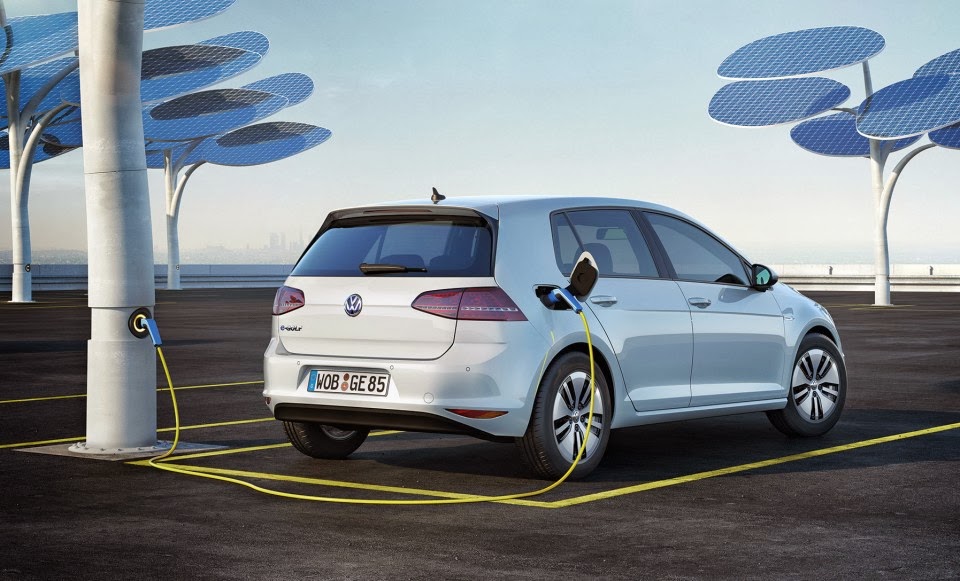
Volkswagen launch e-Golf in Germany with 190 km range

The Golf is the most successful European car of all time. In launching the new e-Golf, Volkswagen is now bringing the bestseller onto the market as a full production electric vehicle as well. The especially agile and efficient compact car supplements the highly economic fleet of 3 Euro vehicles and boasts an extensive range of standard features. The e-Golf can be immediately recognised by its signature LED headlights and is available from €34,900.

In launching the e-Golf, Volkswagen is bringing its second electric vehicle onto the market inside six months. The agile and efficient e-Golf impresses with best-in-class qualities from the off, leading the way with low power consumption of 12.7 kWh/100 km. In addition to the environmental aspect, the practically silent and thus gliding e-Golf is also very inexpensive to run, as power costs are just €3.28 per 100 kilometres. Thanks to a particularly innovative overall technological system, improved aerodynamics (cw=0,281) and perfected rolling resistance, the new, all-electric Volkswagen is over 15 per cent more energy-efficient than the best steel-built direct competitor. Joining the e-up! and eco-up!, the e-Golf thus extends the Volkswagen brand's fleet of highly efficient 3 Euro vehicles.

The e-Golf is 'Das e-Auto' - it has the same handling, comfortable ride and generous amount of space that has seen the Golf so appreciated for decades by over 30 million car buyers. The e-Golf is in addition fitted with a very good range of standard features, including four doors, the high-end 'Discover Pro' radio/navigation system, heated windscreen, automatic climate control, parking heater and ventilation, leather steering wheel, aerodynamically optimised 'Astana' alloy wheels and, being used for the first time by Volkswagen, full LED headlights. Another especially economic and likewise standard feature are the LED daytime running lights, which by virtue of their signature C-shaped format immediately identify the e-Golf as a Volkswagen electric vehicle.

The electric engine delivers 85 kW / 115 PS and from a standing start develops maximum torque of 270 Nm. This deployment of power produces a superb driving performance: the e-Golf reaches a speed of 60 km/h within 4.2 seconds and after just 10.4 seconds the Volkswagen is up to 100 km/h. A fascinating factor here is the pull-away performance, which is extremely comfortable and totally free of any delay. Depending on the nature of the route, driving style and load, the range is between 130 and 190 kilometres. The new e-Golf is available in Germany now. Prices start from €34,900 (including the 8-year / 160,000-kilometre battery guarantee).

World’s First Large-Scale Power Storage System Made From Reused EV Batteries

Japanese Firm Sumitomo Corporation has developed and installed the world’s first large-scale power storage system which utilizes used batteries collected from electric vehicles. This commercial scale storage system, built on Yume-shima Island, Osaka, will begin operating in February 2014.

Over the next three years, the system will measure the smoothing effect of energy output fluctuation from the nearby “Hikari-no-mori,” solar farm, and will aim to establish a large-scale power storage technology by safely and effectively utilizing the huge quantities of discarded used EV batteries which will become available in the future. This project has been selected as a model project for "Verification of the battery storage control to promote renewable energy" for the fiscal year 2013 by the Ministry of the Environment of Japan.

Nissan and Sumitomo Corporation created the joint venture company, “4R Energy Corporation”, in September 2010, to address the secondary use of EV lithium-ion batteries. The used EV batteries that will be recycled into this large-scale storage system have been recovered and have gone through thorough inspection and maintenance at 4R, to confirm safety and performance. This prototype system (600kW/400kWh) consists of sixteen used EV batteries.

Battery Business Development Department General Manager, Norihiko Nonaka said “We are pleased to be a part of such an important verification project that can both utilize used EV batteries, and provide a large-scale power storage facility, which are important issues that need to be addressed for the future of renewable energy.”

Sumitomo will seek new business opportunities which can make use of the highly economical storage system, as well as work on developing new applications for used EV batteries. The company aims to actively promote this approach, which can both contribute to expanding the use of EV and encourage the use of renewable energy. Sumitomo is committed to the movement toward lowering the carbon footprint of a sustainable society.

Mitsubishi Develops EV Motor Drive with Built-in Silicon Carbide Inverter

Mitsubishi Electric today announced it has developed a prototype electric vehicle (EV) motor drive system with a built-in silicon-carbide inverter. The EV motor drive system, the smallest of its kind, will enable manufacturers to develop EVs offering more passenger space and greater energy efficiency.

Mitsubishi Electric plans to commercialize its new EV motor system after finalizing technologies for motor/inverter cooling, further downsizing and additional efficiency.

Features

1)Downsized motor drive system with integrated all silicon-carbide inverter
-Achieves further system downsizing (14.1L, 60kW) with smaller motor resulting from improved thermal resistance between motor drive system and cooling system.
-Equal to existing EV motors in power and volume, enabling replacement.
2)Improved motor cooling performance
-Integrates cooling system for motor and inverter thanks to cylindrical shape of power module accommodating parallel cooling ducts for motor and inverter.
-Ensures stable cooling with even a low-power pump.

Global demand for EVs and hybrid EVs (HEVs) has been growing in recent years, reflecting increasingly strict regulations for fuel efficiency and growing public interest in saving energy resources and reducing carbon dioxide emissions. As EVs and HEVs require relatively large spaces to accommodate their robust battery systems, there is a strong need to reduce the size and weight of motor systems and other equipment to ensure sufficient passenger space.

Patents
Pending patents for the technology announced in this news release number 94 in Japan and 29 abroad.

Bosch, GS Yuasa, & Mitsubishi Corp to Double Capacity for EV Batteries

In November 2013, Robert Bosch GmbH and the Japanese companies GS Yuasa International Ltd., based in Kyoto, and Mitsubishi Corporation, based in Tokyo, set up a joint venture. Known as Lithium Energy and Power GmbH & Co. KG, the new company will be headquartered in Stuttgart. It will develop next-generation lithium-ion battery technology. This next generation is needed in order to make the electric vehicle a successful mass product in the next decade. “In setting up this joint venture, we want to achieve nothing less than a giant leap forward in the development of battery technology. Our aim is to make lithium-ion batteries twice as efficient,” says Dr. Volkmar Denner, who, as chairman of the board of management of Robert Bosch GmbH, is responsible for research and development.

For electric vehicles, more efficient batteries will mean greater range. For consumers, the car will also be more affordable, since the rechargeable batteries can be smaller. Robert Bosch GmbH and its partners are confident that electromobilty will become a mass market from 2020 onward. Electromobility is an important step toward making mobility climate-friendly and sustainable.

Bosch holds a 50 percent stake in Lithium Energy and Power GmbH & Co. KG, with GS Yuasa International Ltd. and Mitsubishi Corporation each holding 25 percent. The composition of the board of management reflects these shareholdings. Its members are Dr. Rolf Speicher from Robert Bosch GmbH, Toshio Ohara from GS Yuasa International Ltd., and Yutaka Kashiwagi from Mitsubishi Corporation. They will initially head up a team of some 70 associates in Germany and Japan.

Bosch will support these joint activities with its entire portfolio of components for electromobility. With its competence in the area of battery packs and battery management systems, Bosch specializes in the monitoring and control of cells and complete systems, as well as in integrating them into vehicles. In addition, it will contribute its know-how in production processes and quality management relating to the large-scale series production of complex products.

GS Yuasa will contribute its many years of experience in manufacturing lithium-ion battery cells whose high density makes for a longer range, as well as its expertise in materials systems and electrochemistry. As an established manufacturer of automotive and non-automotive lithium-ion battery cells, GS Yuasa has a strong engineering team and modern production lines with a high level of automation.

Mitsubishi Corporation will contribute its global sales network and experience as an integrated global business enterprise. In addition, Mitsubishi will use its strengths in the establishment of global value-added chains – which include raw materials, semi-finished products, and marketing – to take the joint venture forward.

Mahindra unveil Reva Halo concept EV sports car [VIDEO]

Mahindra & Mahindra unveiled its concept electric sports car 'Halo' which it expects to launch commercially in the next three years.

"There is a plan to commercialise Halo, we are working on a bigger powertrain and a final design. It will take about three years to be production ready," Mahindra & Mahindra Executive Director and President Pawan Goenka told reporters at the Indian Auto Expo.

According to the company, the Halo can touch a speed of 0-100 kmph in less than 8 seconds. It has a top speed of 160 kmph with a range of 200 km on full recharge.

"This car has been fully designed and developed in India with all indigenous technology," Mahindra Reva Electric Vehicle CEO Chetan Maini said.

The company also introduced a quick recharge variant of its existing electric car e20, equipped with smart port technology.

The car can be fully recharged in one hour, while a recharge of 15 minutes will give a range of 25 km.

First all-electric BYD E6 taxi fleet launched in London

Chinese carmaker BYD will launch London’s first ever all-electric taxi fleet on Tuesday, pulling ahead of global rivals such as Nissan in the race to roll out zero emission cabs by 2018.

Following similar BYD E6 taxi fleets in China, Hong Kong and South America, BYD’s move into London transport comes ahead of a 2018 deadline set by Mayor Boris Johnson for all of the city’s taxis to be zero-emission, which has sparked a battle between manufacturers to develop green vehicles.

The Chinese manufacturer, 9.9 per cent owned by Mr Buffett, will initially launch a fleet of 20 electric cars operated by Thriev, a taxi company, less than two months after supplying the first-ever fully-electric buses to the capital.

“Londoners are typically early adopters to new technology . . . and we are very happy to be first and beat the deadline by a few years. This is where the electric vehicle technology will shine,” Isbrand Ho, managing director of BYD Europe told the Financial Times.

Although the E6 cannot be registered as a ‘Black Cab’ because of the turning circle requirements, Thriev is aiming at the established 50,000-strong mini cab market, which relies heavily on diesel-powered MPVs.

The BYD E6 is powered by a 40kWh battery and should offer a range of around 180 miles on a single charge, according to Isbrand Ho, managing director of BYD’s export division. The E6 was launched as a taxi in Hong Kong last March and a fleet is already operating in Shenzhen, the Netherlands and Columbia.

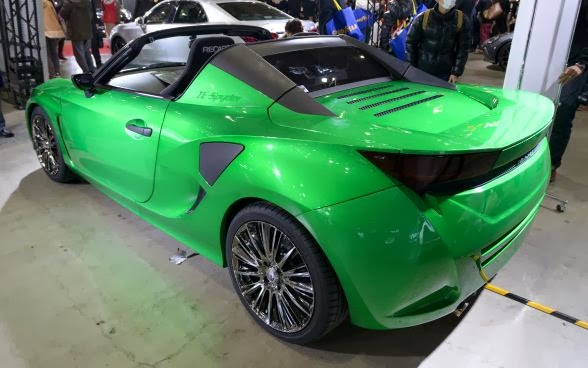
Toyota TE-Spyder 800 Plug-In Hybrid concept [VIDEO]

A Prius hybrid powertrain into a Toyota MR2 chassis sounds like a no-brainer.

This is the TE-S800, and it represents what one Toyota engineer imagines an MR2 successor could be. It weighs approx 1,000 kg and with the 1.5 liter Otto-cycle 1NZ-FE engine outputting more than 115 hp at 6400 rpm plus the plug-in Prius’ 102 hp electric motor coupled to a Toyota E-CVT transmission, the TE-800 does 0-100 km/h in just 5.8 seconds.

The MR2 plug-in hybrid was one of several cars unveiled at the Tokyo Auto Salon by the Toyota Engineering Society which is a volunteer collective that mostly comprises Toyota engineers.

Renault Kwid Plug-In Hybrid Concept unveiled

KWID CONCEPT, a concept car unveiled at the Delhi Auto Expo, highlights both Renault's commitment to new markets, such as India, as well as the company's ability to produce appealing products in the compact car segment. The vehicle's robust, yet fun design, along with its technology-driven features, is targeted at meeting the needs of young customers in these markets.

A robust yet joyful vehicle

The KWID CONCEPT was designed with inputs from Renault Design India and is covered by the 'Explore' petal of Renault's lifecycle-based design strategy. The vehicle's exciting proportions and dimensions as well as very short overhangs give the impression of a bouncing vehicle, while its oversized wheels protrude past the fenders and make the KWID CONCEPT look like a buggy car.

The playfulness of the vehicle's exterior design is offset by a robust appearance due to its protective guards and chunky wings, which exude an impression of strength. The vehicle comes with a two-wheel drive transmission, but projects the facade of an off-road car.

The interior of the KWID CONCEPT is designed to serve as a snug cocoon and is inspired by a bird's nest. The vehicle's seats, suspended over a solid base in white, give an impression of lightness, while their 2-tone elastomer material provides a sense of brightness. The KWID CONCEPT also features rear climate control with controls on the driver seat's back as well as ventilation through concentric perforations. The dashboard is an integrated tablet for commanding the navigation of the Flying Companion.

A high-tech concept car

Beyond the playful and imaginative styling of the KWID CONCEPT, the concept car also comes equipped with a host of technology-driven features, led by its Flying Companion. Aimed at offering a safe as well as fun driving experience, the Flying Companion is the first of its kind in the automotive world. Taking off from the rotating rear portion of the KWID CONCEPT's roof, the Flying Companion can be operated in one of two modes – the automatic mode using a pre-programmed flying sequence and GPS location as well as the manual mode, which enables the companion to be controlled using a tablet inside the vehicle. The Flying Companion can be used for a variety of purposes, including scouting traffic, taking landscape pictures and detecting obstacles on the road ahead.

"Customers in new markets are much younger. Their expectations are different and customers are basically gamers. They tend to take a closer interest in technology and want to enjoy themselves. This concept car meets those needs in a variety of ways, but mainly thanks to the Flying Companion which makes driving both safe and fun. This is the very first time in the long automotive history we can dry on earth with an eye in the sky. It's an amazing feature!" Serge Mouangue, Brand Manager and Innovative Cooperative Laboratory Manager.

The KWID CONCEPT is also Z.E. ready - being pre-disposed to receive batteries for electric use - and comes with a charging plug behind the Renault logo. It's powered by the latest-generation downsized 1.2-litre petrol turbocharged engine mated to dual-clutch transmission EDC to combine driving enjoyment with low fuel consumption. Other technology-rich features include electric operated front bench seat on a center rail, electric opening doors, LED lighting, lack of gearshift (command with touches next to the steering). The vertically-mounted TFT touchscreen display acts as the dashboard in the KWID CONCEPT and also provides access to connected services.

Designed by an international team for international markets

A multinational concept car, the KWID CONCEPT is the first of its kind in Renault to target new markets and Renault Designers around the world cooperated to conceive a vehicle made for local markets and designed to meet the latters' needs. The interior of the vehicle was designed by François Grenier (Technocentre Design, France) based on original drawings by Mishu Batra (Renault Design India) and the exterior by Anton Shamenkov (of Russian origins, Technocentre Design, France) based on original drawings by Jean Semeriva (Studio Design Brazil). The colors and materials of the vehicle were worked upon by Neha Lad (Indian trainee, Technocentre Design) and developed by Chie Yanagisawa (Japanese designer, Technocentre Design). Axel Breun (Technocentre Design) was the overall Project Manager.

"Renault Design is a highly international team with studios in France, Romania, Brazil, Korea and India. This concept car is a reflection of the distinctly international flavour of our design network." Laurens van den Acker, Head of Industrial Design

Reitarating commitment to India

The first Renault concept car to be unveiled outside Europe, the KWID CONCEPT also emphasises India's significant place in Renault's global strategy as well as the company's ability to offer appealing products in the compact car segment.

"This is the first time we have chosen to reveal a concept car outside Europe and this is an eloquent sign of our commitment to India. Young customers in India are often trend setters, looking forward to pushing the envelope when it comes to technology and enjoyable drives. The KWID CONCEPT, with its Flying Companion, meets this forward-looking spirit with both its dynamic styling and hyper connectivity." Gilles Normand, Chairman of Asia-Pacific Region, Renault S.A.S.

The KWID CONCEPT is also tailored specifically to meet the needs of Indian drivers. The vehicle is a compact five-seater to enable family trips, a common occurrence in India. The multimedia dashboard, along with the Flying Companion, answers the young and modern Indian need to stay connected, with a strong attempt for technology. The vehicle's lightweight interior design is also adapted to warm weather conditions.

The KWID CONCEPT 's two-tone body coloring consists of satin grey for the body and textured grey for functional parts as well as golden yellow for contrasting roof and air intake. The vehicle also sports yellow inserts on wheels, lower doors and perforated parts. While this colour scheme features the corporate colors of the Renault Group, the tones also evoke associations with India: the grey represents the soil, while the yellow and gold symbolise flowers and spices.

Additionally, the KWID CONCEPT features an unusual seat arrangement, with three passengers up front and the driver seat in the middle, in a slightly forward position to offer shoulder room, as well as two seats at the back. The central driving position afforded by this arrangement meets international driving demands, enabling the car to driven in both right hand and left hand drive markets.

"Renault has seen unparalleled growth in India in just under 3 years and the market is set to continue playing a significant role in the company's global strategy in the years to come." said Sumit Sawhney, Managing Director, Renault India Pvt. Ltd. "The reveal of the KWID CONCEPT in India – the first such unveil outside Europe, as well as its design keeping in mind the young customers in India illustrate our strong commitment to the country."

Kia Niro four-wheel drive Hybrid electric makes US debut @ Chicago [VIDEO]

Kia’s Niro urban lifestyle concept vehicle, unveiled last September at the Frankfurt Motor Show, made its US debut at the 2014 Chicago Auto Show. The Niro suggests a possible future B-segment contender, and features a hybrid electric powertrain working through an advanced four-wheel drive system.

The concept is powered by a variant of Kia’s turbocharged 1.6-liter Gamma engine, capable of 160 hp (119 kW). The engine and a seven-speed, dual-clutch transmission serve the front wheels while an electric hybrid system powered by regenerative braking delivers up to 45 hp (34 kW) to the rear wheels when road conditions require extra grip.

Although Niro presents a sturdy and muscular outline, it has relatively compact dimensions on its all-new B-segment platform. Its 164.8-inch overall length, 72.8-inch width and 61.3-inch height place it firmly in the city car bracket.

Entry into the vehicle is by way of dihedral “butterfly” doors with flush door handles, that swing up high into the roof. Mounted directly onto the side windows are milled Plexiglas door mirrors with built-in cameras.

Kia debuts its first electric vehicle for US market

Kia Motors Corp rolled out an electric version of its Soul compact car on Thursday that the Korean automaker plans to begin selling in some U.S. markets later this year.

The 2015 Soul EV, unveiled at the media kick-off for the 2014 Chicago Auto Show, is Kia's first all-electric, zero-emissions car in the United States and its second "green" car for the U.S. market, joining a hybrid version of the company's best-selling Optima sedan that has been available here since 2011.

The Soul EV is powered by an air-cooled lithium-ion polymer battery and an 81.4 kW, 109-horsepower, liquid-cooled electric motor, which produces a 210 lb.-ft. of torque, according to Kia.

The car can go from 0 to 60 mph (0 to 96 km per hour) in less than 12 seconds, has a top speed of 90 mph (144 km per hour) and can drive 80 to 100 miles (129 to 161 km) on a full charge, the company said. The vehicle can be recharged by plugging into any standard 120v outlet or a conventional 240v EV charger.

The Soul EV will initially be sold in a handful of states, including California, Oregon, New York, New Jersey and Maryland, Kia said. Pricing has not yet been announced.

Tesla confirm AWD Model S & cheaper batteries [VIDEO]

Speaking to owners during a European tour, Tesla Motors CEO Elon Musk has announced several product developments and company goals.

Musk confirmed plans to release an all-wheel-drive edition of its Model S sedan. The option may be available by the time the Model X arrives on the market, around early 2015.

The company is also working on higher-capacity battery options and new seats that will likely be ready by next year. For current owners, a seat modification will be available to improve comfort.

In the meantime, existing owners will be able to experience the Version 6.0 software update within a few weeks. The revision adds real-time traffic data, along with more control over suspension settings and ride-height adjustment, among other improvements.

Musk expects its "giga factory" to reduce battery costs by at least 30 percent, hopefully as much as 40 percent, with 30 gigawatt-hours of production capacity. Cheaper batteries are likely necessary for the company to meet its goal for a $30,000 mass-market car with a 200-mile range.

Following the completion of its transcontinental charging network in the US, Tesla is currently bringing new Superchargers on line at a rate of five per week. The chargers will eventually charge at a maximum 135 kW current.

While Musk was chatting with owners at the casual town-hall meetings, Consumer Reports was completing its latest brand-perception survey that showed the startup surging into the top five ahead of Subaru, Mercedes-Benz, BMW and other established players.

Tesla Model S Cross Country Rally — Los Angeles to New York [VIDEO]

On January 30, 2014, Tesla Motors embarked on a promotional tour.

The plan was to drive two Model S sedans across the United States, powering them for free on the newly completed cross-continental Supercharger network.

In addition, the team would set the world record for charge time of an electric vehicle driving the across the US.

Fully Charged – The Electric Highway – London to Edinburgh [VIDEO]

This episode follows Robert Llewellyn's one day electric car journey from London to Edinburgh in a Nissan Leaf. Using the Ecotricity fast charge network they covered the 407 miles with 8 rapid charge stops in just 13 hours.

In 2011 the BBC's Brian Milligan took 4 days to drive an electric car from London to Edinburgh. In what could only be seen as an anti-EV publicity stunt, Milligan set out to make the 484-mile journey using only publicly available charging infrastructure, making eight stops and spending about 46 hours of his total trip sleeping and waiting for the Mini E to refill its battery.

On day 3 of the BBC trip, David Peilow talked Tesla Motors into loaning him a Roadster to complete the same distance in 1 day. The Roadster stopped twice enroute and handsomely beat the BBC crew but could have potentially completed the trip in one day AND on a single charge.

As the Leaf comes with a Level 3 CHAdeMO charging socket fitted as standard, a Nissan Leaf, using the Ecotricity Fast Charge network, can cover the BBC trip in 1 day so on the third anniversary of the BBC's trip Robert Llewellyn and David Peilow set out to prove it.

In fact we posted a video of a British couple doing 500 miles (800 km) in a day in a Nissan Leaf using the Ecotricity Electric Highway backed by renewable energy.

Audi approve Q8 e-tron SUV with 600 km range for production

An all-electric version of Audi's upcoming Q8 sports SUV has been approved for production, according to Autocar citing senior company sources.

The battery-powered version of the Q8 SUV due in 2017 will use battery and electric powertrain technology from the upcoming R8 e-tron supercar, with Audi engineers targeting a practical range of 370 miles (592 km).

The R8 e-tron project was recently reprised, with the updated car getting 400km (248.5 miles) range.

The new Q8 model is aimed directly at the upcoming Tesla Model X SUV, which is due to be launched later this year. Like the Tesla, the Q8 e-tron will will be AWD with electric motors driving the front and rear wheels.

The Q8 e-tron is expected to have a large battery pack, at least equal to the 80kWh pack that will be available in the Tesla. Battery technology is expected to make significant advances by the time the Q8 arrives, which will improve its potential range.

Source: Autocar

World’s largest lithium-ion battery maker invests in graphene manufacturer

XG Sciences announced today it has closed on a strategic investment led by Samsung Ventures Investment Corporation.

Philip Rose, XG Sciences CEO, said the investment will be used to fund additional research and development of the company’s advanced materials. The terms of the investment were not disclosed.

“The investment from Samsung is a real honor for XG Sciences,” Rose said “and it represents another significant milestone in our progress toward commercialization of large-scale graphene applications. A number of applications for our advanced graphene and battery materials have been demonstrated in the electronics industry, and a partner like Samsung will help us move these applications to market faster than we could on our own.

We look forward to formalizing our development work with Samsung SDI in a joint development program aimed at next-generation batteries for consumer electronics and other devices. Samsung’s shareholding will reinforce our leading position and help serve all our customers better.”

“Our investment in XG Sciences is consistent with our strategy to work closely with established market leaders.” says Michael Pachos, Senior Investment Manager at Samsung Ventures. “XGS is a technology leader and has built a significant business in the graphene and energy storage spaces. The company has demonstrated both a technical and business vision in driving adoption of graphene across a wide variety of industries and we look forward to contributing to the progress of XG Sciences.”

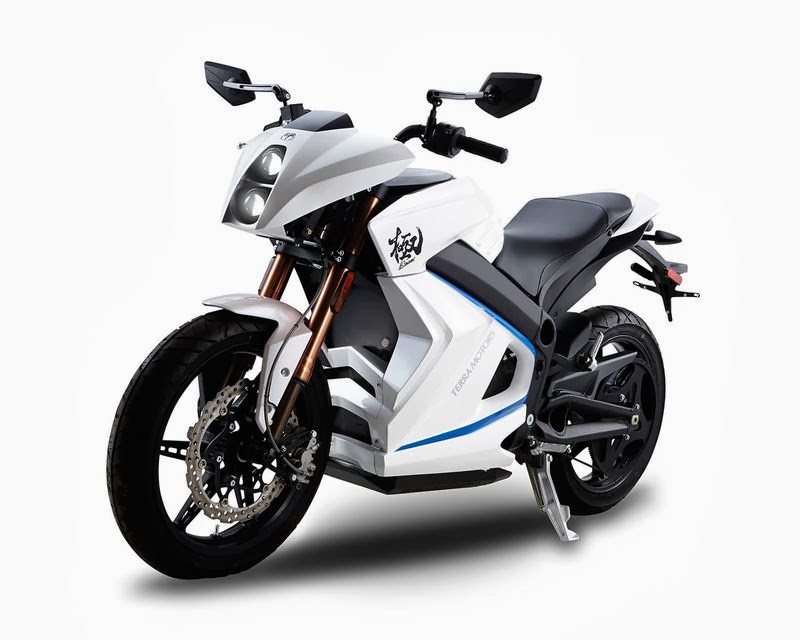
Japan’s Terra Motors unveils electric superbike

Japanese electric two wheeler maker Terra Motors Corporation has unveiled an electric superbike, the Kiwami electric bike in India.

The company, which plans to start selling the bike in next couple of months, also plans to bring in a premium electric scooter, a range of affordable electric bikes and electric three wheelers into the Indian market.

“Besides, Kiwami, we plan to bring in a premium electric scooter and an electric three-wheeler this year. We will also consider launching affordable range electric bikes in the future,” Terra Motors Chief Executive Officer Toru Tokushige told reporters in New Delhi.

The Tokyo-headquartered firm, which will be importing the superbike initially into the country, is looking to garner 25 per cent market share in the Indian electric bike segment.

“We are targeting 25 per cent market share this year in the electric bike segment. We also plan to invest Rs 30 crore during the year,” Mr. Tokushige said.

The Indian electric bike market is estimated to be around 60,000 units per annum.

The Kiwami can cover a distance of 200 km with a single charge and achieve a top speed of 140 km/hr.

Terra Motors, which sold 20,000 electric vehicles in Japan last year, is also in the process of finalising dealer partners in India.

“With immense knowledge of electric vehicles, we will associate ourselves with the dealers who are well experienced in service quality,” Mr. Tokushige said.

Terming India as an important market, Mr. Tokushige said the company wants to be a front runner in the electric two-wheeler segment in the country.

“India is the second largest producer of two-wheelers in the world. Hence it is an important market in our strategic growth plan,” Mr. Tokushige said.

Nissan Installs Europe’s 1,000th 30-Minute Electric Car Charger

Nissan has announced 1,000 CHAdeMO quick chargers have now been installed in Europe with the commissioning of the charger at the Roadchef Clacket Lane Services in Surrey, UK. The fast charging unit can recharge the batteries of compatible* electric vehicles- including the 100% electric Nissan LEAF- from zero to 80 percent charge in just 30 minutes, and at zero cost.

The installation of the fastest type of chargers dramatically increases the uptake and usage of electric vehicles. In Norway, Europe's biggest EV market, the number of electric vehicles using the E18 highway increased eight fold in an 18 month period after a CHAdeMO quick charger was installed on the route**.

The new charger has been installed in collaboration with Ecotricity, a UK green energy specialist and pioneer in electric vehicle charging. The location south of London on the M25 motorway, one of the busiest in Europe, allows drivers west of London easy access to Kent and onwards into Europe.

Director of Electric Vehicles, Nissan Europe, Jean Pierre Diernaz commented: "This is a huge landmark for zero-emission mobility, allowing a range of EVs, including the Nissan LEAF and forthcoming Nissan e-NV200 electric van, to quickly extend their journeys. The UK charging network is expanding rapidly and through our partner Ecotricity, customers are able to "refuel" their car for free with wind and solar generated electricity."

This latest charger is part of a network of 195 chargers in the UK, which is forming electric corridors across the country, linking major towns and cities. In the UK, Nissan has been working with partners including IKEA, Moto, Roadchef, Welcome Break and Nissan dealers to create this rapidly growing network with 124 quick chargers installed in 2013. The rate of installation of CHAdeMO quick chargers across Europe rose sharply in 2013, hugely increasing access for Nissan LEAF customers. In 2010 there were just 16 quick charging points. This rose to 155 a year later and 540 in 2012. The 1,000 mark in 2013 will be dwarfed by the end of 2014 with over 1,800 quick charger points expected. Together with Nissan, investment in this Euope-wide development of infrastructure comes from a multitude of partners in the energy field, including the Swiss multinational power company ABB, French quick charger manufacturers DBT, and the Portuguese EFACEC Corporation, leaders in the electromechanics field.

Toyota Racing release details about AWD hybrid powertrain

TOYOTA Racing can reveal the first details of its participation in the 2014 FIA World Endurance Championship (WEC), in which it will push the limits of hybrid powertrain technology in motorsport.

TOYOTA Racing entered two cars for the WEC season, including the Le Mans 24 Hours, and the Automobile Club de l’Ouest is scheduled to confirm the full grid on 13 February.

For the third consecutive year, Alex Wurz, Nicolas Lapierre, Kazuki Nakajima, Anthony Davidson, Sébastien Buemi and Stéphane Sarrazin will drive for TOYOTA Racing. They are joined by test and reserve driver Mike Conway.

The TS040 HYBRID prototype has been designed according to new regulations intended to keep the WEC and Le Mans at the forefront of road-relevant technology development.

Its first public appearance will come at the WEC official test session on 28-29 March when it will take to the track alongside prototypes from Audi and Porsche for the first time.

After the TS030 HYBRID established TOYOTA Racing as a pioneer in the field of hybrid powertrains for motorsport, its successor, the TS040 HYBRID, takes the technology to the next level.

The addition of an Aisin AW motor/generator on the front axle, in combination with the DENSO unit at the rear, means the TOYOTA HYBRID System – Racing now provides power to all four wheels.

Under deceleration, the motor/generators apply braking force in combination with traditional mechanical brakes to generate energy, which is transferred via a DENSO inverter to the Nisshinbo super-capacitor. During acceleration, the motor/generator reverses its function, acting as a motor to deliver a significant power boost.

That four-wheel-drive hybrid power is allied to a petrol-powered V8 engine, both having been developed by Motor Sports Unit Development Division at the Higashifuji technical centre, where next generation TOYOTA road car technology is also under development.

Such a link between motorsport technology and future road cars is fundamental to TOYOTA Racing, with the TS040 HYBRID, like its predecessor, acting as a real-life test bench for TOYOTA’s latest hybrid concepts. TOYOTA has already sold 6million hybrid road cars since the launch of the Prius in 1997.

The TS040 HYBRID chassis is designed, developed, manufactured, built and operated by TOYOTA Motorsport GmbH (TMG) in Cologne. It represents a major evolution on the TS030 HYBRID thanks to advanced aerodynamics and lightweight design.

New regulations with revised dimensions have made the 2014-generation LMP1 cars narrower by 10cm while measures such as wheel tethers and a rear crash box have further increased safety.

Intensive simulation and calculation work at TMG has refined the TS040 HYBRID, utilising hardware-in-the-loop technology to test individual components based on real track data and powerful calculation computers to optimise designs.

Such cutting-edge techniques are significantly more efficient than track testing, allowing TMG engineers to continue optimising all aspects of the TS040 HYBRID chassis and lay-out for longer than rivals relying on traditional methods.

Development of the TS040 HYBRID has been completed alongside a range of external motorsport and automotive projects running concurrently at TMG, for third-party clients and Toyota Motor Corporation.

The car completed a successful roll-out at Paul Ricard earlier this month (21-23 January), with Alex Wurz and Anthony Davidson driving. Further testing is planned prior to the season-opening Six Hours of Silverstone (20 April).

More details about the TS040 HYBRID, including technical specifications, will be released immediately prior to the 28-29 official WEC test.

Toyota Racing release details about AWD hybrid powertrain

TOYOTA Racing can reveal the first details of its participation in the 2014 FIA World Endurance Championship (WEC), in which it will push the limits of hybrid powertrain technology in motorsport.

TOYOTA Racing entered two cars for the WEC season, including the Le Mans 24 Hours, and the Automobile Club de l’Ouest is scheduled to confirm the full grid on 13 February.

For the third consecutive year, Alex Wurz, Nicolas Lapierre, Kazuki Nakajima, Anthony Davidson, Sébastien Buemi and Stéphane Sarrazin will drive for TOYOTA Racing. They are joined by test and reserve driver Mike Conway.

The TS040 HYBRID prototype has been designed according to new regulations intended to keep the WEC and Le Mans at the forefront of road-relevant technology development.

Its first public appearance will come at the WEC official test session on 28-29 March when it will take to the track alongside prototypes from Audi and Porsche for the first time.

After the TS030 HYBRID established TOYOTA Racing as a pioneer in the field of hybrid powertrains for motorsport, its successor, the TS040 HYBRID, takes the technology to the next level.

The addition of an Aisin AW motor/generator on the front axle, in combination with the DENSO unit at the rear, means the TOYOTA HYBRID System – Racing now provides power to all four wheels.

Under deceleration, the motor/generators apply braking force in combination with traditional mechanical brakes to generate energy, which is transferred via a DENSO inverter to the Nisshinbo super-capacitor. During acceleration, the motor/generator reverses its function, acting as a motor to deliver a significant power boost.

That four-wheel-drive hybrid power is allied to a petrol-powered V8 engine, both having been developed by Motor Sports Unit Development Division at the Higashifuji technical centre, where next generation TOYOTA road car technology is also under development.

Such a link between motorsport technology and future road cars is fundamental to TOYOTA Racing, with the TS040 HYBRID, like its predecessor, acting as a real-life test bench for TOYOTA’s latest hybrid concepts. TOYOTA has already sold 6million hybrid road cars since the launch of the Prius in 1997.

The TS040 HYBRID chassis is designed, developed, manufactured, built and operated by TOYOTA Motorsport GmbH (TMG) in Cologne. It represents a major evolution on the TS030 HYBRID thanks to advanced aerodynamics and lightweight design.

New regulations with revised dimensions have made the 2014-generation LMP1 cars narrower by 10cm while measures such as wheel tethers and a rear crash box have further increased safety.

Intensive simulation and calculation work at TMG has refined the TS040 HYBRID, utilising hardware-in-the-loop technology to test individual components based on real track data and powerful calculation computers to optimise designs.

Such cutting-edge techniques are significantly more efficient than track testing, allowing TMG engineers to continue optimising all aspects of the TS040 HYBRID chassis and lay-out for longer than rivals relying on traditional methods.

Development of the TS040 HYBRID has been completed alongside a range of external motorsport and automotive projects running concurrently at TMG, for third-party clients and Toyota Motor Corporation.

The car completed a successful roll-out at Paul Ricard earlier this month (21-23 January), with Alex Wurz and Anthony Davidson driving. Further testing is planned prior to the season-opening Six Hours of Silverstone (20 April).

More details about the TS040 HYBRID, including technical specifications, will be released immediately prior to the 28-29 official WEC test.