BMW i3 with F1 Technology [VIDEO]

BMW i3 is one of many cars that now come equipped with F1 technology. The carbon fibre reinforced plastic (CFRP) Monocoque is used to reduce weight and ensure road safety.

The extensive use of carbon fibre keeps the curb weight down to 1,195 kg which is much lower then either a Nissan Leaf (1,500 kg) or a plug-in hybrid like the Chevy Volt (1,700 kg).

When combined with the i3's 125 kW BLDC electric motor, which is more powerful than either the Leaf (80 kW) or the Volt (110 kW), the result is a 0-100 km/h time of 7 seconds.

Toyota i-ROAD: Tokyo Trials [VIDEO]

Toyota's i-ROAD compact electric personal mobility vehicle takes to the streets in Japan's capital.

Participants in the limited public trials share their feedback on the ultra-compact, fun to drive i-ROAD, which is available in five colors.

Nissan Leaf Replacement Battery Priced At $5,499

The Nissan Leaf has been on the market since 2010, so there’s a good chance that some of them are getting close to 60,000 miles. This is important because it’s when the 5 years/60,000 miles capacity loss warranty expires. Nissan has announced that pricing for a replacement battery start at $5,499.

As an EV battery pack is defined as 'used' once it's capacity reduces to approx 80% Nissan have developed a new business model to create a market for 'used' Leaf battery packs. The old battery must be exchanged for the new battery as a condition of the sale of the replacement battery, and Nissan’s suggested retail battery pricing reflects a $1,000 core value assigned to the battery. Nissan will ensure that the old battery is recycled and reused as part of their 4R Energy business.

Nissan and Sumitomo Corporation created the joint venture company, “4R Energy Corporation”, in September 2010, to address the secondary use of EV lithium-ion batteries. Earlier this year they launched the world’s first large-scale power storage system which utilizes used batteries collected from electric vehicles.

The used EV batteries that will be recycled into this large-scale storage system have been recovered and have gone through thorough inspection and maintenance at 4R, to confirm safety and performance. The prototype system (600kW/400kWh) consists of sixteen used EV batteries.

The $5,499 price is just for the battery, and that doesn’t include taxes or dealer installation. Owners of the 2011 and 2012 Nissan Leaf will also need to pay $225 for an installation kit that allows the newer battery design to fit into the older models.

Nissan will offer financing options to customers who need to replace their battery. Details about this financing probably won’t be finalized until closer to the end of the year, but Nissan expects to keep monthly payments close to $100 per month.

Like the batteries found in a new Nissan Leaf, the replacement batteries will carry an eight-year/100,000-mile warranty against defects and a five-year/60,000-mile against capacity loss.

Check out the official statement from Nissan spokesman Brian Brockman available below, or head on over to the My Nissan Leaf forum to read more.

Source: AutoblogGreen

Audi plans plug-in hybrid offensive

Audi plans to launch at least four plug-in hybrid cars as it bets on the technology to counter rival BMW's electric car offensive.

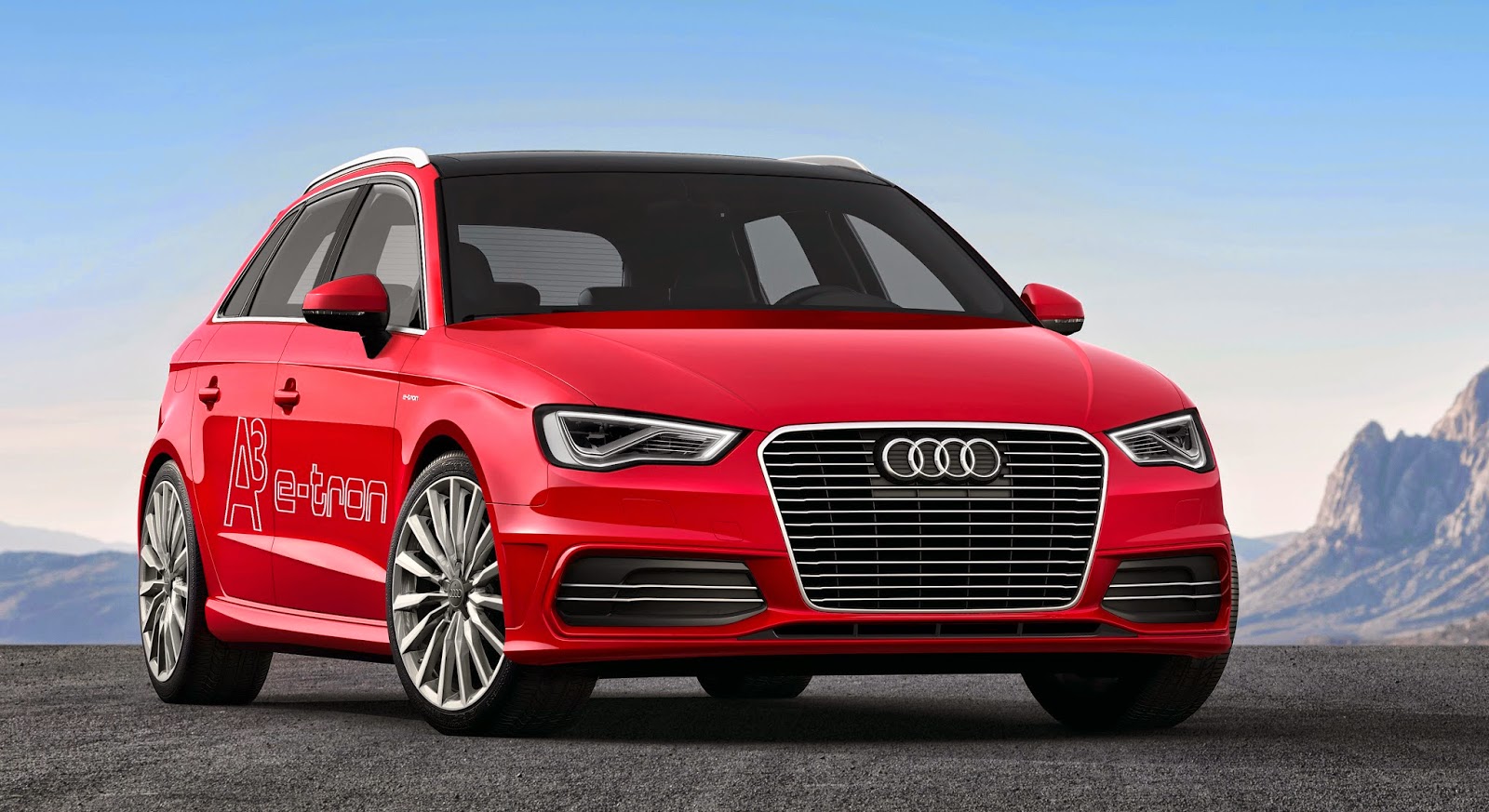
Audi will roll out the A3 Sportback E-tron, its first plug-in hybrid, in Europe this month. U.S. sales are expected to begin in the second or third quarter of 2015, while China deliveries will start in the first or second quarter of next year.

The model will compete with cars such as the battery-powered BMW i3 in a bid to win customers looking for environmentally friendly vehicles.

Audi CEO Rupert Stadler said today the A3 Sportback E-tron will be followed by other plug-in hybrids.

"We strongly believe in plug-in hybrids and we will add a new model each year, beginning with the Q7 next year, followed by the A6 long-wheelbase sedan for China and the A8," Stadler said on the sidelines of the A3 Sportback E-tron's introduction here.

Audi believes plug-in hybrids are the best solution for low-emission vehicles because they don't face the same range constraints as battery-powered vehicles. Plug-in hybrids use a conventional internal combustion engine but can also run on electric power with zero emissions.

“Plug-in hybrids are electric vehicles for everyday driving, exactly what our customers are asking for,” Stadler said.

The A3 Sportback E-tron can be driven under electric power for about 30 miles. Using the gasoline engine, it has a 373-mile range. BMW's i3 has a driving range of up to 100 miles, rising to about 187 miles for the version with a range extender.

Audi’s approach to clean-car technology diverges from the path taken by BMW, which created the “i” subbrand to showcase its environmental technology. The i3 city car and the plug-in hybrid i8 supercar have plastic exterior body panels and distinctive styling to make them stand out from other cars on the road.

“BMW created a product that is totally different,” while Audi as well as Mercedes-Benz “try to integrate e-mobility into their existing vehicles,” said Christian Breitsprecher, a Frankfurt-based analyst with Macquarie Europe. The advantage for Audi and Mercedes is “if there’s lots of demand, they can produce a lot. If not, they can allocate the capacity to their normal cars.”

Stadler said he could not give a figure for how may plug-in hybrids Audi will sell. "Plug-in hybrids could account for 10 percent to 20 percent, even 40 percent of the 2 million units we plan to build annually by 2020. It will be our customers who decide, and we are ready to satisfy their demand,” he said.

“Plug-in hybrids are fully integrated in our platforms and production process, so we are beginning with the A3 E-tron in Germany, but the same technology could be applied to the production lines we have in China and in Mexico,” Stadler added.

Extra cost

Audi's approach may keep spending under control, but the question is whether customers will pay the extra cost for technology that’s not evident from the curbside.

The A3 Sportback E-tron looks identical to its conventional A3 counterpart and starts at 37,900 euros ($51,700) in Germany. That’s 15,100 euros more than the base gasoline-powered version of the A3.

Hiding its green technology under the hood could be a risk for Audi. Inroads by electric-car maker Tesla Motors into the luxury-car segment show that wealthy drivers are ready to buy upscale green cars, if they get noticed. That goes for the BMW i3 as well. Demand for the car prompted BMW to triple production of carbon fiber, which is used for the passenger compartment.

“In an i3 and the Tesla, the attributes of luxury, modern technology and protecting the environment are clearly visible to everyone,” Breitsprecher said. The Audi plug-in “doesn’t show off that the consumer paid extra.”

Still, the threat for Audi is more to its image as a technology leader, with demand for plug-in hybrids and electric vehicles expected to remain restrained. The segment is forecast to account for just 5.7 percent of global auto production in 2019, according to IHS Automotive.

In Germany, Audi is selling the A3 Sportback E-tron via a network of 100 selected dealerships where service employees have been trained to work with high-voltage technology. The E-tron dealerships have an electric charging station that customers can use free of charge during business hours.

The A3 E-tron has a 150 hp 1.4-liter direct injection turbo gasoline engine and a 102 hp electric motor housed within the six-speed dual clutch transmission. As the two power sources never work together at full force, combined system power is 204 hp, Audi said. Top speed is 137 mph in hybrid mode and 80 mph in pure electric mode.

Audi said it takes about 3 hours and 45 minutes to fully recharge the lithium ion 8.8 kWh battery from a 200 volt household outlet. With an industrial 380 volt charging station, recharging time decreases to 2 hours and 15 minutes, the company said.

Driving Tesla Model S P85 on German autobahn [VIDEO]

Norwegian Tesla owner Bjørn Nyland has uploaded a video demonstrating his Model S at Autobahn speeds.

A Tesla Model S P85 driven at it's maximum speed of 210 km/h (130 mph) has an estimated range of 154 kms (96 Miles)

Having recently returned from Munich I can vouch for the fact that driving at 160 km/h (100 mph) in the fast lane is considered slow, they really do drive at 200 km/h routinely on unlimited sections, yet the road toll is actually lower than in many other countries (including Australia).

Continental introduce tire optimized for hybrids [VIDEO]

Continental has taken the Conti.eContact that was originally launched in 2011 with electric vehicles in mind and refined it to meet the needs of hybrid models. Thanks to the introduction of numerous new technologies and processes, this new and extensively hand-crafted summer tire is the first from Continental to obtain the top A rating on the EU Tire Label for both wet grip and rolling resistance, while making no significant compromises in terms of the many other performance parameters.

With immediate effect Continental is offering the Conti.eContact in six sizes for 17 and 18-inch rims, specially designed for models such as the Opel Ampera, BMW 5 ActiveHybrid, Lexus LS 600h and Porsche Cayenne S Hybrid, as well as other cars and SUVs with hybrid drive. Given that this is a new vehicle segment that also involves highly complex production processes, Continental is kicking off with low-volume production at its French tire plant in Sarreguemines.

The rolling resistance of the new Conti.eContact for hybrid vehicles is some 20 percent lower than in a conventional tire, while delivering a wet braking performance similar to that of a normal car tire. This is made possible by a combination of advanced technologies in the development, compounding and production sectors. In terms of handling and braking on dry roads, the tire performs at the same high level as a Continental sedan tire of comparable size. As a member of the Continental tire family for hybrid and electric vehicles, the Conti.eContact bears the “BlueEco” logo on the sidewall. Continental’s in-house studies point to incremental growth in the proportion of hybrid vehicles in the passenger car segment, which could account for as much as eight percent by 2020.

Green Chili compound
Featuring the newly developed Green Chili compound, the silica compound of the new Conti.eContact for hybrid vehicles is made up in such a way that the internal friction of the filler particles and the polymers is lower than in conventional rubber compounds. The use of special additives provides an additional boost in terms of handling properties. With this new compound, the chemists at Continental have achieved a marked reduction in rolling resistance, while maintaining a high level of handling and braking performance on dry roads.

Hydro-sipes

On wet roads the specially configured twin sipes in the tread blocks generate a ‘windshield wiper’ effect that breaks up the film of water under the contact patch. This smart thinking by the tread designers at Continental enables the water between the surface of the tread blocks and the road to be rapidly dispersed, making for very short stopping distances in the wet. The fast dispersion of the water also benefits the tire’s wet handling – even at higher speeds. The tread design makes a valuable contribution to the short stopping distances in the wet that led to the Conti.eContact’s A rating for wet grip on the EU Tire Label.

AeroFlex technologyAlong with the new technologies adopted for the compound and tread design, the sidewalls of the new Conti.eContact have also been redesigned. In this case the tire designers focused on minimizing aerodynamic drag and rolling resistance. This they achieved through the aerodynamically modified sidewall and its flexible, lightweight design. As a result, in the new Conti.eContact less energy is lost when the tire deflects and rebounds than in a conventional tire. In addition, the drop in turbulence has led to a further reduction in the tire’s contribution to fuel consumption.

ContiSilent

When hybrid vehicles run in electric mode they are virtually silent. As tire noise is no longer drowned out by other sources of noise such as a conventional engine, it is all the more noticeable. Consequently, the new Conti.eContact is designed to generate minimum audible noise in the vehicle interior. This is achieved with the aid of ContiSilent technology. A thin layer of polyurethane foam attached to the inside of the tread reduces the vibrations that are generated as the tire rolls along the road. This means that less vibration is communicated to the chassis, leading to a lower level of noise in the cabin.

Outlander PHEV to Tackle Asia Cross Country Rally 2014

Mitsubishi Motors Corporation (MMC) announces that it will dispatch a team of technical support engineers for an Outlander PHEV entered in the T1.3 4x4 Electric class of the grueling 2,200km FIA-certified Asia Cross Country Rally 2014 (AXCR) from August 9 through 15, to be run from Thailand to Cambodia. The Two & Four Motor Sports rally team (Two & Four), headed by Kenji Ishida, will run an Outlander PHEV in the race for the second straight year. MMC engineers will provide Two & Four's team technical support for the plug-in hybrid four-wheel drive SUV for the duration of the rally. MMC will utilize valuable data and knowhow acquired by the technical support team in future vehicle development.

The 19th edition of the AXCR will get under way with the Ceremonial Start in the Thai beach resort of Pattaya on Saturday August 9. The next day, August 10, sees the start of the rally proper as Leg 1 takes entrants from Pattaya to Sakaeo. On August 12, Leg 3 of the rally takes the competitors into Cambodia and past the World Heritage site of Angkor Wat. The event finishes in the Cambodian capital of Phnom Penh on Friday August 15. The AXCR covers a total distance of 2,200 km and offers a grueling test of all-terrain performance and durability as it requires competitors to conquer mountains, forests, swamps and river crossings.

The Outlander PHEV rally car will use competition suspension and reinforced mountings to raise ground clearance and improve all-terrain performance over poor surfaces. The vehicle's S-AWC integrated vehicle dynamics control system will be tuned for competition use to deliver better traction. Other modifications include the fitting of a roll cage and underbody skid plate, the use of lighter engine hood, rear gate and interior parts, and additional sealing and a snorkel for water crossings.

Audi Plans Range of High-Performance Electric Cars

Audi has drawn up blueprints for a wider range of high-performance electric cars to help it take on German rivals and U.S. firm Tesla Motors, according to sources at the carmaker.

Tesla has managed to stay ahead of the pack with new technology, which has extended driving range and reduced costs. Its success and the excitement about BMW's new "i" electric series have caught the attention of Audi, which some analysts have said risks looking like a laggard in an industry where innovation is a major draw for customers.

Audi, a unit of Volkswagen, is about to launch its first purely electric car, a battery-powered version of its R8 supercar, which is due to hit European dealerships in 2015. It will offer a driving range of 450 km (280 miles), close to the 502 km of Tesla's top-selling Model S luxury saloon.

Meanwhile, Audi has scaled up its electric car plans, having devised blueprints for several high-performance electric saloons and sport-utility vehicles, two company sources told Reuters, asking not to be identified because the matter is confidential.

VW declined to comment. Audi did not return calls seeking comment. The manufacturer has shown various hybrid and purely electric concept cars since about 2009, but the latest blueprints stand a bigger chance of getting the nod for production after it lately overcame range limits.

"Germany's major carmakers all have their electric car plans ready in the drawer," Hanover-based NordLB analyst Frank Schwope said. "They want to be prepared when demand accelerates," he said. The sources at Audi did not specify how many models were being planned or the scale of any production plans.

They said, however, that one of the blueprints is for an electric version of a new Q8 SUV that would pit the brand against Tesla's forthcoming Model X. Audi has defined a range target of about 400 km for any future electric model it aims to develop, the sources said.

Audi's plans will be helped by steps underway to upgrade a production platform dubbed MLB that already underpins larger models across the VW group, such as the Audi A8 saloon and Porsche Cayenne SUV, and would cut costs for electric cars.

INNOVATIONS

Sales of electric cars are expected to surge to 2.7 million globally by 2018 from 180,000 last year as more models come to market, battery costs fall and the number of charging stations grows, according to business consultancy Frost & Sullivan. While mid-market battery cars such as the Renault Zoe and Nissan Leaf have missed sales targets, there has been more buoyant demand for premium offerings. Germany's three leading luxury carmakers are all advancing on the electric market.

Rival BMW has launched its "i" series of electric models, including a 34,950 euro ($47,400) city car, while Mercedes, whose parent Daimler owns a 4.3 percent stake in Tesla, started production in April of its B-Class electric compact.

Tesla has devised innovations that have cut the cost and raised the safety of battery packs. Its models also recharge more quickly than those of rivals, thanks to its connectors, software and efficient power management.

But the California-based company is now facing its own challenges related to scaling up further after its success. It said last week it would share its patents with competitors in hopes of speeding up development of electric cars across the industry.

Tesla executives have also met counterparts from BMW to discuss ways to promote electric cars which analysts say must include steps to create a common infrastructure and share the cost of building recharging stations.

Audi's electric-car moves highlight a change of tack at VW. In 2012 Audi shelved the R8 e-tron at request of its parent as efforts to expand the model's driving range had stalled at only 215 km.

Audi, which has since swapped R&D chiefs, has overcome the range limits by increasing the efficiency of the electric drivetrain and curbing on-board power consumption, development chief Ulrich Hackenberg has said.

"Electric mobility is a key focus of our development strategy," he said in March. "We are ideally prepared for the future with our strategic roadmap and a well-filled development pipeline."

Harley-Davidson Reveals Project LiveWire EV Concept [VIDEO]

Innovation, meet heritage. Today, Harley-Davidson reveals Project LiveWire – the first Harley-Davidson® electric motorcycle.

In keeping with the company's customer-led product development approach, starting next week select consumers across the country will be able to ride and provide feedback on the bike, helping to shape the future of Harley-Davidson's first-ever electric motorcycle.

While not for sale, Project LiveWire is specifically designed for the purpose of getting insight into rider expectations of an electric Harley-Davidson motorcycle.

"America at its best has always been about reinvention," said Matt Levatich, President and Chief Operating Officer, Harley-Davidson Motor Company. "And, like America, Harley-Davidson has reinvented itself many times in our history, with customers leading us every step of the way. Project LiveWire is another exciting, customer-led moment in our history."

Spurred by this heritage, the Project LiveWire Experience invites customers to test ride, provide feedback and learn more about the story of the motorcycle. Even those who don't yet ride will have the opportunity to feel the power of Project LiveWire through Jumpstart – a simulated riding experience.

A 2014 U.S. tour – kicking off with a journey down Route 66 – will visit more than 30 Harley-Davidson dealerships now through the end of the year. In 2015, the Project LiveWire Experience will continue in the U.S. and expand into Canada and Europe.

"This builds on many recent reinvention successes for Harley-Davidson," said Levatich. "In just the last few years, we've broadened our reach to serve an increasingly diverse society, as well as reinvented our approach to product development and manufacturing. This has resulted in cutting-edge products like the recently launched Project Rushmore touring bikes, Harley-Davidson Street 500 and 750 models and this reveal of Project LiveWire."

An Innovative Approach to Advance the Possibilities of Personal Freedom This exciting new ride blends the company's styling heritage with the latest technology to deliver a new expression of the signature Harley-Davidson look, sound and feel.

"Project LiveWire is more like the first electric guitar – not an electric car," said Mark-Hans Richer, Senior Vice President and Chief Marketing Officer, Harley-Davidson Motor Company. "It's an expression of individuality and iconic style that just happens to be electric. Project LiveWire is a bold statement for us as a company and a brand."

The bike offers a visceral riding experience with tire-shredding acceleration and an unmistakable new sound.

"The sound is a distinct part of the thrill," said Richer. "Think fighter jet on an aircraft carrier. Project LiveWire's unique sound was designed to differentiate it from internal combustion and other electric motorcycles on the market."

Longer term plans for retail availability of Project LiveWire will be influenced by feedback from riders along the Project Livewire Experience tour.

"We offer a no excuses riding experience in everything we do and we are led by what our customers tell us matters most," said Richer. "Because electric vehicle technology is evolving rapidly, we are excited to learn more from riders through the Project LiveWire Experience to fully understand the definition of success in this market as the technology continues to evolve."

Helping Preserve and Renew the Freedom to Ride for Generations As riding in the great outdoors is one of the best elements of motorcycling, sustainability remains a core strategic focus at Harley-Davidson.

"Preserving the riding environment is important to all of us," said Levatich. "Project LiveWire is just one element in our efforts to preserve and renew the freedom to ride for generations to come. As a company that has seen success for 111 years, we think in generational terms about our great riding environments for the next 111 years."

Partnership to Develop Dual Carbon Battery for Racing [VIDEO]

Racing group Team TAISAN and materials engineer Power Japan Plus have formed a partnership to develop an electric racing vehicle, which will be the first in the world to use the Ryden dual carbon battery.

Under this partnership, Power Japan Plus will provide Ryden cells and Team TAISAN will leverage its vast experience in international racing to optimize the battery and develop a battery pack and management circuit. A go-kart powered by the Ryden dual carbon battery will begin test driving August of this year.

“We have faced a number of issues with electric vehicle batteries up until now. The Ryden battery from Power Japan Plus is the solution we have been searching for,” said Yasutsune Chiba, owner of Team TAISAN. “We will first develop a battery capable of withstanding the rigorous demands of racing, before advancing the technology for use in commercial applications."

Team TAISAN has faced many roadblocks with conventional battery technology, the danger of thermal runaway being the most prevalent. Intense heating prevented other electric vehicle (a Tesla Roadster) racing cars used by TAISAN from running continuously. In searching for a solution to this problem, Team TAISAN discovered the Ryden dual carbon battery developed by Power Japan Plus.

The Ryden dual carbon battery wields an energy density comparable to lithium-ion batteries, with a much faster charge time. In addition, Ryden is resistant to heating during operation, mitigating the threat of thermal runway and yielding a simpler battery pack cooling system.

"Team TAISAN has profound experience in automotive technology, especially with the high demand world of motorsports,” said Dou Kani, CEO and co-founder of Power Japan Plus. “I am confident that by working together with Team TAISAN, we can produce an irreplaceable electric vehicle battery unlike any ever made.”

Development will start with a go-kart powered by the Ryden dual carbon battery, which will undergo endurance testing in harsh summer heat conditions this August. The team will then build a full scale EV racing car driven by a Ryden battery pack. Team TAISAN will conduct endurance and safety tests on the electric racing vehicle at its facilities in Chiba Prefecture, Japan, with a goal for the vehicle to debut in a Japanese EV racing competition.

Established in 1983, Team TAISAN is recognized as one of Japan’s most prestigious racing teams, with a total count of 72 victories. Among these victories, Team TAISAN has won 13 Japanese national racing championships – eight during the last 20 years – at the All Japan Grand Touring Car Championship (JGTC) / Super GT (SGT). The team has also won six overseas championships, including The 24 Hours of Le Mans in the GT class in its very first attempt, going on to complete the race a total of six times. The team has also been actively involved in EV endurance racing in Japan. Team TAISAN was an early adopter of the Tesla Roadster, champion at the 2011 ALL JAPAN EV-GP SERIES, as well as the modified EV Porsche 916 model, which completed four, one-hour endurance races hosted by the EV Club, with third place honors in the lead-based battery class.

The partnership was announced publically prior to the start of the 24 Hours of Le Mans race this past Saturday in Le Mans, France.

Nissan & BMW keen to collaborate with Tesla on Supercharger standards

We recently reported that BMW is keen to collaborate with Tesla on creating possible global vehicle-charging standards, and now Nissan is also interested according to sources.

“It is obviously clear that everyone would benefit if there was a far more simple way for everyone to charge their cars,” said one executive, who declined to be named as the plans are not yet official.

Between them, Nissan, the world’s biggest electric-car manufacturer, BMW and Tesla account for about 80 per cent of the world’s battery electric-car sales.

Tesla has risen from an ambitious San Francisco start-up to account for about a quarter of the world’s electric-car market, and defy naysayers at some of the world’s largest carmakers that said that the vehicles were not commercially viable.

BMW, which has invested heavily in its electric i range, said that it and Tesla were “strongly committed to the success of electro-mobility”, and used their meeting to discuss ways to “further strengthen” the global electric-vehicle market.

BMW was informed of Mr Musk’s patent decision at the Wednesday meeting, but both companies stressed that the meeting’s timing was coincidental.

“Nissan welcomes any initiative to expand the volumes of electric vehicles,” the Japanese manufacturer said. “Nissan is the market leader in EVs and has worked with other manufacturers to help proliferate the technology.”

Source: FT

BMW + Tesla superchargers a strategic move?

On Wednesday Tesla and BMW met, but what specifically was discussed was not published.

“Both companies are strongly committed to the success of electromobility and discussed how to further strengthen the development of electromobility on an international level,” a BMW spokesman said today in a statement.

On Thursday, Tesla CEO Elon Musk said his company has been in talks with BMW and other automakers on the topic of promoting EVs and making better use of its German Supercharger charging stations.

Musk said that Tesla’s intent wasn’t to create a walled garden around it's supercharger network and that the company is more than happy to allow other makers to use its fast chargers.

There are number of preconditions, though. Firstly, other makers’ cars would need to be able to accept the 135kW output of the Supercharger. Secondly, rival manufacturers would have to contribute to some of the capital cost of the fast charging network.

The Germany market for long range EVs has some unique requirements. Not only is Tesla offering a special tune-up so that its Model S is capable of 130 MPH to compete against the local Porsches, BMW,s Mercedes and Audis on Germany’s unrestricted, high-speed autobahns. But the extra aerodynamic load resulting from sustained Autobahn speeds means that a huge network of very high powered (read Fast) EV charging stations is essential for the long range EV market to be viable in Germany.

With BMW, Audi, Porsche & Mercedes all having leaked plans for 400-600km BEVs there will definatly be future demand for a fast charger network in German. Establishing the Tesla fast charger standard in Germany now in partnership with BMW, the undisputed leader in EV investment, could be seen as a strategic move.

If Tesla doesn't build it, then someone else will!

Mitsubishi Outlander PHEV 830 KM Test Drive

The Swiss Mitsubishi importer has demonstrated that a plug-in hybrid Mitsubishi Outlander PHEV can travel 830 km (518 miles) on a single tank of petrol.

Mitsubishi Motors claims the plug-in hybrid Outlander PHEV has a range of 824 kilometers (512 Miles) in the combined hybrid mode. The Swiss Mitsubishi importer wanted to know whether this is feasible in practice so hired Felix Egolf - a pioneer in the field of ultra-efficient driving over long distances.

Egolf departed on 12 May in a hybrid Outlander from the headquarters of the Swiss importer Härkingen and drove through Basel and the Vosges to Metz. From there he went through Luxembourg and Belgium in the Netherlands. End of the journey was the Dutch Mitsubishi importer in Amstelveen, where Egolf arrived on May 14. The route began in hilly area and 38 percent of the journey performed over highways.

Upon arrival in Amstelveen odometer gave 729 kilometers and the remaining range was further than 90 kilometers. Egolf then drove the Outlander PHEV for a photoshoot to Amsterdam and Utrecht. The onboard computer gave a mileage of more than 830km to when the Outlander PHEV was refueled. For the first time since leaving again There was 45.14 liters of petrol in the tank, which means that consumption 5.44 liters per 100 km. The electricity was approximately 1 kWh/100 km.

Mitsubishi Motors gives the official standard has a range of 824 kilometers. So that, in practice, is actually feasible. Of course, the rider must anticipate well in traffic and clever use of the plug-in hybrid techniek. That is, charge the battery while driving (CHARGE) or save energy (SAVE) and continuous regeneration system utilization, which produce electricity, which is stored in the battery during braking.

EV News will be picking up a Mitsubishi Outlander PHEV for a test drive next week so perhaps we can also test the 800+ km range.

BMW and Tesla executives meet to discuss electric cars

Executives from German carmaker BMW and U.S.-based Tesla Motors Inc met this week in a move which could lead to the creation of charging stations usable for different types of electric cars. Both carmakers are seeking ways to raise the popularity of battery-powered vehicles.

"Both companies are strongly committed to the success of electro-mobility and discussed how to further strengthen the development of electro-mobility on an international level," a BMW spokesman said in a statement on Friday.

BMW said the meeting had taken place on Wednesday but declined to comment in detail about the nature of the talks, or about which BMW executives had met with Tesla.

In a conference call on Thursday, Tesla Chief Executive Elon Musk said there had been talks with BMW about how to promote the use of electric vehicles and how to make better use of Tesla's network of charging stations.

Carmakers including General Motors, Ford, Chrysler, BMW, Daimler, Volkswagen, Audi and Porsche have committed to adopting a common SAE combo standard for fast-charging connectors.

Fast-charging stations allow electric vehicle owners to recharge batteries up to 80 percent in less than 20 minutes.

Today, the Chevrolet Spark and the BMW i3 for example can use the same battery recharging stations.

Tesla has, however, developed its own network of high-speed charging stations including along key autobahn routes in Germany in an effort to make electric cars viable for long-distance commuting.

Tesla's charger system can be fitted with an adapter that allows its cars, including the Tesla Model S, to be recharged on both the SAE chargers and its own system.

SHARING PATENTS

Tesla also said on Thursday that it would allow others to make use of its intellectual property in the hope of speeding up development of electric cars by all manufacturers.

Musk said this included all of Tesla's patents, including several hundred current ones and several thousand in the future.

German premium auto makers have been keen to collaborate with Tesla.

In January, Daimler Chief Executive Dieter Zetsche said the German maker of Mercedes-Benz cars was open to deepening its partnership with the U.S. firm.

Daimler holds a 4.3 percent stake in Tesla, which is already supplying it with electric motors and batteries for its Smart Fortwo electric vehicle (EV) and the new Mercedes-Benz B-Class EV.

Toyota Hybrid Takes Record Breaking Pole at Le Mans

Toyota Racing's Kazuki Nakajima set a new Le Mans qualifying lap record to put the #7 TS040 Hybrid in pole position for the 82nd running of the famous 24-hour endurance race this weekend.

It was the first pole position ever for a Japanese driver and lowered last year's pole position time by more than half a second.

Nakajima, who shares the #7 car with Alex Wurz and Stéphane Sarrazin, scorched around the 13.629km track in 3 mins 21.789 secs to record Toyota's second pole position at Le Mans.

The feat highlighted the performance and efficiency of the 736kW Toyota Hybrid System - Racing which set the fastest qualifying time despite a 25 per cent reduction in fuel consumption compared with last year's car.

The #8 car of Anthony Davidson, Nicolas Lapierre and Sébastien Buemi will start Saturday's race from third on the grid.

As well as starting from first place on the grid, the TS040 Hybrid enters this year's race with two wins from the opening two FIA World Endurance Championship races.

This is the fourth pole position for Sarrazin who achieved the honour in 2007-09 and who has been runner-up three times, including last year. He praised the team for its work in setting up the #7 car and Nakajima for a "brilliant lap".

"It is promising for the race because we feel so confident in the car," he said. "We can push on every corner, every lap. Like that everything is positive. The race will be very long, we know that we have to be very calm and not attack it like a short sprint."

The 24-hour race begins at 11 p.m. tomorrow AEST.

Nissan Zeod RC hits 300 km/h on Mulsanne Straight [VIDEO]

Nissan's ZEOD RC has recorded the highest ever speed by an electric vehicle at Le Mans with Japanese ace Satoshi Motoyama reaching 300km/h on the Mulsanne Straight in qualifying for the Le Mans 24 Hours.

Motoyama reached the speed on his electric run, achieving one the key goals of the unique prototype which features a dual electric/internal combustion engine powertrain featuring a pair of 110kW electric motors along with a remarkable 40 kg, 400 horsepower 1.5 liter three-cylinder turbo engine.

The ZEOD (zero emissions on demand) permits the driver to switch back and forth between the two power sources.

Motoyama achieved the target on his first run in the car after he missed out on driving on Wednesday night to a gearbox issue in the first session and a series of session-stopping red flags during the night.

"I drove ZEOD at Le Mans for the first time and instantly we were able to reach our target to run at more than 300km/h with electric power only," Motoyama said.

"I was so surprised with the speed and power of electricity and it felt great. In yesterday’s session we had some trouble with the gearbox in the first session then we had a heap of red flag periods and I didn’t get the chance to get into the car.

"But the guys on the team did a great job to fix the car and I and I was able to get started tonight right at the green flag tonight.

“Our first target of the top speed of 300 km/h with electric power is done and I think that was a really good first step."

Motoyama along with GT Academy winners Lucas Ordóñez and Wolfgang Reip all drove multiple stints aboard the ZEOD tonight - each recording their mandatory five night laps.

The Nissan ZEOD RC competes at Le Mans this week in "Garage 56" - an additional entry for vehicles showcasing new and innovative technology.

500hp Plug-In Hybrid BMW Supra / Z7 due 2019

Following reports in November about Toyota testing a BMW i8 at their Mt. Fuji proving grounds as a pre-lude to a joint venture sports car, a report now claims BMW and Toyota are already developing a second sports car which, like the i8, is a mid-engine model that will battle the Porsche 911.

According to Car Magazine, the model is codenamed "Silk Road 2" and will spawn a BMW Z7 and Supra. The cars will reportedly be developed by BMW in Munich and is expected to be launched in late 2018 or early 2019.

While development is reportedly at an early stage, the magazine says the car will be a plug-in hybrid featuring a twin-turbo 3.0-liter six cylinder engine, a 150 bhp (111 kW) electric motor, a small battery pack between the seats (again like an i8) and a seven-speed dual clutch transmission. This setup will reportedly enable them to have a combined output of 400-500 bhp (298-372 kW).

If everything pans out, the cars will weigh less than 1650 kg (3637 lbs) and cost approximately €90,000 ($122,010 / £72,720).

Source: Car Magazine

Copper Wires Could Become NanoTech Batteries

Researchers at Florida University have turned copper wires into batteries for much simpler power storage.

The breakthrough could mean smaller consumer electronics, or could be embedded in to hybrid and electric cars or even clothing to help recharge gadgets like phones.

Nanotechnology scientist Jayan Thomas was reported in the media as saying "he believes he has discovered a way to store energy in a thin sheath around an ordinary lightweight copper electrical wire so that wires sending energy can also store it. "We can just convert those wires into batteries so there is no need of a separate battery," Thomas told Reuters. "It has applications everywhere."

The discovery has created a lot excitement in both the mainstream and scientific media. It's both the cover story in the latest Advanced Materials Journal and an article in the current edition of science magazine Nature.

One of the co-authors of the study, Thomas's Ph.D. student Zenan Yu, told Reuters the process is relatively simple.

"First", he said, "he heated the copper wire to create what he described as fuzzy "nano-whiskers," which are naturally insulated by copper oxide, vastly expanding the wire's surface area that can store energy."

"A second plastic-covered layer of nano-whiskers creates a second electrode, similar to the positive and negative sides of a standard battery," Thomas told Reuters.

"The technique could be used to lighten airplanes and spacecraft, to store excess energy from solar panels, and to further miniaturize small electronics," he said.

"The technique could also replace high energy-density supercapacitors, sometimes mistaken by hybrid car owners as a second battery, which provide the quick shot of energy that cars and heavy machinery need to start."

"You open your trunk and you see a lot of space is taken by your batteries. If you can just use some of the cables along the length of your car, you don't need any of that space for batteries," Thomas said.

He plans further research to apply the same technique to fibers woven into clothing along with a flexible solar cell, creating a wearable battery pack.