Nissan BMW Renault and VW unite to form Rapid Charge Network

A partnership of Battery Electric Vehicle (BEV) manufacturers have joined forces through the European Union's TEN-T programme to create a multi-standard and inter-operable charging network through the United Kingdom and Ireland.

As well as helping to finance the scheme, the consortium is providing other members of the project with the benefit of its extensive experience in the BEV field.

This is the first time leading BEV companies Renault, Nissan, BMW and Volkswagen have united to accelerate the growth of EV charging infrastructure, seen as a key enabler towards making zero-emission mobility a market reality. The project, managed by Zero Carbon Futures in North East England also draws on the network expertise of ESB, one of Ireland's foremost energy company and leader of a previous TEN-T project completed this summer, and Newcastle University.

When complete, the UK Rapid Charge Network (RCN) will comprise more than 70 multi standard rapid chargers covering some 1,100km of major trunk routes and providing EV-friendly links to five seaports and five international airports.

Running on two priority road axis on the mainland, the UK RCN will link major ports and cities including Stranraer, Liverpool, Holyhead, Birmingham, Felixstowe, Leeds and Kingston upon Hull while there will also be networks embracing Dublin, Ireland and Belfast, Northern Ireland.

Significantly, the rapid chargers are the latest state-of-the-art multi-standard units and are compatible with cars using 44kW CCS, 44kW CHAdeMO or 43kW AC systems. This will ensure that EV drivers travelling in the UK can undertake long journeys secure in the knowledge that they will never be far from a rapid charger.

Ten rapid chargers have been already installed with a further 28 sites soon to be commissioned.

The UK RCN is part of the European Union-financed Trans European Transport Network (TEN-T) and represents a substantial partnership investment of €7,358,000, half of which is being funded by the EU.

A significant portion of the BEV manufacturers' contribution to the overall costs will be used to fund a research program, led by Newcastle University. This will aim to confirm the benefits of such an advanced inter-operable EV rapid charging network.

Strategic information gathered from users, including customer charging behaviour and changes in mobility patterns, will help plan the roll-out future rapid charging infrastructure in member states across Europe.

Tesla expect another ‘Significant’ Toyota deal by 2017

During a recent trip to Japan, Tesla CEO Elon Musk says his company and Toyota could team on another “significant” joint project in two or three years, and at higher volumes than the soon-to-end RAV4 program.

Musk’s comments came just four months after Tesla Motors Inc. announced that the agreement to supply battery packs for the electric Toyota crossover would finish this year with sales around 2,500.

Musk said there were no concrete plans for a new vehicle with Toyota but dangled the possibility of a bigger project soon.

“I think that if you look out maybe two or three years from now, that I would not be surprised if there is a significant deal with Toyota,” Musk said today at a ceremony to deliver the first Tesla Model S sedans to customers in Japan.

“My best guess is that it would probably be something significant, maybe on a much higher volume level,” he said.

Toyota Motor Corp., which owns 2.4 percent of Tesla, said in May 2012 it envisioned building around 2,500 RAV4 EVs over three years. When the partners announced in May that the program would wrap this year, they were noncommittal about future projects.

The Japanese and American companies have since sparred over alternative visions for tomorrow’s alternative drivetrains.

Toyota has channeled its focus into hydrogen fuel cells, while dismissing EVs as impractical and impossibly short-ranged. Meanwhile, Tesla has beat the drum for batteries, while deriding cars powered by hydrogen stacks as “fool cells.”

Toyota spokesman Dion Corbett said the world’s biggest carmaker had “nothing to say” in response to Musk’s latest overture.

Toyota sold 2,130 RAV4 EVs through August. The company expects to sell the rest of the planned 2,500 by year’s end.

After those are delivered, Toyota will have neither a single EV nameplate in its lineup nor public plans to add one.

Musk was not expected to meet with Toyota officials during his visit to Japan. While in Tokyo, he handed over the keys to nine new Model S sedans on the 52nd-floor observatory of Roppongi Hills Mori Tower, one of the tallest buildings in town.

“We love working with Toyota,” he said. “We have a huge amount of respect for them as a company and certainly much to learn.”

Sales of BMW’s electric car jump in August [VIDEO]

Sales in the United States of BMW electric cars jumped in August, inching closer or, depending on whom you ask, even surpassing sales of Tesla Motors luxury Model S sedan.

The continued success of BMW’s i3 model, which sells for about $41,000 in the U.S., could pressure Tesla and dampen enthusiasm for its Model 3, Tesla’s mass-produced car that is expected to hit the road within the next two or three years. The Model 3 would carry a sticker price of about $35,000.

Tesla last week said it chose Nevada as the site of its battery factory, expected to churn out more and cheaper batteries -- enough to power Tesla’s through its expansion into the mass market.

Tesla shares rose on intraday and closing records of $291.42 and $286.04, respectively, on Thursday. The stock was hit by profit-taking — and comments by CEO Elon Musk, who called Tesla shares “kind of high” — on Friday.

BMW sold 1,025 BMW i3s in August, according to industry and analyst reports, up from less than 400 units in the previous three months. The car was launched in the U.S. in May.

Tesla’s Model S sales in August were estimated at around 1,600 by Autodata Corp, 18% lower year-on-year. Tesla does not release monthly car sales.

Tesla is expected to launch the next vehicle in its line up, the crossover Model X, next year.

Back in May, analysts at Barclays flagged BMW’s electric-car offerings — which include the more expensive, sporty hybrid plug-in i8 — as a threat to Tesla. Tesla’s target audience is likely sandwiched between the i3 and the i8 models, the analysts said.

Fully Charged VW Golf GTE Plug-In Hybrid [VIDEO]

Robert Llewellyn takes a brief test drive of the soon to be launched Volkswagen Golf GTE, the first plug in hybrid Golf.

With a 1.4 litre TSI petrol engine, 100 HP electric motor coupled to a 6 speed DSG gearbox and 8.8 kWh battery pack, the GTE can cover 0 - 100 km/h in 7.6 sec and returns 1.5L/100km.

Tesla Model S Vs Sunswift eVe.. 500 km range on 1/5 the battery capacity

Recently EV News had the opportunity to test drive two electric vehicles with 500 km range within a fortnight of each other. One, a world record breaking electric car, the University of New South Wales Sunswift eVe solar race car and the other a Tesla Model S P85+.

I wrote last year how in many ways the two share a common heritage with technology in the Tesla having a direct evolutionary path from the inaugural World Solar Challenge in 1987. While I was massively impressed by my short drive in the top-of-the-line Model S, it's interesting to analyse the strengths and weaknesses of two EVs that both achieve the holy grail of plug-in vehicles, 500 km range on a single charge.

Following Sunswift eVe's World Record run in July, Wired magazine hailed the student-run university project as being Tesla's new competitor, ahead of the likes of BMW or General Motors. Hyperbole? Perhaps as eVe is not a road registered vehicle let alone production ready. But that doesn't detract from the fact that during the world record run, Sunswift eVe achieved 500 km range at highway speeds of 107 km/h (66 mph), without solar array assistance, using a battery pack made of the exact same Panasonic cells used by Tesla but with 1/5 th the capacity of the Model S.

When you take into consideration that much of the Model S design, from the large wheelbase to the all Aluminium body construction, is dictated by the 500 km range goal and the size and weight of the battery pack required to achieve that, any vehicle that achieves energy efficiency sufficient to reduce the 18650 battery cell count from 7,104 to 1,200 must offer some advantages.

Number one on the list is direct drive in-wheel motors. Sunswift eVe is RWD and powered by 2x 1.8 Kw (10 Kw Peak) Australian developed direct drive CSIRO wheel motors, that give eVe a top speed of 140 km/h. These axial flux BLDC wheel motors are 98.3% energy efficient and because they are inside the wheel with the rotor turning at the same RPM as the tire, there is no mechanical transmission gearing losses which typically range from 20-30%.

Sure, rated power of only 1.8 kw is barely enough to run a 4 slice toaster but the driving experience proved that 20 kw peak (27 horsepower) provides enough performance to accelerate and maintain highway speeds with minimal fuss. Each wheel motor weighs in at only 15 kg with the 99.2% efficient motor inverters adding less than 1 kg each to over-all powertrain weight.

Next up is aero efficiency. Because the car was deigned for a 3,000 km race with a high average speed on extremely limited solar power, aerodynamic efficiency is king. Sunswift eVe has a 1800 x 4500 mm footprint (larger than a Tesla Roadster). Although the car has twice the frontal area of its blade-like solar car predecessor, Sunswift has achieved a similar drag coefficient. It’s managed this partly through a unique high-set “tunnel” underside design, giving the car the look of a catamaran.

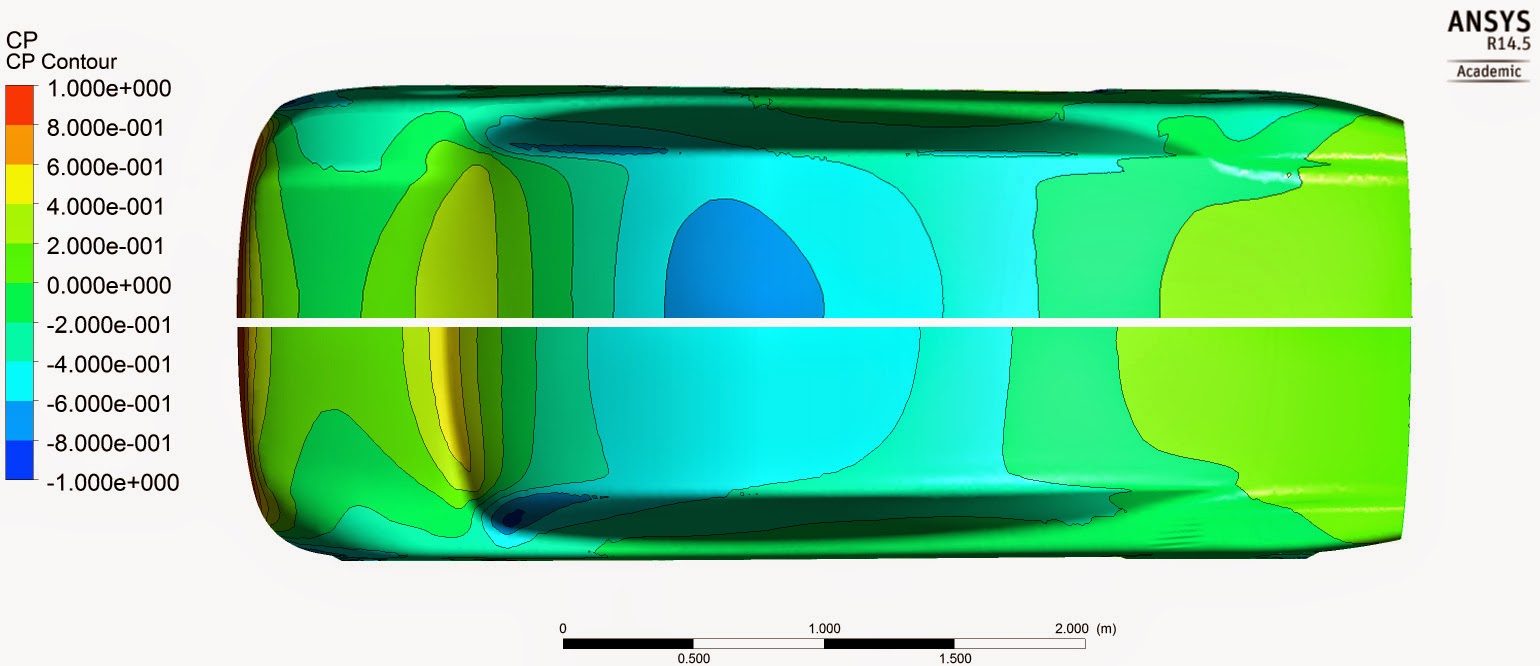
Where the Tesla Model S has the lowest drag coefficient of any production vehicle of 0.24, Sunswift eVe, designed exclusively using Computational fluid dynamics (CFD), achieves a Cd of 0.16. During my test drive of eVe, even though the vehicle had both doors removed for easy access, the lack of aero drag was noticeable while coasting. One team member told me it takes eVe several kilometers to coast to a stop from 100 km/h.

While Tesla claimed that every panel on the Roadster was carbon fibre, UNSW has taken that a step further and fabricated the entire chassis from the material. Manufactured through a sponsorship deal with New Zealand firm Core Builders Composites, the company that build much of the America's Cup fleet, the vehicle has a kurb weigh of just 320 kg. A Tesla Model S weighs 2100 kg.

The main benefit of light weight is reduced rolling resistance. Approximately 5–15% of the fuel consumed by a typical car may be used to overcome rolling resistance. Michelin special order low rolling resistance tyres are used which are run at 80 psi. While not exactly the same kind of road car tires as the 285/30 R21 used on the rear of a P85+, they are possibly not too far removed from the bicycle like 155/70 R19 tires fitted to the BMW i3.

The combination of electrical energy efficiency, low aero drag and rolling resistance means a 16 kWh battery made from 1200x Panasonic NCR18650 cylindrical Lithium Ion cells with a weight of only 63 Kg is enough to give eVe a single charge highway speed cruising range of over 500 km. That's the same battery capacity as a Mitsubishi iMiEV which has a maximum range of 155 km.

Although carbon fiber is roughly 20 times more expensive than steel, BMW have invested €400 million to launch the first carbon fibre reinforced plastic (CFRP) production car, the all electric i3. BMW’s goal is to get the expense of a carbon-fiber frame down to the level of aluminium by 2020. While only the passenger cabin of the i3 is made from carbon fiber with the drive train, battery and suspension attached to an aluminium chassis, it seems only a mater of time before 100% CF chassis like eVe become economically viable for mass produced road cars.

The next challenge for the Sunswift team is to make the eVe the first road-legal solar-powered car in Australia. They expect it to meet Australian road registration requirements within as little as one year.

Foxconn invest $800M to build electric cars in China

Foxconn Technology Group, the maker of Apple’s iPhone, is investing at least 5 billion yuan (US$811 million) to develop electric car manufacturing in a Chinese province.

The Taiwanese company is making the investment in China’s Shanxi province, it said on Wednesday. Foxconn already has two factories in the province. One of these assembles smartphones while the other is devoted to producing robots and automation equipment, it added.

Foxconn has largely focused on electronics manufacturing for clients including Microsoft, Sony and Amazon.com. But the company is branching out into new business sectors, as a way to grow its revenue streams. Analysts estimate that it makes as much as half of its revenue from assembling Apple products.

In June, Foxconn’s CEO Terry Gou said that the company is targeting to build electric cars with a price of less than $15,000.

Foxconn has already been developing electric car batteries for some time, and the company has many customers for them, he added. It also manufactures the touchscreen panels found inside the electric cars from Tesla Motors.

Foxconn Technology Group and BAIC Motor Corporation recently agreed to jointly establish a company that provides electric vehicle rental services, set to become operational in September. BAIC launched the E150 EV in China earlier this year.

The BAIC E150 EV is powered by an 60 hp and 144nm electric motor powered by a 25.6kwh lithium-ion battery. Top speed is 125km/h, range is 150km. Price range from $20.300 to 22.000.

China is mandating that electric cars make up at least 30 percent of government vehicle purchases by 2016, the latest measure to fight pollution and cut energy use after previously exempting EVs from a purchase tax.

Kia pushes energy-density frontier with Soul EV battery [VIDEO]

Kia Motors is using a 360-V lithium-ion battery pack of “class-leading” energy density (200 W·h/kg) in the 2015 Soul EV to give it range of about 200 km (125 mi) on the European Driving Cycle, and “real-world” range of 80-100 mi (129-161 km) in the U.S. The cells and the battery are the same in all regions.

The battery in the 2015 Kia Soul EV is the result of a three-year development program with lithium-ion cell maker SK Innovation. The 192 cells are packaged into eight modules and deliver a total battery capacity of 27 kW·h. The cell cathode is of nickel-rich NCM (nickel-cobalt-manganese) chemistry, with the raw materials for that and other components optimized for energy density, durability, and safety.

Kia says high-performance anode and gel electrolyte additive materials were developed. The new electrolyte additive allows for better range by more effectively dealing with low and high temperatures. A “special” ceramic separator with improved thermal resistance properties is used.

The cell casings are of polymer pouch type (as opposed to metal), and the battery pack is air-cooled. Standard equipment on the Soul EV includes receptacles for SAE J1772 Level 1 and Level 2 ac charging, as well as CHAdeMO dc fast charging (480 V).

The car goes on sale in the U.S. in third quarter 2014.

Tesla to Roll Out “Destination Charging” Program At Hotels, Restaurants And Resorts

Tesla has begun installing high-power wall chargers at restaurants, hotels, beach parking and other locations that can send 80 amps of electricity into the Model S and add 58 miles of range in an hour. While that’s not nearly as fast as a Supercharger, which can recharge the 85 kWh pack in around 30 minutes, it’s twice as fast as the standard 240-volt chargers that can be more commonly be found around in parking lots and garages.

Tesla has been rolling these out quickly across the US as a convenience to customers. The company says 106 of them have been installed since the program began this spring, with more coming online daily. Like the Superchargers, they are free to use for Tesla owners.

Unlike Superchargers, which function more like a petrol station, these wall chargers are designed for destinations. Teslas can also use standard charging stations with the use of an adapter that comes with the car but due to the out-sized capacity of the battery in a Model S (up to 85 kWh), a full charge from a standard 240v 10 amp outlet might take as long as 30 hours. To make utilizing the full range of a Model S practical, for example for weekend trips, higher powered 'destination' charging is required to provide up to 500 km worth of charge in approx 4-5 hours.

London’s hybrid buses to wirelessly recharge at stops

Hybrid London buses that use batteries and a motor will now start recharging at stops, wirelessly. The inductive charge should mean the engine won't need to be used as much, or at all.

The inductive charging, built into the bus stops, will be trialled by TfL in four stops in east London from next year. The special Enviro400H E400 hybrid buses, with wireless charging capabilities, will run on route 69 between Canning Town and Walthamstow.

By keeping the batteries topped up the buses should be able to run longer in battery mode meaning lower running costs and less environmental damage. The journey should offer less vibrations and noise while travelling too. The trial should help enhance the electric bus offerings in London.

There are currently six pure electric buses being tested in London also. The Mayor of London wants the city to be the world's first Ultra Low Emission Zone by 2020. There are currently 800 hybrid buses operating in London with 1,700 expected in 2016 – making up 20 per cent of the total bus fleet.

Mike Weston, TfL’s Director of Buses, said: "We are continuing our assessment of new technology in the capital that can deliver genuine environmental benefits. This trial of extended range diesel electric hybrid buses, utilising the latest inductive charging technology, could be a step closer to getting even cleaner double deck buses on London’s streets. We will be closely monitoring the results of the trials, which may help us adopt this new cleaner technology more widely in London."

Mitsubishi Outlander PHEV to enter 2014 Australian Safari

Mitsubishi’s top selling Outlander PHEV plug-in hybrid electric vehicle is set to tackle a new frontier when it takes on one of the toughest off-road events in outback Australia next month.

With technical support from Mitsubishi Motors Australia (MMAL), Team Mitsubishi Ralliart Australia (TMR Australia) will enter a plug-in hybrid Outlander PHEV in the iconic Australasian Safari, which takes place in Western Australia from 19-27 September.

It will be the first plug-in hybrid four-wheel drive officially entered in an Australian motorsport event – including the Safari, which is considered one of the most demanding off-road endurance rallies in Australia.

Experienced local driver and co-driver team of Steve Glenney and Bernie Webb will put the TMR Australia petrol electric Outlander PHEV through its paces during the nine-day outback event.

The Outlander PHEV will compete in class A1 for production vehicles, in a category specially created for hybrid or dual powered vehicles.

TMR Australia’s Australasian Safari entry marks the third international off-road rally outing for an Outlander PHEV since its launch in late 2012. Previously, the Outlander PHEV’s all-terrain performance and durability have been tested in the Thailand, Cambodia Asia Cross Country Rally, which the Mitsubishi SUV successfully completed in 2013 and 2014.

TMR Australia Outlander PHEV Safari Team Principal Alan Heaphy said the Australasian Safari is a challenging event that demands stamina and endurance from competitors and vehicles alike.

“We’re very excited about building the first plug-in hybrid to compete in the Australasian Safari,” he said.

“The Outlander PHEV showcases the latest Mitsubishi hybrid and four-wheel drive technology, making it an ideal platform for an entry in the Australasian Safari.

“From our long-term experience working with Mitsubishi products, the quality of engineering and technology is a good match for motorsport, and we’re looking forward to proving the Outlander PHEV’s durability and technology in genuine off-road conditions.”

Competing in Australasian Safari production class A1, the Outlander PHEV will be built to meet FIA specification with only minor modifications made for durability and safety.

To help it withstand the punishing conditions, the Outlander PHEV will have extra underbody and frontal protection, reinforced suspension arms and strut towers along with competition brake pads, rally tyres and springs with adjustable dampers for added strength and durability.

The Mitsubishi Outlander PHEV is the world’s first plug-in hybrid SUV. It uses Mitsubishi Motors’ advanced electric vehicle technology by combining a 2.0L MIVEC petrol engine with high output 60kW twin front and rear motors, high capacity 12kWh drive battery and regenerative braking system for maximum efficiency and performance.

Mitsubishi Motor Company will support the TMR Australia Outlander PHEV Safari entry by sending three plug-in hybrid specialist engineers to Western Australia for technical assistance during the gruelling seven day event, which will cover more than 2,500 competitive kilometres through sand, salt plains, dry river beds and rugged desert tracks.

The 2014 Australasian Safari concludes in Kalbarri – 600 kilometres north of Perth – on Saturday 27 September.

Next Generation Nissan Leaf to get 300 km range and new look

The next-generation Nissan Leaf will boast a more conventional hatchback look and an improved 300 km driving range, according to a report from Auto Express.

Nissan bosses are promising new battery technology is on the way, with better energy density for a more usable pure electric vehicle. A figure of about 186 miles (300 kilometres) is likely to be the target.

There’s a good chance Nissan will offer smaller battery packs with less range, like Tesla does with its 60kWh and 85kWh packs. The new battery technology and motor will be shared with Nissan’s luxury brand, Infiniti, too.

Source: AutoExpress

Ultracapacitors to be used for braking energy recuperation in Spanish rail system

Maxwell Technologies, Inc has announced that Win Inertia, an engineering firm specializing in power electronics, energy storage and control and communication systems, is using its ultracapacitors for a stationary wayside braking energy recuperation system at an electric rail system in Cerro Negro, Spain. Win Inertia designed and installed the system under a contract with the Spanish government's Administrator of Railway Infrastructures (ADIF). In this installation, the system also enables ADIF to store excess energy in a battery bank that supplies an electric vehicle (EV) charging station located at the rail station. The facility also seamlessly integrated a photovoltaic (PV) generator to supply additional energy if required.

The recuperation system employs Win Inertia's SHAD® hybrid control technology (international patent pending) to integrate batteries and Maxwell ultracapacitors to increase energy recovery efficiency and reduce stress on the batteries, thereby extending battery life. Ultracapacitors' rapid charge/discharge characteristics uniquely enable them to capture and store more energy during each braking event than battery-based systems, which have limited ability to absorb energy in the few seconds required to stop a vehicle. Win Inertia's high-efficiency hybrid energy storage and power delivery system furthers ADIF's return on investment as it enables dual use of the recuperated energy for rail vehicle propulsion and EV charging. By converting kinetic energy into stored electric energy through regenerative braking, the system recovers 8 to 10 percent of the total energy used by the railway system, which is then used to power the EV charging station.

"By incorporating ultracapacitors, which accept charge from the braking energy recuperation system much more efficiently than batteries, the system recovers significantly more energy," said Eugenio Domínguez Amarillo, Win Inertia's CEO and chief technology officer. "Additionally, by using ultracapacitors to relieve the batteries of the stress of repetitive cycling, we expect to extend battery life by 20 to 25 percent."

Braking energy recuperation systems in electric and hybrid rail vehicles save fuel and electrical energy by using resistance from the electric motor to stop the vehicle, and, through that process, converting kinetic energy that would be wasted in a conventional friction-based braking system into stored electrical energy. Ultracapacitors' high reliability and extremely long operational life also make them a preferred option for heavy cycling electric utility grid applications.

Dr. Franz Fink, Maxwell's president and CEO, said, "Transportation is the world's largest energy consumer, so systems that enhance energy efficiency and reduce fossil fuel consumption and emissions can play a transformational role in energy management and create tremendous long-term growth opportunities for rapidly advancing ultracapacitor technology."

Unlike batteries, which produce and store energy by means of a chemical reaction, ultracapacitors store energy in an electric field. This electrostatic energy storage mechanism enables ultracapacitors to charge and discharge in as little as fractions of a second, perform normally over a broad temperature range (-40°C to +65°C), operate reliably through one million or more charge/discharge cycles and resist shock and vibration. Maxwell offers ultracapacitor cells ranging in capacitance from one to 3,000 farads and multi-cell modules ranging from 16 to 160 volts.

A ‘quick’ test drive in a Tesla Model S P85+

Earlier this week EV News had the pleasure of test driving a Tesla Model S P85+ around the streets of Sydney. It was only a very brief experience compared to the week long test drives we've had with most other EVs, but it was long enough to confirm Tesla Motors electric vehicles are in another league.

The first thing you notice about the Model S is that it's a big car. All dimensions including wheelbase and track are larger than a Holden Commodore VF. The upshot of this being the Model S has more interior storage space (1,796 L) than the Mitsubishi Outlander PHEV SUV we tested a few weeks ago. The overall size of the wheelbase seems governed by the size of the flat-pack battery enclosure which makes up 700 kg of the vehicles 2,100 kg kerb weight.

For such a heavy car the weight wasn't noticeable while driving, although the test route didn't allow for any high speed loaded cornering. In acceleration the P85 Model S is stunning! Unlike all other EVs I've driven which have synchronous BLDC permanent magnet motors, the asynchronous AC induction motor in the Model S really has a kick in the back off the line. So much so it might be a good idea for Tesla reps to wear a neck brace on test drives.

The BMW i3 I drove in Munich earlier this year was the fastest EV I had previously driven but full acceleration in the i3 didn't really come on strong until over approx 25 km/h. With 310 kw and 600 Nm peak torque from zero RPM from the 3 phase AC induction motor, the P85 Model S launches from a standing start to 100 km/h in just 4 seconds. That's faster than your average Porsche.

As with all EVs, mid-speed acceleration was impressive but with the Tesla, mind blowingly so! The main reason I've been so keen to sample a Model S was because my daily driver has 255 Kw / 500 Nm with a 1600 kg chassis, so on paper the two are broadly comparable. My 5.7 Lt 4 door sedan does 0-100 km/h in around 5 sec which is faster than both a standard Model S 85 (5.6s) the 60 version (6.2s). I've clocked up over 300,000 km in my current car so am fairly familiar with impressive acceleration, yet the Model S P85 absolutely kills it!

I've been trying to get my head around how the Tesla Model S P85's mid-speed acceleration felt twice as fast as my car. The Tesla's 600 Nm multiplied by the 9.73:1 reduction gear ratio gives 5,898 Nm at the rear wheels. Divide that by the 2,100 kg kerb weigh and the Model S has 2.8 Nm /kg. Running the same numbers for my Corvette engined family sedan gives 4,476 Nm (in first gear only) divided by 1,600 kg kerb weigh surprisingly gives the same 2.8 Nm/kg figure.

So why does the P85 feel twice as fast at mid speed? The 3 phase AC copper rotor induction motor's torque curve gives a flat 600 Nm between 0 and 5,000 rpm. Like with all EVs this broad torque curve allows the Tesla to have a single speed transmission. This means it's effectively in first gear all the time. So while my ICE powered car, even in 1st gear, doesn't reach peak torque until 4,400 rpm (although it has approx 80% of that from 1,500 rpm), cruising in top gear reduces maximum rear wheel torque to 'only' 1,500 Nm at mid-speeds. By comparison, the Tesla has approx 6,000 Nm available from standstill up to approx 70 km/h.

The bottom line is, at mid-speeds, the Tesla has up to 4x as much peak torque available at the flick of the throttle pedal compared to my ICE car and I can confirm, you can certainly feel the difference. The rep spotted the "Tesla grin" immediately. It's no surprise that Mercedes, Audi and BMW are already working on their own versions of the Model S. I don't think it's much of an exaggeration to say this car is revolutionary!

The Model S P85+ as driven was priced around $190k. A basic P85 option package with the full 310 kw / 600 Nm and 21" wheels is $130,600. Unfortunately luxury tax and other government charges add another $25k bringing the total cost to $155k in Australia.

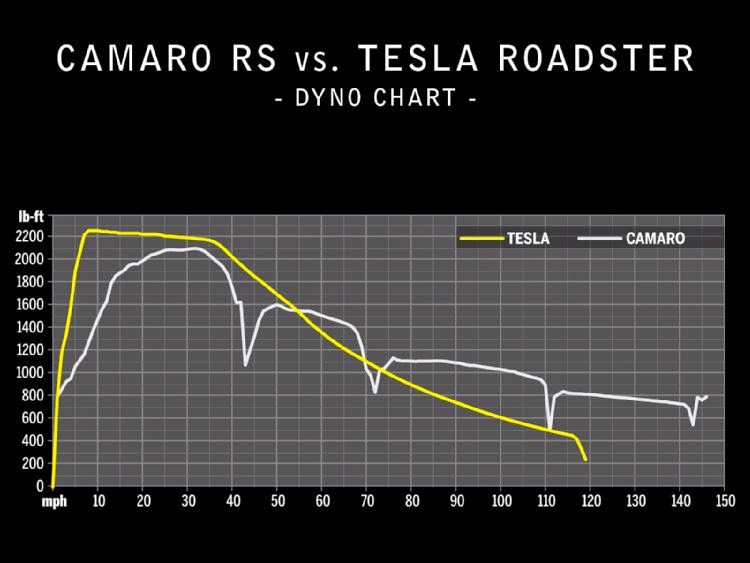
(dyno torque curve from a Tesla Roadster - the Model S P85 has 2x more torque @ the wheels)

The global market for EV traction motors will be over $25 billion in 2025

The electric vehicle business will approach a massive $500 billion in 2025 with the traction motors being over $25 billion.

Their design, location and integration is changing rapidly. Traction motors propelling land, water and air vehicles along can consist of one inboard motor or - an increasing trend - more than one near the wheels, in the wheels, in the transmission or ganged to get extra power. Integrating is increasing with an increasing number of motor manufacturers making motors with integral controls and sometimes integral gearing. Alternatively they may sell motors to the vehicle manufacturers or to those integrating them into transmission.

In a new report from IDTechEx called "Electric Motors for Hybrid and Pure Electric Vehicles 2015-2025: Land, Water, Air" these complex trends are explained with pie charts, tables, graphs and text and future winning suppliers are identified alongside market forecasts. There are sections on newly important versions such as in-wheel, quadcopter and outboard motor for boats.

Today, with the interest in new traction motor design there is a surge in R&D activities in this area, much of it directed at specific needs such as electric aircraft needing superlative reliability and power to weight ratio. Hybrid vehicles may have the electric motor near the conventional engine or its exhaust and this may mean they need to tolerate temperatures never encountered in pure electric vehicles. Motors for highly price-sensitive markets such as electric bikes, scooters, e-rickshaws and micro EVs (car-like vehicles not homologated as cars so made more primitively) should avoid the price hikes of neodymium and other rare earths in the magnets. In-wheel and near-wheel motors in any vehicle need to be very compact. Sometimes they must be disc-shaped to fit in.

However, fairly common requirements can be high energy efficiency and cost-effectiveness, high torque (3-4 times nominal value) for acceleration and hill climbing and peak power twice the rated value at high speeds. Wide operating torque range is a common and onerous requirement. Overall energy saving over the drive cycle is typically critical. Usually winding and magnet temperature must be kept below 120C and then there are issues of demagnetisation and mechanical strength.

BMW Formula E course cars to be equipped with Qualcomm wireless charging

The all-electric FIA Formula E Championship has today confirmed that its course cars for the inaugural season will be fitted with Qualcomm Halo™ wireless charging technology – an inductive charging system which allows the car’s battery to be charged without the use of cables.

With the final specification of car set to be announced shortly, the championship’s technical team took advantage of today’s final test at Donington Park to trial two BMW i8 and two BMW i3 models with the aim to evaluate them for the series’ official course cars. Earlier this year, the German marque was part of the Global Launch event of the Formula E in London.

All four BMWs have been specifically modified to meet FIA requirements, with one of the BMW i3 models featuring an inductive charging system from Qualcomm Incorporated (NASDAQ: QCOM), with the remaining three vehicles set to be adapted at a later stage. The technology has been developed by San Diego-based Qualcomm Incorporated, one of the official Founding and Technology Partners of the series and a global leader in 3G, 4G and next-generation wireless technologies. The Qualcomm Halo™ technology uses resonant magnetic induction to transfer energy between a ground-based pad and a charging pad fitted to the underside of the vehicle. The cars can then simply park over the base pad for charging to start automatically.

The chosen safety car – which will be officially entitled the Qualcomm Safety Car - will be driven by experienced driver Bruno Correia, whilst the medical and extraction cars will be overseen by FIA Medical Delegate Dr Phil Rayner and his team. The cars will be positioned at the end of the pitlane, charging wirelessly and ready to be rapidly deployed as required during each practice, qualifying and race.

Steve Pazol, GM, Wireless Charging at Qualcomm Incorporated, said: “Qualcomm is honoured to be an integral part of FIA’s Formula E Championship. As electric vehicles become more ubiquitous, charging them wirelessly is an obvious next step in the EV evolution and we are excited to showcase this in Formula E. Motorsport is a known proving ground for new technologies, and in addition to our wireless EV charging technology, Qualcomm will be bringing more of its technologies to bear as the series goes forward.” Alejandro Agag, CEO of Formula E, said: “Qualcomm’s wireless charging system is ground-breaking technology and represents an exciting evolution for charging electric vehicles. Wireless charging has the potential to radically improve the electric vehicle driver experience and Formula E provides the perfect platform in which to develop, test and showcase this exciting new technology.”

Formula E is the FIA’s new fully-electric single-seater championship designed to appeal to a new generation of motorsport fans, whilst accelerating the interest in electric vehicles and promoting sustainability. Competing entirely on city-centre circuits – with races also in China, Malaysia, Uruguay, USA, Monaco, Germany and the UK – it uses cars capable of speeds in excess of 150mph (225kph). Its 10 teams and 20 drivers feature some of the leading international names in motorsport including Alain Prost and Michael Andretti, along with high-profile environmental supporters including Sir Richard Branson.

LG Chem wins battery order from Audi for plug-in hybrid cars [VIDEO]

South Korea's LG Chem said on Wednesday it had won an order from Audi to supply batteries for its plug-in hybrid and micro hybrid electric vehicles.

LG Chem said the deal was "worth hundreds of millions of dollars" but declined to give further details. It said it expected to win more such orders from Audi parent Volkswagen in the future.

LG Chem, which has secured a total of 20 customers including General Motors, also it aims to achieve combined sales of over $10 billion from large-sized batteries by 2018.

LG Chem signs battery deal with Volkswagen [VIDEO]

LG Chem has agreed to supply electric-vehicle batteries to Volkswagen, a company executive said Tuesday.

"Volkswagen has designated LG Chem as one of its key battery-sourcing channels to push its electric car projects," the executive said by telephone on condition of anonymity, citing the sensitivity of the issue. "LG is going to supply battery packs and solutions to the German carmaker."

The deal with Volkswagen is not as big as similar deals between LG and other leading carmakers such as General Motors and Ford, said the executive.

The partnership also involves collaboration on various products the German car manufacturer is working to develop as part of its electric-vehicle projects, part of its efforts to reduce carbon emissions.

For example, Volkswagen is working to attain "ultra-low-carbon mobility" for its new eGolf electric vehicle, said officials.

The vehicle is a fully electric version of Volkswagen's popular Golf.

"LG Chem will join futuristic electric car business projects such as [projects to develop] plug-in hybrid electric vehicles led by the German carmaker thanks to the latest battery deal," said the official.

An LG Chem spokesman declined to confirm.

LG Chem has been in talks with Volkswagen over the past four years regarding a business partnership involving batteries for electric vehicles.

The executive said it was Beijing's approval to proceed with LG's plans to build a battery joint venture in China that helped the LG Group affiliate land the partnership with Volkswagen.

Volkswagen plans to spend more than $2 billion on models and on two new facilities in China, increasing total investments in the world's biggest auto market to nearly $8 billion.

LG Chem Chief Financial Officer Cho Suk-jeh told investors and analysts that the company aimed to generate nearly 2 trillion won in revenue from its large battery business, including energy systems, by 2016.

The petrochemical business is the biggest cash cow for LG Chem, accounting for 77 percent of its 5.87 trillion won in sales in the second quarter. Batteries accounted for 12.3 percent and electronic information materials 12.1 percent.

LG Chem is gradually cutting its reliance on petrochemical products as part of an effort to diversify its revenue sources.

On a related note, in 2016 the company plans to begin providing carmakers with batteries capable of powering electric vehicles for at least 200 miles (322 kilometers).

LG Chem currently supplies lithium-ion batteries to General Motors, Ford, Hyundai-Kia, Renault, Volvo, and other carmakers. The 200-mile-plus range of the new batteries is roughly double that of the company's current, first-generation electric-vehicle batteries.

WORLD FIRST: Electric Racer beats field of petrol powered cars.. twice

With less than 4 weeks to go until the inaugural FIA Formula E race in Beijing China, an electric race car in Australia has already made history.

In what is believed to be a world first, a battery powered Radical SR8 entered by ELMOFO in the NSW SuperSports State Championship has become the first electric car to win a race against petrol vehicles in a sanctioned race event. To prove it was no fluke, it won twice!

Not only did the EV win two of the three races comprising round four of the championship, held 17th August at Wakefield Park Raceway, the ELMOFO Radical, driven by Garth Walden, also set the fastest lap time for the entire meeting (57.6870 sec) beating all other categories which included Formula 3 and Sports Sedans.

The ELMOFO Radical is similar in concept to the current Nürburgring EV lap record, the TMG EV P001 built by Toyota Motorsport GmbH and the TMG EV P002 modified by TOYOTA Racing Development U.S.A. to tackle Pikes Peak in 2013.

The race winning electric Radical SREV was built by Newcastle based Solar PV systems firm Solar Power Australia. The car delivers 280 kw (375 hp) and 570 Nm (428 ft-lbs) of torque almost instantly from its twin sequential BLDC motors. Power is controlled by dual Rinehart Motion Systems inverters which are fed voltage from a 37 kWh lithium ion battery pack controlled by a Batrium BMS. Power is transmitted to the rear wheels via a single speed limited slip differential. Performance specs for the all-electric racer, built on a Radical SR8 chassis, include 0 to 100 km/h (62 mph) in 3.5 seconds, 0 to 160 km/h (100 mph) in 6.5 seconds with a top speed of 265 km/h (165 mph).

The 2014 CAMS NSW SuperSports Championship is mostly a one-make series for Radicals, with a couple of Stohr WF1 single seaters also contesting the series. The ELFOMO team have worked hard over the previous three rounds to debug the car and the wins are a just reward for achieving solid reliability. Since the beginning of the season the car has demonstrated it had raw speed by routinely qualifying on the front row of the grid. In only round 4 of the championship the battery powered racer dominated from the front with Walden blasting well ahead of the pack for the first 4 or 5 laps and then backing off a little to preserve the car.

The ELMOFO team would like to thank Rinehart Motion Systems, AM Racing, Batrium, Garth Walden Racing, Royal Purple and the Supersports Racecar Club Committee who have been very supportive of the car, scheduling some races of a length that the battery powered vehicle could complete to ensure it’s inclusion in the series.

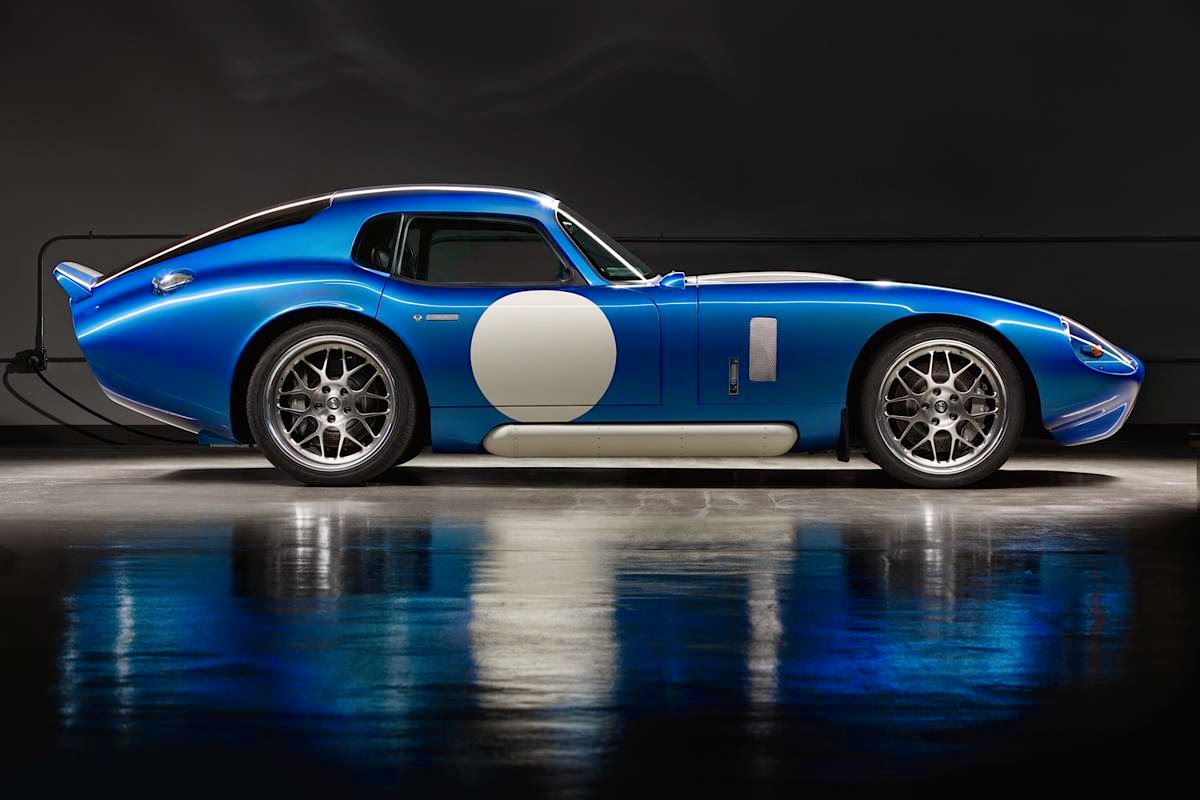
Silicon Valley startup Renovo Motors unveil $529,000 EV supercar [VIDEO]

When they started their company in 2010, the founders of Silicon Valley startup Renovo Motors saw a hole in the market for a pure electric supercar.

Today they revealed their first product, the $529,000 Renovo Coupe, scheduled to launch in the United States next year.

Performance specs for the all-electric two-seater, built on the Shelby CSX9000 chassis, include 0 to 60 mph in 3.4 seconds, with a top speed of 120 mph. The company says the car will deliver 370 kw (500 hp) and 1,356 Nm (1,000 ft-lbs) of torque almost instantly from its twin sequential axial flux motors. Power is controlled by dual RMS inverters which are fed high-voltage from a 740 volt lithium ion battery pack, with output power transmitted to the rear wheels via a single speed differential.

After developing the car in secrecy for the past four years, Renovo launched the running prototype last weekend at the Pebble Beach Concours d’Elegance. The company plans to begin taking orders for a production run of less than 100 cars, with the first cars due to be delivered in California next year.

Renovo’s founders, Christopher Heiser and Jason Stinson, previously worked at the computer security company Verisign and chipmaker Intel. Though they are new to the industry, they hope to find space in the supercar market alongside venerable names such Ferrari and Lamborghini, and relative newcomers such as Pagani and Koenigsegg.

Though many luxury brands and exotic car companies are starting to offer plug-in hybrids and pure EVs, including Ferrari and McLaren with their LaFerrari and P1, Heiser said in an interview Thursday that no one offers a product like the Renovo Coupe. That includes their Silicon Valley neighbor and inspiration of sorts, Tesla Motors Inc., which stopped selling its Roadster sports car in 2012.

Source: Renovo Motors

Tesla Model S Drive Unit now has Infinite Mile Warranty

Following recent negative reports about Tesla Model S drive unit reliability, Tesla has increased the Model S drive unit warranty to match that of the battery pack. That means the 85 kWh Model S, the most popular model by far, now has an 8 year, infinite mile warranty on both the battery pack and drive unit. There is also no limit on the number of owners during the warranty period. Moreover, the warranty extension will apply retroactively to all Model S vehicles ever produced.

The drive unit is now covered under the same provisions as the existing battery warranty, so owners with an 85 kWh battery will benefit from eight years of coverage with no mileage restrictions, while 60 kWh owners have up to 125,000 miles.

The drive unit issue, described as a grinding or “milling” noise that increases over time, was picked up by Motor Trend Magazine who reported that they had to have a drive unit replaced in their Model S. The issue really hit the headlines when Edmunds reported they are on their 4th drive train.

Tesla had transmission issues with the Roadster. The two-speed transmission designed for the Roadster by a previous supplier proved not to be durable so in 2008 Tesla Motors selected BorgWarner for the production of a single-speed gearbox.

The source of the current 9.73:1 Model S gearbox is not known. Anecdotal evidence suggests the Borg Warner eGearDrives supplied for the the Ford eTransit Connect has quite a high failure rate but as the Model S transmission casting is integrated with the AC Induction motor enclosure and without knowing which component has suffered premature wear, it's too early to attribute blame for the design fault.

When you take into consideration how common transmission failures are within the automotive industry and how high performance the Tesla Model S is, it's not so surprising to find the powertrain needs some mechanical debugging. For example, Subaru have been making the Impresa WRX since 1992 and after two decades in production they're still prone to transmission failure. The only sure way to avoid mechanical transmission issues is to not have one by using direct drive wheel motors.

The standard warranty for Tesla Model S is 4 year, 50,000 mile (80,000 km). In April last year Tesla announced an unlimited "no-fault" battery warranty. Elon Musk says that in hindsight, the infinite warranty should have been policy for the powertrain from the beginning of the Model S program. If they truly believe that electric motors are fundamentally more reliable than gasoline engines, with far fewer moving parts and no oily residue or combustion byproducts to gum up the works, then the warranty policy should reflect that.