BMW Plans to Roll Out Plug-in Versions for Its Top Cars

BMW plans to offer plug-in hybrid versions of all its main models, including the best-selling 3-Series sedan, as the world’s largest maker of luxury vehicles reacts to tighter emissions regulations.

Carmakers are adding electric motors to improve fuel efficiency and make their vehicles viable in cities like London, which has set up a low-emission zone to improve air quality. Plug-in hybrids have batteries that can be recharged from electrical outlets and can drive emission-free for longer distances than conventional hybrids.

BMW is presenting a prototype of a plug-in hybrid 3-Series today in Miramas, France, the company said in a statement. The car combines a four-cylinder gasoline engine with an electric motor and can drive about 35 kilometers (22 miles) on battery power.

The German carmaker also plans to roll out a plug-in hybrid version of its X5 sport-utility vehicle and other “core-brand” models, according to the statement. Electric versions from the Mini and Rolls-Royce brands are also “a possibility,” said Manfred Poschenrieder, a spokesman for the Munich-based company.

Bayerische Motoren Werke AG (BMW) created the ‘’i’’ sub-brand for showcasing its clean-car technology and safeguarding its image as a maker of sporty vehicles. The first cars from the BMW i unit were the i3 battery-powered city car and the i8 plug-in hybrid super car. The company didn’t specify a timeframe for rolling out plug-in hybrid versions of its models.

Daimler to spend 100 million euros to expand German battery output

Daimler will spend about 100 million euros (US$125 million) in coming years to increase production of lithium-ion battery packs in eastern Germany.

The German automaker said on Monday it will expand capacity at Deutsche ACCUmotive, its battery-making division in Saxony as it expects "high and steadily-growing demand" for electric-car batteries.

The unit supplies batteries for the luxury Mercedes division's hybrid S-Class, E-Class and C-Class models, Daimler said.

Steps to increase battery output tie in with Daimler's plans announced last month to phase out production of lithium-ion battery cells at its second Saxony-based Li-Tec division by the end of 2015.

Daimler aims to employ the bulk of Li-Tec's 250 workers at Deutsche ACCUmotive.

The Stuttgart-based manufacturer in future plans to buy battery cells from LG Chem.

Asian makers of battery cells such as Samsung, Panasonic and LG Chem are producing the cells at lower costs, reaping benefits from scale effects as they're also serving non-automotive industries, analysts said.

Volvo hybrid bus with Siemens fast-charging system starts service in Hamburg

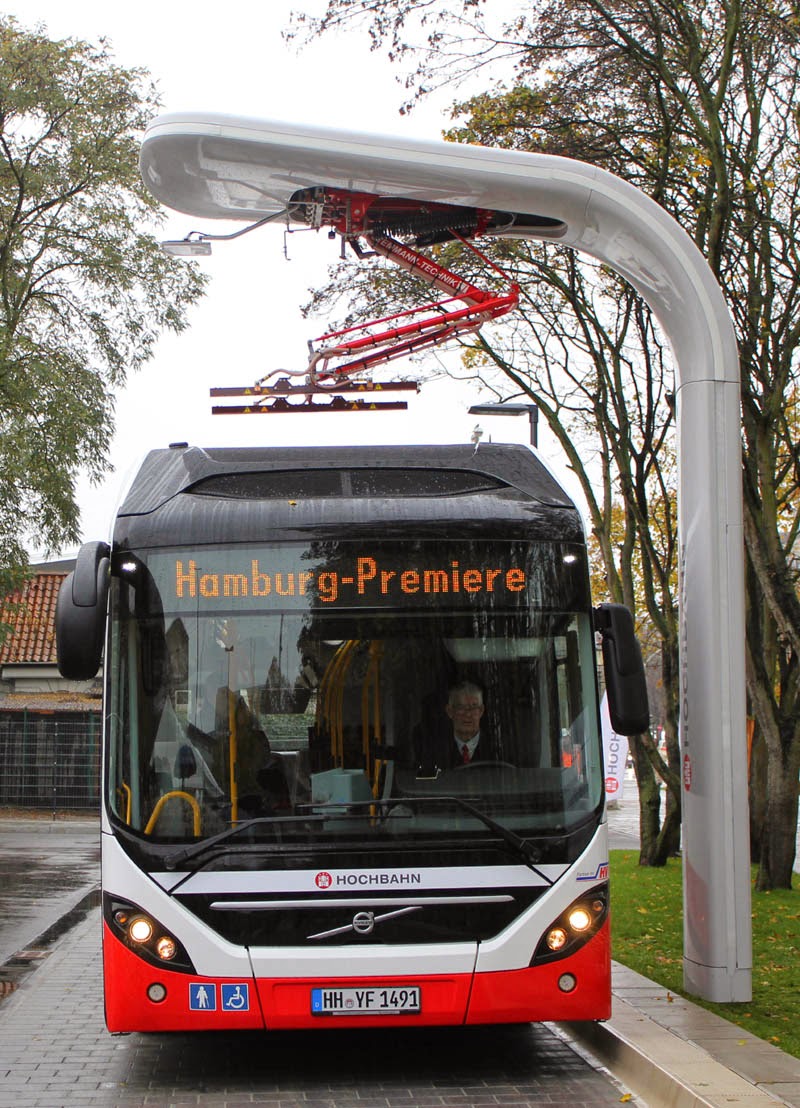
Officially launched at the International IAA Commercial Vehicles show, the Volvo 7900 Electric Hybrid buses equipped with a Siemens fast charging systems has taken its maiden tour in Hamburg, where it will be deployed from December on the 109 service.

“Battery technology is becoming increasingly attractive for use in buses. The electric hybrid bus is an important further step for us on the way to procuring 100% electric buses. Hochbahn sees itself as industry's partner in gathering important experience in everyday service,” said Ulrike Riedel, vice president for operation and human resources at public transport operator Hamburger Hochbahn.

The Volvo 7900 Electric Hybrid has an electric hybrid powertrain that combines a four-cylinder diesel 240 hp (177 kW) with an electric motor of 150 kW. The latter receives energy from a lithium ion battery of 19 kWh total storage capacity, this allows travel in electric mode a distance of 7 km between charges.

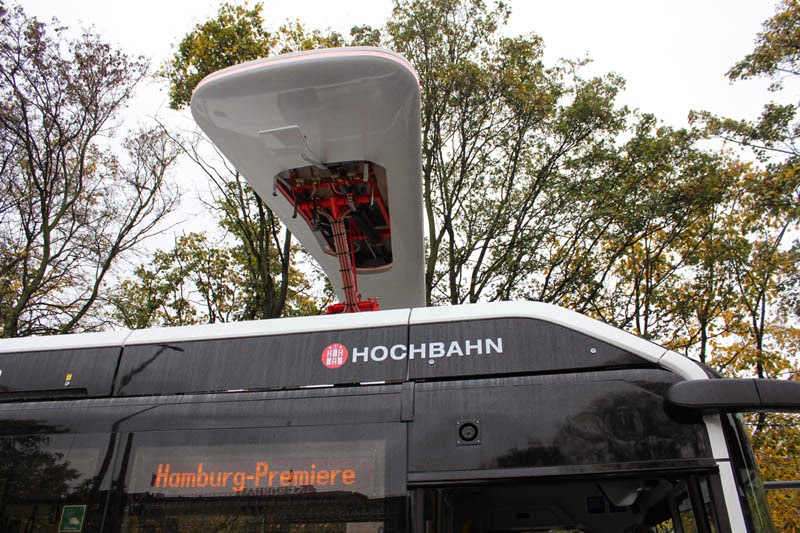
The lithium-ion battery is charged via two charging rails on the roof. Fast charging stations have been set up next to the route with a contact arm fastened to a mast. If the bus is with range of the contact system, the drive operates the parking brake and charging will start automatically. Charging is performed fully automatically and ends as soon as the charging is fully completed. The process also can be cut short by releasing the parking brake.

The fast charging stations in Hamburg are the latest development from Siemens for high-performance charging systems for electric buses. On the buses, it is only necessary to mount contact rails and a WiFi communication box. That saves space, weight, and costs on each bus. Communication between the bus and the charging station is established by WiFi. In this way, the bus is identified and the requirements of the battery management system are transmitted to the charging station. To make contact, the contact arm is lowered onto the charging contacts on the bus. The bus is electrically grounded before current starts to flow. The flow of current between the vehicle and the charging station is controlled continuously and matched to the individual charge state and battery type. The charging operation is completed in no more than six minutes.

World Record holders Sunswift launch Pozible to fund refit of car for road registration

UNSW’s solar racing team Sunswift has launched a crowd-funding campaign to raise money to rebuild their car for Australian road registration.

The eVe vehicle, which recently smashed a 26-year-old world record for the fastest electric car over 500 km, is seen as a symbol for a new era of sustainable driving. It is covered in zero-emission solar panels and uses a battery storage system that can be charged with the solar cells or by plugging the car into a power outlet.

The world record proved the car is technically capable of covering the maximum distance a normal road user might want to drive in a single day.

The next step in the Sunswift journey is to put eVe within reach of the average driver by converting it from concept car to road-registered coupe.

The team of 60 undergraduate students behind Sunswift is aiming to raise $30,000 – about one-third of the amount they need – using the crowd-funding site Pozible. They plan to source the remaining money and components via sponsors and in-kind contributions from industry partners.

If successful, it will mark the first time a university solar car team has built a vehicle to the stringent standards of the Australian Design Rules – the national motoring standards that govern vehicle safety, anti-theft and emissions.

“Full registration is no humble feat with essentially the whole car needing to be deconstructed and rebuilt,” says project director and engineering student Hayden Smith.

“The car requires front, rear and side impact protection, headlights, windscreen wipers, new raised suspension and new wheels in addition to updated electrical components.

“The interior will also be redesigned to meet safety regulations and offer a level of comfort that would be expected from a commercial car.”

Coinciding with its latest fundraising push, the team has set an ambitious goal of achieving road registration as early as March 2015.

“Having solar cars conquer the roads would mark a huge leap in the race to develop more sustainable transport alternatives, showcasing their potential to be commercialised in the near future,” Sunswift’s chief business officer and student Rob Ireland says.

"However, we can't change the world by ourselves so we're asking for help to make it happen."

Supporters who contribute to the crowd-funding campaign will be offered rewards including 3D printed models of the car, solar cell mantlepiece trophies and one-time advertising space during PR events. The campaign begins on Monday 1 December.

BMW reveal 500 kW eDrive plug-in hybrid system

Following the success of the BMW i3 electric car, and the i8 hybrid supercar, BMW has developed an even more powerful petrol-electric drivetrain that could underpin prestige and performance models in the future.

The new system is part of an increasing investment into hybrid electric powertrains, starting with the upcoming 3-Series ActiveHybrid. This one in particular will sit at the top of the range. Expect it to appear in the firm's large saloons and M-powered SUVs in the next few years.

Dubbed Power eDrive, the new system forms part of a extended range of modular hybrid drivetrains being developed in a performance-based EfficientDynamics engineering program at BMW's research and development centre in Munich and envisaged for launch on a limited number of BMW Group production models in what it describes as "up-market segments" before the end of the decade.

The new hybrid system aims to provide the sort of smooth yet urgent step-off performance qualities delivered by a contemporary battery powered electric drive systems like that offered in the Tesla Model S, albeit with an overall range described as being over 600km thanks to a range extender function, including a 100km range on electric power alone.

Revealed in a 5-series GT bodied prototype, the most powerful of BMW's new modular hybrid drivetrains uses the company's new 170 kW turbocharged 2.0-litre four-cylinder direct injection petrol engine in combination with two electric motors – a 150 kW version of the i3's synchronous unit mounted up front in the space usually taken up by the torque converter in the car's eight-speed automatic gearbox and an even more powerful 200 kW unit set within the rear axle assembly.

All up, it is claimed to boast a combined system output of 500 kW along with a torque loading that, BMW engineers suggest, reaches beyond 1000 Nm – figures that easily top the 338 kW and 720 Nm of the existing 6.75-litre V12 petrol engine used by the 11-year-old Rolls-Royce Phantom.

The principle behind BMW's Power eDrive system is a maximization of electric motor performance.

"The electric motors provide approximately two-thirds of the combined output, with the combustion engine accounting for the remaining third," says Franz Drescher-Kaden, a BMW concept engineer responsible for the new petrol-electric hybrid set-up.

Energy for the electric motors is provided by a 20 kWh lithium-ion battery mounted both longitudinally in the rear of the 5-series GT's centre tunnel and horizontally underneath the rear seat in a space ahead of the rear axle. It can be charged both via plug-in means and on the run using the combustion engine in a steady state mode. The fuel tank has been reduced in size from a standard 70-litres to 30-litres.

As well as acting as a generator to produce electricity, the Power eDrive hybrid system's petrol engine can also provide a performance boost with direct drive to the front wheels during kick down, in which all three power sources are used for propulsion.

Drive is nominally channeled to the rear wheels via the rear electric motor, whose reserves are sent through a multi-speed gearbox like the front motor in an i8. The introduction of the front electric motor, which operates via the eight-speed automatic in which it is housed, provides all-electric four-wheel drive. This is further enhanced by the combustion engine, which also delivers its power to the front wheels.

BMW has not revealed a weight figure for its new hybrid system. However, it does concede the addition of two electric motors as well as the lithium ion battery pack and ancillary electronic management system adds handsomely to the kerb weight. Despite this, the German car maker says the straight line performance of its 5-series GT Power eDrive prototype exceeds that of the 330 kW twin-turbocharged 4.4-litre V8 powered 550i GT, which tips the scales at 2070 kg.

Power eDrive is being developed as a scalable system with power outputs ranging from 190kW to over 500 kW, according to BMW, which says the plug-in hybrid technology will be "a natural choice for use in up-market vehicle segments".

Electric vehicles account for almost 10% of Californian new-car sales

Hybrid electric and plug-in electric vehicle now account for almost 10 percent (9.6%) of all new car sales in California.

Electric vehicles, which registered nearly zero in state-wide new car-sales as recently as three years ago, are now taking a noticeable market share, according to the latest quarterly report released by the California New Car Dealers Association.

CNCDA said 23,648 registrations of various plug-in hybrid models in California from January through September this year accounted for 1.7 percent of all new-vehicle purchases. Registrations of all-electric vehicles, like Nissan’s Leaf, accounted for 20,516 new vehicle sales, or 1.5 percent, during that time.

The combined total of 44,164 for the first nine months of 2014 already tops California’s electric vehicle sales for all of last year. In 2013, combined sales of plug-in hybrids and all-electric vehicles in California topped 42,000, up 500 percent from 2011.

Sales of new, standard hybrid vehicles, another segment where California leads the nation, totalled 89,486 through September this year. That represents 6.4 percent all new cars sold state-wide in the January-September period.

Renault-Nissan sell 200,000th Electric Vehicle [VIDEO]

The Renault-Nissan Alliance has sold its 200,000th electric vehicle and has a leading 58% market share for zero-emission cars.

Together, Renault and Nissan EVs have driven approximately 4 billion zero-emission kilometers – enough to circle the earth 100,000 times. Renault-Nissan’s EVs represent 200 million liters of fuel saved – enough to fill about 80 Olympic-sized swimming pools. Alliance EVs also represent 450 million kg of CO2 that has not been emitted while driving.

The Alliance sold its 200,000th EV in early November, about four years after the launch of the Nissan LEAF, the world’s first mass-market electric vehicle. Nissan LEAF remains the best-selling electric vehicle in history.

From January through the first week of November of this year, the Alliance has sold about 66,500 units—an increase of about 20% from the same period last year. The Alliance sells about two out of three electric vehicles worldwide, including Twizy, Renault’s two-seater urban commuter vehicle and the Nissan e-NV200 van on sale in Europe and Japan.

“Renault and Nissan’s electric vehicles are the zero-emission volume leaders – and, most important, they enjoy high satisfaction rates from customers around the world,” said Carlos Ghosn, Chairman & CEO of the Renault-Nissan Alliance. “Based on positive owner feedback and the increasing demand for cars that run on renewable energy, it’s no surprise that EV sales are accelerating – particularly in regions where charging infrastructure is well developed.”

To capture what the first 200,000 consumers love about their electric vehicles, the Renault-Nissan Alliance is launching a series of videos featuring EV owners on three continents. “I Made the Switch” tells why people bought their electric vehicles and how switching to a zero-emission vehicle has changed their lives. The first video features Chris Beers, a software engineer from Holliston, Massachusetts, USA, one of many Americans who powers his Nissan LEAF with clean solar energy.

USA and Japan lead the world in EV ownership

In the United States, the Alliance’s biggest electric vehicle market, there are more than 750 quick chargers in operation. Nissan is working with its dealers and charging partners to increase that number to 1,100 by mid-2015. The quick chargers are able to charge a LEAF from zero to 80% capacity in about 30 minutes.

This year, Nissan also launched its “No Charge to Charge” program, which provides free access to selected charging stations for two years with the purchase or lease of a new Nissan LEAF. “No Charge to Charge” is currently active in 12 U.S. markets, and Nissan plans to expand to additional markets by mid-2015.

In Japan, the Alliance’s second-biggest EV market, there are more than 2,900 quick chargers in operation. Nissan and Japan’s three other top automakers have pledged to work together to raise that number to 6,000 by March 2015.

In Europe, the UK is the most advanced market in terms of electric vehicle infrastructure. Today, the quick charging network already covers 87% of the UK’s motorways.

Nissan LEAF is the world’s best-selling electric vehicle; Renault led in Europe in October

With six electric vehicle models on the road, the Renault-Nissan Alliance is the only global car group with a full range of 100% electric vehicles – and they can be fully charged with purely renewable energy.

Yokohama, Japan-based Nissan has sold a cumulative 148,700 units worldwide since December 2010, when Nissan LEAF went on sale. Nissan LEAF has collected industry honors including the 2011 World Car of the Year, European Car of the Year 2011 and Car of the Year Japan 2011-2012.The electric vehicle has the highest global customer satisfaction rate for any Nissan vehicle ever.

The top markets for Nissan LEAF are the United States with about 67,000 sales since its launch, Japan with about 46,500 units and Europe with about 31,000 units.

In the United States, LEAF is on track to be the top electric vehicle in 2014, outselling all other electric and plug-in hybrid vehicles. Sales so far this year are up 35%, and Nissan LEAF has enjoyed 21 consecutive record sales months and has already shattered its own yearly U.S. sales record with two months to go. In addition to LEAF, Nissan also sells the e-NV200 van, which went on sale in Europe in June and in Japan in October.

Meanwhile, Boulogne-Billancourt, France-based Renault has sold a cumulative 51,500 electric vehicles worldwide since its first model the Kangoo Z.E. went on sale in October 2011. Kangoo Z.E. was voted International Van of the Year 2012. Renault recently delivered its 5,000th Kangoo Z.E. to La Poste, France’s national postal service and operator of the country’s largest corporate fleet. An additional 5,000 units will be delivered in the coming years.

In addition to Kangoo Z.E. and Twizy, Renault’s zero-emission range also includes the ZOE subcompact and the Fluence Z.E. sedan. In South Korea, the Fluence Z.E. is sold as the SM3 Z.E. under the Renault Samsung Motor badge. Like Nissan LEAF, ZOE enjoys the highest satisfaction rate of Renault’s global product lineup.

Renault’s top markets in Europe - its main electric vehicle market - are France, Germany and the United Kingdom. In October, Renault regained the number one EV position in Europe with a market share of 31%. ZOE was the most popular vehicle with a 23% market share.

Demand for Tesla’s Dual-Motor Vehicles “Off the Charts”

Tesla Motors CEO Elon Musk has weighed in with one of the most useful updates to date on the company's new dual-motor versions of its Model S. The verdict? One month after it was introduced, demand for the all-wheel-drive version of the model isn't lacking. In fact, demand for the new motor system is incredibly robust. Here's what investors need to know.

The P85D is Tesla's halo car

"This is the fastest accelerating four-door production car in the world," Musk explained in a GQ magazine interview published Tuesday, referencing Tesla's new dual-motor option for its flagship 85-kilowatt-hour-battery performance Model S, officially dubbed the P85D.

The new dual-motor system with a motor connected to both the rear and front axle is an upgrade offered for the 85-kWh-battery version of the Model S and now comes standard on the performance version. Tesla's smaller 60-kWh-battery version of the Model S is still only available with the rear-wheel-drive one-motor configuration.

The dual-motor system is helping Tesla set new standards in the automotive industry. Most notably, Tesla showed off how a dual-motor, all-wheel-drive system gives owners all-weather traction without sacrificing efficiency. Tesla's all-wheel-drive system actually boosts range, top speeds, and acceleration times over their rear-wheel drive counterparts running on the same battery. And now with a zero-to-60 acceleration time of just 3.2 seconds, Tesla is making it harder for premium internal-combustion-engine vehicles to compete.

Musk went on to explain in the interview that Tesla built the car to prove a point.

"We wanted to position it as the fastest in order to change the public mind-set. It had to be something dramatic. And getting those few extra 10ths of a second was hard," Musk said. He told GQ that the P85D is Tesla's "halo car," or the car that shows off the strengths of electric vehicles.

Demand is hot

But Tesla's dual-motor system is doing more than just drawing attention to the company. It is apparently convincing a large number of consumers to put in a cash deposit to wait in line for a built-to-order version of their own Model S.

"Demand for the P85D is off the charts," Musk said. "We're seeing a very high proportion of orders for all-wheel drive, either P85D or 85D (which has smaller, equal-sized electric motors front and rear), so 70%-plus of our cars will be dual-motor."

Musk went on to reiterate a common theme: Demand is not a problem for Tesla; ramping up production to meet demand, however, is.

The company is guiding to report record quarterly sales in Q4 and 50% higher annual Model S sales in 2015. But Tesla contends that the company will still not be fully meeting demand, even at these levels.

Tesla said in its third-quarter earnings call that with the help of the additional cost for dual-motor versions of the Model S, it expected Model S average selling to improve going forward. This favorable trend likely plays a role in Tesla's bullishness for its automotive gross profit margin to continue to improve in Q4 and into 2015, though the most important factor influencing Tesla's improving gross profit margin is undoubtedly growing sales of its Model S, which spread fixed costs across a larger number of deliveries.

While Tesla's ability to set standards and its soaring demand are both great for the company, investors should be careful to maintain proper perspective. Given Tesla's $31 billion market capitalization, the market is already betting on Tesla to be wildly successful in the coming years. Furthermore, Tesla's focused product portfolio and strict emphasis on battery-powered vehicles means that missteps could significantly delay its ambitious plans.

On the other hand, it's market-leading pure plays like Tesla with a proven record of execution on growth plans that are probably most likely to exceed market expectations. So, investors who already own shares should think carefully before they sell Tesla stock simply because they think shares are overvalued.

First Audi A3 Sportback e-tron plug-in hybrid drive off the assembly line in Ingolstadt

Production of the Audi A3 Sportback e-tron: Assembly – On the engine and component assembly line, the electric motor and transmission are fitted to the engine.

Approximately 50 cars every day, with the same timing and on the same assembly line as the other models: Audi is now ramping up production of the Audi A3 Sportback e-tron*. The premium manufacturer is producing its first plug-in hybrid model at the brand's main plant in Ingolstadt.

"We started series production of the Audi A3 Sportback e‑tron in the summer," said Dr. Hubert Waltl, Board of Management Member for Production at AUDI AG. "Most of the assembly work is integrated into the A3 line; no separate manufacturing is necessary. That demonstrates the flexibility and efficiency of our production planners and employees."

With the Audi A3 Sportback e‑tron, Audi is launching the mobility of the future. The compact five‑door combines a 1.4 TFSI combustion engine with a 75 kW electric motor, resulting in a total system output of 150 kW (204 horsepower). Despite the sporty driving performance, fuel consumption in the NEDC is just 1.5 liters per 100 kilometers (35 grams of CO2 per kilometer). The A3 Sportback e‑tron can travel up to 50 kilometers in purely electric mode and up to 890 kilometers more with the gasoline engine.

"We first of all ramped up production of the A3 Sportback e‑tron to about 30 cars a day in September," explained Board of Management member for Production Waltl. "Our peak is approximately 50 units each day now. In any case, we are keeping additional capacity available."

Peter Kössler, head of the Ingolstadt plant, stated: "Working with high‑voltage systems in series production was a new challenge for us, but we mastered it well. At all stages of assembly, we achieve maximum levels of safety for our employees and quality for our customers."

Safety is given top priority during the entire assembly process. All the employees who come into contact with the A3 Sportback e‑tron have received technical safety instructions for the new technology; some employee who are directly involved are qualified as specialist electricians for automotive technology.

Sydney International Airport Tests the World’s Longest Range Electric Bus

Carbridge Pty Ltd, an Australian airport ground transportation provider, has begun a six-month Electric Bus pilot program at Sydney International Airport. The bus selected for the pilot was made by BYD Company Ltd, which has been recognized over the past few months for its industry leading operational range. The bus will be used as an airport passenger shuttle.

At a launch ceremony held at Sydney International Airport, BYD Asia Pacific General Manager Liu Xueliang said, “Compared with fossil-fueled buses, BYD’s pure electric bus has zero emissions, doesn’t make noise and ensures a comfortable ride without disturbances associated with conventional buses of combustion engines. These characteristics will provide a great experience for visitors to the Airport.” Sydney Airport plans to electrify their entire bus fleet in the coming years.

BYD’s Battery Electric bus employs many advanced technologies developed in-house by a staff of more than 15,000 R&D engineers, such as the advanced environmentally friendly, BYD Iron-Phosphate battery, in-wheel hub motors and regenerative braking system. The break-through Iron-Phosphate battery is fire-safe and non-toxic: there are no caustic materials contained in the battery, no toxic electrolytes or heavy metals and can be completely recycled.

The BYD electric bus delivers a host of operational and environmental benefits for public transport riders, operators and people in the community — it is very quiet and ensures a comfortable ride without vibrations, jerks or noise associated with the conventional buses and combustion engines. The bus can also drive for more than 250 km (155 miles) even in heavy city traffic on a single charge. The bus has completed more than 20 million kilometers of “in revenue service” and has been evaluated in many major cities all over the world.

GM to Study Vehicle Sharing with Shanghai Jiao Tong University

General Motors China has signed a memorandum of understanding with Shanghai Jiao Tong University to collaborate on a vehicle sharing program featuring the Chevrolet EN-V 2.0 starting next year.

A fleet of EN-V 2.0 vehicles will be integrated with a multi-modal transportation system alongside bicycles, cars and shuttle buses at the university’s Minhang campus in Shanghai to evaluate the benefits and challenges of a vehicle sharing transportation model.

“The vehicle sharing program with Shanghai Jiao Tong University will allow us to assess the real-world application of the EN-V 2.0 as part of a vehicle sharing system,” said Matt Tsien, GM executive vice president and president of GM China. “We will apply these learnings to the development of future urban mobility transportation solutions, not just for China but for the world.”

"Electric vehicles represent the transportation mode of the future, but the big topic now is how to develop them," according to Yin Chengliang, vice president of the Shanghai Jiao Tong University Automotive Engineering School. "This project will explore a model that integrates electric vehicles with the transportation network and intelligent transportation system."

The Chevrolet EN-V 2.0 is the next generation of GM’s original Electric Networked-Vehicle (EN-V), which made its global debut at Expo 2010 in Shanghai. It can travel up to 40 kilometers on a single charge.

The Shanghai Jiao Tong University collaboration is a continuation of GM’s vision for sustainable urban mobility announced at Expo 2010. Shanghai Jiao Tong University is a comprehensive research-oriented university and one of China’s leading educational institutions. GM and Shanghai Jiao Tong University have collaborated on many automotive, training and development projects over the past two decades.

Porsche Readying Tesla Model S Fighter

The German automaker is currently in the early stages of development for an EV that will target the Tesla Model S and will be a new dedicated fifth model range slotting beneath the existing Panamera. While details on Porsche’s first all-electric production vehicle are mostly being kept under wraps at the moment, it will likely be built on the automaker’s second-generation MSB platform that underpins the current Panamera.

It will have a shorter wheelbase than the existing Panamera sedan but will be a five-door hatchback, similar in style to the Panamera Sport Turismo concept that debuted at the 2012 Paris Motor Show. The company is hoping to keep it around 2,100 kg and its electric powertrain will provide similar performance as the Model S, though Tesla did just announced the more powerful all-wheel drive Model S P85D.

Porsche is aiming for a range of over 450 km and the company is expected to work with Audi, so we expect they will also use solid-state batteries.

Audi Confirm Tesla Model S Rival with 450 km Range for 2017

According to a report by Auto Express, Audi is also looking to join the electric vehicle sedan market with its own offering sporting a 450 km (280-mile) all-electric range.

The vehicle is currently under development according to Audi’s Dr. Ulrich Hackenberg, who also revealed that it will arrive in 2017 as an all-new model.

In the interview, Hackenberg said that he was “able to re-engineer the R8 e-tron project and technology with the team” and confirmed that it will not be a sports car.

The German automaker will use next-generation batteries in order to achieve the 450 km range, technology that is said to have up to five times more energy density than the current batteries used in vehicles such as the Volkswagen e-Golf.

Tesla in talks with BMW over car batteries & component alliance

Tesla Motors is in talks with Germany's BMW over a possible alliance in batteries and light-weight components, Tesla's Chief Executive Elon Musk told German weekly Der Spiegel.

In an interview published on Sunday, Musk described BMW's production of carbon fibre reinforced car body parts as "interesting" and "relatively cost efficient."

BMW uses carbon fibres from its joint venture with materials supplier SGL to make reinforced passenger cell parts for its i3 electric hatchback and i8 plug-in hybrid sports car.

Officials at BMW were not immediately available to comment.

"We are talking about whether we can collaborate in battery technology or charging stations," Musk was quoted as saying in the interview.

There were no further details on the specific nature of the alliance, however BMW and Tesla executives already met in June to discuss the creation of charging stations usable for different types of electric cars.

Rival Daimler, owner of the Mercedes brand, said last month it would continue to collaborate with Tesla even after selling its remaining four percent stake in the U.S. company. Tesla has also worked with Toyota on electric SUVs.

Tesla's billionaire co-founder Musk also told Der Spiegel that he expects Tesla to have a battery production plant in Germany in five to six years.

Korean Companies Taking Lead in EV Battery Market

An increasing number of carmakers such as Nissan and Daimler are opting for Korean battery manufacturers’ products instead of doing the lithium-ion secondary battery business on their own. The trend is expected to be a boon for LG Chem, Samsung SDI, and SK Innovation in the fledgling eco-friendly car battery market.

The only German factory that produces battery cells for electric cars is closing. Within little more than one year, the company Li-Tec in Saxon Kamenz, will cease manufacture of battery cells. The company is a subsidiary of the Daimler Group.

The Li-Tec factory will close December 2015 but will be retained as a research location; the majority of the 280 employees will be transferred to the Deutsche Accumotive—also a wholly owned Daimler subsidiary—which manufactures battery packs. Accumotive is currently expanding its production capacity to build systems for the next generation of the electric smart among others. Cells are slated to come from LG Chem.

“Nissan has purchased EV batteries from AESC since 2009, but will diversify the supply sources to LG Chem and many more,” Renault Nissan Alliance Chairman Carlos Ghosn said in September. It is said that AESC’s products are approximately 15 percent more expensive than those of LG Chem.

These decisions come about because it is difficult for a company to realize the economy of scale and achieve price competitiveness on its own in the eco-friendly vehicle market. Battery manufacturers that have produced small batteries for use in smartphones and the like have more advanced technological strength, too. It is in this context that Hyundai Motor Company, Kia Motors, and BMW have procured battery cells from external sources from the get go.

At present, LG Chem’s customers include not only Hyundai and Kia but also about 20 automakers such as GM and Ford. Samsung SDI has done business with about 10, including BMW, as well. SK Innovation, which started relatively late, has supplied batteries for Kia Motors’ Soul EV, and set up a joint venture in China with the Beijing Automotive Group. The EV battery market is estimated to grow to US$11.9 billion by 2018.

ELMOFO enter final round of the 2014 Australian eFXC Superbike Race Series

ELMOFO will have an entry in the last round of the 2014 Australian eFXC Superbike Race Series this weekend in the form of a recently purchased Brammo Empulse TTX.

This particular bike has enjoyed a lot of success in the US in the hands of Eric Bostrom. Elmofo will have local pro-rider Simon Galloway to race the bike in an effort to promote Brammo production bikes in Australia.

There should be a good mix of bikes at the final round at Eastern Creek including some modified production along with some super-high-powered privately built bikes.

SUBARU VIZIV GT Vision Wheel-Motor powered series hybrid concept [VIDEO]

Subaru has revealed the digital-only Viziv GT Vision Gran Turismo, which will find its way into the Gran Turismo 6 on the PlayStation 3 video game system . It takes up the mantle from the Viziv Concept that debuted at the Tokyo motor show last year.

The virtual Viziv GT is powered (virtually) by a 2-liter boxer four featuring both direct injection and turbocharging to the tune of 591 imaginary horsepower.

The Viziv GT has all wheel drive with little lights over each fender that light up when the axle is receiving torque vectoring courtesy of three electric motors, one up front and two in the rear. Subaru compares it to their iconic "Symmetrical AWD" in an attempt to link it to their road-going cars, but this is a hybrid system unlike anything the company has previously worked on.

“By independently controlling each of the motor outputs, turning ability while cornering is drastically improved, while the torque vectoring lamps built into the fenders visualize its movement, Thus, as with any other Subaru, the car is made controllable for anyone driving the car, regardless of its extremely high performance levels.”

Maybe it's where the company is headed? Mitsubishi is already going down that road. Perhaps this is a sneak peek at a hybridized, CUV-like future for the iconic WRX and STI. Or it could just be a digital flight of fancy, which of course it is.

Next Generation GS Yuasa lithium-ion battery triples energy density

GS Yuasa Corp. said Monday it has developed a next-generation lithium-ion battery with three times the capacity of existing products.

The battery uses sulfur as a key material for the positive electrode. The Kyoto-based company now aims to improve the durability of the silicon-based negative electrode, so it can commercialize the next-generation lithium-ion battery by 2020.

Sulfur is harmless to humans, cheap and found in abundance in nature. But it does not conduct electricity, making it difficult to obtain strong electric output from batteries using sulfur-based electrodes.

GS Yuasa succeeded in discharging the high-capacity battery by filling sulfur into small holes on carbon rods in order to make the element conductive, the company said.

“This battery can be manufactured at a lower cost,” said Shuji Hitomi, group manager at GS Yuasa’s research and development center. “If it is used in a car, the range (without recharging) would be greatly increased.”

Germany exits EV Battery Cell Manufacture Business

The only German factory that produces battery cells for electric cars is closed. Little more than one year, the company Li-Tec in Saxon Kamenz will manufacture battery cells. The company is a subsidiary of the Daimler Group.

"Our cells are very good, but at current production figures too expensive", the Daimler-manager Harald Kröger justified the closure in an interview with SPIEGEL. Last week, Daimler had 250 employees internally announced the end of the factory, more than half should be able to remain in the group. Only mass production makes such factories profitable. Therefore, it was part of the Daimler-calculus that other auto companies participate and would leave produce in Kamenz cells for their e-Mobile. But the partners did not materialize.

Now the company changes its strategy. "We have realised that a car manufacturer does not have to produce the cells themselves," says Kroeger.

Li-Tec will be retained as a research location; the majority of the 280 employees will be transferred to the Deutsche Accumotive—also a wholly owned Daimler subsidiary—which manufactures battery packs. Accumotive is currently expanding its production capacity to build systems for the next generation of the electric smart among others. Cells are slated to come from LG Chem.

VW Chairman thinks solid-state batteries can deliver 700 km range

Following persistent news leaks from 'highly placed insiders' about an all-electric version of Audi's upcoming Q8 sports SUV with 700 km battery range, VW Chairman Prof. Dr. Martin Winterkorn, has hinted at the battery technology Audi may use to achieve that range.

In a speech at Stanford University, during the award of the 3rd Science Award for Electrochemistry, Dr Winterkorn said he sees great potential in solid-state batteries.

"Increasing the specific energy of lithium-ion cells to as much as 380 Wh/l will reduce driving range drawbacks.

With a higher nickel content, much more will be feasible.

But we also need to intensify basic research into batteries with an even greater specific energy, such as solid-state batteries.

I see great potential in this new technology, possibly boosting the range to as much as 700 kilometers (1,000 Wh/l)."

In March we reported that VW were bench testing new battery chemistry capable of providing "between three and four times the power" from a given capacity. This would mean up to 80kWh from a similar volume occupied by the current Golf Blue-e-motion's 26.5kWh battery pack.

Dr Heinz-Jakob Neusser, VW board member responsible for development, speaking at the Geneva motor show, refused to name the battery chemistry, but doesn’t deny it is a lithium-air unit, which are capable of delivering huge amounts of power, but are in the very early stages of development.

Given Dr Winterkorn's statement that current energy density with lithium-ion batteries, which allow a range of 190 kilometers, is 260 Wh/l and in the same speech he references solid-state batteries @ 1,000 wh/l, a 4x increase, I think it becomes clear this is the chemistry VW are bench testing.

The Science Award Electrochemistry was initiated by BASF and Volkswagen in 2012. The aim being to foster exceptional scientific and engineering achievements in electrochemistry and to provide an incentive for the development of high-performance energy storage.

Source: VW